
Cell Reprogramming Market Overview:
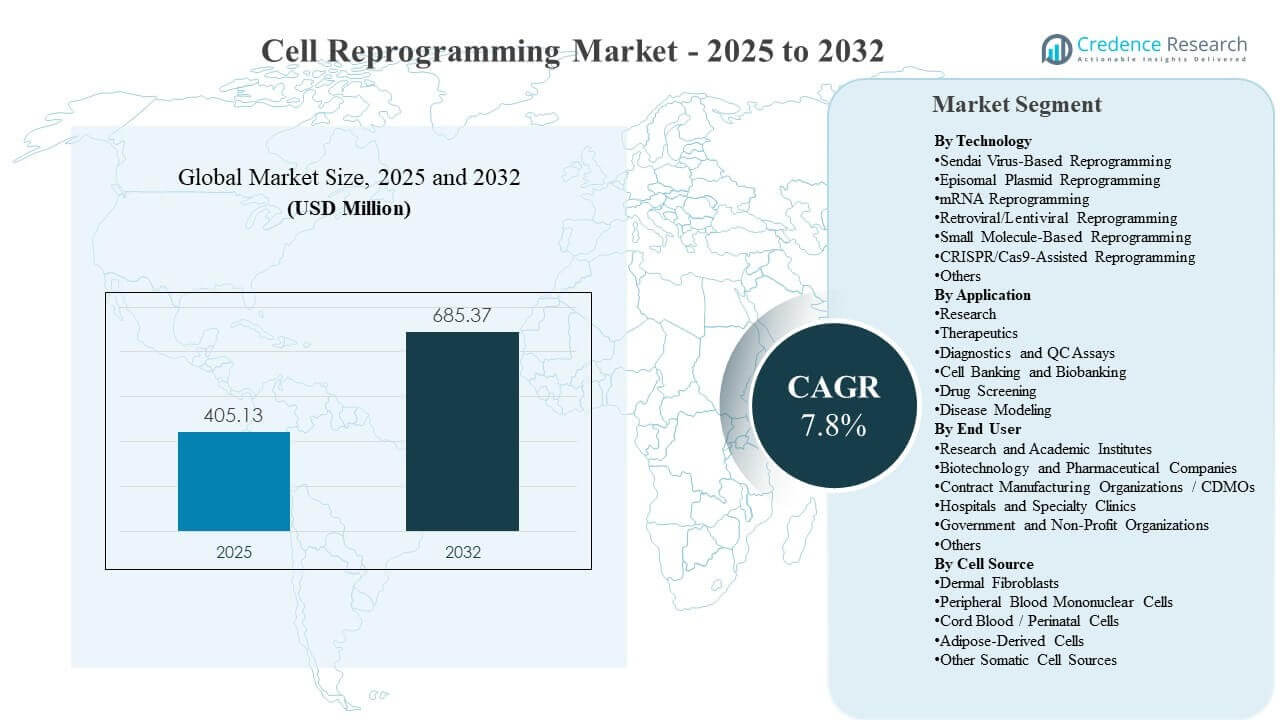
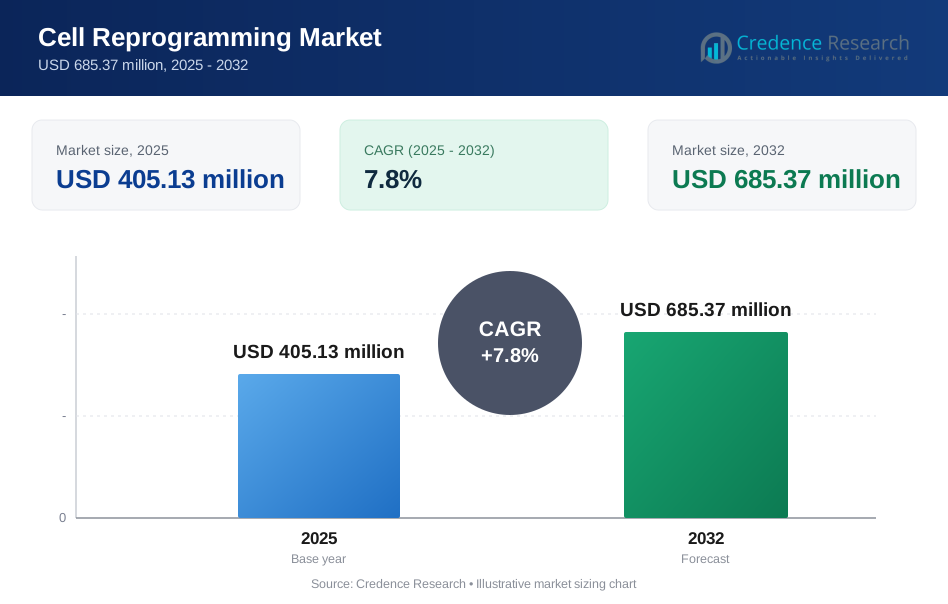
The global Cell Reprogramming Market size was estimated at USD 405.13 million in 2025 and is expected to reach USD 685.37 million by 2032, growing at a CAGR of 7.8% from 2025 to 2032. Cell Reprogramming Market growth is primarily supported by expanding induced pluripotent stem cell workflows for disease modeling and drug screening, which require reliable reprogramming methods with consistent performance. Cell Reprogramming Market adoption is also widening across translational pipelines as non-integrating approaches and stronger QC expectations increase demand for standardized protocols and validated reagents.
| REPORT ATTRIBUTE | DETAILS |
|---|---|
| Historical Period | 2020-2024 |
| Base Year | 2025 |
| Forecast Period | 2026-2032 |
| Cell Reprogramming Market Size 2025 | USD 405.13 million |
| Cell Reprogramming Market, CAGR | 7.8% |
| Cell Reprogramming Market Size 2032 | USD 685.37 million |
Key Market Trends & Insights
- The Cell Reprogramming Market is projected to expand from USD 405.13 million (2025) to USD 685.37 million (2032) at 7.8% CAGR (2025–2032).
- North America accounted for 36.8% in 2025, reflecting the strongest concentration of advanced research infrastructure and translational programs.
- mRNA Reprogramming accounted for the largest share of 31.6% in 2025, supported by demand for integration-free and scalable workflows.
- Research accounted for the largest share of 64.9% in 2025, driven by sustained use of reprogrammed cells in functional biology and screening pipelines.
- Research and Academic Institutes accounted for the largest share of 66.2% in 2025, reflecting high-volume protocol development and discovery-stage experimentation.
Segment Analysis
Cell Reprogramming Market segmentation is shaped by technology selection criteria that balance reprogramming efficiency, genomic integration risk, workflow complexity, and downstream suitability for characterization. Non-integrating and controllable approaches are gaining wider attention in programs that prioritize consistency and traceability across repeated experiments. Viral and plasmid-based approaches remain important in research environments where method maturity, protocol availability, and predictable execution are critical for timelines.
Cell Reprogramming Market application demand spans early discovery through translational validation, with strong pull from disease modeling and drug screening where reprogrammed cells provide human-relevant biology. Therapeutics-facing work increases emphasis on QC assays, documentation, and reproducible starting materials, which strengthens demand for standardized methods and validated reagents. Cell banking and biobanking use cases also increase focus on stable inventory creation and batch comparability across long program cycles.
By Technology Insights
mRNA Reprogramming accounted for the largest share of 31.6% in 2025. mRNA Reprogramming leadership is supported by strong alignment with non-integrating preferences and controllable workflow design across multiple cell types. mRNA Reprogramming adoption is reinforced by compatibility with standardized pipelines that emphasize repeatability and consistent outcomes. mRNA Reprogramming value also increases when programs require faster optimization cycles and clear downstream characterization expectations.
By Application Insights
Research accounted for the largest share of 64.9% in 2025. Research leadership reflects the large volume of discovery-stage studies that use reprogrammed cells for disease mechanisms, target biology, and functional assays. Research workflows benefit from repeatable cell generation that supports multi-batch comparisons and longitudinal experiments. Research demand is further supported by growing integration of reprogrammed cell systems into screening and phenotypic validation pipelines.
By End User Insights
Research and Academic Institutes accounted for the largest share of 66.2% in 2025. Research and Academic Institutes lead due to frequent protocol development, iterative optimization, and sustained use across multiple disease areas and experimental designs. Research and Academic Institutes also maintain large training ecosystems that support method diffusion and broader adoption. Research and Academic Institutes demand remains strong where standardized reagents and clear documentation reduce variability across labs and projects.
By Cell Source Insights
Cell source leadership was not specified for the Cell Reprogramming Market. Dermal Fibroblasts remain widely used due to accessibility and long-standing protocol precedent that supports comparability across studies. Peripheral Blood Mononuclear Cells support less invasive sampling and can fit programs requiring repeat collections or patient-linked studies. Cord Blood / Perinatal Cells and Adipose-Derived Cells expand options based on starting-material availability, biological attributes, and downstream differentiation intent.
Cell Reprogramming Market Drivers
Expansion Of iPSC Research And Translational Programs
Cell Reprogramming Market growth is supported by expanding iPSC research that depends on consistent reprogramming performance across multiple cell sources. Translational programs increasingly require standardized workflows that reduce variability and improve repeatability. Research teams prioritize methods with predictable execution and compatible downstream characterization. Biopharma pipelines benefit when reprogramming supports decision-grade disease models and screening assays. Collaboration between academic institutes and industry programs accelerates adoption and strengthens demand for validated reagents.
Rising Demand For Human-Relevant Disease Models
Cell Reprogramming Market demand rises as disease modeling shifts toward human-relevant cellular systems that improve biological relevance for target validation. Reprogrammed cells enable genotype-linked models that support mechanistic studies and functional readouts. Drug discovery teams use these systems to improve early confidence and reduce late-stage attrition risk. Better reproducibility increases value for cross-study comparisons and longitudinal experiments. These factors collectively strengthen adoption across research and early therapeutic development workflows.
Growth Of Drug Screening And Phenotypic Validation Workflows
Cell Reprogramming Market expansion is supported by growth in screening workflows that require scalable cell inputs for repeated assays. Reprogrammed cells help enable pathway-specific and phenotype-driven studies across multiple disease areas. Screening programs benefit from consistent cell generation that supports batch control and assay standardization. Wider integration with imaging and multi-parameter analytics increases the utility of reprogrammed cell platforms. These capabilities strengthen recurring demand across discovery teams and partner organizations.
- For instance, Ncardia states that its Heart in a Box platform is designed for 384-well high-throughput cardiac screening and supports more than 1,500 data points per day, while its Proteinopathy Assays are fully automated for 96- and 384-well formats with results delivered in 6 weeks, showing how iPSC-based systems are being operationalized for phenotypic screening at scale.
Increasing Focus On Quality Control And Standardization
Cell Reprogramming Market progress is reinforced by increasing emphasis on QC assays, documentation, and workflow standardization across research-to-translation pathways. Programs require stronger identity confirmation and functional validation to reduce variability. Standardized reagents and defined protocols support repeatability across sites and teams. Manufacturing-adjacent expectations increase demand for traceable processes and consistent starting materials. These requirements increase the value of integrated solutions spanning methods, reagents, and QC support.
- For instance, Thermo Fisher states that its CTS CytoTune-iPS 2.1 Sendai Reprogramming Kit is supplied at 0.5 x 10^8 to 2.0 x 10^8 virus particles per mL and lists typical reprogramming efficiency at about 0.01% to 1% depending on cell type, while an evaluation of 150 iPSC lines reported the highest observed efficiency for this kit at 1.199% ± 0.529, underscoring why defined inputs and documented performance are central to QC-led standardization.
Cell Reprogramming Market Challenges
Cell Reprogramming Market adoption faces challenges related to reproducibility across laboratories, protocols, and cell sources. Starting material variability and donor-specific biology can affect reprogramming efficiency and downstream behavior. Technology selection involves trade-offs between efficiency, workflow complexity, and safety considerations. Specialized expertise requirements can slow adoption in organizations without strong cell biology infrastructure. Standardization gaps across assays and acceptance criteria can complicate comparison of outcomes across programs.
Cell Reprogramming Market scaling constraints also appear when workflows transition from research settings toward translational or manufacturing-adjacent environments. Process changes during scale-up can shift cell-state outcomes and introduce batch differences. QC demands increase operating complexity due to expanded testing and documentation. Supply consistency for specialized reagents can create execution risk for longer programs. Regulatory expectations for clinically adjacent work raise process rigor and validation burden.
- For instance, bit.bio states that its opti-ox platform can manufacture billions of consistently programmed cells, while every ioCell lot is characterized by at least three identity assays ICC, RT-qPCR, and RNA-Seq highlighting the level of scale and analytical control needed for more industrialized workflows.
Cell Reprogramming Market Trends and Opportunities
Cell Reprogramming Market trends increasingly favor non-integrating and controllable methods that align with higher expectations for consistency and traceability. mRNA and episomal approaches gain attention where programs prioritize reduced integration concerns and repeatable outcomes. Small-molecule strategies support opportunities for simplified workflows and pathway-driven control of cell fate. Genome-editing assisted reprogramming expands targeted research opportunities, especially for functional studies and engineered model creation. Integration with advanced analytics improves characterization depth and strengthens downstream value.
- For instance, REPROCELL’s StemRNA 3rd Gen Reprogramming Kit uses a non-integrating RNA-based approach and reports primary iPSC colonies in 10 to 14 days from fibroblasts with 1% to 4% reprogramming efficiency, while requiring 4 transfections across 9 wells and no vector screening, which reflects the market’s shift toward faster, more controllable, and traceable reprogramming workflows.
Cell Reprogramming Market opportunities also emerge from workflow consolidation across discovery, QC, and cell banking needs. End users increasingly value end-to-end solutions that simplify sourcing, reprogramming, validation, and storage. Partnerships with CDMOs can accelerate later-stage readiness through stronger process discipline and tech transfer support. Biobanking demand increases as programs build long-term cell inventories for repeated studies. These dynamics create opportunities for suppliers that deliver standardized kits, documentation support, and scalable service offerings.
Cell Reprogramming Market Insights
North America (36.8% share in 2025)
Cell Reprogramming Market in North America holds the largest share at 36.8% in 2025, supported by strong academic density, high biopharma activity, and broad access to enabling tools and specialized services. North America demand is reinforced by extensive disease modeling and screening workflows that require repeatable reprogramming outcomes. North America programs also prioritize standardized documentation and QC practices that support comparability across teams. These factors collectively sustain high adoption across research and translation.
Europe (26.6% share in 2025)
Cell Reprogramming Market in Europe accounted for 26.6% share in 2025, supported by established academic networks and structured translational initiatives focused on standardized workflows. Europe adoption benefits from strong collaboration across research centers and biopharma programs. Europe programs often emphasize method validation and consistency across sites, which strengthens demand for defined reagents and repeatable protocols. These characteristics support a solid base of adoption across research and early development.
Asia Pacific (22.1% share in 2025)
Cell Reprogramming Market in Asia Pacific represented 22.1% share in 2025, strengthened by expanding biotech ecosystems and rising investment in advanced cellular methods. Asia Pacific adoption increases as more organizations build capacity in iPSC research, screening workflows, and translational development. Asia Pacific demand also benefits from increasing partnerships and capability development across research institutions and industry programs. These factors support strong participation and continued momentum.
Latin America (7.9% share in 2025)
Cell Reprogramming Market in Latin America captured 7.9% share in 2025, supported by select research hubs and collaborative networks that adopt reprogramming workflows for targeted studies. Latin America uptake is influenced by infrastructure availability, funding continuity, and access to standardized reagents. Latin America programs often focus on building core capability in disease modeling and assay development. These drivers support a smaller but developing regional base.
Middle East & Africa (6.6% share in 2025)
Cell Reprogramming Market in the Middle East & Africa held 6.6% share in 2025, shaped by gradual expansion of research capacity and selective investment in life-science infrastructure. Middle East & Africa adoption tends to concentrate in emerging hubs with stronger institutional support and collaboration. Middle East & Africa growth is supported by training expansion and increasing access to specialized suppliers. These factors sustain steady development from a smaller base.
Competitive Landscape
Cell Reprogramming Market competition centers on workflow reliability, protocol standardization, integration-free performance positioning, and support for reproducible outcomes across cell sources. Vendors differentiate through reagent quality, method usability, technical support depth, and compatibility with downstream characterization and QC assays. Strategic partnerships and ecosystem integration across analytics and cell processing workflows strengthen customer retention. Competitive positioning also depends on the ability to support transitions from discovery to translational readiness without major workflow redesign.
Thermo Fisher Scientific Inc. competes through broad workflow coverage across instruments, reagents, and consumables that support standardized reprogramming pipelines. Thermo Fisher Scientific Inc. portfolio breadth supports multiple technology routes and varied end-user needs across research and early development. Thermo Fisher Scientific Inc. value increases when workflows require consistent inputs, strong documentation, and integration with adjacent characterization steps. Thermo Fisher Scientific Inc. scale and support infrastructure strengthen adoption across global research ecosystems.
The industry research and growth report includes detailed analyses of the competitive landscape of the market and information about key companies, including:
- Thermo Fisher Scientific Inc.
- Lonza Group
- Merck KGaA
- STEMCELL Technologies
- REPROCELL Inc.
- FUJIFILM Cellular Dynamics
- Takara Bio Inc.
- Bio-Techne
- ALSTEM
- Allele Biotechnology and Pharmaceuticals Inc.
- Mogrify Limited
- Astellas Pharma
- Fate Therapeutics
- BlueRock Therapeutics
Qualitative and quantitative analysis of companies has been conducted to help clients understand the wider business environment as well as the strengths and weaknesses of key industry players. Data is qualitatively analyzed to categorize companies as pure play, category-focused, industry-focused, and diversified; it is quantitatively analyzed to categorize companies as dominant, leading, strong, tentative, and weak.
Recent Developments
- In May 2025, REPROCELL launched new StemEdit Human iPSC HLA Knock lines, including non-HLA class 1 and non-HLA class 1/2 cell lines for research use. The company said these immune-modulated iPSC products were derived from StemRNA Clinical iPSCs using its StemEdit gene-editing technology, giving researchers new tools to study immune interactions and support iPSC-based cell therapy programs.
- In June 2025, uBriGene Biosciences launched fully characterized, ready-to-use induced pluripotent stem cell banks to support research, translational development, and clinical applications. The company stated that the new iPSC banks were developed using its proprietary RNA-LNP reprogramming technology and are offered to help accelerate regenerative medicine and cell therapy development.
- In July 2025, Life Biosciences entered into a research collaboration with the SingHealth Duke-NUS Regenerative Medicine Institute of Singapore (REMEDIS) to advance cellular rejuvenation therapies. According to the announcement, the partnership is designed to expand the use of Life Biosciences’ partial epigenetic reprogramming platform across multiple organ systems and support work on age-related diseases.
- In March 2026, REPROCELL announced the launch of its US FDA-compliant GMP Master Cell Bank manufacturing service for human induced pluripotent stem cells at its Beltsville, Maryland facility. The company said the new service provides an end-to-end workflow spanning clinical seed iPSC manufacturing, gene editing, and GMP master cell bank production to help cell therapy developers accelerate IND submissions and reduce manufacturing uncertainty.
Report Scope
| Report Attribute | Details |
| Market size value in 2025 | USD 405.13 million |
| Revenue forecast in 2032 | USD 685.37 million |
| Growth rate (CAGR) | 7.8% (2025–2032) |
| Base year | 2025 |
| Forecast period | 2026-2032 |
| Quantitative units | USD million |
| Segments covered | By Technology; By Application; By End User; By Cell Source |
| Regional scope | North America, Europe, Asia Pacific, Latin America, Middle East & Africa |
| Key companies profiled | Thermo Fisher Scientific Inc.; Lonza Group; Merck KGaA; STEMCELL Technologies; REPROCELL Inc.; FUJIFILM Cellular Dynamics; Takara Bio Inc.; Bio-Techne; ALSTEM; Allele Biotechnology and Pharmaceuticals Inc.; Mogrify Limited; Astellas Pharma; Fate Therapeutics; BlueRock Therapeutics |
| No.of Pages | 336 |
Segmentation
By Technology
- Sendai Virus-Based Reprogramming
- Episomal Plasmid Reprogramming
- mRNA Reprogramming
- Retroviral/Lentiviral Reprogramming
- Small Molecule-Based Reprogramming
- CRISPR/Cas9-Assisted Reprogramming
- Others
By Application
- Research
- Therapeutics
- Diagnostics and QC Assays
- Cell Banking and Biobanking
- Drug Screening
- Disease Modeling
By End User
- Research and Academic Institutes
- Biotechnology and Pharmaceutical Companies
- Contract Manufacturing Organizations / CDMOs
- Hospitals and Specialty Clinics
- Government and Non-Profit Organizations
- Others
By Cell Source
- Dermal Fibroblasts
- Peripheral Blood Mononuclear Cells
- Cord Blood / Perinatal Cells
- Adipose-Derived Cells
- Other Somatic Cell Sources
By Region
- North America
- U.S.
- Canada
- Mexico
- Europe
- Germany
- France
- U.K.
- Italy
- Spain
- Rest of Europe
- Asia Pacific
- China
- Japan
- India
- South Korea
- South-east Asia
- Rest of Asia Pacific
- Latin America
- Brazil
- Argentina
- Rest of Latin America
- Middle East & Africa
- GCC Countries
- South Africa
- Rest of the Middle East and Africa
Request a Free Sample
Fill in your details and we'll send you a free sample report.
- Sample data tables & charts
- Research methodology
Need a Custom Version of This Report?
Tailor the scope, geography, or segments to your exact requirements.
- Custom geography or segment scope
- Direct access to our analyst team
Frequently Asked Questions
What is the market size of the Cell Reprogramming Market in 2025 and the forecast for 2032?
What is the CAGR for the Cell Reprogramming Market during 2025–2032?
Which segment is the largest in the Cell Reprogramming Market?
What factors are driving growth in the Cell Reprogramming Market?
Who are the leading companies in the Cell Reprogramming Market?
Which region leads the Cell Reprogramming Market?
Table of Content
Chapter 1. Report Introduction
- 1.1 Report Description & Purpose
- 1.1.1 Report Title & Market Definition
- 1.1.2 Unique Selling Propositions (USP) & Key Differentiators
- 1.1.3 Value Proposition for Stakeholders
- 1.2 Research Objectives
- 1.2.1 Market Sizing Objectives (Volume & Revenue)
- 1.2.2 Segmentation Objectives
- 1.2.3 Competitive Intelligence Objectives
- 1.2.4 Forecast & Scenario Objectives
- 1.3 Report Scope
- 1.3.1 Cell Reprogramming Scope – Types & Subtypes Covered
- 1.3.2 Geographic Scope – Regions & Countries Covered
- 1.3.3 Historical Period, Base Year & Forecast Period (2025; forecast to 2032)
- 1.3.4 Inclusions & Exclusions
- 1.4 HS Code & Classification Framework
- 1.5 Currency, Units & Pricing Basis
- 1.6 Target Stakeholders
- 1.7 Limitations & Assumptions
Chapter 2. Executive Summary
- 2.1 Global Cell Reprogramming Market Snapshot
- 2.1.1 Market Size – Historical (2025) & Forecast (2025-2032) (2025: USD 405.13 million → 2032: USD 685.37 million)
- 2.1.2 Volume & Revenue – Global Totals
- 2.1.3 Key Market Highlights – Top Five Facts
- 2.2 Cell Reprogramming Market Segmentation Snapshot
- 2.2.1 Market Split by Region – 2025 vs. 2032
- 2.3 Competitive Snapshot
- 2.3.1 Top 10 Players by Revenue Share – 2025
- 2.3.2 Top 10 Players by Volume Share – 2025
- 2.3.3 Recent Strategic Developments (18-Month Summary)
- 2.4 Key Investment Highlights & Strategic Conclusions
Chapter 3. Cell Reprogramming Market Dynamics & Industry Analysis
- 3.1 Market Overview & Context
- 3.1.1 Cell Reprogramming Market Position in the Broader Automotive Value Chain
- 3.1.2 OEM vs. Replacement Market Dynamics
- 3.1.3 Market Maturity & Development Stage by Region
- 3.2 Cell Reprogramming Market Drivers
- 3.3 Cell Reprogramming Market Restraints & Challenges
- 3.4 Cell Reprogramming Market Opportunities
- 3.5 Porter's Five Forces Analysis
- 3.5.1 Threat of New Entrants
- 3.5.2 Bargaining Power of Suppliers
- 3.5.3 Bargaining Power of Buyers
- 3.5.4 Threat of Substitutes
- 3.5.5 Competitive Rivalry – Intensity Assessment
- 3.6 Cell Reprogramming Value Chain Analysis
- 3.6.1 Upstream – Raw Material/Input Suppliers
- 3.6.1.1 Raw Material/Input 1
- 3.6.1.2 Raw Material/Input 2
- 3.6.1.3 Raw Material/Input 3
- 3.6.2 Midstream – Production/Manufacturing/Service Delivery
- 3.6.2.1 Production/Process Overview
- 3.6.2.2 Key Facility Locations & Capacity by Manufacturer
- 3.6.3 Downstream – Distribution & End Consumer
- 3.6.3.1 Primary Channel – B2B/OEM
- 3.6.3.2 Secondary Channels – Dealer, Retail, Online, Direct
- 3.6.4 Value Chain Profitability Analysis
- 3.6.1 Upstream – Raw Material/Input Suppliers
- 3.7 PESTEL Analysis
- 3.7.1 Political Factors
- 3.7.2 Economic Factors
- 3.7.3 Social Factors
- 3.7.4 Technological Factors
- 3.7.5 Environmental Factors
- 3.7.6 Legal Factors
- 3.8 Cell Reprogramming Supply Chain Analysis
- 3.8.1 Raw Material/Input Supply Risk Assessment
- 3.8.2 Manufacturing Concentration Risk (Geographic Exposure)
- 3.8.3 Trade Disruption Impact Analysis
- 3.9 Regulatory & Policy Landscape
Note: The regulatory and policy landscape section covers regulations based on their applicability to the market, Cell Reprogramming category, geography, and scope of the study. Only regulatory frameworks with a material impact on operations, compliance, trade, sustainability, or market access are analyzed in detail.
Chapter 4. Key Investment Pockets & Opportunity Analysis
- 4.1 Cell Reprogramming Market Attractiveness Analysis
- 4.1.1 By Region – Investment Attractiveness Matrix (Volume × CAGR)
- 4.2 Absolute Revenue Growth Opportunity
- 4.2.1 By Region – Absolute USD Growth Through 2032
- 4.3 Incremental Volume Opportunity
- 4.3.1 By Region – Incremental Volume Through 2032
- 4.3.2 Segment – Incremental Volume
- 4.4 Emerging Submarket Opportunity Deep Dive (Subject to Applicability)
- 4.5 Emerging Market Opportunity Scorecards
- 4.5.1 United States
- 4.5.2 Europe
- 4.5.3 Asia
- 4.5.4 Middle East & Africa
Note: Emerging Market Opportunity Scorecards will be included based on relevance and strategic importance. Regions listed are indicative and may vary depending on data availability and market dynamics.
Chapter 5. Cell Reprogramming Import-Export Analysis & Trade Flows
- 5.1 Global Trade Overview
- 5.1.1 Global Export Value by Country (2025)
- 5.1.2 Global Export Volume by Country (2025)
- 5.1.3 Global Import Value by Country (2025)
- 5.1.4 Global Import Volume by Country (2025)
- 5.1.5 Net Trade Balance by Country (2025)
- 5.2 Export Analysis – Segment
- 5.2.1 Type 1 (HS Code)
- 5.2.2 Type 2 (HS Code)
- 5.2.3 Type 3 (HS Code)
- 5.2.4 Type 4 (HS Code)
- 5.2.5 Type 5 (HS Code)
- 5.3 Import Analysis – Segment
- 5.3.1 Type 1 (HS Code)
- 5.3.2 Type 2 (HS Code)
- 5.3.3 Type 3 (HS Code)
- 5.3.4 Type 4 (HS Code)
- 5.3.5 Type 5 (HS Code)
- 5.4 Average Unit Trade Prices
- 5.4.1 Average Export Price – Segment & Country
- 5.4.2 Average Import Price – Segment & Source Country
- 5.4.3 Price Trends (2025)
- 5.5 Key Trade Route Analysis
- 5.5.1 Trade Route 1
- 5.5.2 Trade Route 2
- 5.5.3 Trade Route 3
- 5.5.4 Trade Route 4
- 5.5.5 Trade Route 5
- 5.6 Trade Policy Impact Assessment
- 5.6.1 US Anti-Dumping & Section 301 Tariffs
- 5.6.2 EU Customs Union Impact
- 5.6.3 Major Free Trade Agreements
- 5.6.4 USMCA Rules of Origin
Note: Trade policy analysis will be included only where relevant to the Cell Reprogramming market.
Chapter 6. Competitive Landscape & Company Benchmarking
- 6.1 Cell Reprogramming Market Concentration & Structure
- 6.1.1 Herfindahl-Hirschman Index (HHI) – vs. 2025
- 6.1.2 Tier 1, Tier 2 & Tier 3 Market Structure
- 6.1.3 Global, Regional & Local Player Dynamics
- 6.2 Cell Reprogramming Market Share Analysis – 2025
- 6.2.1 Global Revenue Share by Company
- 6.2.2 Global Volume Share by Company
- 6.2.3 Regional Revenue Share
- 6.2.4 Market Share Evolution ( vs. 2025)
- 6.2.5 OEM Segment Share by Company
- 6.2.6 Replacement Segment Share by Company
- 6.3 Production/Delivery Capacity & Facility Analysis
- 6.3.1 Global Installed Capacity
- 6.3.2 Capacity Utilization Rates
- 6.3.3 Production/Output Volume
- 6.3.4 Facility Locations & Capacity Map
- 6.3.5 Planned Capacity Additions
- 6.4 Cell Reprogramming Competitive Benchmarking Matrix
- 6.4.1 Revenue, Volume, CAGR & Profitability Comparison
- 6.4.2 Channel Revenue Mix
- 6.4.3 Geographic Revenue Exposure
- 6.4.4 R&D Intensity
- 6.4.5 Sustainability Maturity
- 6.5 Strategic Developments in Cell Reprogramming (Last 24 Months)
- 6.5.1 Mergers, Acquisitions & Divestments
- 6.5.2 New Cell Reprogramming Launches
- 6.5.3 Facility Expansions
- 6.5.4 Strategic Alliances, Joint Ventures & Partnerships
- 6.5.5 Distribution Expansion & Market Entry
- 6.5.6 Sustainability & ESG Initiatives
- 6.6 Competitive Strategy Mapping
- 6.6.1 Leader, Challenger, Follower & Niche Classification
- 6.6.2 Pricing Strategy Comparison
- 6.6.3 Channel Strategy Matrix
Note: Strategic developments are included based on their materiality and the availability of reliable information.
Chapter 7. Global Cell Reprogramming Market – By Distribution Channel
- 7.1 Segment Overview
- 7.1.1 Volume & Revenue Split by Channel (2025 & 2032)
- 7.1.2 Channel Mix Evolution (2025-2032)
Chapter 8. Regional Market Analysis – Global Overview
- 8.1 Global Regional Overview
- 8.1.1 Regional Volume Share
- 8.1.2 Regional Revenue Share
- 8.1.3 Regional Volume by Region
- 8.1.4 Regional Revenue by Region
- 8.1.5 Regional Forecast Through 2032
- 8.2 Cross-Regional Segment Analysis
- 8.2.1 By Distribution Channel
- 8.2.2 By Brand/Price Tier
Chapter 9. North America Cell Reprogramming Market
- 9.1 United States
- 9.2 Canada
- 9.3 Mexico
Chapter 10. Europe Cell Reprogramming Market
- 10.1 Germany
- 10.2 France
- 10.3 Italy
- 10.4 United Kingdom
- 10.5 Spain
- 10.6 Poland
- 10.7 Russia
- 10.8 Netherlands
- 10.9 Belgium
- 10.10 Sweden
- 10.11 Denmark
- 10.12 Norway
- 10.13 Rest of Europe
Chapter 11. Asia Pacific Cell Reprogramming Market
- 11.1 China
- 11.2 India
- 11.3 Japan
- 11.4 South Korea
- 11.5 Thailand
- 11.6 Indonesia
- 11.7 Vietnam
- 11.8 Malaysia
- 11.9 Australia
- 11.10 Rest of Asia Pacific
Chapter 12. Latin America Cell Reprogramming Market
- 12.1 Brazil
- 12.2 Argentina
- 12.3 Colombia
- 12.4 Chile
- 12.5 Rest of Latin America
Chapter 13. Middle East Cell Reprogramming Market
- 13.1 Saudi Arabia
- 13.2 United Arab Emirates
- 13.3 Turkey
- 13.4 Israel
- 13.5 Iran
- 13.6 Rest of the Middle East
Chapter 14. Africa Cell Reprogramming Market
- 14.1 South Africa
- 14.2 Egypt
- 14.3 Nigeria
- 14.4 Morocco
- 14.5 Rest of Africa
Chapter 15. Cell Reprogramming Company Profiles
- 15.1 [Company 01]
- 15.1.1 Company Overview
- 15.1.2 Key Management Personnel
- 15.1.3 Products & Services Portfolio
- 15.1.4 Financial Performance
- 15.1.5 Key Market Focus & Geographic Presence
- 15.1.6 Recent Developments & Strategic Initiatives
Note: The company profile list is preliminary and may change based on research findings, market developments, data availability, and client requirements.
Chapter 16. Appendices
- Appendix A – List of Abbreviations & Acronyms
- Appendix B – Industry Classification Code Reference – Full Series
- Appendix C – Production & Capacity Data Tables
- Appendix D – End-Use & Demand Base Tables
- Appendix E – Consumption & Replacement Rate Assumptions
- Appendix F – ASP Reference Tables
- Appendix G – Manufacturing & Facility Database
- Appendix H – Import-Export Data Tables
- Appendix I – Regulatory Summary Tables
- Appendix J – Primary Research Participant List (Anonymized)
- Appendix K – Primary Research Questionnaire Framework
- Appendix L – Data Sources & Bibliography
- Appendix M – Market Size Divergence & Source Comparison
Chapter 17. Research Methodology
- 17.1 Research Framework & Philosophy
- 17.2 Secondary Research – Sources, Hierarchy & Data Extraction
- 17.3 Data Modeling – Bottom-Up & Top-Down Market Sizing
- 17.4 Primary Research – Stakeholder Framework, LOI & Sample Sizes
- 17.5 Forecast Methodology – Regression, Scenario & Sensitivity Analysis
- 17.6 Quality Control – Four-Layer Validation Framework
- 17.7 Limitations & Standard Assumptions
- 17.8 Disclaimer
