
Cell Therapy CDMO Market Overview:
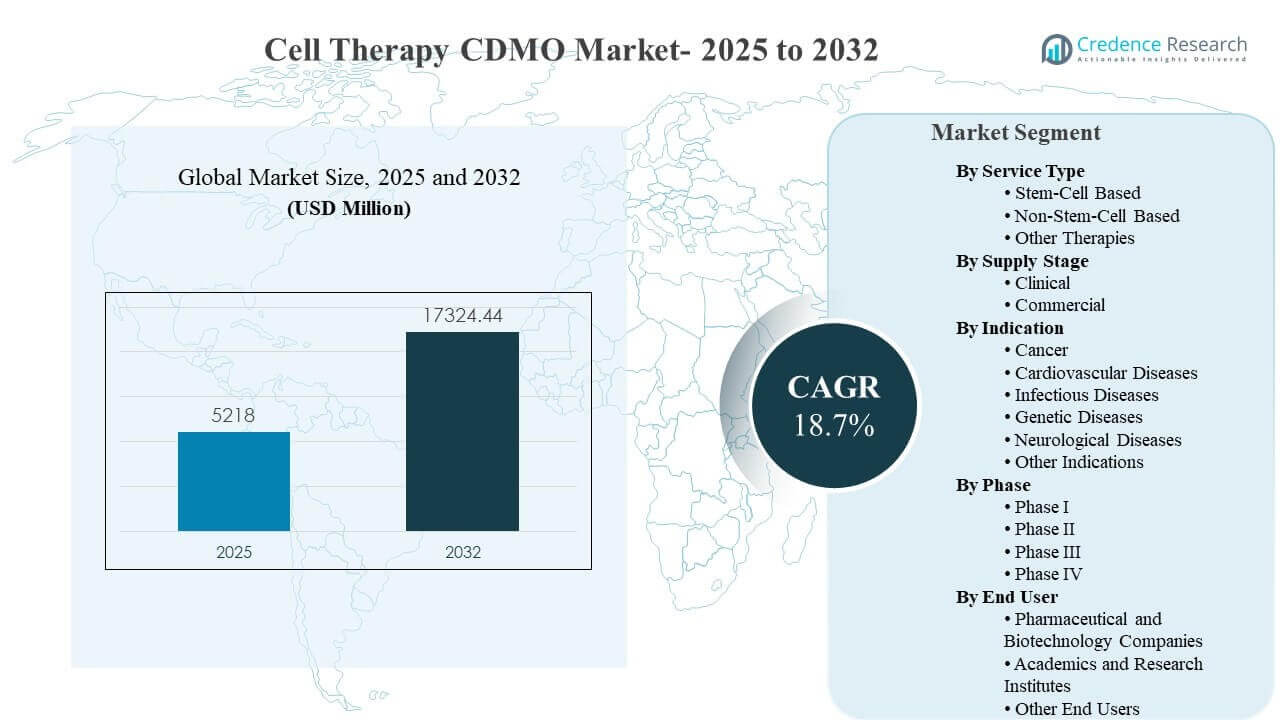
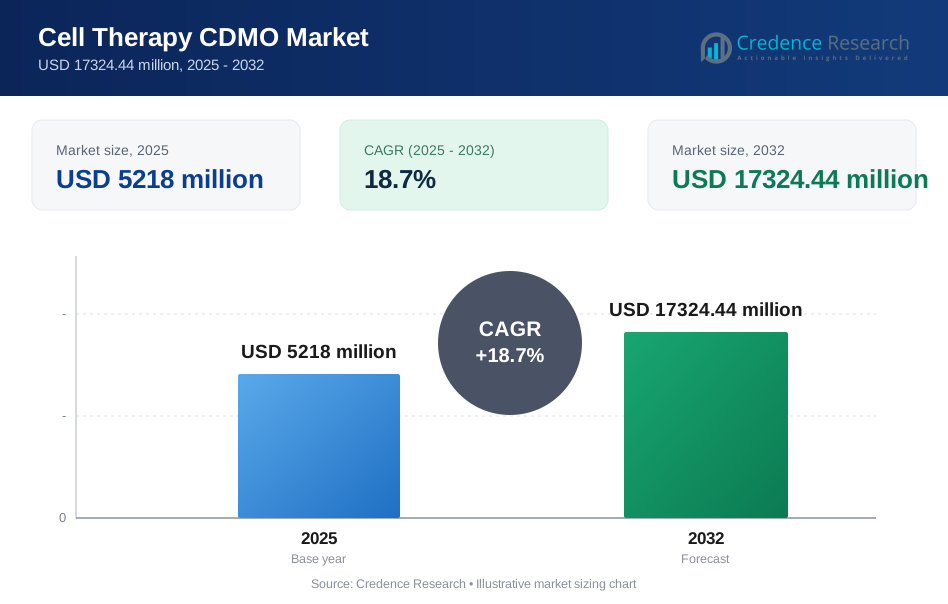
The global Cell Therapy CDMO Market size was estimated at USD 5218 million in 2025 and is expected to reach USD 17324.44 million by 2032, growing at a CAGR of 18.7% from 2025 to 2032. Expansion in clinical pipelines for oncology and rare diseases is increasing demand for specialized process development, GMP manufacturing, and quality systems that many sponsors prefer to outsource to experienced CDMOs. Asia Pacific is scaling outsourcing capacity rapidly, while North America continues to anchor demand through dense sponsor concentration, mature regulatory pathways, and established advanced-therapy manufacturing networks.
| REPORT ATTRIBUTE | DETAILS |
|---|---|
| Historical Period | 2020-2024 |
| Base Year | 2025 |
| Forecast Period | 2026-2032 |
| Cell Therapy CDMO Market Size 2025 | USD 5218 million |
| Cell Therapy CDMO Market, CAGR | 18.7% |
| Cell Therapy CDMO Market Size 2032 | USD 17324.44 million |
Key Market Trends & Insights
- The Cell Therapy CDMO Market is projected to grow from USD 5218 million in 2025 to USD 17324.44 million by 2032 at an 18.7% CAGR (2025–2032).
- Non-Stem-Cell Based services accounted for the largest share of 52% in 2025, supported by strong demand for complex immune-cell manufacturing workflows.
- Clinical supply stage represented 71% share in 2025, reflecting development-weighted outsourcing needs across process development, analytics, and GMP manufacturing.
- Cancer indication held the leading share of 57% in 2025, driven by sustained trial volumes and manufacturing intensity for advanced oncology programs.
- North America led regional demand with 39.1% share in 2025, supported by sponsor concentration and mature CDMO ecosystems.
Segment Analysis
The Cell Therapy CDMO Market demand profile is shaped by complex manufacturing steps, strict quality controls, and the need for reproducible outcomes across patient-specific and platform-based therapies. Sponsor organizations increasingly prioritize CDMOs with closed, automated, and contamination-resilient workflows to improve batch consistency and reduce operational risk. Service selection is closely tied to therapy modality complexity, speed of technology transfer, and the ability to execute comparability and validation requirements as programs progress. Integrated offerings that connect development, GMP manufacturing, and testing support are gaining traction because fewer vendor handoffs help shorten timelines.
Buyer behavior in the Cell Therapy CDMO Market also reflects capacity availability and the ability to scale from clinical to commercial with robust documentation. Clinical programs require flexible suites, rapid changeovers, and responsive analytics, while commercial programs require sustained supply assurance, validated release testing, and stronger supply-chain controls. End users weigh regulatory track record, deviation management maturity, and the ability to manage chain-of-custody and chain-of-identity needs in relevant workflows. CDMO differentiation increasingly comes from platform standardization, digital batch records, and modular capacity strategies that reduce lead times.
By Service Type Insights
Non-Stem-Cell Based accounted for the largest share of 52% in 2025. The leading position is supported by higher near-term clinical activity across immune-cell programs and greater manufacturing intensity per batch for many advanced oncology workflows. CDMO demand is reinforced by the need for robust aseptic handling, high-quality raw material controls, and consistent cell processing outcomes. Sponsors also prefer CDMOs that can execute technology transfer efficiently and maintain comparability frameworks across process changes.
By Supply Stage Insights
Clinical accounted for the largest share of 71% in 2025. The leading position reflects heavy early-stage pipeline activity that requires process development, analytical method readiness, and small-to-mid scale GMP manufacturing. Clinical demand favors CDMOs with flexible capacity, rapid scheduling, and strong quality systems that support frequent iteration. Many sponsors also use CDMOs to de-risk manufacturing before late-stage scale-up and commercial validation activities.
By Indication Insights
Cancer accounted for the largest share of 57% in 2025. Oncology programs generate substantial outsourcing volume due to multi-site trial activity, manufacturing complexity, and stringent quality release requirements. CDMO selection in oncology emphasizes reliability, chain-of-custody discipline where relevant, and the ability to scale capacity without disrupting quality performance. A broad oncology pipeline also sustains demand for integrated development-to-manufacturing support to compress timelines.
By Phase Insights
Phase I accounted for the largest share of 35% in 2025. Early-stage activity leads because sponsors require rapid process establishment, feasibility runs, and GMP manufacturing with tight turnaround expectations. Phase I demand also depends on strong analytics and documentation capabilities to satisfy regulatory submissions and protocol evolution. As programs advance into Phase II and Phase III, CDMO value shifts toward scale-up readiness, comparability planning, and more structured supply assurance.
By End User Insights
Pharmaceutical and Biotechnology Companies accounted for the largest share of 74% in 2025. Sponsor-driven outsourcing remains dominant because many developers lack internal GMP infrastructure or prefer to preserve capital for clinical expansion. Partner evaluation focuses on regulatory track record, quality systems maturity, and the ability to scale reliably under GMP constraints. Academic and translational groups contribute meaningful demand through early development work, but commercial and late-stage scale expectations are largely sponsor-led.
Cell Therapy CDMO Market Drivers
Expanding Cell Therapy Clinical Pipelines
The Cell Therapy CDMO Market is driven by rising clinical activity across oncology and rare disease programs that require specialized manufacturing and quality systems. Increasing trial volumes amplify demand for process development, analytical readiness, and GMP production capacity that sponsors cannot always build internally. Manufacturing complexity, tight turnaround needs, and evolving regulatory expectations further increase reliance on external partners. Sponsors also prefer integrated service models that reduce vendor handoffs and streamline program execution across milestones.
Scale-Up Requirements And Capacity Constraints
The Cell Therapy CDMO Market growth is supported by limited global availability of qualified suites, experienced staff, and validated workflows for advanced therapies. Scale-up from early clinical batches to late-stage supply requires disciplined comparability strategies, tighter supply-chain controls, and validated release testing. Many sponsors secure capacity early through longer-term agreements to reduce scheduling risk. CDMOs that can expand capacity using modular suites and standardized platforms benefit from stronger utilization and repeat business.
Automation And Closed Manufacturing Workflows
The Cell Therapy CDMO Market is increasingly shaped by demand for closed, automated, and contamination-resilient manufacturing designs. Automation supports batch-to-batch consistency, reduces manual handling risk, and improves operational throughput for complex cell processing steps. Closed workflows can also strengthen deviation control and support more predictable quality outcomes. Sponsors view manufacturing modernization as a differentiator when selecting CDMOs, especially for programs that anticipate scaling and multi-site execution.
- For instance, Cellares says its closed Cell Shuttle platform reduces process failures by 75 percent, requires 90 percent less labor, and needs 90 percent less facility space, while allowing up to 16 cartridges to be loaded asynchronously for concurrent multi-product manufacturing.
Regulatory And Quality System Complexity
The Cell Therapy CDMO Market benefits from sponsor preference for partners with strong quality management systems and proven regulatory execution. Cell therapies require rigorous documentation, traceability controls where relevant, and robust deviation and change control practices. Regulatory submissions and inspections reward consistent quality performance and validated processes. CDMOs with established compliance cultures and experienced regulatory teams help sponsors reduce execution risk and maintain development momentum.
- For instance, Catalent states that its cell therapy facilities in Belgium and the United States are FDA- and EMA-compliant and that its Gosselies campus includes more than 130,000 square feet of dedicated footprint, more than 20 CGMP Grade B and C cleanrooms, dedicated QC labs, and qualified person services, all of which reinforce the kind of documentation, release, and oversight capabilities sponsors seek in regulated cell therapy manufacturing.
Cell Therapy CDMO Market Challenges
Cell Therapy CDMO Market operations face pressure from capacity bottlenecks, specialized labor shortages, and uneven readiness across global sites. Advanced therapy manufacturing requires trained operators, strong QA oversight, and consistent materials control, which can be difficult to scale quickly. Batch failures and deviations can be costly due to high input costs and limited scheduling flexibility. Program timelines can also be disrupted by tech transfer complexity and variable readiness of sponsor processes and analytics.
- For instance, Cellares reports that its automated Cell Shuttle can process 16 batches in parallel, reduce process failures by 75%, cut labor and facility space requirements by 90%, and support up to 2,800 batches per year per Cell Shuttle, highlighting how automation is being used to ease bottlenecks and reduce operator dependence.
The Cell Therapy CDMO Market also encounters challenges linked to standardization limits across diverse therapy modalities and evolving regulatory expectations. Differences in cell sources, process steps, and critical quality attributes reduce the ability to apply one-size-fits-all manufacturing templates. Raw material variability and supply-chain constraints can affect consistency and scheduling reliability. Contracting complexity increases when sponsors require multi-region supply strategies, long-term capacity commitments, and performance guarantees.
Cell Therapy CDMO Market Trends and Opportunities
The Cell Therapy CDMO Market is seeing increased adoption of modular and flexible manufacturing approaches that allow capacity expansion without long construction cycles. Standardized platforms for upstream and downstream processing can reduce tech transfer friction and strengthen reproducibility. Digital batch records, advanced analytics, and stronger process monitoring support improved right-first-time outcomes. These trends create opportunities for CDMOs that invest in scalable infrastructure and data-driven quality execution.
The Cell Therapy CDMO Market opportunity set is also expanding through end-to-end service bundling that combines development, GMP manufacturing, and testing support. Sponsors prefer fewer handoffs and clearer accountability across the supply chain. Regional diversification strategies are growing as sponsors aim to de-risk supply and improve proximity to clinical and commercial markets. CDMOs with multi-site networks and consistent quality frameworks are positioned to win longer-term contracts as programs advance.
- For instance, Catalent’s cell therapy network spans Gosselies, Princeton, and Düsseldorf, including about 67,000 square feet of clinical manufacturing space with 12 CGMP clean rooms in Gosselies, 60,000 square feet of commercial space on the same Belgian campus, a 7,500-square-foot iPSC clinical facility in Düsseldorf, and roughly 30,000 square feet with 16 flexible CGMP clean rooms in Princeton.
Regional Insights
North America
North America accounted for 39.1% share in 2025, reflecting dense sponsor concentration and mature ecosystems for advanced therapy development and manufacturing. Demand is supported by strong clinical trial activity and established regulatory pathways that encourage scale-up planning. CDMO selection emphasizes quality system maturity, experienced staff, and availability of validated suites for complex workflows. Long-term capacity agreements are common as sponsors seek to reduce scheduling risk and protect development timelines.
Europe
Europe represented 22.1% share in 2025, supported by established GMP manufacturing capability and strong quality and compliance expectations. Regional demand benefits from active clinical programs and a growing focus on scalable manufacturing readiness. Sponsors value CDMOs that can execute consistent documentation, comparability strategies, and validated release testing. Manufacturing expansion is increasingly tied to flexible capacity and process standardization that supports multi-country supply needs.
Asia Pacific
Asia Pacific contributed 29.6% share in 2025, reflecting rapid capacity build-outs and increased outsourcing adoption across emerging and established biotech hubs. Growth is supported by expanding manufacturing infrastructure and stronger integration into global supply chains. CDMOs in the region compete on speed, scale, and cost efficiency while upgrading quality systems to meet global sponsor expectations. Regional expansion also improves proximity to clinical development activity and strengthens supply resilience strategies.
Latin America
Latin America held 6.2% share in 2025, supported by select country clusters with improving biopharma infrastructure and rising participation in clinical activities. CDMO demand is more limited than major regions due to smaller manufacturing depth and fewer large-scale advanced therapy programs. Partnerships and technology transfer models can accelerate capability development for specialized workflows. Sponsors often use regional strategies to support clinical supply needs and targeted market access planning.
Middle East & Africa
Middle East & Africa recorded 3.0% share in 2025, reflecting early-stage ecosystem development and limited localized advanced-therapy manufacturing depth. Demand is concentrated in a smaller set of countries with growing healthcare investment and research activity. CDMO engagement often focuses on targeted projects, technology partnerships, and longer-term capability building. External capacity remains important for scaling and for meeting stringent GMP and regulatory expectations.
Competitive Landscape
Competition in the Cell Therapy CDMO Market is centered on manufacturing reliability, quality system maturity, and the ability to scale capacity without compromising compliance performance. Leading CDMOs invest in flexible suites, automation, and standardized platforms to reduce technology transfer friction and improve batch consistency. Integrated offerings that combine development support, GMP manufacturing, and testing enable clearer accountability and faster execution. Multi-site networks and long-term capacity commitments are increasingly used to secure sponsor relationships and stabilize utilization.
Catalent, Inc. competes through an established CDMO footprint and a focus on executing complex programs with strong quality oversight. Catalent, Inc. benefits from capabilities that support process development through GMP manufacturing and operational execution aligned to sponsor timeline expectations. Investment priorities often emphasize capacity readiness, platform standardization, and disciplined project management to reduce deviation risk. Catalent, Inc. is positioned to benefit from long-horizon investments that strengthen competitiveness in advanced modalities manufacturing.
The industry research and growth report includes detailed analyses of the competitive landscape of the market and information about key companies, including:
- Catalent, Inc.
- Lonza Group
- Recipharm AB
- WuXi Advanced Therapies
- Charles River Laboratories International, Inc.
- Cytiva
- Samsung Biologics
- Thermo Fisher Scientific Inc.
- Novartis AG
- WuXi AppTec
- AGC Biologics
- OmniaBio
- Rentschler Biopharma
- Charles River Laboratories
Qualitative and quantitative analysis of companies has been conducted to help clients understand the wider business environment as well as the strengths and weaknesses of key industry players. Data is qualitatively analyzed to categorize companies as pure play, category-focused, industry-focused, and diversified; it is quantitatively analyzed to categorize companies as dominant, leading, strong, tentative, and weak.
Recent Developments
- In February 2026, Cellipont Bioservices announced a strategic collaboration with Soter Bio to support integrated manufacturing pathways for complex cell therapies, making it a recent partnership update in the cell therapy CDMO market.
- In February 2026, OXB expanded its strategic partnership with Bristol Myers Squibb through a new multi-year commercial supply agreement to manufacture and supply lentiviral vectors for BMS CAR-T programs.
- In May 2025, CellProthera selected CELLforCURE by SEQENS as its CDMO partner for Phase 3 GMP manufacturing of ProtheraCytes, with technology transfer scheduled in 2025 and clinical batch production planned for 2026.
- In April 2025, AGC Biologics launched a new dedicated Cell and Gene Technologies Division to strengthen its CDMO service offering and support developers that need added manufacturing capacity and technical expertise.
Report Scope
| Report Attribute | Details |
| Market size value in 2025 | USD 5218 million |
| Revenue forecast in 2032 | USD 17324.44 million |
| Growth rate (CAGR) | 18.7% (2025–2032) |
| Base year | 2025 |
| Forecast period | 2026-2032 |
| Quantitative units | USD million |
| Segments covered | By Service Type Outlook: Stem-Cell Based, Non-Stem-Cell Based, Other Therapies; By Supply Stage Outlook: Clinical, Commercial; By Indication Outlook: Cancer, Cardiovascular Diseases, Infectious Diseases, Genetic Diseases, Neurological Diseases, Other Indications; By Phase Outlook: Phase I, Phase II, Phase III, Phase IV; By End User Outlook: Pharmaceutical and Biotechnology Companies, Academics and Research Institutes, Other End Users |
| Regional scope | North America, Europe, Asia Pacific, Latin America, Middle East & Africa |
| Key companies profiled | Catalent, Inc.; Lonza Group; Recipharm AB; WuXi Advanced Therapies; Charles River Laboratories International, Inc.; Cytiva; Samsung Biologics; Thermo Fisher Scientific Inc.; Novartis AG; WuXi AppTec; AGC Biologics; OmniaBio; Rentschler Biopharma; Charles River Laboratories |
| No.of Pages | 328 |
Segmentation
By Service type
- Stem-Cell Based
- Non-Stem-Cell Based
- Other Therapies
By Supply stage
- Clinical
- Commercial
By Indication
- Cancer
- Cardiovascular Diseases
- Infectious Diseases
- Genetic Diseases
- Neurological Diseases
- Other Indications
By Phase
- Phase I
- Phase II
- Phase III
- Phase IV
By End user
- Pharmaceutical and Biotechnology Companies
- Academics and Research Institutes
- Other End Users
By Region
- North America
- U.S.
- Canada
- Mexico
- Europe
- Germany
- France
- U.K.
- Italy
- Spain
- Rest of Europe
- Asia Pacific
- China
- Japan
- India
- South Korea
- South-east Asia
- Rest of Asia Pacific
- Latin America
- Brazil
- Argentina
- Rest of Latin America
- Middle East & Africa
- GCC Countries
- South Africa
- Rest of the Middle East and Africa
Request a Free Sample
Fill in your details and we'll send you a free sample report.
- Sample data tables & charts
- Research methodology
Need a Custom Version of This Report?
Tailor the scope, geography, or segments to your exact requirements.
- Custom geography or segment scope
- Direct access to our analyst team
Frequently Asked Questions
What is the current and forecast market size for the Cell Therapy CDMO Market?
What is the expected growth rate for the Cell Therapy CDMO Market?
Which segment holds the largest share in the Cell Therapy CDMO Market?
What factors are driving growth in the Cell Therapy CDMO Market?
Who are the leading companies in the Cell Therapy CDMO Market?
Which region leads the Cell Therapy CDMO Market?
Table of Content
Chapter 1. Report Introduction
- 1.1 Report Description & Purpose
- 1.1.1 Report Title & Market Definition
- 1.1.2 Unique Selling Propositions (USP) & Key Differentiators
- 1.1.3 Value Proposition for Stakeholders
- 1.2 Research Objectives
- 1.2.1 Market Sizing Objectives (Volume & Revenue)
- 1.2.2 Segmentation Objectives
- 1.2.3 Competitive Intelligence Objectives
- 1.2.4 Forecast & Scenario Objectives
- 1.3 Report Scope
- 1.3.1 Cell Therapy CDMO Scope – Types & Subtypes Covered
- 1.3.2 Geographic Scope – Regions & Countries Covered
- 1.3.3 Historical Period, Base Year & Forecast Period (2025; forecast to 2032)
- 1.3.4 Inclusions & Exclusions
- 1.4 HS Code & Classification Framework
- 1.5 Currency, Units & Pricing Basis
- 1.6 Target Stakeholders
- 1.7 Limitations & Assumptions
Chapter 2. Executive Summary
- 2.1 Global Cell Therapy CDMO Market Snapshot
- 2.1.1 Market Size – Historical (2025) & Forecast (2025-2032) (2025: USD 5218 million → 2032: USD 17324.44 million)
- 2.1.2 Volume & Revenue – Global Totals
- 2.1.3 Key Market Highlights – Top Five Facts
- 2.2 Cell Therapy CDMO Market Segmentation Snapshot
- 2.2.1 Market Split by Region – 2025 vs. 2032
- 2.3 Competitive Snapshot
- 2.3.1 Top 10 Players by Revenue Share – 2025
- 2.3.2 Top 10 Players by Volume Share – 2025
- 2.3.3 Recent Strategic Developments (18-Month Summary)
- 2.4 Key Investment Highlights & Strategic Conclusions
Chapter 3. Cell Therapy CDMO Market Dynamics & Industry Analysis
- 3.1 Market Overview & Context
- 3.1.1 Cell Therapy CDMO Market Position in the Broader Automotive Value Chain
- 3.1.2 OEM vs. Replacement Market Dynamics
- 3.1.3 Market Maturity & Development Stage by Region
- 3.2 Cell Therapy CDMO Market Drivers
- 3.3 Cell Therapy CDMO Market Restraints & Challenges
- 3.4 Cell Therapy CDMO Market Opportunities
- 3.5 Porter's Five Forces Analysis
- 3.5.1 Threat of New Entrants
- 3.5.2 Bargaining Power of Suppliers
- 3.5.3 Bargaining Power of Buyers
- 3.5.4 Threat of Substitutes
- 3.5.5 Competitive Rivalry – Intensity Assessment
- 3.6 Cell Therapy CDMO Value Chain Analysis
- 3.6.1 Upstream – Raw Material/Input Suppliers
- 3.6.1.1 Raw Material/Input 1
- 3.6.1.2 Raw Material/Input 2
- 3.6.1.3 Raw Material/Input 3
- 3.6.2 Midstream – Production/Manufacturing/Service Delivery
- 3.6.2.1 Production/Process Overview
- 3.6.2.2 Key Facility Locations & Capacity by Manufacturer
- 3.6.3 Downstream – Distribution & End Consumer
- 3.6.3.1 Primary Channel – B2B/OEM
- 3.6.3.2 Secondary Channels – Dealer, Retail, Online, Direct
- 3.6.4 Value Chain Profitability Analysis
- 3.6.1 Upstream – Raw Material/Input Suppliers
- 3.7 PESTEL Analysis
- 3.7.1 Political Factors
- 3.7.2 Economic Factors
- 3.7.3 Social Factors
- 3.7.4 Technological Factors
- 3.7.5 Environmental Factors
- 3.7.6 Legal Factors
- 3.8 Cell Therapy CDMO Supply Chain Analysis
- 3.8.1 Raw Material/Input Supply Risk Assessment
- 3.8.2 Manufacturing Concentration Risk (Geographic Exposure)
- 3.8.3 Trade Disruption Impact Analysis
- 3.9 Regulatory & Policy Landscape
Note: The regulatory and policy landscape section covers regulations based on their applicability to the market, Cell Therapy CDMO category, geography, and scope of the study. Only regulatory frameworks with a material impact on operations, compliance, trade, sustainability, or market access are analyzed in detail.
Chapter 4. Key Investment Pockets & Opportunity Analysis
- 4.1 Cell Therapy CDMO Market Attractiveness Analysis
- 4.1.1 By Region – Investment Attractiveness Matrix (Volume × CAGR)
- 4.2 Absolute Revenue Growth Opportunity
- 4.2.1 By Region – Absolute USD Growth Through 2032
- 4.3 Incremental Volume Opportunity
- 4.3.1 By Region – Incremental Volume Through 2032
- 4.3.2 Segment – Incremental Volume
- 4.4 Emerging Submarket Opportunity Deep Dive (Subject to Applicability)
- 4.5 Emerging Market Opportunity Scorecards
- 4.5.1 United States
- 4.5.2 Europe
- 4.5.3 Asia
- 4.5.4 Middle East & Africa
Note: Emerging Market Opportunity Scorecards will be included based on relevance and strategic importance. Regions listed are indicative and may vary depending on data availability and market dynamics.
Chapter 5. Cell Therapy CDMO Import-Export Analysis & Trade Flows
- 5.1 Global Trade Overview
- 5.1.1 Global Export Value by Country (2025)
- 5.1.2 Global Export Volume by Country (2025)
- 5.1.3 Global Import Value by Country (2025)
- 5.1.4 Global Import Volume by Country (2025)
- 5.1.5 Net Trade Balance by Country (2025)
- 5.2 Export Analysis – Segment
- 5.2.1 Type 1 (HS Code)
- 5.2.2 Type 2 (HS Code)
- 5.2.3 Type 3 (HS Code)
- 5.2.4 Type 4 (HS Code)
- 5.2.5 Type 5 (HS Code)
- 5.3 Import Analysis – Segment
- 5.3.1 Type 1 (HS Code)
- 5.3.2 Type 2 (HS Code)
- 5.3.3 Type 3 (HS Code)
- 5.3.4 Type 4 (HS Code)
- 5.3.5 Type 5 (HS Code)
- 5.4 Average Unit Trade Prices
- 5.4.1 Average Export Price – Segment & Country
- 5.4.2 Average Import Price – Segment & Source Country
- 5.4.3 Price Trends (2025)
- 5.5 Key Trade Route Analysis
- 5.5.1 Trade Route 1
- 5.5.2 Trade Route 2
- 5.5.3 Trade Route 3
- 5.5.4 Trade Route 4
- 5.5.5 Trade Route 5
- 5.6 Trade Policy Impact Assessment
- 5.6.1 US Anti-Dumping & Section 301 Tariffs
- 5.6.2 EU Customs Union Impact
- 5.6.3 Major Free Trade Agreements
- 5.6.4 USMCA Rules of Origin
Note: Trade policy analysis will be included only where relevant to the Cell Therapy CDMO market.
Chapter 6. Competitive Landscape & Company Benchmarking
- 6.1 Cell Therapy CDMO Market Concentration & Structure
- 6.1.1 Herfindahl-Hirschman Index (HHI) – vs. 2025
- 6.1.2 Tier 1, Tier 2 & Tier 3 Market Structure
- 6.1.3 Global, Regional & Local Player Dynamics
- 6.2 Cell Therapy CDMO Market Share Analysis – 2025
- 6.2.1 Global Revenue Share by Company
- 6.2.2 Global Volume Share by Company
- 6.2.3 Regional Revenue Share
- 6.2.4 Market Share Evolution ( vs. 2025)
- 6.2.5 OEM Segment Share by Company
- 6.2.6 Replacement Segment Share by Company
- 6.3 Production/Delivery Capacity & Facility Analysis
- 6.3.1 Global Installed Capacity
- 6.3.2 Capacity Utilization Rates
- 6.3.3 Production/Output Volume
- 6.3.4 Facility Locations & Capacity Map
- 6.3.5 Planned Capacity Additions
- 6.4 Cell Therapy CDMO Competitive Benchmarking Matrix
- 6.4.1 Revenue, Volume, CAGR & Profitability Comparison
- 6.4.2 Channel Revenue Mix
- 6.4.3 Geographic Revenue Exposure
- 6.4.4 R&D Intensity
- 6.4.5 Sustainability Maturity
- 6.5 Strategic Developments in Cell Therapy CDMO (Last 24 Months)
- 6.5.1 Mergers, Acquisitions & Divestments
- 6.5.2 New Cell Therapy CDMO Launches
- 6.5.3 Facility Expansions
- 6.5.4 Strategic Alliances, Joint Ventures & Partnerships
- 6.5.5 Distribution Expansion & Market Entry
- 6.5.6 Sustainability & ESG Initiatives
- 6.6 Competitive Strategy Mapping
- 6.6.1 Leader, Challenger, Follower & Niche Classification
- 6.6.2 Pricing Strategy Comparison
- 6.6.3 Channel Strategy Matrix
Note: Strategic developments are included based on their materiality and the availability of reliable information.
Chapter 7. Global Cell Therapy CDMO Market – By Distribution Channel
- 7.1 Segment Overview
- 7.1.1 Volume & Revenue Split by Channel (2025 & 2032)
- 7.1.2 Channel Mix Evolution (2025-2032)
Chapter 8. Regional Market Analysis – Global Overview
- 8.1 Global Regional Overview
- 8.1.1 Regional Volume Share
- 8.1.2 Regional Revenue Share
- 8.1.3 Regional Volume by Region
- 8.1.4 Regional Revenue by Region
- 8.1.5 Regional Forecast Through 2032
- 8.2 Cross-Regional Segment Analysis
- 8.2.1 By Distribution Channel
- 8.2.2 By Brand/Price Tier
Chapter 9. North America Cell Therapy CDMO Market
- 9.1 United States
- 9.2 Canada
- 9.3 Mexico
Chapter 10. Europe Cell Therapy CDMO Market
- 10.1 Germany
- 10.2 France
- 10.3 Italy
- 10.4 United Kingdom
- 10.5 Spain
- 10.6 Poland
- 10.7 Russia
- 10.8 Netherlands
- 10.9 Belgium
- 10.10 Sweden
- 10.11 Denmark
- 10.12 Norway
- 10.13 Rest of Europe
Chapter 11. Asia Pacific Cell Therapy CDMO Market
- 11.1 China
- 11.2 India
- 11.3 Japan
- 11.4 South Korea
- 11.5 Thailand
- 11.6 Indonesia
- 11.7 Vietnam
- 11.8 Malaysia
- 11.9 Australia
- 11.10 Rest of Asia Pacific
Chapter 12. Latin America Cell Therapy CDMO Market
- 12.1 Brazil
- 12.2 Argentina
- 12.3 Colombia
- 12.4 Chile
- 12.5 Rest of Latin America
Chapter 13. Middle East Cell Therapy CDMO Market
- 13.1 Saudi Arabia
- 13.2 United Arab Emirates
- 13.3 Turkey
- 13.4 Israel
- 13.5 Iran
- 13.6 Rest of the Middle East
Chapter 14. Africa Cell Therapy CDMO Market
- 14.1 South Africa
- 14.2 Egypt
- 14.3 Nigeria
- 14.4 Morocco
- 14.5 Rest of Africa
Chapter 15. Cell Therapy CDMO Company Profiles
- 15.1 [Company 01]
- 15.1.1 Company Overview
- 15.1.2 Key Management Personnel
- 15.1.3 Products & Services Portfolio
- 15.1.4 Financial Performance
- 15.1.5 Key Market Focus & Geographic Presence
- 15.1.6 Recent Developments & Strategic Initiatives
Note: The company profile list is preliminary and may change based on research findings, market developments, data availability, and client requirements.
Chapter 16. Appendices
- Appendix A – List of Abbreviations & Acronyms
- Appendix B – Industry Classification Code Reference – Full Series
- Appendix C – Production & Capacity Data Tables
- Appendix D – End-Use & Demand Base Tables
- Appendix E – Consumption & Replacement Rate Assumptions
- Appendix F – ASP Reference Tables
- Appendix G – Manufacturing & Facility Database
- Appendix H – Import-Export Data Tables
- Appendix I – Regulatory Summary Tables
- Appendix J – Primary Research Participant List (Anonymized)
- Appendix K – Primary Research Questionnaire Framework
- Appendix L – Data Sources & Bibliography
- Appendix M – Market Size Divergence & Source Comparison
Chapter 17. Research Methodology
- 17.1 Research Framework & Philosophy
- 17.2 Secondary Research – Sources, Hierarchy & Data Extraction
- 17.3 Data Modeling – Bottom-Up & Top-Down Market Sizing
- 17.4 Primary Research – Stakeholder Framework, LOI & Sample Sizes
- 17.5 Forecast Methodology – Regression, Scenario & Sensitivity Analysis
- 17.6 Quality Control – Four-Layer Validation Framework
- 17.7 Limitations & Standard Assumptions
- 17.8 Disclaimer
