
Global Checkpoint Inhibitor Refractory Cancer Drugs Market
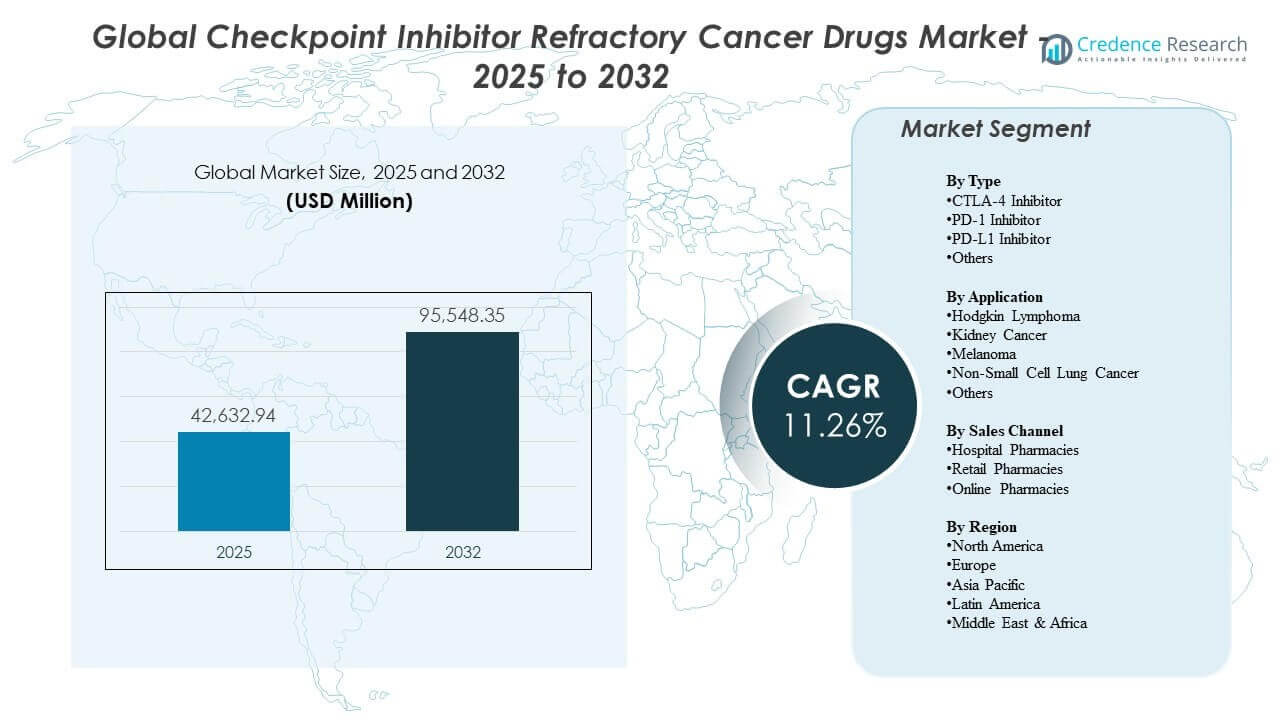
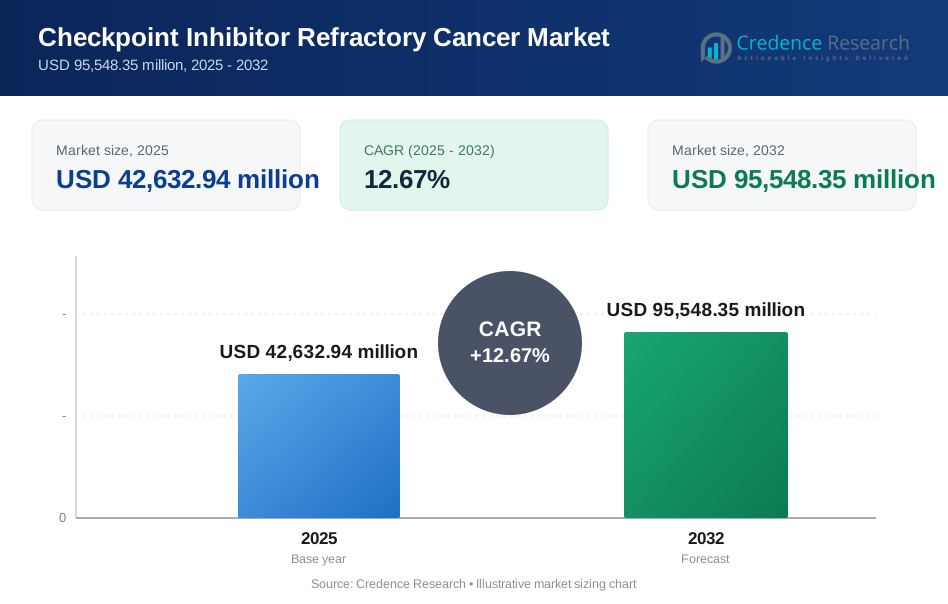
The global checkpoint inhibitor refractory cancer drugs market size was estimated at USD 42,632.94 million in 2025 and is expected to reach USD 95,548.35 million by 2032, growing at a CAGR of 12.67% from 2025 to 2032, driven by the expanding pool of patients who do not respond to, or progress after, PD-(L)1 and CTLA-4 checkpoint inhibitor therapy, which increases demand for next-line regimens and combination strategies. Continued clinical emphasis on treatment sequencing and resistance-focused approaches supports sustained adoption across high-incidence and high-treatment-intensity tumor types.
| REPORT ATTRIBUTE | DETAILS |
|---|---|
| Historical Period | 2020-2023 |
| Base Year | 2024 |
| Forecast Period | 2025-2032 |
| Checkpoint Inhibitor Refractory Cancer Drugs Market Size 2025 | USD 42,632.94 million |
| Checkpoint Inhibitor Refractory Cancer Drugs Market , CAGR | 12.67% |
| Checkpoint Inhibitor Refractory Cancer Drugs Market Size 2032 | USD 95,548.35 million |
Key Market Trends & Insights
- The market is projected to expand at a CAGR of 12.67% during 2025–2032, reflecting rising demand for post–checkpoint inhibitor treatment pathways.
- PD-1 inhibitors accounted for the largest share of 0% in 2025, supported by broad use across multiple tumor types and a continued role as a backbone in combination regimens.
- Non-small cell lung cancer accounted for the largest application share of 0% in 2025, reflecting high immunotherapy penetration and rapid treatment-line sequencing in lung oncology care.
- Asia Pacific is expected to grow at 84% during 2025–2032, indicating faster expansion in refractory-line immuno-oncology demand than mature regions.
- Africa is expected to grow at 14% during 2025–2032, reflecting comparatively slower expansion linked to narrower access to specialty oncology infrastructure.
Segment Analysis
Checkpoint inhibitor refractory cancer drugs demand is anchored in clinical pathways where patients progress following PD-(L)1 and CTLA-4 therapy and require alternative regimens to extend survival and manage disease control. This creates sustained emphasis on combination approaches and sequencing strategies across solid tumors and select hematologic malignancies, particularly where checkpoint inhibitors are widely used in earlier lines. Treatment selection is shaped by prior exposure history, biomarker status, tolerability constraints, and the ability of health systems to support complex oncology protocols.
Market activity increasingly concentrates on optimizing post-progression options within high-volume indications, which sustains utilization across hospital-based oncology settings and specialist-led care pathways. The refractory setting also tends to intensify clinical decision-making because clinicians must balance incremental efficacy with toxicity and cost considerations, especially when combinations are used. These dynamics reinforce demand for therapies that demonstrate benefit in defined post–checkpoint inhibitor populations and can fit into standardized treatment algorithms.
By Type Insights
PD-1 inhibitor accounted for the largest share of 43.0% in 2025. This leadership reflects its broad footprint across multiple tumor types, which enlarges the base of patients who later move into refractory settings after progression. PD-1 agents also remain central to combination strategies intended to deepen response or restore sensitivity, supporting continued use across treatment lines. Familiarity with safety profiles and established clinical experience further sustains adoption in refractory-line sequencing.
By Application Insights
Non-small cell lung cancer accounted for the largest share of 37.0% in 2025. The segment leads due to high incidence and extensive checkpoint inhibitor utilization across multiple disease stages, which expands the refractory patient pool over time. Rapid movement across therapy lines and frequent evaluation of combination regimens increase treatment intensity in this setting. These factors keep NSCLC at the center of refractory-line innovation and clinical adoption.
By Sales Channel Insights
Hospital pharmacies remain critical for checkpoint inhibitor refractory cancer drug access because many regimens require specialist oversight, protocol-driven dosing, and monitoring within oncology centers. Reimbursement processing, payer controls, and formulary governance also reinforce hospital-led distribution for complex immuno-oncology use. Retail and online channels typically play a supporting role where specialty pharmacy models are used, particularly for adjunct therapies or components integrated into broader care pathways. Channel mix continues to be shaped by site-of-care shifts and the availability of outpatient oncology delivery models.
Checkpoint Inhibitor Refractory Cancer Drugs Market Drivers
Expanding Refractory Patient Pool Following Checkpoint Inhibitor Use
Checkpoint inhibitors are used across a growing set of tumor types and treatment lines, which increases the number of patients who eventually progress or fail to respond. This enlarges the addressable population requiring refractory-line therapies and post-progression sequencing options. Clinicians increasingly require structured approaches to manage primary resistance and acquired resistance after PD-(L)1 or CTLA-4 exposure. These conditions sustain demand for therapies that can deliver benefit in previously treated, difficult-to-manage patient populations.
Intensifying Focus on Combination and Sequencing Strategies
Refractory disease management increasingly depends on combination approaches designed to overcome resistance mechanisms. Treatment regimens are selected to balance efficacy with safety, particularly in heavily pretreated patients. As sequencing pathways mature, drug utilization becomes more protocol-driven, supporting consistent demand across oncology centers. The focus on optimizing post-progression outcomes strengthens continued investment in therapies positioned for refractory settings.
- For instance, Bristol Myers Squibb’s RELATIVITY-047 study (nivolumab + relatlimab vs nivolumab in advanced melanoma) reported a median progression-free survival of 10.2 months for the combination vs 4.6 months for nivolumab alone, with an objective response rate of 43.7% vs 33.7%, demonstrating measurable benefit from dual-checkpoint strategies that expand post-progression planning options.
High Treatment Intensity in Major Solid Tumors
Large-volume cancers such as non-small cell lung cancer and kidney cancer sustain high checkpoint inhibitor exposure, which feeds refractory demand over time. The clinical need remains acute because progression after immunotherapy often limits options and elevates urgency for next-line therapies. Ongoing improvements in diagnostics and treatment algorithms increase the number of eligible patients and refine treatment selection. These factors reinforce sustained market expansion in high-incidence tumor categories.
- For instance, in the 5-year update of CheckMate 214 in advanced renal cell carcinoma (nivolumab + ipilimumab vs sunitinib), 48% of patients treated with nivolumab + ipilimumab were alive at 5 years (vs 37% with sunitinib), and complete response rates at long follow-up were reported as 10.7% (vs 2.6%), underscoring both high treatment intensity and the sizable population that ultimately requires later-line decisions after IO exposure.
Access Expansion Across Regions and Care Settings
Health systems continue to broaden access to immuno-oncology through improved coverage, expanding specialty oncology capacity, and wider treatment availability. As checkpoint inhibitor use becomes more normalized, refractory-line demand follows, especially in regions where earlier-line adoption is accelerating. Provider networks and oncology centers are also strengthening care pathways that can support complex therapies. This creates a broader foundation for refractory cancer drug utilization over the forecast period.
Checkpoint Inhibitor Refractory Cancer Drugs Market Challenges
Clinical heterogeneity in refractory disease creates variability in treatment response, making it difficult to standardize regimens across patient subgroups. Prior therapy exposure, biomarker status, and comorbidity burden can materially affect outcomes and tolerability, which complicates clinical decision-making. In addition, combination regimens can increase toxicity management burden, limiting use in frail or heavily pretreated populations. These constraints can slow uptake in settings where monitoring resources are limited.
- For instance, the FDA label for Janssen’s TECVAYLI (teclistamab-cqyv) specifies hospitalization for 48 hours after administration of all step-up doses, and reports cytokine release syndrome (CRS) in 72% of patients at the recommended dose (Grade 1: 50%, Grade 2: 21%, Grade 3: 0.6%)—a concrete example of how advanced regimens can impose significant monitoring and toxicity-management requirements.
Market access and affordability remain significant barriers, particularly where reimbursement is restrictive or specialty oncology services are concentrated in a limited number of centers. Treatment pathways may also be influenced by formulary controls and payer-driven sequencing requirements. Regional disparities in diagnostic capacity and specialist availability can constrain eligible patient identification. These issues are most pronounced in parts of Latin America, the Middle East, and Africa, where access can be uneven across countries and care settings.
Checkpoint Inhibitor Refractory Cancer Drugs Market Trends and Opportunities
Clinical pathways are increasingly shaped by resistance-informed strategies, including biomarker-guided selection and regimen optimization after PD-(L)1 progression. This trend supports opportunities for therapies that can show benefit in well-defined refractory populations and integrate into established sequencing algorithms. Growth also benefits from ongoing expansion of immunotherapy use into earlier disease stages, which increases the downstream refractory pool over time. Treatment standardization in major oncology centers supports faster diffusion of updated protocols.
- For instance, Roche-owned Foundation Medicine’s FDA-approved FoundationOne CDx is designed to profile 324 genes and report genomic signatures such as microsatellite instability (MSI) and tumor mutational burden (TMB), supporting biomarker-driven treatment selection in routine oncology workflows.
Opportunities also arise from expanding oncology capacity in fast-growing regions, particularly Asia Pacific, where infrastructure growth and broader access can accelerate uptake. As oncology service delivery models evolve, specialty pharmacy and outpatient care pathways may expand, supporting smoother distribution and patient management. Greater emphasis on coordinated care pathways can improve persistence and adherence where applicable. These shifts create room for differentiated therapies and regimen strategies that align with real-world clinical constraints.
Regional Insights
North America
North America is expected to grow at 12.06% during 2025–2032, supported by high immunotherapy penetration and established sequencing practices in specialist oncology centers. Strong clinical trial activity and structured treatment pathways reinforce adoption in refractory settings. Access is shaped by payer controls, but mature reimbursement frameworks support continued utilization in eligible patient populations.
Europe
Europe is expected to grow at 11.42% during 2025–2032, supported by guideline-based immunotherapy adoption and broad oncology infrastructure across major markets. Centralized procurement and formulary decision-making influence regimen access and sequencing in refractory care. Continued emphasis on standardized protocols supports steady demand across specialist-led oncology systems.
Asia Pacific
Asia Pacific is expected to grow at 13.84% during 2025–2032, reflecting faster expansion in oncology capacity and widening checkpoint inhibitor use across indications. Growth is reinforced by rising access to specialty cancer care and expanding treatment availability in large patient populations. As immunotherapy adoption scales, the refractory-line patient pool increases, supporting sustained demand for next-line strategies.
Latin America
Latin America is expected to grow at 9.53% during 2025–2032, with adoption influenced by expansion of private oncology networks and gradual improvements in coverage. Access remains uneven across countries, with demand concentrated in major urban centers. Treatment growth is supported as specialty infrastructure expands and immuno-oncology use becomes more integrated into care pathways.
Middle East & Africa
The Middle East is expected to grow at 8.65% during 2025–2032 and Africa at 7.14% during 2025–2032, reflecting slower overall expansion due to access concentration in higher-capability centers. Adoption is driven by specialist oncology hubs, particularly in markets with stronger reimbursement and tertiary care infrastructure. Growth remains dependent on expanding diagnostic capacity, specialist availability, and coverage for advanced oncology therapies.
Competitive Landscape
Competition in checkpoint inhibitor refractory cancer drugs is driven by positioning within post–checkpoint inhibitor sequencing, combination regimen design, and evidence generation in defined refractory populations. Companies differentiate through clinical performance in previously treated settings, tolerability of combinations, and the ability to align therapies with biomarker-driven care pathways. Market success is also influenced by payer acceptance, formulary access, and the capacity to support oncology centers with protocol integration and real-world evidence generation.
Bristol-Myers Squibb Company maintains a strong footprint in immuno-oncology through established checkpoint inhibitor portfolios and ongoing efforts to support sequencing strategies and combinations in complex oncology settings. Its competitive approach centers on reinforcing clinical relevance across multiple tumor types and supporting physician confidence through evidence development and pathway integration. Continued emphasis on refractory-relevant treatment strategies supports differentiation in patient populations where post-progression options are limited. These factors help sustain competitive positioning as refractory demand expands.
The industry research and growth report includes detailed analyses of the competitive landscape of the market and information about key companies, including:
- Bristol-Myers Squibb Company
- Merck & Co., Inc.
- Regeneron Pharmaceuticals, Inc.
- Exelixis, Inc.
- AstraZeneca plc
- GSK plc
- F. Hoffmann-La Roche Ltd
- Eisai Co., Ltd.
- Others
Qualitative and quantitative analysis of companies has been conducted to help clients understand the wider business environment as well as the strengths and weaknesses of key industry players. Data is qualitatively analyzed to categorize companies as pure play, category-focused, industry-focused, and diversified; it is quantitatively analyzed to categorize companies as dominant, leading, strong, tentative, and weak.
Recent Developments
- In June 2025, Teva Pharmaceutical Industries and Fosun Pharma announced a strategic partnership to develop TEV‑56278, described as an investigational anti‑PD1‑IL2 “ATTENUKINE” therapy intended to accelerate clinical data generation across cancers including melanoma.
- In June 2025, Bristol-Myers Squibb Company and BioNTech announced a global strategic partnership to jointly develop and commercialize BioNTech’s oncology candidate BNT327, positioning it as a potential next-generation immuno-oncology backbone beyond single-mechanism checkpoint inhibitors
- In March 2025, Sun Pharmaceutical Industries announced it would acquire Checkpoint Therapeutics, highlighting Checkpoint’s FDA-approved anti‑PD‑L1 therapy UNLOXCYT (cosibelimab‑ipdl) as part of the transaction.
- In February 2024, Iovance Biotherapeutics received FDA accelerated approval for lifileucel (Amtagvi) for adults with unresectable or metastatic melanoma previously treated with a PD‑1–blocking antibody (and targeted therapy if BRAF V600–positive), creating a new commercial option specifically for a checkpoint-inhibitor–refractory/experienced population.
Report Scope
| Report Attribute | Details |
| Market size value in 2025 | USD 42,632.94 million |
| Revenue forecast in 2032 | USD 95,548.35 million |
| Growth rate (CAGR) | 12.67% (2025–2032) |
| Base year | 2025 |
| Forecast period | 2026–2032 |
| Quantitative units | USD million |
| Segments covered | By Type Outlook: CTLA-4 Inhibitor, PD-1 Inhibitor, PD-L1 Inhibitor, Others; By Application Outlook: Hodgkin Lymphoma, Kidney Cancer, Melanoma, Non-Small Cell Lung Cancer, Others; By Sales Channel Outlook: Hospital Pharmacies, Retail Pharmacies, Online Pharmacies |
| Regional scope | North America, Europe, Asia Pacific, Latin America, Middle East & Africa |
| Key companies profiled | Bristol-Myers Squibb Company, Merck & Co., Inc., Regeneron Pharmaceuticals, Inc., Exelixis, Inc., AstraZeneca plc, GSK plc, F. Hoffmann-La Roche Ltd, Eisai Co., Ltd., Others companies |
| No. of Pages | 322 |
Segmentation
BY TYPE
- CTLA-4 Inhibitor
- PD-1 Inhibitor
- PD-L1 Inhibitor
- Others
BY APPLICATION
- Hodgkin Lymphoma
- Kidney Cancer
- Melanoma
- Non-Small Cell Lung Cancer
- Others
BY SALES CHANNEL
- Hospital Pharmacies
- Retail Pharmacies
- Online Pharmacies
BY REGION
- North America
- U.S.
- Canada
- Mexico
- Europe
- Germany
- France
- U.K.
- Italy
- Spain
- Rest of Europe
- Asia Pacific
- China
- Japan
- India
- South Korea
- South-east Asia
- Rest of Asia Pacific
- Latin America
- Brazil
- Argentina
- Rest of Latin America
- Middle East & Africa
- GCC Countries
- South Africa
- Rest of the Middle East and Africa
Request a Free Sample
Fill in your details and we'll send you a free sample report.
- Sample data tables & charts
- Research methodology
Need a Custom Version of This Report?
Tailor the scope, geography, or segments to your exact requirements.
- Custom geography or segment scope
- Direct access to our analyst team
Frequently Asked Questions
What is the market size of the global checkpoint inhibitor refractory cancer drugs market?
What is the CAGR of the global checkpoint inhibitor refractory cancer drugs market during the forecast period?
Which segment is the largest by type in 2025?
What are the key factors driving growth in this market?
Who are the key players in the global checkpoint inhibitor refractory cancer drugs market?
Which region is expected to grow the fastest during 2025–2032?
Table of Content
Chapter 1. Report Introduction
- 1.1 Report Description & Purpose
- 1.1.1 Report Title & Market Definition
- 1.1.2 Unique Selling Propositions (USP) & Key Differentiators
- 1.1.3 Value Proposition for Stakeholders
- 1.2 Research Objectives
- 1.2.1 Market Sizing Objectives (Volume & Revenue)
- 1.2.2 Segmentation Objectives
- 1.2.3 Competitive Intelligence Objectives
- 1.2.4 Forecast & Scenario Objectives
- 1.3 Report Scope
- 1.3.1 Checkpoint Inhibitor Refractory Cancer Scope – Types & Subtypes Covered
- 1.3.2 Geographic Scope – Regions & Countries Covered
- 1.3.3 Historical Period, Base Year & Forecast Period (2025; forecast to 2032)
- 1.3.4 Inclusions & Exclusions
- 1.4 HS Code & Classification Framework
- 1.5 Currency, Units & Pricing Basis
- 1.6 Target Stakeholders
- 1.7 Limitations & Assumptions
Chapter 2. Executive Summary
- 2.1 Global Checkpoint Inhibitor Refractory Cancer Market Snapshot
- 2.1.1 Market Size – Historical (2025) & Forecast (2025-2032) (2025: USD 42,632.94 million → 2032: USD 95,548.35 million)
- 2.1.2 Volume & Revenue – Global Totals
- 2.1.3 Key Market Highlights – Top Five Facts
- 2.2 Checkpoint Inhibitor Refractory Cancer Market Segmentation Snapshot
- 2.2.1 Market Split by Region – 2025 vs. 2032
- 2.3 Competitive Snapshot
- 2.3.1 Top 10 Players by Revenue Share – 2025
- 2.3.2 Top 10 Players by Volume Share – 2025
- 2.3.3 Recent Strategic Developments (18-Month Summary)
- 2.4 Key Investment Highlights & Strategic Conclusions
Chapter 3. Checkpoint Inhibitor Refractory Cancer Market Dynamics & Industry Analysis
- 3.1 Market Overview & Context
- 3.1.1 Checkpoint Inhibitor Refractory Cancer Market Position in the Broader Automotive Value Chain
- 3.1.2 OEM vs. Replacement Market Dynamics
- 3.1.3 Market Maturity & Development Stage by Region
- 3.2 Checkpoint Inhibitor Refractory Cancer Market Drivers
- 3.3 Checkpoint Inhibitor Refractory Cancer Market Restraints & Challenges
- 3.4 Checkpoint Inhibitor Refractory Cancer Market Opportunities
- 3.5 Porter's Five Forces Analysis
- 3.5.1 Threat of New Entrants
- 3.5.2 Bargaining Power of Suppliers
- 3.5.3 Bargaining Power of Buyers
- 3.5.4 Threat of Substitutes
- 3.5.5 Competitive Rivalry – Intensity Assessment
- 3.6 Checkpoint Inhibitor Refractory Cancer Value Chain Analysis
- 3.6.1 Upstream – Raw Material/Input Suppliers
- 3.6.1.1 Raw Material/Input 1
- 3.6.1.2 Raw Material/Input 2
- 3.6.1.3 Raw Material/Input 3
- 3.6.2 Midstream – Production/Manufacturing/Service Delivery
- 3.6.2.1 Production/Process Overview
- 3.6.2.2 Key Facility Locations & Capacity by Manufacturer
- 3.6.3 Downstream – Distribution & End Consumer
- 3.6.3.1 Primary Channel – B2B/OEM
- 3.6.3.2 Secondary Channels – Dealer, Retail, Online, Direct
- 3.6.4 Value Chain Profitability Analysis
- 3.6.1 Upstream – Raw Material/Input Suppliers
- 3.7 PESTEL Analysis
- 3.7.1 Political Factors
- 3.7.2 Economic Factors
- 3.7.3 Social Factors
- 3.7.4 Technological Factors
- 3.7.5 Environmental Factors
- 3.7.6 Legal Factors
- 3.8 Checkpoint Inhibitor Refractory Cancer Supply Chain Analysis
- 3.8.1 Raw Material/Input Supply Risk Assessment
- 3.8.2 Manufacturing Concentration Risk (Geographic Exposure)
- 3.8.3 Trade Disruption Impact Analysis
- 3.9 Regulatory & Policy Landscape
Note: The regulatory and policy landscape section covers regulations based on their applicability to the market, Checkpoint Inhibitor Refractory Cancer category, geography, and scope of the study. Only regulatory frameworks with a material impact on operations, compliance, trade, sustainability, or market access are analyzed in detail.
Chapter 4. Key Investment Pockets & Opportunity Analysis
- 4.1 Checkpoint Inhibitor Refractory Cancer Market Attractiveness Analysis
- 4.1.1 By Region – Investment Attractiveness Matrix (Volume × CAGR)
- 4.2 Absolute Revenue Growth Opportunity
- 4.2.1 By Region – Absolute USD Growth Through 2032
- 4.3 Incremental Volume Opportunity
- 4.3.1 By Region – Incremental Volume Through 2032
- 4.3.2 Segment – Incremental Volume
- 4.4 Emerging Submarket Opportunity Deep Dive (Subject to Applicability)
- 4.5 Emerging Market Opportunity Scorecards
- 4.5.1 United States
- 4.5.2 Europe
- 4.5.3 Asia
- 4.5.4 Middle East & Africa
Note: Emerging Market Opportunity Scorecards will be included based on relevance and strategic importance. Regions listed are indicative and may vary depending on data availability and market dynamics.
Chapter 5. Checkpoint Inhibitor Refractory Cancer Import-Export Analysis & Trade Flows
- 5.1 Global Trade Overview
- 5.1.1 Global Export Value by Country (2025)
- 5.1.2 Global Export Volume by Country (2025)
- 5.1.3 Global Import Value by Country (2025)
- 5.1.4 Global Import Volume by Country (2025)
- 5.1.5 Net Trade Balance by Country (2025)
- 5.2 Export Analysis – Segment
- 5.2.1 Type 1 (HS Code)
- 5.2.2 Type 2 (HS Code)
- 5.2.3 Type 3 (HS Code)
- 5.2.4 Type 4 (HS Code)
- 5.2.5 Type 5 (HS Code)
- 5.3 Import Analysis – Segment
- 5.3.1 Type 1 (HS Code)
- 5.3.2 Type 2 (HS Code)
- 5.3.3 Type 3 (HS Code)
- 5.3.4 Type 4 (HS Code)
- 5.3.5 Type 5 (HS Code)
- 5.4 Average Unit Trade Prices
- 5.4.1 Average Export Price – Segment & Country
- 5.4.2 Average Import Price – Segment & Source Country
- 5.4.3 Price Trends (2025)
- 5.5 Key Trade Route Analysis
- 5.5.1 Trade Route 1
- 5.5.2 Trade Route 2
- 5.5.3 Trade Route 3
- 5.5.4 Trade Route 4
- 5.5.5 Trade Route 5
- 5.6 Trade Policy Impact Assessment
- 5.6.1 US Anti-Dumping & Section 301 Tariffs
- 5.6.2 EU Customs Union Impact
- 5.6.3 Major Free Trade Agreements
- 5.6.4 USMCA Rules of Origin
Note: Trade policy analysis will be included only where relevant to the Checkpoint Inhibitor Refractory Cancer market.
Chapter 6. Competitive Landscape & Company Benchmarking
- 6.1 Checkpoint Inhibitor Refractory Cancer Market Concentration & Structure
- 6.1.1 Herfindahl-Hirschman Index (HHI) – vs. 2025
- 6.1.2 Tier 1, Tier 2 & Tier 3 Market Structure
- 6.1.3 Global, Regional & Local Player Dynamics
- 6.2 Checkpoint Inhibitor Refractory Cancer Market Share Analysis – 2025
- 6.2.1 Global Revenue Share by Company
- 6.2.2 Global Volume Share by Company
- 6.2.3 Regional Revenue Share
- 6.2.4 Market Share Evolution ( vs. 2025)
- 6.2.5 OEM Segment Share by Company
- 6.2.6 Replacement Segment Share by Company
- 6.3 Production/Delivery Capacity & Facility Analysis
- 6.3.1 Global Installed Capacity
- 6.3.2 Capacity Utilization Rates
- 6.3.3 Production/Output Volume
- 6.3.4 Facility Locations & Capacity Map
- 6.3.5 Planned Capacity Additions
- 6.4 Checkpoint Inhibitor Refractory Cancer Competitive Benchmarking Matrix
- 6.4.1 Revenue, Volume, CAGR & Profitability Comparison
- 6.4.2 Channel Revenue Mix
- 6.4.3 Geographic Revenue Exposure
- 6.4.4 R&D Intensity
- 6.4.5 Sustainability Maturity
- 6.5 Strategic Developments in Checkpoint Inhibitor Refractory Cancer (Last 24 Months)
- 6.5.1 Mergers, Acquisitions & Divestments
- 6.5.2 New Checkpoint Inhibitor Refractory Cancer Launches
- 6.5.3 Facility Expansions
- 6.5.4 Strategic Alliances, Joint Ventures & Partnerships
- 6.5.5 Distribution Expansion & Market Entry
- 6.5.6 Sustainability & ESG Initiatives
- 6.6 Competitive Strategy Mapping
- 6.6.1 Leader, Challenger, Follower & Niche Classification
- 6.6.2 Pricing Strategy Comparison
- 6.6.3 Channel Strategy Matrix
Note: Strategic developments are included based on their materiality and the availability of reliable information.
Chapter 7. Global Checkpoint Inhibitor Refractory Cancer Market – By Distribution Channel
- 7.1 Segment Overview
- 7.1.1 Volume & Revenue Split by Channel (2025 & 2032)
- 7.1.2 Channel Mix Evolution (2025-2032)
Chapter 8. Regional Market Analysis – Global Overview
- 8.1 Global Regional Overview
- 8.1.1 Regional Volume Share
- 8.1.2 Regional Revenue Share
- 8.1.3 Regional Volume by Region
- 8.1.4 Regional Revenue by Region
- 8.1.5 Regional Forecast Through 2032
- 8.2 Cross-Regional Segment Analysis
- 8.2.1 By Distribution Channel
- 8.2.2 By Brand/Price Tier
Chapter 9. North America Checkpoint Inhibitor Refractory Cancer Market
- 9.1 United States
- 9.2 Canada
- 9.3 Mexico
Chapter 10. Europe Checkpoint Inhibitor Refractory Cancer Market
- 10.1 Germany
- 10.2 France
- 10.3 Italy
- 10.4 United Kingdom
- 10.5 Spain
- 10.6 Poland
- 10.7 Russia
- 10.8 Netherlands
- 10.9 Belgium
- 10.10 Sweden
- 10.11 Denmark
- 10.12 Norway
- 10.13 Rest of Europe
Chapter 11. Asia Pacific Checkpoint Inhibitor Refractory Cancer Market
- 11.1 China
- 11.2 India
- 11.3 Japan
- 11.4 South Korea
- 11.5 Thailand
- 11.6 Indonesia
- 11.7 Vietnam
- 11.8 Malaysia
- 11.9 Australia
- 11.10 Rest of Asia Pacific
Chapter 12. Latin America Checkpoint Inhibitor Refractory Cancer Market
- 12.1 Brazil
- 12.2 Argentina
- 12.3 Colombia
- 12.4 Chile
- 12.5 Rest of Latin America
Chapter 13. Middle East Checkpoint Inhibitor Refractory Cancer Market
- 13.1 Saudi Arabia
- 13.2 United Arab Emirates
- 13.3 Turkey
- 13.4 Israel
- 13.5 Iran
- 13.6 Rest of the Middle East
Chapter 14. Africa Checkpoint Inhibitor Refractory Cancer Market
- 14.1 South Africa
- 14.2 Egypt
- 14.3 Nigeria
- 14.4 Morocco
- 14.5 Rest of Africa
Chapter 15. Checkpoint Inhibitor Refractory Cancer Company Profiles
- 15.1 [Company 01]
- 15.1.1 Company Overview
- 15.1.2 Key Management Personnel
- 15.1.3 Products & Services Portfolio
- 15.1.4 Financial Performance
- 15.1.5 Key Market Focus & Geographic Presence
- 15.1.6 Recent Developments & Strategic Initiatives
Note: The company profile list is preliminary and may change based on research findings, market developments, data availability, and client requirements.
Chapter 16. Appendices
- Appendix A – List of Abbreviations & Acronyms
- Appendix B – Industry Classification Code Reference – Full Series
- Appendix C – Production & Capacity Data Tables
- Appendix D – End-Use & Demand Base Tables
- Appendix E – Consumption & Replacement Rate Assumptions
- Appendix F – ASP Reference Tables
- Appendix G – Manufacturing & Facility Database
- Appendix H – Import-Export Data Tables
- Appendix I – Regulatory Summary Tables
- Appendix J – Primary Research Participant List (Anonymized)
- Appendix K – Primary Research Questionnaire Framework
- Appendix L – Data Sources & Bibliography
- Appendix M – Market Size Divergence & Source Comparison
Chapter 17. Research Methodology
- 17.1 Research Framework & Philosophy
- 17.2 Secondary Research – Sources, Hierarchy & Data Extraction
- 17.3 Data Modeling – Bottom-Up & Top-Down Market Sizing
- 17.4 Primary Research – Stakeholder Framework, LOI & Sample Sizes
- 17.5 Forecast Methodology – Regression, Scenario & Sensitivity Analysis
- 17.6 Quality Control – Four-Layer Validation Framework
- 17.7 Limitations & Standard Assumptions
- 17.8 Disclaimer
