Market overview
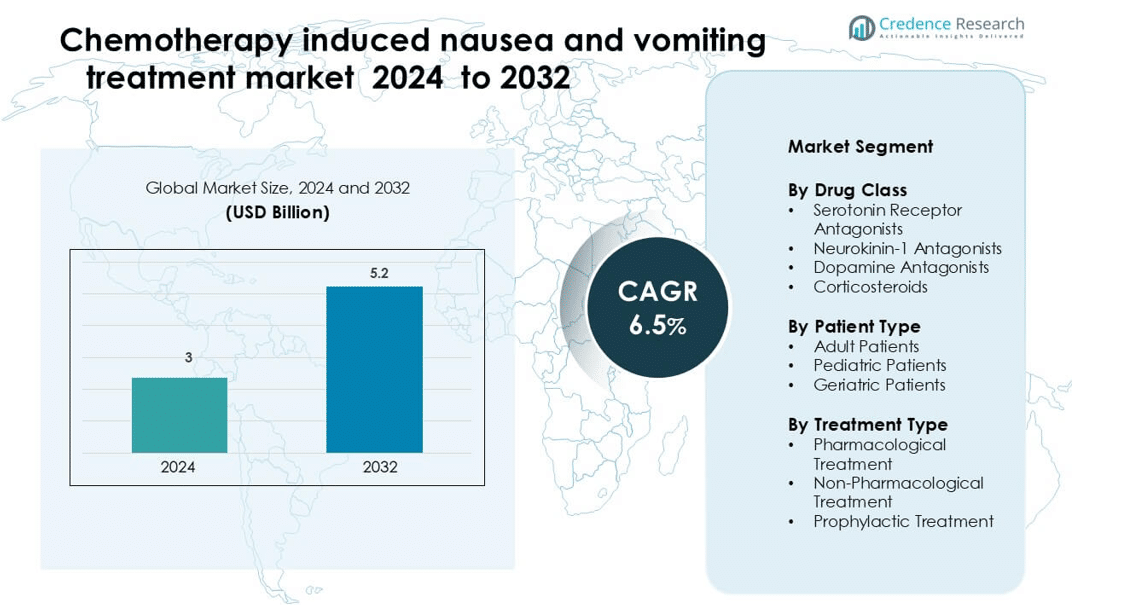
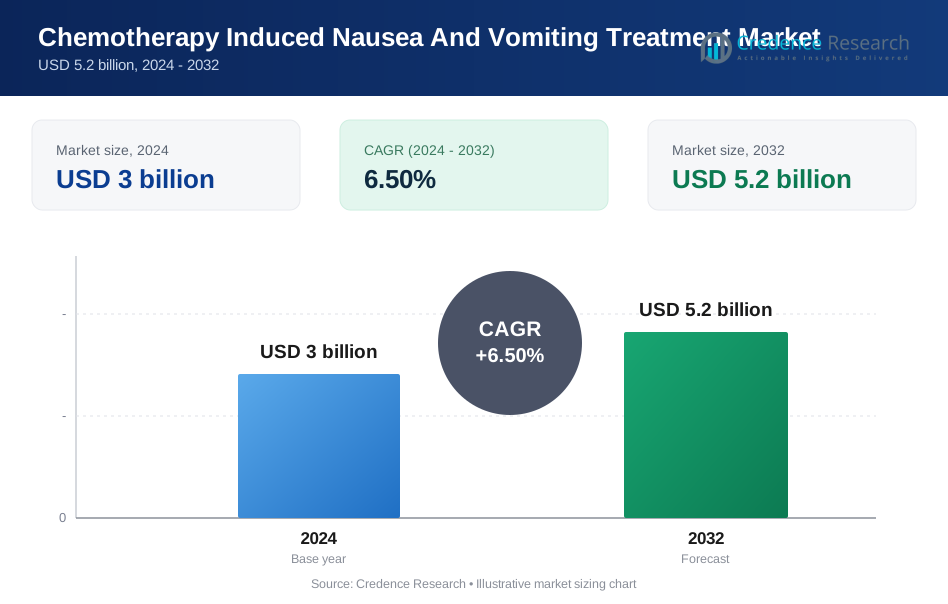
Chemotherapy induced nausea and vomiting treatment market was valued at USD 3 billion in 2024 and is anticipated to reach USD 5.2 billion by 2032, growing at a CAGR of 6.5 % during the forecast period.
| REPORT ATTRIBUTE | DETAILS |
|---|---|
| Historical Period | 2020-2023 |
| Base Year | 2024 |
| Forecast Period | 2025-2032 |
| Chemotherapy Induced Nausea and Vomiting Treatment Market Size 2024 | USD 3 billion |
| Chemotherapy Induced Nausea and Vomiting Treatment Market, CAGR | 6.5% |
| Chemotherapy Induced Nausea and Vomiting Treatment Market Size 2032 | USD 5.2 billion |
The chemotherapy-induced nausea and vomiting treatment market is shaped by strong participation from leading companies such as Tesaro, Qilu Pharma, Mundipharma, Heron Therapeutics, Eisai, Roche, Helsinn Holding S.A., ProStrakan, Novartis AG, and Helsinn Holding. These firms compete by expanding fixed-dose combinations, enhancing multi-pathway antiemetic regimens, and securing wider guideline inclusion across oncology centers. Their strategies focus on improving symptom control, reducing treatment interruptions, and supporting both inpatient and outpatient chemotherapy settings. North America leads the global market with a 41% share, supported by advanced oncology infrastructure, strong reimbursement systems, and high adoption of preventive antiemetic protocols.
Market Insights
- The market reached USD 3 Billion in 2024 and is projected to hit USD 5.2 Billion by 2032, growing at a 6.5% CAGR.
- Demand rises as hospitals increase use of multi-drug antiemetic regimens, especially serotonin antagonists, which hold the dominant share in drug-class segments.
- Trends highlight growing adoption of fixed-dose combinations, long-acting formulations, and preventive treatment pathways that reduce therapy interruptions.
- Competition intensifies as companies enhance safety profiles and expand oncology partnerships, with major players focusing on simplified dosing and improved tolerability.
- North America leads with a 41% share, followed by Europe at 29% and Asia Pacific at 22%, while pharmacological treatment remains the largest segment globally.
Market Segmentation Analysis:
By Drug Class
Serotonin receptor antagonists lead this segment with a 44% share, supported by strong use in acute and delayed nausea control. These agents provide fast symptom relief and show high safety levels, which strengthens adoption across oncology centers. Neurokinin-1 antagonists grow due to improved control in highly emetogenic regimens, while dopamine antagonists remain relevant in breakthrough episodes. Corticosteroids support combination protocols and enhance antiemetic effectiveness. Rising multi-drug therapy use and wider availability of guideline-recommended regimens continue to push demand for serotonin-based drugs in first-line treatment.
- For instance, Eisai’s palonosetron (marketed as Aloxi) binds to the 5-HT₃ receptor with a half-life of approximately 40 hours, enabling prolonged antiemetic effect even in delayed phases of chemotherapy.
By Patient Type
Adult patients dominate this segment with a 67% share, driven by higher chemotherapy volumes and broader adoption of preventive antiemetic protocols. Adults receive more combination regimens, which increases the need for stronger nausea and vomiting control. Pediatric patients gain steady adoption as dosing guidelines improve, while geriatric patients benefit from safer drug profiles and simplified treatment plans. Growing cancer incidence, wider use of high-intensity therapies, and better supportive-care standards strengthen demand among adult patients.
- For instance, in pooled phase III trials involving 1,787 adult patients receiving palonosetron, the complete response (no vomiting, no rescue therapy) rate in the delayed phase (24–120 h) was 57%.
By Treatment Type
Pharmacological treatment holds the dominant position with a 72% share, driven by strong reliance on guideline-backed drug combinations for both acute and delayed symptom control. These therapies deliver predictable outcomes and suit high-risk chemotherapy protocols, which makes them the preferred option for most oncology teams. Prophylactic treatment gains traction as hospitals prioritize prevention to reduce emergency visits and improve patient comfort. Non-pharmacological methods, including relaxation and dietary support, rise slowly but remain supplemental. Strong clinical evidence and wider access to combination antiemetics continue to reinforce the leadership of pharmacological approaches.
Key Growth Drivers
Growing Use of Highly Emetogenic Chemotherapy Regimens
The rise in highly emetogenic chemotherapy regimens strengthens demand for advanced antiemetic therapies. Oncologists use more aggressive combinations to improve cancer survival, which raises the risk of acute and delayed nausea. This shift drives adoption of multi-class antiemetic protocols that combine serotonin antagonists, NK-1 blockers, corticosteroids, and dopamine antagonists. Hospitals rely on guideline-based regimens to prevent treatment interruptions and improve patient adherence. Wider access to targeted therapies and immuno-oncology drugs also expands supportive-care needs. These trends create sustained demand for reliable nausea-prevention solutions that support treatment continuity and patient comfort across diverse cancer profiles.
- For instance, real-world prescribing data information was collected from 45,324 chemotherapy-treated patients across five European countries (France, Germany, Italy, Spain, and the U.K.), which was extrapolated to an estimated 1,394,848 treatments.
Strong Adoption of Prophylactic Treatment Protocols
Preventive antiemetic therapy gains rapid traction as oncology practices shift from reactive to proactive care. Prophylactic protocols lower the risk of severe nausea, reduce emergency visits, and improve therapy tolerance. Healthcare systems integrate standardized antiemetic pathways that support consistent dosing and better clinical outcomes. The focus on patient quality of life and reduced treatment delays drives broader use of first-day and multi-day antiemetic combinations. Growing evidence supporting early intervention encourages oncologists to use serotonin antagonists and NK-1 inhibitors as frontline protection. This move toward preventive care reinforces long-term demand for reliable antiemetic drugs across adult and pediatric populations.
- For instance, in multiple-cycle cisplatin chemotherapy, sustained prophylactic use of aprepitant maintained a no emesis + no significant nausea rate of ~59% by the sixth cycle, compared to ~34% in patients on standard antiemetic therapy.
Expanding Oncology Infrastructure and Access to Supportive Care
Growth in cancer centers, infusion clinics, and ambulatory oncology units increases access to structured antiemetic care. More regions adopt modern cancer-treatment protocols that rely on standardized supportive therapies, including antiemetic drugs. Tele-oncology and remote symptom monitoring help clinicians track nausea episodes and adjust therapy sooner. Pharmaceutical companies introduce improved oral formulations that support outpatient use. Public and private investments expand cancer screening and treatment capacity, raising the number of patients receiving chemotherapy. As supportive care becomes a core component of cancer management, demand for consistent and effective nausea-control solutions continues to increase.
Key Trend & Opportunity
Growth of Combination Antiemetic Therapies
Combination therapies gain strong momentum as clinicians adopt multi-pathway control for both acute and delayed nausea. The use of serotonin antagonists with NK-1 inhibitors and corticosteroids becomes standard in many regimens, improving symptom prevention in high-risk patients. New fixed-dose combinations offer simpler dosing and better adherence. Opportunities grow for companies developing long-acting or oral formulations that reduce clinic visits. Research exploring novel receptor targets enhances the pipeline for next-generation therapies. This trend opens room for innovation in personalized antiemetic strategies tailored to chemotherapy intensity and patient-specific risk factors.
- For instance, Helsinn’s Akynzeo - a fixed-dose oral combination of 300 mg netupitant (NK-1 antagonist) and 0.5 mg palonosetron - showed a complete response rate (no vomiting, no rescue medication) of 76.9% in the delayed (25–120 h) phase versus 69.5% for palonosetron alone, in a phase III trial of 1,455 patients.
Rising Role of Digital Health and Remote Care Tools
Digital symptom tracking tools support earlier intervention and personalized treatment adjustments. Mobile apps help patients record nausea severity, triggers, and medication use, giving clinicians real-time data. Remote monitoring reduces unplanned hospital visits and supports proactive dose adjustments. Oncology practices adopt AI-based tools that predict nausea risk based on treatment factors, enabling targeted prophylaxis. These capabilities create opportunities for drug makers and digital-health firms to collaborate on integrated care models. Expansion of virtual oncology platforms also increases access to supportive care in rural areas, strengthening market reach for antiemetic therapies.
- For instance, the ASyMS system (Advanced Symptom Management System) used in the large eSMART trial across 12 sites in 5 European countries enabled real-time monitoring of 10 chemotherapy-related symptoms (including nausea), with severe alerts (red) sent to clinicians via their dashboard within ~30 minutes.
Increasing Focus on Patient-Centric Care and Quality of Life
Hospitals place stronger emphasis on comfort, symptom relief, and adherence, driving interest in patient-centric antiemetic solutions. Long-acting formulations, non-pharmacological interventions, and simplified dosing schedules align with patient expectations for easier care. Expanded counseling and nutrition support programs improve treatment tolerance. Pharmaceutical companies explore new delivery systems that reduce side effects and enhance convenience. This focus on holistic care opens opportunities for supportive-care innovations that complement chemotherapy protocols. With rising patient awareness and better communication tools, demand for effective nausea-control solutions continues to grow.
Key Challenge
Adverse Effects and Limited Tolerability of Some Antiemetic Drugs
Certain antiemetic classes cause side effects such as constipation, fatigue, or headache, which may limit long-term tolerability. Older dopamine antagonists carry risks of extrapyramidal symptoms, making them less suitable for vulnerable patients. These issues lead clinicians to rely on combination therapies, increasing treatment complexity and overall pill burden. For some patients, managing side effects becomes challenging during multi-day chemotherapy cycles. Limited tolerability can reduce adherence and diminish therapeutic value, especially in outpatient settings. This constraint pushes manufacturers to develop safer formulations while encouraging clinicians to balance efficacy with patient comfort.
High Treatment Costs and Variability in Access
Advanced antiemetic combinations, especially NK-1 inhibitors and newer serotonin antagonists, remain costly for many healthcare systems. Insurance coverage varies, creating gaps in access for patients in low-resource settings. High drug costs can limit use of optimal prophylactic regimens, forcing reliance on older or less effective treatments. Hospitals face budget pressures when adopting standardized multi-drug antiemetic pathways. Cost barriers also affect adherence, particularly for long-term oral therapies used in delayed nausea control. These financial challenges highlight the need for more affordable antiemetic options and expanded reimbursement support to ensure equitable access.
Regional Analysis
North America
North America holds a 41% share, driven by strong oncology infrastructure, high chemotherapy volumes, and early adoption of guideline-based antiemetic protocols. Hospitals use multi-drug regimens that combine serotonin antagonists, NK-1 inhibitors, and corticosteroids to manage acute and delayed nausea. Broad insurance coverage and strong clinical-practice integration reinforce use of prophylactic therapy. The United States leads regional demand due to larger cancer centers and higher uptake of advanced supportive-care drugs. Canada follows with steady adoption in public oncology programs, supported by improved access to fixed-dose antiemetic combinations and standardized care pathways.
Europe
Europe accounts for a 29% share, supported by well-established cancer networks and high adherence to evidence-based antiemetic guidelines. Countries such as Germany, the UK, France, and Italy prioritize preventive therapy to reduce treatment interruptions and hospitalizations. Widespread use of serotonin antagonists and NK-1 blockers strengthens first-line adoption across both inpatient and outpatient care. National cancer programs encourage standardization of supportive-care protocols, improving consistency in treatment outcomes. Rising geriatric populations and expanding chemotherapy access across Eastern Europe further drive regional growth.
Asia Pacific
Asia Pacific captures a 22% share, driven by rising cancer incidence and expanding chemotherapy services in China, India, Japan, and South Korea. Growing investments in cancer hospitals and improved availability of supportive-care drugs support rapid market expansion. Japan maintains strong uptake due to established antiemetic guidelines, while China and India see fast growth as access to multi-drug antiemetic regimens improves. Regional oncology centers increasingly adopt prophylactic protocols to enhance patient comfort and reduce therapy drop-outs. Rising awareness and better reimbursement structures continue to boost demand.
Latin America
Latin America holds a 5% share, supported by expanding oncology capacity in Brazil, Mexico, Argentina, and Chile. Public hospitals adopt more standardized antiemetic regimens as cancer-treatment programs mature. Access to serotonin antagonists grows steadily, while NK-1 inhibitors gain traction in large urban centers with advanced chemotherapy services. Economic constraints limit widespread adoption of premium antiemetic combinations, but rising private healthcare penetration helps close the gap. Improved training and guideline implementation in major cancer institutes continue to support gradual market growth.
Middle East & Africa
The Middle East & Africa region accounts for a 3% share, shaped by uneven access to cancer treatment across markets. Gulf countries, including the UAE, Saudi Arabia, and Qatar, lead adoption due to advanced oncology centers and strong investment in supportive care. North African countries experience moderate growth as access to essential antiemetics improves. Limited reimbursement and infrastructure challenges restrict use of high-cost NK-1 inhibitors in several African regions. However, ongoing healthcare modernization and expansion of cancer screening programs gradually increase uptake of essential nausea-control therapies.
Market Segmentations
By Drug Class
- Serotonin Receptor Antagonists
- Neurokinin-1 Antagonists
- Dopamine Antagonists
- Corticosteroids
By Patient Type
- Adult Patients
- Pediatric Patients
- Geriatric Patients
By Treatment
- Pharmacological Treatment
- Non-Pharmacological Treatment
- Prophylactic Treatment
By Geography
- North America
- U.S.
- Canada
- Mexico
- Europe
- Germany
- France
- U.K.
- Italy
- Spain
- Rest of Europe
- Asia Pacific
- China
- Japan
- India
- South Korea
- South-east Asia
- Rest of Asia Pacific
- Latin America
- Brazil
- Argentina
- Rest of Latin America
- Middle East & Africa
- GCC Countries
- South Africa
- Rest of the Middle East and Africa
Competitive Landscape
The competitive landscape of the chemotherapy-induced nausea and vomiting treatment market features a mix of global pharmaceutical leaders and specialized supportive-care developers. Companies focus on improving multi-pathway antiemetic regimens that combine serotonin antagonists, NK-1 inhibitors, dopamine antagonists, and corticosteroids to enhance control of both acute and delayed nausea. Leading players invest in fixed-dose combinations, long-acting formulations, and oral therapies that support outpatient chemotherapy. Firms such as Helsinn, Eisai, Novartis, Roche, and Heron Therapeutics strengthen their positions through clinical data, streamlined dosing profiles, and expanded label indications. Partnerships with oncology networks and guideline updates further shape competitive strategies, while emerging players from Asia intensify price competition. Overall, companies aim to deliver safer, more predictable, and more convenient antiemetic solutions that align with evolving cancer-care protocols.
Key Player Analysis
- Tesaro
- Qilu Pharma
- Mundipharma
- Heron Therapeutics
- Eisai
- Roche
- Helsinn Holding S.A.
- ProStrakan
- Novartis AG
- Helsinn Holding
Recent Developments
- In September 2025, Eisai A phase IV STOP-CINV study reported that IV Akynzeo (fosnetupitant 235 mg + palonosetron 0.25 mg), a fixed NK1/5-HT3 combination co-marketed in various regions by partners including Eisai, achieved complete response rates of 84.27 % in the acute phase, 93.26 % in the delayed phase, and 96.07 % in the extended phase for CINV prevention in 178 Indian patients receiving highly or moderately emetogenic chemotherapy, with no new safety signals identified.
- In October 2024, Heron Therapeutics Heron Therapeutics reaffirmed that it had ample U.S. supply of its CINV portfolio products CINVANTI (aprepitant injectable emulsion) and SUSTOL (extended-release granisetron) for chemotherapy-induced nausea and vomiting prevention, highlighting that these ready-to-administer formulations do not require dilution with IV fluids and can help maintain antiemetic care during an anticipated national IV fluid shortage linked to Hurricane Helene
Report Coverage
The research report offers an in-depth analysis based on Drug Class, Patient Type, Treatment Type and Geography. It details leading market players, providing an overview of their business, product offerings, investments, revenue streams, and key applications. Additionally, the report includes insights into the competitive environment, SWOT analysis, current market trends, as well as the primary drivers and constraints. Furthermore, it discusses various factors that have driven market expansion in recent years. The report also explores market dynamics, regulatory scenarios, and technological advancements that are shaping the industry. It assesses the impact of external factors and global economic changes on market growth. Lastly, it provides strategic recommendations for new entrants and established companies to navigate the complexities of the market.
Future Outlook
- Demand for multi-pathway antiemetic combinations will rise as chemotherapy intensity increases.
- Prophylactic treatment protocols will become standard in most oncology centers to prevent symptom escalation.
- Long-acting and fixed-dose formulations will gain wider adoption for better adherence and convenience.
- Digital monitoring tools will support earlier intervention and improve treatment personalization.
- Emerging biologics and novel receptor-targeted agents will expand options for resistant nausea cases.
- Outpatient chemotherapy growth will drive demand for safe and easy-to-administer oral therapies.
- Precision-based antiemetic strategies will strengthen as clinicians integrate patient risk scoring.
- Lower-cost generics will increase access in developing regions and broaden market penetration.
- Collaborations between oncology networks and drug manufacturers will accelerate guideline inclusion.
- Supportive-care integration will remain central to improving patient quality of life and treatment continuity.
Request a Free Sample
Fill in your details and we'll send you a free sample report.
- Sample data tables & charts
- Research methodology
Market Dynamics
Growing Use of Highly Emetogenic Chemotherapy Regimens
The increasing adoption of aggressive chemotherapy protocols raises the risk of severe nausea and vomiting, driving demand for advanced multi-class antiemetic therapies to ensure treatment adherence and patient comfort.
Strong Adoption of Prophylactic Treatment Protocols
Oncology centers are shifting toward preventive antiemetic regimens, which reduce emergency visits and improve patient quality of life, fueling broader use of guideline-backed drug combinations.
Expanding Oncology Infrastructure and Access to Supportive Care
The growth of cancer centers, infusion clinics, and ambulatory units globally increases access to structured antiemetic care, supporting market expansion as more patients receive chemotherapy.
Growth of Combination Antiemetic Therapies
Clinicians increasingly use multi-pathway antiemetic combinations, such as fixed-dose regimens of serotonin antagonists and NK-1 inhibitors, to improve symptom control and simplify dosing, boosting market demand.
Rising Role of Digital Health and Remote Care Tools
Digital symptom tracking and remote monitoring enable earlier intervention and personalized antiemetic adjustments, supporting better outcomes and expanding the reach of antiemetic therapies, especially in outpatient and rural settings.
Need a Custom Version of This Report?
Tailor the scope, geography, or segments to your exact requirements.
- Custom geography or segment scope
- Direct access to our analyst team
Frequently Asked Questions
What is the current market size for the Chemotherapy-Induced Nausea and Vomiting Treatment Market, and what is its projected size in 2032?
At what Compound Annual Growth Rate is the Chemotherapy-Induced Nausea and Vomiting Treatment Market projected to grow between 2025 and 2032?
Which administration route segment governs the market demand for Chemotherapy-Induced Nausea and Vomiting Therapeutics ?
Who are the major players in the global Chemotherapy-Induced Nausea and Vomiting Therapeutics Market?
What are the major market drivers of the Chemotherapy-Induced Nausea and Vomiting Therapeutics industry?
What are the major market restraints of the Chemotherapy-Induced Nausea and Vomiting Therapeutics industry?
What are the major market opportunities of the Chemotherapy-Induced Nausea and Vomiting Therapeutics industry?
Who are the leading companies in the Chemotherapy-Induced Nausea and Vomiting Treatment Market?
Table of Content
Chapter 1 Market Segmentation
- 1.1 Segmentation Framework
- 1.1.1 Product and Service Classification
- 1.1.2 Application and End-Use Classification
- 1.1.3 Technology and Solution Classification
- 1.1.4 Customer and Distribution Channel Classification
- 1.1.5 Geographic Segmentation
- 1.1.6 Market Segment Definitions and Boundaries
- 1.2 By Drug Class
- 1.2.1 Serotonin Receptor Antagonists
- 1.2.2 Neurokinin-1 Antagonists
- 1.2.3 Dopamine Antagonists
- 1.2.4 Corticosteroids
- 1.3 By Patient Type
- 1.3.1 Adult Patients
- 1.3.2 Pediatric Patients
- 1.3.3 Geriatric Patients
- 1.4 By Treatment Type
- 1.4.1 Pharmacological Treatment
- 1.4.2 Non-Pharmacological Treatment
- 1.4.3 Prophylactic Treatment
Chapter 2 Introduction
- 2.1 Report Objectives and Scope
- 2.2 Product Definition and Industry Terminology
- 2.3 Market Inclusions and Exclusions
- 2.4 Research Process
- 2.4.1 Primary Research and Expert Interviews
- 2.4.2 Secondary Research and Source Review
- 2.4.3 Top-Down and Bottom-Up Estimation
- 2.4.4 Data Triangulation and Verification
- 2.5 Market Size Measurement Basis
- 2.5.1 2024: USD 3 billion → 2032: USD 5.2 billion
- 2.6 Historical and Forecast Reference Periods
- 2.6.1 Base Year: 2024
- 2.6.2 Forecast Period: 2024-2032
- 2.7 Research Assumptions and Limitations
Chapter 3 Executive Summary
- 3.1 Market Snapshot and Key Findings
- 3.2 Base-Year Market Size, 2024
- 3.3 Forecast Market Size, 2032
- 3.4 Revenue and Volume Growth Outlook
- 3.5 Key Demand and Supply Indicators
- 3.6 Leading Market Segments
- 3.7 Fastest-Growing Market Opportunities
- 3.8 Regional Performance Highlights
- 3.9 Technology and Industry Transformation
- 3.10 Competitive Landscape Summary
- 3.11 Analyst View and Strategic Implications
Chapter 4 Global Chemotherapy Induced Nausea And Vomiting Treatment Market Trends and Developments
- 4.1 Historical Industry Development
- 4.2 Recent Market Trends and Developments
- 4.3 Demand and Customer Behavior Trends
- 4.4 Technology and Product Innovation
- 4.5 Artificial Intelligence, Automation and Digitalization
- 4.6 Local Manufacturing and Supply Chain Realignment
- 4.7 Industry Partnerships, Mergers and Acquisitions
- 4.8 Sustainability and Circular Economy Developments
- 4.9 Government and Private Sector Investment Trends
- 4.10 Emerging Business Models and Commercialization
- 4.11 Industry Developments and Announcements
Chapter 5 Global Chemotherapy Induced Nausea And Vomiting Treatment Market Production, Supply and Demand Analysis
- 5.1 Demand Trend and Consumption Analysis
- 5.2 Demand Forecast, 2024-2032
- 5.3 Production and Output Trend
- 5.4 Production and Output Forecast, 2024-2032
- 5.5 Installed Capacity and Capacity Utilization
- 5.6 Company-Wise Production Plants and Statistics
- 5.6.1 Installed Production Capacity
- 5.6.2 Actual Production
- 5.6.3 Planned Capacity and Expansion Targets
- 5.7 Supply Chain Structure and Procurement Trends
- 5.8 Supply-Demand Gap and Bottlenecks
- 5.9 Import Dependence and Sourcing Structure
- 5.10 Contract Manufacturing and Outsourcing
- 5.11 Regional Supply and Demand Concentration
Chapter 6 Global Chemotherapy Induced Nausea And Vomiting Treatment Market Pricing Analysis
- 6.1 Pricing Structure and Measurement
- 6.2 Historical Pricing Trends
- 6.3 Pricing Outlook, 2024-2032
- 6.4 Average Selling Price and Unit Economics
- 6.5 Pricing by Product and Market Segment
- 6.6 Geographic Pricing Differences
- 6.7 Key Input, Energy, Labor and Logistics Costs
- 6.8 Contract Pricing and Purchasing Models
- 6.9 Pricing Sensitivity and Competitive Positioning
- 6.10 Price, Margin and Profitability Implications
Chapter 7 Global Chemotherapy Induced Nausea And Vomiting Treatment Market Dynamics
- 7.1 Market Growth Drivers
- 7.1.1 Demand-Side Drivers
- 7.1.2 Technology and Innovation Drivers
- 7.1.3 Infrastructure and Investment Drivers
- 7.1.4 Regulatory and Policy Drivers
- 7.2 Market Restraints
- 7.2.1 Cost and Affordability Constraints
- 7.2.2 Technology and Adoption Barriers
- 7.2.3 Supply Chain and Operational Constraints
- 7.3 Market Challenges
- 7.3.1 Competitive Pressure and Margin Erosion
- 7.3.2 Skills, Infrastructure and Implementation Gaps
- 7.4 Emerging Market Opportunities
- 7.5 Market Dynamics Impact and Time-Horizon Assessment
Chapter 8 Global Chemotherapy Induced Nausea And Vomiting Treatment Value Chain Analysis
- 8.1 Industry Value Chain Overview
- 8.2 Upstream Suppliers and Critical Inputs
- 8.3 Technology and Component Providers
- 8.4 Manufacturing or Service Delivery
- 8.5 Distribution, Channel Partners and Integrators
- 8.6 Downstream Applications and End Users
- 8.7 Value Addition and Profit Pools
- 8.8 Vertical Integration and Outsourcing
- 8.9 Supplier Concentration and Risk
- 8.10 Supply Chain Localization and Resilience
Chapter 9 Global Chemotherapy Induced Nausea And Vomiting Treatment Market Regulations and Policies
- 9.1 Relevant Laws, Standards and Compliance Frameworks
- 9.2 Product, Service, Safety and Quality Requirements
- 9.3 Government Policies, Incentives and Subsidies
- 9.4 Imports, Exports and Trade Barriers
- 9.5 Public Procurement and Local Content Requirements
- 9.6 Environmental and Sustainability Compliance
- 9.7 Upcoming Policy Changes and Market Implications
Chapter 10 Global Chemotherapy Induced Nausea And Vomiting Treatment Market Hotspots and Opportunities
- 10.1 Market Opportunity Mapping and Growth Hotspots
- 10.2 High-Growth Applications and Customer Groups
- 10.3 Underserved Markets and White-Space Opportunities
- 10.4 Emerging Technology and Product Opportunities
- 10.5 New Capacity and Investment Hotspots
- 10.6 Market Entry and Expansion Opportunities
- 10.7 Distribution and Partnership Opportunities
- 10.8 Near-Term and Long-Term Commercial Potential
- 10.9 Opportunity Attractiveness and Execution Risks
Chapter 11 Global Chemotherapy Induced Nausea And Vomiting Treatment Market Outlook, 2024-2032
- 11.1 Market Size and Analysis
- 11.1.1 Revenue (Market Measurement: 2024: USD 3 billion → 2032: USD 5.2 billion)
- 11.1.2 Market Volume and Quantity Sold
- 11.1.3 Historical Market Size
- 11.1.4 Base-Year Market Size, 2024
- 11.2 Market Forecast, 2024-2032
- 11.2.1 Revenue Forecast to 2032
- 11.2.2 Volume Forecast to 2032
- 11.2.3 CAGR and Year-on-Year Growth
- 11.2.4 Incremental Revenue Opportunity
- 11.3 Forecast Assumptions and Scenario Analysis
- 11.3.1 Base-Case Forecast
- 11.3.2 Optimistic and Conservative Scenarios
- 11.3.3 Technology, Pricing and Policy Sensitivities
- 11.4 Market Attractiveness and Growth Outlook
Chapter 12 Global Chemotherapy Induced Nausea And Vomiting Treatment Market Segmentation and Outlook
- 12.1 Segmentation Summary and Market Shares, 2024
- 12.2 Largest and Fastest-Growing Segments
- 12.3 By Drug Class - Market Size and Forecast, 2024-2032
- 12.3.1 Segment Definition and Scope
- 12.3.2 Historical Market Size
- 12.3.3 Revenue Forecast, 2024-2032
- 12.3.4 Volume Forecast, 2024-2032
- 12.3.5 Base-Year Market Share, 2024
- 12.3.6 Segment CAGR and Growth Drivers
- 12.3.7 Subsegment Market Size and Forecast
- 12.3.7.1 Serotonin Receptor Antagonists
- 12.3.7.2 Neurokinin-1 Antagonists
- 12.3.7.3 Dopamine Antagonists
- 12.3.7.4 Corticosteroids
- 12.3.8 Subsegment Pricing and Adoption Trends
- 12.3.9 Leading Suppliers and Competition
- 12.3.10 Regional Demand and Opportunities
- 12.4 By Patient Type - Market Size and Forecast, 2024-2032
- 12.4.1 Segment Definition and Scope
- 12.4.2 Historical Market Size
- 12.4.3 Revenue Forecast, 2024-2032
- 12.4.4 Volume Forecast, 2024-2032
- 12.4.5 Base-Year Market Share, 2024
- 12.4.6 Segment CAGR and Growth Drivers
- 12.4.7 Subsegment Market Size and Forecast
- 12.4.7.1 Adult Patients
- 12.4.7.2 Pediatric Patients
- 12.4.7.3 Geriatric Patients
- 12.4.8 Subsegment Pricing and Adoption Trends
- 12.4.9 Leading Suppliers and Competition
- 12.4.10 Regional Demand and Opportunities
- 12.5 By Treatment Type - Market Size and Forecast, 2024-2032
- 12.5.1 Segment Definition and Scope
- 12.5.2 Historical Market Size
- 12.5.3 Revenue Forecast, 2024-2032
- 12.5.4 Volume Forecast, 2024-2032
- 12.5.5 Base-Year Market Share, 2024
- 12.5.6 Segment CAGR and Growth Drivers
- 12.5.7 Subsegment Market Size and Forecast
- 12.5.7.1 Pharmacological Treatment
- 12.5.7.2 Non-Pharmacological Treatment
- 12.5.7.3 Prophylactic Treatment
- 12.5.8 Subsegment Pricing and Adoption Trends
- 12.5.9 Leading Suppliers and Competition
- 12.5.10 Regional Demand and Opportunities
- 12.6 Segment Growth Comparison
- 12.7 Segment Attractiveness and Priority Matrix
Chapter 13 Global Chemotherapy Induced Nausea And Vomiting Treatment Geographic Market Outlook, 2024-2032
- 13.1 Regional Market Size and Share, 2024
- 13.2 Regional Market Forecast, 2024-2032
- 13.3 Regional Pricing, Production and Demand Differences
- 13.4 North America
- 13.4.1 United States
- 13.4.2 Canada
- 13.4.3 Mexico
- 13.5 Europe
- 13.5.1 Germany
- 13.5.2 France
- 13.5.3 Italy
- 13.5.4 United Kingdom
- 13.5.5 Spain
- 13.5.6 Poland
- 13.5.7 Russia
- 13.5.8 Netherlands
- 13.5.9 Belgium
- 13.5.10 Sweden
- 13.5.11 Denmark
- 13.5.12 Norway
- 13.5.13 Rest of Europe
- 13.6 Asia Pacific
- 13.6.1 China
- 13.6.2 India
- 13.6.3 Japan
- 13.6.4 South Korea
- 13.6.5 Thailand
- 13.6.6 Indonesia
- 13.6.7 Vietnam
- 13.6.8 Malaysia
- 13.6.9 Australia
- 13.6.10 Rest of Asia Pacific
- 13.7 Latin America
- 13.7.1 Brazil
- 13.7.2 Argentina
- 13.7.3 Colombia
- 13.7.4 Chile
- 13.7.5 Rest of Latin America
- 13.8 Middle East
- 13.8.1 Saudi Arabia
- 13.8.2 United Arab Emirates
- 13.8.3 Turkey
- 13.8.4 Israel
- 13.8.5 Iran
- 13.8.6 Rest of the Middle East
- 13.9 Africa
- 13.9.1 South Africa
- 13.9.2 Egypt
- 13.9.3 Nigeria
- 13.9.4 Morocco
- 13.9.5 Rest of Africa
- 13.10 Regional Investment, Policy and Supply Chain Differences
- 13.11 Regional Competitive Landscape
- 13.12 Geographic Growth Hotspots
Chapter 14 Global Chemotherapy Induced Nausea And Vomiting Treatment Technology, Innovation and Sustainability Outlook
- 14.1 Technology Landscape and Maturity
- 14.2 Product, Process and Service Innovation
- 14.3 AI, Automation and Digital Tools in the Industry
- 14.4 Technology Adoption and Performance Benchmarking
- 14.5 Innovation Pipeline and R&D Investment
- 14.6 Patent and Intellectual Property Trends
- 14.7 Energy Efficiency and Resource Management
- 14.8 Sustainability, Recycling and Circularity
- 14.9 Technology Roadmap, 2024-2032
- 14.10 Risks of Obsolescence and Technology Substitution
Chapter 15 Global Chemotherapy Induced Nausea And Vomiting Treatment Market Key Strategic Imperatives
- 15.1 Growth and Market Entry Priorities
- 15.2 High-Return Products and Segments
- 15.3 Pricing, Profitability and Cost Optimization
- 15.4 Technology Investment and Product Differentiation
- 15.5 Supply Chain Localization and Resilience
- 15.6 Distribution and Customer Acquisition
- 15.7 Partnership, Acquisition and Capacity Strategy
- 15.8 Regional Expansion Priorities
- 15.9 Short-, Medium- and Long-Term Actions
Chapter 16 Competition Outlook
- 16.1 Industry Competition Characteristics
- 16.2 Market Structure and Concentration
- 16.3 Market Share and Competitive Positioning, 2024
- 16.4 Company-Wise Revenue and Product Benchmarking
- 16.5 Production and Service Capacity Benchmarking
- 16.6 Technology, Pricing and Differentiation
- 16.7 Regional Footprint and Distribution Strength
- 16.8 Mergers, Acquisitions and Strategic Alliances
- 16.9 New Entrants and Competitive Threats
- 16.10 Porter's Five Forces and Industry Attractiveness
- 16.11 Competitive Outlook, 2024-2032
Chapter 17 Company Profiles
- 17.1 Company Coverage and Selection Criteria
- 17.2 Tesaro
- 17.2.1 Business Description
- 17.2.2 Company Ownership and Geographic Presence
- 17.2.3 Product and Service Portfolio
- 17.2.4 Manufacturing and Operating Footprint
- 17.2.5 Production Capacity and Expansion Plans
- 17.2.6 Financial Performance and Investment
- 17.2.7 Market Share and Competitive Position
- 17.2.8 Technology and Innovation Capabilities
- 17.2.9 Strategic Alliances or Partnerships
- 17.2.10 Recent Developments
- 17.2.11 Growth Strategy and Outlook
- 17.3 Qilu Pharma
- 17.4 Mundipharma
- 17.5 Heron Therapeutics
- 17.6 Eisai
- 17.7 Roche
- 17.8 Helsinn Holding S.A.
- 17.9 ProStrakan
- 17.10 Novartis AG
- 17.11 Other Relevant Market Participants
Note: Every listed company is profiled on the structure shown under the first company. The company list is preliminary and may change based on research findings, market developments, data availability and client requirements.
Chapter 18 Disclaimer
- 18.1 Research and Forecast Disclaimer
- 18.2 Data Source and Estimation Limitations
Note: The depth of individual sections depends on data availability for this market. Volume, capacity, trade and other unit-based metrics are included where applicable.