
Chromatography Data Systems Market Overview:
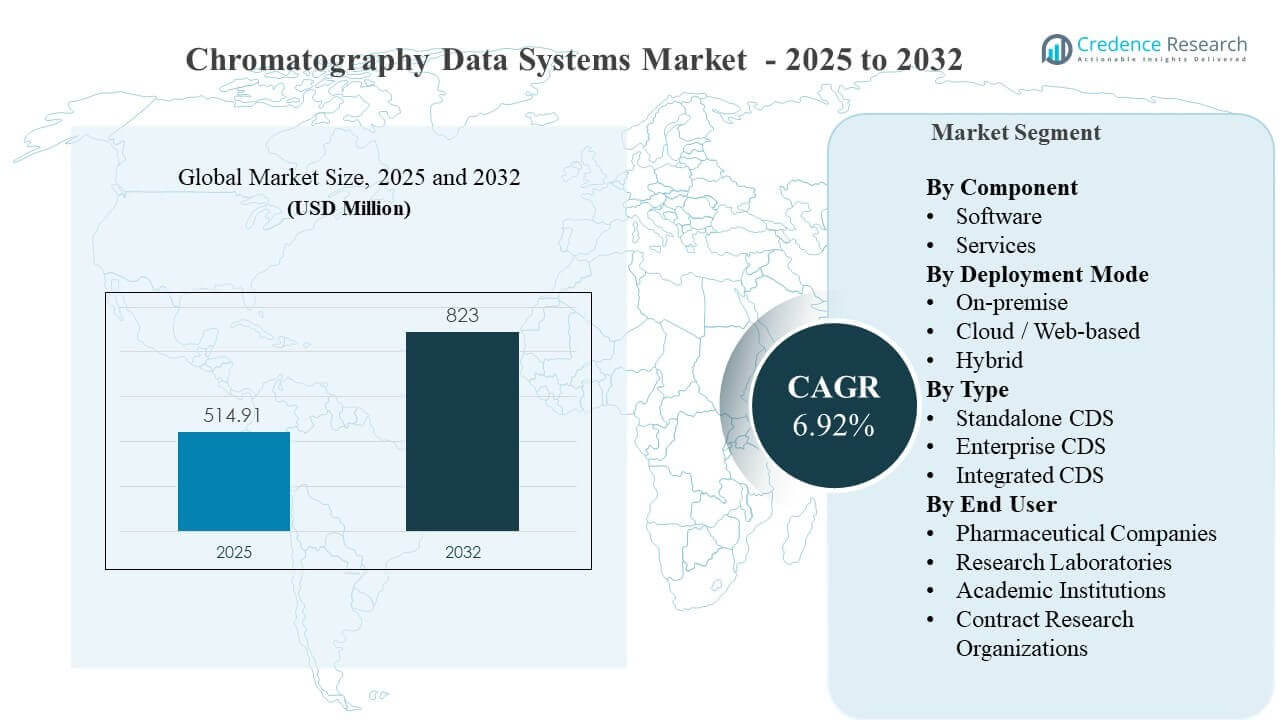
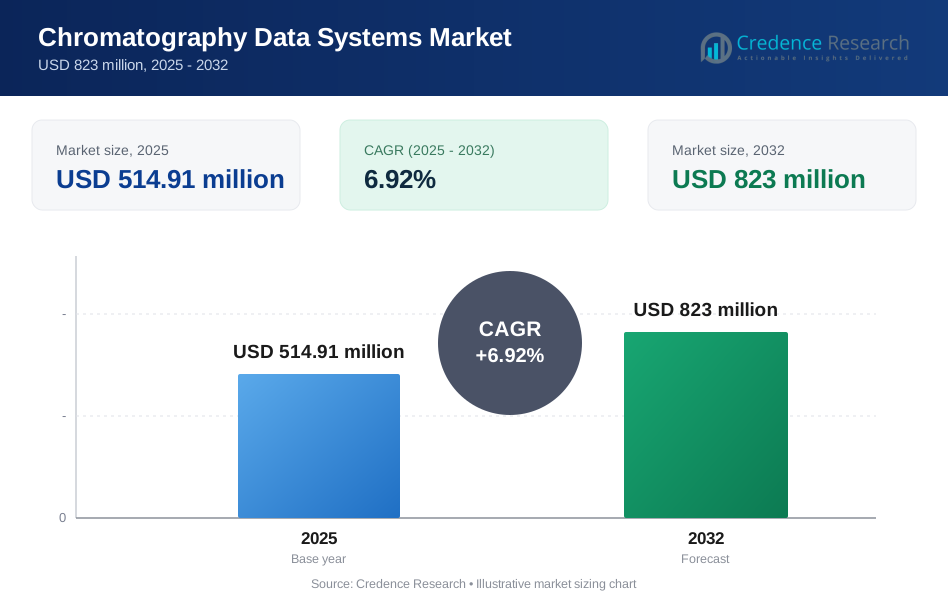
The global Chromatography Data Systems Market size was estimated at USD 514.91 million in 2025 and is expected to reach USD 823 million by 2032, growing at a CAGR of 6.92% from 2025 to 2032. Accelerating compliance pressure around data integrity, audit readiness, and traceable electronic workflows is pushing regulated laboratories to modernize chromatography informatics and standardize methods across instrument fleets. Asia Pacific remains a key expansion engine as new analytical capacity is added across pharmaceutical manufacturing and outsourced testing networks, increasing demand for scalable CDS architectures across multi-site environments.
| REPORT ATTRIBUTE | DETAILS |
|---|---|
| Historical Period | 2020-2024 |
| Base Year | 2025 |
| Forecast Period | 2026-2032 |
| Chromatography Data Systems Market Size 2025 | USD 514.91 million |
| Chromatography Data Systems Market, CAGR | 6.92% |
| Chromatography Data Systems Market Size 2032 | USD 823 million |
Key Market Trends & Insights
- Chromatography Data Systems Market is projected to expand from USD 514.91 million (2025) to USD 823 million (2032).
- Integrated CDS accounted for the largest adjusted share of 53.20% in 2025, reflecting consolidation toward unified workflows and governance.
- On-premise deployment retained the largest adjusted share of 58.70% in 2025, supported by validation rigor and conservative change control.
- Pharmaceutical Companies represented an adjusted 44.10% share in 2025, anchored by GMP-driven QC and analytical development requirements.
- Cloud / Web-based deployment shows strong momentum driven by collaboration and scalable compute needs.
Segment Analysis
Chromatography Data Systems Market demand is increasingly shaped by compliance-first buying behavior, where laboratories prioritize secure audit trails, electronic signatures, and controlled access to ensure inspection readiness. Platform standardization is rising as multi-site organizations seek consistent method management, centralized user administration, and harmonized reporting templates across varied chromatography instrument fleets. Cloud enablement is expanding in parallel, but adoption commonly follows a phased approach that balances innovation with validation, change control, and security requirements in regulated environments.
Chromatography Data Systems Market segmentation indicates that leadership concentrates in architectures that simplify governance, reduce integration burden, and support cross-team collaboration. Integrated platforms benefit from consolidated workflows that minimize manual handoffs and improve traceability from acquisition to reporting. End-user adoption remains strongest in pharmaceutical settings due to the highest compliance intensity and the highest throughput needs, while research and service labs increasingly adopt scalable models to accelerate onboarding and manage variable project volumes.
By Component Insights
Software remains the decision anchor in Chromatography Data Systems Market evaluations because compliance-grade controls, audit readiness, and data integrity safeguards are embedded primarily in the core platform. Services activity expands as deployments scale across sites and instruments, especially when laboratories require qualification support, validation documentation, training, and upgrade governance. Implementation complexity rises when connectivity spans multiple chromatography modalities and peripheral systems such as LIMS or ELN. Standard operating procedures and controlled configuration management sustain recurring service needs after go-live.
By Deployment Mode Insights
On-premise accounted for the largest share of 58.70% in 2025. Regulated laboratories continue to favor local control to align with established validation protocols, security policies, and conservative change management practices. On-premise models also simplify certain audit and qualification workflows where infrastructure ownership is preferred. Cloud / Web-based and hybrid patterns rise when multi-site collaboration, remote review, and centralized analytics become strategic priorities, particularly for organizations operating distributed laboratory networks.
By Type Insights
Integrated CDS accounted for the largest share of 53.20% in 2025. Integrated CDS leadership reflects the operational value of unified acquisition-to-reporting workflows, centralized governance, and standardized methods across instrument fleets. Integrated CDS also reduces fragmentation by limiting the number of interfaces that require validation and ongoing change control. Enterprise-wide configurations improve traceability and enable harmonized reporting, which is critical for method transfer, comparative analytics, and audit preparedness across multiple laboratories.
By End User Insights
Pharmaceutical Companies accounted for the largest share of 44.10% in 2025. Pharmaceutical Companies prioritize CDS platforms that strengthen compliance, ensure data integrity, and support consistent QC execution across high-throughput environments. Method lifecycle management and controlled access become critical where laboratories handle regulated release testing and stability programs. Contract Research Organizations and research laboratories increasingly emphasize scalability and faster onboarding to support variable client workflows, which reinforces interest in modern deployment and integration models.
Chromatography Data Systems Market Drivers
Compliance-led digitization of chromatography workflows
Chromatography Data Systems Market growth is driven by rising data integrity and audit-readiness requirements across regulated laboratories that rely on chromatography as a core analytical method. Laboratories increasingly shift from fragmented tools toward controlled electronic records, audit trails, and standardized reporting to reduce inspection risk. Platform standardization also improves method governance and supports consistent execution across sites. The result is a sustained replacement cycle and incremental upgrades across installed instrument fleets, especially in quality and development labs.
- For instance, Thermo Fisher Scientific states that its Chromeleon 7 CDS was built to address all 19 requirements listed in 21 CFR Part 11 and includes more than 160 configurable privileges for role-based control, alongside up to 3 electronic signoff levels Submit, Review, and Approve showing how vendors are engineering CDS platforms around compliance-ready electronic workflows rather than paper-dependent review models.
Platform consolidation and cross-site standardization
Chromatography Data Systems Market expansion is supported by organizations reducing informatics sprawl and consolidating onto fewer platforms to simplify validation and change control. Unified workflows strengthen traceability from acquisition to approval and reduce operational risk from manual handoffs. Standardization improves method transfer between facilities and accelerates technology transfer programs. Central administration also strengthens role-based access and governance for distributed teams. These benefits drive adoption of integrated and enterprise-grade architectures across multi-lab networks.
Growth in regulated testing throughput and instrument density
Chromatography Data Systems Market demand increases as laboratories expand sample volumes across QC, stability, and analytical development programs. Higher instrument density increases the value of consistent instrument connectivity, templated methods, and streamlined review processes. Operational pressure to reduce cycle time drives adoption of automation features, standardized calculations, and controlled reporting formats. Larger datasets also increase the need for reliable storage, retrieval, and reproducibility. These factors reinforce investment in CDS upgrades across pharmaceutical and contract testing environments.
- For instance, Agilent documents that a standard OpenLab CDS Workstation can support instrument configurations totaling 4 instrument points, while an OpenLab CDS VL Workstation supports 1 instrument with up to 2 instrument points, providing a concrete example of how vendors define scalable architecture around growing instrument density and controlled throughput expansion.
Increasing need for interoperability with digital lab ecosystems
Chromatography Data Systems Market growth is reinforced by integration requirements that connect chromatography workflows with broader lab systems. Laboratories increasingly expect structured data exchange with LIMS, ELN, and quality systems to reduce manual transcription and improve end-to-end traceability. Interoperable platforms reduce error risk and improve review efficiency. Standardized interfaces also simplify multi-vendor instrument environments. As digital lab modernization expands, CDS selection criteria increasingly reward platforms with robust integration options and scalable administration.
Chromatography Data Systems Market Challenges
Chromatography Data Systems Market adoption faces friction from validation burden and change control constraints in regulated environments. CDS migrations require careful planning for method recreation, data retention policies, and audit trail continuity, which can extend deployment timelines. Integration complexity increases when laboratories operate mixed instrument fleets and legacy interfaces. Cybersecurity and access governance also add overhead, especially for distributed environments. These requirements raise total deployment effort and slow decision-making for platform transitions.
Chromatography Data Systems Market growth is also constrained by skills and operational readiness gaps within laboratory IT and informatics teams. Configuration governance, user role management, and periodic upgrades demand sustained administrative capability. Laboratories with limited informatics resources may delay modernization or restrict scope to minimal functionality to reduce operational risk. Multi-site rollouts amplify training and standard operating procedure alignment needs. Budget scrutiny further intensifies when benefits are difficult to quantify against competing lab automation investments.
- For instance, Waters states that Empower Workgroup is limited to 10 users, while Empower Personal workstations and each LAC/E device can bring online only up to 4 chromatographic systems at one time; moving beyond those limits typically requires broader enterprise administration, user management, and rollout planning, which increases the training and governance burden on laboratory informatics teams.
Chromatography Data Systems Market Trends and Opportunities
Chromatography Data Systems Market trends include structured migration toward hybrid architectures that balance local control with centralized collaboration. Hybrid pathways allow laboratories to maintain controlled acquisition environments while enabling remote review, standardized reporting, and cross-site analytics. Subscription packaging creates a lower barrier for small and mid-sized laboratories that prefer predictable operating expense models. Vendor roadmaps increasingly emphasize usability, templated workflows, and improved audit-ready reporting. These trends create opportunities for platforms that simplify governance and accelerate deployment time-to-value.
Chromatography Data Systems Market opportunities also expand as laboratories pursue broader digital transformation initiatives that connect analytical instruments to enterprise quality processes. Strong demand emerges for interoperability features that reduce manual handoffs across LIMS, ELN, and quality management systems. Standardized data models and APIs support multi-vendor environments and improve scalability. Advanced analytics layers that accelerate investigation workflows and exception handling also gain interest. Vendors that deliver compliance-aligned automation and integration-friendly architectures can increase footprint in multi-site organizations.
- For instance, Agilent reports that OpenLab CDS offers more than 20 standard report templates, can generate sequence summary reports for hundreds of samples, and can export outputs in TXT, CSV, PDF, Microsoft Word, and Excel formats for import into LIMS and other systems, which directly supports standardized reporting and lower-manual-handoff workflows in connected lab environments.
Regional Insights
North America
Chromatography Data Systems Market performance in North America remains strong due to high concentration of regulated pharmaceutical and biopharmaceutical laboratories and mature informatics adoption. The adjusted regional share for 2025 is 31.90%, reflecting strong installed chromatography fleets and compliance-driven upgrade cycles. Laboratory standardization programs across multi-site networks increase demand for centralized governance and consistent reporting. Investment in data integrity and audit readiness keeps replacement and upgrade activity steady. Vendor presence and service ecosystems further support adoption depth.
Europe
Chromatography Data Systems Market demand in Europe benefits from stringent regulatory expectations, strong quality infrastructure, and mature pharmaceutical manufacturing and testing networks. The adjusted regional share for 2025 is 26.80%, supported by continued platform standardization and modernization of legacy informatics. Laboratories emphasize validated workflows, controlled user administration, and secure electronic records. Cross-border manufacturing and testing networks increase interest in harmonized methods and consistent review processes. These drivers sustain ongoing CDS replacement and expansion programs.
Asia Pacific
Chromatography Data Systems Market expansion in Asia Pacific is underpinned by rising pharmaceutical production capacity, growing CRO activity, and increasing analytical throughput in expanding laboratory networks. The adjusted regional share for 2025 is 29.60%, reflecting strong momentum from new lab buildouts and modernization programs. Multi-site collaboration needs increase the attractiveness of scalable architectures and standardized workflows. Growing outsourcing activity also increases demand for faster onboarding and repeatable analytical processes. These factors keep adoption intensity high across diverse end users.
Latin America
Chromatography Data Systems Market growth in Latin America is supported by selective expansion in pharmaceutical manufacturing, contract testing, and regulatory modernization efforts. The adjusted regional share for 2025 is 6.40%, reflecting lower overall instrument density and uneven laboratory infrastructure maturity. Adoption is strongest where laboratories prioritize standardized reporting and traceable workflows for regulated submissions. Budget constraints and informatics skill availability influence deployment pace and scope. Vendors that simplify deployment and training can unlock incremental growth.
Middle East & Africa
Chromatography Data Systems Market adoption in Middle East & Africa is led by pockets of advanced laboratory infrastructure, especially in industrial testing and select life-science hubs. The adjusted regional share for 2025 is 5.30%, reflecting uneven penetration across countries and sectors. Laboratories prioritize secure data handling, controlled reporting, and stability in validated workflows. Modernization programs are most active where laboratory networks are expanding and governance is strengthening. Targeted investments in compliance-aligned digitization can lift adoption over time.
Competitive Landscape
Chromatography Data Systems Market competition centers on compliance strength, scalability, and the ability to integrate across diverse chromatography instruments and enterprise lab ecosystems. Vendors compete on audit-ready features, administrative controls, standardized workflows, and deployment flexibility spanning on-premise, hybrid, and cloud-adjacent models. Differentiation also comes from ecosystem depth, including implementation support, validation services, training, and ongoing upgrade governance. Platform consolidation strategies are common as laboratories prefer fewer systems to reduce validation effort and operational complexity.
Thermo Fisher Scientific positioning in Chromatography Data Systems Market emphasizes enterprise-ready governance, broad instrument connectivity, and workflow standardization aligned to regulated laboratory expectations. Thermo Fisher Scientific also benefits from a large installed base across chromatography instrumentation and informatics, which supports integrated deployments and consistent method management. Thermo Fisher Scientific service and support capabilities strengthen qualification, rollout, and controlled upgrade pathways for validated environments. Thermo Fisher Scientific roadmaps typically emphasize usability improvements, harmonized reporting, and scalability for multi-site laboratories.
The industry research and growth report includes detailed analyses of the competitive landscape of the market and information about key companies, including:
- Thermo Fisher Scientific
- Waters Corporation
- Agilent Technologies
- Shimadzu Corporation
- Danaher Corporation
- PerkinElmer
- Bruker Corporation
- Tosoh Bioscience
- KNAUER Wissenschaftliche Geräte
- DataApex
- Gilson
- JASCO
Qualitative and quantitative analysis of companies has been conducted to help clients understand the wider business environment as well as the strengths and weaknesses of key industry players. Data is qualitatively analyzed to categorize companies as pure play, category-focused, industry-focused, and diversified; it is quantitatively analyzed to categorize companies as dominant, leading, strong, tentative, and weak.
Recent Developments
- In April 2026, MilliporeSigma, the U.S. and Canada life science business of Merck KGaA, completed the acquisition of JSR Life Sciences’ chromatography business. The deal added Amsphere Protein A resins and advanced Protein A chromatography capabilities to MilliporeSigma’s downstream processing portfolio, strengthening scalable purification workflows for monoclonal antibody manufacturing.
- In September 2024, Dotmatics announced the acquisition of Virscidian, a provider of analytical chemistry software and automated chromatography and mass spectrometry data processing solutions. Through this acquisition, Dotmatics expanded its ability to automate laboratory data workflows and enhanced its informatics offering for high-throughput purification, sample quality control, and other chromatography-related analytical applications.
- In September 2025, Thermo Fisher Scientific released Chromeleon 7.4, a new feature release of its Chromeleon chromatography data system. The release was listed by Thermo Fisher as the current feature release for Chromeleon 7 CDS, reflecting continued product development in chromatography data system software.
Report Scope
| Report Attribute | Details |
| Market size value in 2025 | USD 514.91 million |
| Revenue forecast in 2032 | USD 823 million |
| Growth rate (CAGR) | 6.92% (2025–2032) |
| Base year | 2025 |
| Forecast period | 2026-2032 |
| Quantitative units | USD million |
| Segments covered | By Component Outlook: Software, Services; By Deployment Mode Outlook: On-premise, Cloud / Web-based, Hybrid; By Type Outlook: Standalone CDS, Enterprise CDS, Integrated CDS; By End User Outlook: Pharmaceutical Companies, Research Laboratories, Academic Institutions, Contract Research Organizations |
| Regional scope | North America, Europe, Asia Pacific, Latin America, Middle East & Africa |
| Key companies profiled | Thermo Fisher Scientific, Waters Corporation, Agilent Technologies, Shimadzu Corporation, Danaher Corporation, PerkinElmer, Bruker Corporation, Tosoh Bioscience, KNAUER Wissenschaftliche Geräte, DataApex, Gilson, JASCO |
| No. of Pages | 328 |
Segmentation
By Component
- Software
- Services
By Deployment Mode
- On-premise
- Cloud / Web-based
- Hybrid
By Type
- Standalone CDS
- Enterprise CDS
- Integrated CDS
By End User
- Pharmaceutical Companies
- Research Laboratories
- Academic Institutions
- Contract Research Organizations
By Region
- North America
- U.S.
- Canada
- Mexico
- Europe
- Germany
- France
- U.K.
- Italy
- Spain
- Rest of Europe
- Asia Pacific
- China
- Japan
- India
- South Korea
- South-east Asia
- Rest of Asia Pacific
- Latin America
- Brazil
- Argentina
- Rest of Latin America
- Middle East & Africa
- GCC Countries
- South Africa
- Rest of the Middle East and Africa
Request a Free Sample
Fill in your details and we'll send you a free sample report.
- Sample data tables & charts
- Research methodology
Need a Custom Version of This Report?
Tailor the scope, geography, or segments to your exact requirements.
- Custom geography or segment scope
- Direct access to our analyst team
Frequently Asked Questions
What is the market size and forecast for Chromatography Data Systems Market?
What is the CAGR for Chromatography Data Systems Market?
What is the largest segment in Chromatography Data Systems Market?
What factors are driving growth in Chromatography Data Systems Market?
Who are the leading companies in Chromatography Data Systems Market?
Which region leads Chromatography Data Systems Market?
Table of Content
Chapter 1. Report Introduction
- 1.1 Report Description & Purpose
- 1.1.1 Report Title & Market Definition
- 1.1.2 Unique Selling Propositions (USP) & Key Differentiators
- 1.1.3 Value Proposition for Stakeholders
- 1.2 Research Objectives
- 1.2.1 Market Sizing Objectives (Volume & Revenue)
- 1.2.2 Segmentation Objectives
- 1.2.3 Competitive Intelligence Objectives
- 1.2.4 Forecast & Scenario Objectives
- 1.3 Report Scope
- 1.3.1 Chromatography Data Systems Scope – Types & Subtypes Covered
- 1.3.2 Geographic Scope – Regions & Countries Covered
- 1.3.3 Historical Period, Base Year & Forecast Period (2025; forecast to 2032)
- 1.3.4 Inclusions & Exclusions
- 1.4 HS Code & Classification Framework
- 1.5 Currency, Units & Pricing Basis
- 1.6 Target Stakeholders
- 1.7 Limitations & Assumptions
Chapter 2. Executive Summary
- 2.1 Global Chromatography Data Systems Market Snapshot
- 2.1.1 Market Size – Historical (2025) & Forecast (2025-2032) (2025: USD 514.91 million → 2032: USD 823 million)
- 2.1.2 Volume & Revenue – Global Totals
- 2.1.3 Key Market Highlights – Top Five Facts
- 2.2 Chromatography Data Systems Market Segmentation Snapshot
- 2.2.1 Market Split by Region – 2025 vs. 2032
- 2.3 Competitive Snapshot
- 2.3.1 Top 10 Players by Revenue Share – 2025
- 2.3.2 Top 10 Players by Volume Share – 2025
- 2.3.3 Recent Strategic Developments (18-Month Summary)
- 2.4 Key Investment Highlights & Strategic Conclusions
Chapter 3. Chromatography Data Systems Market Dynamics & Industry Analysis
- 3.1 Market Overview & Context
- 3.1.1 Chromatography Data Systems Market Position in the Broader Automotive Value Chain
- 3.1.2 OEM vs. Replacement Market Dynamics
- 3.1.3 Market Maturity & Development Stage by Region
- 3.2 Chromatography Data Systems Market Drivers
- 3.3 Chromatography Data Systems Market Restraints & Challenges
- 3.4 Chromatography Data Systems Market Opportunities
- 3.5 Porter's Five Forces Analysis
- 3.5.1 Threat of New Entrants
- 3.5.2 Bargaining Power of Suppliers
- 3.5.3 Bargaining Power of Buyers
- 3.5.4 Threat of Substitutes
- 3.5.5 Competitive Rivalry – Intensity Assessment
- 3.6 Chromatography Data Systems Value Chain Analysis
- 3.6.1 Upstream – Raw Material/Input Suppliers
- 3.6.1.1 Raw Material/Input 1
- 3.6.1.2 Raw Material/Input 2
- 3.6.1.3 Raw Material/Input 3
- 3.6.2 Midstream – Production/Manufacturing/Service Delivery
- 3.6.2.1 Production/Process Overview
- 3.6.2.2 Key Facility Locations & Capacity by Manufacturer
- 3.6.3 Downstream – Distribution & End Consumer
- 3.6.3.1 Primary Channel – B2B/OEM
- 3.6.3.2 Secondary Channels – Dealer, Retail, Online, Direct
- 3.6.4 Value Chain Profitability Analysis
- 3.6.1 Upstream – Raw Material/Input Suppliers
- 3.7 PESTEL Analysis
- 3.7.1 Political Factors
- 3.7.2 Economic Factors
- 3.7.3 Social Factors
- 3.7.4 Technological Factors
- 3.7.5 Environmental Factors
- 3.7.6 Legal Factors
- 3.8 Chromatography Data Systems Supply Chain Analysis
- 3.8.1 Raw Material/Input Supply Risk Assessment
- 3.8.2 Manufacturing Concentration Risk (Geographic Exposure)
- 3.8.3 Trade Disruption Impact Analysis
- 3.9 Regulatory & Policy Landscape
Note: The regulatory and policy landscape section covers regulations based on their applicability to the market, Chromatography Data Systems category, geography, and scope of the study. Only regulatory frameworks with a material impact on operations, compliance, trade, sustainability, or market access are analyzed in detail.
Chapter 4. Key Investment Pockets & Opportunity Analysis
- 4.1 Chromatography Data Systems Market Attractiveness Analysis
- 4.1.1 By Region – Investment Attractiveness Matrix (Volume × CAGR)
- 4.2 Absolute Revenue Growth Opportunity
- 4.2.1 By Region – Absolute USD Growth Through 2032
- 4.3 Incremental Volume Opportunity
- 4.3.1 By Region – Incremental Volume Through 2032
- 4.3.2 Segment – Incremental Volume
- 4.4 Emerging Submarket Opportunity Deep Dive (Subject to Applicability)
- 4.5 Emerging Market Opportunity Scorecards
- 4.5.1 United States
- 4.5.2 Europe
- 4.5.3 Asia
- 4.5.4 Middle East & Africa
Note: Emerging Market Opportunity Scorecards will be included based on relevance and strategic importance. Regions listed are indicative and may vary depending on data availability and market dynamics.
Chapter 5. Chromatography Data Systems Import-Export Analysis & Trade Flows
- 5.1 Global Trade Overview
- 5.1.1 Global Export Value by Country (2025)
- 5.1.2 Global Export Volume by Country (2025)
- 5.1.3 Global Import Value by Country (2025)
- 5.1.4 Global Import Volume by Country (2025)
- 5.1.5 Net Trade Balance by Country (2025)
- 5.2 Export Analysis – Segment
- 5.2.1 Type 1 (HS Code)
- 5.2.2 Type 2 (HS Code)
- 5.2.3 Type 3 (HS Code)
- 5.2.4 Type 4 (HS Code)
- 5.2.5 Type 5 (HS Code)
- 5.3 Import Analysis – Segment
- 5.3.1 Type 1 (HS Code)
- 5.3.2 Type 2 (HS Code)
- 5.3.3 Type 3 (HS Code)
- 5.3.4 Type 4 (HS Code)
- 5.3.5 Type 5 (HS Code)
- 5.4 Average Unit Trade Prices
- 5.4.1 Average Export Price – Segment & Country
- 5.4.2 Average Import Price – Segment & Source Country
- 5.4.3 Price Trends (2025)
- 5.5 Key Trade Route Analysis
- 5.5.1 Trade Route 1
- 5.5.2 Trade Route 2
- 5.5.3 Trade Route 3
- 5.5.4 Trade Route 4
- 5.5.5 Trade Route 5
- 5.6 Trade Policy Impact Assessment
- 5.6.1 US Anti-Dumping & Section 301 Tariffs
- 5.6.2 EU Customs Union Impact
- 5.6.3 Major Free Trade Agreements
- 5.6.4 USMCA Rules of Origin
Note: Trade policy analysis will be included only where relevant to the Chromatography Data Systems market.
Chapter 6. Competitive Landscape & Company Benchmarking
- 6.1 Chromatography Data Systems Market Concentration & Structure
- 6.1.1 Herfindahl-Hirschman Index (HHI) – vs. 2025
- 6.1.2 Tier 1, Tier 2 & Tier 3 Market Structure
- 6.1.3 Global, Regional & Local Player Dynamics
- 6.2 Chromatography Data Systems Market Share Analysis – 2025
- 6.2.1 Global Revenue Share by Company
- 6.2.2 Global Volume Share by Company
- 6.2.3 Regional Revenue Share
- 6.2.4 Market Share Evolution ( vs. 2025)
- 6.2.5 OEM Segment Share by Company
- 6.2.6 Replacement Segment Share by Company
- 6.3 Production/Delivery Capacity & Facility Analysis
- 6.3.1 Global Installed Capacity
- 6.3.2 Capacity Utilization Rates
- 6.3.3 Production/Output Volume
- 6.3.4 Facility Locations & Capacity Map
- 6.3.5 Planned Capacity Additions
- 6.4 Chromatography Data Systems Competitive Benchmarking Matrix
- 6.4.1 Revenue, Volume, CAGR & Profitability Comparison
- 6.4.2 Channel Revenue Mix
- 6.4.3 Geographic Revenue Exposure
- 6.4.4 R&D Intensity
- 6.4.5 Sustainability Maturity
- 6.5 Strategic Developments in Chromatography Data Systems (Last 24 Months)
- 6.5.1 Mergers, Acquisitions & Divestments
- 6.5.2 New Chromatography Data Systems Launches
- 6.5.3 Facility Expansions
- 6.5.4 Strategic Alliances, Joint Ventures & Partnerships
- 6.5.5 Distribution Expansion & Market Entry
- 6.5.6 Sustainability & ESG Initiatives
- 6.6 Competitive Strategy Mapping
- 6.6.1 Leader, Challenger, Follower & Niche Classification
- 6.6.2 Pricing Strategy Comparison
- 6.6.3 Channel Strategy Matrix
Note: Strategic developments are included based on their materiality and the availability of reliable information.
Chapter 7. Global Chromatography Data Systems Market – By Distribution Channel
- 7.1 Segment Overview
- 7.1.1 Volume & Revenue Split by Channel (2025 & 2032)
- 7.1.2 Channel Mix Evolution (2025-2032)
Chapter 8. Regional Market Analysis – Global Overview
- 8.1 Global Regional Overview
- 8.1.1 Regional Volume Share
- 8.1.2 Regional Revenue Share
- 8.1.3 Regional Volume by Region
- 8.1.4 Regional Revenue by Region
- 8.1.5 Regional Forecast Through 2032
- 8.2 Cross-Regional Segment Analysis
- 8.2.1 By Distribution Channel
- 8.2.2 By Brand/Price Tier
Chapter 9. North America Chromatography Data Systems Market
- 9.1 United States
- 9.2 Canada
- 9.3 Mexico
Chapter 10. Europe Chromatography Data Systems Market
- 10.1 Germany
- 10.2 France
- 10.3 Italy
- 10.4 United Kingdom
- 10.5 Spain
- 10.6 Poland
- 10.7 Russia
- 10.8 Netherlands
- 10.9 Belgium
- 10.10 Sweden
- 10.11 Denmark
- 10.12 Norway
- 10.13 Rest of Europe
Chapter 11. Asia Pacific Chromatography Data Systems Market
- 11.1 China
- 11.2 India
- 11.3 Japan
- 11.4 South Korea
- 11.5 Thailand
- 11.6 Indonesia
- 11.7 Vietnam
- 11.8 Malaysia
- 11.9 Australia
- 11.10 Rest of Asia Pacific
Chapter 12. Latin America Chromatography Data Systems Market
- 12.1 Brazil
- 12.2 Argentina
- 12.3 Colombia
- 12.4 Chile
- 12.5 Rest of Latin America
Chapter 13. Middle East Chromatography Data Systems Market
- 13.1 Saudi Arabia
- 13.2 United Arab Emirates
- 13.3 Turkey
- 13.4 Israel
- 13.5 Iran
- 13.6 Rest of the Middle East
Chapter 14. Africa Chromatography Data Systems Market
- 14.1 South Africa
- 14.2 Egypt
- 14.3 Nigeria
- 14.4 Morocco
- 14.5 Rest of Africa
Chapter 15. Chromatography Data Systems Company Profiles
- 15.1 [Company 01]
- 15.1.1 Company Overview
- 15.1.2 Key Management Personnel
- 15.1.3 Products & Services Portfolio
- 15.1.4 Financial Performance
- 15.1.5 Key Market Focus & Geographic Presence
- 15.1.6 Recent Developments & Strategic Initiatives
Note: The company profile list is preliminary and may change based on research findings, market developments, data availability, and client requirements.
Chapter 16. Appendices
- Appendix A – List of Abbreviations & Acronyms
- Appendix B – Industry Classification Code Reference – Full Series
- Appendix C – Production & Capacity Data Tables
- Appendix D – End-Use & Demand Base Tables
- Appendix E – Consumption & Replacement Rate Assumptions
- Appendix F – ASP Reference Tables
- Appendix G – Manufacturing & Facility Database
- Appendix H – Import-Export Data Tables
- Appendix I – Regulatory Summary Tables
- Appendix J – Primary Research Participant List (Anonymized)
- Appendix K – Primary Research Questionnaire Framework
- Appendix L – Data Sources & Bibliography
- Appendix M – Market Size Divergence & Source Comparison
Chapter 17. Research Methodology
- 17.1 Research Framework & Philosophy
- 17.2 Secondary Research – Sources, Hierarchy & Data Extraction
- 17.3 Data Modeling – Bottom-Up & Top-Down Market Sizing
- 17.4 Primary Research – Stakeholder Framework, LOI & Sample Sizes
- 17.5 Forecast Methodology – Regression, Scenario & Sensitivity Analysis
- 17.6 Quality Control – Four-Layer Validation Framework
- 17.7 Limitations & Standard Assumptions
- 17.8 Disclaimer
