
| REPORT ATTRIBUTE | DETAILS |
|---|---|
| Historical Period | 2020-2023 |
| Base Year | 2024 |
| Forecast Period | 2025-2032 |
| Conference Room Solutions Market Size 2024 | USD 1533.9 Million |
| Conference Room Solutions Market, CAGR | 14.8% |
| Conference Room Solutions Market Size 2032 | USD 4627.34 Million |
Market Overview
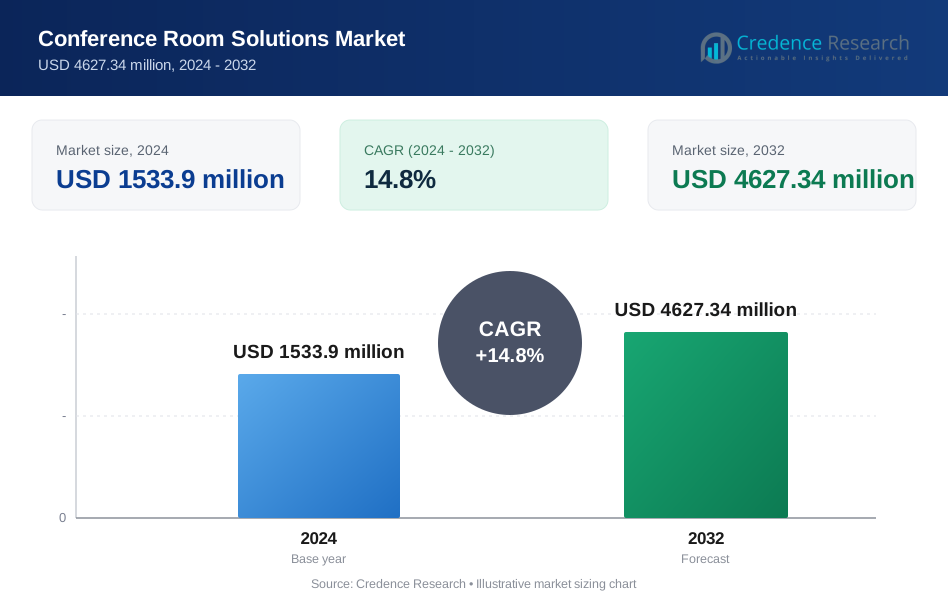
The Conference Room Solutions Market is expected to grow from USD 1533.9 million in 2024 to USD 4627.34 million by 2032, with a compound annual growth rate (CAGR) of 14.8%.
The Conference Room Solutions Market is driven by increasing demand for seamless, high-quality communication solutions across businesses. As organizations continue to adopt remote and hybrid work models, the need for efficient collaboration tools and advanced conferencing technologies has surged. The market is also influenced by the growing trend of integrating artificial intelligence (AI) and cloud-based solutions, enabling enhanced functionality and scalability. Furthermore, the rising adoption of video conferencing, interactive displays, and real-time collaboration tools is fueling market expansion. The shift towards smarter, more flexible conference rooms, supported by advanced automation systems, is another key trend. Additionally, the integration of advanced audio-visual equipment and 5G connectivity is improving user experience and enabling more dynamic interactions. These drivers, along with the increasing focus on reducing travel expenses and carbon footprints, are set to accelerate the growth of the Conference Room Solutions Market in the coming years.
The Conference Room Solutions Market is experiencing significant growth across various regions, with North America leading at a 40% market share in 2024, driven by high adoption rates and technological advancements. Europe follows with a 25% share, fueled by digital transformation and hybrid work models. The Asia Pacific region, holding 20% of the market, is rapidly expanding due to increasing digitalization, particularly in countries like China, India, and Japan. Latin America and the Middle East & Africa contribute 15% to the market, with governments and businesses focusing on digital infrastructure. Key players such as Samsung, Shure, Crestron, Logitech, Microsoft, Cisco, Huawei, Sony, Yamaha, and Barco are well-positioned to capitalize on these regional opportunities by offering innovative conferencing solutions tailored to diverse market needs.
Market Insights
- The Conference Room Solutions Market is projected to grow from USD 1533.9 million in 2024 to USD 4627.34 million by 2032, at a CAGR of 14.8%.
- Increasing adoption of remote and hybrid work models is driving the demand for advanced conferencing technologies and collaboration tools.
- The integration of AI and cloud-based solutions enhances functionality, scalability, and user experience in conference room setups.
- Growing demand for interactive and collaborative tools, such as touchscreen displays and real-time document sharing, is transforming traditional meetings into dynamic sessions.
- A focus on cost-effective, sustainable solutions is pushing businesses to invest in energy-efficient technologies, reducing travel costs and carbon footprints.
- North America leads the market with a 40% share in 2024, driven by high adoption rates and technological advancements across various sectors.
- Asia Pacific is experiencing rapid growth, holding a 20% market share in 2024, due to increased digitalization and hybrid work adoption in countries like China, India, and Japan.
Market Drivers
Increasing Adoption of Remote and Hybrid Work Models
The shift toward remote and hybrid work models is one of the primary drivers of the Conference Room Solutions Market. As businesses embrace flexible work arrangements, the need for efficient and high-quality communication tools has risen dramatically. Virtual meetings, collaboration platforms, and video conferencing have become integral to daily operations, driving demand for advanced conference room solutions that facilitate seamless remote interactions and foster team collaboration. For instance, Microsoft Teams has become a key tool for businesses embracing hybrid work models, providing seamless virtual meeting and collaboration capabilities. This trend is expected to continue growing as companies recognize the long-term benefits of hybrid work environments.
Integration of Artificial Intelligence and Cloud-Based Technologies
Another key driver is the growing integration of Artificial Intelligence (AI) and cloud-based technologies into conference room solutions. AI-enabled features, such as real-time transcription, automated meeting scheduling, and intelligent meeting assistants, enhance the efficiency and functionality of conference rooms. For example, Zoom's AI-driven features like real-time transcription and automated meeting scheduling improve conference room efficiency. Furthermore, cloud-based solutions allow for easier access, scalability, and integration with other business applications, making it easier for organizations to manage their conferencing needs. These technologies enhance user experience and support the evolving demands of businesses in the digital age.
Rising Demand for Interactive and Collaborative Tools
There is an increasing demand for interactive and collaborative tools in conference rooms. Technologies such as interactive whiteboards, touchscreen displays, and real-time document sharing have transformed traditional meetings into dynamic collaboration sessions. For instance, Google Jamboard provides an interactive whiteboard experience, facilitating real-time collaboration and brainstorming. These tools enhance productivity, facilitate brainstorming, and support efficient decision-making. As businesses seek more engaging ways to conduct meetings, the demand for these advanced tools continues to grow, driving innovation in the conference room solutions market.
Focus on Cost-Effective Solutions and Sustainability
Organizations are increasingly focused on cost-effective solutions and sustainability, further propelling the demand for advanced conference room technologies. By reducing travel costs, promoting virtual collaboration, and utilizing energy-efficient solutions, companies are not only saving money but also reducing their carbon footprint. For example, Cisco Webex offers virtual collaboration tools that help reduce the need for business travel, promoting sustainability. This growing focus on sustainability aligns with the broader corporate responsibility trends, making conference room solutions an essential component of modern business strategy. As a result, businesses are increasingly investing in high-performance, cost-effective solutions to optimize their operations.
Market Trends
Rise of Hybrid Work Environments
The continued adoption of hybrid work models is a major trend shaping the Conference Room Solutions Market. With employees working both remotely and in-office, businesses are investing in technology that supports seamless communication across locations. Hybrid work environments demand advanced conferencing tools that integrate video conferencing, screen sharing, and collaboration features to ensure productivity remains high regardless of physical presence. For instance, Cisco Webex offers comprehensive conferencing tools that cater to both in-office and remote participants, ensuring inclusivity and flexibility. This trend has led to the development of more versatile conference room solutions that cater to both in-office and remote participants, ensuring inclusivity and flexibility.
Integration of AI and Automation
Artificial Intelligence (AI) and automation are increasingly integrated into conference room solutions. AI-driven features such as voice recognition, automatic meeting transcription, and intelligent scheduling systems are revolutionizing the way meetings are conducted. Automated systems can also control lighting, temperature, and video settings, creating an optimized environment for collaboration with minimal manual input. For example, Microsoft Teams uses AI-driven features like real-time transcription and intelligent meeting assistants to streamline operations and enhance the user experience. This integration enhances the user experience, streamlines operations, and improves meeting outcomes, making it a significant trend in the market.
Advanced Audio-Visual Systems
Another trend gaining traction is the enhancement of audio-visual (AV) systems in conference rooms. As the quality of video conferencing becomes more critical to business success, there is a greater emphasis on high-definition displays, immersive audio systems, and noise-canceling technologies. Businesses are increasingly investing in AV equipment that ensures clear, professional presentations and smooth communication. For instance, Logitech's high-definition displays and immersive audio systems are designed to enhance video conferencing quality and ensure clear communication. The growing demand for high-quality AV solutions is influencing manufacturers to develop state-of-the-art conference room technologies that meet evolving business needs.
Cloud-Based and Scalable Solutions
Cloud-based conference room solutions are becoming increasingly popular due to their scalability and ease of access. Cloud technology enables organizations to manage and access their conferencing tools from any location, facilitating collaboration and improving overall productivity. These solutions offer flexibility, allowing businesses to scale their operations without the need for expensive on-site infrastructure. For example, Zoom offers cloud-based conferencing solutions that allow businesses to manage and access their tools from any location, enhancing collaboration and productivity. As cloud-based solutions continue to evolve, they are expected to play a crucial role in shaping the future of conference room technology.
Market Challenges Analysis
Integration and Compatibility Issues
One of the key challenges in the Conference Room Solutions Market is the integration and compatibility of various technologies. Many businesses use a mix of conferencing solutions, hardware, and software from different providers, leading to potential compatibility issues when trying to integrate new systems into existing infrastructures. Conference room solutions often require seamless interaction between video conferencing tools, AV equipment, collaboration platforms, and cloud systems. However, achieving this integration can be complex and time-consuming. Businesses may encounter difficulties when aligning new conference room technologies with legacy systems, which can result in inefficiencies, increased costs, and disrupted operations. Ensuring that new solutions are compatible with existing setups is a significant challenge for organizations looking to adopt advanced conferencing technologies while maintaining operational continuity across their teams and locations.
High Costs of Implementation and Maintenance
The cost of implementing and maintaining advanced conference room solutions presents another challenge for businesses. While these solutions can provide substantial benefits in terms of improved collaboration and productivity, the initial investment in hardware, software, and professional installation can be prohibitively expensive, particularly for small to medium-sized businesses. Additionally, ongoing maintenance, updates, and support for these technologies can add to the overall costs. Many organizations are hesitant to invest in high-end conference room solutions due to concerns over the total cost of ownership. This can limit market growth, as some businesses may opt for less expensive, lower-quality alternatives or delay upgrades to their conferencing infrastructure. Balancing the cost of technology with the need for enhanced communication capabilities remains a significant hurdle in the market, making it essential for providers to offer more cost-effective solutions that cater to diverse business needs.
Market Opportunities
The Conference Room Solutions Market presents significant opportunities driven by the growing demand for advanced, flexible, and scalable communication tools. As businesses continue to embrace hybrid and remote work models, there is an increasing need for conference room solutions that enable seamless collaboration between in-office and remote teams. This shift has created a substantial opportunity for providers to offer integrated solutions that include high-quality video conferencing, cloud-based collaboration tools, and interactive displays. Companies are seeking solutions that can be easily adapted to different environments, from small meeting rooms to large conference halls, providing an expansive growth potential for providers that can offer versatile and user-friendly systems. Additionally, the trend towards smarter conference rooms, enhanced by automation, AI-driven features, and real-time data analytics, presents a further opportunity to enhance user experience and efficiency.
Moreover, the increasing focus on sustainability and cost-efficiency within businesses presents an opportunity for conference room solution providers to innovate in terms of energy-efficient technologies and cost-effective systems. Companies are looking for solutions that not only improve collaboration but also reduce costs associated with travel, energy consumption, and maintenance. The development of cloud-based and subscription-based models further supports this trend, as businesses can scale their conference room solutions without significant upfront investments. As organizations continue to prioritize seamless communication, cost savings, and sustainable practices, the market is primed for the development of advanced, integrated solutions that cater to evolving business needs, offering numerous opportunities for market growth and innovation.
Market Segmentation Analysis:
By Solution Type
The Conference Room Solutions Market can be segmented based on solution type, which includes video conferencing systems, audio conferencing solutions, collaboration software, and display solutions. Video conferencing systems dominate the market, driven by increasing demand for remote communication. Audio conferencing solutions are gaining traction in sectors with limited video needs, while collaboration software and display technologies complement overall conference room functionality.
By Deployment Mode
The market is also segmented by deployment mode, with cloud-based and on-premise solutions being the primary categories. Cloud-based solutions are rapidly growing due to their scalability, flexibility, and cost-effectiveness, allowing businesses to implement conferencing systems without heavy upfront investments. On-premise solutions, however, remain preferred by large organizations with specific security requirements or control over their IT infrastructure, providing a more stable, long-term deployment.
By Application
Conference room solutions cater to various industries, including corporate, educational, healthcare, and government sectors. The corporate sector holds the largest share, driven by the widespread adoption of hybrid work models and remote collaboration. In education and healthcare, these solutions facilitate distance learning and telemedicine, while government applications focus on secure, high-quality communication for operations and decision-making.
Segments:
Based on Solution Type
- Video Conferencing
- Audio Conferencing
- Unified Communications
- Collaboration Tools
Based on Deployment Mode
- Cloud-based
- On-premises
- Hybrid
Based on Application
- Business Meetings
- Training and Development
- Customer Support
- Remote Collaboration
Based on End-User
- Healthcare
- Financial Services
- Education
- Information Technology
Based on Enterprise Size
- Large Enterprises
- Small and Medium-sized Enterprises (SMEs)
Based on the Geography:
- North America
- U.S.
- Canada
- Mexico
- Europe
- Germany
- France
- U.K.
- Italy
- Spain
- Rest of Europe
- Asia Pacific
- China
- Japan
- India
- South Korea
- South-east Asia
- Rest of Asia Pacific
- Latin America
- Brazil
- Argentina
- Rest of Latin America
- Middle East & Africa
- GCC Countries
- South Africa
- Rest of the Middle East and Africa
Regional Analysis
North America
North America holds the largest market share in the Conference Room Solutions Market, accounting for 40% in 2024. The region’s strong market position is primarily driven by the high adoption of advanced conferencing solutions by businesses across various sectors, including corporate, education, healthcare, and government. The ongoing shift to hybrid and remote work models has accelerated demand for seamless communication technologies. The presence of major technology companies and a well-established infrastructure for cloud-based and AI-powered solutions further supports market growth in the region. Additionally, large enterprises in North America are increasingly investing in advanced video conferencing systems, smart collaboration tools, and high-quality AV equipment to facilitate better communication and collaboration.
Europe
Europe holds a significant market share of 25% in 2024. The demand for conference room solutions in this region is driven by the rapid digital transformation of businesses and organizations. Key countries like the UK, Germany, and France are witnessing substantial investments in collaborative technologies due to the growing adoption of hybrid work models. Europe’s focus on sustainability also plays a role in the market’s growth, as companies seek cost-effective, energy-efficient conferencing solutions. Additionally, the education and healthcare sectors are increasingly using these solutions to support remote learning and telemedicine, driving further growth in the region.
Asia Pacific
Asia Pacific is emerging as a rapidly growing region, holding a market share of 20% in 2024. The region’s increasing digitalization, coupled with the expansion of small to medium-sized businesses adopting advanced conference room technologies, contributes to this growth. Countries like China, India, and Japan are making significant strides in the adoption of video conferencing and collaboration software, driven by the need for better communication across vast geographical areas. The rise of hybrid work practices, especially in IT and tech sectors, has further fueled demand for scalable, cost-efficient conferencing solutions. Moreover, government initiatives in these countries to enhance digital infrastructure are providing opportunities for market expansion.
Latin America & Middle East & Africa
Latin America and the Middle East & Africa (MEA) together account for 15% of the market share in 2024. In Latin America, demand for conference room solutions is being driven by the growing adoption of cloud-based technologies, especially in Brazil and Mexico, where businesses are increasingly adopting remote and hybrid work practices. In the MEA region, the market is expanding as governments and businesses invest in digital transformation. The rising trend of video conferencing and collaborative workspaces in the UAE and Saudi Arabia is accelerating market growth. However, these regions are experiencing slower adoption compared to North America and Europe, mainly due to lower technology penetration and infrastructure challenges.
Key Player Analysis
- Shure
- Cisco
- Barco
- Sony
- Crestron
- Logitech
- Huawei
- Samsung
- Yamaha
- Microsoft
Competitive Analysis
The Conference Room Solutions Market is highly competitive, with major players focusing on innovation and strategic partnerships to maintain their market position. Leading players like Samsung, Shure, Crestron, Logitech, Microsoft, Cisco, Huawei, Sony, Yamaha, and Barco are continually enhancing their product portfolios to meet the growing demand for advanced collaboration and communication technologies. These companies are investing in AI-driven solutions, cloud-based systems, and high-quality audio-visual technologies to provide seamless, scalable, and cost-effective conferencing solutions. For example, Samsung's conference room solutions combine high-definition displays with advanced audio-visual technology to create immersive meeting experiences. Samsung, Cisco, and Microsoft lead in offering integrated hardware and software solutions, while Logitech and Crestron are known for their interactive conference room equipment. Companies like Shure and Yamaha specialize in audio solutions, ensuring clear and effective communication. With the increasing trend towards hybrid work, these players are also expanding their offerings to address the specific needs of remote and in-office collaboration, gaining a competitive edge in this dynamic market.
Recent Developments
- In April 2023, Biamp announced the release of new bundle offerings for small conference rooms, designed to help organizations streamline the purchasing and installation process. These bundles provide an entire system in a box, featuring a single hardware solution that ensures end-user transparency.
- In April 2023, ClearOne unveiled enhancements aimed at improving meeting room performance and ease of use. The updates included the BMA 360 microphones, the CONVERGE Pro 2 (CP2) family of digital signal processing mixers (DSPs), and the intuitive CONSOLE AI implementation software.
- In 2023, WolfVision introduced a new BYOM (Bring Your Own Meeting) web-based conference feature for its Cynap systems. This updated feature, which is available for free with the latest firmware revision v1.58 for Cynap Pure models and above, is easy to access.
- In November 2024, Poly expanded its Studio X Series by introducing new models with enhanced video and audio capabilities, offering compatibility with multiple conferencing platforms.
Market Concentration & Characteristics
The Conference Room Solutions Market exhibits a moderately concentrated structure, with a few major players holding a significant share of the market. Leading companies such as Samsung, Cisco, Microsoft, Logitech, and Crestron dominate, leveraging their technological expertise and global reach to offer comprehensive solutions. These key players are actively investing in product innovation, AI integration, and cloud-based technologies to enhance their offerings and maintain a competitive edge. Despite the dominance of established brands, the market is characterized by ongoing innovation and increasing competition from smaller, niche players offering specialized solutions. As businesses demand more flexible, scalable, and cost-efficient conference room technologies, the market is seeing a shift towards smarter, AI-driven, and automated solutions. The growing focus on sustainability, energy efficiency, and hybrid work models is also shaping market dynamics, encouraging players to offer more integrated, user-friendly solutions tailored to the evolving needs of modern organizations.
Report Coverage
The research report offers an in-depth analysis based on Solution Type, Deploymnet Mode, Application, Enterprise Size, End-User and Geography. It details leading market players, providing an overview of their business, product offerings, investments, revenue streams, and key applications. Additionally, the report includes insights into the competitive environment, SWOT analysis, current market trends, as well as the primary drivers and constraints. Furthermore, it discusses various factors that have driven market expansion in recent years. The report also explores market dynamics, regulatory scenarios, and technological advancements that are shaping the industry. It assesses the impact of external factors and global economic changes on market growth. Lastly, it provides strategic recommendations for new entrants and established companies to navigate the complexities of the market.
Future Outlook
- The Conference Room Solutions Market is expected to see significant growth driven by the increasing adoption of hybrid and remote work models.
- AI-powered features, such as intelligent meeting assistants and real-time transcription, will play a crucial role in enhancing conference room functionality.
- Cloud-based conferencing solutions will continue to gain traction due to their scalability and ease of integration with other business applications.
- Video conferencing systems, interactive displays, and real-time collaboration tools will remain in high demand, facilitating more dynamic meetings.
- The focus on sustainability will drive the adoption of energy-efficient, cost-effective conference room technologies.
- Integration with 5G networks will improve connectivity and enhance the overall user experience during virtual meetings.
- Small to medium-sized businesses are expected to increasingly adopt advanced conferencing solutions as costs become more accessible.
- The demand for smarter, automated conference rooms will rise, offering greater flexibility and enhanced productivity.
- Regional markets, particularly in Asia Pacific, will witness rapid expansion due to increasing digitalization.
- The competitive landscape will continue to evolve, with established players and new entrants offering innovative solutions to meet diverse business needs.
Request a Free Sample
Fill in your details and we'll send you a free sample report.
- Sample data tables & charts
- Research methodology
Need a Custom Version of This Report?
Tailor the scope, geography, or segments to your exact requirements.
- Custom geography or segment scope
- Direct access to our analyst team
Frequently Asked Questions
What is the current size of the Conference Room Solutions Market?
What factors are driving the growth of the Conference Room Solutions Market?
What are the key segments within the Conference Room Solutions Market?
What are some challenges faced by the Conference Room Solutions Market?
Who are the major players in the Conference Room Solutions Market?
Table of Content
Chapter 1. Report Introduction
- 1.1 Report Description & Purpose
- 1.1.1 Report Title & Market Definition
- 1.1.2 Unique Selling Propositions (USP) & Key Differentiators
- 1.1.3 Value Proposition for Stakeholders
- 1.2 Research Objectives
- 1.2.1 Market Sizing Objectives (Volume & Revenue) (Volume Where Applicable)
- 1.2.2 Segmentation Objectives
- 1.2.3 Competitive Intelligence Objectives
- 1.2.4 Forecast & Scenario Objectives
- 1.3 Report Scope
- 1.3.1 Conference Room Solutions Scope – Segments & Subsegments Covered
- 1.3.2 Geographic Scope – Regions & Countries Covered
- 1.3.3 Historical Period, Base Year & Forecast Period (2024; forecast to 2032)
- 1.3.4 Inclusions & Exclusions
- 1.4 Industry Classification & Applicable Codes
- 1.5 Currency, Measurement Units & Valuation Basis
- 1.6 Target Stakeholders
- 1.7 Limitations & Assumptions
Chapter 2. Executive Summary
- 2.1 Global Conference Room Solutions Market Snapshot
- 2.1.1 Market Size – Historical (2024) & Forecast (2024-2032) (2024: USD 1533.9 million → 2032: USD 4627.34 million)
- 2.1.2 Volume & Revenue – Global Totals (Volume Where Applicable)
- 2.1.3 Key Market Highlights – Top Five Facts
- 2.2 Conference Room Solutions Market Segmentation Snapshot
- 2.2.1 Market Split by Region – 2024 vs. 2032
- 2.3 Competitive Snapshot
- 2.3.1 Top 10 Players by Revenue Share – 2024
- 2.3.2 Top 10 Players by Volume Share – 2024 (Volume Where Applicable)
- 2.3.3 Recent Strategic Developments (18-Month Summary)
- 2.4 Key Investment Highlights & Strategic Conclusions
Chapter 3. Conference Room Solutions Market Dynamics & Industry Analysis
- 3.1 Market Overview & Context
- 3.1.1 Conference Room Solutions Market Position in the Broader Industry Value Chain
- 3.1.2 Demand Structure & Purchasing Dynamics
- 3.1.3 Market Maturity & Development Stage by Region
- 3.2 Conference Room Solutions Market Drivers
- 3.3 Conference Room Solutions Market Restraints & Challenges
- 3.4 Conference Room Solutions Market Opportunities
- 3.5 Porter's Five Forces Analysis
- 3.5.1 Threat of New Entrants
- 3.5.2 Bargaining Power of Suppliers
- 3.5.3 Bargaining Power of Buyers
- 3.5.4 Threat of Substitutes
- 3.5.5 Competitive Rivalry – Intensity Assessment
- 3.6 Conference Room Solutions Value Chain Analysis
- 3.6.1 Upstream – Key Inputs, Resources & Suppliers
- 3.6.1.1 Key Input/Resource 1
- 3.6.1.2 Key Input/Resource 2
- 3.6.1.3 Key Input/Resource 3
- 3.6.2 Midstream – Core Operations & Value Creation
- 3.6.2.1 Operating Model & Process Overview
- 3.6.2.2 Key Operating Locations & Capabilities by Company
- 3.6.3 Downstream – Market Channels & End Users
- 3.6.3.1 Direct Sales & Customer Engagement Channels
- 3.6.3.2 Indirect Sales, Intermediaries & Partner Channels
- 3.6.4 Value Chain Profitability Analysis
- 3.6.1 Upstream – Key Inputs, Resources & Suppliers
- 3.7 PESTEL Analysis
- 3.7.1 Political Factors
- 3.7.2 Economic Factors
- 3.7.3 Social Factors
- 3.7.4 Technological Factors
- 3.7.5 Environmental Factors
- 3.7.6 Legal Factors
- 3.8 Conference Room Solutions Supply Chain Analysis
- 3.8.1 Critical Input & Resource Availability Risk Assessment
- 3.8.2 Supplier & Operational Concentration Risk (Geographic Exposure)
- 3.8.3 Supply & Service Disruption Impact Analysis
- 3.9 Regulatory & Policy Landscape
Note: The regulatory and policy landscape section covers regulations based on their applicability to the market, Conference Room Solutions category, geography, and scope of the study. Only regulatory frameworks with a material impact on operations, compliance, trade, sustainability, or market access are analyzed in detail.
Chapter 4. Key Investment Pockets & Opportunity Analysis
- 4.1 Conference Room Solutions Market Attractiveness Analysis
- 4.1.1 By Region – Investment Attractiveness Matrix (Market Size × CAGR)
- 4.2 Absolute Revenue Growth Opportunity
- 4.2.1 By Region – Absolute Revenue Growth Through 2032
- 4.3 Incremental Demand Opportunity
- 4.3.1 By Region – Incremental Demand Through 2032
- 4.3.2 Segment – Incremental Demand
- 4.4 Emerging Submarket Opportunity Deep Dive (Subject to Applicability)
- 4.5 Priority Market Opportunity Scorecards
- 4.5.1 United States
- 4.5.2 Europe
- 4.5.3 Asia
- 4.5.4 Middle East & Africa
Note: Priority market opportunity scorecards reflect the geographic scope and strategic relevance of the study. Listed markets are indicative and may be adapted to the industry.
Chapter 5. Conference Room Solutions Cross-Border Trade & Market Access Analysis
- 5.1 International Trade & Cross-Border Activity Overview
- 5.1.1 Global Export Value by Country (2024)
- 5.1.2 Global Export Volume by Country (2024) (Volume Where Applicable)
- 5.1.3 Global Import Value by Country (2024)
- 5.1.4 Global Import Volume by Country (2024) (Volume Where Applicable)
- 5.1.5 Net Trade Balance by Country (2024)
- 5.2 Export Analysis – Segment
- 5.2.1 Category 1 (Applicable Classification Code)
- 5.2.2 Category 2 (Applicable Classification Code)
- 5.2.3 Category 3 (Applicable Classification Code)
- 5.2.4 Category 4 (Applicable Classification Code)
- 5.2.5 Category 5 (Applicable Classification Code)
- 5.3 Import Analysis – Segment
- 5.3.1 Category 1 (Applicable Classification Code)
- 5.3.2 Category 2 (Applicable Classification Code)
- 5.3.3 Category 3 (Applicable Classification Code)
- 5.3.4 Category 4 (Applicable Classification Code)
- 5.3.5 Category 5 (Applicable Classification Code)
- 5.4 Cross-Border Pricing & Transaction Benchmarks
- 5.4.1 Export Pricing – Segment & Country
- 5.4.2 Import Pricing – Segment & Source Country
- 5.4.3 Price Trends (2024)
- 5.5 Key Cross-Border Trade & Delivery Routes
- 5.5.1 Cross-Border Trade/Delivery Route 1
- 5.5.2 Cross-Border Trade/Delivery Route 2
- 5.5.3 Cross-Border Trade/Delivery Route 3
- 5.5.4 Cross-Border Trade/Delivery Route 4
- 5.5.5 Cross-Border Trade/Delivery Route 5
- 5.6 Trade Policy & Market Access Impact Assessment
- 5.6.1 Tariff & Non-Tariff Barriers
- 5.6.2 Regional Trade & Economic Integration Frameworks
- 5.6.3 Bilateral & Multilateral Trade Agreements
- 5.6.4 Cross-Border Operating, Licensing & Localization Requirements
Note: This chapter applies where cross-border trade or delivery is relevant to Conference Room Solutions. Goods, services, and digital offerings are assessed using applicable classifications and transaction measures. Import-export volumes, trade balances, and route analyses are included only where meaningful to the market.
Chapter 6. Competitive Landscape & Company Benchmarking
- 6.1 Conference Room Solutions Market Concentration & Structure
- 6.1.1 Herfindahl-Hirschman Index (HHI) – vs. 2024
- 6.1.2 Leading, Mid-Sized & Emerging Player Structure
- 6.1.3 Global, Regional & Local Player Dynamics
- 6.2 Conference Room Solutions Market Share Analysis – 2024
- 6.2.1 Global Revenue Share by Company
- 6.2.2 Global Volume Share by Company (Volume Where Applicable)
- 6.2.3 Regional Revenue Share
- 6.2.4 Market Share Evolution ( vs. 2024)
- 6.2.5 Company Market Share by Key Segment
- 6.2.6 Company Market Share by Customer Group
- 6.3 Operating Scale, Capacity & Infrastructure Analysis
- 6.3.1 Global Operating Scale & Supply Capacity
- 6.3.2 Resource Utilization & Operating Efficiency
- 6.3.3 Output, Service Delivery & Activity Metrics
- 6.3.4 Operating Footprint & Infrastructure Map
- 6.3.5 Planned Operational & Capacity Expansion
- 6.4 Conference Room Solutions Competitive Benchmarking Matrix
- 6.4.1 Revenue, Growth, Profitability & Operating Metric Comparison
- 6.4.2 Channel Revenue Mix
- 6.4.3 Geographic Revenue Exposure
- 6.4.4 R&D Intensity
- 6.4.5 Sustainability Maturity
- 6.5 Strategic Developments in Conference Room Solutions (Last 24 Months)
- 6.5.1 Mergers, Acquisitions & Divestments
- 6.5.2 New Products, Services & Solutions in Conference Room Solutions
- 6.5.3 Operational & Infrastructure Expansions
- 6.5.4 Strategic Alliances, Joint Ventures & Partnerships
- 6.5.5 Distribution Expansion & Market Entry
- 6.5.6 Sustainability & ESG Initiatives
- 6.6 Competitive Strategy Mapping
- 6.6.1 Leader, Challenger, Follower & Niche Classification
- 6.6.2 Pricing Strategy Comparison
- 6.6.3 Channel Strategy Matrix
Note: Strategic developments are included based on their materiality and the availability of reliable information.
Chapter 7. Global Conference Room Solutions Market – By Sales & Delivery Channel
- 7.1 Segment Overview
- 7.1.1 Volume & Revenue Split by Channel (2024 & 2032) (Volume Where Applicable)
- 7.1.2 Channel Mix Evolution (2024-2032)
Chapter 8. Regional Market Analysis – Global Overview
- 8.1 Global Regional Overview
- 8.1.1 Regional Volume Share (Volume Where Applicable)
- 8.1.2 Regional Revenue Share
- 8.1.3 Regional Volume by Region (Volume Where Applicable)
- 8.1.4 Regional Revenue by Region
- 8.1.5 Regional Forecast Through 2032
- 8.2 Cross-Regional Segment Analysis
- 8.2.1 By Sales & Delivery Channel
- 8.2.2 By Competitive Positioning & Price Tier
Chapter 9. North America Conference Room Solutions Market
- 9.1 United States
- 9.2 Canada
- 9.3 Mexico
Chapter 10. Europe Conference Room Solutions Market
- 10.1 Germany
- 10.2 France
- 10.3 Italy
- 10.4 United Kingdom
- 10.5 Spain
- 10.6 Poland
- 10.7 Russia
- 10.8 Netherlands
- 10.9 Belgium
- 10.10 Sweden
- 10.11 Denmark
- 10.12 Norway
- 10.13 Rest of Europe
Chapter 11. Asia Pacific Conference Room Solutions Market
- 11.1 China
- 11.2 India
- 11.3 Japan
- 11.4 South Korea
- 11.5 Thailand
- 11.6 Indonesia
- 11.7 Vietnam
- 11.8 Malaysia
- 11.9 Australia
- 11.10 Rest of Asia Pacific
Chapter 12. Latin America Conference Room Solutions Market
- 12.1 Brazil
- 12.2 Argentina
- 12.3 Colombia
- 12.4 Chile
- 12.5 Rest of Latin America
Chapter 13. Middle East Conference Room Solutions Market
- 13.1 Saudi Arabia
- 13.2 United Arab Emirates
- 13.3 Turkey
- 13.4 Israel
- 13.5 Iran
- 13.6 Rest of the Middle East
Chapter 14. Africa Conference Room Solutions Market
- 14.1 South Africa
- 14.2 Egypt
- 14.3 Nigeria
- 14.4 Morocco
- 14.5 Rest of Africa
Chapter 15. Conference Room Solutions Company Profiles
- 15.1 [Company 01]
- 15.1.1 Company Overview
- 15.1.2 Key Management Personnel
- 15.1.3 Products & Services Portfolio
- 15.1.4 Financial Performance
- 15.1.5 Key Market Focus & Geographic Presence
- 15.1.6 Recent Developments & Strategic Initiatives
Note: The company profile list is preliminary and may change based on research findings, market developments, data availability, and client requirements.
Chapter 16. Appendices
- Appendix A – List of Abbreviations & Acronyms
- Appendix B – Industry Classification Code Reference – Full Series
- Appendix C – Supply, Output & Operating Capacity Data Tables
- Appendix D – End-Use & Demand Base Tables
- Appendix E – Demand, Adoption & Usage Assumptions
- Appendix F – Pricing & Revenue Metric Reference Tables
- Appendix G – Company Operations & Infrastructure Database
- Appendix H – Cross-Border Trade & Activity Data Tables (Where Applicable)
- Appendix I – Regulatory Summary Tables
- Appendix J – Primary Research Participant List (Anonymized)
- Appendix K – Primary Research Questionnaire Framework
- Appendix L – Data Sources & Bibliography
- Appendix M – Market Size Divergence & Source Comparison
Chapter 17. Research Methodology
- 17.1 Research Framework & Philosophy
- 17.2 Secondary Research – Sources, Hierarchy & Data Extraction
- 17.3 Data Modeling – Bottom-Up & Top-Down Market Sizing
- 17.4 Primary Research – Stakeholder Framework, LOI & Sample Sizes
- 17.5 Forecast Methodology – Regression, Scenario & Sensitivity Analysis
- 17.6 Quality Control – Four-Layer Validation Framework
- 17.7 Limitations & Standard Assumptions
- 17.8 Disclaimer
