Market Overview
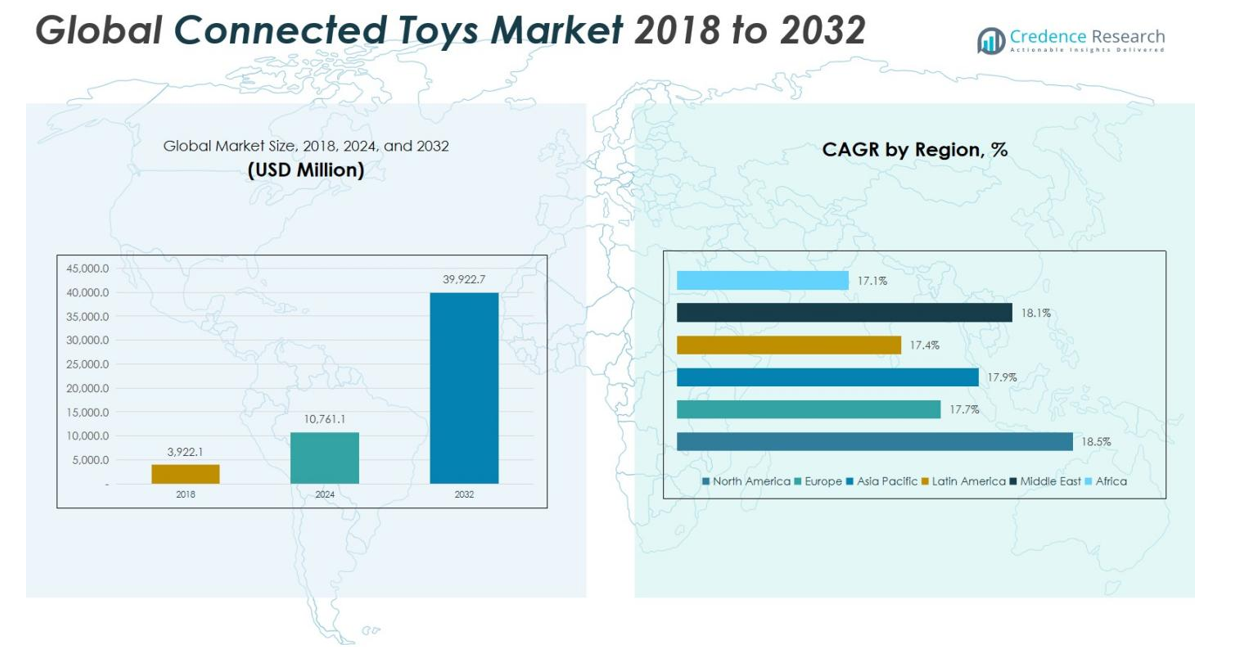
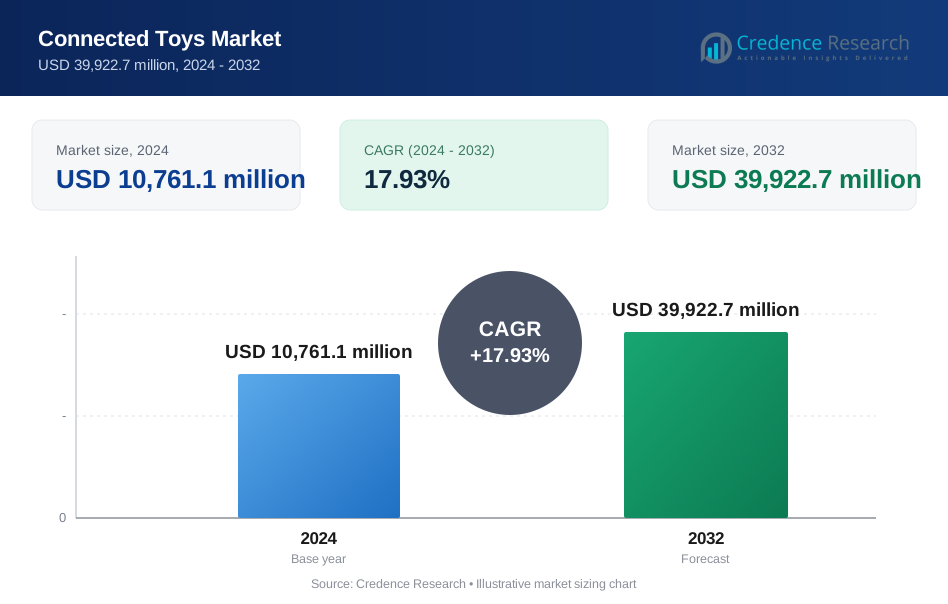
The Global Connected Toys Market size was valued at USD 3,922.1 million in 2018, increasing to USD 10,761.1 million in 2024, and is anticipated to reach USD 39,922.7 million by 2032, growing at a CAGR of 17.93% during the forecast period.
| REPORT ATTRIBUTE | DETAILS |
|---|---|
| Historical Period | 2020-2023 |
| Base Year | 2024 |
| Forecast Period | 2025-2032 |
| Connected Toys Market Size 2024 | USD 10,761.1 million |
| Connected Toys Market, CAGR | 17.93% |
| Connected Toys Market Size 2032 | USD 39,922.7 million |
The Global Connected Toys Market is dominated by major players such as Sphero, Hasbro, Inc., Sony Corporation, The LEGO Group, Mattel Inc., Fisher-Price, LeapFrog Enterprises, Playmobil, KidsII, Inc., and Tomy Company, Ltd. These companies lead through innovation, integrating AI, IoT, and augmented reality to enhance interactive and educational play experiences. They emphasize STEM-based learning, personalization, and app-enabled connectivity to attract tech-savvy parents and children. Strategic collaborations with technology firms and educational institutions further strengthen product development and market penetration. North America emerged as the leading region in 2024, commanding 35% of the global market share, supported by strong consumer spending, advanced digital infrastructure, and early adoption of smart toy technologies.
Market Insights
- The Global Connected Toys Market was valued at USD 10,761.1 million in 2024 and is projected to reach USD 39,922.7 million by 2032, growing at a CAGR of 17.93%, with North America leading at 35% share and the app-enabled mechanical toys & drones segment holding 48% of the market.
- The market growth is driven by rising adoption of IoT and AI-based technologies that enhance interactive, educational, and personalized play experiences for children.
- Increasing demand for STEM-focused learning toys and integration of voice and image recognition features are shaping market trends toward intelligent, adaptive, and connected play solutions.
- The market is highly competitive with key players such as Hasbro, LEGO, Sony, Mattel, and Sphero focusing on product innovation, digital connectivity, and strategic collaborations to gain market presence.
- Regional growth is strongest in Asia Pacific with a 19.8% CAGR, driven by expanding smartphone usage, digital literacy, and urbanization.
Market Segmentation Analysis:
By Toy Type:
The global connected toys market by toy type is dominated by app-enabled mechanical toys and drones, accounting for 48% of the total market share in 2024. These toys are increasingly popular due to their integration with smartphones and tablets, offering enhanced interactivity, motion control, and STEM-based learning experiences. Voice and image recognition toys are gaining traction with about 32% share, driven by the rise of AI-enabled companions and smart speakers. Health tracking toys and wearables, holding 20% share, are expanding steadily as parents seek products that combine play with physical activity monitoring and child wellness features.
- For instance, DJI’s Tello EDU drone allows children to program flight paths using Scratch and Python, while LEGO Mindstorms Robot Inventor kits enable users to code movements through the LEGO Robot Inventor App.
By Device:
Based on the device segment, smartphone and tablet connected toys lead the market with 57% share in 2024, as mobile integration enables remote control, app-based customization, and gamified learning. The convenience of app connectivity and widespread smartphone penetration globally are major growth drivers. Laptop-connected toys capture about 25% share, primarily used in educational settings and coding-based applications. Console-connected toys, holding roughly 18% share, remain popular among gaming enthusiasts seeking immersive play experiences enhanced by augmented reality and motion sensors.
- For instance, LEGO’s Boost and SPIKE Essential kits allow children to program robots via the LEGO Education app, linking seamlessly with iOS and Android devices.
By Sales Channel:
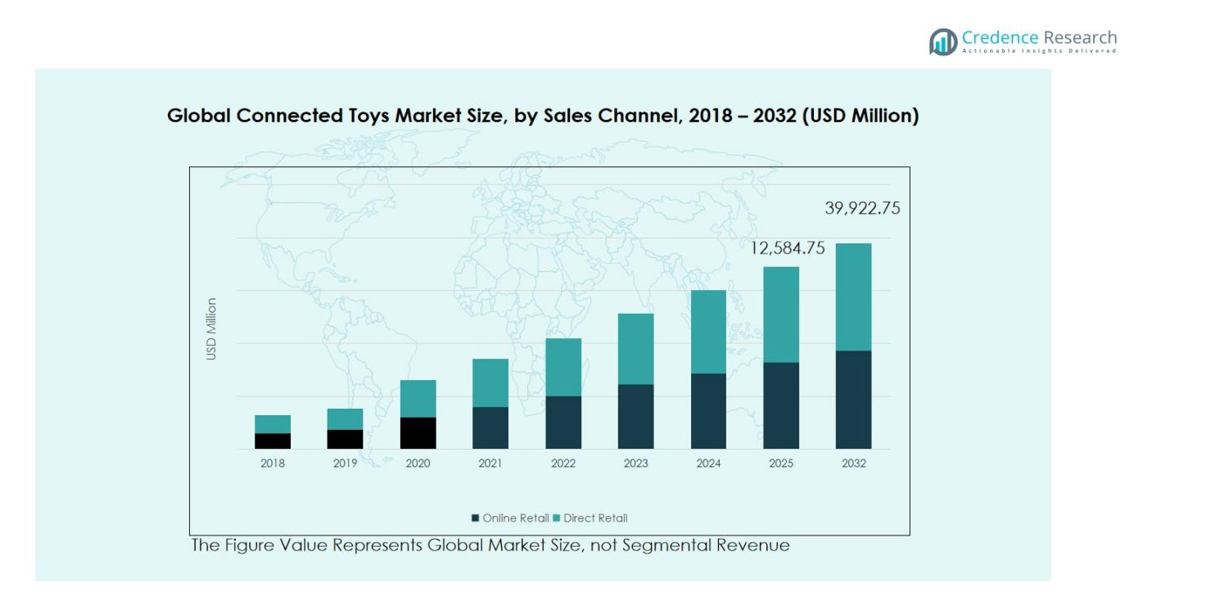
The online retail segment dominates the connected toys market, accounting for 64% of the global share in 2024. The growth is fueled by e-commerce expansion, digital marketing, and the availability of a wide product range with user reviews influencing purchase decisions. Online platforms also facilitate product customization and international accessibility, enhancing consumer engagement. Direct retail, holding about 36% share, continues to attract buyers seeking hands-on experience before purchase, particularly in developed markets where specialty toy stores and brand outlets offer interactive product demonstrations and premium models.
Key Growth Drivers
Integration of IoT and AI Technologies
The growing integration of IoT and AI technologies is a major driver for the global connected toys market. These technologies enable real-time data exchange, personalized interaction, and adaptive learning experiences that appeal to both children and parents. AI-driven toys enhance engagement through speech recognition, motion sensing, and intelligent response systems. The ability to connect seamlessly with mobile apps and smart home ecosystems has expanded product functionality, fostering innovation among toy manufacturers and attracting tech-savvy consumers seeking educational and interactive play solutions.
- For instance, Anki's Cozmo robot, which uses machine vision to recognize faces and perform programmed actions, offering educational coding experiences for children.
Rising Demand for STEM-Based Learning Toys
An increasing focus on science, technology, engineering, and mathematics (STEM) education is significantly boosting demand for connected toys. Parents and educators are recognizing the value of these toys in improving cognitive and problem-solving skills through interactive play. Companies are designing smart toys that blend entertainment with education, making learning engaging and accessible. The integration of coding, robotics, and app-based platforms in connected toys is helping children develop future-ready skills, driving market growth, especially across developed regions with advanced digital literacy levels.
- For instance, SMARTIVITY’s Space Rocket kit allows children to build a functional rocket and launcher, delivering a real rocket launch experience while teaching space science concepts and interactive experiments, combining fun with education.
Expanding E-Commerce and Digital Retail Channels
The rapid expansion of e-commerce platforms and digital retail networks is accelerating market penetration of connected toys worldwide. Online marketplaces offer a diverse range of products, competitive pricing, and consumer reviews that influence purchasing decisions. Digital platforms also provide a direct channel for manufacturers to showcase new technologies and customization options. The convenience of online purchasing, coupled with targeted marketing and global reach, has made e-commerce a crucial growth driver, particularly among tech-oriented parents seeking innovative and interactive learning solutions for their children.
Key Trends & Opportunities
Personalization and Adaptive Learning Features
A notable trend shaping the connected toys market is the rise of personalized play experiences powered by adaptive learning technologies. Toys equipped with AI algorithms can analyze user behavior and adjust activities based on skill level or learning pace. This personalization enhances engagement, retention, and educational outcomes. Manufacturers are increasingly leveraging data analytics and cloud connectivity to create toys that evolve with the user, offering long-term value and fostering emotional connections, which open significant opportunities for differentiation in a competitive market.
- For instance, Sphero’s Spider-Man connected toy, which incorporates regular Wi-Fi updates and speech recognition to tailor storytelling and interactive missions to the child’s preferences, fostering an evolving play experience.
Collaborations Between Toy Makers and Tech Companies
Strategic collaborations between traditional toy manufacturers and technology companies are emerging as a key opportunity. Partnerships allow toy brands to integrate advanced digital features such as augmented reality, voice assistance, and app synchronization. These alliances enhance product innovation, reduce development costs, and expand market reach. As a result, the connected toys market is witnessing hybrid models that combine classic play with smart technology, appealing to both children and parents while driving higher adoption rates across global markets.
- For instance, Hasbro collaborated with Epic Games to incorporate popular gaming elements into its toys, such as a joint launch of Nerf blasters inspired by Fortnite, which connect physically to digital gameplay.
Key Challenges
Data Privacy and Cybersecurity Concerns
One of the most pressing challenges in the connected toys market is ensuring data privacy and cybersecurity. As these toys collect personal data, including voice recordings and behavioral patterns, the risk of breaches and misuse increases. Parents are increasingly concerned about data protection and child safety in digital environments. Manufacturers must comply with stringent regulations such as GDPR and COPPA to maintain consumer trust. Addressing these privacy issues through secure encryption and transparent data policies is essential for sustaining long-term market growth.
High Product Costs and Limited Accessibility
The high cost of connected toys remains a barrier to widespread adoption, particularly in emerging economies. Advanced features such as AI, sensors, and wireless connectivity significantly raise production expenses, translating into premium retail prices. Limited affordability restricts market reach among middle-income households, where traditional toys remain dominant. Additionally, uneven internet connectivity and device compatibility issues in developing regions further limit access. Manufacturers need to focus on cost optimization and localization strategies to make smart toys more accessible and affordable globally.
Regional Analysis
North America
The North America connected toys market was valued at USD 1,372.7 million in 2018, growing to USD 3,766.4 million in 2024, and is anticipated to reach USD 13,973.9 million by 2032, accounting for about 35% of the global share at a CAGR of 16.9%. The region’s growth is driven by high consumer spending on smart, app-enabled, and educational toys. The United States leads the market due to strong digital infrastructure, early adoption of IoT-enabled products, and high investment in STEM education. Robust e-commerce channels and innovation from major players like LEGO and Hasbro further enhance regional dominance.
Europe
Europe accounted for USD 1,029.1 million in 2018, expanding to USD 2,905.5 million in 2024, and projected to reach USD 10,779.1 million by 2032, holding around 27% market share with a CAGR of 17.5%. Demand is supported by growing parental preference for interactive learning toys and stringent safety regulations fostering product quality. The UK, Germany, and France are key contributors, driven by widespread internet access and early integration of AI-enabled educational tools. Increasing digital literacy, online retail expansion, and partnerships between toy manufacturers and tech firms are fueling sustained market growth.
Asia Pacific
Asia Pacific’s connected toys market was valued at USD 980.5 million in 2018, increasing to USD 2,690.3 million in 2024, and is forecasted to reach USD 9,980.6 million by 2032, capturing around 25% global share and growing at a CAGR of 19.8%. The region’s growth is fueled by rapid urbanization, expanding middle-class income, and high smartphone penetration. China, Japan, and India dominate the market, supported by digital learning initiatives and local production advantages. Rising awareness of STEM education, increasing affordability of connected devices, and government-backed education reforms are key drivers accelerating adoption across major Asia Pacific economies.
Latin America
The Latin America connected toys market was valued at USD 274.5 million in 2018, reaching USD 753.3 million in 2024, and expected to attain USD 2,794.6 million by 2032, representing nearly 7% of global share with a CAGR of 16.4%. Market expansion is supported by improving internet infrastructure, increasing digital learning awareness, and growing adoption of smart toys in urban centers. Brazil and Mexico dominate regional sales, driven by e-commerce penetration and the rising availability of affordable smart toys. However, high import costs and uneven access to advanced technologies limit adoption in rural and lower-income markets.
Middle East & Africa (MEA)
The Middle East & Africa market was valued at USD 265.3 million in 2018, growing to USD 646.2 million in 2024, and projected to reach USD 2,395.6 million by 2032, accounting for about 6% of the global share with a CAGR of 15.8%. Market growth is influenced by increasing internet access, urbanization, and rising awareness of tech-integrated learning tools. The GCC countries and South Africa represent major growth hubs due to higher disposable incomes and education-oriented consumer spending. However, limited local manufacturing capacity and higher product pricing continue to constrain faster market penetration in some areas.
Market Segmentations:
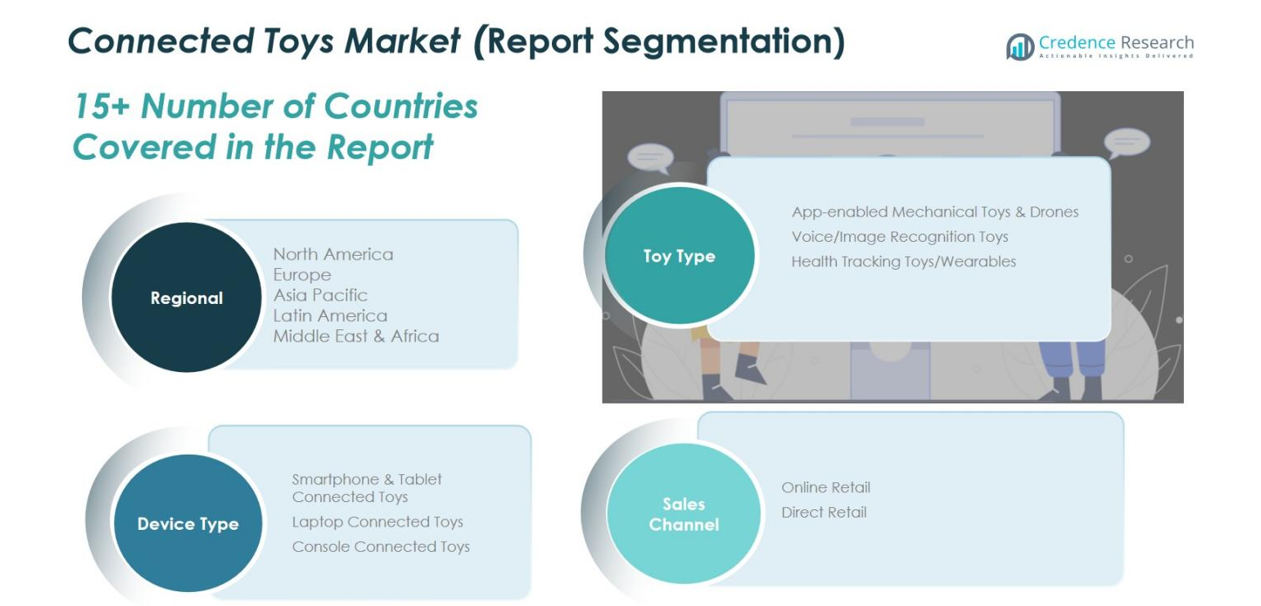
By Toy Type:
- App-enabled Mechanical Toys & Drones
- Voice/Image Recognition Toys
- Health Tracking Toys / Wearables
By Device:
- Smartphone & Tablet Connected Toys
- Laptop Connected Toys
- Console Connected Toys
By Sales Channel:
- Online Retail
- Direct Retail
By Region:
- North America
- U.S.
- Canada
- Mexico
- Europe
- Germany
- France
- U.K.
- Italy
- Spain
- Rest of Europe
- Asia Pacific
- China
- Japan
- India
- South Korea
- South-east Asia
- Rest of Asia Pacific
- Latin America
- Brazil
- Argentina
- Rest of Latin America
- Middle East & Africa
- GCC Countries
- South Africa
- Rest of the Middle East and Africa
Competitive Landscape
The competitive landscape of the Global Connected Toys Market is characterized by the presence of major players such as Sphero, Hasbro, Inc., Sony Corporation, The LEGO Group, Mattel Inc., Fisher-Price, Inc., LeapFrog Enterprises, Inc., Playmobil, KidsII, Inc., and Tomy Company, Ltd. These companies focus on product innovation, strategic partnerships, and technological integration to strengthen their market presence. Leading players are increasingly incorporating artificial intelligence, augmented reality, and IoT connectivity to enhance user interaction and learning experiences. Collaborations with educational institutions and tech firms are driving the development of STEM-based toys and adaptive learning products. E-commerce expansion and omnichannel distribution strategies are helping companies reach a broader consumer base. Additionally, continuous investment in R&D and sustainability initiatives is shaping the competitive dynamics, as brands strive to offer secure, personalized, and eco-friendly connected toys that cater to evolving consumer expectations and regulatory standards worldwide.
Key Player Analysis
- Sphero
- Hasbro, Inc.
- Sony Corporation
- KidsII, Inc.
- Playmobil
- Fisher-Price, Inc.
- The LEGO Group
- Mattel Inc.
- LeapFrog Enterprises, Inc.
- Tomy Company, Ltd.
- Other Key Players
Recent Developments
- In June 2025, Mattel, Inc. announced a partnership with OpenAI to introduce a new line of AI-powered connected toys, blending physical play with intelligent digital interactions.
- In July 2025, Moose Toys expanded its connected play portfolio through the acquisition of the Bananagrams brand, strengthening its position in the global interactive and educational toy market.
- In February 2025, Spin Master Corp. unveiled its “2025 Innovation Unlocked” initiative, introducing a series of next-generation connected and interactive toys designed to enhance digital engagement and creative play experiences globally.
Report Coverage
The research report offers an in-depth analysis based on Toy Type, Device, Sales Channel and Region. It details leading market players, providing an overview of their business, product offerings, investments, revenue streams, and key applications. Additionally, the report includes insights into the competitive environment, SWOT analysis, current market trends, as well as the primary drivers and constraints. Furthermore, it discusses various factors that have driven market expansion in recent years. The report also explores market dynamics, regulatory scenarios, and technological advancements that are shaping the industry. It assesses the impact of external factors and global economic changes on market growth. Lastly, it provides strategic recommendations for new entrants and established companies to navigate the complexities of the market.
Future Outlook
- The global connected toys market will continue to expand rapidly, driven by increasing adoption of smart and interactive learning solutions.
- Integration of artificial intelligence and IoT technologies will enhance personalization and real-time engagement in toys.
- STEM-based educational toys will remain a key focus, supporting skill development and digital learning for children.
- Voice and image recognition features will become more advanced, improving interactive play experiences.
- Online retail channels will further dominate sales, supported by global e-commerce growth and digital marketing strategies.
- Partnerships between toy manufacturers and technology firms will accelerate innovation and product diversification.
- Data privacy and cybersecurity solutions will become essential to maintain consumer trust and regulatory compliance.
- Sustainability and eco-friendly materials will gain prominence as manufacturers adopt green production practices.
- Emerging markets in Asia Pacific and Latin America will offer significant growth opportunities due to rising digital penetration.
- The future market will emphasize safe, educational, and adaptive toys that merge entertainment with learning.
Request a Free Sample
Fill in your details and we'll send you a free sample report.
- Sample data tables & charts
- Research methodology
Market Dynamics
Integration of IoT and AI Technologies
The adoption of IoT and AI in connected toys enables real-time data exchange, personalized interactions, and adaptive learning, making toys more engaging and educational for children. This technological integration is attracting tech-savvy parents and fostering innovation among manufacturers.
Rising Demand for STEM-Based Learning Toys
Parents and educators are increasingly seeking toys that support science, technology, engineering, and mathematics (STEM) education. Connected toys that blend entertainment with coding, robotics, and interactive learning are helping children develop critical skills, driving market growth.
Expanding E-Commerce and Digital Retail Channels
The growth of online retail platforms has made connected toys more accessible globally, offering a wide product range, competitive pricing, and consumer reviews. E-commerce facilitates international reach and product customization, accelerating market penetration.
Personalization and Adaptive Learning Features
AI-powered toys that adapt to a child's learning pace and preferences are enhancing engagement and educational outcomes. Personalization through data analytics and cloud connectivity is creating long-term value and differentiation in a competitive market.
Collaborations Between Toy Makers and Tech Companies
Strategic partnerships between traditional toy manufacturers and technology firms are enabling the integration of advanced features like augmented reality and voice assistance. These collaborations are driving product innovation, reducing development costs, and expanding market reach.
Need a Custom Version of This Report?
Tailor the scope, geography, or segments to your exact requirements.
- Custom geography or segment scope
- Direct access to our analyst team
Frequently Asked Questions
What is the current market size for the Global Connected Toys Market, and what is its projected size in 2032?
At what Compound Annual Growth Rate is the Global Connected Toys Market projected to grow between 2025 and 2032?
Which Global Connected Toys Market segment held the largest share in 2024?
What are the primary factors fueling the growth of the Global Connected Toys Market?
Who are the leading companies in the Global Connected Toys Market?
Who are the major players in this market?
Table of Content
Chapter 1 Market Segmentation
- 1.1 Segmentation Framework
- 1.1.1 Product and Service Classification
- 1.1.2 Application and End-Use Classification
- 1.1.3 Technology and Solution Classification
- 1.1.4 Customer and Distribution Channel Classification
- 1.1.5 Geographic Segmentation
- 1.1.6 Market Segment Definitions and Boundaries
- 1.2 By Device
- 1.2.1 Smartphone & Tablet Connected Toys
- 1.2.2 Laptop Connected Toys
- 1.2.3 Console Connected Toys
- 1.3 By Toy Type
- 1.3.1 App-enabled Mechanical Toys & Drones
- 1.3.2 Voice/Image Recognition Toys
- 1.3.3 Health Tracking Toys / Wearables
- 1.4 By Sales Channel
- 1.4.1 Online Retail
- 1.4.2 Direct Retail
Chapter 2 Introduction
- 2.1 Report Objectives and Scope
- 2.2 Product Definition and Industry Terminology
- 2.3 Market Inclusions and Exclusions
- 2.4 Research Process
- 2.4.1 Primary Research and Expert Interviews
- 2.4.2 Secondary Research and Source Review
- 2.4.3 Top-Down and Bottom-Up Estimation
- 2.4.4 Data Triangulation and Verification
- 2.5 Market Size Measurement Basis
- 2.5.1 2024: USD 10,761.1 million → 2032: USD 39,922.7 million
- 2.6 Historical and Forecast Reference Periods
- 2.6.1 Base Year: 2024
- 2.6.2 Forecast Period: 2024-2032
- 2.7 Research Assumptions and Limitations
Chapter 3 Executive Summary
- 3.1 Market Snapshot and Key Findings
- 3.2 Base-Year Market Size, 2024
- 3.3 Forecast Market Size, 2032
- 3.4 Revenue and Volume Growth Outlook
- 3.5 Key Demand and Supply Indicators
- 3.6 Leading Market Segments
- 3.7 Fastest-Growing Market Opportunities
- 3.8 Regional Performance Highlights
- 3.9 Technology and Industry Transformation
- 3.10 Competitive Landscape Summary
- 3.11 Analyst View and Strategic Implications
Chapter 4 Global Connected Toys Market Trends and Developments
- 4.1 Historical Industry Development
- 4.2 Recent Market Trends and Developments
- 4.3 Demand and Customer Behavior Trends
- 4.4 Technology and Product Innovation
- 4.5 Artificial Intelligence, Automation and Digitalization
- 4.6 Local Manufacturing and Supply Chain Realignment
- 4.7 Industry Partnerships, Mergers and Acquisitions
- 4.8 Sustainability and Circular Economy Developments
- 4.9 Government and Private Sector Investment Trends
- 4.10 Emerging Business Models and Commercialization
- 4.11 Industry Developments and Announcements
Chapter 5 Global Connected Toys Market Production, Supply and Demand Analysis
- 5.1 Demand Trend and Consumption Analysis
- 5.2 Demand Forecast, 2024-2032
- 5.3 Production and Output Trend
- 5.4 Production and Output Forecast, 2024-2032
- 5.5 Installed Capacity and Capacity Utilization
- 5.6 Company-Wise Production Plants and Statistics
- 5.6.1 Installed Production Capacity
- 5.6.2 Actual Production
- 5.6.3 Planned Capacity and Expansion Targets
- 5.7 Supply Chain Structure and Procurement Trends
- 5.8 Supply-Demand Gap and Bottlenecks
- 5.9 Import Dependence and Sourcing Structure
- 5.10 Contract Manufacturing and Outsourcing
- 5.11 Regional Supply and Demand Concentration
Chapter 6 Global Connected Toys Market Pricing Analysis
- 6.1 Pricing Structure and Measurement
- 6.2 Historical Pricing Trends
- 6.3 Pricing Outlook, 2024-2032
- 6.4 Average Selling Price and Unit Economics
- 6.5 Pricing by Product and Market Segment
- 6.6 Geographic Pricing Differences
- 6.7 Key Input, Energy, Labor and Logistics Costs
- 6.8 Contract Pricing and Purchasing Models
- 6.9 Pricing Sensitivity and Competitive Positioning
- 6.10 Price, Margin and Profitability Implications
Chapter 7 Global Connected Toys Market Dynamics
- 7.1 Market Growth Drivers
- 7.1.1 Demand-Side Drivers
- 7.1.2 Technology and Innovation Drivers
- 7.1.3 Infrastructure and Investment Drivers
- 7.1.4 Regulatory and Policy Drivers
- 7.2 Market Restraints
- 7.2.1 Cost and Affordability Constraints
- 7.2.2 Technology and Adoption Barriers
- 7.2.3 Supply Chain and Operational Constraints
- 7.3 Market Challenges
- 7.3.1 Competitive Pressure and Margin Erosion
- 7.3.2 Skills, Infrastructure and Implementation Gaps
- 7.4 Emerging Market Opportunities
- 7.5 Market Dynamics Impact and Time-Horizon Assessment
Chapter 8 Global Connected Toys Value Chain Analysis
- 8.1 Industry Value Chain Overview
- 8.2 Upstream Suppliers and Critical Inputs
- 8.3 Technology and Component Providers
- 8.4 Manufacturing or Service Delivery
- 8.5 Distribution, Channel Partners and Integrators
- 8.6 Downstream Applications and End Users
- 8.7 Value Addition and Profit Pools
- 8.8 Vertical Integration and Outsourcing
- 8.9 Supplier Concentration and Risk
- 8.10 Supply Chain Localization and Resilience
Chapter 9 Global Connected Toys Market Regulations and Policies
- 9.1 Relevant Laws, Standards and Compliance Frameworks
- 9.2 Product, Service, Safety and Quality Requirements
- 9.3 Government Policies, Incentives and Subsidies
- 9.4 Imports, Exports and Trade Barriers
- 9.5 Public Procurement and Local Content Requirements
- 9.6 Environmental and Sustainability Compliance
- 9.7 Data Protection, AI and Cybersecurity Compliance
- 9.8 Upcoming Policy Changes and Market Implications
Chapter 10 Global Connected Toys Market Hotspots and Opportunities
- 10.1 Market Opportunity Mapping and Growth Hotspots
- 10.2 High-Growth Applications and Customer Groups
- 10.3 Underserved Markets and White-Space Opportunities
- 10.4 Emerging Technology and Product Opportunities
- 10.5 New Capacity and Investment Hotspots
- 10.6 Market Entry and Expansion Opportunities
- 10.7 Distribution and Partnership Opportunities
- 10.8 Near-Term and Long-Term Commercial Potential
- 10.9 Opportunity Attractiveness and Execution Risks
Chapter 11 Global Connected Toys Market Outlook, 2024-2032
- 11.1 Market Size and Analysis
- 11.1.1 Revenue (Market Measurement: 2024: USD 10,761.1 million → 2032: USD 39,922.7 million)
- 11.1.2 Market Volume and Quantity Sold
- 11.1.3 Historical Market Size
- 11.1.4 Base-Year Market Size, 2024
- 11.2 Market Forecast, 2024-2032
- 11.2.1 Revenue Forecast to 2032
- 11.2.2 Volume Forecast to 2032
- 11.2.3 CAGR and Year-on-Year Growth
- 11.2.4 Incremental Revenue Opportunity
- 11.3 Forecast Assumptions and Scenario Analysis
- 11.3.1 Base-Case Forecast
- 11.3.2 Optimistic and Conservative Scenarios
- 11.3.3 Technology, Pricing and Policy Sensitivities
- 11.4 Market Attractiveness and Growth Outlook
Chapter 12 Global Connected Toys Market Segmentation and Outlook
- 12.1 Segmentation Summary and Market Shares, 2024
- 12.2 Largest and Fastest-Growing Segments
- 12.3 By Device - Market Size and Forecast, 2024-2032
- 12.3.1 Segment Definition and Scope
- 12.3.2 Historical Market Size
- 12.3.3 Revenue Forecast, 2024-2032
- 12.3.4 Volume Forecast, 2024-2032
- 12.3.5 Base-Year Market Share, 2024
- 12.3.6 Segment CAGR and Growth Drivers
- 12.3.7 Subsegment Market Size and Forecast
- 12.3.7.1 Smartphone & Tablet Connected Toys
- 12.3.7.2 Laptop Connected Toys
- 12.3.7.3 Console Connected Toys
- 12.3.8 Subsegment Pricing and Adoption Trends
- 12.3.9 Leading Suppliers and Competition
- 12.3.10 Regional Demand and Opportunities
- 12.4 By Toy Type - Market Size and Forecast, 2024-2032
- 12.4.1 Segment Definition and Scope
- 12.4.2 Historical Market Size
- 12.4.3 Revenue Forecast, 2024-2032
- 12.4.4 Volume Forecast, 2024-2032
- 12.4.5 Base-Year Market Share, 2024
- 12.4.6 Segment CAGR and Growth Drivers
- 12.4.7 Subsegment Market Size and Forecast
- 12.4.7.1 App-enabled Mechanical Toys & Drones
- 12.4.7.2 Voice/Image Recognition Toys
- 12.4.7.3 Health Tracking Toys / Wearables
- 12.4.8 Subsegment Pricing and Adoption Trends
- 12.4.9 Leading Suppliers and Competition
- 12.4.10 Regional Demand and Opportunities
- 12.5 By Sales Channel - Market Size and Forecast, 2024-2032
- 12.5.1 Segment Definition and Scope
- 12.5.2 Historical Market Size
- 12.5.3 Revenue Forecast, 2024-2032
- 12.5.4 Volume Forecast, 2024-2032
- 12.5.5 Base-Year Market Share, 2024
- 12.5.6 Segment CAGR and Growth Drivers
- 12.5.7 Subsegment Market Size and Forecast
- 12.5.7.1 Online Retail
- 12.5.7.2 Direct Retail
- 12.5.8 Subsegment Pricing and Adoption Trends
- 12.5.9 Leading Suppliers and Competition
- 12.5.10 Regional Demand and Opportunities
- 12.6 Segment Growth Comparison
- 12.7 Segment Attractiveness and Priority Matrix
Chapter 13 Global Connected Toys Geographic Market Outlook, 2024-2032
- 13.1 Regional Market Size and Share, 2024
- 13.2 Regional Market Forecast, 2024-2032
- 13.3 Regional Pricing, Production and Demand Differences
- 13.4 North America
- 13.4.1 United States
- 13.4.2 Canada
- 13.4.3 Mexico
- 13.5 Europe
- 13.5.1 Germany
- 13.5.2 France
- 13.5.3 Italy
- 13.5.4 United Kingdom
- 13.5.5 Spain
- 13.5.6 Poland
- 13.5.7 Russia
- 13.5.8 Netherlands
- 13.5.9 Belgium
- 13.5.10 Sweden
- 13.5.11 Denmark
- 13.5.12 Norway
- 13.5.13 Rest of Europe
- 13.6 Asia Pacific
- 13.6.1 China
- 13.6.2 India
- 13.6.3 Japan
- 13.6.4 South Korea
- 13.6.5 Thailand
- 13.6.6 Indonesia
- 13.6.7 Vietnam
- 13.6.8 Malaysia
- 13.6.9 Australia
- 13.6.10 Rest of Asia Pacific
- 13.7 Latin America
- 13.7.1 Brazil
- 13.7.2 Argentina
- 13.7.3 Colombia
- 13.7.4 Chile
- 13.7.5 Rest of Latin America
- 13.8 Middle East
- 13.8.1 Saudi Arabia
- 13.8.2 United Arab Emirates
- 13.8.3 Turkey
- 13.8.4 Israel
- 13.8.5 Iran
- 13.8.6 Rest of the Middle East
- 13.9 Africa
- 13.9.1 South Africa
- 13.9.2 Egypt
- 13.9.3 Nigeria
- 13.9.4 Morocco
- 13.9.5 Rest of Africa
- 13.10 Regional Investment, Policy and Supply Chain Differences
- 13.11 Regional Competitive Landscape
- 13.12 Geographic Growth Hotspots
Chapter 14 Global Connected Toys Technology, Innovation and Sustainability Outlook
- 14.1 Technology Landscape and Maturity
- 14.2 Product, Process and Service Innovation
- 14.3 AI, Automation and Digital Tools in the Industry
- 14.4 Technology Adoption and Performance Benchmarking
- 14.5 Innovation Pipeline and R&D Investment
- 14.6 Patent and Intellectual Property Trends
- 14.7 Energy Efficiency and Resource Management
- 14.8 Sustainability, Recycling and Circularity
- 14.9 Technology Roadmap, 2024-2032
- 14.10 Risks of Obsolescence and Technology Substitution
Chapter 15 Global Connected Toys Market Key Strategic Imperatives
- 15.1 Growth and Market Entry Priorities
- 15.2 High-Return Products and Segments
- 15.3 Pricing, Profitability and Cost Optimization
- 15.4 Technology Investment and Product Differentiation
- 15.5 Supply Chain Localization and Resilience
- 15.6 Distribution and Customer Acquisition
- 15.7 Partnership, Acquisition and Capacity Strategy
- 15.8 Regional Expansion Priorities
- 15.9 Short-, Medium- and Long-Term Actions
Chapter 16 Competition Outlook
- 16.1 Industry Competition Characteristics
- 16.2 Market Structure and Concentration
- 16.3 Market Share and Competitive Positioning, 2024
- 16.4 Company-Wise Revenue and Product Benchmarking
- 16.5 Production and Service Capacity Benchmarking
- 16.6 Technology, Pricing and Differentiation
- 16.7 Regional Footprint and Distribution Strength
- 16.8 Mergers, Acquisitions and Strategic Alliances
- 16.9 New Entrants and Competitive Threats
- 16.10 Porter's Five Forces and Industry Attractiveness
- 16.11 Competitive Outlook, 2024-2032
Chapter 17 Company Profiles
- 17.1 Company Coverage and Selection Criteria
- 17.2 Sphero
- 17.2.1 Business Description
- 17.2.2 Company Ownership and Geographic Presence
- 17.2.3 Product and Service Portfolio
- 17.2.4 Manufacturing and Operating Footprint
- 17.2.5 Production Capacity and Expansion Plans
- 17.2.6 Financial Performance and Investment
- 17.2.7 Market Share and Competitive Position
- 17.2.8 Technology and Innovation Capabilities
- 17.2.9 Strategic Alliances or Partnerships
- 17.2.10 Recent Developments
- 17.2.11 Growth Strategy and Outlook
- 17.3 Hasbro, Inc.
- 17.4 Sony Corporation
- 17.5 The LEGO Group
- 17.6 Mattel Inc.
- 17.7 Fisher-Price, Inc.
- 17.8 LeapFrog Enterprises, Inc.
- 17.9 Playmobil
- 17.10 KidsII, Inc.
- 17.11 Tomy Company, Ltd.
- 17.12 Other Relevant Market Participants
Note: Every listed company is profiled on the structure shown under the first company. The company list is preliminary and may change based on research findings, market developments, data availability and client requirements.
Chapter 18 Disclaimer
- 18.1 Research and Forecast Disclaimer
- 18.2 Data Source and Estimation Limitations
Note: The depth of individual sections depends on data availability for this market. Volume, capacity, trade and other unit-based metrics are included where applicable.