
| REPORT ATTRIBUTE | DETAILS |
|---|---|
| Historical Period | 2020-2023 |
| Base Year | 2024 |
| Forecast Period | 2025-2032 |
| Corrugated Boxes Market Size 2024 | USD165.94 million |
| Corrugated Boxes Market, CAGR | 5.51% |
| Corrugated Boxes Market Size 2032 | USD262.83 million |
Market Overview
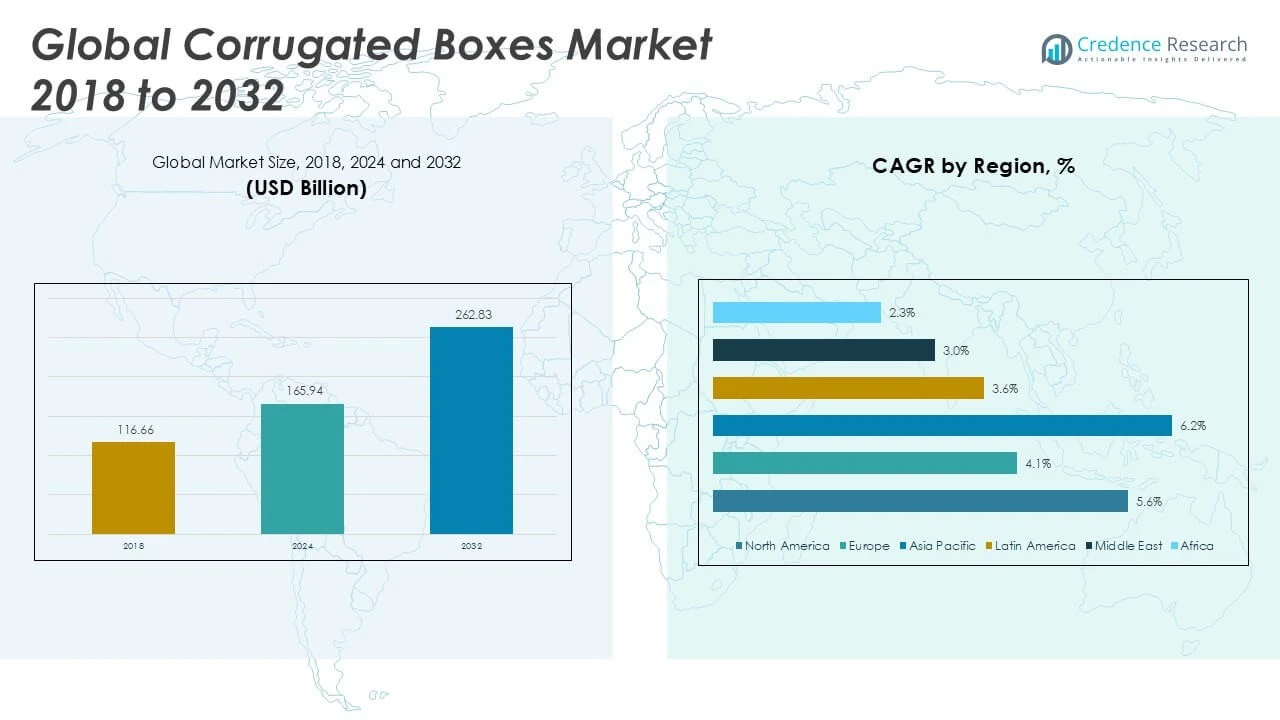
The Global Corrugated Boxes Market is projected to grow from USD165.94 million in 2024 to an estimated USD262.83 million based on 2032, with a compound annual growth rate (CAGR) of 5.51% from 2025 to 2032.
The market growth is fueled by several factors, including the boom in online retail, which demands robust and customizable packaging solutions. Environmental concerns have pushed both manufacturers and end-users to favor corrugated packaging over plastic alternatives. Additionally, advancements in digital printing and structural design are enhancing the appeal and functionality of corrugated boxes. The increasing focus on sustainable packaging is also encouraging innovation in lightweight, biodegradable box designs.
Geographically, Asia Pacific leads the global market due to high manufacturing activity and expanding e-commerce penetration in countries like China and India. North America and Europe follow closely, driven by strong demand in retail and food delivery services. Key players operating in the global corrugated boxes market include International Paper Company, WestRock Company, Smurfit Kappa Group, DS Smith Plc, and Mondi Group. These companies are focusing on mergers, acquisitions, and technological advancements to strengthen their market positions and cater to evolving packaging needs.
Market Insights
- The Global Corrugated Boxes Market is projected to grow from USD 165.94 million in 2024 to USD 262.83 million by 2032, at a CAGR of 5.51%.
- E-commerce expansion is the key growth driver, increasing demand for durable and customizable corrugated packaging solutions.
- Rising consumer preference for eco-friendly materials supports the market’s shift away from plastic-based alternatives.
- Volatility in raw material prices, especially kraft paper and containerboard, continues to challenge profit margins.
- Asia Pacific dominates the market due to high manufacturing output and rapid digital retail penetration in countries like China and India.
- North America and Europe follow with strong demand from retail, food services, and robust recycling infrastructure.
- Sustainability goals and regulatory support in developed regions are accelerating the adoption of recyclable corrugated packaging.
Market Drivers
Surge in E-commerce Activities Driving Demand for Protective and Sustainable Packaging Solutions
The Global Corrugated Boxes Market is experiencing significant growth due to the rapid expansion of e-commerce platforms worldwide. Online retailers require reliable, lightweight, and cost-efficient packaging materials to ensure the safe delivery of goods. Corrugated boxes meet these needs by offering durability and customization, supporting a wide range of products from consumer electronics to groceries. It benefits from the need for branding and unboxing experiences, which are crucial in digital retail. Retailers are choosing corrugated packaging to align with consumer preferences for sustainable materials. This shift is fueling continuous demand from major e-commerce markets in North America, Asia Pacific, and Europe.
- For instance, leading e-commerce platforms have reported a 30% increase in demand for corrugated packaging due to rising online retail activity.
Regulatory Pressure and Environmental Awareness Boost Adoption of Recyclable Packaging Materials
Governments and environmental agencies across the globe are enforcing regulations that encourage the use of eco-friendly packaging materials. The Global Corrugated Boxes Market responds to these directives by promoting fully recyclable and biodegradable solutions. It reduces the environmental footprint of packaging, helping companies meet sustainability goals and improve brand image. Consumers are also becoming more environmentally conscious, influencing businesses to select packaging with lower carbon emissions. Regulatory frameworks, such as bans on single-use plastics, are driving companies to adopt corrugated alternatives. This regulatory momentum is shaping packaging decisions across several industries.
- For instance, the U.S. Environmental Protection Agency (EPA) reported that 96% of corrugated boxes were successfully recycled in 2024, reinforcing the shift toward eco-friendly packaging.
Growth in Food and Beverage Sector Supporting Demand for Hygienic and Customizable Packaging
The food and beverage industry represents a major end-user segment in the Global Corrugated Boxes Market. It relies on corrugated boxes for safe, hygienic, and temperature-resistant transport of packaged foods and beverages. The ability to customize box size, shape, and protective features makes corrugated packaging ideal for perishable goods. Food producers use it to improve shelf presentation and logistics efficiency. Corrugated packaging complies with food safety standards, supporting its use in direct food contact scenarios. This reinforces its critical role in the supply chains of processed food, dairy, and beverages.
Technological Advancements in Printing and Automation Enhancing Product Appeal and Efficiency
Recent advancements in digital printing and packaging automation are strengthening the competitive edge of the Global Corrugated Boxes Market. High-resolution printing enhances visual branding directly on packaging, eliminating the need for additional labels. It allows brands to deliver impactful marketing while maintaining packaging efficiency. Automated production lines reduce operational costs and ensure consistency in box quality. Technology improves flexibility in short-run orders, which is essential for fast-moving consumer goods and promotional packaging. These innovations support both small-scale and large-scale manufacturers seeking efficiency and customization.
Market Trends
Rising Demand for Sustainable and Biodegradable Packaging in Retail and Logistics
Sustainability has become a core focus for businesses across industries, influencing packaging choices in retail, logistics, and manufacturing. The Global Corrugated Boxes Market is adapting to this shift by emphasizing recyclable, biodegradable, and lightweight materials. It supports environmental goals and aligns with corporate social responsibility strategies. Businesses are moving away from plastic packaging and adopting corrugated alternatives to reduce waste and meet consumer expectations. Corrugated boxes offer a renewable solution with minimal environmental impact, making them increasingly popular in eco-conscious supply chains. This trend continues to influence procurement decisions globally.
- For instance, reports indicate that over 70% of consumers are willing to pay a premium for sustainable packaging, driving the demand for recyclable and biodegradable corrugated boxes
Customization and Personalization Emerging as Key Differentiators in Packaging
Brands are prioritizing customized packaging to improve customer engagement and reinforce brand identity. The Global Corrugated Boxes Market is responding by offering tailored box designs, sizes, and printing options that match product requirements and enhance unboxing experiences. It allows businesses to create packaging that communicates brand values and stands out on shelves. Digital printing technologies support fast, cost-effective personalization for both large and small batch orders. Seasonal promotions, limited editions, and subscription models are driving demand for flexible packaging formats. This trend is especially strong in e-commerce, cosmetics, and premium food sectors.
- For instance, printing processes such as lithography, flexography, and digital printing are widely used in the corrugated box market, enabling high-quality customization and branding for businesses
Adoption of Digital Printing Technologies to Improve Production Efficiency and Visual Appeal
Advancements in digital printing are transforming the aesthetics and functionality of corrugated boxes. The Global Corrugated Boxes Market is embracing high-speed printing methods that reduce lead times and enhance product presentation. It helps manufacturers deliver vibrant graphics and detailed designs directly on corrugated surfaces. Digital printing reduces waste and setup costs, making it suitable for variable data printing and just-in-time production. Brands benefit from on-demand customization without sacrificing production efficiency. This trend is gaining momentum among packaging converters and end-users focused on high-impact visuals.
Growth in Lightweight and High-Performance Corrugated Solutions for Industrial Use
Industrial applications are increasingly demanding corrugated boxes that balance strength with reduced material usage. The Global Corrugated Boxes Market is shifting toward innovative lightweight designs that do not compromise durability. It enables cost savings in transportation and improves overall logistics efficiency. Industries such as electronics, automotive, and pharmaceuticals are seeking packaging solutions that offer protective features with reduced environmental load. New grades of corrugated fiberboard support heavy-duty applications while maintaining recyclability. This trend reflects a growing need for smart packaging solutions that optimize both performance and sustainability.
Market Challenges
Fluctuating Raw Material Prices Impacting Production Stability and Profit Margins
The Global Corrugated Boxes Market faces persistent challenges from volatile raw material prices, particularly kraft paper and containerboard. It depends heavily on wood pulp, which is subject to supply chain disruptions, seasonal constraints, and regulatory pressures. Price fluctuations directly affect manufacturing costs, making it difficult for producers to maintain stable pricing for clients. Smaller manufacturers struggle to absorb these cost variations, impacting profitability and competitiveness. Market players must constantly adapt procurement strategies to maintain margin stability. This uncertainty creates planning difficulties for packaging producers and end-users alike.
- For instance, the global corrugated packaging industry saw over 224 million units of corrugated boxes used in e-commerce shipments in 2023.
Limited Recycling Infrastructure in Developing Regions Restricting Circular Economy Goals
Many developing countries lack sufficient recycling infrastructure to support large-scale reuse of corrugated materials. The Global Corrugated Boxes Market relies on strong collection, sorting, and recycling systems to fulfill sustainability promises. It encounters challenges where municipal waste management systems are underdeveloped or inconsistent. Poor recycling rates lead to increased demand for virgin materials, reducing environmental benefits. Companies operating in these markets face regulatory and reputational risks due to limited circularity. Expanding recycling capabilities is essential to support long-term growth and environmental responsibility in emerging economies.
Market Opportunities
Expansion of E-commerce in Emerging Economies Creating New Growth Channels for Corrugated Packaging
Rapid digitalization and increasing internet penetration in emerging economies are expanding the reach of online retail. The Global Corrugated Boxes Market stands to benefit from this growth, as e-commerce requires robust, lightweight, and protective packaging solutions. It can serve a wide range of product categories, from electronics to household goods. Countries in Asia Pacific, Latin America, and Africa are witnessing a surge in online consumer activity, supported by mobile access and digital payment systems. Local and regional e-commerce platforms present new opportunities for packaging suppliers. This expanding retail ecosystem fuels consistent demand for customized corrugated packaging.
Innovation in Smart and Multi-functional Packaging Driving Premium Segment Demand
Technological innovations in packaging are opening up premium market segments for value-added solutions. The Global Corrugated Boxes Market can capitalize on features such as RFID tracking, temperature-sensitive inks, and tamper-evident seals. It allows brands to enhance security, traceability, and customer engagement through packaging. Smart packaging applications are particularly relevant in pharmaceuticals, electronics, and high-value consumer goods. Brands are seeking packaging that goes beyond protection to provide supply chain visibility and consumer interaction. These innovations create new revenue streams and help packaging providers differentiate in a competitive landscape.
Market Segmentation Analysis
By Type
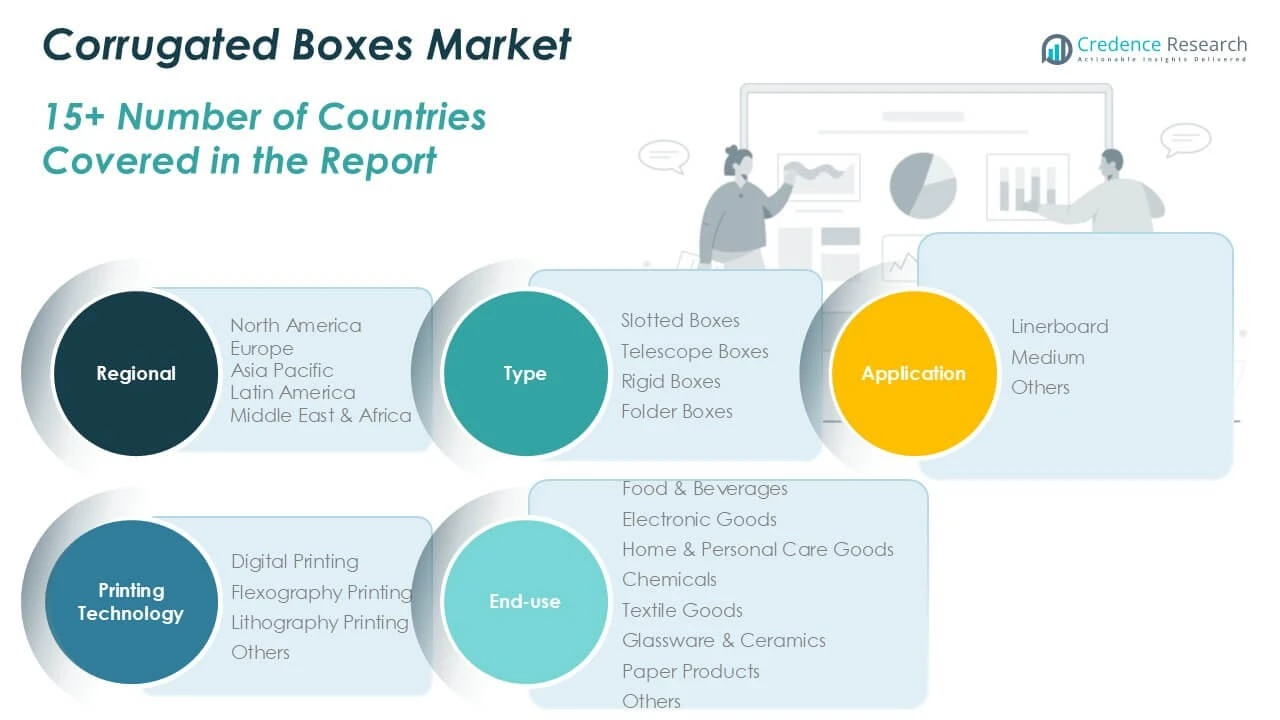
The Global Corrugated Boxes Market segments by type into slotted boxes, telescope boxes, rigid boxes, and folder boxes. Slotted boxes hold the largest share due to their cost efficiency, structural simplicity, and compatibility with automated packaging systems. It dominates in e-commerce, logistics, and consumer goods. Telescope boxes are gaining traction in electronics and delicate item packaging, offering superior cushioning. Rigid boxes are preferred for luxury packaging, especially in cosmetics and premium electronics. Folder boxes find use in retail and apparel, benefiting from easy assembly and visual appeal. Demand across all types is driven by product-specific packaging needs and increasing customization.
By Material
Material segmentation includes linerboard, medium, and others, with linerboard holding a significant share due to its strength and printability. The Global Corrugated Boxes Market favors high-quality linerboard for superior packaging durability and surface finish. Medium material contributes to the internal fluting structure, offering strength and flexibility. It supports product protection during transit and storage. Manufacturers are exploring alternative and recycled materials to meet sustainability targets. Material selection impacts packaging performance, cost, and recyclability, influencing end-user preferences across industries.
By Printing Technology
Printing technology in the market includes digital printing, flexography, lithography, and others. Flexography holds a substantial share due to speed and cost-effectiveness in high-volume production. Digital printing is growing due to demand for customization, short runs, and high-quality graphics. The Global Corrugated Boxes Market leverages lithography for premium visuals, especially in luxury and gift packaging. It benefits from these technologies to enhance brand identity, reduce lead time, and align with just-in-time inventory models. Advancements in printing support complex design needs and improve shelf appeal.
By End-use
End-use segments include food & beverages, electronic goods, home & personal care goods, chemicals, textile goods, glassware & ceramics, paper products, and others. The food & beverage sector leads due to strict packaging standards and high-volume consumption. The Global Corrugated Boxes Market sees strong adoption in electronics and personal care due to protective and branded packaging requirements. Textile and chemical sectors require specialized formats for safety and durability. Glassware and ceramics depend on reinforced designs for impact resistance. Diverse end-user demand supports continuous innovation in design, material, and structure.
Segments
Based on Type
- Slotted Boxes
- Telescope Boxes
- Rigid Boxes
- Folder Boxes
Based on Material
- Linerboard
- Medium
- Other
Based on Printing Technology
- Digital Printing
- Flexography Printing
- Lithography Printing
- Others
Based on End-use
- Food & Beverages
- Electronic Goods
- Home & Personal Care Goods
- Chemicals
- Textile Goods
- Glassware & Ceramics
- Paper Products
- Others
Based on Region
- North America
- U.S.
- Canada
- Mexico
- Europe
- UK
- France
- Germany
- Italy
- Spain
- Russia
- Belgium
- Netherlands
- Austria
- Sweden
- Poland
- Denmark
- Switzerland
- Rest of Europe
- Asia Pacific
- China
- Japan
- South Korea
- India
- Australia
- Thailand
- Indonesia
- Vietnam
- Malaysia
- Philippines
- Taiwan
- Rest of Asia Pacific
- Latin America
- Brazil
- Argentina
- Peru
- Chile
- Colombia
- Rest of Latin America
- Middle East
- UAE
- KSA
- Israel
- Turkey
- Iran
- Rest of Middle East
- Africa
- Egypt
- Nigeria
- Algeria
- Morocco
- Rest of Africa
Regional Analysis
North America Corrugated Boxes Market
The North America Corrugated Boxes Market was valued at USD 38.30 billion in 2024 and is projected to reach USD 60.98 billion by 2032, registering a CAGR of 5.6%. It holds a 20.7% share of the global market. Strong demand from the U.S. e-commerce sector, retail chains, and food service providers continues to drive market expansion. It benefits from established recycling infrastructure and growing investment in sustainable packaging solutions. Technological advancements in automated box production and digital printing support cost efficiency and customization. Consumer preference for eco-friendly packaging is also influencing manufacturers in the region.
Europe Corrugated Boxes Market
The Europe Corrugated Boxes Market is expected to grow from USD 26.09 billion in 2024 to USD 37.12 billion in 2032, with a CAGR of 4.1%. Holding 14.1% of the global market share, it is supported by strong environmental regulations and high consumer awareness. Countries like Germany, France, and the UK are leading contributors due to their advanced packaging sectors and focus on recyclability. The market responds to growing demand in food delivery, pharmaceuticals, and industrial goods. It aligns with the EU’s circular economy objectives, pushing the shift from plastic to paper-based materials. Innovation in design and printing enhances brand visibility in retail packaging.
Asia Pacific Corrugated Boxes Market
Asia Pacific dominates the global market with a share of 47.3%, valued at USD 88.36 billion in 2024 and projected to reach USD 147.22 billion by 2032, at a CAGR of 6.2%. China, India, and Japan drive growth with expanding manufacturing bases and booming e-commerce sectors. The Corrugated Boxes Market in this region is fueled by rising disposable income, urbanization, and increased demand for consumer goods. Local manufacturers are focusing on high-volume, cost-effective solutions. It benefits from government initiatives promoting sustainable packaging practices. The shift toward digital trade channels further accelerates the use of corrugated packaging.
Latin America Corrugated Boxes Market
Latin America’s Corrugated Boxes Market was valued at USD 6.74 billion in 2024 and is forecasted to reach USD 9.27 billion by 2032, growing at a CAGR of 3.6%. It holds a 3.6% share of the global market. Brazil and Mexico contribute the largest volumes due to their growing retail and agriculture sectors. The market responds to rising exports of packaged food and beverages, which require strong and reliable packaging. Local production capabilities are expanding to meet regional demand. It sees increased attention toward sustainable practices, though infrastructure remains a constraint in rural areas.
Middle East Corrugated Boxes Market
The Middle East Corrugated Boxes Market is expected to rise from USD 3.81 billion in 2024 to USD 4.98 billion by 2032, with a CAGR of 3.0% and a market share of 2.1%. The market is supported by increasing demand in sectors like packaged foods, electronics, and FMCG. Gulf countries such as the UAE and Saudi Arabia are investing in logistics and retail infrastructure, supporting packaging needs. It adapts to consumer expectations for eco-conscious solutions. The growth in online retail is creating fresh opportunities for corrugated suppliers. Challenges include dependency on imported raw materials and limited recycling facilities.
Africa Corrugated Boxes Market
Africa’s Corrugated Boxes Market holds a 1.4% global market share and is projected to grow from USD 2.65 billion in 2024 to USD 3.28 billion by 2032, at a CAGR of 2.3%. South Africa, Nigeria, and Egypt are leading contributors due to expanding consumer markets and packaging demand from agriculture and personal care. The Corrugated Boxes Market in Africa is driven by population growth and urbanization trends. It faces challenges related to limited manufacturing capacity and inconsistent supply chains. Investment in local production and recycling infrastructure can improve long-term prospects. Global players are exploring the region as a future growth destination.
Key players
- GB Pack
- Smurfit Kappa
- National Carton Factory (NCF)
- Packaging Corporation of America
- Georgia-Pacific, LLC
- International Paper
- Cascades Inc.
- Australian Corrugated Packaging
- Visy
- DS Smith
- Rengo Co. Ltd
- WestRock Company
- Mondi
Competitive Analysis
The Corrugated Boxes Market is characterized by strong competition among global and regional players that focus on capacity expansion, innovation, and sustainable practices. Leading companies like Smurfit Kappa, International Paper, and WestRock dominate the landscape with extensive manufacturing networks and diversified product portfolios. It sees increasing investments in digital printing, lightweight materials, and eco-friendly designs to meet evolving client demands. Regional players such as GB Pack and National Carton Factory (NCF) compete by offering cost-effective and localized solutions. Strategic mergers, acquisitions, and facility upgrades help large firms strengthen market share and enhance global reach. Innovation and operational efficiency remain central to competitive positioning.
Recent Developments
- In April 2025, Packaging Corporation of America reported its Q1 results, noting an uptick in box shipments despite facing reduced containerboard production volumes.
- In January 2025, Georgia-Pacific completed a \$34 million upgrade to its Bradford, Pennsylvania corrugated facility to boost efficiency and expand production.
- In April 2025, International Paper entered exclusive negotiations to divest five European corrugated box plants as part of antitrust commitments linked to its acquisition of DS Smith.
- In January 2025, DS Smith agreed to merge with Mondi in a deal valued over £10 billion, positioning the company as Europe’s leading corrugated cardboard manufacturer.
- In October 2024, Mondi announced it would acquire Schumacher Packaging's assets in Germany, Benelux, and the UK for €634 million. This acquisition aimed to expand Mondi's corrugated footprint in Western Europe and enhance its customer offering, particularly in the eCommerce and FMCG sectors
Market Concentration and Characteristics
The Corrugated Boxes Market exhibits moderate to high market concentration, with several key players holding significant global and regional shares. It is characterized by a mix of large multinational corporations and specialized regional manufacturers, creating a competitive yet fragmented landscape. The market favors companies with strong distribution networks, advanced manufacturing capabilities, and sustainable product offerings. Innovation in design, print quality, and material efficiency plays a vital role in gaining competitive advantage. It responds quickly to trends in e-commerce, retail, and regulatory standards, requiring adaptability and investment in technology. Cost competitiveness, customization, and environmental compliance remain defining features of the market.
Report Coverage
The research report offers an in-depth analysis based on Type, Material, Printing Technology, End-use and Region. It details leading market players, providing an overview of their business, product offerings, investments, revenue streams, and key applications. Additionally, the report includes insights into the competitive environment, SWOT analysis, current market trends, as well as the primary drivers and constraints. Furthermore, it discusses various factors that have driven market expansion in recent years. The report also explores market dynamics, regulatory scenarios, and technological advancements that are shaping the industry. It assesses the impact of external factors and global economic changes on market growth. Lastly, it provides strategic recommendations for new entrants and established companies to navigate the complexities of the market.
Future Outlook
- The surge in online retail transactions will fuel demand for durable, lightweight corrugated packaging. E-retailers will invest in custom-sized boxes to optimize logistics and reduce damage rates.
- Companies will prioritize recyclable, biodegradable corrugated materials to align with environmental goals. Governments and consumers will increasingly favor sustainable packaging over plastic alternatives.
- Corrugated box manufacturers will integrate automated lines and digital printing to meet rising expectations for speed and flexibility. These technologies will support short-run orders and brand-specific packaging designs.
- China, India, and Southeast Asia will continue leading production and consumption of corrugated boxes. Growing middle-class populations and industrial expansion will strengthen regional demand.
- Embedding RFID tags, QR codes, and tamper-evident features in corrugated packaging will create added value. Brands will adopt smart boxes to enhance traceability and consumer interaction.
- Corrugated boxes will remain critical in food supply chains due to their compliance with hygiene standards and ease of customization. Ready-to-eat and delivery-based models will expand packaging needs.
- Leading firms will acquire regional manufacturers to strengthen distribution, reduce costs, and expand product offerings. This consolidation trend will boost innovation and competitive positioning.
- Latin America, Africa, and the Middle East will attract investments in packaging infrastructure. Rising urbanization and e-commerce adoption will drive localized demand for corrugated solutions.
- Brands will focus on improving the visual appeal and structural integrity of corrugated boxes. Enhanced printing, folding mechanisms, and tactile finishes will become more common.
- Public and private investments in waste management will improve corrugated material recovery rates. Efficient recycling systems will reinforce circular economy goals and ensure long-term market stability.

Request a Free Sample
Fill in your details and we'll send you a free sample report.
- Sample data tables & charts
- Research methodology
Market Dynamics
E-commerce Expansion
The rapid growth of online retail platforms globally is driving demand for durable, customizable, and lightweight corrugated packaging to ensure safe delivery and enhance the unboxing experience. E-commerce companies are increasingly choosing corrugated boxes to meet consumer expectations for both protection and sustainability.
Sustainability and Regulatory Pressure
Rising environmental awareness and stricter regulations on single-use plastics are pushing manufacturers and end-users toward recyclable and biodegradable corrugated packaging. This shift is reinforced by government policies and consumer preference for eco-friendly materials, accelerating market adoption.
Technological Advancements in Printing and Automation
Innovations in digital printing and automated production lines are enabling high-quality customization, faster turnaround, and cost efficiency in corrugated box manufacturing. These advancements support branding, short-run orders, and operational flexibility, making corrugated packaging more attractive to a wide range of industries.
Growth in Food & Beverage and FMCG Sectors
The food and beverage industry, along with fast-moving consumer goods, relies heavily on corrugated boxes for hygienic, safe, and customizable packaging. Increasing demand for packaged foods, ready-to-eat meals, and home delivery services is boosting the need for corrugated solutions that comply with safety standards and enhance logistics.
Emergence of Smart and Value-Added Packaging
Brands are adopting smart packaging features such as RFID tags, QR codes, and tamper-evident seals in corrugated boxes to improve traceability, security, and consumer engagement. These innovations are opening up premium market segments and differentiating offerings in a competitive landscape.
Need a Custom Version of This Report?
Tailor the scope, geography, or segments to your exact requirements.
- Custom geography or segment scope
- Direct access to our analyst team
Frequently Asked Questions
What was the market size of the Global Corrugated Boxes Market in 2023 and its forecast for 2032 along with the CAGR?
What are the main factors driving the growth of the Corrugated Boxes Market?
Which regions dominate the Global Corrugated Boxes Market?
Who are the key players in the Global Corrugated Boxes Market?
Table of Content
Chapter 1 Market Segmentation
- 1.1 Segmentation Framework
- 1.1.1 Product and Service Classification
- 1.1.2 Application and End-Use Classification
- 1.1.3 Technology and Solution Classification
- 1.1.4 Customer and Distribution Channel Classification
- 1.1.5 Geographic Segmentation
- 1.1.6 Market Segment Definitions and Boundaries
- 1.2 By Type
- 1.2.1 Slotted Boxes
- 1.2.2 Telescope Boxes
- 1.2.3 Rigid Boxes
- 1.2.4 Folder Boxes
- 1.3 By End-use
- 1.3.1 Food & Beverages
- 1.3.2 Electronic Goods
- 1.3.3 Home & Personal Care Goods
- 1.3.4 Chemicals
- 1.3.5 Textile Goods
- 1.3.6 Glassware & Ceramics
- 1.3.7 Paper Products
- 1.3.8 Others
- 1.4 By Material
- 1.4.1 Linerboard
- 1.4.2 Medium
- 1.4.3 Other
- 1.5 By Printing Technology
- 1.5.1 Digital Printing
- 1.5.2 Flexography Printing
- 1.5.3 Lithography Printing
- 1.5.4 Others
Chapter 2 Introduction
- 2.1 Report Objectives and Scope
- 2.2 Product Definition and Industry Terminology
- 2.3 Market Inclusions and Exclusions
- 2.4 Research Process
- 2.4.1 Primary Research and Expert Interviews
- 2.4.2 Secondary Research and Source Review
- 2.4.3 Top-Down and Bottom-Up Estimation
- 2.4.4 Data Triangulation and Verification
- 2.5 Market Size Measurement Basis
- 2.5.1 2024: USD 165.94 million → 2032: USD 262.83 million
- 2.6 Historical and Forecast Reference Periods
- 2.6.1 Base Year: 2024
- 2.6.2 Forecast Period: 2024-2032
- 2.7 Research Assumptions and Limitations
Chapter 3 Executive Summary
- 3.1 Market Snapshot and Key Findings
- 3.2 Base-Year Market Size, 2024
- 3.3 Forecast Market Size, 2032
- 3.4 Revenue and Volume Growth Outlook
- 3.5 Key Demand and Supply Indicators
- 3.6 Leading Market Segments
- 3.7 Fastest-Growing Market Opportunities
- 3.8 Regional Performance Highlights
- 3.9 Technology and Industry Transformation
- 3.10 Competitive Landscape Summary
- 3.11 Analyst View and Strategic Implications
Chapter 4 Global Corrugated Boxes Market Trends and Developments
- 4.1 Historical Industry Development
- 4.2 Recent Market Trends and Developments
- 4.3 Demand and Customer Behavior Trends
- 4.4 Technology and Product Innovation
- 4.5 Artificial Intelligence, Automation and Digitalization
- 4.6 Local Manufacturing and Supply Chain Realignment
- 4.7 Industry Partnerships, Mergers and Acquisitions
- 4.8 Sustainability and Circular Economy Developments
- 4.9 Government and Private Sector Investment Trends
- 4.10 Emerging Business Models and Commercialization
- 4.11 Industry Developments and Announcements
Chapter 5 Global Corrugated Boxes Market Production, Supply and Demand Analysis
- 5.1 Demand Trend and Consumption Analysis
- 5.2 Demand Forecast, 2024-2032
- 5.3 Production and Output Trend
- 5.4 Production and Output Forecast, 2024-2032
- 5.5 Installed Capacity and Capacity Utilization
- 5.6 Company-Wise Production Plants and Statistics
- 5.6.1 Installed Production Capacity
- 5.6.2 Actual Production
- 5.6.3 Planned Capacity and Expansion Targets
- 5.7 Supply Chain Structure and Procurement Trends
- 5.8 Supply-Demand Gap and Bottlenecks
- 5.9 Import Dependence and Sourcing Structure
- 5.10 Contract Manufacturing and Outsourcing
- 5.11 Regional Supply and Demand Concentration
Chapter 6 Global Corrugated Boxes Market Pricing Analysis
- 6.1 Pricing Structure and Measurement
- 6.2 Historical Pricing Trends
- 6.3 Pricing Outlook, 2024-2032
- 6.4 Average Selling Price and Unit Economics
- 6.5 Pricing by Product and Market Segment
- 6.6 Geographic Pricing Differences
- 6.7 Key Input, Energy, Labor and Logistics Costs
- 6.8 Contract Pricing and Purchasing Models
- 6.9 Pricing Sensitivity and Competitive Positioning
- 6.10 Price, Margin and Profitability Implications
Chapter 7 Global Corrugated Boxes Market Dynamics
- 7.1 Market Growth Drivers
- 7.1.1 Demand-Side Drivers
- 7.1.2 Technology and Innovation Drivers
- 7.1.3 Infrastructure and Investment Drivers
- 7.1.4 Regulatory and Policy Drivers
- 7.2 Market Restraints
- 7.2.1 Cost and Affordability Constraints
- 7.2.2 Technology and Adoption Barriers
- 7.2.3 Supply Chain and Operational Constraints
- 7.3 Market Challenges
- 7.3.1 Competitive Pressure and Margin Erosion
- 7.3.2 Skills, Infrastructure and Implementation Gaps
- 7.4 Emerging Market Opportunities
- 7.5 Market Dynamics Impact and Time-Horizon Assessment
Chapter 8 Global Corrugated Boxes Value Chain Analysis
- 8.1 Industry Value Chain Overview
- 8.2 Upstream Suppliers and Critical Inputs
- 8.3 Technology and Component Providers
- 8.4 Manufacturing or Service Delivery
- 8.5 Distribution, Channel Partners and Integrators
- 8.6 Downstream Applications and End Users
- 8.7 Value Addition and Profit Pools
- 8.8 Vertical Integration and Outsourcing
- 8.9 Supplier Concentration and Risk
- 8.10 Supply Chain Localization and Resilience
Chapter 9 Global Corrugated Boxes Market Regulations and Policies
- 9.1 Relevant Laws, Standards and Compliance Frameworks
- 9.2 Product, Service, Safety and Quality Requirements
- 9.3 Government Policies, Incentives and Subsidies
- 9.4 Imports, Exports and Trade Barriers
- 9.5 Public Procurement and Local Content Requirements
- 9.6 Environmental and Sustainability Compliance
- 9.7 Upcoming Policy Changes and Market Implications
Chapter 10 Global Corrugated Boxes Market Hotspots and Opportunities
- 10.1 Market Opportunity Mapping and Growth Hotspots
- 10.2 High-Growth Applications and Customer Groups
- 10.3 Underserved Markets and White-Space Opportunities
- 10.4 Emerging Technology and Product Opportunities
- 10.5 New Capacity and Investment Hotspots
- 10.6 Market Entry and Expansion Opportunities
- 10.7 Distribution and Partnership Opportunities
- 10.8 Near-Term and Long-Term Commercial Potential
- 10.9 Opportunity Attractiveness and Execution Risks
Chapter 11 Global Corrugated Boxes Market Outlook, 2024-2032
- 11.1 Market Size and Analysis
- 11.1.1 Revenue (Market Measurement: 2024: USD 165.94 million → 2032: USD 262.83 million)
- 11.1.2 Market Volume and Quantity Sold
- 11.1.3 Historical Market Size
- 11.1.4 Base-Year Market Size, 2024
- 11.2 Market Forecast, 2024-2032
- 11.2.1 Revenue Forecast to 2032
- 11.2.2 Volume Forecast to 2032
- 11.2.3 CAGR and Year-on-Year Growth
- 11.2.4 Incremental Revenue Opportunity
- 11.3 Forecast Assumptions and Scenario Analysis
- 11.3.1 Base-Case Forecast
- 11.3.2 Optimistic and Conservative Scenarios
- 11.3.3 Technology, Pricing and Policy Sensitivities
- 11.4 Market Attractiveness and Growth Outlook
Chapter 12 Global Corrugated Boxes Market Segmentation and Outlook
- 12.1 Segmentation Summary and Market Shares, 2024
- 12.2 Largest and Fastest-Growing Segments
- 12.3 By Type - Market Size and Forecast, 2024-2032
- 12.3.1 Segment Definition and Scope
- 12.3.2 Historical Market Size
- 12.3.3 Revenue Forecast, 2024-2032
- 12.3.4 Volume Forecast, 2024-2032
- 12.3.5 Base-Year Market Share, 2024
- 12.3.6 Segment CAGR and Growth Drivers
- 12.3.7 Subsegment Market Size and Forecast
- 12.3.7.1 Slotted Boxes
- 12.3.7.2 Telescope Boxes
- 12.3.7.3 Rigid Boxes
- 12.3.7.4 Folder Boxes
- 12.3.8 Subsegment Pricing and Adoption Trends
- 12.3.9 Leading Suppliers and Competition
- 12.3.10 Regional Demand and Opportunities
- 12.4 By End-use - Market Size and Forecast, 2024-2032
- 12.4.1 Segment Definition and Scope
- 12.4.2 Historical Market Size
- 12.4.3 Revenue Forecast, 2024-2032
- 12.4.4 Volume Forecast, 2024-2032
- 12.4.5 Base-Year Market Share, 2024
- 12.4.6 Segment CAGR and Growth Drivers
- 12.4.7 Subsegment Market Size and Forecast
- 12.4.7.1 Food & Beverages
- 12.4.7.2 Electronic Goods
- 12.4.7.3 Home & Personal Care Goods
- 12.4.7.4 Chemicals
- 12.4.7.5 Textile Goods
- 12.4.7.6 Glassware & Ceramics
- 12.4.7.7 Paper Products
- 12.4.7.8 Others
- 12.4.8 Subsegment Pricing and Adoption Trends
- 12.4.9 Leading Suppliers and Competition
- 12.4.10 Regional Demand and Opportunities
- 12.5 By Material - Market Size and Forecast, 2024-2032
- 12.5.1 Segment Definition and Scope
- 12.5.2 Historical Market Size
- 12.5.3 Revenue Forecast, 2024-2032
- 12.5.4 Volume Forecast, 2024-2032
- 12.5.5 Base-Year Market Share, 2024
- 12.5.6 Segment CAGR and Growth Drivers
- 12.5.7 Subsegment Market Size and Forecast
- 12.5.7.1 Linerboard
- 12.5.7.2 Medium
- 12.5.7.3 Other
- 12.5.8 Subsegment Pricing and Adoption Trends
- 12.5.9 Leading Suppliers and Competition
- 12.5.10 Regional Demand and Opportunities
- 12.6 By Printing Technology - Market Size and Forecast, 2024-2032
- 12.6.1 Segment Definition and Scope
- 12.6.2 Historical Market Size
- 12.6.3 Revenue Forecast, 2024-2032
- 12.6.4 Volume Forecast, 2024-2032
- 12.6.5 Base-Year Market Share, 2024
- 12.6.6 Segment CAGR and Growth Drivers
- 12.6.7 Subsegment Market Size and Forecast
- 12.6.7.1 Digital Printing
- 12.6.7.2 Flexography Printing
- 12.6.7.3 Lithography Printing
- 12.6.7.4 Others
- 12.6.8 Subsegment Pricing and Adoption Trends
- 12.6.9 Leading Suppliers and Competition
- 12.6.10 Regional Demand and Opportunities
- 12.7 Segment Growth Comparison
- 12.8 Segment Attractiveness and Priority Matrix
Chapter 13 Global Corrugated Boxes End-Use and Application Market Outlook
- 13.1 End-Use Industry and Customer Demand Structure
- 13.2 Leading Applications and Customer Groups
- 13.3 End-Use Market Size, Share and Forecast
- 13.4 Major End-Use Industry Deep Dives
- 13.4.1 Customer Requirements and Use Cases
- 13.4.2 Demand and Replacement Cycles
- 13.4.3 Technical and Regulatory Considerations
- 13.4.4 Purchasing and Procurement Models
- 13.4.5 Leading Vendors and Distribution Channels
- 13.4.6 Forecast and Commercial Opportunities
- 13.5 Emerging Applications and Cross-Segment Demand
- 13.6 End-Use Industry Investment Priorities
Chapter 14 Global Corrugated Boxes Geographic Market Outlook, 2024-2032
- 14.1 Regional Market Size and Share, 2024
- 14.2 Regional Market Forecast, 2024-2032
- 14.3 Regional Pricing, Production and Demand Differences
- 14.4 North America
- 14.4.1 United States
- 14.4.2 Canada
- 14.4.3 Mexico
- 14.5 Europe
- 14.5.1 Germany
- 14.5.2 France
- 14.5.3 Italy
- 14.5.4 United Kingdom
- 14.5.5 Spain
- 14.5.6 Poland
- 14.5.7 Russia
- 14.5.8 Netherlands
- 14.5.9 Belgium
- 14.5.10 Sweden
- 14.5.11 Denmark
- 14.5.12 Norway
- 14.5.13 Rest of Europe
- 14.6 Asia Pacific
- 14.6.1 China
- 14.6.2 India
- 14.6.3 Japan
- 14.6.4 South Korea
- 14.6.5 Thailand
- 14.6.6 Indonesia
- 14.6.7 Vietnam
- 14.6.8 Malaysia
- 14.6.9 Australia
- 14.6.10 Rest of Asia Pacific
- 14.7 Latin America
- 14.7.1 Brazil
- 14.7.2 Argentina
- 14.7.3 Colombia
- 14.7.4 Chile
- 14.7.5 Rest of Latin America
- 14.8 Middle East
- 14.8.1 Saudi Arabia
- 14.8.2 United Arab Emirates
- 14.8.3 Turkey
- 14.8.4 Israel
- 14.8.5 Iran
- 14.8.6 Rest of the Middle East
- 14.9 Africa
- 14.9.1 South Africa
- 14.9.2 Egypt
- 14.9.3 Nigeria
- 14.9.4 Morocco
- 14.9.5 Rest of Africa
- 14.10 Regional Investment, Policy and Supply Chain Differences
- 14.11 Regional Competitive Landscape
- 14.12 Geographic Growth Hotspots
Chapter 15 Global Corrugated Boxes Technology, Innovation and Sustainability Outlook
- 15.1 Technology Landscape and Maturity
- 15.2 Product, Process and Service Innovation
- 15.3 AI, Automation and Digital Tools in the Industry
- 15.4 Technology Adoption and Performance Benchmarking
- 15.5 Innovation Pipeline and R&D Investment
- 15.6 Patent and Intellectual Property Trends
- 15.7 Energy Efficiency and Resource Management
- 15.8 Sustainability, Recycling and Circularity
- 15.9 Technology Roadmap, 2024-2032
- 15.10 Risks of Obsolescence and Technology Substitution
Chapter 16 Global Corrugated Boxes Market Key Strategic Imperatives
- 16.1 Growth and Market Entry Priorities
- 16.2 High-Return Products and Segments
- 16.3 Pricing, Profitability and Cost Optimization
- 16.4 Technology Investment and Product Differentiation
- 16.5 Supply Chain Localization and Resilience
- 16.6 Distribution and Customer Acquisition
- 16.7 Partnership, Acquisition and Capacity Strategy
- 16.8 Regional Expansion Priorities
- 16.9 Short-, Medium- and Long-Term Actions
Chapter 17 Competition Outlook
- 17.1 Industry Competition Characteristics
- 17.2 Market Structure and Concentration
- 17.3 Market Share and Competitive Positioning, 2024
- 17.4 Company-Wise Revenue and Product Benchmarking
- 17.5 Production and Service Capacity Benchmarking
- 17.6 Technology, Pricing and Differentiation
- 17.7 Regional Footprint and Distribution Strength
- 17.8 Mergers, Acquisitions and Strategic Alliances
- 17.9 New Entrants and Competitive Threats
- 17.10 Porter's Five Forces and Industry Attractiveness
- 17.11 Competitive Outlook, 2024-2032
Chapter 18 Company Profiles
- 18.1 Company Coverage and Selection Criteria
- 18.2 International Paper Company
- 18.2.1 Business Description
- 18.2.2 Company Ownership and Geographic Presence
- 18.2.3 Product and Service Portfolio
- 18.2.4 Manufacturing and Operating Footprint
- 18.2.5 Production Capacity and Expansion Plans
- 18.2.6 Financial Performance and Investment
- 18.2.7 Market Share and Competitive Position
- 18.2.8 Technology and Innovation Capabilities
- 18.2.9 Strategic Alliances or Partnerships
- 18.2.10 Recent Developments
- 18.2.11 Growth Strategy and Outlook
- 18.3 WestRock Company
- 18.4 Smurfit Kappa Group
- 18.5 DS Smith Plc
- 18.6 Mondi Group
- 18.7 Georgia-Pacific LLC
- 18.8 Packaging Corporation of America
- 18.9 Cascades Inc.
- 18.10 Rengo Co. Ltd
- 18.11 Visy
- 18.12 Other Relevant Market Participants
Note: Every listed company is profiled on the structure shown under the first company. The company list is preliminary and may change based on research findings, market developments, data availability and client requirements.
Chapter 19 Disclaimer
- 19.1 Research and Forecast Disclaimer
- 19.2 Data Source and Estimation Limitations
Note: The depth of individual sections depends on data availability for this market. Volume, capacity, trade and other unit-based metrics are included where applicable.

