Market Overview
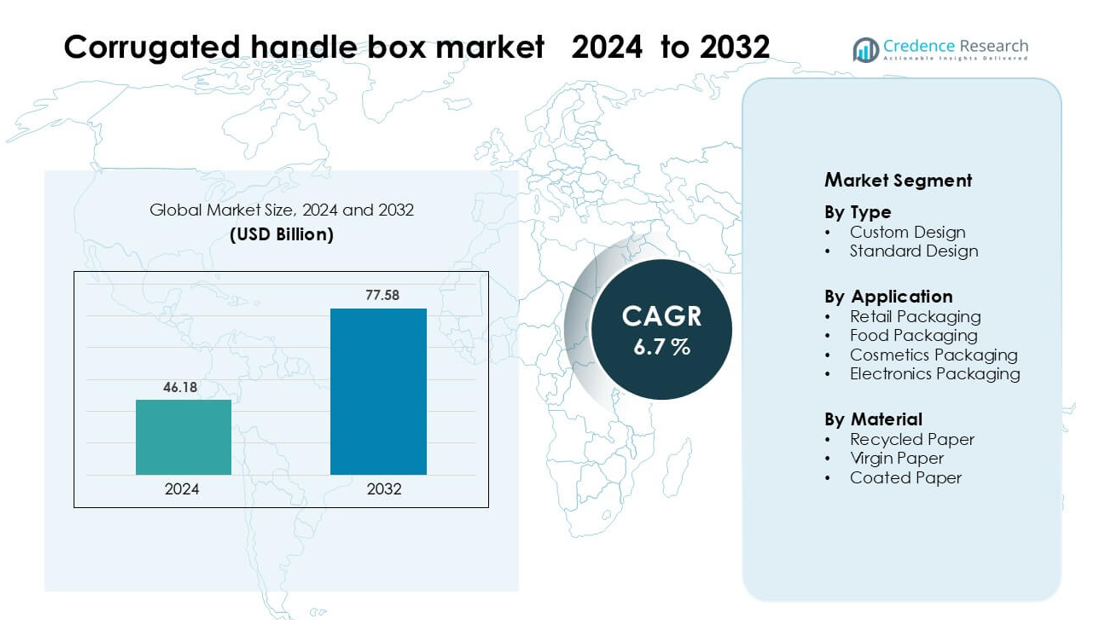
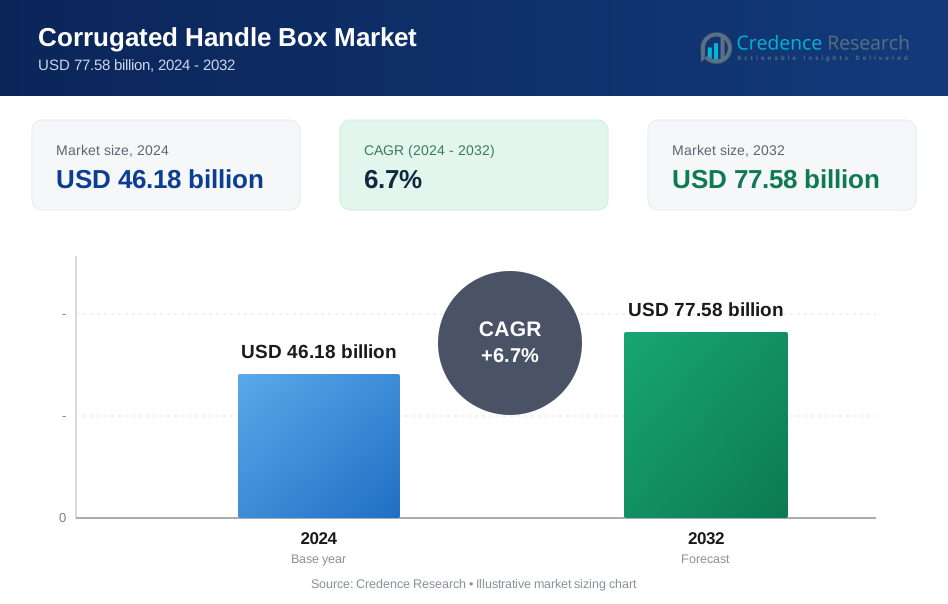
Corrugated handle box market was valued at USD 46.18 billion in 2024 and is anticipated to reach USD 77.58 billion by 2032, growing at a CAGR of 6.7 % during the forecast period.
| REPORT ATTRIBUTE | DETAILS |
|---|---|
| Historical Period | 2020-2023 |
| Base Year | 2024 |
| Forecast Period | 2025-2032 |
| Corrugated Handle Box Market Size 2024 | USD 46.18 billion |
| Corrugated Handle Box Market, CAGR | 6.7% |
| Corrugated Handle Box Market Size 2032 | USD 77.58 billion |
The corrugated handle box market is shaped by key players such as GWP Group, CBS Packaging, Unicraft, FOREST PACKING GROUP CO., LTD., Riverside Paper Co. Inc., REID Packaging, Guangzhou Bosing Paper Printing and Packaging Co., Ltd., Allen Field Company Inc., WH Skinner, and BR Engineering Plastics Private Limited. These companies compete through custom design capabilities, strong printing quality, and sustainable material use. Asia-Pacific remained the leading region in 2024 with about 41% share, supported by high retail activity, expanding e-commerce, and strong manufacturing capacity. Growing sustainability adoption and rising branding needs continue to strengthen competition across global markets.
Market Insights
- The Corrugated Handle Box Market was valued at USD 46.18 billion in 2024 and is projected to reach USD 77.58 billion by 2032, growing at a CAGR of 6.7 %.
- Strong demand for sustainable packaging drives growth as recycled paper boxes gain wider adoption, supporting the leading recycled material segment holding about 52% share in 2024.
- Custom-designed handle boxes remain the dominant type with nearly 58% share, supported by rising demand for branded, visually appealing, and durable formats across retail and food sectors.
- Competition intensifies among players such as GWP Group and CBS Packaging as companies invest in lightweight designs, improved printing tech, and reinforced handle structures while managing raw material fluctuations.
- Asia-Pacific led with about 41% share in 2024 due to strong retail, food delivery, and e-commerce expansion, followed by North America at 34%, while retail packaging remained the top application segment with nearly 46% share.
Market Segmentation Analysis:
By Type
Custom design held about 58% share in 2024 due to strong demand for brand-specific packaging that helps retailers improve shelf impact and product differentiation. Buyers choose custom formats because these boxes support unique dimensions, reinforced handles, and visual branding that boost consumer appeal. Standard design grew at a steady pace as companies with lower budgets preferred ready-made formats for fast procurement. Growth in custom variants also came from rising e-commerce needs, where brands sought durable and personalized packaging solutions.
- For instance, Mondi deployed its high-performance digital printing to produce corrugated boxes for KOMSA, enabling the company to ship up to 35,000 parcels per day with sequential barcodes printed directly on all four sides eliminating the need for separate labels.
By Application
Retail packaging dominated the segment with nearly 46% share in 2024 as stores used handle boxes for apparel, accessories, gifts, and premium goods. This application expanded because retailers needed sturdy, easy-to-carry packaging to enhance customer experience and branding. Food packaging grew quickly as bakeries and takeaway chains adopted corrugated handle boxes for safety and transport ease. Cosmetics and electronics packaging contributed steady demand as brands relied on compact, protective, and visually appealing formats for sensitive products.
- For instance, DS Smith developed its Easy Bowl® corrugated food-contact tray with a double rim that enabled Panvita to convert over 1.6 million trays annually, replacing rigid plastic containers and reducing plastic use significantly.
By Material
Recycled paper led the material segment with around 52% share in 2024 as brands focused on sustainability and cost-efficient packaging. Companies favored recycled grades because they lowered material waste and met rising environmental compliance needs across major markets. Virgin paper held a smaller but steady share where higher strength and print quality were required, especially for premium goods. Coated paper grew in niche uses due to its smooth surface and moisture resistance, supporting cosmetics and electronics packaging.
Key Growth Drivers
Rising Demand or Sustainable and Eco-Friendly Packaging
Sustainability remains a major growth engine for the corrugated handle box market as brands shift toward recyclable and low-impact packaging solutions. Many companies choose corrugated formats because the material reduces environmental load and aligns with global waste-reduction policies. Retailers and food chains steadily replace plastic carry containers with recycled corrugated boxes to meet evolving customer expectations around responsible packaging. This shift encourages higher adoption across apparel, bakery, cosmetics, and premium gift segments. Government regulations promoting biodegradable packaging further support this growth path. The trend strengthens as manufacturers introduce lightweight, durable, and visually enhanced corrugated designs that keep performance strong while maintaining eco-safe properties, boosting long-term demand.
- For instance, Mondi commissioned a recycled containerboard machine at its Duino mill in Italy that can produce 420,000 tonnes of containerboard annually from 100% recovered fibre, enhancing its capacity to supply eco-friendly corrugated solutions.
Expansion of E-Commerce and Omni-Channel Retail
The rapid rise of e-commerce plays a central role in increasing the need for strong, convenient, and branded packaging such as corrugated handle boxes. Online sellers rely on these boxes to enhance unboxing experience, offer easy handling, and ensure secure product delivery. Handle boxes also support hybrid retail formats where consumers buy online and pick up in-store, increasing the demand for durable, transport-friendly packaging. Growth in express delivery and subscription services adds steady volume to this segment. Brands benefit from the large printing surface of corrugated boxes, which helps strengthen identity and improve customer recognition. As global online retail continues its strong upward curve, demand for handle-equipped corrugated packaging grows across electronics, beauty, fashion, and gourmet food categories.
- For instance, Amazon operates more than 50 dedicated packaging labs worldwide, where its Frustration-Free Packaging program tests corrugated designs capable of withstanding up to 26 drop sequences under ISTA-6 standards, helping reduce damage during e-commerce shipments
Rising Use in Foodservice, Bakery, and Premium Retail
Foodservice chains, bakeries, and specialty retailers drive strong adoption because they require sturdy boxes with easy portability for takeaway items, confectionery, and premium goods. Corrugated handle boxes offer higher load-bearing strength, ventilation options, and personalized branding, making them suitable for delicate food and luxury gift products. Growth accelerates as small restaurants, cloud kitchens, and café chains adopt corrugated packaging to improve presentation and minimize leakage or damage. Premium retail brands also favor these boxes due to their ability to support creative shapes, embossing, and coatings. The combination of convenience, strength, and visual appeal expands the market footprint across diverse use cases, strengthening long-term demand.
Key Trend & Opportunity
Advancements in Box Customization and Print Technology
Digital and flexographic printing technologies create major opportunities by enabling brands to personalize corrugated handle boxes with high-quality visuals, QR codes, and product details. Retailers and consumer brands leverage this capability to create premium unboxing experiences and enhance shelf presence. Custom die-cutting, reinforced handles, and ergonomic box formats also support niche uses across cosmetics, electronics, and gourmet food. As manufacturers offer low-minimum-order customization, small businesses gain access to premium branded packaging that was earlier limited to large retailers. This trend unlocks wider adoption, encouraging new product innovation, high-value packaging formats, and stronger competitive differentiation in the market.
- For instance, HP’s PageWide T1195i Press, used by several major corrugated converters, can print at speeds up to 305 meters per minute and supports 1,200-dpi graphics, enabling large-scale production of highly customized corrugated boxes with variable data and branding.
Growing Shift Toward Lightweight and Cost-Optimized Packaging
Brands increasingly prefer lightweight corrugated handle boxes to reduce logistics costs and improve material efficiency. Manufacturers respond by developing thinner yet strong boards, advanced fluting structures, and hybrid paper combinations that maintain durability while reducing weight. This shift opens opportunities for high-volume sectors such as e-commerce, apparel, and food delivery. Lightweight packaging also supports sustainability goals by lowering fiber use and energy consumption during production. Together, these developments create new growth paths for manufacturers that offer efficient, durable, and cost-optimized handle box solutions tailored to diverse industry needs.
- For instance, DS Smith introduced its R-Flute®, designed to be thinner than B-flute while offering up to 15% more box strength per millimetre, allowing brands to optimize packaging weight without compromising durability.
Key Challenge
Fluctuating Costs of Paper and Raw Materials
Volatile prices of recycled paper, virgin fiber, adhesives, and coatings remain a major restraint for market growth. Manufacturers struggle to maintain stable pricing because raw material costs shift due to supply shortages, freight issues, and rising global demand for sustainable packaging. Sudden price spikes can reduce profit margins for small and mid-scale converters, limiting their ability to invest in new designs or advanced machinery. These fluctuations also push end-users to seek cheaper alternatives during economic slowdowns, affecting long-term stability. Managing raw material volatility remains a critical operational challenge for the industry.
Competition from Alternative Packaging Formats
Corrugated handle boxes face competitive pressure from reusable bags, rigid plastic containers, molded pulp carriers, and foldable paperboard boxes. These alternatives often offer lighter weight, lower cost, or better moisture resistance depending on the application. Retailers and food brands sometimes switch to alternative formats when seeking ultra-low-cost or waterproof solutions. Strong competition forces corrugated box manufacturers to innovate constantly, improve coating technologies, and strengthen value-added features such as branding and ergonomics. The need to differentiate against multiple packaging materials becomes a persistent challenge that shapes market strategies and investment priorities.
Regional Analysis
North America
North America held about 34% share in 2024, driven by strong use of corrugated handle boxes across retail, foodservice, and e-commerce sectors. Brands in the United States and Canada favored recyclable packaging as sustainability mandates strengthened. Rising adoption in apparel, bakery, and premium gift packaging supported steady market expansion. E-commerce players used durable handle boxes to improve delivery convenience and branding impact. Growth also came from small businesses choosing customizable formats for enhanced shelf presence. The regional focus on eco-friendly materials and high-quality printing kept demand stable across diverse applications.
Europe
Europe accounted for nearly 29% share in 2024 as strict environmental regulations boosted demand for recyclable corrugated handle boxes. Retailers and FMCG brands adopted recycled paper formats to comply with packaging waste directives. The presence of advanced printing and converting technologies encouraged broader use in cosmetics, gourmet food, and electronics packaging. Germany, France, Italy, and the U.K. led consumption due to strong retail and bakery sectors. Premium brands also preferred coated and custom-designed handle boxes for enhanced branding. Sustainability-driven innovation and regulatory alignment continued to shape the regional market landscape.
Asia-Pacific
Asia-Pacific dominated with approximately 41% share in 2024, supported by rapid expansion in retail, e-commerce, and food delivery services. China, India, Japan, and Southeast Asian markets showed strong adoption as businesses sought cost-efficient and durable packaging. Rising urbanization and growing organized retail chains fueled higher use of corrugated handle boxes for fashion, electronics, and takeaway food. Manufacturers benefited from abundant raw material availability and competitive production costs. Digital printing growth enabled small brands to offer attractive customized packaging. The region remained the fastest-growing due to rising consumer demand and expanding supply capabilities.
Latin America
Latin America captured around 12% share in 2024, driven by rising adoption in retail, bakery, and small business packaging. Brazil and Mexico led the region as demand grew for lightweight and cost-effective corrugated handle boxes. Food delivery services continued to expand, supporting higher consumption of durable takeaway packaging. Economic shifts encouraged brands to move toward recyclable materials as sustainability awareness grew. Limited local manufacturing capabilities in some countries slowed high-end customization, but demand remained steady across apparel, cosmetics, and artisanal product packaging. Growth prospects improved with increasing investment in packaging upgrades.
Middle East & Africa
The Middle East & Africa region held nearly 9% share in 2024 as demand increased from retail chains, confectionery brands, and rising e-commerce activity. The UAE, Saudi Arabia, and South Africa led adoption due to expanding modern trade channels and premium gifting culture. Growing interest in sustainable packaging encouraged gradual transition from plastic carriers to corrugated handle boxes. Foodservice and bakery applications supported consistent usage, especially in urban centers. While customization adoption remained slower than other regions, rising import availability and local production improvements strengthened the market outlook.
Market Segmentations:
By Type
- Custom Design
- Standard Design
By Application
- Retail Packaging
- Food Packaging
- Cosmetics Packaging
- Electronics Packaging
By Material
- Recycled Paper
- Virgin Paper
- Coated Paper
By Geography
- North America
- U.S.
- Canada
- Mexico
- Europe
- Germany
- France
- U.K.
- Italy
- Spain
- Rest of Europe
- Asia Pacific
- China
- Japan
- India
- South Korea
- South-east Asia
- Rest of Asia Pacific
- Latin America
- Brazil
- Argentina
- Rest of Latin America
- Middle East & Africa
- GCC Countries
- South Africa
- Rest of the Middle East and Africa
Competitive Landscape
The competitive landscape of the corrugated handle box market features a mix of global converters, regional packaging specialists, and custom box manufacturers focused on sustainable, durable, and brand-enhancing solutions. Companies such as GWP Group, CBS Packaging, Unicraft, FOREST PACKING GROUP CO., LTD., and Riverside Paper Co. Inc. strengthen competition through advanced corrugation technology, strong print capabilities, and tailored design services. REID Packaging and Guangzhou Bosing Paper Printing and Packaging Co., Ltd. emphasize customized formats and fast-turnaround production for retail, food, and gift packaging. Allen Field Company Inc., WH Skinner, and BR Engineering Plastics Private Limited expand market reach with specialty handles, reinforced structures, and structural engineering expertise. Competitors invest in eco-friendly materials, digital printing upgrades, and lightweight board innovations to meet rising sustainability expectations and brand-driven customization needs. The market remains moderately fragmented, with companies competing on design versatility, quality, pricing, and supply reliability across global and regional segments.
Key Player Analysis
- GWP Group
- CBS PACKAGING
- Unicraft
- FOREST PACKING GROUP CO., LTD.
- Riverside Paper Co. Inc.
- REID PACKAGING
- Guangzhou Bosing Paper Printing and Packaging Co., Ltd
- Allen Field Company Inc.
- WH Skinner
- BR Engineering Plastics Private Limited
Recent Developments
- In September 2025, DuPont™ Cyrel® Flexographic Solutions unveiled its new branded DEC-185 flexo plates in India at the IndiaCorr Expo, embedding the DuPont™ Cyrel® logo into the plate base to assure authenticity and help customers avoid counterfeit products. The DEC-185 is a low-to-medium durometer digital plate designed for demanding corrugated board applications, offering strong ink transfer, high exposure resolution, and compatibility with water-based inks.
- In July 2025, UniPack Corrugated announced the acquisition of Congzhou Machinery, marking its entry into the Indian packaging machinery market. The deal establishes “UniPack India,” which will localise manufacturing through two plants for corrugated lines, rolls, and re-fluting services, supported by seven spare-parts hubs and regional sales offices. UniPack also introduced its product ranges-UniCorr lines (Smart, Pro, Giant), finishing equipment (UniPrint, UniCut, UniFold)-alongside a strong support infrastructure offering technical assistance in regional languages, aiming to capture the INR 50,000-crore corrugated packaging sector in India.
- In October 2024, Reid Packaging acquired by TransPak.TransPak announced the acquisition of Reid Packaging (Peachtree Corners / Atlanta area) to expand its East Coast packaging, crating, and corrugated capability a move that strengthens regional capacity for custom corrugated and industrial packaging solutions.
Report Coverage
The research report offers an in-depth analysis based on Type, Application, Material and Geography. It details leading market players, providing an overview of their business, product offerings, investments, revenue streams, and key applications. Additionally, the report includes insights into the competitive environment, SWOT analysis, current market trends, as well as the primary drivers and constraints. Furthermore, it discusses various factors that have driven market expansion in recent years. The report also explores market dynamics, regulatory scenarios, and technological advancements that are shaping the industry. It assesses the impact of external factors and global economic changes on market growth. Lastly, it provides strategic recommendations for new entrants and established companies to navigate the complexities of the market.
Future Outlook
- Demand for sustainable corrugated handle boxes will grow as brands move away from plastic.
- Custom-designed boxes will gain traction as companies prioritize stronger branding and customer appeal.
- E-commerce expansion will increase the need for durable, lightweight, and easy-to-carry packaging.
- Food delivery and bakery chains will adopt reinforced handle boxes to improve transport safety.
- Digital printing will advance, allowing faster customization and better visual quality.
- Recycled paper use will rise as firms align with stricter environmental standards.
- Premium products will drive demand for coated and high-strength handle box designs.
- Automation in converting and printing processes will boost efficiency and reduce production time.
- Small businesses will adopt low-volume custom printing as technology becomes more accessible.
- Emerging markets will experience strong growth due to expanding retail and shifting consumer preferences.
Request a Free Sample
Fill in your details and we'll send you a free sample report.
- Sample data tables & charts
- Research methodology
Market Dynamics
Sustainability and Eco-Friendly Packaging
Brands and retailers are increasingly shifting to corrugated handle boxes made from recycled materials to meet consumer and regulatory demands for sustainable, low-impact packaging. This trend is driving the adoption of recycled paper-based handle boxes, especially as companies seek to reduce plastic use and align with global waste-reduction policies.
Expansion of E-Commerce and Omni-Channel Retail
The rapid growth of e-commerce and hybrid retail models is fueling demand for durable, branded, and easy-to-carry corrugated handle boxes. Online sellers and retailers require packaging that enhances the unboxing experience, protects products during transit, and supports branding, leading to increased use of custom and standard handle box formats.
Advancements in Customization and Print Technology
Digital and flexographic printing advancements enable brands to create highly customized, visually appealing corrugated handle boxes with features like QR codes and premium graphics. This supports stronger brand differentiation and allows even small businesses to access low-volume, high-quality custom packaging.
Rising Use in Foodservice, Bakery, and Premium Retail
Foodservice chains, bakeries, and premium retailers are adopting corrugated handle boxes for their strength, portability, and ability to support creative branding. The need for sturdy, attractive, and safe packaging for takeaway, confectionery, and luxury goods is expanding the market across these segments.
Shift Toward Lightweight and Cost-Optimized Packaging
Manufacturers are innovating with thinner, stronger corrugated boards and advanced fluting structures to reduce packaging weight and logistics costs. This not only supports sustainability goals but also appeals to high-volume sectors like e-commerce and food delivery, driving further market growth.
Need a Custom Version of This Report?
Tailor the scope, geography, or segments to your exact requirements.
- Custom geography or segment scope
- Direct access to our analyst team
Frequently Asked Questions
What is the current market size for Corrugated Handle Box Market, and what is its projected size in 2032?
At what Compound Annual Growth Rate is the Corrugated Handle Box Market projected to grow between 2025 and 2032?
Which is the leading market for Corrugated Handle boxes?
What are the key drivers for the growth of the Corrugated Handle Box market?
Who are the leading companies in the Corrugated Handle Box Market?
Table of Content
Chapter 1 Market Segmentation
- 1.1 Segmentation Framework
- 1.1.1 Product and Service Classification
- 1.1.2 Application and End-Use Classification
- 1.1.3 Technology and Solution Classification
- 1.1.4 Customer and Distribution Channel Classification
- 1.1.5 Geographic Segmentation
- 1.1.6 Market Segment Definitions and Boundaries
- 1.2 By Type
- 1.2.1 Custom Design
- 1.2.2 Standard Design
- 1.3 By Material
- 1.3.1 Recycled Paper
- 1.3.2 Virgin Paper
- 1.3.3 Coated Paper
- 1.4 By Application
- 1.4.1 Retail Packaging
- 1.4.2 Food Packaging
- 1.4.3 Cosmetics Packaging
- 1.4.4 Electronics Packaging
Chapter 2 Introduction
- 2.1 Report Objectives and Scope
- 2.2 Product Definition and Industry Terminology
- 2.3 Market Inclusions and Exclusions
- 2.4 Research Process
- 2.4.1 Primary Research and Expert Interviews
- 2.4.2 Secondary Research and Source Review
- 2.4.3 Top-Down and Bottom-Up Estimation
- 2.4.4 Data Triangulation and Verification
- 2.5 Market Size Measurement Basis
- 2.5.1 2024: USD 46.18 billion → 2032: USD 77.58 billion
- 2.6 Historical and Forecast Reference Periods
- 2.6.1 Base Year: 2024
- 2.6.2 Forecast Period: 2024-2032
- 2.7 Research Assumptions and Limitations
Chapter 3 Executive Summary
- 3.1 Market Snapshot and Key Findings
- 3.2 Base-Year Market Size, 2024
- 3.3 Forecast Market Size, 2032
- 3.4 Revenue and Volume Growth Outlook
- 3.5 Key Demand and Supply Indicators
- 3.6 Leading Market Segments
- 3.7 Fastest-Growing Market Opportunities
- 3.8 Regional Performance Highlights
- 3.9 Technology and Industry Transformation
- 3.10 Competitive Landscape Summary
- 3.11 Analyst View and Strategic Implications
Chapter 4 Global Corrugated Handle Box Market Trends and Developments
- 4.1 Historical Industry Development
- 4.2 Recent Market Trends and Developments
- 4.3 Demand and Customer Behavior Trends
- 4.4 Technology and Product Innovation
- 4.5 Artificial Intelligence, Automation and Digitalization
- 4.6 Local Manufacturing and Supply Chain Realignment
- 4.7 Industry Partnerships, Mergers and Acquisitions
- 4.8 Sustainability and Circular Economy Developments
- 4.9 Government and Private Sector Investment Trends
- 4.10 Emerging Business Models and Commercialization
- 4.11 Industry Developments and Announcements
Chapter 5 Global Corrugated Handle Box Market Production, Supply and Demand Analysis
- 5.1 Demand Trend and Consumption Analysis
- 5.2 Demand Forecast, 2024-2032
- 5.3 Production and Output Trend
- 5.4 Production and Output Forecast, 2024-2032
- 5.5 Installed Capacity and Capacity Utilization
- 5.6 Company-Wise Production Plants and Statistics
- 5.6.1 Installed Production Capacity
- 5.6.2 Actual Production
- 5.6.3 Planned Capacity and Expansion Targets
- 5.7 Supply Chain Structure and Procurement Trends
- 5.8 Supply-Demand Gap and Bottlenecks
- 5.9 Import Dependence and Sourcing Structure
- 5.10 Contract Manufacturing and Outsourcing
- 5.11 Regional Supply and Demand Concentration
Chapter 6 Global Corrugated Handle Box Market Pricing Analysis
- 6.1 Pricing Structure and Measurement
- 6.2 Historical Pricing Trends
- 6.3 Pricing Outlook, 2024-2032
- 6.4 Average Selling Price and Unit Economics
- 6.5 Pricing by Product and Market Segment
- 6.6 Geographic Pricing Differences
- 6.7 Key Input, Energy, Labor and Logistics Costs
- 6.8 Contract Pricing and Purchasing Models
- 6.9 Pricing Sensitivity and Competitive Positioning
- 6.10 Price, Margin and Profitability Implications
Chapter 7 Global Corrugated Handle Box Market Dynamics
- 7.1 Market Growth Drivers
- 7.1.1 Demand-Side Drivers
- 7.1.2 Technology and Innovation Drivers
- 7.1.3 Infrastructure and Investment Drivers
- 7.1.4 Regulatory and Policy Drivers
- 7.2 Market Restraints
- 7.2.1 Cost and Affordability Constraints
- 7.2.2 Technology and Adoption Barriers
- 7.2.3 Supply Chain and Operational Constraints
- 7.3 Market Challenges
- 7.3.1 Competitive Pressure and Margin Erosion
- 7.3.2 Skills, Infrastructure and Implementation Gaps
- 7.4 Emerging Market Opportunities
- 7.5 Market Dynamics Impact and Time-Horizon Assessment
Chapter 8 Global Corrugated Handle Box Value Chain Analysis
- 8.1 Industry Value Chain Overview
- 8.2 Upstream Suppliers and Critical Inputs
- 8.3 Technology and Component Providers
- 8.4 Manufacturing or Service Delivery
- 8.5 Distribution, Channel Partners and Integrators
- 8.6 Downstream Applications and End Users
- 8.7 Value Addition and Profit Pools
- 8.8 Vertical Integration and Outsourcing
- 8.9 Supplier Concentration and Risk
- 8.10 Supply Chain Localization and Resilience
Chapter 9 Global Corrugated Handle Box Market Regulations and Policies
- 9.1 Relevant Laws, Standards and Compliance Frameworks
- 9.2 Product, Service, Safety and Quality Requirements
- 9.3 Government Policies, Incentives and Subsidies
- 9.4 Imports, Exports and Trade Barriers
- 9.5 Public Procurement and Local Content Requirements
- 9.6 Environmental and Sustainability Compliance
- 9.7 Upcoming Policy Changes and Market Implications
Chapter 10 Global Corrugated Handle Box Market Hotspots and Opportunities
- 10.1 Market Opportunity Mapping and Growth Hotspots
- 10.2 High-Growth Applications and Customer Groups
- 10.3 Underserved Markets and White-Space Opportunities
- 10.4 Emerging Technology and Product Opportunities
- 10.5 New Capacity and Investment Hotspots
- 10.6 Market Entry and Expansion Opportunities
- 10.7 Distribution and Partnership Opportunities
- 10.8 Near-Term and Long-Term Commercial Potential
- 10.9 Opportunity Attractiveness and Execution Risks
Chapter 11 Global Corrugated Handle Box Market Outlook, 2024-2032
- 11.1 Market Size and Analysis
- 11.1.1 Revenue (Market Measurement: 2024: USD 46.18 billion → 2032: USD 77.58 billion)
- 11.1.2 Market Volume and Quantity Sold
- 11.1.3 Historical Market Size
- 11.1.4 Base-Year Market Size, 2024
- 11.2 Market Forecast, 2024-2032
- 11.2.1 Revenue Forecast to 2032
- 11.2.2 Volume Forecast to 2032
- 11.2.3 CAGR and Year-on-Year Growth
- 11.2.4 Incremental Revenue Opportunity
- 11.3 Forecast Assumptions and Scenario Analysis
- 11.3.1 Base-Case Forecast
- 11.3.2 Optimistic and Conservative Scenarios
- 11.3.3 Technology, Pricing and Policy Sensitivities
- 11.4 Market Attractiveness and Growth Outlook
Chapter 12 Global Corrugated Handle Box Market Segmentation and Outlook
- 12.1 Segmentation Summary and Market Shares, 2024
- 12.2 Largest and Fastest-Growing Segments
- 12.3 By Type - Market Size and Forecast, 2024-2032
- 12.3.1 Segment Definition and Scope
- 12.3.2 Historical Market Size
- 12.3.3 Revenue Forecast, 2024-2032
- 12.3.4 Volume Forecast, 2024-2032
- 12.3.5 Base-Year Market Share, 2024
- 12.3.6 Segment CAGR and Growth Drivers
- 12.3.7 Subsegment Market Size and Forecast
- 12.3.7.1 Custom Design
- 12.3.7.2 Standard Design
- 12.3.8 Subsegment Pricing and Adoption Trends
- 12.3.9 Leading Suppliers and Competition
- 12.3.10 Regional Demand and Opportunities
- 12.4 By Material - Market Size and Forecast, 2024-2032
- 12.4.1 Segment Definition and Scope
- 12.4.2 Historical Market Size
- 12.4.3 Revenue Forecast, 2024-2032
- 12.4.4 Volume Forecast, 2024-2032
- 12.4.5 Base-Year Market Share, 2024
- 12.4.6 Segment CAGR and Growth Drivers
- 12.4.7 Subsegment Market Size and Forecast
- 12.4.7.1 Recycled Paper
- 12.4.7.2 Virgin Paper
- 12.4.7.3 Coated Paper
- 12.4.8 Subsegment Pricing and Adoption Trends
- 12.4.9 Leading Suppliers and Competition
- 12.4.10 Regional Demand and Opportunities
- 12.5 By Application - Market Size and Forecast, 2024-2032
- 12.5.1 Segment Definition and Scope
- 12.5.2 Historical Market Size
- 12.5.3 Revenue Forecast, 2024-2032
- 12.5.4 Volume Forecast, 2024-2032
- 12.5.5 Base-Year Market Share, 2024
- 12.5.6 Segment CAGR and Growth Drivers
- 12.5.7 Subsegment Market Size and Forecast
- 12.5.7.1 Retail Packaging
- 12.5.7.2 Food Packaging
- 12.5.7.3 Cosmetics Packaging
- 12.5.7.4 Electronics Packaging
- 12.5.8 Subsegment Pricing and Adoption Trends
- 12.5.9 Leading Suppliers and Competition
- 12.5.10 Regional Demand and Opportunities
- 12.6 Segment Growth Comparison
- 12.7 Segment Attractiveness and Priority Matrix
Chapter 13 Global Corrugated Handle Box End-Use and Application Market Outlook
- 13.1 End-Use Industry and Customer Demand Structure
- 13.2 Leading Applications and Customer Groups
- 13.3 End-Use Market Size, Share and Forecast
- 13.4 Major End-Use Industry Deep Dives
- 13.4.1 Customer Requirements and Use Cases
- 13.4.2 Demand and Replacement Cycles
- 13.4.3 Technical and Regulatory Considerations
- 13.4.4 Purchasing and Procurement Models
- 13.4.5 Leading Vendors and Distribution Channels
- 13.4.6 Forecast and Commercial Opportunities
- 13.5 Emerging Applications and Cross-Segment Demand
- 13.6 End-Use Industry Investment Priorities
Chapter 14 Global Corrugated Handle Box Geographic Market Outlook, 2024-2032
- 14.1 Regional Market Size and Share, 2024
- 14.2 Regional Market Forecast, 2024-2032
- 14.3 Regional Pricing, Production and Demand Differences
- 14.4 North America
- 14.4.1 United States
- 14.4.2 Canada
- 14.4.3 Mexico
- 14.5 Europe
- 14.5.1 Germany
- 14.5.2 France
- 14.5.3 Italy
- 14.5.4 United Kingdom
- 14.5.5 Spain
- 14.5.6 Poland
- 14.5.7 Russia
- 14.5.8 Netherlands
- 14.5.9 Belgium
- 14.5.10 Sweden
- 14.5.11 Denmark
- 14.5.12 Norway
- 14.5.13 Rest of Europe
- 14.6 Asia Pacific
- 14.6.1 China
- 14.6.2 India
- 14.6.3 Japan
- 14.6.4 South Korea
- 14.6.5 Thailand
- 14.6.6 Indonesia
- 14.6.7 Vietnam
- 14.6.8 Malaysia
- 14.6.9 Australia
- 14.6.10 Rest of Asia Pacific
- 14.7 Latin America
- 14.7.1 Brazil
- 14.7.2 Argentina
- 14.7.3 Colombia
- 14.7.4 Chile
- 14.7.5 Rest of Latin America
- 14.8 Middle East
- 14.8.1 Saudi Arabia
- 14.8.2 United Arab Emirates
- 14.8.3 Turkey
- 14.8.4 Israel
- 14.8.5 Iran
- 14.8.6 Rest of the Middle East
- 14.9 Africa
- 14.9.1 South Africa
- 14.9.2 Egypt
- 14.9.3 Nigeria
- 14.9.4 Morocco
- 14.9.5 Rest of Africa
- 14.10 Regional Investment, Policy and Supply Chain Differences
- 14.11 Regional Competitive Landscape
- 14.12 Geographic Growth Hotspots
Chapter 15 Global Corrugated Handle Box Technology, Innovation and Sustainability Outlook
- 15.1 Technology Landscape and Maturity
- 15.2 Product, Process and Service Innovation
- 15.3 AI, Automation and Digital Tools in the Industry
- 15.4 Technology Adoption and Performance Benchmarking
- 15.5 Innovation Pipeline and R&D Investment
- 15.6 Patent and Intellectual Property Trends
- 15.7 Energy Efficiency and Resource Management
- 15.8 Sustainability, Recycling and Circularity
- 15.9 Technology Roadmap, 2024-2032
- 15.10 Risks of Obsolescence and Technology Substitution
Chapter 16 Global Corrugated Handle Box Market Key Strategic Imperatives
- 16.1 Growth and Market Entry Priorities
- 16.2 High-Return Products and Segments
- 16.3 Pricing, Profitability and Cost Optimization
- 16.4 Technology Investment and Product Differentiation
- 16.5 Supply Chain Localization and Resilience
- 16.6 Distribution and Customer Acquisition
- 16.7 Partnership, Acquisition and Capacity Strategy
- 16.8 Regional Expansion Priorities
- 16.9 Short-, Medium- and Long-Term Actions
Chapter 17 Competition Outlook
- 17.1 Industry Competition Characteristics
- 17.2 Market Structure and Concentration
- 17.3 Market Share and Competitive Positioning, 2024
- 17.4 Company-Wise Revenue and Product Benchmarking
- 17.5 Production and Service Capacity Benchmarking
- 17.6 Technology, Pricing and Differentiation
- 17.7 Regional Footprint and Distribution Strength
- 17.8 Mergers, Acquisitions and Strategic Alliances
- 17.9 New Entrants and Competitive Threats
- 17.10 Porter's Five Forces and Industry Attractiveness
- 17.11 Competitive Outlook, 2024-2032
Chapter 18 Company Profiles
- 18.1 Company Coverage and Selection Criteria
- 18.2 GWP Group
- 18.2.1 Business Description
- 18.2.2 Company Ownership and Geographic Presence
- 18.2.3 Product and Service Portfolio
- 18.2.4 Manufacturing and Operating Footprint
- 18.2.5 Production Capacity and Expansion Plans
- 18.2.6 Financial Performance and Investment
- 18.2.7 Market Share and Competitive Position
- 18.2.8 Technology and Innovation Capabilities
- 18.2.9 Strategic Alliances or Partnerships
- 18.2.10 Recent Developments
- 18.2.11 Growth Strategy and Outlook
- 18.3 CBS Packaging
- 18.4 Unicraft
- 18.5 FOREST PACKING GROUP CO., LTD.
- 18.6 Riverside Paper Co. Inc.
- 18.7 REID Packaging
- 18.8 Guangzhou Bosing Paper Printing and Packaging Co., Ltd.
- 18.9 Allen Field Company Inc.
- 18.10 WH Skinner
- 18.11 BR Engineering Plastics Private Limited
- 18.12 Other Relevant Market Participants
Note: Every listed company is profiled on the structure shown under the first company. The company list is preliminary and may change based on research findings, market developments, data availability and client requirements.
Chapter 19 Disclaimer
- 19.1 Research and Forecast Disclaimer
- 19.2 Data Source and Estimation Limitations
Note: The depth of individual sections depends on data availability for this market. Volume, capacity, trade and other unit-based metrics are included where applicable.