Cell-Free RNA (cfRNA) Analysis Market Size Overview:
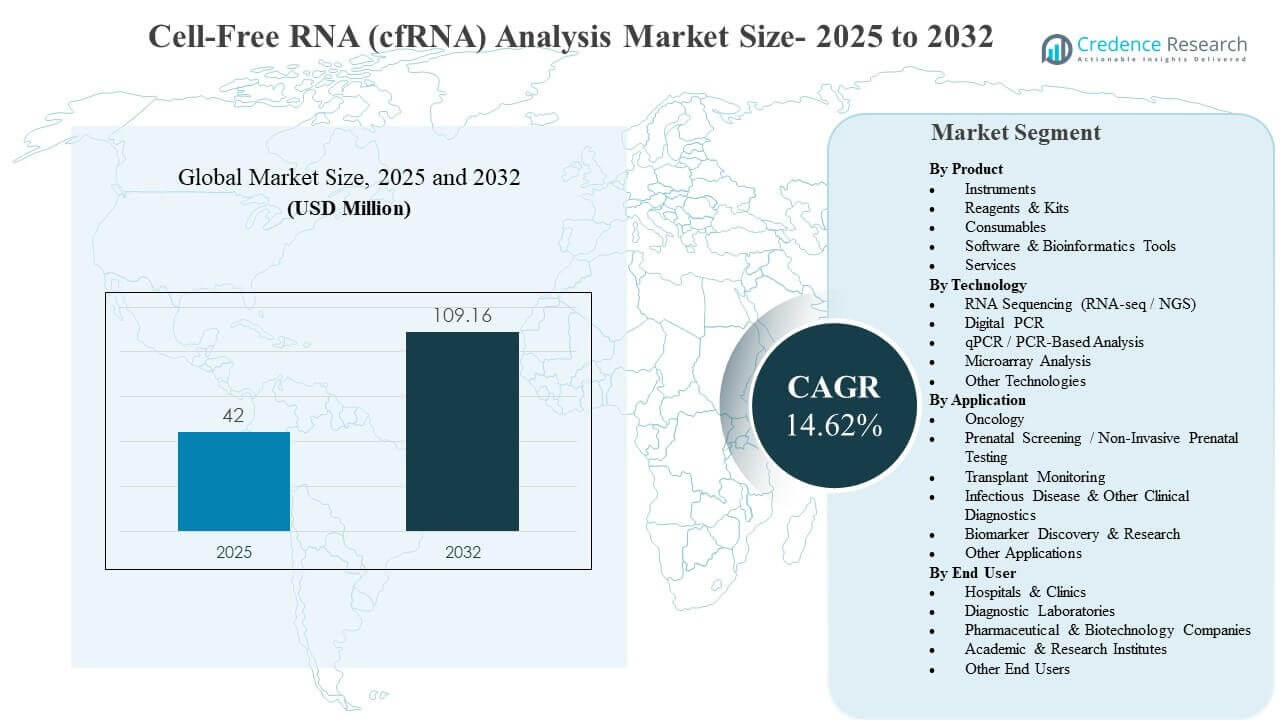
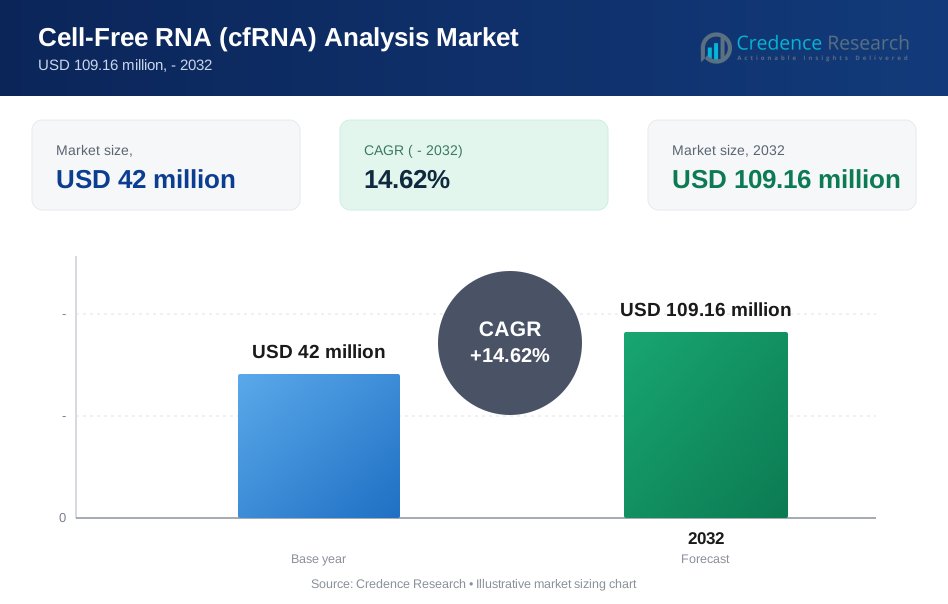
The global Cell-Free RNA (cfRNA) Analysis Market Size was estimated at USD 42 million in 2025 and is expected to reach USD 109.16 million by 2032, growing at a CAGR of 14.62% from 2025 to 2032. Growth momentum is primarily driven by expanding liquid biopsy workflows that increasingly require RNA-level signals to improve disease characterization, therapy monitoring, and biomarker validation across clinical and translational settings. North America remains the largest commercialization hub, supported by strong sequencing infrastructure, advanced diagnostics adoption, and concentrated supplier ecosystems across instruments, reagents, and bioinformatics.
| REPORT ATTRIBUTE | DETAILS |
|---|---|
| Historical Period | 2020-2024 |
| Base Year | 2025 |
| Forecast Period | 2026-2032 |
| Cell-Free RNA (cfRNA) Analysis Market Size 2025 | USD 42 million |
| Cell-Free RNA (cfRNA) Analysis Market, CAGR | 14.62% |
| Cell-Free RNA (cfRNA) Analysis Market Size 2032 | USD 109.16 million |
Key Market Trends & Insights
- The Cell-Free RNA (cfRNA) Analysis Market Size expands from USD 42 million (2025) to USD 109.16 million (2032) at 14.62% CAGR (2025–2032).
- RNA Sequencing (RNA-seq/NGS) leads technology adoption with 48.6% share (2025) as transcriptome-scale profiling supports signature discovery and assay development.
- Reagents & Kits represent the largest product pool at 41.7% share (2025) due to per-sample consumption across extraction, library preparation, and QC steps.
- Oncology accounts for the leading application footprint at 39.4% share (2025) as cfRNA complements ctDNA for monitoring and tumor biology insights.
- North America holds the leading regional position at 39.2% share (2025), reflecting mature molecular diagnostics infrastructure and high research intensity.
Segment Analysis
Cell-free RNA analysis adoption is shaped by workflow sensitivity, where low-abundance and fragmented RNA creates strong demand for optimized extraction chemistries, contamination control, and repeatable pre-analytics. Standardized pipelines that reduce variability across collection, stabilization, isolation, and library preparation remain a decisive purchase factor for hospitals, diagnostic laboratories, and translational research groups. As cfRNA signatures broaden beyond discovery studies, end users increasingly prioritize turnkey workflows that preserve compatibility across RT-qPCR, digital PCR, and sequencing outputs.
Technology selection is increasingly use-case driven. RNA-seq/NGS remains central for discovery and assay refinement, especially when the objective requires broad transcript detection, splice variants, and pathway-level signals. Digital PCR and qPCR-based approaches gain traction for sensitive confirmation and longitudinal monitoring once target panels are defined, supporting operational scale-up in diagnostic laboratories. Bioinformatics tools and services expand alongside multi-sample studies, since robust interpretation of cfRNA signals requires normalization, batch correction, and clinically meaningful reporting.
By Product Insights
Reagents & Kits accounted for the largest share of 41.7% in 2025. Reagents & kits lead because cfRNA workflows consume extraction and preparation inputs per sample, and higher sample volumes directly increase recurring spend. Demand concentrates around RNA stabilization, isolation, library preparation, and assay controls that improve reproducibility and reduce false signals from degradation or contamination. Service and software expansion also lifts reagent usage because outsourced sequencing and analysis still require standardized upstream chemistries and validated protocols.
By Technology Insights
RNA Sequencing (RNA-seq / NGS) accounted for the largest share of 48.6% in 2025. RNA-seq/NGS leads because transcriptome-scale profiling supports biomarker discovery, panel design, and multi-disease signature development from plasma and other biofluids. RNA-seq/NGS also enables higher-dimensional interpretation such as differential expression and pathway-level signals, which improves biological resolution versus single-target assays. Digital PCR and qPCR-based analysis remain essential for sensitive verification and routine monitoring once targets are established.
By Application Insights
Oncology accounted for the largest share of 39.4% in 2025. Oncology leads because liquid biopsy programs require minimally invasive tools for disease detection, stratification, and longitudinal monitoring, and cfRNA expands the biomarker space beyond DNA alterations. cfRNA-derived expression and fusion signals support therapy response assessment and residual disease investigation in research and translational settings. Biomarker discovery demand remains strong because oncology programs continuously refresh target panels and require large-scale validation.
By End User Insights
Diagnostic Laboratories accounted for the largest share of 31.8% in 2025. Diagnostic laboratories lead because centralized testing models allow consolidation of sample throughput, instrument utilization, and standardized SOPs across multi-site collections. Diagnostic laboratories also maintain the operational structure to integrate extraction automation, sequencing workflows, and data interpretation tools at scale. Hospitals and clinics contribute meaningfully through sample collection and care pathways, but high-complexity processing and analytics remain concentrated in laboratory environments.
Cell-Free RNA (cfRNA) Analysis Market Drivers
Expansion Of Liquid Biopsy And Longitudinal Monitoring Workflows
Liquid biopsy programs increasingly seek RNA-level signals to complement DNA alterations, improving disease characterization and biological interpretation. cfRNA supports non-invasive monitoring across treatment cycles, which increases recurring testing demand in oncology and other clinical areas. Research-to-clinic translation also strengthens funding and procurement for standardized workflows spanning extraction, quantification, and sequencing. As biomarker pipelines mature, clinical validation programs expand sample volumes, raising sustained consumption of reagents, kits, and data analysis capabilities.
- For instance, in the PREMOM study (NCT04990141) spanning 9,586 pregnant women across 14 Spanish hospitals (2021–2024), trimester-specific plasma cfRNA profiling predicted early-onset preeclampsia with 83% sensitivity and 88% specificity (AUC 0.85) at 18.0 weeks before clinical onset, and late-onset preeclampsia with 86% sensitivity and 89% specificity (AUC 0.88) at 14.9 weeks before onset, demonstrating large-scale clinical validation driving standardized cfRNA workflow adoption.
Higher Sensitivity Requirements For Low-Abundance Biomarkers
cfRNA samples often contain fragmented and low-concentration material, creating a strong emphasis on high-yield extraction and robust downstream detection. End users prioritize technologies that improve sensitivity and reproducibility, which supports adoption of advanced NGS workflows and high-performance PCR platforms. Workflow optimization reduces variability from pre-analytic handling and improves confidence in longitudinal measurement. This sensitivity-driven purchasing behavior strengthens demand for validated kits, QC controls, and automation-friendly protocols.
Growing Biopharma Use In Biomarker Discovery And Trial Enablement
Biopharmaceutical and biotechnology companies expand cfRNA usage for translational research, patient stratification, and response monitoring in clinical trials. cfRNA expression and fusion signals can support pharmacodynamic insights and mechanism-of-action validation, strengthening the role of cfRNA analytics in development pipelines. As trial footprints grow, external partners and CRO-linked laboratories increase throughput needs across sequencing and analysis. Expanded trial-driven volume strengthens demand across reagents, sequencing, software, and specialized services.
Advancements In Bioinformatics And Multi-Omics Integration
cfRNA interpretation requires robust computational workflows for normalization, batch correction, and clinically meaningful reporting. Increasing integration of multi-omics approaches encourages adoption of bioinformatics tools that link cfRNA signals with DNA variants, proteins, and clinical metadata. Improved pipelines reduce false positives and enhance reproducibility, supporting broader adoption in translational settings. Demand also rises for standardized analysis modules that support regulated workflows and scalable reporting across diagnostic laboratories.
- For instance, Exai Bio developed Exai-1, a multimodal transformer-based foundation model pretrained on 7,349 cfRNA features across 13,014 plasma and serum samples (6,792 serum, 6,222 plasma) from 11 suppliers, achieving R² 0.89 (95% CI: 0.88–0.89) versus 0.57 for dataset-average baseline, coupled with an automated cfRNA assay processing hundreds of samples per batch.
Cell-Free RNA (cfRNA) Analysis Market Challenges
Pre-analytical variability remains a major constraint for cfRNA workflows because collection tubes, stabilization conditions, transport time, and processing protocols can alter RNA integrity and downstream results. Standardization across sites remains difficult, especially in multi-center studies where operational differences influence assay reproducibility. Sample scarcity and fragmentation further complicate data quality, increasing the burden on extraction performance and QC. These factors slow clinical translation and increase the need for validated end-to-end workflows.
- For instance, Streck's Cell-Free RNA BCT® tubes demonstrated stable cfRNA preservation for 7 days at 18–25°C with no significant degradation in spike-in control recovery (coefficient of variation <8%) across 48 samples in a 2024 multi-site validation study, while preventing white blood cell lysis that would otherwise increase background RNA by 12–15-fold compared to standard K3EDTA tubes.
Data interpretation complexity adds another barrier because cfRNA profiles reflect mixed biological signals from multiple tissues and cell types, which complicates attribution and clinical decision-making. Bioinformatics pipelines require careful normalization and confounder control, particularly when batch effects arise across sequencing runs or sites. Clinical validation requires large datasets and robust reference baselines, increasing cost and time-to-deployment. Skills gaps in computational biology and regulated reporting further constrain adoption in resource-limited environments.
Cell-Free RNA (cfRNA) Analysis Market Trends and Opportunities
Multi-omics study designs represent a major opportunity as developers combine cfRNA with complementary analytes to improve sensitivity and biological interpretability. The approach supports richer signatures for oncology and broader clinical diagnostics, which strengthens demand for integrated sample preparation, sequencing, and analysis platforms. Automation adoption is also rising because laboratories aim to reduce hands-on time and improve repeatability across high-throughput operations. These trends expand value capture across instruments, reagents, software, and services.
- For example, a 2024 multi-omics workflow combining cfDNA signatures (methylation, fragment length, motif ends, copy number alterations) with cfmRNA features from 822 subjects increased overall sensitivity from 64–81% (cfDNA-only) to 71–73% across breast, colorectal, and gastric cancers at 92.6% specificity, with cfmRNA features contributing 19% of total discriminative features enriched in immune-related pathways.
Targeted cfRNA panels and streamlined workflows create another growth pathway as discovery outputs transition into operational assays with defined markers. Targeted designs reduce sequencing burden and enable scalable monitoring in diagnostic laboratories, supporting broader deployment and repeat testing. Expanded use beyond oncology, including transplant monitoring and infectious disease-related applications, broadens the addressable customer base across clinical networks. Wider clinical adoption increases the need for standardized analytics, quality systems, and interoperable reporting solutions.
Regional Insights
North America
North America holds 39.2% share in 2025, supported by strong sequencing infrastructure, advanced molecular diagnostics adoption, and concentrated supplier ecosystems across instruments, reagents, and bioinformatics. Clinical research networks and biopharma trial activity create sustained demand for cfRNA discovery and monitoring workflows. Laboratory consolidation and automation investments strengthen throughput economics and standardization. Regulatory-ready pipelines and established reimbursement experimentation further reinforce commercialization momentum.
Europe
Europe holds 26.1% share in 2025, supported by strong translational research capacity, established academic collaborations, and steady integration of molecular diagnostics into specialty care. European laboratories often emphasize harmonized protocols and quality systems, which supports adoption of validated cfRNA workflows. Public-private partnerships and biobank-linked programs encourage cohort-scale studies that expand sequencing and analysis demand. Growth potential remains linked to standardization progress and scalable clinical validation.
Asia Pacific
Asia Pacific holds 24.3% share in 2025, with expanding sequencing capacity, rising precision medicine initiatives, and increasing clinical research activity across major healthcare systems. Regional growth is strengthened by infrastructure build-outs in centralized laboratories and rising adoption of molecular testing platforms. Local manufacturing expansion and cost optimization also improve accessibility of reagents and consumables. Faster translation into routine testing will depend on standardization progress and workforce readiness for advanced analytics.
Latin America
Latin America holds 6.4% share in 2025, driven by gradual expansion of molecular diagnostics capabilities in centralized laboratories and increasing participation in clinical research programs. Adoption is often concentrated in larger urban centers where sequencing access and specialist care networks are stronger. Procurement sensitivity and uneven infrastructure can slow multi-site standardization. Partnerships with global suppliers and regional reference laboratories can accelerate scaling over the forecast period.
Middle East & Africa
Middle East & Africa holds 4.0% share in 2025, supported by selective investments in precision medicine centers, reference laboratories, and academic-led translational research programs. Adoption remains uneven across countries, with growth concentrated in well-funded healthcare hubs. Limited access to advanced sequencing infrastructure and trained bioinformatics capacity can constrain wider deployment. Expansion of regional research networks and laboratory automation initiatives can improve adoption potential.
Competitive Landscape
Competition in the Cell-Free RNA (cfRNA) Analysis Market Size centers on building reliable end-to-end workflows that reduce pre-analytical variability and improve sensitivity across extraction, quantification, sequencing, and analysis. Leading suppliers differentiate through breadth of product portfolios, workflow validation, automation compatibility, and integrated informatics that supports scalable interpretation. Partnerships across laboratories and platform providers help accelerate adoption by simplifying implementation and improving reproducibility. Service offerings and software tools also expand as customers seek faster study execution and standardized reporting.
Thermo Fisher Scientific Inc. maintains a strong position through broad workflow coverage that spans sample preparation, PCR-based detection, sequencing-enabling consumables, and supporting analysis capabilities. Thermo Fisher Scientific Inc. benefits from scale in manufacturing and distribution that supports reliable supply of high-consumption kits and reagents. Thermo Fisher Scientific Inc. also aligns product development with multi-omics and translational research needs, supporting adoption in both discovery and applied settings. This approach strengthens customer retention by reducing workflow fragmentation across multi-step protocols.
The industry research and growth report includes detailed analyses of the competitive landscape of the market and information about key companies, including:
- Thermo Fisher Scientific Inc.
- Illumina, Inc.
- QIAGEN N.V.
- Bio-Rad Laboratories, Inc.
- Agilent Technologies, Inc.
- Promega Corporation
- Merck KGaA
- New England Biolabs, Inc.
- Zymo Research Corporation
- Norgen Biotek Corp
Qualitative and quantitative analysis of companies has been conducted to help clients understand the wider business environment as well as the strengths and weaknesses of key industry players. Data is qualitatively analyzed to categorize companies as pure play, category-focused, industry-focused, and diversified; it is quantitatively analyzed to categorize companies as dominant, leading, strong, tentative, and weak.
Recent Developments
- In January 2026, nRichDX (USA) and Hamilton (Switzerland) expanded their strategic collaboration to deliver automated liquid biopsy sample preparation solutions, combining the nRichDX Revolution Plus Sample Prep System with the Hamilton Microlab STAR platform for automated extraction of cfDNA, cfRNA, cfTNA (total nucleic acids), and circulating tumor cells (CTCs).
- In January 2025, Flomics Biotech (Portugal) reported a breakthrough multi-cancer early detection (MCED) screening test that combines cfRNA sequencing, next-generation sequencing (NGS), and artificial intelligence, achieving approximately 92% AUC and 83% sensitivity at 90% specificity for five major cancers (colorectal, lung, breast, prostate, and pancreatic), with ~80% sensitivity even for Stage I cancers.
- In September 2024, PreAnalytiX GmbH, a joint venture between QIAGEN (Germany) and BD (Becton, Dickinson, and Company) (USA), introduced the PAXgene Urine Liquid Biopsy Set, which enables reliable analysis of cell-free nucleic acids (including cfRNA) from urine and is compatible with qPCR, digital PCR, and NGS technologies, with QIAGEN commercializing the new set.
Report Scope
| Report Attribute | Details |
| Market size value in 2025 | USD 42 million |
| Revenue forecast in 2032 | USD 109.16 million |
| Growth rate (CAGR) | 14.62% (2025–2032) |
| Base year | 2025 |
| Forecast period | 2026-2032 |
| Quantitative units | USD million |
| Segments covered | By Product Outlook: Instruments, Reagents & Kits, Consumables, Software & Bioinformatics Tools, Services; By Technology Outlook: RNA Sequencing (RNA-seq / NGS), Digital PCR, qPCR / PCR-Based Analysis, Microarray Analysis, Other Technologies; By Application Outlook: Oncology, Prenatal Screening / Non-Invasive Prenatal Testing, Transplant Monitoring, Infectious Disease & Other Clinical Diagnostics, Biomarker Discovery & Research, Other Applications; By End User Outlook: Hospitals & Clinics, Diagnostic Laboratories, Pharmaceutical & Biotechnology Companies, Academic & Research Institutes, Other End Users |
| Regional scope | North America, Europe, Asia Pacific, Latin America, Middle East & Africa |
| Key companies profiled | Thermo Fisher Scientific Inc.; Illumina, Inc.; QIAGEN N.V.; Bio-Rad Laboratories, Inc.; Agilent Technologies, Inc.; Promega Corporation; Merck KGaA; New England Biolabs, Inc.; Zymo Research Corporation; Norgen Biotek Corp |
| No.of Pages | 336 |
Segmentation
By Product
- Instruments
- Reagents & Kits
- Consumables
- Software & Bioinformatics Tools
- Services
By Technology
- RNA Sequencing (RNA-seq / NGS)
- Digital PCR
- qPCR / PCR-Based Analysis
- Microarray Analysis
- Other Technologies
By Application
- Oncology
- Prenatal Screening / Non-Invasive Prenatal Testing
- Transplant Monitoring
- Infectious Disease & Other Clinical Diagnostics
- Biomarker Discovery & Research
- Other Applications
By End User
- Hospitals & Clinics
- Diagnostic Laboratories
- Pharmaceutical & Biotechnology Companies
- Academic & Research Institutes
- Other End Users
By Region
- North America
- U.S.
- Canada
- Mexico
- Europe
- Germany
- France
- U.K.
- Italy
- Spain
- Rest of Europe
- Asia Pacific
- China
- Japan
- India
- South Korea
- South-east Asia
- Rest of Asia Pacific
- Latin America
- Brazil
- Argentina
- Rest of Latin America
- Middle East & Africa
- GCC Countries
- South Africa
- Rest of the Middle East and Africa
Request a Free Sample
Fill in your details and we'll send you a free sample report.
- Sample data tables & charts
- Research methodology
Need a Custom Version of This Report?
Tailor the scope, geography, or segments to your exact requirements.
- Custom geography or segment scope
- Direct access to our analyst team
Frequently Asked Questions
What is the current and forecast market size for the Cell-Free RNA (cfRNA) Analysis Market Size?
What is the CAGR for the Cell-Free RNA (cfRNA) Analysis Market Size during 2025–2032?
Which is the largest segment in the market by product in 2025?
What factors are driving growth in the Cell-Free RNA (cfRNA) Analysis Market Size?
Who are the leading companies operating in the Cell-Free RNA (cfRNA) Analysis Market Size?
Which region leads the market in 2025?
Table of Content
Chapter 1 Market Segmentation
- 1.1 Segmentation Framework
- 1.1.1 Product and Service Classification
- 1.1.2 Application and End-Use Classification
- 1.1.3 Technology and Solution Classification
- 1.1.4 Customer and Distribution Channel Classification
- 1.1.5 Geographic Segmentation
- 1.1.6 Market Segment Definitions and Boundaries
Chapter 2 Introduction
- 2.1 Report Objectives and Scope
- 2.2 Product Definition and Industry Terminology
- 2.3 Market Inclusions and Exclusions
- 2.4 Research Process
- 2.4.1 Primary Research and Expert Interviews
- 2.4.2 Secondary Research and Source Review
- 2.4.3 Top-Down and Bottom-Up Estimation
- 2.4.4 Data Triangulation and Verification
- 2.5 Market Size Measurement Basis
- 2.5.1 2025: USD 42 million → 2032: USD 109.16 million
- 2.6 Historical and Forecast Reference Periods
- 2.6.1 Base Year: 2025
- 2.6.2 Forecast Period: 2025-2032
- 2.7 Research Assumptions and Limitations
Chapter 3 Executive Summary
- 3.1 Market Snapshot and Key Findings
- 3.2 Base-Year Market Size, 2025
- 3.3 Forecast Market Size, 2032
- 3.4 Revenue and Volume Growth Outlook
- 3.5 Key Demand and Supply Indicators
- 3.6 Leading Market Segments
- 3.7 Fastest-Growing Market Opportunities
- 3.8 Regional Performance Highlights
- 3.9 Technology and Industry Transformation
- 3.10 Competitive Landscape Summary
- 3.11 Analyst View and Strategic Implications
Chapter 4 Global Cell-Free RNA (cfRNA) Analysis Market Trends and Developments
- 4.1 Historical Industry Development
- 4.2 Recent Market Trends and Developments
- 4.3 Demand and Customer Behavior Trends
- 4.4 Technology and Product Innovation
- 4.5 Artificial Intelligence, Automation and Digitalization
- 4.6 Local Manufacturing and Supply Chain Realignment
- 4.7 Industry Partnerships, Mergers and Acquisitions
- 4.8 Sustainability and Circular Economy Developments
- 4.9 Government and Private Sector Investment Trends
- 4.10 Emerging Business Models and Commercialization
- 4.11 Industry Developments and Announcements
Chapter 5 Global Cell-Free RNA (cfRNA) Analysis Market Production, Supply and Demand Analysis
- 5.1 Demand Trend and Consumption Analysis
- 5.2 Demand Forecast, 2025-2032
- 5.3 Production and Output Trend
- 5.4 Production and Output Forecast, 2025-2032
- 5.5 Installed Capacity and Capacity Utilization
- 5.6 Company-Wise Production Plants and Statistics
- 5.6.1 Installed Production Capacity
- 5.6.2 Actual Production
- 5.6.3 Planned Capacity and Expansion Targets
- 5.7 Supply Chain Structure and Procurement Trends
- 5.8 Supply-Demand Gap and Bottlenecks
- 5.9 Import Dependence and Sourcing Structure
- 5.10 Contract Manufacturing and Outsourcing
- 5.11 Regional Supply and Demand Concentration
Chapter 6 Global Cell-Free RNA (cfRNA) Analysis Market Pricing Analysis
- 6.1 Pricing Structure and Measurement
- 6.2 Historical Pricing Trends
- 6.3 Pricing Outlook, 2025-2032
- 6.4 Average Selling Price and Unit Economics
- 6.5 Pricing by Product and Market Segment
- 6.6 Geographic Pricing Differences
- 6.7 Key Input, Energy, Labor and Logistics Costs
- 6.8 Contract Pricing and Purchasing Models
- 6.9 Pricing Sensitivity and Competitive Positioning
- 6.10 Price, Margin and Profitability Implications
Chapter 7 Global Cell-Free RNA (cfRNA) Analysis Market Dynamics
- 7.1 Market Growth Drivers
- 7.1.1 Demand-Side Drivers
- 7.1.2 Technology and Innovation Drivers
- 7.1.3 Infrastructure and Investment Drivers
- 7.1.4 Regulatory and Policy Drivers
- 7.2 Market Restraints
- 7.2.1 Cost and Affordability Constraints
- 7.2.2 Technology and Adoption Barriers
- 7.2.3 Supply Chain and Operational Constraints
- 7.3 Market Challenges
- 7.3.1 Competitive Pressure and Margin Erosion
- 7.3.2 Skills, Infrastructure and Implementation Gaps
- 7.4 Emerging Market Opportunities
- 7.5 Market Dynamics Impact and Time-Horizon Assessment
Chapter 8 Global Cell-Free RNA (cfRNA) Analysis Value Chain Analysis
- 8.1 Industry Value Chain Overview
- 8.2 Upstream Suppliers and Critical Inputs
- 8.3 Technology and Component Providers
- 8.4 Manufacturing or Service Delivery
- 8.5 Distribution, Channel Partners and Integrators
- 8.6 Downstream Applications and End Users
- 8.7 Value Addition and Profit Pools
- 8.8 Vertical Integration and Outsourcing
- 8.9 Supplier Concentration and Risk
- 8.10 Supply Chain Localization and Resilience
Chapter 9 Global Cell-Free RNA (cfRNA) Analysis Market Regulations and Policies
- 9.1 Relevant Laws, Standards and Compliance Frameworks
- 9.2 Product, Service, Safety and Quality Requirements
- 9.3 Government Policies, Incentives and Subsidies
- 9.4 Imports, Exports and Trade Barriers
- 9.5 Public Procurement and Local Content Requirements
- 9.6 Environmental and Sustainability Compliance
- 9.7 Upcoming Policy Changes and Market Implications
Chapter 10 Global Cell-Free RNA (cfRNA) Analysis Market Hotspots and Opportunities
- 10.1 Market Opportunity Mapping and Growth Hotspots
- 10.2 High-Growth Applications and Customer Groups
- 10.3 Underserved Markets and White-Space Opportunities
- 10.4 Emerging Technology and Product Opportunities
- 10.5 New Capacity and Investment Hotspots
- 10.6 Market Entry and Expansion Opportunities
- 10.7 Distribution and Partnership Opportunities
- 10.8 Near-Term and Long-Term Commercial Potential
- 10.9 Opportunity Attractiveness and Execution Risks
Chapter 11 Global Cell-Free RNA (cfRNA) Analysis Market Outlook, 2025-2032
- 11.1 Market Size and Analysis
- 11.1.1 Revenue (Market Measurement: 2025: USD 42 million → 2032: USD 109.16 million)
- 11.1.2 Market Volume and Quantity Sold
- 11.1.3 Historical Market Size
- 11.1.4 Base-Year Market Size, 2025
- 11.2 Market Forecast, 2025-2032
- 11.2.1 Revenue Forecast to 2032
- 11.2.2 Volume Forecast to 2032
- 11.2.3 CAGR and Year-on-Year Growth
- 11.2.4 Incremental Revenue Opportunity
- 11.3 Forecast Assumptions and Scenario Analysis
- 11.3.1 Base-Case Forecast
- 11.3.2 Optimistic and Conservative Scenarios
- 11.3.3 Technology, Pricing and Policy Sensitivities
- 11.4 Market Attractiveness and Growth Outlook
Chapter 12 Global Cell-Free RNA (cfRNA) Analysis Market Segmentation and Outlook
- 12.1 Segmentation Summary and Market Shares, 2025
- 12.2 Largest and Fastest-Growing Segments
- 12.3 Segment Growth Comparison
- 12.4 Segment Attractiveness and Priority Matrix
Chapter 13 Global Cell-Free RNA (cfRNA) Analysis Geographic Market Outlook, 2025-2032
- 13.1 Regional Market Size and Share, 2025
- 13.2 Regional Market Forecast, 2025-2032
- 13.3 Regional Pricing, Production and Demand Differences
- 13.4 North America
- 13.4.1 United States
- 13.4.2 Canada
- 13.4.3 Mexico
- 13.5 Europe
- 13.5.1 Germany
- 13.5.2 France
- 13.5.3 Italy
- 13.5.4 United Kingdom
- 13.5.5 Spain
- 13.5.6 Poland
- 13.5.7 Russia
- 13.5.8 Netherlands
- 13.5.9 Belgium
- 13.5.10 Sweden
- 13.5.11 Denmark
- 13.5.12 Norway
- 13.5.13 Rest of Europe
- 13.6 Asia Pacific
- 13.6.1 China
- 13.6.2 India
- 13.6.3 Japan
- 13.6.4 South Korea
- 13.6.5 Thailand
- 13.6.6 Indonesia
- 13.6.7 Vietnam
- 13.6.8 Malaysia
- 13.6.9 Australia
- 13.6.10 Rest of Asia Pacific
- 13.7 Latin America
- 13.7.1 Brazil
- 13.7.2 Argentina
- 13.7.3 Colombia
- 13.7.4 Chile
- 13.7.5 Rest of Latin America
- 13.8 Middle East
- 13.8.1 Saudi Arabia
- 13.8.2 United Arab Emirates
- 13.8.3 Turkey
- 13.8.4 Israel
- 13.8.5 Iran
- 13.8.6 Rest of the Middle East
- 13.9 Africa
- 13.9.1 South Africa
- 13.9.2 Egypt
- 13.9.3 Nigeria
- 13.9.4 Morocco
- 13.9.5 Rest of Africa
- 13.10 Regional Investment, Policy and Supply Chain Differences
- 13.11 Regional Competitive Landscape
- 13.12 Geographic Growth Hotspots
Chapter 14 Global Cell-Free RNA (cfRNA) Analysis Technology, Innovation and Sustainability Outlook
- 14.1 Technology Landscape and Maturity
- 14.2 Product, Process and Service Innovation
- 14.3 AI, Automation and Digital Tools in the Industry
- 14.4 Technology Adoption and Performance Benchmarking
- 14.5 Innovation Pipeline and R&D Investment
- 14.6 Patent and Intellectual Property Trends
- 14.7 Energy Efficiency and Resource Management
- 14.8 Sustainability, Recycling and Circularity
- 14.9 Technology Roadmap, 2025-2032
- 14.10 Risks of Obsolescence and Technology Substitution
Chapter 15 Global Cell-Free RNA (cfRNA) Analysis Market Key Strategic Imperatives
- 15.1 Growth and Market Entry Priorities
- 15.2 High-Return Products and Segments
- 15.3 Pricing, Profitability and Cost Optimization
- 15.4 Technology Investment and Product Differentiation
- 15.5 Supply Chain Localization and Resilience
- 15.6 Distribution and Customer Acquisition
- 15.7 Partnership, Acquisition and Capacity Strategy
- 15.8 Regional Expansion Priorities
- 15.9 Short-, Medium- and Long-Term Actions
Chapter 16 Competition Outlook
- 16.1 Industry Competition Characteristics
- 16.2 Market Structure and Concentration
- 16.3 Market Share and Competitive Positioning, 2025
- 16.4 Company-Wise Revenue and Product Benchmarking
- 16.5 Production and Service Capacity Benchmarking
- 16.6 Technology, Pricing and Differentiation
- 16.7 Regional Footprint and Distribution Strength
- 16.8 Mergers, Acquisitions and Strategic Alliances
- 16.9 New Entrants and Competitive Threats
- 16.10 Porter's Five Forces and Industry Attractiveness
- 16.11 Competitive Outlook, 2025-2032
Chapter 17 Company Profiles
- 17.1 Company Coverage and Selection Criteria
- 17.2 Leading Market Participants – Standard Profile Structure
- 17.2.1 Business Description
- 17.2.2 Company Ownership and Geographic Presence
- 17.2.3 Product and Service Portfolio
- 17.2.4 Manufacturing and Operating Footprint
- 17.2.5 Production Capacity and Expansion Plans
- 17.2.6 Financial Performance and Investment
- 17.2.7 Market Share and Competitive Position
- 17.2.8 Technology and Innovation Capabilities
- 17.2.9 Strategic Alliances or Partnerships
- 17.2.10 Recent Developments
- 17.2.11 Growth Strategy and Outlook
- 17.3 Other Relevant Market Participants
Note: Every listed company is profiled on the structure shown under the first company. The company list is preliminary and may change based on research findings, market developments, data availability and client requirements.
Chapter 18 Disclaimer
- 18.1 Research and Forecast Disclaimer
- 18.2 Data Source and Estimation Limitations
Note: The depth of individual sections depends on data availability for this market. Volume, capacity, trade and other unit-based metrics are included where applicable.