Market Overview:
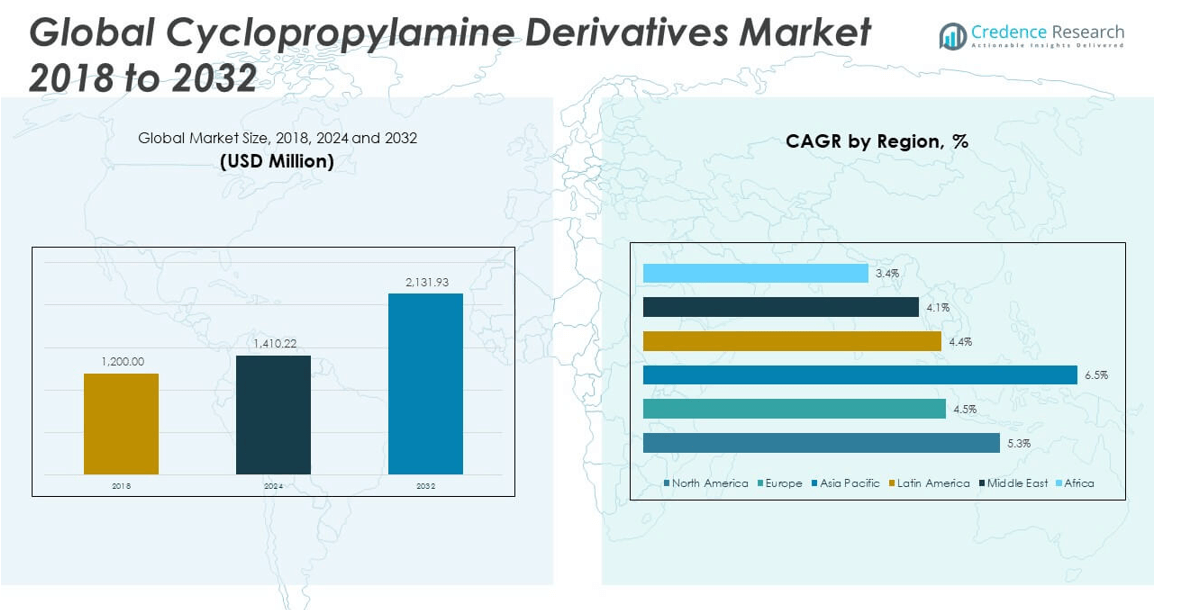
The Cyclopropylamine Derivatives Market size was valued at USD 1,200.00 million in 2018 to USD 1,410.22 million in 2024 and is anticipated to reach USD 2,131.93 million by 2032, at a CAGR of 5.33% during the forecast period.
| REPORT ATTRIBUTE | DETAILS |
|---|---|
| Historical Period | 2020-2023 |
| Base Year | 2024 |
| Forecast Period | 2025-2032 |
| Cyclopropylamine Derivatives Market Size 2024 | USD 1,410.22 million |
| Cyclopropylamine Derivatives Market, CAGR | 5.33% |
| Cyclopropylamine Derivatives Market Size 2032 | USD 2,131.93 million |
Rising demand from the pharmaceutical and agrochemical sectors drives growth in the Cyclopropylamine Derivatives Market. These derivatives are essential intermediates in synthesizing various active pharmaceutical ingredients and crop protection compounds. Increasing investments in drug discovery and the expansion of high-performance crop production technologies are accelerating product demand. Regulatory support for low-toxicity and high-efficacy formulations is also encouraging manufacturers to adopt cyclopropylamine-based solutions, thus reinforcing market expansion across end-user industries.
Regionally, North America leads the market due to its advanced pharmaceutical manufacturing capabilities and strong presence of key players. Europe follows closely, driven by strict environmental regulations that favor safer chemical intermediates. The Asia-Pacific region is emerging rapidly, with countries like China and India expanding their pharmaceutical and agrochemical production capacities. Growing industrialization, cost-effective manufacturing, and supportive government initiatives are enabling this regional shift, positioning Asia-Pacific as a high-growth zone in the global market landscape.
Market Insights:
- The Cyclopropylamine Derivatives Market was valued at USD 1,410.22 million in 2024 and is expected to reach USD 2,131.93 million by 2032, growing at a CAGR of 5.33%.
- Strong demand from pharmaceutical and agrochemical sectors is fueling growth, driven by the need for high-purity intermediates.
- Increasing investment in sustainable and low-toxicity chemical synthesis is supporting market expansion across end-use industries.
- High production costs due to complex multi-step synthesis processes limit scalability for small- and mid-sized manufacturers.
- Limited supplier availability and stringent regulatory requirements create entry barriers and sourcing constraints.
- North America holds the largest share due to robust pharmaceutical infrastructure, while Asia Pacific is the fastest-growing region due to cost-efficient manufacturing.
- Europe maintains stable growth with a focus on regulatory-compliant formulations and sustainable chemical practices.
Market Drivers:
Increased Demand from the Pharmaceutical Sector Due to Active Ingredient Compatibility
The Cyclopropylamine Derivatives Market is witnessing strong momentum from the pharmaceutical industry due to the compatibility of these compounds in synthesizing APIs. Their rigid cyclopropane ring structure contributes to high bioactivity and target specificity in drug development. It helps enhance drug stability and metabolic resistance, making these derivatives ideal candidates for antivirals, antidepressants, and oncology drugs. Pharmaceutical manufacturers are integrating cyclopropylamine derivatives into R&D pipelines for next-generation therapeutics. The growing focus on customized and targeted medicines further drives their adoption. Global pharmaceutical spending is rising, supporting the scale-up of API production. This trend strengthens long-term demand for high-purity derivatives. Continuous investment in drug innovation and patent filings expands the usage scope across therapeutic areas.
- For instance, a patent assigned to Pfizer (US 9487512 B2) describes novel heteroaryl‑cyclopropylamine compounds as potent LSD1 inhibitors for cancer and neurological diseases, explicitly noting the preference for trans‑cyclopropyl configurations of ≥99.5 mole‑% stereochemical purity.
Growing Application in Agrochemical Formulations for Enhanced Crop Protection
The agrochemical industry is adopting cyclopropylamine derivatives for developing advanced crop protection agents. Their chemical structure allows effective bonding in the synthesis of herbicides and fungicides. It supports better resistance management and prolonged field efficacy compared to traditional compounds. Rising global concerns about food security and sustainable agriculture are prompting formulators to design low-toxicity and high-performance solutions. Governments are enforcing stricter limits on harmful pesticide residues, increasing interest in cyclopropylamine-based alternatives. These derivatives play a key role in the synthesis of environmentally safer agrochemicals. The push for residue-free agricultural exports supports their usage. Companies are expanding research into next-generation pesticides that integrate cyclopropylamine groups for optimized performance.
Increased Industrial R&D Investments and Customized Synthesis Capabilities
Industrial players are expanding their investment in specialty amines R&D, where cyclopropylamine derivatives serve as key building blocks. It supports tailored synthesis of complex molecules in fine chemicals, dyes, and specialty polymers. The ability to control stereochemistry and functionality adds value to custom synthesis applications. Chemical companies are scaling up facilities to meet rising demand for these intermediates. This trend is reinforced by the surge in outsourced chemical synthesis and CDMO (Contract Development and Manufacturing Organization) services. The growing preference for high-purity, batch-specific synthesis enables deeper market penetration. It also benefits from digitized labs and AI-assisted formulation platforms that rely on consistent input compounds. New patent applications citing cyclopropylamine structures underscore its expanding industrial relevance.
- For example, CuI‑catalyzed N‑arylation protocols involving cyclopropylamine were recently scaled up. A 2024 Org. Chem. study described gram‑scale synthesis of N‑aryl cyclopropylamines in moderate to excellent yields (≥80%) using 5 mol % CuI and ligand under room‑temperature conditions, illustrating industrially viable routes to cyclopropylamine derivatives.
Regulatory Endorsement for Low Toxicity and Environmental Compatibility
Cyclopropylamine derivatives are gaining regulatory acceptance due to their lower toxicity profiles and environmental safety. It supports usage across industries under stricter chemical safety regulations. Authorities in North America and Europe have cleared several cyclopropylamine-based intermediates for use in regulated applications. This is accelerating the shift from conventional high-toxicity amines to safer alternatives. Growing awareness around workplace safety and compliance is influencing purchasing decisions in industrial sectors. Adoption of green chemistry principles further aligns with the rise of cyclopropylamine usage. These factors make it easier for companies to maintain REACH and EPA compliance without compromising on performance. Product portfolios are increasingly being adjusted to prioritize regulatory-approved compounds.
Market Trends
Emergence of Cyclopropylamine-Based Compounds in Antiviral Research Pipelines
Cyclopropylamine derivatives are becoming central to antiviral research efforts, particularly for RNA-targeted therapies. Research institutes are actively exploring their unique molecular geometry to inhibit viral replication processes. It supports the design of novel antivirals against influenza, hepatitis, and coronaviruses. The Cyclopropylamine Derivatives Market benefits from this surge in global pandemic preparedness programs. These compounds show promise in enhancing selectivity and minimizing off-target interactions. Lab results indicate improved therapeutic indices when compared to older scaffolds. The trend is accelerating industry-academic collaborations to explore structure-activity relationships. Funding for infectious disease research includes dedicated focus on amine-based molecular libraries. Pharmaceutical pipelines are expanding to include cyclopropyl-functionalized lead candidates.
- For instance, a 2023 MDPI study synthesized 4,7‑disubstituted pyrimido[4,5‑d]pyrimidines featuring a cyclopropylamino group, where compounds such as 7a, 7b, and 7f exhibited notable antiviral potency against human coronavirus 229E-demonstrating clear virus inhibition in vitro with higher selectivity indexes versus non‑cyclopropyl controls.
Growing Use in Optoelectronic Materials and High-Performance Polymer Synthesis
New trends indicate the adoption of cyclopropylamine derivatives in optoelectronic and advanced polymer applications. Their structural rigidity supports precise functionalization for semiconducting polymers. It enables higher electron mobility, thermal resistance, and optical clarity. Specialty chemical firms are using these compounds to design next-gen coatings, OLEDs, and flexible electronics. The Cyclopropylamine Derivatives Market is expanding beyond traditional segments into high-tech materials. The demand is growing from defense and automotive sectors for specialized adhesives and insulating materials. Start-ups are actively licensing cyclopropyl-based chemistries for performance enhancement. These applications demand chemical purity and consistency, aligning with the properties of these derivatives.
- For instance, patent application WO2005056526A1, filed by Daiichi Pharmaceutical Co., Ltd., discloses the preparation of optically active cyclopropylamine intermediates through stereoselective synthetic processes. These intermediates are intended for applications requiring precise chiral control in downstream chemical transformations,
Rising Integration into AI-Based Molecular Design Platforms
Chemical companies are integrating cyclopropylamine derivatives into AI-driven design platforms for faster molecule screening. These platforms rely on predefined chemical frameworks to predict efficacy and synthetic feasibility. It supports rapid ideation of drug candidates, agrochemicals, and functional materials. The Cyclopropylamine Derivatives Market benefits from this digital acceleration across R&D ecosystems. Virtual libraries are expanding to include cyclopropyl scaffolds due to their compact geometry and known reactivity. AI models prefer this class of molecules due to strong prediction reliability. This trend is speeding up go-to-market timelines across regulated industries. Demand for machine-readable, structure-indexed derivatives is steadily growing.
Shift Toward Sustainable and Renewable Feedstocks in Synthesis Routes
Sustainability trends are shaping how cyclopropylamine derivatives are sourced and manufactured. Companies are investing in greener feedstocks and bio-based synthesis to reduce carbon footprints. It aligns with rising pressure to decarbonize specialty chemical supply chains. The Cyclopropylamine Derivatives Market is witnessing pilot-scale adoption of renewable routes for derivative production. Suppliers are leveraging catalytic and enzymatic processes to eliminate hazardous intermediates. This shift supports broader ESG targets while maintaining product performance. Circular chemistry principles are becoming central to procurement decisions. Consumers and industrial buyers are seeking verified low-emission ingredients for downstream integration.
Market Challenges Analysis
Complex and Expensive Synthesis Process Impacts Cost Competitiveness
The Cyclopropylamine Derivatives Market faces challenges due to the complexity and high cost of synthesizing these compounds. Their rigid structure often requires multi-step processes with low overall yields. It increases production costs and limits the scalability of manufacturing. The use of specialized catalysts and controlled environments adds to capital expenditure. Small- to mid-scale companies struggle to achieve economic feasibility at commercial volumes. Pricing pressure from end-user industries forces suppliers to limit margins. Continuous process optimization is necessary but often difficult due to technical limitations. This cost sensitivity impacts adoption in price-sensitive markets like agrochemicals and bulk chemicals. Companies must balance purity requirements with cost-effectiveness.
Limited Supplier Base and Regulatory Approvals Constrain Market Access
Access to high-quality cyclopropylamine derivatives remains limited due to a small pool of global suppliers. It poses a bottleneck for companies seeking reliable sourcing for high-volume production. The Cyclopropylamine Derivatives Market is also affected by stringent regulatory requirements in pharmaceuticals and crop protection. Gaining approvals involves extensive toxicology data, delaying time-to-market. Smaller innovators often lack resources for regulatory navigation and compliance testing. It slows down new product integration despite high potential. Logistics issues, such as safe handling and international transport of amines, add complexity. The lack of harmonized standards across regions further complicates global supply chain planning.
Market Opportunities
Expansion into Targeted Therapy and Rare Disease Treatment Segments
Emerging pharmaceutical focus on rare diseases and targeted therapies presents a strong opportunity for the Cyclopropylamine Derivatives Market. These segments require specialized intermediates with high specificity, where cyclopropyl structures offer clear advantages. It enables the development of novel treatment classes with optimized pharmacokinetics. Regulatory fast-tracking for orphan drugs also benefits suppliers of high-purity building blocks. This niche demand supports premium pricing and long-term supply contracts.
Innovation in Greener Synthesis Routes and Contract Manufacturing Integration
Advances in green chemistry open new avenues for sustainable cyclopropylamine derivative production. Chemical companies are forming partnerships with CDMOs to scale these innovations efficiently. It strengthens market reach into regulated end-user sectors. Companies adopting eco-friendly processes gain competitive advantages under ESG frameworks. Demand from pharmaceutical and agrochemical firms for low-impact intermediates supports ongoing innovation and capacity expansion.
Market Segmentation Analysis:
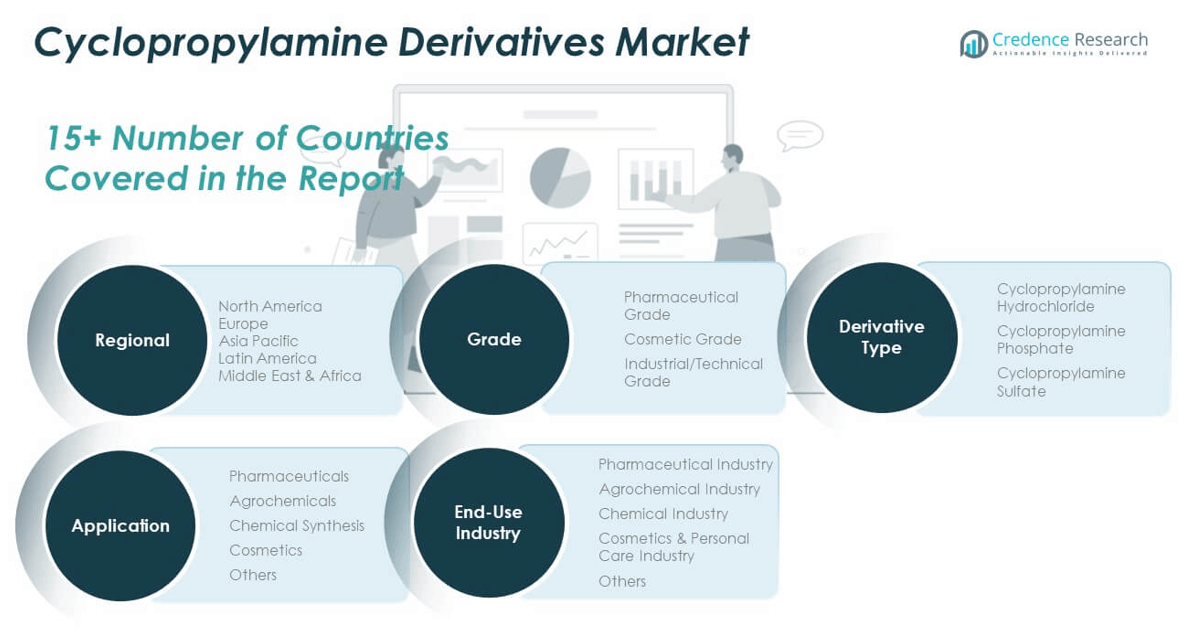
The Cyclopropylamine Derivatives Market is segmented by grade, derivative type, application, and end-use industry, each influencing the market’s direction.
By grade segments, pharmaceutical-grade cyclopropylamine dominates due to its extensive use in active pharmaceutical ingredient (API) synthesis, while industrial/technical grade supports chemical manufacturing and cosmetic-grade finds limited but growing demand in personal care products.
- For instance, GlaxoSmithKline developed GSK2879552, a trans‑2‑phenylcyclopropylamine‑derived irreversible LSD1 inhibitor, advanced into Phase I trials for acute myeloid leukemia (AML) and small‑cell lung cancer (SCLC).
By derivative type, Cyclopropylamine Hydrochloride holds a significant share, driven by its stable performance in pharmaceutical and agrochemical formulations. Cyclopropylamine Phosphate and Sulphate derivatives cater to specific applications that demand controlled reactivity and solubility.
By application, pharmaceuticals lead the application segment due to expanding therapeutic research and demand for high-purity amines. Agrochemicals follow, where cyclopropylamine compounds serve as essential intermediates for pesticides and herbicides. Chemical synthesis and cosmetics segments show consistent growth, driven by innovation and specialty formulation demand.
By end-use industries, the pharmaceutical industry remains the largest consumer, while the agrochemical and chemical industries contribute substantially. The cosmetics and personal care sector is emerging with increased demand for safe and efficient ingredients. The market benefits from cross-industry integration and tailored product development.
- MilliporeSigma for example, supports research and industrial synthesis with high-purity cyclopropylamine for specialty chemical.
Segmentation:
By Grade:
- Pharmaceutical Grade
- Cosmetic Grade
- Industrial/Technical Grade
By Derivative Type:
- Cyclopropylamine Hydrochloride
- Cyclopropylamine Phosphate
- Cyclopropylamine Sulphate
By Application:
- Pharmaceuticals
- Agrochemicals
- Chemical Synthesis
- Cosmetics
- Others
By End-Use Industry:
- Pharmaceutical Industry
- Agrochemical Industry
- Chemical Industry
- Cosmetics & Personal Care Industry
- Others
By Region:
- North America
- U.S.
- Canada
- Mexico
- Europe
- Germany
- France
- U.K.
- Italy
- Spain
- Rest of Europe
- Asia Pacific
- China
- Japan
- India
- South Korea
- South-east Asia
- Rest of Asia Pacific
- Latin America
- Brazil
- Argentina
- Rest of Latin America
- Middle East & Africa
- GCC Countries
- South Africa
- Rest of the Middle East and Africa
Regional Analysis:
North America
The North America Cyclopropylamine Derivatives Market size was valued at USD 414.00 million in 2018 to USD 480.31 million in 2024 and is anticipated to reach USD 725.07 million by 2032, at a CAGR of 5.3% during the forecast period. North America accounts for 33.3% of the global market share in 2024. It is driven by advanced pharmaceutical infrastructure and high demand for specialty chemicals. The United States leads regional consumption due to robust R&D in oncology and infectious disease therapies. Favorable regulatory policies and increasing adoption of high-purity intermediates support market expansion. Strong emphasis on innovation and presence of leading chemical manufacturers further strengthen regional growth. CDMO partnerships are rising, fueling demand for customized cyclopropylamine derivatives. Industrial usage is expanding across polymer and coating applications. The region maintains stable import-export dynamics with Asia for raw material integration.
Europe
The Europe Cyclopropylamine Derivatives Market size was valued at USD 289.44 million in 2018 to USD 325.72 million in 2024 and is anticipated to reach USD 462.53 million by 2032, at a CAGR of 4.5% during the forecast period. Europe holds a 23.1% market share in 2024. It benefits from stringent regulatory frameworks that favor low-toxicity chemical intermediates. Germany and France lead market adoption due to strong pharmaceutical and agrochemical sectors. High investment in sustainable chemistry is encouraging adoption of bio-based cyclopropylamine production methods. The region supports a mature network of chemical formulators and contract manufacturers. Demand is steadily rising in precision agriculture and green solvents. R&D initiatives supported by EU funding accelerate innovation. Brexit-related regulatory shifts continue to impact UK supply chains. Companies are diversifying sourcing strategies to ensure uninterrupted operations.
Asia Pacific
The Asia Pacific Cyclopropylamine Derivatives Market size was valued at USD 331.80 million in 2018 to USD 405.22 million in 2024 and is anticipated to reach USD 669.00 million by 2032, at a CAGR of 6.5% during the forecast period. Asia Pacific captures 28.7% of the global market share in 2024. China and India dominate regional growth due to expanding pharmaceutical manufacturing and agrochemical exports. Government support for Make-in-Asia initiatives and lower production costs enhance competitiveness. Domestic demand is also increasing due to growing healthcare infrastructure and rising food production needs. Local players are investing in upgrading synthesis technology and complying with global standards. The region is witnessing increased collaboration between academic institutions and industry for molecule design. Export-driven growth remains strong with favorable trade regulations. Asia Pacific continues to attract international manufacturers for capacity expansion.
Latin America
The Latin America Cyclopropylamine Derivatives Market size was valued at USD 82.68 million in 2018 to USD 96.30 million in 2024 and is anticipated to reach USD 135.95 million by 2032, at a CAGR of 4.4% during the forecast period. It represents 6.8% of the global market share in 2024. Brazil and Mexico lead consumption, driven by rising agrochemical usage in commercial farming. The region is investing in crop protection innovation to meet export standards. Pharmaceutical applications are also emerging, though at a slower pace than other regions. Market growth is constrained by fragmented regulatory frameworks. Companies are focusing on localized production to reduce dependency on imports. Industrial diversification and urbanization contribute to new use cases. Research institutions are starting to explore functionalized amine derivatives. Political stability remains a factor influencing foreign direct investment.
Middle East
The Middle East Cyclopropylamine Derivatives Market size was valued at USD 49.44 million in 2018 to USD 54.71 million in 2024 and is anticipated to reach USD 75.27 million by 2032, at a CAGR of 4.1% during the forecast period. The region contributes 3.9% to the global market share in 2024. Growth is driven by increasing demand in petrochemical derivatives and pharmaceutical imports. The UAE and Saudi Arabia lead adoption due to investments in healthcare and industrial chemicals. Regulatory reforms and economic diversification support the specialty chemicals sector. Market players are targeting the region for distribution partnerships. Infrastructure improvements enhance supply chain efficiency. Demand from the agrochemical sector is also growing with modernized farming practices. Regional manufacturers are gradually adopting green chemistry frameworks. Import reliance persists due to limited domestic synthesis capabilities.
Africa
The Africa Cyclopropylamine Derivatives Market size was valued at USD 32.64 million in 2018 to USD 47.95 million in 2024 and is anticipated to reach USD 64.11 million by 2032, at a CAGR of 3.4% during the forecast period. Africa accounts for 3.4% of the global market share in 2024. South Africa remains the key regional hub with a rising footprint in pharmaceutical manufacturing. Demand is slowly increasing for crop protection chemicals due to expanding agricultural practices. The market is in a nascent stage, limited by weak infrastructure and regulatory fragmentation. Government-led healthcare initiatives are fostering interest in local formulation and production. Import dependency remains high, especially for high-purity intermediates. Companies are exploring pilot-scale projects for onshore chemical production. International aid and NGO-backed health programs indirectly influence demand. Long-term growth depends on sustained economic development and industrial policy reforms.
Key Player Analysis:
- Sigma-Aldrich Corporation
- Thermo Fisher Scientific Inc.
- Tokyo Chemical Industry Co., Ltd.
- BOC Sciences, Inc.
- ABCR GmbH & Co. KG
- Spectrum Chemical Manufacturing Corp.
- Lancaster Synthesis Inc.
- Hangzhou Dayangchem Co., Ltd.
- Anhui Tianfu Chemical Co., Ltd.
- Jiangsu Haiman Chemical Co., Ltd.
Competitive Analysis:
The Cyclopropylamine Derivatives Market features a competitive landscape dominated by a few established global chemical manufacturers and select specialized producers. BASF and Zhejiang Wansheng demonstrate strong innovation and capacity, leveraging advanced R&D capabilities to drive process improvement and product diversification in cyclopropylamine intermediates. It faces competition from emerging regional players aiming to capitalize on industrial demand in pharmaceuticals and agrochemicals. Companies focus on proprietary synthesis technology, quality control, and regulatory compliance to differentiate. It benefits from long-term supply agreements and strategic partnerships with contract development and manufacturing organizations. Market leaders maintain tight control over high-purity production capacity and cost-efficient processes. They expand through alliances and targeted investments in scalable production. Smaller firms support niche applications or specialized grades, adding depth to the competitive field.
Recent Developments:
- In July 2025, BOC Sciences announced it would showcase innovative research and product solutions at the American Chemical Society (ACS) Fall 2025 event, demonstrating its latest advancements in targeted therapies, high-purity inhibitors, and custom synthesis for pharmaceutical and biochemical applications.
- In Feb 2024, Sigma-Aldrich Corporation (under MilliporeSigma) collaborated with Quantum Science to expand its platform's quantum dot product offerings, giving researchers broader access to advanced infrared PbS and lead-free INFIQ quantum dots. This partnership is designed to enhance research capabilities in optoelectronic materials and related scientific sectors.
- In October 2023, BASF SE announced the expansion of its specialty amines production line in Ludwigshafen, Germany. This expansion includes capacity to synthesize key cyclopropylamine derivatives used in pharmaceutical and agrochemical applications. The strategic move strengthens BASF’s position as a leading supplier of advanced amine solutions and addresses the rising global demand for high-purity cyclopropylamine derivatives.
Market Concentration & Characteristics
The Cyclopropylamine Derivatives Market exhibits moderate concentration, with a few large chemical manufacturers controlling a significant share while numerous small- to mid-sized suppliers handle niche or regional demand. Market leaders invest heavily in process innovation, quality assurance, and regulatory compliance to maintain their competitive edge It relies on high-purity synthesis and strict safety protocols, which limits new entrants and favors vertically integrated players. Contract manufacturing and CDMO collaboration further concentrate supply toward established capabilities. Buyers place high value on consistency, traceability, and certification, driving reliance on trusted suppliers. Smaller producers often specialize in bespoke synthesis or regional markets. The market structure encourages strategic partnerships, licensing, and incremental capacity expansion to address evolving demand.
Report Coverage:
The research report offers an in-depth analysis based on Grade, Derivative Type, Application and End-Use Industry. It details leading market players, providing an overview of their business, product offerings, investments, revenue streams, and key applications. Additionally, the report includes insights into the competitive environment, SWOT analysis, current market trends, as well as the primary drivers and constraints. Furthermore, it discusses various factors that have driven market expansion in recent years. The report also explores market dynamics, regulatory scenarios, and technological advancements that are shaping the industry. It assesses the impact of external factors and global economic changes on market growth. Lastly, it provides strategic recommendations for new entrants and established companies to navigate the complexities of the market.
Future Outlook:
- Demand for cyclopropylamine derivatives will grow steadily due to rising applications in targeted pharmaceutical formulations.
- Continued innovation in agrochemicals will drive the adoption of low-toxicity, high-performance intermediates.
- Sustainable synthesis methods will gain traction, improving environmental compliance and operational efficiency.
- Asia Pacific will emerge as a key production and consumption hub due to cost advantages and manufacturing capacity.
- Regulatory approvals for advanced therapeutic APIs will expand the scope of high-purity derivatives.
- Expansion of contract development and manufacturing services will create new supply chain opportunities.
- Technological advancements in molecular design will enable broader usage in specialty chemicals.
- Strategic partnerships and mergers will reshape the competitive landscape, favoring integration and scalability.
- Market diversification into electronics and performance materials will open niche application segments.
- Investment in digital R&D platforms will enhance product development speed and customization.

Request a Free Sample
Fill in your details and we'll send you a free sample report.
- Sample data tables & charts
- Research methodology
Market Dynamics
Pharmaceutical Sector Demand for High-Purity Intermediates
Cyclopropylamine derivatives are essential in synthesizing active pharmaceutical ingredients, particularly for antivirals, antidepressants, and oncology drugs, due to their rigid ring structure and high bioactivity. The expansion of pharmaceutical R&D and the push for targeted therapies are increasing the need for these high-purity intermediates.
Agrochemical Industry Adoption for Advanced Crop Protection
The agrochemical sector is increasingly utilizing cyclopropylamine derivatives to develop low-toxicity, high-efficacy herbicides and fungicides. Regulatory pressure for safer crop protection solutions and the need for residue-free agricultural exports are driving this trend.
Regulatory Support for Low-Toxicity and Environmental Safety
Authorities in North America and Europe are endorsing cyclopropylamine-based intermediates due to their lower toxicity and environmental compatibility, making it easier for manufacturers to comply with stringent chemical safety regulations and expand into regulated markets.
Innovation in Sustainable and Green Synthesis Methods
Growing emphasis on sustainable chemistry is prompting manufacturers to invest in renewable feedstocks and greener synthesis routes for cyclopropylamine derivatives. This not only reduces environmental impact but also aligns with the ESG goals of major end-user industries.
Expansion of Contract Manufacturing and Custom Synthesis
The rise of CDMO partnerships and outsourced chemical synthesis is enabling broader access to cyclopropylamine derivatives, supporting customized production for pharmaceuticals, agrochemicals, and specialty chemicals, and facilitating market expansion across regions.
Need a Custom Version of This Report?
Tailor the scope, geography, or segments to your exact requirements.
- Custom geography or segment scope
- Direct access to our analyst team
Frequently Asked Questions
What is the current size of the Cyclopropylamine Derivatives Market ?
What are the key segments within the Cyclopropylamine Derivatives Market?
What are some challenges faced by the Cyclopropylamine Derivatives Market ?
Who are the major players in the Cyclopropylamine Derivatives Market?
Table of Content
Chapter 1 Market Segmentation
- 1.1 Segmentation Framework
- 1.1.1 Product and Service Classification
- 1.1.2 Application and End-Use Classification
- 1.1.3 Technology and Solution Classification
- 1.1.4 Customer and Distribution Channel Classification
- 1.1.5 Geographic Segmentation
- 1.1.6 Market Segment Definitions and Boundaries
- 1.2 By Grade
- 1.2.1 Pharmaceutical Grade
- 1.2.2 Cosmetic Grade
- 1.2.3 Industrial/Technical Grade
- 1.3 By Application
- 1.3.1 Pharmaceuticals
- 1.3.2 Agrochemicals
- 1.3.3 Chemical Synthesis
- 1.3.4 Cosmetics
- 1.3.5 Others
- 1.4 By Derivative Type
- 1.4.1 Cyclopropylamine Hydrochloride
- 1.4.2 Cyclopropylamine Phosphate
- 1.4.3 Cyclopropylamine Sulphate
- 1.5 By End-Use Industry
- 1.5.1 Pharmaceutical Industry
- 1.5.2 Agrochemical Industry
- 1.5.3 Chemical Industry
- 1.5.4 Cosmetics & Personal Care Industry
- 1.5.5 Others
Chapter 2 Introduction
- 2.1 Report Objectives and Scope
- 2.2 Product Definition and Industry Terminology
- 2.3 Market Inclusions and Exclusions
- 2.4 Research Process
- 2.4.1 Primary Research and Expert Interviews
- 2.4.2 Secondary Research and Source Review
- 2.4.3 Top-Down and Bottom-Up Estimation
- 2.4.4 Data Triangulation and Verification
- 2.5 Market Size Measurement Basis
- 2.5.1 2024: USD 1,410.22 million → 2032: USD 2,131.93 million
- 2.6 Historical and Forecast Reference Periods
- 2.6.1 Base Year: 2024
- 2.6.2 Forecast Period: 2024-2032
- 2.7 Research Assumptions and Limitations
Chapter 3 Executive Summary
- 3.1 Market Snapshot and Key Findings
- 3.2 Base-Year Market Size, 2024
- 3.3 Forecast Market Size, 2032
- 3.4 Revenue and Volume Growth Outlook
- 3.5 Key Demand and Supply Indicators
- 3.6 Leading Market Segments
- 3.7 Fastest-Growing Market Opportunities
- 3.8 Regional Performance Highlights
- 3.9 Technology and Industry Transformation
- 3.10 Competitive Landscape Summary
- 3.11 Analyst View and Strategic Implications
Chapter 4 Global Cyclopropylamine Derivatives Market Trends and Developments
- 4.1 Historical Industry Development
- 4.2 Recent Market Trends and Developments
- 4.3 Demand and Customer Behavior Trends
- 4.4 Technology and Product Innovation
- 4.5 Artificial Intelligence, Automation and Digitalization
- 4.6 Local Manufacturing and Supply Chain Realignment
- 4.7 Industry Partnerships, Mergers and Acquisitions
- 4.8 Sustainability and Circular Economy Developments
- 4.9 Government and Private Sector Investment Trends
- 4.10 Emerging Business Models and Commercialization
- 4.11 Industry Developments and Announcements
Chapter 5 Global Cyclopropylamine Derivatives Market Production, Supply and Demand Analysis
- 5.1 Demand Trend and Consumption Analysis
- 5.2 Demand Forecast, 2024-2032
- 5.3 Production and Output Trend
- 5.4 Production and Output Forecast, 2024-2032
- 5.5 Installed Capacity and Capacity Utilization
- 5.6 Company-Wise Production Plants and Statistics
- 5.6.1 Installed Production Capacity
- 5.6.2 Actual Production
- 5.6.3 Planned Capacity and Expansion Targets
- 5.7 Supply Chain Structure and Procurement Trends
- 5.8 Supply-Demand Gap and Bottlenecks
- 5.9 Import Dependence and Sourcing Structure
- 5.10 Contract Manufacturing and Outsourcing
- 5.11 Regional Supply and Demand Concentration
Chapter 6 Global Cyclopropylamine Derivatives Market Pricing Analysis
- 6.1 Pricing Structure and Measurement
- 6.2 Historical Pricing Trends
- 6.3 Pricing Outlook, 2024-2032
- 6.4 Average Selling Price and Unit Economics
- 6.5 Pricing by Product and Market Segment
- 6.6 Geographic Pricing Differences
- 6.7 Key Input, Energy, Labor and Logistics Costs
- 6.8 Contract Pricing and Purchasing Models
- 6.9 Pricing Sensitivity and Competitive Positioning
- 6.10 Price, Margin and Profitability Implications
Chapter 7 Global Cyclopropylamine Derivatives Market Dynamics
- 7.1 Market Growth Drivers
- 7.1.1 Demand-Side Drivers
- 7.1.2 Technology and Innovation Drivers
- 7.1.3 Infrastructure and Investment Drivers
- 7.1.4 Regulatory and Policy Drivers
- 7.2 Market Restraints
- 7.2.1 Cost and Affordability Constraints
- 7.2.2 Technology and Adoption Barriers
- 7.2.3 Supply Chain and Operational Constraints
- 7.3 Market Challenges
- 7.3.1 Competitive Pressure and Margin Erosion
- 7.3.2 Skills, Infrastructure and Implementation Gaps
- 7.4 Emerging Market Opportunities
- 7.5 Market Dynamics Impact and Time-Horizon Assessment
Chapter 8 Global Cyclopropylamine Derivatives Value Chain Analysis
- 8.1 Industry Value Chain Overview
- 8.2 Upstream Suppliers and Critical Inputs
- 8.3 Technology and Component Providers
- 8.4 Manufacturing or Service Delivery
- 8.5 Distribution, Channel Partners and Integrators
- 8.6 Downstream Applications and End Users
- 8.7 Value Addition and Profit Pools
- 8.8 Vertical Integration and Outsourcing
- 8.9 Supplier Concentration and Risk
- 8.10 Supply Chain Localization and Resilience
Chapter 9 Global Cyclopropylamine Derivatives Market Regulations and Policies
- 9.1 Relevant Laws, Standards and Compliance Frameworks
- 9.2 Product, Service, Safety and Quality Requirements
- 9.3 Government Policies, Incentives and Subsidies
- 9.4 Imports, Exports and Trade Barriers
- 9.5 Public Procurement and Local Content Requirements
- 9.6 Environmental and Sustainability Compliance
- 9.7 Upcoming Policy Changes and Market Implications
Chapter 10 Global Cyclopropylamine Derivatives Market Hotspots and Opportunities
- 10.1 Market Opportunity Mapping and Growth Hotspots
- 10.2 High-Growth Applications and Customer Groups
- 10.3 Underserved Markets and White-Space Opportunities
- 10.4 Emerging Technology and Product Opportunities
- 10.5 New Capacity and Investment Hotspots
- 10.6 Market Entry and Expansion Opportunities
- 10.7 Distribution and Partnership Opportunities
- 10.8 Near-Term and Long-Term Commercial Potential
- 10.9 Opportunity Attractiveness and Execution Risks
Chapter 11 Global Cyclopropylamine Derivatives Market Outlook, 2024-2032
- 11.1 Market Size and Analysis
- 11.1.1 Revenue (Market Measurement: 2024: USD 1,410.22 million → 2032: USD 2,131.93 million)
- 11.1.2 Market Volume and Quantity Sold
- 11.1.3 Historical Market Size
- 11.1.4 Base-Year Market Size, 2024
- 11.2 Market Forecast, 2024-2032
- 11.2.1 Revenue Forecast to 2032
- 11.2.2 Volume Forecast to 2032
- 11.2.3 CAGR and Year-on-Year Growth
- 11.2.4 Incremental Revenue Opportunity
- 11.3 Forecast Assumptions and Scenario Analysis
- 11.3.1 Base-Case Forecast
- 11.3.2 Optimistic and Conservative Scenarios
- 11.3.3 Technology, Pricing and Policy Sensitivities
- 11.4 Market Attractiveness and Growth Outlook
Chapter 12 Global Cyclopropylamine Derivatives Market Segmentation and Outlook
- 12.1 Segmentation Summary and Market Shares, 2024
- 12.2 Largest and Fastest-Growing Segments
- 12.3 By Grade - Market Size and Forecast, 2024-2032
- 12.3.1 Segment Definition and Scope
- 12.3.2 Historical Market Size
- 12.3.3 Revenue Forecast, 2024-2032
- 12.3.4 Volume Forecast, 2024-2032
- 12.3.5 Base-Year Market Share, 2024
- 12.3.6 Segment CAGR and Growth Drivers
- 12.3.7 Subsegment Market Size and Forecast
- 12.3.7.1 Pharmaceutical Grade
- 12.3.7.2 Cosmetic Grade
- 12.3.7.3 Industrial/Technical Grade
- 12.3.8 Subsegment Pricing and Adoption Trends
- 12.3.9 Leading Suppliers and Competition
- 12.3.10 Regional Demand and Opportunities
- 12.4 By Application - Market Size and Forecast, 2024-2032
- 12.4.1 Segment Definition and Scope
- 12.4.2 Historical Market Size
- 12.4.3 Revenue Forecast, 2024-2032
- 12.4.4 Volume Forecast, 2024-2032
- 12.4.5 Base-Year Market Share, 2024
- 12.4.6 Segment CAGR and Growth Drivers
- 12.4.7 Subsegment Market Size and Forecast
- 12.4.7.1 Pharmaceuticals
- 12.4.7.2 Agrochemicals
- 12.4.7.3 Chemical Synthesis
- 12.4.7.4 Cosmetics
- 12.4.7.5 Others
- 12.4.8 Subsegment Pricing and Adoption Trends
- 12.4.9 Leading Suppliers and Competition
- 12.4.10 Regional Demand and Opportunities
- 12.5 By Derivative Type - Market Size and Forecast, 2024-2032
- 12.5.1 Segment Definition and Scope
- 12.5.2 Historical Market Size
- 12.5.3 Revenue Forecast, 2024-2032
- 12.5.4 Volume Forecast, 2024-2032
- 12.5.5 Base-Year Market Share, 2024
- 12.5.6 Segment CAGR and Growth Drivers
- 12.5.7 Subsegment Market Size and Forecast
- 12.5.7.1 Cyclopropylamine Hydrochloride
- 12.5.7.2 Cyclopropylamine Phosphate
- 12.5.7.3 Cyclopropylamine Sulphate
- 12.5.8 Subsegment Pricing and Adoption Trends
- 12.5.9 Leading Suppliers and Competition
- 12.5.10 Regional Demand and Opportunities
- 12.6 By End-Use Industry - Market Size and Forecast, 2024-2032
- 12.6.1 Segment Definition and Scope
- 12.6.2 Historical Market Size
- 12.6.3 Revenue Forecast, 2024-2032
- 12.6.4 Volume Forecast, 2024-2032
- 12.6.5 Base-Year Market Share, 2024
- 12.6.6 Segment CAGR and Growth Drivers
- 12.6.7 Subsegment Market Size and Forecast
- 12.6.7.1 Pharmaceutical Industry
- 12.6.7.2 Agrochemical Industry
- 12.6.7.3 Chemical Industry
- 12.6.7.4 Cosmetics & Personal Care Industry
- 12.6.7.5 Others
- 12.6.8 Subsegment Pricing and Adoption Trends
- 12.6.9 Leading Suppliers and Competition
- 12.6.10 Regional Demand and Opportunities
- 12.7 Segment Growth Comparison
- 12.8 Segment Attractiveness and Priority Matrix
Chapter 13 Global Cyclopropylamine Derivatives End-Use and Application Market Outlook
- 13.1 End-Use Industry and Customer Demand Structure
- 13.2 Leading Applications and Customer Groups
- 13.3 End-Use Market Size, Share and Forecast
- 13.4 Major End-Use Industry Deep Dives
- 13.4.1 Customer Requirements and Use Cases
- 13.4.2 Demand and Replacement Cycles
- 13.4.3 Technical and Regulatory Considerations
- 13.4.4 Purchasing and Procurement Models
- 13.4.5 Leading Vendors and Distribution Channels
- 13.4.6 Forecast and Commercial Opportunities
- 13.5 Emerging Applications and Cross-Segment Demand
- 13.6 End-Use Industry Investment Priorities
Chapter 14 Global Cyclopropylamine Derivatives Geographic Market Outlook, 2024-2032
- 14.1 Regional Market Size and Share, 2024
- 14.2 Regional Market Forecast, 2024-2032
- 14.3 Regional Pricing, Production and Demand Differences
- 14.4 North America
- 14.4.1 United States
- 14.4.2 Canada
- 14.4.3 Mexico
- 14.5 Europe
- 14.5.1 Germany
- 14.5.2 France
- 14.5.3 Italy
- 14.5.4 United Kingdom
- 14.5.5 Spain
- 14.5.6 Poland
- 14.5.7 Russia
- 14.5.8 Netherlands
- 14.5.9 Belgium
- 14.5.10 Sweden
- 14.5.11 Denmark
- 14.5.12 Norway
- 14.5.13 Rest of Europe
- 14.6 Asia Pacific
- 14.6.1 China
- 14.6.2 India
- 14.6.3 Japan
- 14.6.4 South Korea
- 14.6.5 Thailand
- 14.6.6 Indonesia
- 14.6.7 Vietnam
- 14.6.8 Malaysia
- 14.6.9 Australia
- 14.6.10 Rest of Asia Pacific
- 14.7 Latin America
- 14.7.1 Brazil
- 14.7.2 Argentina
- 14.7.3 Colombia
- 14.7.4 Chile
- 14.7.5 Rest of Latin America
- 14.8 Middle East
- 14.8.1 Saudi Arabia
- 14.8.2 United Arab Emirates
- 14.8.3 Turkey
- 14.8.4 Israel
- 14.8.5 Iran
- 14.8.6 Rest of the Middle East
- 14.9 Africa
- 14.9.1 South Africa
- 14.9.2 Egypt
- 14.9.3 Nigeria
- 14.9.4 Morocco
- 14.9.5 Rest of Africa
- 14.10 Regional Investment, Policy and Supply Chain Differences
- 14.11 Regional Competitive Landscape
- 14.12 Geographic Growth Hotspots
Chapter 15 Global Cyclopropylamine Derivatives Technology, Innovation and Sustainability Outlook
- 15.1 Technology Landscape and Maturity
- 15.2 Product, Process and Service Innovation
- 15.3 AI, Automation and Digital Tools in the Industry
- 15.4 Technology Adoption and Performance Benchmarking
- 15.5 Innovation Pipeline and R&D Investment
- 15.6 Patent and Intellectual Property Trends
- 15.7 Energy Efficiency and Resource Management
- 15.8 Sustainability, Recycling and Circularity
- 15.9 Technology Roadmap, 2024-2032
- 15.10 Risks of Obsolescence and Technology Substitution
Chapter 16 Global Cyclopropylamine Derivatives Market Key Strategic Imperatives
- 16.1 Growth and Market Entry Priorities
- 16.2 High-Return Products and Segments
- 16.3 Pricing, Profitability and Cost Optimization
- 16.4 Technology Investment and Product Differentiation
- 16.5 Supply Chain Localization and Resilience
- 16.6 Distribution and Customer Acquisition
- 16.7 Partnership, Acquisition and Capacity Strategy
- 16.8 Regional Expansion Priorities
- 16.9 Short-, Medium- and Long-Term Actions
Chapter 17 Competition Outlook
- 17.1 Industry Competition Characteristics
- 17.2 Market Structure and Concentration
- 17.3 Market Share and Competitive Positioning, 2024
- 17.4 Company-Wise Revenue and Product Benchmarking
- 17.5 Production and Service Capacity Benchmarking
- 17.6 Technology, Pricing and Differentiation
- 17.7 Regional Footprint and Distribution Strength
- 17.8 Mergers, Acquisitions and Strategic Alliances
- 17.9 New Entrants and Competitive Threats
- 17.10 Porter's Five Forces and Industry Attractiveness
- 17.11 Competitive Outlook, 2024-2032
Chapter 18 Company Profiles
- 18.1 Company Coverage and Selection Criteria
- 18.2 Sigma-Aldrich Corporation
- 18.2.1 Business Description
- 18.2.2 Company Ownership and Geographic Presence
- 18.2.3 Product and Service Portfolio
- 18.2.4 Manufacturing and Operating Footprint
- 18.2.5 Production Capacity and Expansion Plans
- 18.2.6 Financial Performance and Investment
- 18.2.7 Market Share and Competitive Position
- 18.2.8 Technology and Innovation Capabilities
- 18.2.9 Strategic Alliances or Partnerships
- 18.2.10 Recent Developments
- 18.2.11 Growth Strategy and Outlook
- 18.3 Thermo Fisher Scientific Inc.
- 18.4 Tokyo Chemical Industry Co., Ltd.
- 18.5 BOC Sciences, Inc.
- 18.6 ABCR GmbH & Co. KG
- 18.7 Spectrum Chemical Manufacturing Corp.
- 18.8 Lancaster Synthesis Inc.
- 18.9 Hangzhou Dayangchem Co., Ltd.
- 18.10 Anhui Tianfu Chemical Co., Ltd.
- 18.11 Jiangsu Haiman Chemical Co., Ltd.
- 18.12 Other Relevant Market Participants
Note: Every listed company is profiled on the structure shown under the first company. The company list is preliminary and may change based on research findings, market developments, data availability and client requirements.
Chapter 19 Disclaimer
- 19.1 Research and Forecast Disclaimer
- 19.2 Data Source and Estimation Limitations
Note: The depth of individual sections depends on data availability for this market. Volume, capacity, trade and other unit-based metrics are included where applicable.