
| REPORT ATTRIBUTE | DETAILS |
|---|---|
| Historical Period | 2020-2023 |
| Base Year | 2024 |
| Forecast Period | 2025-2032 |
| Data Center Containment Market Size 2024 | USD 3,719.95 million |
| Data Center Containment Market, CAGR | 11.13% |
| Data Center Containment Market Size 2032 | USD 8,654.34 million |
Market Overview
The global Data Center Containment Market is projected to grow from USD 3,719.95 million in 2024 to an estimated USD 8,654.34 million by 2032, reflecting a compound annual growth rate (CAGR) of 11.13% from 2025 to 2032. This growth is driven by the increasing demand for efficient cooling solutions and the expansion of data center infrastructures worldwide.
Key drivers of this market include the rising need for energy-efficient cooling systems, the proliferation of data generation, and the growing adoption of cloud computing services. Trends such as the development of modular containment solutions and the integration of advanced monitoring technologies are further propelling market growth.
Geographically, North America holds a significant share of the Data Center Containment Market, owing to the presence of major data center operators and technological advancements. Key players in this market include Schneider Electric, Vertiv, and Eaton, all of which offer innovative containment solutions to meet the evolving demands of data centers.
Market Insights
- The Global Data Center Containment Market is projected to grow from USD 3,719.95 million in 2024 to USD 8,654.34 million by 2032, driven by a CAGR of 11.13% from 2025 to 2032.
- The increasing demand for energy-efficient cooling solutions, expansion of data center infrastructures, and rapid adoption of cloud computing services are key drivers.
- Data centers are adopting advanced containment solutions to reduce energy consumption and improve cooling efficiency, aligning with sustainability goals and regulatory requirements.
- The development of modular containment solutions is gaining traction, offering scalability and flexibility to accommodate growing data center demands without major infrastructure changes.
- High initial investment and maintenance costs, along with space constraints in existing data centers, pose challenges for the widespread adoption of containment systems.
- North America dominates the market due to the presence of major cloud service providers and data center operators, while Asia-Pacific is expected to experience rapid growth in the coming years.
- Integration of advanced monitoring systems and AI-driven control systems is shaping the future of data center containment solutions, offering greater efficiency and automation.
Market Drivers
Rising Demand for Energy-Efficient Cooling Solutions
The increasing demand for energy-efficient cooling solutions is a primary driver for the growth of the global data center containment market. As the volume of data generated by businesses and consumers continues to rise, the need to store, process, and manage this data efficiently has led to a surge in data center construction. These facilities require substantial amounts of energy to operate, especially for cooling purposes. Traditional cooling methods often consume large amounts of electricity, leading to higher operational costs and environmental concerns. For instance, companies like Google have implemented AI-powered cooling systems that leverage containment strategies to optimize airflow and reduce energy consumption. In response, data center operators are turning to containment solutions to optimize cooling efficiency and reduce energy consumption. Containment strategies, such as hot and cold aisle containment, isolate hot and cold air streams within the facility, which ensures that cooling systems work more efficiently. These containment solutions prevent the mixing of hot and cold air, which in turn reduces the amount of energy needed to cool the space. As energy efficiency becomes a key focus for both environmental and economic reasons, demand for containment systems is expected to continue growing.
Growing Adoption of Cloud Computing and Digital Transformation
The global shift towards cloud computing and digital transformation has significantly impacted the demand for data center containment systems. As businesses increasingly rely on cloud-based solutions to store, process, and manage data, the need for robust data center infrastructures has grown. Cloud service providers, such as Amazon Web Services (AWS), Microsoft Azure, and Google Cloud, operate massive data centers worldwide to cater to the expanding digital ecosystem. For instance, Facebook's expansion of its data centers in the U.S. highlights the growing need for data center capacities due to data generation from various sectors such as social media and e-commerce. Data center containment solutions help cloud providers meet the growing demands for scalability, operational efficiency, and reliability. With data centers growing in size and capacity, maintaining optimal conditions within these facilities becomes more challenging. The adoption of containment systems ensures that data centers can handle the rising heat loads generated by advanced computing hardware and the increasing processing requirements of cloud-based services. This growing reliance on cloud computing continues to fuel the demand for effective containment solutions as businesses seek to keep their operations running smoothly without compromising on performance or energy efficiency.
Increasing Data Center Infrastructure Investments
The increasing investments in data center infrastructure globally are also driving the growth of the data center containment market. As organizations across industries expand their digital operations, they are investing heavily in data center technologies to support data storage, management, and security. According to industry reports, the global market for data center infrastructure is expected to grow steadily, with companies looking to build more efficient and high-performance data centers. These investments often focus on improving the physical infrastructure of data centers, which includes cooling and containment systems. The need for better management of airflow and temperature within data centers is essential for maintaining equipment longevity and operational performance. Containment solutions offer a cost-effective way to optimize the performance of cooling systems and ensure that the infrastructure remains sustainable and efficient. This trend of investing in advanced data center infrastructure, driven by the need for improved reliability and reduced operational costs, is a key market driver for the containment sector.
Focus on Sustainability and Environmental Regulations
As environmental concerns continue to rise, data centers are under increasing pressure to reduce their carbon footprint and adhere to stricter sustainability standards. Data centers are known for their significant energy consumption, and many operators are working to reduce their environmental impact by adopting green technologies. The introduction of various environmental regulations and industry standards aimed at curbing energy consumption is pushing data center operators to implement more sustainable practices. Containment systems help data centers meet sustainability goals by enhancing cooling efficiency and reducing the amount of energy required to maintain optimal temperature conditions. In some regions, regulatory requirements have become more stringent, requiring businesses to implement energy-efficient solutions. For instance, the European Union’s “Green Deal” and similar initiatives in other regions are pushing for the adoption of sustainable practices across industries, including data centers. As governments and regulatory bodies continue to enforce stricter environmental standards, the demand for energy-efficient data center containment solutions will likely rise. This growing emphasis on sustainability will continue torive market growth as companies seek to minimize their environmental impact while optimizing operational efficiency.
Market Trends
Focus on Sustainability and Green Data Centers
Sustainability has become a key trend in the data center industry, with operators increasingly adopting energy-efficient containment solutions to reduce their environmental footprint. Data centers are known for their high energy consumption, and as the global demand for data storage and processing increases, the environmental impact of data centers has come under scrutiny. To address this, many companies are focusing on implementing green data center practices, with energy-efficient containment systems playing a critical role. Containment solutions, particularly hot aisle and cold aisle containment systems, are essential for improving cooling efficiency, which is one of the largest energy consumers in a data center. These systems help to isolate hot and cold air streams, ensuring that cooling units operate more effectively and consume less power. Additionally, many data centers are utilizing renewable energy sources, such as solar and wind power, to further reduce their carbon emissions. The growing emphasis on sustainability is also reflected in the rise of certifications and standards for energy efficiency, such as the U.S. Green Building Council’s LEED certification and the Energy Star rating. As regulatory pressures continue to increase and sustainability becomes a top priority for both businesses and consumers, the demand for environmentally friendly containment solutions is expected to rise.
Adoption of Liquid Cooling Technologies
Liquid cooling technology is rapidly gaining traction as a viable alternative to traditional air cooling systems in data centers, particularly in high-density environments. While air cooling has been the standard for many years, it is becoming less effective as data center hardware becomes more powerful and generates more heat. Liquid cooling, which uses water or other coolants to absorb and dissipate heat more efficiently than air, is being increasingly integrated into data center containment solutions. This trend is especially evident in high-performance computing (HPC) data centers and facilities that house large-scale servers, such as those used by cloud service providers and research institutions. Liquid cooling systems can be more efficient and compact compared to traditional air-based solutions, allowing data centers to support more hardware in a smaller footprint. Additionally, liquid cooling reduces the need for large air-conditioning units, which can be expensive and energy-intensive. The growing trend toward high-performance computing and the increasing need for energy-efficient solutions are driving the adoption of liquid cooling technologies in data center containment strategies. As data centers continue to evolve to handle greater computational loads and reduce their environmental impact, liquid cooling is expected to become a standard part of data center containment systems.
Shift Toward Modular and Scalable Containment Solutions
A prominent trend in the data center containment market is the growing adoption of modular and scalable containment solutions. Traditional containment systems were often fixed and inflexible, requiring substantial changes when data centers expanded or required upgrades. However, the demand for more adaptive and cost-efficient containment solutions is pushing operators to favor modular designs that can be easily scaled according to the evolving needs of the data center. For instance, companies like Dell and Schneider Electric are offering modular solutions that allow for quick deployment and expansion without disrupting ongoing operations. This flexibility is crucial for data centers that must quickly adjust to increasing data processing and cooling requirements. Modular containment solutions enable operators to install additional containment units as needed without having to redesign the entire infrastructure. Furthermore, modular containment systems can be integrated with other technologies, such as cooling and monitoring systems, to create a more efficient and unified infrastructure. As the demand for scalable solutions increases, manufacturers are focusing on providing customizable containment systems that can meet the unique requirements of different data centers, whether they are small, medium, or large-scale operations.
Integration of Advaned Monitoring and AI-Based Control Systems
Another significant trend in the data center containment market is the integration of advanced monitoring systems and artificial intelligence (AI) to optimize containment performance. With the increasing complexity of modern data centers, operators are relying more on intelligent systems to monitor and manage airflow, cooling efficiency, and overall energy usage. AI and machine learning technologies enable real-time adjustments to containment systems, ensuring that energy is used more efficiently and that temperature and humidity levels are maintained within optimal ranges. For instance, surveys by government authorities and industry reports highlight how companies like Vertiv are leveraging AI to enhance data center operations. AI-based control systems can automatically adjust containment barriers, cooling units, and airflow based on real-time data from sensors placed throughout the data center. This dynamic management approach not only improves the overall efficiency of the containment system but also reduces operational costs by optimizing energy use. The use of predictive analytics and AI-driven decision-making helps prevent system failures by identifying potential issues before they arise, thus enhancing the overall reliability of the data center. As the demand for intelligent data centers continues to grow, the integration of AI and advanced monitoring systems will play a crucial role in shaping the future of the data center containment market.
Market Challenges
High Initial Investment and Maintenance Costs
Implementing data center containment solutions involves substantial upfront investment and ongoing maintenance costs, posing challenges for organizations. These systems are tailored to optimize airflow and cooling efficiency, which is critical for the longevity and performance of data center infrastructure. For instance, companies like Vertiv have introduced advanced solutions such as modular containment systems to address these needs. However, the complexity of these systems demands skilled technicians proficient in HVAC systems and airflow dynamics to ensure their reliability. Maintenance costs can accumulate over time, making it essential for organizations to weigh the benefits of energy efficiency against the financial burden. This evaluation becomes even more critical for smaller enterprises with limited budgets, as they must balance operational savings with high initial costs.
Space Constraints and Integration Challenges
Integrating containment systems within existing data centers can be challenging due to spatial limitations. Data centers are often designed with specific layouts and space allocations, and introducing containment solutions may require significant modifications to the physical infrastructure. Ensuring that these systems do not obstruct access to equipment for maintenance and repairs is a critical consideration. Physical barriers used in containment systems can make accessing equipment for maintenance and repairs more difficult, potentially leading to increased downtime and operational inefficiencies. Moreover, the presence of non-contained equipment within the data center can lead to operational issues, such as the mixing of hot and cold air streams, which undermines the effectiveness of containment strategies. Therefore, meticulous planning and design are essential to seamlessly integrate containment solutions without disrupting existing operations or compromising system accessibility.
Market Opportunities
Growing Demand for Energy-Efficient Solutions
The increasing global focus on sustainability presents a significant opportunity for the data center containment market. With energy consumption being one of the largest operating costs in data centers, the demand for energy-efficient containment solutions is expected to rise. As companies and governments implement stricter environmental regulations, data centers are under pressure to reduce their carbon footprints. Containment systems, such as hot and cold aisle containment, enable better cooling efficiency, helping data centers reduce energy consumption and comply with sustainability goals. The adoption of these solutions aligns with the broader trend toward green technologies, offering data center operators a clear path to not only lower costs but also enhance their environmental credentials. This growing emphasis on energy efficiency, coupled with rising energy prices, positions the data center containment market for significant growth as businesses prioritize long-term operational savings and sustainability.
Expansion of Cloud Computing and Edge Data Centers
The rapid expansion of cloud computing services and the proliferation of edge data centers present another key opportunity for the data center containment market. As more organizations migrate to cloud-based infrastructures and demand for low-latency services increases, the need for highly efficient, scalable, and reliable data centers has never been greater. Edge data centers, in particular, require specialized containment solutions to manage the higher density of servers and cooling demands associated with these distributed networks. The ongoing digital transformation across industries, including healthcare, finance, and retail, will continue to drive the need for advanced containment systems to support these growing infrastructures. Data center containment providers are well-positioned to offer solutions that help businesses manage the increasing volume of data processing while ensuring operational efficiency and scalability
Market Segmentation Analysis
By Containment Type
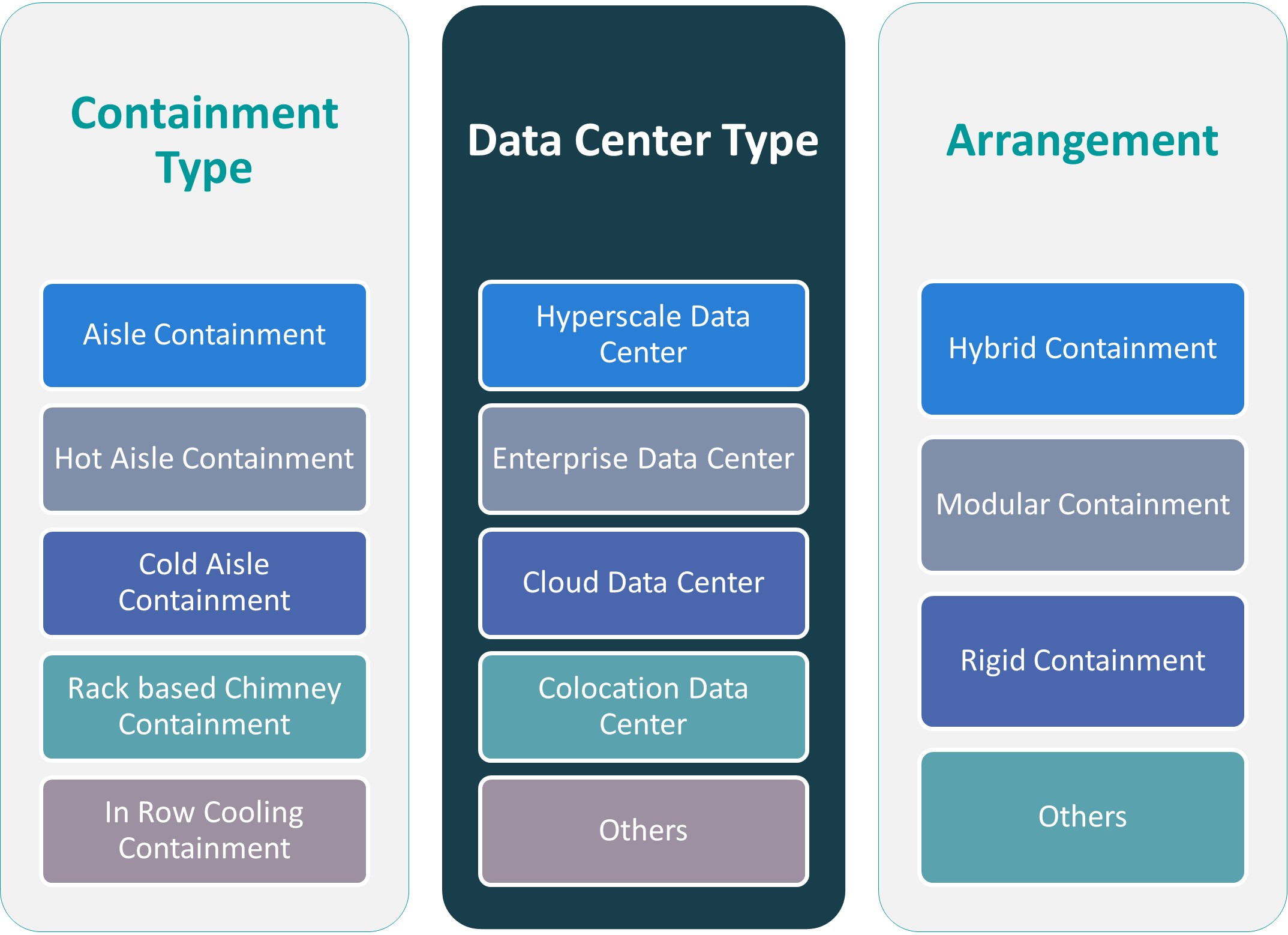
The data center containment market offers a range of solutions designed to enhance airflow management and improve cooling efficiency. Among the most widely adopted is Hot Aisle Containment (HAC), which captures and isolates hot air expelled from servers, directing it away from cold airflows to reduce energy consumption-particularly beneficial in large-scale, high-density facilities. In contrast, Cold Aisle Containment (CAC) focuses on enclosing the cold air aisles to ensure a more direct and efficient flow of cool air to equipment. Another effective solution is Rack-Based Chimney Containment, which features vertical chimneys over server racks to channel hot air directly into return air plenums or cooling systems, thus minimizing recirculation. Additionally, In-Row Cooling Containment places cooling units between server rows, offering localized cooling particularly suited for compact, high-density configurations, ensuring optimal performance in confined layouts.
By Data Center Type
Data centers vary in structure and function, and each type has specific containment requirements. Hyperscale Data Centers, built to support large-scale cloud service providers, demand advanced and highly scalable containment systems to manage substantial processing loads and cooling needs. Enterprise Data Centers, operated by individual organizations for internal use, often implement customized containment strategies to ensure high performance and reliability. The surge in cloud computing has also increased the prevalence of Cloud Data Centers, which require adaptable and efficient containment solutions to support dynamic workloads. Meanwhile, Colocation Data Centers, which serve multiple clients within shared infrastructure, prioritize flexible containment to accommodate varying equipment and cooling needs. The Others category encompasses smaller or specialized facilities that require tailored containment setups, ensuring thermal efficiency regardless of scale or application.
Segments
Based on Containment Type
- Aisle Containment
- Hot Aisle Containment
- Cold Aisle Containment
- Rack based Chimney Containment
- In Row Cooling Containment
Based on Data Center Type
- Hyperscale Data Center
- Enterprise Data Center
- Cloud Data Center
- Colocation Data Center
- Others
Based on Arrangement
- Hybrid Containment
- Modular Containment
- Rigid Containment
- Others
Based on Region
- North America
- U.S.
- Canada
- Mexico
- Europe
- Germany
- France
- U.K.
- Italy
- Spain
- Rest of Europe
- Asia Pacific
- China
- Japan
- India
- South Korea
- South-east Asia
- Rest of Asia Pacific
- Latin America
- Brazil
- Argentina
- Rest of Latin America
- Middle East & Africa
- GCC Countries
- South Africa
- Rest of the Middle East and Africa
Regional Analysis
North America (45%)
North America holds the largest market share of the global Data Center Containment Market, accounting for approximately 45% of the total market. The United States, in particular, is a major contributor, driven by the presence of key players like Amazon Web Services, Microsoft, and Google. These large-scale cloud service providers require advanced data center containment solutions to ensure operational efficiency and reduce energy consumption in their high-density environments. Furthermore, the increasing focus on sustainability and regulatory pressure to meet environmental standards is driving the adoption of energy-efficient containment solutions. As data traffic continues to grow, the demand for effective containment solutions that optimize cooling and reduce operational costs is expected to remain high.
Europe (30%)
Europe holds the second-largest share in the market, accounting for approximately 30%. The region is increasingly focused on sustainable practices, with stringent regulations such as the EU’s Green Deal pushing data center operators to adopt energy-efficient containment solutions. Countries like Germany, the UK, and the Netherlands are at the forefront of this transition, where energy efficiency, cost reduction, and sustainability are key drivers. The presence of large colocation data centers and the growing adoption of cloud computing also contribute to the demand for data center containment solutions in this region. As Europe continues to emphasize green technologies, containment solutions that optimize cooling while minimizing energy consumption will remain a priority.
Key players
- Schneider Electric
- Vertiv
- Airedale International Air Conditioning Ltd.
- Stulz
- Rittal
Competitive Analysis
The global Data Center Containment Market is highly competitive, with leading players focusing on delivering innovative and energy-efficient solutions. Schneider Electric offers a comprehensive product portfolio, including energy management and automation solutions, strengthening its position in providing sustainable containment systems. Vertiv, known for its thermal management solutions, competes through its strong focus on efficiency and scalability for large-scale data centers. Airedale International Air Conditioning Ltd. focuses on advanced cooling technologies, offering high-performance systems for large data centers. Stulz, with its expertise in precision cooling and containment systems, emphasizes adaptability to various data center environments. Rittal is recognized for its modular solutions, delivering customized containment solutions that optimize space and cooling efficiency. These players constantly innovate to stay ahead in the market, providing comprehensive solutions to meet the growing demand for energy-efficient, sustainable, and scalable data center infrastructures.
Recent Developments
- In November 2023, Huawei introduced two new additions to its Smart Modular Data Center and SmartLi uninterruptible power supply (UPS) series – FusionModule2000 6.0, a modular small/medium-sized data center solution, and UPS2000-H, a small-footprint power supply solution running on SmartLi Mini.
- In February 2025, Trane Technologies expanded its data center solutions to include liquid cooling thermal management systems, introducing the Trane 1MW Coolant Distribution Unit for high-performance workloads.
- In 2025, Honeywell launched a data center management suite to improve efficiency and sustainability by integrating operational and IT infrastructure data.
- In March 2025, Vertiv introduced new solutions to support dense AI and high-performance computing workloads, including consolidated infrastructure management software and prefabricated modular overhead infrastructure.
- In March 2025, Siemens announced a $285 million investment in U.S. manufacturing, including establishing new facilities in California and Texas. This investment aims to enhance manufacturing capabilities and advance AI technologies, supporting sectors such as commercial, industrial, construction, and AI data centers
Market Concentration and Characteristics
The global Data Center Containment Market exhibits moderate market concentration, with a few key players holding substantial market share, including companies like Schneider Electric, Vertiv, Airedale International Air Conditioning Ltd., Stulz, and Rittal. These companies dominate the market through innovation, advanced technologies, and diverse product offerings, focusing on energy-efficient, scalable, and sustainable containment solutions. While the market is led by these established players, there is also significant competition from regional and niche players who provide tailored solutions for specific customer needs. The market is characterized by rapid technological advancements, with a growing emphasis on sustainability, energy efficiency, and customizable solutions to meet the increasing demands of hyperscale data centers and the expanding cloud computing industry. As data center infrastructures continue to grow in complexity, the market is likely to see further innovation, with ongoing investments in research and development.
Report Coverage
The research report offers an in-depth analysis based on Containment Type, Data Center Type, Arrangement and Region. It details leading market players, providing an overview of their business, product offerings, investments, revenue streams, and key applications. Additionally, the report includes insights into the competitive environment, SWOT analysis, current market trends, as well as the primary drivers and constraints. Furthermore, it discusses various factors that have driven market expansion in recent years. The report also explores market dynamics, regulatory scenarios, and technological advancements that are shaping the industry. It assesses the impact of external factors and global economic changes on market growth. Lastly, it provides strategic recommendations for new entrants and established companies to navigate the complexities of the market.
Future Outlook
- As data centers continue to expand, there will be a growing emphasis on energy-efficient containment solutions to reduce operational costs and meet environmental regulations. Containment systems that optimize cooling efficiency will remain a key driver in the market.
- Hyperscale data centers will continue to dominate the market, fueling the need for advanced containment solutions to manage the high-density servers and cooling requirements. These facilities will drive the demand for scalable and energy-efficient containment systems.
- With the expansion of cloud computing and the rise of edge data centers, the market will see an increased need for specialized containment systems to support decentralized data processing. This shift will create new opportunities for containment providers.
- Innovative containment solutions, such as AI-powered cooling and modular systems, will emerge, offering greater efficiency and adaptability. These advancements will be essential to managing the complexity and high operational costs of modern data centers.
- As sustainability becomes a key focus, data centers will increasingly integrate renewable energy sources like solar and wind. This will drive the need for containment solutions that complement energy-efficient and sustainable data center operations.
- Stricter environmental regulations globally will push data center operators to adopt energy-efficient containment solutions to reduce their carbon footprints. Compliance with these regulations will be a driving factor for containment market growth.
- The market will see increased demand for modular containment solutions, allowing data centers to scale easily without extensive redesigns. Modular systems offer flexibility and cost-effectiveness, making them attractive to data center operators.
- As data centers strive for sustainability, green technologies like liquid cooling and highly efficient containment systems will see increased adoption. These technologies help minimize energy consumption while supporting the growing demand for digital services.
- Emerging markets in Asia-Pacific, Latin America, and Africa will experience rapid growth in data center infrastructure, driving the demand for containment solutions. The expansion of digital services in these regions will open up new opportunities.
- The competitive landscape will intensify as both established players and new entrants focus on innovation. Strategic partnerships and collaborations will become common as companies aim to offer comprehensive and integrated solutions to meet the evolving needs of data centers.

Request a Free Sample
Fill in your details and we'll send you a free sample report.
- Sample data tables & charts
- Research methodology
Market Dynamics
Demand for Energy-Efficient Cooling Solutions
As data centers consume significant energy for cooling, operators are increasingly adopting containment systems to optimize airflow and reduce energy consumption, directly lowering operational costs and supporting sustainability goals.
Expansion of Data Center Infrastructure
The global surge in data generation and digital transformation is driving investments in new and upgraded data centers, which in turn fuels the need for advanced containment solutions to manage higher heat loads and ensure reliable operations.
Growth of Cloud Computing and Edge Data Centers
The proliferation of cloud services and the rise of edge computing require scalable, adaptable containment systems to support high-density server environments and decentralized data processing, boosting market demand.
Regulatory Pressure and Sustainability Initiatives
Stricter environmental regulations and industry standards are compelling data center operators to implement energy-efficient containment solutions to reduce carbon footprints and comply with sustainability mandates.
Adoption of Modular and Advanced Technologies
The trend toward modular, scalable containment systems and the integration of AI-driven monitoring and control technologies is enabling data centers to achieve greater efficiency, flexibility, and automation, accelerating market growth.
Need a Custom Version of This Report?
Tailor the scope, geography, or segments to your exact requirements.
- Custom geography or segment scope
- Direct access to our analyst team
Frequently Asked Questions
What is the market size of the global Data Center Containment Market in 2023 and 2032?
What are the main drivers of the global Data Center Containment Market?
Which regions are leading in the Data Center Containment Market?
Who are the key players in the Data Center Containment Market?
Table of Content
Chapter 1 Market Segmentation
- 1.1 Segmentation Framework
- 1.1.1 Product and Service Classification
- 1.1.2 Application and End-Use Classification
- 1.1.3 Technology and Solution Classification
- 1.1.4 Customer and Distribution Channel Classification
- 1.1.5 Geographic Segmentation
- 1.1.6 Market Segment Definitions and Boundaries
- 1.2 By Arrangement
- 1.2.1 Hybrid Containment
- 1.2.2 Modular Containment
- 1.2.3 Rigid Containment
- 1.2.4 Others
- 1.3 By Containment Type
- 1.3.1 Hot Aisle Containment
- 1.3.2 Cold Aisle Containment
- 1.3.3 Rack Based Chimney Containment
- 1.3.4 In Row Cooling Containment
- 1.3.5 Aisle Containment
- 1.4 By Data Center Type
- 1.4.1 Hyperscale Data Center
- 1.4.2 Enterprise Data Center
- 1.4.3 Cloud Data Center
- 1.4.4 Colocation Data Center
- 1.4.5 Others
Chapter 2 Introduction
- 2.1 Report Objectives and Scope
- 2.2 Product Definition and Industry Terminology
- 2.3 Market Inclusions and Exclusions
- 2.4 Research Process
- 2.4.1 Primary Research and Expert Interviews
- 2.4.2 Secondary Research and Source Review
- 2.4.3 Top-Down and Bottom-Up Estimation
- 2.4.4 Data Triangulation and Verification
- 2.5 Market Size Measurement Basis
- 2.5.1 2024: USD 3,719.95 million → 2024: USD 3,719.95 million
- 2.6 Historical and Forecast Reference Periods
- 2.6.1 Base Year: 2024
- 2.6.2 Forecast Period: 2024-2024
- 2.7 Research Assumptions and Limitations
Chapter 3 Executive Summary
- 3.1 Market Snapshot and Key Findings
- 3.2 Base-Year Market Size, 2024
- 3.3 Forecast Market Size, 2024
- 3.4 Revenue and Volume Growth Outlook
- 3.5 Key Demand and Supply Indicators
- 3.6 Leading Market Segments
- 3.7 Fastest-Growing Market Opportunities
- 3.8 Regional Performance Highlights
- 3.9 Technology and Industry Transformation
- 3.10 Competitive Landscape Summary
- 3.11 Analyst View and Strategic Implications
Chapter 4 Global Data Center Containment Market Trends and Developments
- 4.1 Historical Industry Development
- 4.2 Recent Market Trends and Developments
- 4.3 Demand and Customer Behavior Trends
- 4.4 Technology and Product Innovation
- 4.5 Artificial Intelligence, Automation and Digitalization
- 4.6 Local Manufacturing and Supply Chain Realignment
- 4.7 Industry Partnerships, Mergers and Acquisitions
- 4.8 Sustainability and Circular Economy Developments
- 4.9 Government and Private Sector Investment Trends
- 4.10 Emerging Business Models and Commercialization
- 4.11 Industry Developments and Announcements
Chapter 5 Global Data Center Containment Market Production, Supply and Demand Analysis
- 5.1 Demand Trend and Consumption Analysis
- 5.2 Demand Forecast, 2024-2024
- 5.3 Production and Output Trend
- 5.4 Production and Output Forecast, 2024-2024
- 5.5 Installed Capacity and Capacity Utilization
- 5.6 Company-Wise Production Plants and Statistics
- 5.6.1 Installed Production Capacity
- 5.6.2 Actual Production
- 5.6.3 Planned Capacity and Expansion Targets
- 5.7 Supply Chain Structure and Procurement Trends
- 5.8 Supply-Demand Gap and Bottlenecks
- 5.9 Import Dependence and Sourcing Structure
- 5.10 Contract Manufacturing and Outsourcing
- 5.11 Regional Supply and Demand Concentration
Chapter 6 Global Data Center Containment Market Pricing Analysis
- 6.1 Pricing Structure and Measurement
- 6.2 Historical Pricing Trends
- 6.3 Pricing Outlook, 2024-2024
- 6.4 Average Selling Price and Unit Economics
- 6.5 Pricing by Product and Market Segment
- 6.6 Geographic Pricing Differences
- 6.7 Key Input, Energy, Labor and Logistics Costs
- 6.8 Contract Pricing and Purchasing Models
- 6.9 Pricing Sensitivity and Competitive Positioning
- 6.10 Price, Margin and Profitability Implications
Chapter 7 Global Data Center Containment Market Dynamics
- 7.1 Market Growth Drivers
- 7.1.1 Demand-Side Drivers
- 7.1.2 Technology and Innovation Drivers
- 7.1.3 Infrastructure and Investment Drivers
- 7.1.4 Regulatory and Policy Drivers
- 7.2 Market Restraints
- 7.2.1 Cost and Affordability Constraints
- 7.2.2 Technology and Adoption Barriers
- 7.2.3 Supply Chain and Operational Constraints
- 7.3 Market Challenges
- 7.3.1 Competitive Pressure and Margin Erosion
- 7.3.2 Skills, Infrastructure and Implementation Gaps
- 7.4 Emerging Market Opportunities
- 7.5 Market Dynamics Impact and Time-Horizon Assessment
Chapter 8 Global Data Center Containment Value Chain Analysis
- 8.1 Industry Value Chain Overview
- 8.2 Upstream Suppliers and Critical Inputs
- 8.3 Technology and Component Providers
- 8.4 Manufacturing or Service Delivery
- 8.5 Distribution, Channel Partners and Integrators
- 8.6 Downstream Applications and End Users
- 8.7 Value Addition and Profit Pools
- 8.8 Vertical Integration and Outsourcing
- 8.9 Supplier Concentration and Risk
- 8.10 Supply Chain Localization and Resilience
Chapter 9 Global Data Center Containment Market Regulations and Policies
- 9.1 Relevant Laws, Standards and Compliance Frameworks
- 9.2 Product, Service, Safety and Quality Requirements
- 9.3 Government Policies, Incentives and Subsidies
- 9.4 Imports, Exports and Trade Barriers
- 9.5 Public Procurement and Local Content Requirements
- 9.6 Environmental and Sustainability Compliance
- 9.7 Data Protection, AI and Cybersecurity Compliance
- 9.8 Upcoming Policy Changes and Market Implications
Chapter 10 Global Data Center Containment Market Hotspots and Opportunities
- 10.1 Market Opportunity Mapping and Growth Hotspots
- 10.2 High-Growth Applications and Customer Groups
- 10.3 Underserved Markets and White-Space Opportunities
- 10.4 Emerging Technology and Product Opportunities
- 10.5 New Capacity and Investment Hotspots
- 10.6 Market Entry and Expansion Opportunities
- 10.7 Distribution and Partnership Opportunities
- 10.8 Near-Term and Long-Term Commercial Potential
- 10.9 Opportunity Attractiveness and Execution Risks
Chapter 11 Global Data Center Containment Market Outlook, 2024-2024
- 11.1 Market Size and Analysis
- 11.1.1 Revenue (Market Measurement: 2024: USD 3,719.95 million → 2024: USD 3,719.95 million)
- 11.1.2 Market Volume and Quantity Sold
- 11.1.3 Historical Market Size
- 11.1.4 Base-Year Market Size, 2024
- 11.2 Market Forecast, 2024-2024
- 11.2.1 Revenue Forecast to 2024
- 11.2.2 Volume Forecast to 2024
- 11.2.3 CAGR and Year-on-Year Growth
- 11.2.4 Incremental Revenue Opportunity
- 11.3 Forecast Assumptions and Scenario Analysis
- 11.3.1 Base-Case Forecast
- 11.3.2 Optimistic and Conservative Scenarios
- 11.3.3 Technology, Pricing and Policy Sensitivities
- 11.4 Market Attractiveness and Growth Outlook
Chapter 12 Global Data Center Containment Market Segmentation and Outlook
- 12.1 Segmentation Summary and Market Shares, 2024
- 12.2 Largest and Fastest-Growing Segments
- 12.3 By Arrangement - Market Size and Forecast, 2024-2024
- 12.3.1 Segment Definition and Scope
- 12.3.2 Historical Market Size
- 12.3.3 Revenue Forecast, 2024-2024
- 12.3.4 Volume Forecast, 2024-2024
- 12.3.5 Base-Year Market Share, 2024
- 12.3.6 Segment CAGR and Growth Drivers
- 12.3.7 Subsegment Market Size and Forecast
- 12.3.7.1 Hybrid Containment
- 12.3.7.2 Modular Containment
- 12.3.7.3 Rigid Containment
- 12.3.7.4 Others
- 12.3.8 Subsegment Pricing and Adoption Trends
- 12.3.9 Leading Suppliers and Competition
- 12.3.10 Regional Demand and Opportunities
- 12.4 By Containment Type - Market Size and Forecast, 2024-2024
- 12.4.1 Segment Definition and Scope
- 12.4.2 Historical Market Size
- 12.4.3 Revenue Forecast, 2024-2024
- 12.4.4 Volume Forecast, 2024-2024
- 12.4.5 Base-Year Market Share, 2024
- 12.4.6 Segment CAGR and Growth Drivers
- 12.4.7 Subsegment Market Size and Forecast
- 12.4.7.1 Hot Aisle Containment
- 12.4.7.2 Cold Aisle Containment
- 12.4.7.3 Rack Based Chimney Containment
- 12.4.7.4 In Row Cooling Containment
- 12.4.7.5 Aisle Containment
- 12.4.8 Subsegment Pricing and Adoption Trends
- 12.4.9 Leading Suppliers and Competition
- 12.4.10 Regional Demand and Opportunities
- 12.5 By Data Center Type - Market Size and Forecast, 2024-2024
- 12.5.1 Segment Definition and Scope
- 12.5.2 Historical Market Size
- 12.5.3 Revenue Forecast, 2024-2024
- 12.5.4 Volume Forecast, 2024-2024
- 12.5.5 Base-Year Market Share, 2024
- 12.5.6 Segment CAGR and Growth Drivers
- 12.5.7 Subsegment Market Size and Forecast
- 12.5.7.1 Hyperscale Data Center
- 12.5.7.2 Enterprise Data Center
- 12.5.7.3 Cloud Data Center
- 12.5.7.4 Colocation Data Center
- 12.5.7.5 Others
- 12.5.8 Subsegment Pricing and Adoption Trends
- 12.5.9 Leading Suppliers and Competition
- 12.5.10 Regional Demand and Opportunities
- 12.6 Segment Growth Comparison
- 12.7 Segment Attractiveness and Priority Matrix
Chapter 13 Global Data Center Containment Geographic Market Outlook, 2024-2024
- 13.1 Regional Market Size and Share, 2024
- 13.2 Regional Market Forecast, 2024-2024
- 13.3 Regional Pricing, Production and Demand Differences
- 13.4 North America
- 13.4.1 United States
- 13.4.2 Canada
- 13.4.3 Mexico
- 13.5 Europe
- 13.5.1 Germany
- 13.5.2 France
- 13.5.3 Italy
- 13.5.4 United Kingdom
- 13.5.5 Spain
- 13.5.6 Poland
- 13.5.7 Russia
- 13.5.8 Netherlands
- 13.5.9 Belgium
- 13.5.10 Sweden
- 13.5.11 Denmark
- 13.5.12 Norway
- 13.5.13 Rest of Europe
- 13.6 Asia Pacific
- 13.6.1 China
- 13.6.2 India
- 13.6.3 Japan
- 13.6.4 South Korea
- 13.6.5 Thailand
- 13.6.6 Indonesia
- 13.6.7 Vietnam
- 13.6.8 Malaysia
- 13.6.9 Australia
- 13.6.10 Rest of Asia Pacific
- 13.7 Latin America
- 13.7.1 Brazil
- 13.7.2 Argentina
- 13.7.3 Colombia
- 13.7.4 Chile
- 13.7.5 Rest of Latin America
- 13.8 Middle East
- 13.8.1 Saudi Arabia
- 13.8.2 United Arab Emirates
- 13.8.3 Turkey
- 13.8.4 Israel
- 13.8.5 Iran
- 13.8.6 Rest of the Middle East
- 13.9 Africa
- 13.9.1 South Africa
- 13.9.2 Egypt
- 13.9.3 Nigeria
- 13.9.4 Morocco
- 13.9.5 Rest of Africa
- 13.10 Regional Investment, Policy and Supply Chain Differences
- 13.11 Regional Competitive Landscape
- 13.12 Geographic Growth Hotspots
Chapter 14 Global Data Center Containment Technology, Innovation and Sustainability Outlook
- 14.1 Technology Landscape and Maturity
- 14.2 Product, Process and Service Innovation
- 14.3 AI, Automation and Digital Tools in the Industry
- 14.4 Technology Adoption and Performance Benchmarking
- 14.5 Innovation Pipeline and R&D Investment
- 14.6 Patent and Intellectual Property Trends
- 14.7 Energy Efficiency and Resource Management
- 14.8 Sustainability, Recycling and Circularity
- 14.9 Technology Roadmap, 2024-2024
- 14.10 Risks of Obsolescence and Technology Substitution
Chapter 15 Global Data Center Containment Market Key Strategic Imperatives
- 15.1 Growth and Market Entry Priorities
- 15.2 High-Return Products and Segments
- 15.3 Pricing, Profitability and Cost Optimization
- 15.4 Technology Investment and Product Differentiation
- 15.5 Supply Chain Localization and Resilience
- 15.6 Distribution and Customer Acquisition
- 15.7 Partnership, Acquisition and Capacity Strategy
- 15.8 Regional Expansion Priorities
- 15.9 Short-, Medium- and Long-Term Actions
Chapter 16 Competition Outlook
- 16.1 Industry Competition Characteristics
- 16.2 Market Structure and Concentration
- 16.3 Market Share and Competitive Positioning, 2024
- 16.4 Company-Wise Revenue and Product Benchmarking
- 16.5 Production and Service Capacity Benchmarking
- 16.6 Technology, Pricing and Differentiation
- 16.7 Regional Footprint and Distribution Strength
- 16.8 Mergers, Acquisitions and Strategic Alliances
- 16.9 New Entrants and Competitive Threats
- 16.10 Porter's Five Forces and Industry Attractiveness
- 16.11 Competitive Outlook, 2024-2024
Chapter 17 Company Profiles
- 17.1 Company Coverage and Selection Criteria
- 17.2 Schneider Electric
- 17.2.1 Business Description
- 17.2.2 Company Ownership and Geographic Presence
- 17.2.3 Product and Service Portfolio
- 17.2.4 Manufacturing and Operating Footprint
- 17.2.5 Production Capacity and Expansion Plans
- 17.2.6 Financial Performance and Investment
- 17.2.7 Market Share and Competitive Position
- 17.2.8 Technology and Innovation Capabilities
- 17.2.9 Strategic Alliances or Partnerships
- 17.2.10 Recent Developments
- 17.2.11 Growth Strategy and Outlook
- 17.3 Vertiv
- 17.4 Airedale International Air Conditioning Ltd.
- 17.5 Stulz
- 17.6 Rittal
- 17.7 Eaton
- 17.8 Huawei
- 17.9 Trane Technologies
- 17.10 Siemens
- 17.11 Honeywell
- 17.12 Other Relevant Market Participants
Note: Every listed company is profiled on the structure shown under the first company. The company list is preliminary and may change based on research findings, market developments, data availability and client requirements.
Chapter 18 Disclaimer
- 18.1 Research and Forecast Disclaimer
- 18.2 Data Source and Estimation Limitations
Note: The depth of individual sections depends on data availability for this market. Volume, capacity, trade and other unit-based metrics are included where applicable.

