
Market Overview:
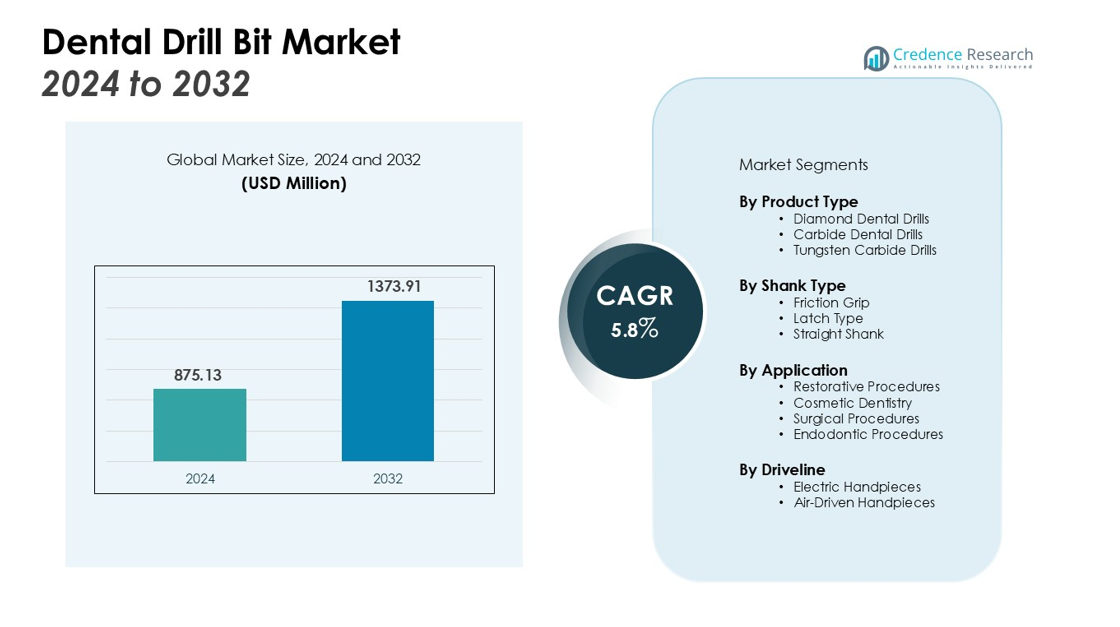
The Dental Drill Bit Market size was valued at USD 875.13 million in 2024 and is anticipated to reach USD 1373.91 million by 2032, at a CAGR of 5.8% during the forecast period (2024-2032).
| REPORT ATTRIBUTE | DETAILS |
|---|---|
| Historical Period | 2020-2023 |
| Base Year | 2024 |
| Forecast Period | 2025-2032 |
| Dental Drill Bit Market Size 2024 | USD 875.13 million |
| Dental Drill Bit Market, CAGR | 5.8% |
| Dental Drill Bit Market Size 2032 | USD 1373.91 million |
Key market drivers include the growing prevalence of dental disorders, such as cavities and gum diseases, coupled with advancements in dental technology. Innovations like high-speed diamond dental drills, laser-based drill bits, and smart drill systems are enhancing precision and efficiency, further fueling market demand. Additionally, rising disposable income in emerging economies has led to an increase in cosmetic dental procedures, contributing to the market's growth. The aging population, particularly in developed nations, is also a significant factor driving the demand for dental services and, consequently, dental drill bits.
Regionally, North America dominates the dental drill bit market, accounting for a significant share due to the high adoption of advanced dental technologies and a large number of dental procedures performed annually. Europe follows closely, driven by an aging population and advancements in dental healthcare. The Asia Pacific region is anticipated to witness the highest growth rate, fueled by increasing dental healthcare awareness and improvements in healthcare infrastructure in countries like China and India.
Market Insights:
- The global dental drill bit market size was valued at USD 875.13 million in 2024 and is expected to reach USD 1373.91 million by 2032, growing at a CAGR of 5.8% from 2024 to 2032.
- Key drivers include the increasing prevalence of dental disorders like cavities and gum diseases, which require efficient treatment tools, such as dental drill bits. The World Health Organization estimates that 60-90% of school-age children experience dental cavities, increasing the demand for dental procedures globally.
- Technological advancements in dental drill technology, such as high-speed diamond drills, laser-assisted drill bits, and smart drill systems, are improving precision and patient comfort, leading to higher market demand.
- Rising disposable incomes, especially in emerging economies, have led to greater access to cosmetic dental procedures, including tooth reshaping and dental implants. This increase in aesthetic dental treatments is contributing significantly to the market's growth.
- The aging population, particularly in developed nations, is expanding the dental drill bit market. As people age, they require more dental treatments for tooth loss and decay, significantly driving the demand for dental tools.
- North America holds a 35% share of the market, driven by advanced dental technologies, a high number of dental procedures, and a well-established healthcare infrastructure. The region’s dominance is supported by a large consumer base and high disposable income.
- The Asia Pacific region is experiencing the highest growth rate, expected to reach 23% market share. Rapid urbanization, increased healthcare investments, and growing awareness of dental health in countries like China and India are contributing to the region's expansion.
Market Drivers:
Rising Prevalence of Dental Disorders
The increasing prevalence of dental disorders such as cavities, gum disease, and tooth decay is a primary driver for the dental drill bit market. The World Health Organization (WHO) estimates that nearly 60-90% of school-aged children and a large portion of adults experience dental cavities, driving demand for dental procedures. These conditions require efficient and precise tools, such as dental drill bits, to ensure effective treatment. The growing global population further contributes to the rising incidence of dental issues, increasing the overall demand for dental procedures.
- For instance, the WHO's 2022 Global Oral Health Status Report identified untreated dental caries as the most prevalent health condition, affecting an estimated 2.5 billion people worldwide.
Technological Advancements in Dental Tools
Technological innovations in dental equipment have enhanced the functionality and efficiency of dental drill bits. The development of high-speed diamond dental drills, laser-assisted drill bits, and even smart drill systems that offer enhanced precision has bolstered the demand for these tools. These advancements enable more accurate and comfortable treatments, improving patient satisfaction. Dental drill bit manufacturers are continuously focusing on product innovation to cater to the evolving needs of dental professionals, contributing to the market's growth.
- For instance, NSK has engineered an air turbine handpiece that achieves a rotational speed of 400,000 RPM, which allows for highly efficient cutting while incorporating a bearing design that can stop the drill in less than one second to improve safety.
Rising Disposable Income and Cosmetic Dentistry Demand
Increasing disposable income, particularly in emerging markets, has led to greater access to dental care, including elective cosmetic dental procedures. Dental drill bits are integral to various aesthetic procedures, such as tooth reshaping, dental implants, and veneers. Rising awareness of cosmetic dentistry and the desire for improved appearance among consumers drive the demand for advanced dental tools. This trend is expected to continue, propelling market growth for dental drill bits.
Growing Geriatric Population
The global aging population plays a significant role in expanding the dental drill bit market. As individuals age, they often require more dental treatments due to age-related issues like tooth loss and decay. According to the United Nations, the number of people aged 60 years or older is expected to double by 2050. This demographic shift will increase the need for dental services, directly influencing the demand for dental drill bits.
Market Trends:
Increasing Adoption of Laser and Ultrasonic Dental Drill Technology
The dental drill bit market is witnessing a growing trend toward the adoption of laser and ultrasonic technologies. Laser-assisted drill systems offer precise cutting with minimal discomfort, reducing the need for anesthesia and enhancing patient experience. Ultrasonic dental drills, known for their ability to treat hard and soft tissues without damaging surrounding structures, are gaining popularity due to their accuracy and efficiency. These technologies contribute to faster recovery times and are being integrated into both cosmetic and restorative dental procedures. The rising demand for minimally invasive treatments is driving this trend, particularly among patients seeking a less painful dental experience. As technological advancements continue to evolve, manufacturers are focusing on enhancing the capabilities of laser and ultrasonic drills, further stimulating the market.
- For instance, BIOLASE Technology's Waterlase iPlus is an all-tissue dental laser that uses a patented combination of laser energy and water spray to perform a wide range of procedures, having obtained more than 80 FDA-cleared indications.
Shift Toward Biocompatible and Environmentally Friendly Materials
A notable trend in the dental drill bit market is the growing demand for biocompatible and environmentally friendly materials. With increasing awareness of sustainability and patient safety, dental drill bit manufacturers are prioritizing materials that reduce the risk of allergic reactions and promote better healing. Biocompatible materials, such as high-quality titanium and ceramic composites, are becoming more common due to their durability and compatibility with human tissues. Environmentally conscious consumers and regulatory bodies are also pushing manufacturers to adopt greener production methods, including reduced waste and sustainable sourcing of raw materials. This shift is helping dental drill bit companies align with both patient care standards and environmental responsibility.
- For instance, MIS Implants Technologies manufactures its Internal Hex Dental Implant System using biocompatible Titanium 6Al-4V ELI, a material that meets ASTM F136 standards for surgical implants.
Market Challenges Analysis:
High Cost of Advanced Dental Drill Technology
One significant challenge facing the dental drill bit market is the high cost of advanced dental drill technologies. Innovations like laser and ultrasonic drills require significant investment in research, development, and production, making them more expensive than traditional drill bits. This price disparity limits their widespread adoption, especially in cost-sensitive regions or among smaller dental practices. The high upfront costs of these advanced systems also pose barriers to entry for new dental clinics, potentially slowing the market's growth in emerging economies. As dental professionals look for cost-effective alternatives, balancing innovation with affordability remains a key hurdle for manufacturers in the market.
Regulatory and Safety Compliance Requirements
The dental drill bit market also faces challenges related to regulatory and safety compliance. Stringent regulations governing medical devices and materials require manufacturers to meet high standards for safety and effectiveness. Compliance with these regulations, particularly in different regions, adds complexity and cost to the production process. Variations in standards across markets, such as the European Union and the United States, require manufacturers to adapt their products to meet region-specific guidelines. These regulatory requirements can delay product approvals, increase operational costs, and limit the speed at which new innovations reach the market.
Market Opportunities:
Growing Demand for Cosmetic and Aesthetic Dentistry
The increasing popularity of cosmetic dentistry presents a significant opportunity for the dental drill bit market. Procedures such as dental implants, tooth reshaping, and veneers are gaining traction, particularly in developed regions where patients seek aesthetic improvements. These treatments often require specialized dental drill bits for precision and minimal invasiveness, driving demand for advanced tools. As more consumers prioritize cosmetic dental care, the market for dental drill bits used in these procedures is expected to expand. This shift in patient preference toward aesthetics offers a promising growth avenue for manufacturers to innovate and cater to the evolving needs of the dental industry.
Expansion in Emerging Markets
Emerging markets, particularly in Asia Pacific and Latin America, offer significant growth potential for the dental drill bit market. Rapid urbanization, increased disposable income, and growing healthcare infrastructure are driving the demand for dental services in these regions. As dental care accessibility improves, more people are seeking preventive and restorative dental treatments. This creates an opportunity for manufacturers to introduce cost-effective yet high-quality dental drill bits tailored to these markets. By expanding their presence and establishing partnerships with local dental clinics, manufacturers can capitalize on the rising dental care demand in these regions, fueling long-term market growth.
Market Segmentation Analysis:
By Product Type:
The market is primarily segmented into diamond dental drills, carbide dental drills, and tungsten carbide drills. Diamond dental drills dominate due to their superior cutting ability and precision, making them ideal for hard materials like enamel. Carbide drills follow closely, offering cost-effective alternatives for less complex procedures. Tungsten carbide drills are known for their durability and resistance to wear, contributing to their growing demand in both professional and commercial dental practices.
- For instance, tungsten carbide dental drills exhibit remarkable durability with a hardness rating of 9 on the Mohs scale.
By Shank Type:
The dental drill bit market is further segmented into friction grip, latch type, and straight shank types. Friction grip shank types lead the market due to their compatibility with most dental handpieces, ensuring stability and control during procedures. Latch-type shanks are gaining traction for their ease of use and secure attachment to handpieces, especially in restorative dental treatments. Straight shank types, while less common, are still in demand for specific dental applications requiring long drill bits.
- For instance, long shank dental burs range from 20 to 55 mm in length and are employed in oral surgery and endodontic treatment for deeper access and controlled cutting.
By Application:
The application segment includes restorative, cosmetic, surgical, and endodontic procedures. Restorative procedures hold the largest share, driven by high demand for cavity fillings and dental repairs. Cosmetic dentistry is expanding due to the rising popularity of aesthetic procedures like implants and veneers. Surgical and endodontic applications are also significant, with increasing use of advanced drill bits for precise root canal treatments and tooth extractions.
Segmentations:
- By Product Type:
- Diamond Dental Drills
- Carbide Dental Drills
- Tungsten Carbide Drills
- By Shank Type:
- Friction Grip
- Latch Type
- Straight Shank
- By Application:
- Restorative Procedures
- Cosmetic Dentistry
- Surgical Procedures
- Endodontic Procedures
- By Driveline Source:
- Electric Handpieces
- Air-Driven Handpieces
-
- North America
- U.S.
- Canada
- Mexico
- Europe
- UK
- France
- Germany
- Italy
- Spain
- Russia
- Rest of Europe
- Asia Pacific
- China
- Japan
- South Korea
- India
- Australia
- Southeast Asia
- Rest of Asia Pacific
- Latin America
- Brazil
- Argentina
- Rest of Latin America
- Middle East
- GCC Countries
- Israel
- Turkey
- Rest of Middle East
- Africa
- South Africa
- Egypt
- Rest of AfricaBy Region:
- North America
Regional Analysis:
North America
North America leads the dental drill bit market with a share of 35%. The U.S. contributes significantly to this dominance due to its advanced healthcare infrastructure and high consumer awareness. Technological advancements in dental tools, such as laser-assisted and ultrasonic drills, are widely adopted, driving market growth. The region also benefits from a strong presence of leading dental drill bit manufacturers and a growing trend toward cosmetic dentistry. High disposable income and an aging population further support the demand for dental procedures, ensuring the region’s dominant position in the market.
Europe
Europe accounts for 27% of the global dental drill bit market. Growth is driven by an aging population and increasing adoption of advanced dental technologies. Countries like Germany, the UK, and France have well-established dental sectors, with a high demand for both preventive and restorative treatments. Innovations in dental tools, especially those focused on precision and patient comfort, are gaining traction. The region’s strict regulatory standards for medical devices ensure high-quality products, contributing to the demand for reliable dental drill bits. Growing healthcare investments, along with rising awareness of oral hygiene, will continue to drive market growth in Europe.
Asia Pacific
Asia Pacific holds 23% of the global dental drill bit market and is expected to grow at the fastest rate. Rapid urbanization, increased healthcare investments, and improving dental care access are key factors contributing to this growth. Emerging markets like China and India are experiencing a surge in demand for dental services due to rising disposable incomes and growing awareness of oral health. The region's expanding healthcare infrastructure is also boosting the adoption of advanced dental technologies. As the dental care sector continues to evolve in Asia Pacific, the market for dental drill bits is poised for significant expansion.
Key Player Analysis:
- Dentsply Sirona
- Danaher Corporation
- Kavo Kerr
- Shofu
- BienAir
- Planmeca
- 3M
- Zimmer Biomet
- Sirona
- Midmark Corporation
- Adec
- KaVo Dental
- NSK
Competitive Analysis:
The dental drill bit market is highly competitive, with key players like Dentsply Sirona, Danaher Corporation, 3M, KaVo Kerr, and NSK Dental leading the charge. These companies focus on product innovation, such as the development of high-speed, durable, and precise drill bits to cater to diverse dental applications. They also emphasize strategic partnerships with dental clinics and healthcare institutions to expand their market presence. Additionally, regional expansion in emerging markets, fueled by the rising demand for dental procedures, is a crucial strategy to tap into growth opportunities. As these companies continuously innovate and adapt to technological advancements, the market remains dynamic, with competition driven by performance, product quality, and customer satisfaction.
Recent Developments:
- In April 2024, KaVo launched four new products for its treatment units including the KaVo Minilight 3F, KaVo ProXam iCam intraoral camera, and upgrades to the KaVo uniQa dental unit.
- In March 2025, Planmeca launched new products at IDS 2025 across extraoral and intraoral imaging, dental units, CAD/CAM, and software categories, including Planmeca Viso® imaging units and Romexis 7 with advanced AI tools.
- In March 2025, Planmeca announced its first handheld intraoral X-ray device, Planmeca ProX GO, debuting at IDS 2025.
- In March 2025, Solventum announced a strategic partnership with SprintRay to enhance digital dentistry with high-quality, permanent same-day restorations.
Report Coverage:
The research report offers an in-depth analysis based on Product Type, Shank Tank, Application, Driveline Source and Region. It details leading market players, providing an overview of their business, product offerings, investments, revenue streams, and key applications. Additionally, the report includes insights into the competitive environment, SWOT analysis, current market trends, as well as the primary drivers and constraints. Furthermore, it discusses various factors that have driven market expansion in recent years. The report also explores market dynamics, regulatory scenarios, and technological advancements that are shaping the industry. It assesses the impact of external factors and global economic changes on market growth. Lastly, it provides strategic recommendations for new entrants and established companies to navigate the complexities of the market.
Future Outlook:
- The dental drill bit market will see increased demand due to growing dental healthcare awareness globally.
- Technological advancements will drive the market, with innovations in laser-assisted, ultrasonic, and smart drill systems enhancing precision.
- The rise in cosmetic dentistry, particularly in developed regions, will contribute significantly to the growth of the market.
- The aging population worldwide will continue to drive the need for restorative dental treatments, increasing demand for dental drill bits.
- Increased disposable income, especially in emerging markets, will make advanced dental treatments more accessible, boosting market growth.
- The market will experience growth in the Asia Pacific region due to urbanization, improved healthcare infrastructure, and rising dental awareness.
- Advancements in biocompatible and environmentally friendly materials for drill bits will shape future product development.
- Increasing adoption of electric and air-driven handpieces will drive demand for specific types of dental drill bits.
- Regulatory standards will continue to evolve, creating opportunities for manufacturers to develop products that comply with stringent safety requirements.
- The trend towards minimally invasive procedures will accelerate the adoption of high-precision dental drill bits, driving demand for advanced, comfortable solutions.

Request a Free Sample
Fill in your details and we'll send you a free sample report.
- Sample data tables & charts
- Research methodology
Market Dynamics
Rising Prevalence of Dental Disorders
The increasing incidence of dental conditions such as cavities, gum disease, and tooth decay is driving demand for dental procedures that require efficient and precise drill bits. As the global population grows and ages, the need for restorative and preventive dental treatments continues to rise.
Technological Advancements in Dental Tools
Innovations such as high-speed diamond drills, laser-assisted drill bits, and smart drill systems are improving treatment precision and patient comfort. These advancements are encouraging dental professionals to upgrade their equipment, fueling market growth.
Growth in Cosmetic Dentistry and Disposable Income
Rising disposable incomes, especially in emerging economies, are making cosmetic dental procedures like implants and veneers more accessible. This trend is increasing the demand for advanced dental drill bits used in aesthetic treatments.
Aging Global Population
As the proportion of elderly individuals increases worldwide, there is a greater need for dental treatments related to tooth loss and decay. This demographic shift is significantly boosting the demand for dental drill bits in restorative and surgical applications.
Expansion of Dental Healthcare Infrastructure in Emerging Markets
Rapid urbanization and increased investment in healthcare infrastructure in regions such as Asia Pacific and Latin America are improving access to dental care. This expansion is creating new opportunities for dental drill bit manufacturers to serve a growing patient base.
Need a Custom Version of This Report?
Tailor the scope, geography, or segments to your exact requirements.
- Custom geography or segment scope
- Direct access to our analyst team
Frequently Asked Questions
What is the current market size for Dental Drill Bit, and what is its projected size in 2032?
At what Compound Annual Growth Rate is the Dental Drill Bit market projected to grow between 2024 and 2032?
Which Dental Drill Bit market segment held the largest share in 2024?
4What are the primary factors fueling the growth of the Dental Drill Bit market?
Who are the leading companies in the Dental Drill Bit market?
Table of Content
Chapter 1 Market Segmentation
- 1.1 Segmentation Framework
- 1.1.1 Product and Service Classification
- 1.1.2 Application and End-Use Classification
- 1.1.3 Technology and Solution Classification
- 1.1.4 Customer and Distribution Channel Classification
- 1.1.5 Geographic Segmentation
- 1.1.6 Market Segment Definitions and Boundaries
- 1.2 By Shank Type
- 1.2.1 Friction Grip
- 1.2.2 Latch Type
- 1.2.3 Straight Shank
- 1.3 By Application
- 1.3.1 Restorative Procedures
- 1.3.2 Cosmetic Dentistry
- 1.3.3 Surgical Procedures
- 1.3.4 Endodontic Procedures
- 1.4 By Product Type
- 1.4.1 Diamond Dental Drills
- 1.4.2 Carbide Dental Drills
- 1.4.3 Tungsten Carbide Drills
- 1.5 By Driveline Source
- 1.5.1 Electric Handpieces
- 1.5.2 Air-Driven Handpieces
Chapter 2 Introduction
- 2.1 Report Objectives and Scope
- 2.2 Product Definition and Industry Terminology
- 2.3 Market Inclusions and Exclusions
- 2.4 Research Process
- 2.4.1 Primary Research and Expert Interviews
- 2.4.2 Secondary Research and Source Review
- 2.4.3 Top-Down and Bottom-Up Estimation
- 2.4.4 Data Triangulation and Verification
- 2.5 Market Size Measurement Basis
- 2.5.1 2024: USD 875.13 million → 2032: USD 1373.91 million
- 2.6 Historical and Forecast Reference Periods
- 2.6.1 Base Year: 2024
- 2.6.2 Forecast Period: 2024-2032
- 2.7 Research Assumptions and Limitations
Chapter 3 Executive Summary
- 3.1 Market Snapshot and Key Findings
- 3.2 Base-Year Market Size, 2024
- 3.3 Forecast Market Size, 2032
- 3.4 Revenue and Volume Growth Outlook
- 3.5 Key Demand and Supply Indicators
- 3.6 Leading Market Segments
- 3.7 Fastest-Growing Market Opportunities
- 3.8 Regional Performance Highlights
- 3.9 Technology and Industry Transformation
- 3.10 Competitive Landscape Summary
- 3.11 Analyst View and Strategic Implications
Chapter 4 Global Dental Drill Bit Market Trends and Developments
- 4.1 Historical Industry Development
- 4.2 Recent Market Trends and Developments
- 4.3 Demand and Customer Behavior Trends
- 4.4 Technology and Product Innovation
- 4.5 Artificial Intelligence, Automation and Digitalization
- 4.6 Local Manufacturing and Supply Chain Realignment
- 4.7 Industry Partnerships, Mergers and Acquisitions
- 4.8 Sustainability and Circular Economy Developments
- 4.9 Government and Private Sector Investment Trends
- 4.10 Emerging Business Models and Commercialization
- 4.11 Industry Developments and Announcements
Chapter 5 Global Dental Drill Bit Market Production, Supply and Demand Analysis
- 5.1 Demand Trend and Consumption Analysis
- 5.2 Demand Forecast, 2024-2032
- 5.3 Production and Output Trend
- 5.4 Production and Output Forecast, 2024-2032
- 5.5 Installed Capacity and Capacity Utilization
- 5.6 Company-Wise Production Plants and Statistics
- 5.6.1 Installed Production Capacity
- 5.6.2 Actual Production
- 5.6.3 Planned Capacity and Expansion Targets
- 5.7 Supply Chain Structure and Procurement Trends
- 5.8 Supply-Demand Gap and Bottlenecks
- 5.9 Import Dependence and Sourcing Structure
- 5.10 Contract Manufacturing and Outsourcing
- 5.11 Regional Supply and Demand Concentration
Chapter 6 Global Dental Drill Bit Market Pricing Analysis
- 6.1 Pricing Structure and Measurement
- 6.2 Historical Pricing Trends
- 6.3 Pricing Outlook, 2024-2032
- 6.4 Average Selling Price and Unit Economics
- 6.5 Pricing by Product and Market Segment
- 6.6 Geographic Pricing Differences
- 6.7 Key Input, Energy, Labor and Logistics Costs
- 6.8 Contract Pricing and Purchasing Models
- 6.9 Pricing Sensitivity and Competitive Positioning
- 6.10 Price, Margin and Profitability Implications
Chapter 7 Global Dental Drill Bit Market Dynamics
- 7.1 Market Growth Drivers
- 7.1.1 Demand-Side Drivers
- 7.1.2 Technology and Innovation Drivers
- 7.1.3 Infrastructure and Investment Drivers
- 7.1.4 Regulatory and Policy Drivers
- 7.2 Market Restraints
- 7.2.1 Cost and Affordability Constraints
- 7.2.2 Technology and Adoption Barriers
- 7.2.3 Supply Chain and Operational Constraints
- 7.3 Market Challenges
- 7.3.1 Competitive Pressure and Margin Erosion
- 7.3.2 Skills, Infrastructure and Implementation Gaps
- 7.4 Emerging Market Opportunities
- 7.5 Market Dynamics Impact and Time-Horizon Assessment
Chapter 8 Global Dental Drill Bit Value Chain Analysis
- 8.1 Industry Value Chain Overview
- 8.2 Upstream Suppliers and Critical Inputs
- 8.3 Technology and Component Providers
- 8.4 Manufacturing or Service Delivery
- 8.5 Distribution, Channel Partners and Integrators
- 8.6 Downstream Applications and End Users
- 8.7 Value Addition and Profit Pools
- 8.8 Vertical Integration and Outsourcing
- 8.9 Supplier Concentration and Risk
- 8.10 Supply Chain Localization and Resilience
Chapter 9 Global Dental Drill Bit Market Regulations and Policies
- 9.1 Relevant Laws, Standards and Compliance Frameworks
- 9.2 Product, Service, Safety and Quality Requirements
- 9.3 Government Policies, Incentives and Subsidies
- 9.4 Imports, Exports and Trade Barriers
- 9.5 Public Procurement and Local Content Requirements
- 9.6 Environmental and Sustainability Compliance
- 9.7 Upcoming Policy Changes and Market Implications
Chapter 10 Global Dental Drill Bit Market Hotspots and Opportunities
- 10.1 Market Opportunity Mapping and Growth Hotspots
- 10.2 High-Growth Applications and Customer Groups
- 10.3 Underserved Markets and White-Space Opportunities
- 10.4 Emerging Technology and Product Opportunities
- 10.5 New Capacity and Investment Hotspots
- 10.6 Market Entry and Expansion Opportunities
- 10.7 Distribution and Partnership Opportunities
- 10.8 Near-Term and Long-Term Commercial Potential
- 10.9 Opportunity Attractiveness and Execution Risks
Chapter 11 Global Dental Drill Bit Market Outlook, 2024-2032
- 11.1 Market Size and Analysis
- 11.1.1 Revenue (Market Measurement: 2024: USD 875.13 million → 2032: USD 1373.91 million)
- 11.1.2 Market Volume and Quantity Sold
- 11.1.3 Historical Market Size
- 11.1.4 Base-Year Market Size, 2024
- 11.2 Market Forecast, 2024-2032
- 11.2.1 Revenue Forecast to 2032
- 11.2.2 Volume Forecast to 2032
- 11.2.3 CAGR and Year-on-Year Growth
- 11.2.4 Incremental Revenue Opportunity
- 11.3 Forecast Assumptions and Scenario Analysis
- 11.3.1 Base-Case Forecast
- 11.3.2 Optimistic and Conservative Scenarios
- 11.3.3 Technology, Pricing and Policy Sensitivities
- 11.4 Market Attractiveness and Growth Outlook
Chapter 12 Global Dental Drill Bit Market Segmentation and Outlook
- 12.1 Segmentation Summary and Market Shares, 2024
- 12.2 Largest and Fastest-Growing Segments
- 12.3 By Shank Type - Market Size and Forecast, 2024-2032
- 12.3.1 Segment Definition and Scope
- 12.3.2 Historical Market Size
- 12.3.3 Revenue Forecast, 2024-2032
- 12.3.4 Volume Forecast, 2024-2032
- 12.3.5 Base-Year Market Share, 2024
- 12.3.6 Segment CAGR and Growth Drivers
- 12.3.7 Subsegment Market Size and Forecast
- 12.3.7.1 Friction Grip
- 12.3.7.2 Latch Type
- 12.3.7.3 Straight Shank
- 12.3.8 Subsegment Pricing and Adoption Trends
- 12.3.9 Leading Suppliers and Competition
- 12.3.10 Regional Demand and Opportunities
- 12.4 By Application - Market Size and Forecast, 2024-2032
- 12.4.1 Segment Definition and Scope
- 12.4.2 Historical Market Size
- 12.4.3 Revenue Forecast, 2024-2032
- 12.4.4 Volume Forecast, 2024-2032
- 12.4.5 Base-Year Market Share, 2024
- 12.4.6 Segment CAGR and Growth Drivers
- 12.4.7 Subsegment Market Size and Forecast
- 12.4.7.1 Restorative Procedures
- 12.4.7.2 Cosmetic Dentistry
- 12.4.7.3 Surgical Procedures
- 12.4.7.4 Endodontic Procedures
- 12.4.8 Subsegment Pricing and Adoption Trends
- 12.4.9 Leading Suppliers and Competition
- 12.4.10 Regional Demand and Opportunities
- 12.5 By Product Type - Market Size and Forecast, 2024-2032
- 12.5.1 Segment Definition and Scope
- 12.5.2 Historical Market Size
- 12.5.3 Revenue Forecast, 2024-2032
- 12.5.4 Volume Forecast, 2024-2032
- 12.5.5 Base-Year Market Share, 2024
- 12.5.6 Segment CAGR and Growth Drivers
- 12.5.7 Subsegment Market Size and Forecast
- 12.5.7.1 Diamond Dental Drills
- 12.5.7.2 Carbide Dental Drills
- 12.5.7.3 Tungsten Carbide Drills
- 12.5.8 Subsegment Pricing and Adoption Trends
- 12.5.9 Leading Suppliers and Competition
- 12.5.10 Regional Demand and Opportunities
- 12.6 By Driveline Source - Market Size and Forecast, 2024-2032
- 12.6.1 Segment Definition and Scope
- 12.6.2 Historical Market Size
- 12.6.3 Revenue Forecast, 2024-2032
- 12.6.4 Volume Forecast, 2024-2032
- 12.6.5 Base-Year Market Share, 2024
- 12.6.6 Segment CAGR and Growth Drivers
- 12.6.7 Subsegment Market Size and Forecast
- 12.6.7.1 Electric Handpieces
- 12.6.7.2 Air-Driven Handpieces
- 12.6.8 Subsegment Pricing and Adoption Trends
- 12.6.9 Leading Suppliers and Competition
- 12.6.10 Regional Demand and Opportunities
- 12.7 Segment Growth Comparison
- 12.8 Segment Attractiveness and Priority Matrix
Chapter 13 Global Dental Drill Bit End-Use and Application Market Outlook
- 13.1 End-Use Industry and Customer Demand Structure
- 13.2 Leading Applications and Customer Groups
- 13.3 End-Use Market Size, Share and Forecast
- 13.4 Major End-Use Industry Deep Dives
- 13.4.1 Customer Requirements and Use Cases
- 13.4.2 Demand and Replacement Cycles
- 13.4.3 Technical and Regulatory Considerations
- 13.4.4 Purchasing and Procurement Models
- 13.4.5 Leading Vendors and Distribution Channels
- 13.4.6 Forecast and Commercial Opportunities
- 13.5 Emerging Applications and Cross-Segment Demand
- 13.6 End-Use Industry Investment Priorities
Chapter 14 Global Dental Drill Bit Geographic Market Outlook, 2024-2032
- 14.1 Regional Market Size and Share, 2024
- 14.2 Regional Market Forecast, 2024-2032
- 14.3 Regional Pricing, Production and Demand Differences
- 14.4 North America
- 14.4.1 United States
- 14.4.2 Canada
- 14.4.3 Mexico
- 14.5 Europe
- 14.5.1 Germany
- 14.5.2 France
- 14.5.3 Italy
- 14.5.4 United Kingdom
- 14.5.5 Spain
- 14.5.6 Poland
- 14.5.7 Russia
- 14.5.8 Netherlands
- 14.5.9 Belgium
- 14.5.10 Sweden
- 14.5.11 Denmark
- 14.5.12 Norway
- 14.5.13 Rest of Europe
- 14.6 Asia Pacific
- 14.6.1 China
- 14.6.2 India
- 14.6.3 Japan
- 14.6.4 South Korea
- 14.6.5 Thailand
- 14.6.6 Indonesia
- 14.6.7 Vietnam
- 14.6.8 Malaysia
- 14.6.9 Australia
- 14.6.10 Rest of Asia Pacific
- 14.7 Latin America
- 14.7.1 Brazil
- 14.7.2 Argentina
- 14.7.3 Colombia
- 14.7.4 Chile
- 14.7.5 Rest of Latin America
- 14.8 Middle East
- 14.8.1 Saudi Arabia
- 14.8.2 United Arab Emirates
- 14.8.3 Turkey
- 14.8.4 Israel
- 14.8.5 Iran
- 14.8.6 Rest of the Middle East
- 14.9 Africa
- 14.9.1 South Africa
- 14.9.2 Egypt
- 14.9.3 Nigeria
- 14.9.4 Morocco
- 14.9.5 Rest of Africa
- 14.10 Regional Investment, Policy and Supply Chain Differences
- 14.11 Regional Competitive Landscape
- 14.12 Geographic Growth Hotspots
Chapter 15 Global Dental Drill Bit Technology, Innovation and Sustainability Outlook
- 15.1 Technology Landscape and Maturity
- 15.2 Product, Process and Service Innovation
- 15.3 AI, Automation and Digital Tools in the Industry
- 15.4 Technology Adoption and Performance Benchmarking
- 15.5 Innovation Pipeline and R&D Investment
- 15.6 Patent and Intellectual Property Trends
- 15.7 Energy Efficiency and Resource Management
- 15.8 Sustainability, Recycling and Circularity
- 15.9 Technology Roadmap, 2024-2032
- 15.10 Risks of Obsolescence and Technology Substitution
Chapter 16 Global Dental Drill Bit Market Key Strategic Imperatives
- 16.1 Growth and Market Entry Priorities
- 16.2 High-Return Products and Segments
- 16.3 Pricing, Profitability and Cost Optimization
- 16.4 Technology Investment and Product Differentiation
- 16.5 Supply Chain Localization and Resilience
- 16.6 Distribution and Customer Acquisition
- 16.7 Partnership, Acquisition and Capacity Strategy
- 16.8 Regional Expansion Priorities
- 16.9 Short-, Medium- and Long-Term Actions
Chapter 17 Competition Outlook
- 17.1 Industry Competition Characteristics
- 17.2 Market Structure and Concentration
- 17.3 Market Share and Competitive Positioning, 2024
- 17.4 Company-Wise Revenue and Product Benchmarking
- 17.5 Production and Service Capacity Benchmarking
- 17.6 Technology, Pricing and Differentiation
- 17.7 Regional Footprint and Distribution Strength
- 17.8 Mergers, Acquisitions and Strategic Alliances
- 17.9 New Entrants and Competitive Threats
- 17.10 Porter's Five Forces and Industry Attractiveness
- 17.11 Competitive Outlook, 2024-2032
Chapter 18 Company Profiles
- 18.1 Company Coverage and Selection Criteria
- 18.2 Dentsply Sirona
- 18.2.1 Business Description
- 18.2.2 Company Ownership and Geographic Presence
- 18.2.3 Product and Service Portfolio
- 18.2.4 Manufacturing and Operating Footprint
- 18.2.5 Production Capacity and Expansion Plans
- 18.2.6 Financial Performance and Investment
- 18.2.7 Market Share and Competitive Position
- 18.2.8 Technology and Innovation Capabilities
- 18.2.9 Strategic Alliances or Partnerships
- 18.2.10 Recent Developments
- 18.2.11 Growth Strategy and Outlook
- 18.3 Danaher Corporation
- 18.4 KaVo Kerr
- 18.5 Shofu
- 18.6 BienAir
- 18.7 Planmeca
- 18.8 3M
- 18.9 Zimmer Biomet
- 18.10 NSK
- 18.11 Midmark Corporation
- 18.12 Other Relevant Market Participants
Note: Every listed company is profiled on the structure shown under the first company. The company list is preliminary and may change based on research findings, market developments, data availability and client requirements.
Chapter 19 Disclaimer
- 19.1 Research and Forecast Disclaimer
- 19.2 Data Source and Estimation Limitations
Note: The depth of individual sections depends on data availability for this market. Volume, capacity, trade and other unit-based metrics are included where applicable.

