
| REPORT ATTRIBUTE | DETAILS |
|---|---|
| Historical Period | 2020-2023 |
| Base Year | 2024 |
| Forecast Period | 2025-2032 |
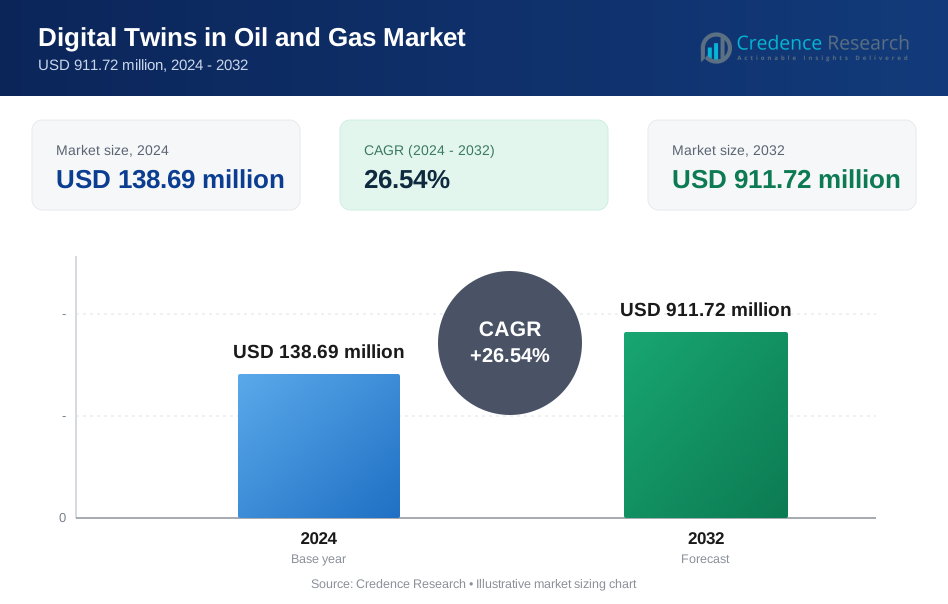
| Digital Twins in Oil and Gas Market Size 2024 | USD 138.69 Million |
| Digital Twins in Oil and Gas Market, CAGR | 26.54% |
| Digital Twins in Oil and Gas Market Size 2032 | USD 911.72 Million |
Market Overview:
The Digital Twins in Oil and Gas Market is projected to grow from USD 138.69 million in 2024 to an estimated USD 911.72 million by 2032, with a compound annual growth rate (CAGR) of 26.54% from 2024 to 2032.
The adoption of Digital Twin technology in the oil and gas industry is primarily driven by the need for enhanced operational efficiency, predictive maintenance, and asset optimization. Digital twins allow real-time monitoring of critical assets, such as drilling rigs and pipelines, enabling operators to track equipment conditions and predict failures before they occur, significantly reducing unplanned downtime and maintenance costs. Additionally, the integration of Digital Twin technology with advanced technologies like AI, machine learning, and cloud computing enhances its capabilities, enabling better decision-making, operational optimization, and strategic planning. As a result, digital twins play a crucial role in improving asset reliability, optimizing operational performance, and reducing costs across the oil and gas sector.
Regionally, North America leads the market, driven by significant investments in automation, analytics, and digital technologies by major oil and gas companies. The region's high adoption of digital twin solutions is also supported by the presence of industry leaders and a strong focus on asset management and operational optimization. In contrast, the Asia Pacific region is rapidly adopting digital twin technology due to rising energy demands and substantial infrastructure investments in countries like China, India, and Australia. Government initiatives promoting digital transformation in the energy sector further accelerate this growth. Europe, with its robust energy sector and government-backed digitalization initiatives, also sees steady growth in digital twin adoption. Meanwhile, the Middle East and Africa are experiencing increased investments in oilfield management and operational sustainability, contributing to the region’s growing market for digital twin technology.
Market Insights:
- The Digital Twin technology market in the oil and gas sector is expected to grow from USD 138.69 million in 2024 to USD 911.72 million by 2032, with a CAGR of 26.54%.
- Key drivers of growth include enhanced operational efficiency, predictive maintenance, and asset optimization, helping companies reduce downtime and maintenance costs.
- The integration of AI, machine learning, and cloud computing with digital twins enables better decision-making, operational optimization, and strategic planning.
- North America leads in market share, driven by significant investments in digital technologies and strong industry presence.
- The Asia Pacific region is rapidly adopting digital twin technology, supported by growing energy demands and government initiatives promoting digital transformation.
- High implementation costs and integration with legacy systems remain significant challenges for oil and gas companies looking to adopt digital twins.
- The need for skilled professionals to manage and operate digital twin technology presents a barrier to widespread adoption, highlighting the importance of workforce training and development.
Market Drivers:
Operational Efficiency and Asset Optimization
One of the primary drivers of the Digital Twin technology adoption in the oil and gas industry is the significant improvement it offers in operational efficiency and asset optimization. Digital twins enable real-time monitoring of physical assets, such as drilling rigs, pipelines, and refineries, by creating virtual replicas of these assets. For instance, BP implemented digital twin solutions across its production systems, resulting in an additional production of 30,000 barrels of oil in the first year alone, alongside measurable cost savings. This technology provides operators with continuous, actionable insights into asset performance, allowing them to predict failures, schedule maintenance proactively, and reduce the risk of unplanned downtime. By optimizing asset utilization, digital twins enhance operational efficiency, ultimately improving the bottom line for oil and gas companies.
Predictive Maintenance and Reduced Downtime
The integration of Digital Twin technology has revolutionized predictive maintenance in the oil and gas sector. Traditional maintenance approaches often result in unanticipated failures or expensive reactive measures. For example, Shell uses digital twins for global asset visualization and advanced analytics to predict failures before they occur, reducing unplanned downtime by up to 20%. Digital twins leverage data from sensors and IoT devices to monitor equipment health continuously. By applying advanced analytics, digital twins can predict potential failures and enable companies to take preemptive actions, such as replacing worn-out components or performing necessary repairs. This predictive maintenance strategy reduces the occurrence of unscheduled downtime, decreases maintenance costs, and extends the lifespan of critical equipment, which contributes to overall operational reliability and cost efficiency.
Integration with Advanced Technologies
The increasing convergence of Digital Twin technology with other advanced technologies, such as artificial intelligence (AI), machine learning, and cloud computing, is another crucial driver of its rapid adoption in the oil and gas industry. AI and machine learning algorithms enhance the capabilities of digital twins by processing large datasets and generating actionable insights, allowing for better decision-making and strategic planning. Moreover, cloud computing enables the storage and analysis of vast amounts of data, facilitating remote monitoring and collaborative efforts across geographically dispersed teams. The integration of these technologies enables oil and gas companies to optimize operations, improve safety, and enhance their competitive advantage in a rapidly evolving market.
Improved Safety and Risk Management
Digital Twin technology plays a vital role in enhancing safety and risk management within the oil and gas industry. By providing a virtual model of physical assets and their operating conditions, digital twins allow operators to simulate and analyze different scenarios to identify potential hazards before they occur. This proactive approach to risk management helps companies improve safety protocols and reduce the likelihood of catastrophic events, such as equipment failures, environmental disasters, or accidents. By enhancing risk mitigation strategies and optimizing safety measures, digital twins contribute to a safer working environment, while also ensuring compliance with industry regulations and reducing the environmental impact of operations.
Market Trends:
Integration of Artificial Intelligence and Machine Learning
A significant trend in the digital twin landscape within the oil and gas industry is the integration of artificial intelligence (AI) and machine learning (ML) technologies. This convergence enhances the predictive capabilities of digital twins, enabling real-time data analysis and simulation of various operational scenarios. For instance, BP's collaboration with Palantir Technologies aims to utilize AI for analyzing data from operational sites, generating actionable insights to optimize performance. This integration facilitates proactive decision-making, improves efficiency, and supports the industry's digital transformation initiatives.
Expansion of Digital Twin Applications
Initially employed for asset monitoring and maintenance, digital twins are now being applied across various facets of oil and gas operations. Their capabilities extend to safety enhancements, predictive maintenance, and remote exploration. The adaptability of digital twins allows for integration into diverse systems, contributing to improved operational efficiency and safety standards. This expansion reflects a broader trend of adopting advanced technologies to address complex challenges within the industry.
Strategic Collaborations and Investments
Oil and gas companies are increasingly engaging in strategic partnerships and investments to leverage digital twin technologies. For example, Eni's development of HPC6, one of the world's most powerful supercomputers, underscores the industry's commitment to enhancing exploration capabilities and advancing clean energy projects. These collaborations and investments are pivotal in driving innovation, optimizing operations, and achieving sustainability goals within the sector.
Emphasis on Workforce Reskilling
The rapid adoption of digital twin technologies necessitates a focus on workforce reskilling. A survey by Ernst & Young LLP revealed that while 92% of energy industry respondents view reskilling as a competitive advantage, only 29% are investing in retraining initiatives. Addressing this gap is crucial for ensuring that the workforce can effectively manage and utilize advanced technologies, thereby maximizing the benefits of digital twins in oil and gas operations.
Market Challenges Analysis:
High Implementation Costs
One of the primary challenges facing the adoption of Digital Twin technology in the oil and gas industry is the high initial cost of implementation. Developing and deploying digital twins requires substantial investment in infrastructure, including advanced sensors, IoT devices, data storage, and analytics platforms. Additionally, integrating digital twins into existing legacy systems and training personnel to use the technology further increases costs. For smaller and mid-sized companies, these financial barriers can be prohibitive, limiting the widespread adoption of digital twins and slowing down the overall market growth.
Data Security and Privacy Concerns
As digital twins rely heavily on data collection from physical assets and systems, concerns surrounding data security and privacy pose significant challenges. The oil and gas sector is a prime target for cyberattacks, with the increasing amount of sensitive data generated through IoT devices and operational technologies. Ensuring that digital twin systems are secure against cyber threats is critical to maintaining the integrity of operations. Additionally, as companies adopt cloud-based solutions to store and process vast amounts of data, ensuring compliance with data protection regulations becomes even more complex. These security challenges may slow the adoption of digital twins in the sector.
Integration with Legacy Systems
Many oil and gas companies still rely on outdated legacy systems, which can pose significant challenges when attempting to integrate digital twin technology. The compatibility of digital twins with these existing systems may not always be seamless, requiring extensive modifications or upgrades to infrastructure. This process can be time-consuming, expensive, and fraught with technical challenges. Moreover, older systems may lack the necessary capabilities to support the real-time data processing required for effective digital twin operations, hindering the full potential of this technology.
Skill Shortage and Workforce Training
Another significant challenge is the shortage of skilled workers capable of managing and operating digital twin technologies. The complexity of these systems requires specialized knowledge in areas such as data analytics, machine learning, and AI. With a growing demand for these skills, there is an urgent need for reskilling and workforce development initiatives to ensure that employees can effectively utilize digital twin solutions. For example, reports indicate that many companies struggle to find professionals capable of managing complex digital twin systems. Without sufficient talent, the successful implementation and management of digital twin technology remain a significant challenge for the oil and gas sector.
Market Opportunities:
The Digital Twin technology in the oil and gas market presents a significant opportunity for companies to enhance operational efficiency, reduce costs, and improve safety standards. As the industry faces increasing pressure to optimize operations and maximize the lifespan of assets, digital twins provide a comprehensive solution by enabling real-time monitoring and predictive analytics. This capability allows oil and gas companies to shift from reactive to proactive maintenance strategies, minimizing unplanned downtime and enhancing asset reliability. Additionally, the integration of digital twins with advanced technologies such as artificial intelligence (AI) and machine learning offers the potential for more accurate decision-making and optimization across various operational facets, including exploration, drilling, production, and transportation. These efficiencies not only lead to substantial cost savings but also enable companies to scale operations without sacrificing performance or safety.
Furthermore, there is a growing opportunity in the energy transition toward more sustainable practices, which is creating a demand for digital solutions that improve resource management and reduce environmental impact. Digital twins can help optimize energy consumption, reduce emissions, and enhance the monitoring of environmental risks in real time. As governments and regulatory bodies increase their focus on sustainability, digital twins offer a crucial tool for companies looking to meet stricter environmental regulations while maintaining operational efficiency. The rising focus on digital transformation within the sector further enhances this opportunity, positioning digital twins as a key enabler in achieving long-term sustainability goals while driving innovation across the oil and gas industry.
Market Segmentation Analysis:
The Digital Twin technology market in the oil and gas sector is segmented across various categories, each playing a pivotal role in its growth and application.
By Type Segment Analysis: The market is categorized into Descriptive, Informative, Predictive, Comprehensive, and Autonomous twins. Predictive twins are particularly popular for maintenance and performance optimization, while Autonomous twins are gaining traction due to their self-operating capabilities, minimizing human intervention.
By Application Segment Analysis: Key applications include Drilling, Pipelines, Virtual Learning and Training, Asset Monitoring and Maintenance, Project Planning, Lifecycle Management, Collaboration and Knowledge Sharing, Offshore Platforms, and Exploration. Asset Monitoring and Maintenance is a prominent segment, allowing real-time monitoring to prevent failures, while Exploration and Geological Study leverage digital twins to simulate underground conditions for better decision-making.
By Component Segment Analysis: The market is divided into Product, Process, and System Digital Twins. Process Digital Twins dominate, as they simulate operational processes for optimized management of resources and workflows.
By Deployment Segment Analysis: On-Premise and Cloud are the primary deployment models. Cloud solutions are favored due to their scalability and cost-efficiency, facilitating remote monitoring and management.
By Enterprise Size Segment Analysis: The market serves both Large Enterprises and Small and Medium-sized Enterprises (SMEs). Larger enterprises lead in adoption due to their more significant capital, but SMEs are catching up as digital twin technologies become more affordable.
Segmentation:
By Type Segment Analysis
- Descriptive Twin
- Informative Twin
- Predictive Twin
- Comprehensive Twin
- Autonomous Twin
By Application Segment Analysis
- Drilling
- Pipelines
- Virtual Learning and Training
- Asset Monitoring and Maintenance
- Project Planning and Lifecycle Management
- Collaboration and Knowledge Sharing
- Offshore Platforms and Infrastructure
- Exploration and Geological Study
By Component Segment Analysis
- Product Digital Twin
- Process Digital Twin
- System Digital Twin
By Deployment Segment Analysis
- On-Premise
- Cloud
By Enterprise Size Segment Analysis
- Large Enterprises
- Small and Medium-sized Enterprises (SMEs)
Regional Analysis:
The Digital Twin technology has significantly transformed the oil and gas industry by offering real-time monitoring, predictive maintenance, and operational optimization. This transformation varies across regions, influenced by technological infrastructure, investment levels, and strategic priorities.
North America
In 2024, North America accounted for approximately 30% of the global digital twin in oil and gas market revenue. This dominance is attributed to the region's mature oil and gas sector, substantial investments in digital technologies, and a strong emphasis on operational efficiency. Companies in North America are actively adopting digital twin solutions to enhance asset management and streamline operations.
Europe
Europe held over 20% of the market share in 2022. The region's established oil and gas operations and government initiatives promoting digital transformation contribute to this significant adoption rate. European companies are leveraging digital twins to improve safety measures, predict equipment failures, and optimize production processes.
Asia Pacific
The Asia Pacific region is emerging as a key growth area for digital twin technology in the oil and gas sector. Countries like China, India, and Australia are experiencing increased energy demand and are investing heavily in infrastructure. These investments are driving the adoption of digital twins for applications such as drilling optimization, asset monitoring, and production management. Government initiatives further accelerate the integration of digital technologies in the energy sector.
Middle East and Africa
The Middle East and Africa are witnessing growth in digital twin adoption, supported by investments in oilfield management and operational sustainability. As the region seeks to enhance operational capabilities and reduce costs, digital twins are becoming integral to strategic planning, improving efficiency, and ensuring safety across the sector.
Key Player Analysis:
- General Electric (GE)
- Siemens
- Microsoft Corporation
- Oracle Corporation
- Robert Bosch GmbH
Competitive Analysis:
The Digital Twin technology in the oil and gas industry has attracted significant attention, leading to a competitive landscape featuring both established technology providers and specialized startups. Major corporations such as IBM, Emerson, and General Electric collectively held over 22% of the market share in 2024. These companies invest heavily in research and development to enhance their digital twin offerings, integrating advanced technologies like artificial intelligence and machine learning to provide comprehensive solutions for asset management and operational optimization. In addition to these industry giants, specialized firms like Akselos are making notable strides. Akselos has partnered with Shell Information Technology to leverage digital twin technology for managing Shell’s oil and gas portfolio, focusing on real-time monitoring and performance optimization. This collaboration exemplifies the industry's trend toward integrating specialized digital solutions to enhance operational efficiency. The competitive landscape is further intensified by new entrants continually introducing innovative solutions, driving advancements in digital twin applications across the sector.
Recent Developments:
- In March 2023, Chevron has expanded its collaboration with Kongsberg Digital to deploy digital twin technology across its global operations. This solution aids in work planning, project execution, troubleshooting, and decision-making while reducing costs and safety risks.
- In Jan 2025, BP has partnered with digital twin software provider Aize under a four-year global contract to enhance asset visualization. The partnership involves deploying Aize's technology across BP facilities worldwide, including regions like the North Sea, Caspian Sea, and West Africa.
- In August 2024, Shell has signed a strategic agreement with Swiss-based Akselos to utilize digital twin technology for real-time structural performance management across its oil and gas portfolio. This partnership focuses on optimizing asset lifecycle performance and maximizing output at facilities like the Shell Scotford Complex in Canada. Akselos will serve as Shell’s primary supplier of digital twin software.
Market Concentration & Characteristics:
The Digital Twin technology market in the oil and gas industry is characterized by a high degree of concentration, with several key players dominating the landscape. Leading companies such as Equinor, General Electric, IBM Corporation, PTC Inc., Microsoft Corporation, Siemens AG, Ansys, Inc., SAP SE, Oracle Corporation, and Robert Bosch GmbH collectively hold a substantial share of the market. This market is marked by continuous innovation, with a strong emphasis on integrating advanced technologies like artificial intelligence (AI) and cloud-based platforms into digital twin solutions. These integrations aim to enhance the capabilities of digital twins, enabling real-time monitoring, predictive maintenance, and improved decision-making processes. The competitive environment is further intensified by a trend toward strategic mergers and acquisitions, as companies strive to consolidate their positions and expand their technological expertise in the digital twin domain
Report Coverage:
The research report offers an in-depth analysis based on By Type Segment Analysis, By Application Segment Analysis, By Component Segment Analysis, By Deployment Segment Analysis and By Enterprise Size Segment Analysis. It details leading market players, providing an overview of their business, product offerings, investments, revenue streams, and key applications. Additionally, the report includes insights into the competitive environment, SWOT analysis, current market trends, as well as the primary drivers and constraints. Furthermore, it discusses various factors that have driven market expansion in recent years. The report also explores market dynamics, regulatory scenarios, and technological advancements that are shaping the industry. It assesses the impact of external factors and global economic changes on market growth. Lastly, it provides strategic recommendations for new entrants and established companies to navigate the complexities of the market.
Future Outlook:
- North America leads in digital twin adoption within the oil and gas market.
- Asia Pacific is witnessing rapid growth, driven by increasing energy demand and infrastructure investments.
- Cloud deployment of digital twin solutions dominates the market due to scalability and cost-effectiveness.
- Asset monitoring and maintenance applications are key drivers of digital twin technology usage in oil and gas.
- Process digital twins are the most widely used in the industry, simulating complex operational processes.
- Integration of AI and machine learning is enhancing predictive analytics and decision-making in operations.
- Investments in supercomputing technologies, like Eni’s HPC6, are advancing exploration and clean energy efforts.
- Strategic collaborations, such as BP’s partnership with Palantir, are pushing forward operational performance improvements.
- Digital twin solutions are being increasingly applied for risk management and safety enhancement across the sector.
- Addressing the workforce skill gap is crucial for the effective implementation of digital twin technologies.
Request a Free Sample
Fill in your details and we'll send you a free sample report.
- Sample data tables & charts
- Research methodology
Need a Custom Version of This Report?
Tailor the scope, geography, or segments to your exact requirements.
- Custom geography or segment scope
- Direct access to our analyst team
Frequently Asked Questions
What is the current size of the Digital Twins in Oil and Gas Market?
What factors are driving the growth of the Digital Twins in Oil and Gas Market?
What are the key segments within the Digital Twins in Oil and Gas Market?
What are some challenges faced by the Digital Twins in Oil and Gas Market?
Who are the major players in the Digital Twins in Oil and Gas Market?
Table of Content
Chapter 1. Report Introduction
- 1.1 Report Description & Purpose
- 1.1.1 Report Title & Market Definition
- 1.1.2 Unique Selling Propositions (USP) & Key Differentiators
- 1.1.3 Value Proposition for Stakeholders
- 1.2 Research Objectives
- 1.2.1 Market Sizing Objectives (Volume & Revenue)
- 1.2.2 Segmentation Objectives
- 1.2.3 Competitive Intelligence Objectives
- 1.2.4 Forecast & Scenario Objectives
- 1.3 Report Scope
- 1.3.1 Digital Twins in Oil and Gas Scope – Types & Subtypes Covered
- 1.3.2 Geographic Scope – Regions & Countries Covered
- 1.3.3 Historical Period, Base Year & Forecast Period (2024; forecast to 2032)
- 1.3.4 Inclusions & Exclusions
- 1.4 HS Code & Classification Framework
- 1.5 Currency, Units & Pricing Basis
- 1.6 Target Stakeholders
- 1.7 Limitations & Assumptions
Chapter 2. Executive Summary
- 2.1 Global Digital Twins in Oil and Gas Market Snapshot
- 2.1.1 Market Size – Historical (2024) & Forecast (2024-2032) (2024: USD 138.69 million → 2032: USD 911.72 million)
- 2.1.2 Volume & Revenue – Global Totals
- 2.1.3 Key Market Highlights – Top Five Facts
- 2.2 Digital Twins in Oil and Gas Market Segmentation Snapshot
- 2.2.1 Market Split by Region – 2024 vs. 2032
- 2.3 Competitive Snapshot
- 2.3.1 Top 10 Players by Revenue Share – 2024
- 2.3.2 Top 10 Players by Volume Share – 2024
- 2.3.3 Recent Strategic Developments (18-Month Summary)
- 2.4 Key Investment Highlights & Strategic Conclusions
Chapter 3. Digital Twins in Oil and Gas Market Dynamics & Industry Analysis
- 3.1 Market Overview & Context
- 3.1.1 Digital Twins in Oil and Gas Market Position in the Broader Automotive Value Chain
- 3.1.2 OEM vs. Replacement Market Dynamics
- 3.1.3 Market Maturity & Development Stage by Region
- 3.2 Digital Twins in Oil and Gas Market Drivers
- 3.3 Digital Twins in Oil and Gas Market Restraints & Challenges
- 3.4 Digital Twins in Oil and Gas Market Opportunities
- 3.5 Porter's Five Forces Analysis
- 3.5.1 Threat of New Entrants
- 3.5.2 Bargaining Power of Suppliers
- 3.5.3 Bargaining Power of Buyers
- 3.5.4 Threat of Substitutes
- 3.5.5 Competitive Rivalry – Intensity Assessment
- 3.6 Digital Twins in Oil and Gas Value Chain Analysis
- 3.6.1 Upstream – Raw Material/Input Suppliers
- 3.6.1.1 Raw Material/Input 1
- 3.6.1.2 Raw Material/Input 2
- 3.6.1.3 Raw Material/Input 3
- 3.6.2 Midstream – Production/Manufacturing/Service Delivery
- 3.6.2.1 Production/Process Overview
- 3.6.2.2 Key Facility Locations & Capacity by Manufacturer
- 3.6.3 Downstream – Distribution & End Consumer
- 3.6.3.1 Primary Channel – B2B/OEM
- 3.6.3.2 Secondary Channels – Dealer, Retail, Online, Direct
- 3.6.4 Value Chain Profitability Analysis
- 3.6.1 Upstream – Raw Material/Input Suppliers
- 3.7 PESTEL Analysis
- 3.7.1 Political Factors
- 3.7.2 Economic Factors
- 3.7.3 Social Factors
- 3.7.4 Technological Factors
- 3.7.5 Environmental Factors
- 3.7.6 Legal Factors
- 3.8 Digital Twins in Oil and Gas Supply Chain Analysis
- 3.8.1 Raw Material/Input Supply Risk Assessment
- 3.8.2 Manufacturing Concentration Risk (Geographic Exposure)
- 3.8.3 Trade Disruption Impact Analysis
- 3.9 Regulatory & Policy Landscape
Note: The regulatory and policy landscape section covers regulations based on their applicability to the market, Digital Twins in Oil and Gas category, geography, and scope of the study. Only regulatory frameworks with a material impact on operations, compliance, trade, sustainability, or market access are analyzed in detail.
Chapter 4. Key Investment Pockets & Opportunity Analysis
- 4.1 Digital Twins in Oil and Gas Market Attractiveness Analysis
- 4.1.1 By Region – Investment Attractiveness Matrix (Volume × CAGR)
- 4.2 Absolute Revenue Growth Opportunity
- 4.2.1 By Region – Absolute USD Growth Through 2032
- 4.3 Incremental Volume Opportunity
- 4.3.1 By Region – Incremental Volume Through 2032
- 4.3.2 Segment – Incremental Volume
- 4.4 Emerging Submarket Opportunity Deep Dive (Subject to Applicability)
- 4.5 Emerging Market Opportunity Scorecards
- 4.5.1 United States
- 4.5.2 Europe
- 4.5.3 Asia
- 4.5.4 Middle East & Africa
Note: Emerging Market Opportunity Scorecards will be included based on relevance and strategic importance. Regions listed are indicative and may vary depending on data availability and market dynamics.
Chapter 5. Digital Twins in Oil and Gas Import-Export Analysis & Trade Flows
- 5.1 Global Trade Overview
- 5.1.1 Global Export Value by Country (2024)
- 5.1.2 Global Export Volume by Country (2024)
- 5.1.3 Global Import Value by Country (2024)
- 5.1.4 Global Import Volume by Country (2024)
- 5.1.5 Net Trade Balance by Country (2024)
- 5.2 Export Analysis – Segment
- 5.2.1 Type 1 (HS Code)
- 5.2.2 Type 2 (HS Code)
- 5.2.3 Type 3 (HS Code)
- 5.2.4 Type 4 (HS Code)
- 5.2.5 Type 5 (HS Code)
- 5.3 Import Analysis – Segment
- 5.3.1 Type 1 (HS Code)
- 5.3.2 Type 2 (HS Code)
- 5.3.3 Type 3 (HS Code)
- 5.3.4 Type 4 (HS Code)
- 5.3.5 Type 5 (HS Code)
- 5.4 Average Unit Trade Prices
- 5.4.1 Average Export Price – Segment & Country
- 5.4.2 Average Import Price – Segment & Source Country
- 5.4.3 Price Trends (2024)
- 5.5 Key Trade Route Analysis
- 5.5.1 Trade Route 1
- 5.5.2 Trade Route 2
- 5.5.3 Trade Route 3
- 5.5.4 Trade Route 4
- 5.5.5 Trade Route 5
- 5.6 Trade Policy Impact Assessment
- 5.6.1 US Anti-Dumping & Section 301 Tariffs
- 5.6.2 EU Customs Union Impact
- 5.6.3 Major Free Trade Agreements
- 5.6.4 USMCA Rules of Origin
Note: Trade policy analysis will be included only where relevant to the Digital Twins in Oil and Gas market.
Chapter 6. Competitive Landscape & Company Benchmarking
- 6.1 Digital Twins in Oil and Gas Market Concentration & Structure
- 6.1.1 Herfindahl-Hirschman Index (HHI) – vs. 2024
- 6.1.2 Tier 1, Tier 2 & Tier 3 Market Structure
- 6.1.3 Global, Regional & Local Player Dynamics
- 6.2 Digital Twins in Oil and Gas Market Share Analysis – 2024
- 6.2.1 Global Revenue Share by Company
- 6.2.2 Global Volume Share by Company
- 6.2.3 Regional Revenue Share
- 6.2.4 Market Share Evolution ( vs. 2024)
- 6.2.5 OEM Segment Share by Company
- 6.2.6 Replacement Segment Share by Company
- 6.3 Production/Delivery Capacity & Facility Analysis
- 6.3.1 Global Installed Capacity
- 6.3.2 Capacity Utilization Rates
- 6.3.3 Production/Output Volume
- 6.3.4 Facility Locations & Capacity Map
- 6.3.5 Planned Capacity Additions
- 6.4 Digital Twins in Oil and Gas Competitive Benchmarking Matrix
- 6.4.1 Revenue, Volume, CAGR & Profitability Comparison
- 6.4.2 Channel Revenue Mix
- 6.4.3 Geographic Revenue Exposure
- 6.4.4 R&D Intensity
- 6.4.5 Sustainability Maturity
- 6.5 Strategic Developments in Digital Twins in Oil and Gas (Last 24 Months)
- 6.5.1 Mergers, Acquisitions & Divestments
- 6.5.2 New Digital Twins in Oil and Gas Launches
- 6.5.3 Facility Expansions
- 6.5.4 Strategic Alliances, Joint Ventures & Partnerships
- 6.5.5 Distribution Expansion & Market Entry
- 6.5.6 Sustainability & ESG Initiatives
- 6.6 Competitive Strategy Mapping
- 6.6.1 Leader, Challenger, Follower & Niche Classification
- 6.6.2 Pricing Strategy Comparison
- 6.6.3 Channel Strategy Matrix
Note: Strategic developments are included based on their materiality and the availability of reliable information.
Chapter 7. Global Digital Twins in Oil and Gas Market – By Distribution Channel
- 7.1 Segment Overview
- 7.1.1 Volume & Revenue Split by Channel (2024 & 2032)
- 7.1.2 Channel Mix Evolution (2024-2032)
Chapter 8. Regional Market Analysis – Global Overview
- 8.1 Global Regional Overview
- 8.1.1 Regional Volume Share
- 8.1.2 Regional Revenue Share
- 8.1.3 Regional Volume by Region
- 8.1.4 Regional Revenue by Region
- 8.1.5 Regional Forecast Through 2032
- 8.2 Cross-Regional Segment Analysis
- 8.2.1 By Distribution Channel
- 8.2.2 By Brand/Price Tier
Chapter 9. North America Digital Twins in Oil and Gas Market
- 9.1 United States
- 9.2 Canada
- 9.3 Mexico
Chapter 10. Europe Digital Twins in Oil and Gas Market
- 10.1 Germany
- 10.2 France
- 10.3 Italy
- 10.4 United Kingdom
- 10.5 Spain
- 10.6 Poland
- 10.7 Russia
- 10.8 Netherlands
- 10.9 Belgium
- 10.10 Sweden
- 10.11 Denmark
- 10.12 Norway
- 10.13 Rest of Europe
Chapter 11. Asia Pacific Digital Twins in Oil and Gas Market
- 11.1 China
- 11.2 India
- 11.3 Japan
- 11.4 South Korea
- 11.5 Thailand
- 11.6 Indonesia
- 11.7 Vietnam
- 11.8 Malaysia
- 11.9 Australia
- 11.10 Rest of Asia Pacific
Chapter 12. Latin America Digital Twins in Oil and Gas Market
- 12.1 Brazil
- 12.2 Argentina
- 12.3 Colombia
- 12.4 Chile
- 12.5 Rest of Latin America
Chapter 13. Middle East Digital Twins in Oil and Gas Market
- 13.1 Saudi Arabia
- 13.2 United Arab Emirates
- 13.3 Turkey
- 13.4 Israel
- 13.5 Iran
- 13.6 Rest of the Middle East
Chapter 14. Africa Digital Twins in Oil and Gas Market
- 14.1 South Africa
- 14.2 Egypt
- 14.3 Nigeria
- 14.4 Morocco
- 14.5 Rest of Africa
Chapter 15. Digital Twins in Oil and Gas Company Profiles
- 15.1 [Company 01]
- 15.1.1 Company Overview
- 15.1.2 Key Management Personnel
- 15.1.3 Products & Services Portfolio
- 15.1.4 Financial Performance
- 15.1.5 Key Market Focus & Geographic Presence
- 15.1.6 Recent Developments & Strategic Initiatives
Note: The company profile list is preliminary and may change based on research findings, market developments, data availability, and client requirements.
Chapter 16. Appendices
- Appendix A – List of Abbreviations & Acronyms
- Appendix B – Industry Classification Code Reference – Full Series
- Appendix C – Production & Capacity Data Tables
- Appendix D – End-Use & Demand Base Tables
- Appendix E – Consumption & Replacement Rate Assumptions
- Appendix F – ASP Reference Tables
- Appendix G – Manufacturing & Facility Database
- Appendix H – Import-Export Data Tables
- Appendix I – Regulatory Summary Tables
- Appendix J – Primary Research Participant List (Anonymized)
- Appendix K – Primary Research Questionnaire Framework
- Appendix L – Data Sources & Bibliography
- Appendix M – Market Size Divergence & Source Comparison
Chapter 17. Research Methodology
- 17.1 Research Framework & Philosophy
- 17.2 Secondary Research – Sources, Hierarchy & Data Extraction
- 17.3 Data Modeling – Bottom-Up & Top-Down Market Sizing
- 17.4 Primary Research – Stakeholder Framework, LOI & Sample Sizes
- 17.5 Forecast Methodology – Regression, Scenario & Sensitivity Analysis
- 17.6 Quality Control – Four-Layer Validation Framework
- 17.7 Limitations & Standard Assumptions
- 17.8 Disclaimer
