
| REPORT ATTRIBUTE | DETAILS |
|---|---|
| Historical Period | 2020-2023 |
| Base Year | 2024 |
| Forecast Period | 2025-2032 |
| Direct Carrier Billing Platform Market Size 2024 | USD 30398.07 Million |
| Direct Carrier Billing Platform Market, CAGR | 9.89% |
| Direct Carrier Billing Platform Market Size 2032 | USD 64641.5 Million |
Market Overview:
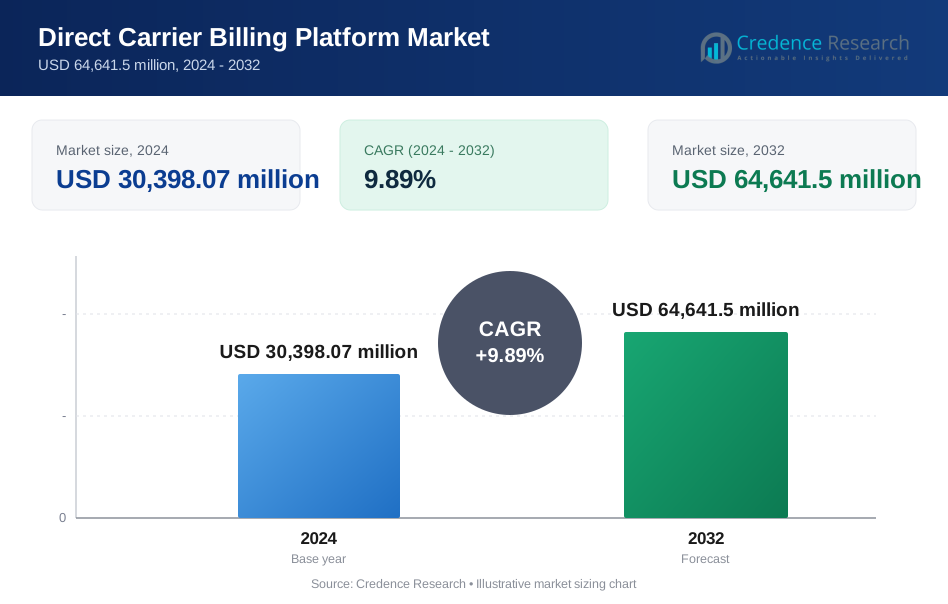
Direct Carrier Billing Platform Market size was valued at USD 30398.07 million in 2024 and is anticipated to reach USD 64641.5 million by 2032, at a CAGR of 9.89% during the forecast period (2024-2032).
Several factors are propelling the growth of the DCB platform market. Firstly, the growing penetration of smartphones and the widespread use of mobile internet have made mobile payments more accessible, especially in developing regions. The rapid adoption of mobile-first services in emerging economies is further accelerating the demand for DCB platforms. Furthermore, the demand for convenient billing solutions for digital content, such as music, games, and videos, is driving the adoption of DCB systems. Additionally, increasing collaborations between telecom operators and digital service providers have improved the availability and reliability of DCB platforms, further fueling market expansion. The enhanced user experience and ease of integration into mobile applications are also contributing to the increasing adoption of DCB solutions. The integration of DCB with other payment methods is anticipated to expand the customer base and enhance the platform’s usability.
Regionally, North America and Europe currently dominate the DCB platform market, owing to the high smartphone penetration and advanced mobile payment infrastructure in these regions. These regions also benefit from well-established regulatory frameworks that support mobile payment innovations. However, the Asia Pacific region is expected to experience the highest growth rate during the forecast period. Countries like India, China, and Southeast Asian nations are witnessing a surge in mobile payment adoption, driven by improving internet connectivity, favorable government policies, and a large population of mobile-first consumers. The expanding middle class in these regions is anticipated to further contribute to the market's robust growth. Additionally, the rise of e-commerce and digital entertainment in these regions is expected to provide further opportunities for DCB platforms.
Market Insights:
- The Direct Carrier Billing (DCB) platform market is expected to grow from USD 30,398.07 million in 2024 to USD 64,641.5 million by 2032.
- Increasing smartphone penetration and widespread mobile internet use are key drivers of DCB platform adoption, particularly in emerging markets.
- The demand for seamless billing solutions for digital content, such as music, video streaming, and gaming, is fueling market growth.
- Telecom operators and digital service providers are forming strategic partnerships to enhance the reliability and availability of DCB services.
- North America and Europe currently lead the market, benefiting from high smartphone penetration, advanced mobile payment infrastructure, and strong regulatory frameworks.
- The Asia-Pacific region is expected to see the highest growth, driven by improving internet connectivity, mobile-first economies, and an expanding middle class.
- Increasing government support for mobile payments, along with the push for cashless economies, is further promoting the growth of DCB platforms.
Market Drivers:
Increasing Smartphone Penetration and Mobile Internet Usage
The growing penetration of smartphones and mobile internet connectivity is one of the key drivers of the Direct Carrier Billing (DCB) platform market. As mobile devices become an integral part of everyday life, users are increasingly shifting toward mobile-first payment solutions for convenience. The continuous advancements in smartphone technology, coupled with affordable internet access, have made mobile payments more accessible, especially in developing regions where traditional banking infrastructure may be limited. This trend is particularly significant in emerging markets, where mobile payment systems such as DCB platforms are filling the gap left by traditional payment methods, driving market growth.
Rising Demand for Digital Content and Services
Another major driver of the DCB platform market is the growing demand for digital content and services. For instance, T-Mobile’s Go5G Next plan integrates premium streaming services like Hulu, Apple TV+, and Netflix into its offerings, catering to consumer preferences for bundled digital content and seamless payment solutions. The shift toward online entertainment, including video streaming, music, and mobile gaming, has created a need for efficient, seamless payment solutions. Consumers are increasingly opting for subscription-based services and pay-per-use models, which are well-suited to be integrated with DCB systems.
Enhanced Partnerships Between Telecom Operators and Digital Service Providers
The strategic collaborations between telecom operators and digital service providers are further accelerating the growth of the DCB platform market. For instance, Vodafone's partnership with Amazon Web Services (AWS) has enabled the deployment of Multi-access Edge Computing (MEC) in regions like Germany, Spain, and the UK. This collaboration allows Vodafone to offer ultra-low latency services, enhancing applications such as real-time safety platforms and connected devices. By integrating payment services directly into telecom networks, telecom operators facilitate a seamless transaction experience for consumers, making it easier to access and pay for digital content. These partnerships also enable operators to monetize their services more effectively while offering more value to their subscribers.
Government Initiatives and Support for Mobile Payments
Governments worldwide are playing a crucial role in fostering the growth of mobile payment solutions, including DCB platforms. In many regions, governments are actively promoting digital payments as part of their financial inclusion initiatives, aiming to reduce the reliance on cash and enhance economic activities through digital means. Supportive regulatory frameworks, such as simplified compliance processes and the promotion of mobile money services, are creating an enabling environment for the expansion of DCB platforms. The increased adoption of mobile-first policies and the push for cashless economies are expected to continue to drive the DCB platform market in the coming years.
Market Trends:
Integration with Digital Content and Services
Direct Carrier Billing (DCB) platforms are increasingly integrated with various digital content services, driving user engagement and enhancing monetization opportunities. Partnerships between DCB providers and over-the-top (OTT) platforms, such as video and music streaming services, have become more common. These collaborations offer consumers seamless payment options for subscriptions and premium content, significantly contributing to the expansion of DCB services across multiple sectors. The trend towards integrating DCB with entertainment and digital content is expected to continue as demand for such services grows.
Technological Advancements and AI Integration
Technological innovations, particularly in artificial intelligence (AI), are transforming the DCB platform landscape. For instance, companies like Invoiced have introduced AI-powered solutions such as their CashMatch algorithm, which automates payment matching processes, ensuring error-free transactions and enhancing efficiency in payment workflows. AI plays a key role in optimizing payment processes, improving fraud detection, and personalizing user experiences. By analyzing consumer behavior, AI helps tailor promotions and offers, increasing customer retention and satisfaction. This integration of AI not only enhances security and user experience but also supports the scalability of DCB platforms by automating and refining transaction flows. AI-driven advancements are a key trend shaping the future of the DCB market.
Expansion into Emerging Markets
Emerging markets, especially in the Asia-Pacific region, are witnessing a rapid rise in the adoption of DCB services. For example, in Kenya, M-Pesa has revolutionized mobile payments by enabling financial transactions via SMS, significantly improving financial inclusion for unbanked populations. The increasing availability of affordable smartphones and improved internet connectivity are making mobile payments more accessible to a wider population. In regions with limited access to traditional banking infrastructure, DCB offers a viable alternative, promoting financial inclusion and contributing to the market's growth. As mobile-first economies continue to grow, DCB platforms are becoming essential payment methods for a large portion of the population in these regions.
Diversification of Payment Methods
The DCB market is also diversifying to accommodate a broader range of payment methods, which is enhancing its appeal to different consumer segments. New payment models, such as limited DCB, pure DCB, and MSISDN forwarding, are emerging to cater to varying transaction types and user preferences. This diversification of payment options allows consumers to select the most convenient and suitable method for their needs, facilitating the widespread adoption of DCB services. As consumer preferences evolve, DCB platforms are adapting to meet these demands, driving further growth in the market.
Market Challenges Analysis:
Regulatory and Compliance Challenges
One of the key challenges facing the Direct Carrier Billing (DCB) platform market is navigating the complex regulatory and compliance landscape across different regions. The lack of uniform global standards for mobile payments presents difficulties for DCB providers, as they must comply with varying local regulations regarding payment processing, data security, and consumer protection. For example, MCP Insight collaborates with aggregators and mobile network operators (MNOs) to implement Due Diligence and Risk Control (DDRC) services. These regulatory disparities can hinder the market’s growth, particularly for international service providers who must adapt to multiple legal frameworks. Additionally, the evolving nature of mobile payment regulations, including the introduction of stricter privacy laws and anti-fraud measures, requires continuous monitoring and adaptation, which can impose additional operational costs on DCB providers. Non-compliance with these regional laws may result in hefty fines and restrictions, further complicating operations. As a result, DCB platforms must invest in legal expertise and regulatory compliance systems to minimize risk.
Fraud and Security Risks
Fraud and security concerns represent another significant challenge for the DCB platform market. As mobile payments become more widespread, the risk of fraud, including unauthorized transactions and identity theft, increases. The lack of robust authentication mechanisms in some regions and the reliance on mobile network operators for transaction verification can expose DCB systems to vulnerabilities. Ensuring the security of consumer data and preventing fraudulent activities are crucial for maintaining trust in DCB platforms. To mitigate these risks, DCB providers must continuously invest in advanced security technologies, such as encryption and multi-factor authentication. Failure to address these security challenges could damage the reputation of DCB services and slow market adoption. Furthermore, consumers’ reluctance to adopt DCB systems due to concerns about security can significantly impact the market's growth potential. Addressing these security risks is crucial to building consumer confidence and ensuring long-term success in the market.
Market Opportunities:
The Direct Carrier Billing (DCB) platform market presents numerous opportunities, particularly in emerging markets where mobile payment adoption is rapidly growing. As smartphone penetration continues to rise, particularly in regions with limited access to traditional banking infrastructure, DCB platforms offer an accessible and convenient payment method for millions of consumers. In markets such as Asia-Pacific, Latin America, and Africa, mobile-first economies are increasingly relying on DCB services for digital content subscriptions, mobile apps, and online gaming. This trend is expected to accelerate as the digital divide narrows, offering substantial growth potential for DCB providers targeting underserved populations.
Additionally, the growing demand for frictionless and secure payment solutions provides a significant opportunity for DCB platforms to expand their offerings. With the rise of e-commerce and the increasing popularity of subscription-based services such as video streaming, music, and digital gaming, DCB can serve as an ideal payment method for consumers seeking quick and secure transactions without the need for credit cards or bank accounts. Furthermore, as telecom operators continue to explore new revenue streams, collaborations with digital service providers and content creators are expected to increase, creating new avenues for DCB adoption. By enhancing integration with a diverse range of services and platforms, DCB providers can capitalize on the expanding digital economy and cater to evolving consumer preferences.
Market Segmentation Analysis:
By Type
The Direct Carrier Billing (DCB) platform market is segmented based on the type of billing system, primarily categorized into limited DCB and pure DCB systems. Limited DCB allows consumers to make small, one-time payments, typically for digital content like games, apps, or music, which are billed to their mobile accounts. Pure DCB, on the other hand, enables a broader range of transactions, including recurring payments for subscription-based services such as streaming platforms. The demand for pure DCB is increasing due to the growing popularity of subscription services. The flexibility of both types is fueling the growth of DCB adoption across various consumer segments, with limited DCB being especially popular in markets with lower transaction values.
By Platform
The DCB platform market is also segmented by the platforms used to process payments, which include mobile applications and web-based platforms. Mobile applications dominate the market, driven by the increasing use of smartphones for purchasing digital content and services. The convenience of in-app payments within mobile games, social media apps, and entertainment platforms boosts the adoption of DCB solutions. Web-based platforms, although growing, cater more to larger-scale, recurring billing models such as subscription services. The ongoing growth of mobile-first economies in emerging markets is expected to further solidify the dominance of mobile app-based DCB solutions in the coming years.
Segmentations:
By Type- Limited DCB
- Pure DCB
- Mobile Applications
- Web-based Platforms
- North America
- U.S.
- Canada
- Mexico
- Europe
- Germany
- France
- U.K.
- Italy
- Spain
- Rest of Europe
- Asia Pacific
- China
- Japan
- India
- South Korea
- South-east Asia
- Rest of Asia Pacific
- Latin America
- Brazil
- Argentina
- Rest of Latin America
- Middle East & Africa
- GCC Countries
- South Africa
- Rest of the Middle East and Africa
Regional Analysis:
North America
The North American market for Direct Carrier Billing (DCB) platforms holds a dominant position, accounting for 35% of the global market share. This leadership can be attributed to the region’s high smartphone penetration, robust mobile payment infrastructure, and a tech-savvy consumer base. The widespread use of digital content services such as video streaming, music, and mobile gaming further supports the adoption of DCB solutions. Telecom operators in North America are increasingly partnering with digital service providers to offer seamless billing experiences for their subscribers. Additionally, the region benefits from well-established regulatory frameworks that promote mobile payment innovations, driving growth in the DCB market. As consumer preferences continue to shift towards more convenient, secure, and integrated payment methods, North America is expected to maintain its stronghold in the market, with continued adoption of DCB services across various sectors. The region’s advanced digital ecosystem also allows for rapid innovation and scalability of DCB platforms.
Europe
Europe holds a significant share in the DCB platform market, capturing 30% of the global market share. The European market is characterized by its advanced mobile payment infrastructure, high smartphone penetration, and strong demand for digital services. The region is home to numerous OTT platforms and content providers that increasingly adopt DCB systems to offer seamless payment experiences for consumers. European telecom operators are leveraging DCB solutions to enhance customer retention and monetize digital content efficiently. The region's regulatory environment, which supports digital payment innovations, has further contributed to the rapid adoption of DCB platforms. Moreover, as the European Union pushes for the development of a digital single market, the opportunity for DCB platforms to expand their services and streamline payment processes across member states continues to grow. The high level of consumer trust in digital payment systems in Europe also aids in the accelerated adoption of DCB services.
Asia-Pacific
The Asia-Pacific region is poised for the highest growth, with a market share of 25%. This growth is driven by the rapid digitalization of mobile payments and increasing smartphone adoption, particularly in countries like India, China, and Southeast Asia. In these regions, the absence of a widespread traditional banking infrastructure has made mobile-first payment solutions, such as DCB, essential for financial inclusion. Telecom operators in the region are capitalizing on this trend by partnering with digital content providers and offering integrated payment solutions. The growing middle class, along with improving internet connectivity, is expected to drive further adoption of DCB services. As the region continues to embrace mobile payments for various digital services, the Asia-Pacific market is expected to experience substantial expansion, solidifying its position as a key growth driver in the global DCB platform market. The region’s large mobile user base presents a vast untapped opportunity for DCB platforms to capture new customers and drive innovation.
Key Player Analysis:
- Google LLC
- Microsoft
- Boku Inc.
- txtNation Limited
- Adpay.net.in.
- Mobiyo
- Fortumo
- Bango.net Limited
- NETWORLD MEDIA GROUP
- DOCOMO Digital
- NTH Mobile
- DIMOCO
- TELENITY
- ZONG
- HIGHCO
Competitive Analysis:
The Direct Carrier Billing (DCB) platform market is highly competitive, with several key players vying for market share through innovative solutions and strategic partnerships. Major telecom operators, such as Vodafone, AT&T, and T-Mobile, are leveraging their established networks and customer bases to expand DCB services. These operators often collaborate with digital service providers, including streaming platforms and mobile app developers, to enhance the availability and functionality of DCB solutions. Additionally, specialized DCB providers like Boku, Fortumo, and DigiPay are focusing on expanding their reach by offering flexible and scalable payment solutions that cater to diverse digital content needs. Competition is also intensifying due to the growing demand for secure, seamless, and frictionless payment experiences. Companies are investing in advanced technologies, such as AI and blockchain, to improve fraud prevention and enhance transaction security, positioning themselves as leaders in this rapidly evolving market.
Recent Developments:
- In Mid-2024, Boku launched broader e-commerce solutions integrated with its DCB platform, further diversifying its offerings for merchants.
- In July 2024, Zong, a division of China Mobile Pakistan, modernized its network infrastructure, indirectly supporting its DCB capabilities. The upgrades included deploying over 400 new 4G sites and enhancing base station technology, which improved connectivity for digital payment services like DCB.
- In February 2023, T-Mobile and Amazon announced a collaboration to integrate T-Mobile’s 5G Advanced Network Solutions portfolio with AWS cloud services and scalable, pre-integrated applications. This partnership allows clients to more efficiently explore, customize, and deploy 5G edge computing solutions.
Market Concentration & Characteristics:
The Direct Carrier Billing (DCB) platform market exhibits a moderate to high level of concentration, with a few key players dominating the landscape. Major telecom operators, including Vodafone, AT&T, and T-Mobile, control a significant portion of the market due to their extensive subscriber bases and established mobile payment infrastructures. Additionally, specialized DCB providers such as Boku, Fortumo, and DigiPay play a crucial role in offering scalable and secure payment solutions tailored to digital content services. The market is characterized by strong partnerships between telecom operators, digital service providers, and content creators, which drive the adoption of DCB services. As competition intensifies, companies are focusing on enhancing user experience, integrating advanced technologies like AI and blockchain, and expanding their service offerings across emerging markets. This dynamic competitive environment encourages innovation and collaboration, ensuring continued growth and development within the DCB platform market.
Report Coverage:
The research report offers an in-depth analysis based on type, platform and region. It details leading market players, providing an overview of their business, product offerings, investments, revenue streams, and key applications. Additionally, the report includes insights into the competitive environment, SWOT analysis, current market trends, as well as the primary drivers and constraints. Furthermore, it discusses various factors that have driven market expansion in recent years. The report also explores market dynamics, regulatory scenarios, and technological advancements that are shaping the industry. It assesses the impact of external factors and global economic changes on market growth. Lastly, it provides strategic recommendations for new entrants and established companies to navigate the complexities of the market.
Future Outlook:
- The Direct Carrier Billing (DCB) platform market is experiencing robust growth, driven by the increasing adoption of mobile payment solutions and the expanding digital economy.
- The market is characterized by the growing penetration of smartphones and the widespread use of mobile internet, making mobile payments more accessible, especially in developing regions.
- The rising demand for convenient billing solutions for digital content, such as music, games, and videos, is significantly contributing to the adoption of DCB systems.
- Strategic collaborations between telecom operators and digital service providers are enhancing the availability and reliability of DCB platforms, further fueling market expansion.
- The enhanced user experience and ease of integration into mobile applications are driving the increasing adoption of DCB solutions.
- Regionally, North America and Europe currently dominate the DCB platform market, owing to high smartphone penetration and advanced mobile payment infrastructure.
- The Asia Pacific region is expected to experience the highest growth rate during the forecast period, driven by improving internet connectivity and a large population of mobile-first consumers.
- The expanding middle class in emerging markets is anticipated to further contribute to the market's robust growth.
- The rise of e-commerce and digital entertainment in these regions is expected to provide additional opportunities for DCB platforms.
- Overall, the DCB platform market is poised for significant expansion, driven by technological advancements, strategic partnerships, and the increasing demand for seamless mobile payment solutions.
Request a Free Sample
Fill in your details and we'll send you a free sample report.
- Sample data tables & charts
- Research methodology
Need a Custom Version of This Report?
Tailor the scope, geography, or segments to your exact requirements.
- Custom geography or segment scope
- Direct access to our analyst team
Frequently Asked Questions
What is the current size of the Direct Carrier Billing (DCB) platform market?
What factors are driving the growth of the DCB platform market?
Which regions dominate the DCB platform market?
Which region is expected to see the highest growth in the DCB platform market?
How is the integration of DCB with other payment methods benefiting the market?
Table of Content
Chapter 1. Report Introduction
- 1.1 Report Description & Purpose
- 1.1.1 Report Title & Market Definition
- 1.1.2 Unique Selling Propositions (USP) & Key Differentiators
- 1.1.3 Value Proposition for Stakeholders
- 1.2 Research Objectives
- 1.2.1 Market Sizing Objectives (Volume & Revenue)
- 1.2.2 Segmentation Objectives
- 1.2.3 Competitive Intelligence Objectives
- 1.2.4 Forecast & Scenario Objectives
- 1.3 Report Scope
- 1.3.1 Direct Carrier Billing Platform Scope – Types & Subtypes Covered
- 1.3.2 Geographic Scope – Regions & Countries Covered
- 1.3.3 Historical Period, Base Year & Forecast Period (2024; forecast to 2032)
- 1.3.4 Inclusions & Exclusions
- 1.4 HS Code & Classification Framework
- 1.5 Currency, Units & Pricing Basis
- 1.6 Target Stakeholders
- 1.7 Limitations & Assumptions
Chapter 2. Executive Summary
- 2.1 Global Direct Carrier Billing Platform Market Snapshot
- 2.1.1 Market Size – Historical (2024) & Forecast (2024-2032) (2024: USD 30,398.07 million → 2032: USD 64,641.5 million)
- 2.1.2 Volume & Revenue – Global Totals
- 2.1.3 Key Market Highlights – Top Five Facts
- 2.2 Direct Carrier Billing Platform Market Segmentation Snapshot
- 2.2.1 Market Split by Region – 2024 vs. 2032
- 2.3 Competitive Snapshot
- 2.3.1 Top 10 Players by Revenue Share – 2024
- 2.3.2 Top 10 Players by Volume Share – 2024
- 2.3.3 Recent Strategic Developments (18-Month Summary)
- 2.4 Key Investment Highlights & Strategic Conclusions
Chapter 3. Direct Carrier Billing Platform Market Dynamics & Industry Analysis
- 3.1 Market Overview & Context
- 3.1.1 Direct Carrier Billing Platform Market Position in the Broader Automotive Value Chain
- 3.1.2 OEM vs. Replacement Market Dynamics
- 3.1.3 Market Maturity & Development Stage by Region
- 3.2 Direct Carrier Billing Platform Market Drivers
- 3.3 Direct Carrier Billing Platform Market Restraints & Challenges
- 3.4 Direct Carrier Billing Platform Market Opportunities
- 3.5 Porter's Five Forces Analysis
- 3.5.1 Threat of New Entrants
- 3.5.2 Bargaining Power of Suppliers
- 3.5.3 Bargaining Power of Buyers
- 3.5.4 Threat of Substitutes
- 3.5.5 Competitive Rivalry – Intensity Assessment
- 3.6 Direct Carrier Billing Platform Value Chain Analysis
- 3.6.1 Upstream – Raw Material/Input Suppliers
- 3.6.1.1 Raw Material/Input 1
- 3.6.1.2 Raw Material/Input 2
- 3.6.1.3 Raw Material/Input 3
- 3.6.2 Midstream – Production/Manufacturing/Service Delivery
- 3.6.2.1 Production/Process Overview
- 3.6.2.2 Key Facility Locations & Capacity by Manufacturer
- 3.6.3 Downstream – Distribution & End Consumer
- 3.6.3.1 Primary Channel – B2B/OEM
- 3.6.3.2 Secondary Channels – Dealer, Retail, Online, Direct
- 3.6.4 Value Chain Profitability Analysis
- 3.6.1 Upstream – Raw Material/Input Suppliers
- 3.7 PESTEL Analysis
- 3.7.1 Political Factors
- 3.7.2 Economic Factors
- 3.7.3 Social Factors
- 3.7.4 Technological Factors
- 3.7.5 Environmental Factors
- 3.7.6 Legal Factors
- 3.8 Direct Carrier Billing Platform Supply Chain Analysis
- 3.8.1 Raw Material/Input Supply Risk Assessment
- 3.8.2 Manufacturing Concentration Risk (Geographic Exposure)
- 3.8.3 Trade Disruption Impact Analysis
- 3.9 Regulatory & Policy Landscape
Note: The regulatory and policy landscape section covers regulations based on their applicability to the market, Direct Carrier Billing Platform category, geography, and scope of the study. Only regulatory frameworks with a material impact on operations, compliance, trade, sustainability, or market access are analyzed in detail.
Chapter 4. Key Investment Pockets & Opportunity Analysis
- 4.1 Direct Carrier Billing Platform Market Attractiveness Analysis
- 4.1.1 By Region – Investment Attractiveness Matrix (Volume × CAGR)
- 4.2 Absolute Revenue Growth Opportunity
- 4.2.1 By Region – Absolute USD Growth Through 2032
- 4.3 Incremental Volume Opportunity
- 4.3.1 By Region – Incremental Volume Through 2032
- 4.3.2 Segment – Incremental Volume
- 4.4 Emerging Submarket Opportunity Deep Dive (Subject to Applicability)
- 4.5 Emerging Market Opportunity Scorecards
- 4.5.1 United States
- 4.5.2 Europe
- 4.5.3 Asia
- 4.5.4 Middle East & Africa
Note: Emerging Market Opportunity Scorecards will be included based on relevance and strategic importance. Regions listed are indicative and may vary depending on data availability and market dynamics.
Chapter 5. Direct Carrier Billing Platform Import-Export Analysis & Trade Flows
- 5.1 Global Trade Overview
- 5.1.1 Global Export Value by Country (2024)
- 5.1.2 Global Export Volume by Country (2024)
- 5.1.3 Global Import Value by Country (2024)
- 5.1.4 Global Import Volume by Country (2024)
- 5.1.5 Net Trade Balance by Country (2024)
- 5.2 Export Analysis – Segment
- 5.2.1 Type 1 (HS Code)
- 5.2.2 Type 2 (HS Code)
- 5.2.3 Type 3 (HS Code)
- 5.2.4 Type 4 (HS Code)
- 5.2.5 Type 5 (HS Code)
- 5.3 Import Analysis – Segment
- 5.3.1 Type 1 (HS Code)
- 5.3.2 Type 2 (HS Code)
- 5.3.3 Type 3 (HS Code)
- 5.3.4 Type 4 (HS Code)
- 5.3.5 Type 5 (HS Code)
- 5.4 Average Unit Trade Prices
- 5.4.1 Average Export Price – Segment & Country
- 5.4.2 Average Import Price – Segment & Source Country
- 5.4.3 Price Trends (2024)
- 5.5 Key Trade Route Analysis
- 5.5.1 Trade Route 1
- 5.5.2 Trade Route 2
- 5.5.3 Trade Route 3
- 5.5.4 Trade Route 4
- 5.5.5 Trade Route 5
- 5.6 Trade Policy Impact Assessment
- 5.6.1 US Anti-Dumping & Section 301 Tariffs
- 5.6.2 EU Customs Union Impact
- 5.6.3 Major Free Trade Agreements
- 5.6.4 USMCA Rules of Origin
Note: Trade policy analysis will be included only where relevant to the Direct Carrier Billing Platform market.
Chapter 6. Competitive Landscape & Company Benchmarking
- 6.1 Direct Carrier Billing Platform Market Concentration & Structure
- 6.1.1 Herfindahl-Hirschman Index (HHI) – vs. 2024
- 6.1.2 Tier 1, Tier 2 & Tier 3 Market Structure
- 6.1.3 Global, Regional & Local Player Dynamics
- 6.2 Direct Carrier Billing Platform Market Share Analysis – 2024
- 6.2.1 Global Revenue Share by Company
- 6.2.2 Global Volume Share by Company
- 6.2.3 Regional Revenue Share
- 6.2.4 Market Share Evolution ( vs. 2024)
- 6.2.5 OEM Segment Share by Company
- 6.2.6 Replacement Segment Share by Company
- 6.3 Production/Delivery Capacity & Facility Analysis
- 6.3.1 Global Installed Capacity
- 6.3.2 Capacity Utilization Rates
- 6.3.3 Production/Output Volume
- 6.3.4 Facility Locations & Capacity Map
- 6.3.5 Planned Capacity Additions
- 6.4 Direct Carrier Billing Platform Competitive Benchmarking Matrix
- 6.4.1 Revenue, Volume, CAGR & Profitability Comparison
- 6.4.2 Channel Revenue Mix
- 6.4.3 Geographic Revenue Exposure
- 6.4.4 R&D Intensity
- 6.4.5 Sustainability Maturity
- 6.5 Strategic Developments in Direct Carrier Billing Platform (Last 24 Months)
- 6.5.1 Mergers, Acquisitions & Divestments
- 6.5.2 New Direct Carrier Billing Platform Launches
- 6.5.3 Facility Expansions
- 6.5.4 Strategic Alliances, Joint Ventures & Partnerships
- 6.5.5 Distribution Expansion & Market Entry
- 6.5.6 Sustainability & ESG Initiatives
- 6.6 Competitive Strategy Mapping
- 6.6.1 Leader, Challenger, Follower & Niche Classification
- 6.6.2 Pricing Strategy Comparison
- 6.6.3 Channel Strategy Matrix
Note: Strategic developments are included based on their materiality and the availability of reliable information.
Chapter 7. Global Direct Carrier Billing Platform Market – By Distribution Channel
- 7.1 Segment Overview
- 7.1.1 Volume & Revenue Split by Channel (2024 & 2032)
- 7.1.2 Channel Mix Evolution (2024-2032)
Chapter 8. Regional Market Analysis – Global Overview
- 8.1 Global Regional Overview
- 8.1.1 Regional Volume Share
- 8.1.2 Regional Revenue Share
- 8.1.3 Regional Volume by Region
- 8.1.4 Regional Revenue by Region
- 8.1.5 Regional Forecast Through 2032
- 8.2 Cross-Regional Segment Analysis
- 8.2.1 By Distribution Channel
- 8.2.2 By Brand/Price Tier
Chapter 9. North America Direct Carrier Billing Platform Market
- 9.1 United States
- 9.2 Canada
- 9.3 Mexico
Chapter 10. Europe Direct Carrier Billing Platform Market
- 10.1 Germany
- 10.2 France
- 10.3 Italy
- 10.4 United Kingdom
- 10.5 Spain
- 10.6 Poland
- 10.7 Russia
- 10.8 Netherlands
- 10.9 Belgium
- 10.10 Sweden
- 10.11 Denmark
- 10.12 Norway
- 10.13 Rest of Europe
Chapter 11. Asia Pacific Direct Carrier Billing Platform Market
- 11.1 China
- 11.2 India
- 11.3 Japan
- 11.4 South Korea
- 11.5 Thailand
- 11.6 Indonesia
- 11.7 Vietnam
- 11.8 Malaysia
- 11.9 Australia
- 11.10 Rest of Asia Pacific
Chapter 12. Latin America Direct Carrier Billing Platform Market
- 12.1 Brazil
- 12.2 Argentina
- 12.3 Colombia
- 12.4 Chile
- 12.5 Rest of Latin America
Chapter 13. Middle East Direct Carrier Billing Platform Market
- 13.1 Saudi Arabia
- 13.2 United Arab Emirates
- 13.3 Turkey
- 13.4 Israel
- 13.5 Iran
- 13.6 Rest of the Middle East
Chapter 14. Africa Direct Carrier Billing Platform Market
- 14.1 South Africa
- 14.2 Egypt
- 14.3 Nigeria
- 14.4 Morocco
- 14.5 Rest of Africa
Chapter 15. Direct Carrier Billing Platform Company Profiles
- 15.1 [Company 01]
- 15.1.1 Company Overview
- 15.1.2 Key Management Personnel
- 15.1.3 Products & Services Portfolio
- 15.1.4 Financial Performance
- 15.1.5 Key Market Focus & Geographic Presence
- 15.1.6 Recent Developments & Strategic Initiatives
Note: The company profile list is preliminary and may change based on research findings, market developments, data availability, and client requirements.
Chapter 16. Appendices
- Appendix A – List of Abbreviations & Acronyms
- Appendix B – Industry Classification Code Reference – Full Series
- Appendix C – Production & Capacity Data Tables
- Appendix D – End-Use & Demand Base Tables
- Appendix E – Consumption & Replacement Rate Assumptions
- Appendix F – ASP Reference Tables
- Appendix G – Manufacturing & Facility Database
- Appendix H – Import-Export Data Tables
- Appendix I – Regulatory Summary Tables
- Appendix J – Primary Research Participant List (Anonymized)
- Appendix K – Primary Research Questionnaire Framework
- Appendix L – Data Sources & Bibliography
- Appendix M – Market Size Divergence & Source Comparison
Chapter 17. Research Methodology
- 17.1 Research Framework & Philosophy
- 17.2 Secondary Research – Sources, Hierarchy & Data Extraction
- 17.3 Data Modeling – Bottom-Up & Top-Down Market Sizing
- 17.4 Primary Research – Stakeholder Framework, LOI & Sample Sizes
- 17.5 Forecast Methodology – Regression, Scenario & Sensitivity Analysis
- 17.6 Quality Control – Four-Layer Validation Framework
- 17.7 Limitations & Standard Assumptions
- 17.8 Disclaimer
