
Market Overview
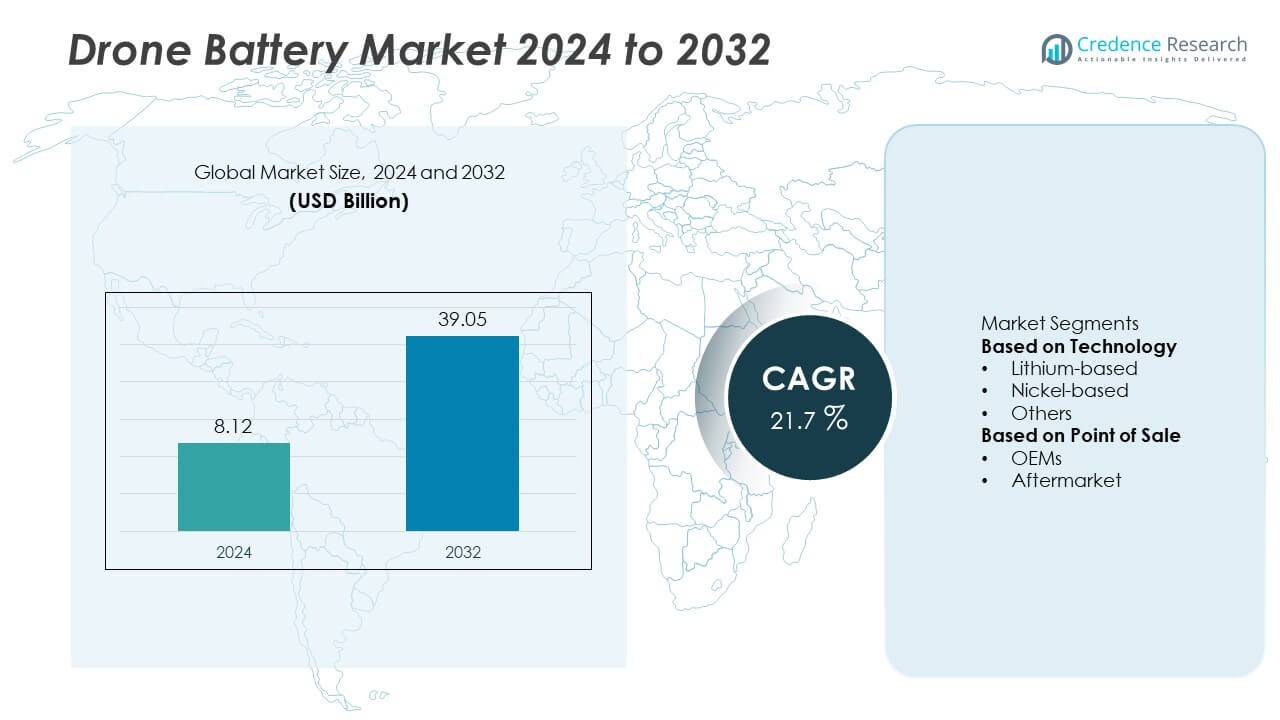
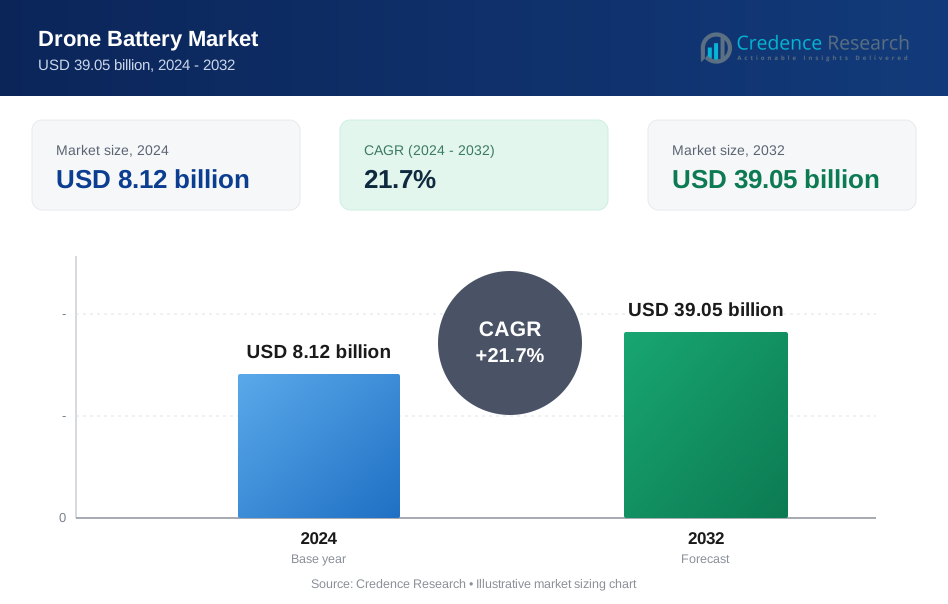
The global drone battery market was valued at USD 8.12 billion in 2024 and is projected to reach USD 39.05 billion by 2032, growing at a CAGR of 21.7% during the forecast period.
| REPORT ATTRIBUTE | DETAILS |
|---|---|
| Historical Period | 2020-2023 |
| Base Year | 2024 |
| Forecast Period | 2025-2032 |
| Drone Battery Market Size 2024 | USD 8.12 Billion |
| Drone Battery Market, CAGR | 21.7% |
| Drone Battery Market Size 2032 | USD 39.05 Billion |
The drone battery market is led by key players including SolidEnergy Systems, Intelligent Energy, Plug Power Inc, Sion Power, Doosan Mobility Innovation, Micromulticopter Aero Technology Co., Ltd., RRC Power Solutions, Oxis Energy Ltd, HES Energy Systems, and EaglePicher Technologies. These companies focus on developing lightweight, high-density, and long-endurance battery technologies to meet growing commercial and defense drone demands. Asia-Pacific emerged as the leading region with a 31% market share in 2024, driven by large-scale drone production and strong government support in China, Japan, and India. North America followed with a 33% share, supported by technological innovation and extensive adoption in logistics, surveillance, and military applications.
Market Insights
- The global drone battery market was valued at USD 8.12 billion in 2024 and is projected to reach USD 39.05 billion by 2032, growing at a CAGR of 21.7%.
- Growth is driven by rising demand for long-endurance drones and rapid adoption in logistics, defense, and agriculture. Lithium-based batteries dominated with a 78% share due to high energy density and lightweight design.
- Emerging trends include solid-state and hydrogen fuel cell innovations, along with swappable and fast-charging battery systems that enhance drone efficiency and flight duration.
- The market is moderately consolidated, with major players such as SolidEnergy Systems, Plug Power Inc, Intelligent Energy, and Doosan Mobility Innovation investing in advanced chemistries and sustainable manufacturing.
- Regionally, North America led with a 33% share, followed by Asia-Pacific at 31% and Europe at 27%, driven by strong drone manufacturing bases, defense investments, and regulatory support for commercial UAV applications.
Market Segmentation Analysis:
By Technology
The lithium-based segment dominated the drone battery market with a 78% share in 2024. This dominance is driven by the high energy density, lightweight design, and long discharge cycles of lithium-ion and lithium-polymer batteries. These batteries enable longer flight durations and faster charging, making them ideal for commercial and defense drone applications. Ongoing advancements in lithium-sulfur and solid-state technologies further enhance safety, performance, and energy efficiency. Manufacturers are investing in improved thermal management and higher voltage configurations to meet rising power demands in high-endurance drones.
- For instance, SolidEnergy Systems (now SES AI) did develop a lithium-metal battery achieving 450 Wh/kg, which enables extended drone flight times. The company has been providing these high-energy-density batteries for various applications, including drones.
By Point of Sale
The OEMs segment accounted for a 69% market share in 2024, leading the drone battery market. This leadership stems from large-scale integration of advanced batteries into newly manufactured drones for commercial, agricultural, and surveillance purposes. OEMs focus on custom battery solutions optimized for flight performance and weight efficiency. Rising drone production and fleet expansions by major manufacturers accelerate demand. The aftermarket segment is growing steadily as end users seek cost-effective replacements and upgraded batteries to extend drone lifespan and improve operational efficiency.
- For instance, DJI integrates 5,000 mAh high-voltage lithium-polymer batteries in its Mavic 3 series. This large capacity provides enough power to support an impressive flight time of up to 46 minutes on a single charge. The high-performance battery is a crucial component for capturing expansive aerial footage.
Key Growth Drivers
Rising Demand for Long-Endurance Drones
Growing adoption of drones in logistics, surveillance, and agriculture is increasing the need for long-endurance batteries. Lithium-ion and solid-state technologies are enabling extended flight times, improved payload capacity, and faster recharge cycles. Companies are focusing on lightweight materials and high energy density designs to enhance operational efficiency. The expansion of drone delivery networks and mapping services continues to accelerate investment in high-performance batteries with longer lifespans and improved safety features.
- For instance, Sion Power’s Licerion battery technology reached 500 Wh/kg, allowing drones to operate significantly longer than conventional lithium-ion systems used in commercial mapping and inspection applications.
Expansion of Commercial Drone Applications
Commercial drone adoption across sectors such as construction, energy, and defense is driving battery demand. Businesses require reliable, high-capacity power systems to support complex missions like infrastructure inspection and aerial mapping. Governments approving wider drone usage further support the commercial market. Battery manufacturers are partnering with drone OEMs to create customized solutions that deliver higher voltage and enhanced endurance, meeting growing operational expectations. This widespread commercial use fuels sustained growth across the global drone battery industry.
- For instance, Intelligent Energy introduced hydrogen fuel cell modules generating 2.4 kW of continuous power, enabling drones to operate for up to 3 hours on a single refuel.
Technological Advancements in Energy Storage
Continuous innovation in lithium-sulfur, solid-state, and graphene-based batteries is transforming drone performance. These new chemistries offer higher power density, lower charging time, and better temperature tolerance. Manufacturers are developing modular battery systems with smart monitoring for optimized flight safety. The integration of AI-based battery management systems enhances energy efficiency and predictive maintenance. These advances allow drones to operate in challenging environments, supporting new industrial and defense applications while significantly reducing power-related downtime.
Key Trends & Opportunities
Emergence of Swappable and Fast-Charging Batteries
The introduction of swappable battery systems is improving drone turnaround times for continuous missions. Commercial operators use these modular solutions to reduce downtime in delivery and surveillance tasks. Fast-charging technologies powered by advanced chargers and improved cooling mechanisms are further increasing operational efficiency. This trend creates opportunities for battery makers to design high-cycle, quick-recharge solutions tailored to industrial and logistics sectors.
- For instance, DJI developed its TB65 Intelligent Flight Battery with a 5880 mAh capacity, enabling rapid charging for its enterprise drones. Using a compatible battery station with a 220V power supply, two TB65 batteries can be charged from 20% to 90% in approximately 30 minutes. A full charge of two batteries under the same conditions takes around 60 minutes.
Growing Focus on Sustainable Battery Materials
Manufacturers are exploring eco-friendly materials and recycling processes to reduce the environmental impact of drone batteries. The shift toward cobalt-free lithium chemistries and bio-based electrolytes aligns with global sustainability goals. Companies investing in circular battery supply chains gain an advantage as environmental regulations tighten. This transition not only lowers production costs but also promotes long-term reliability and brand reputation in the evolving drone ecosystem.
- For instance, Panasonic Energy aims to achieve an increased volumetric energy density of 1,000 Wh/L in its lithium-ion batteries by 2031 and has developed technologies to significantly reduce the cobalt content in its nickel-based EV batteries.
Key Challenges
Safety Risks and Thermal Management Issues
Drone batteries face safety concerns such as overheating, short circuits, and potential fire hazards during high-load operations. Inadequate thermal management can reduce performance and battery lifespan. Manufacturers must incorporate advanced cooling, sensors, and protective casing to ensure flight safety. Balancing high energy density with stability remains a significant technical challenge, particularly for long-range and military-grade drones operating in extreme conditions.
High Cost and Limited Supply Chain for Advanced Materials
The production of high-capacity lithium and solid-state batteries involves expensive raw materials and complex manufacturing. Limited access to lithium, nickel, and graphene increases costs and affects scalability. Supply chain disruptions and geopolitical factors further impact battery availability and pricing. Companies are investing in local material sourcing and recycling initiatives to reduce dependency on critical imports and stabilize long-term production costs.
Regional Analysis
North America
North America held a 33% share of the drone battery market in 2024, driven by the rapid adoption of drones in defense, logistics, and agriculture. The United States leads regional growth due to strong military spending and expanding commercial drone applications. Companies such as Tesla Energy and Amprius Technologies focus on high-density lithium batteries to improve endurance and performance. Government initiatives supporting drone-based delivery and surveillance programs further boost demand. The region’s advanced R&D infrastructure and collaboration between OEMs and energy storage firms strengthen its leadership in innovation and battery optimization.
Europe
Europe accounted for a 27% share in 2024, supported by rising drone deployment for environmental monitoring, infrastructure inspection, and security operations. Countries like Germany, France, and the United Kingdom are investing heavily in renewable energy storage and electric aviation technologies. The European Union’s focus on sustainable battery manufacturing and recycling enhances regional competitiveness. Leading manufacturers are developing cobalt-free and solid-state batteries to align with the EU Battery Directive. Continuous innovation and the integration of eco-friendly technologies make Europe a key hub for advanced drone battery production and regulatory-driven growth.
Asia-Pacific
Asia-Pacific dominated with a 31% market share in 2024, led by strong manufacturing capabilities and rapid drone adoption across China, Japan, and India. China’s large-scale drone production ecosystem, supported by players such as DJI, fuels massive demand for lithium-based batteries. Government incentives for commercial drone usage in agriculture, logistics, and surveillance accelerate regional expansion. Japan’s investment in solid-state battery R&D and India’s drone policy reforms further strengthen growth. The presence of low-cost component suppliers and a skilled electronics workforce makes Asia-Pacific the key production center for drone battery technology worldwide.
Middle East & Africa
The Middle East & Africa region captured a 5% market share in 2024, driven by increasing drone applications in oilfield monitoring, border security, and smart city development. The UAE and Saudi Arabia are leading adopters, supported by strong government digitalization and defense initiatives. Investments in solar-powered charging infrastructure and high-temperature battery systems enhance operational reliability in harsh environments. African nations are exploring drones for agricultural spraying and delivery services, spurring local demand. Regional partnerships with global drone manufacturers are strengthening supply chains and improving battery availability for specialized applications.
Latin America
Latin America held a 4% share in the drone battery market in 2024, with Brazil and Mexico leading regional adoption. Expanding agricultural drone use for crop monitoring and spraying significantly drives battery demand. Governments are encouraging the use of UAVs for infrastructure inspection, mining, and disaster management. Regional suppliers focus on cost-effective lithium-ion solutions tailored for tropical climates. Growing partnerships with Asian and U.S. battery makers improve access to advanced technologies. Continued investments in industrial drone applications position Latin America as an emerging market for drone battery development and deployment.
Market Segmentations:
By Technology
- Lithium-based
- Nickel-based
- Others
By Point of Sale
- OEMs
- Aftermarket
By Geography
- North America
- U.S.
- Canada
- Mexico
- Europe
- Germany
- France
- U.K.
- Italy
- Spain
- Rest of Europe
- Asia Pacific
- China
- Japan
- India
- South Korea
- South-east Asia
- Rest of Asia Pacific
- Latin America
- Brazil
- Argentina
- Rest of Latin America
- Middle East & Africa
- GCC Countries
- South Africa
- Rest of the Middle East and Africa
Competitive Landscape
The competitive landscape of the drone battery market features leading players such as SolidEnergy Systems, Intelligent Energy, Plug Power Inc, Sion Power, Doosan Mobility Innovation, Micromulticopter Aero Technology Co., Ltd., RRC Power Solutions, Oxis Energy Ltd, HES Energy Systems, and EaglePicher Technologies. These companies compete through advancements in lithium-sulfur, hydrogen fuel cell, and solid-state battery technologies. Innovation focuses on enhancing energy density, reducing weight, and improving thermal stability to extend drone flight duration and safety. Strategic partnerships between battery manufacturers and drone OEMs are rising to deliver customized power systems for industrial, defense, and logistics applications. Several firms are also investing in recycling initiatives and sustainable materials to meet global environmental standards. The market is witnessing consolidation as major players expand manufacturing capabilities and secure raw material supply chains. Continuous R&D and large-scale commercialization efforts position these companies at the forefront of the evolving drone battery ecosystem.
Key Player Analysis
- SolidEnergy Systems
- Intelligent Energy
- Plug Power Inc
- Sion Power
- Doosan Mobility Innovation
- Micromulticopter Aero Technology Co., Ltd.
- RRC Power Solutions
- Oxis Energy Ltd
- HES Energy Systems
- EaglePicher Technologies
Recent Development
- In November 2024, DJI introduced the Power Expansion Battery 2000, a 2 kWh add-on for its Power 1000 station. This upgrade significantly enhances drone battery backup and field charging efficiency for extended outdoor or industrial drone operations.
- In June 2024, MaxAmps announced a new LiPo battery pack, the 9000XL 4S 14.8v, which is designed to provide enhanced performance and longer flight times for various UAV applications.
- In March 2024, Atomik RC launched new high-capacity LiPo batteries for hobby drones, aiming to boost performance and extend flight times
Report Coverage
The research report offers an in-depth analysis based on Technology, Point of Sale and Geography. It details leading market players, providing an overview of their business, product offerings, investments, revenue streams, and key applications. Additionally, the report includes insights into the competitive environment, SWOT analysis, current market trends, as well as the primary drivers and constraints. Furthermore, it discusses various factors that have driven market expansion in recent years. The report also explores market dynamics, regulatory scenarios, and technological advancements that are shaping the industry. It assesses the impact of external factors and global economic changes on market growth. Lastly, it provides strategic recommendations for new entrants and established companies to navigate the complexities of the market.
Future Outlook
- Demand for high-capacity batteries will increase as drone flight ranges expand.
- Solid-state and lithium-sulfur batteries will replace conventional lithium-ion technologies.
- Hydrogen fuel cell systems will gain traction in long-endurance and industrial drones.
- OEM partnerships will strengthen to develop customized battery packs for diverse drone models.
- Recycling and sustainable material sourcing will become central to production strategies.
- AI-based battery management systems will enhance performance and safety monitoring.
- Miniaturized and lightweight designs will support the growth of small commercial drones.
- Government incentives and drone-friendly regulations will accelerate market adoption.
- Asia-Pacific will remain the main manufacturing hub, supported by innovation in China and Japan.
- Continuous R&D investments will drive improvements in energy density, charging speed, and thermal stability.
Request a Free Sample
Fill in your details and we'll send you a free sample report.
- Sample data tables & charts
- Research methodology
Need a Custom Version of This Report?
Tailor the scope, geography, or segments to your exact requirements.
- Custom geography or segment scope
- Direct access to our analyst team
Frequently Asked Questions
What is the current market size for Drone Battery market, and what is its projected size in 2032?
At what Compound Annual Growth Rate is the Drone Battery market projected to grow between 2025 and 2032?
Which Drone Battery market segment held the largest share in 2024?
What are the primary factors fueling the growth of the Drone Battery market?
Who are the leading companies in the Drone Battery market?
Which region commanded the largest share of the Drone Battery market in 2024?
Table of Content
Chapter 1. Report Introduction
- 1.1 Report Description & Purpose
- 1.1.1 Report Title & Market Definition
- 1.1.2 Unique Selling Propositions (USP) & Key Differentiators
- 1.1.3 Value Proposition for Stakeholders
- 1.2 Research Objectives
- 1.2.1 Market Sizing Objectives (Volume & Revenue) (Volume Where Applicable)
- 1.2.2 Segmentation Objectives
- 1.2.3 Competitive Intelligence Objectives
- 1.2.4 Forecast & Scenario Objectives
- 1.3 Report Scope
- 1.3.1 Drone Battery Scope – Segments & Subsegments Covered
- 1.3.2 Geographic Scope – Regions & Countries Covered
- 1.3.3 Historical Period, Base Year & Forecast Period (2024; forecast to 2032)
- 1.3.4 Inclusions & Exclusions
- 1.4 Industry Classification & Applicable Codes
- 1.5 Currency, Measurement Units & Valuation Basis
- 1.6 Target Stakeholders
- 1.7 Limitations & Assumptions
Chapter 2. Executive Summary
- 2.1 Global Drone Battery Market Snapshot
- 2.1.1 Market Size – Historical (2024) & Forecast (2024-2032) (2024: USD 8.12 billion → 2032: USD 39.05 billion)
- 2.1.2 Volume & Revenue – Global Totals (Volume Where Applicable)
- 2.1.3 Key Market Highlights – Top Five Facts
- 2.2 Drone Battery Market Segmentation Snapshot
- 2.2.1 Market Split by Region – 2024 vs. 2032
- 2.3 Competitive Snapshot
- 2.3.1 Top 10 Players by Revenue Share – 2024
- 2.3.2 Top 10 Players by Volume Share – 2024 (Volume Where Applicable)
- 2.3.3 Recent Strategic Developments (18-Month Summary)
- 2.4 Key Investment Highlights & Strategic Conclusions
Chapter 3. Drone Battery Market Dynamics & Industry Analysis
- 3.1 Market Overview & Context
- 3.1.1 Drone Battery Market Position in the Broader Industry Value Chain
- 3.1.2 Demand Structure & Purchasing Dynamics
- 3.1.3 Market Maturity & Development Stage by Region
- 3.2 Drone Battery Market Drivers
- 3.3 Drone Battery Market Restraints & Challenges
- 3.4 Drone Battery Market Opportunities
- 3.5 Porter's Five Forces Analysis
- 3.5.1 Threat of New Entrants
- 3.5.2 Bargaining Power of Suppliers
- 3.5.3 Bargaining Power of Buyers
- 3.5.4 Threat of Substitutes
- 3.5.5 Competitive Rivalry – Intensity Assessment
- 3.6 Drone Battery Value Chain Analysis
- 3.6.1 Upstream – Key Inputs, Resources & Suppliers
- 3.6.1.1 Key Input/Resource 1
- 3.6.1.2 Key Input/Resource 2
- 3.6.1.3 Key Input/Resource 3
- 3.6.2 Midstream – Core Operations & Value Creation
- 3.6.2.1 Operating Model & Process Overview
- 3.6.2.2 Key Operating Locations & Capabilities by Company
- 3.6.3 Downstream – Market Channels & End Users
- 3.6.3.1 Direct Sales & Customer Engagement Channels
- 3.6.3.2 Indirect Sales, Intermediaries & Partner Channels
- 3.6.4 Value Chain Profitability Analysis
- 3.6.1 Upstream – Key Inputs, Resources & Suppliers
- 3.7 PESTEL Analysis
- 3.7.1 Political Factors
- 3.7.2 Economic Factors
- 3.7.3 Social Factors
- 3.7.4 Technological Factors
- 3.7.5 Environmental Factors
- 3.7.6 Legal Factors
- 3.8 Drone Battery Supply Chain Analysis
- 3.8.1 Critical Input & Resource Availability Risk Assessment
- 3.8.2 Supplier & Operational Concentration Risk (Geographic Exposure)
- 3.8.3 Supply & Service Disruption Impact Analysis
- 3.9 Regulatory & Policy Landscape
Note: The regulatory and policy landscape section covers regulations based on their applicability to the market, Drone Battery category, geography, and scope of the study. Only regulatory frameworks with a material impact on operations, compliance, trade, sustainability, or market access are analyzed in detail.
Chapter 4. Key Investment Pockets & Opportunity Analysis
- 4.1 Drone Battery Market Attractiveness Analysis
- 4.1.1 By Region – Investment Attractiveness Matrix (Market Size × CAGR)
- 4.2 Absolute Revenue Growth Opportunity
- 4.2.1 By Region – Absolute Revenue Growth Through 2032
- 4.3 Incremental Demand Opportunity
- 4.3.1 By Region – Incremental Demand Through 2032
- 4.3.2 Segment – Incremental Demand
- 4.4 Emerging Submarket Opportunity Deep Dive (Subject to Applicability)
- 4.5 Priority Market Opportunity Scorecards
- 4.5.1 United States
- 4.5.2 Europe
- 4.5.3 Asia
- 4.5.4 Middle East & Africa
Note: Priority market opportunity scorecards reflect the geographic scope and strategic relevance of the study. Listed markets are indicative and may be adapted to the industry.
Chapter 5. Drone Battery Cross-Border Trade & Market Access Analysis
- 5.1 International Trade & Cross-Border Activity Overview
- 5.1.1 Global Export Value by Country (2024)
- 5.1.2 Global Export Volume by Country (2024) (Volume Where Applicable)
- 5.1.3 Global Import Value by Country (2024)
- 5.1.4 Global Import Volume by Country (2024) (Volume Where Applicable)
- 5.1.5 Net Trade Balance by Country (2024)
- 5.2 Export Analysis – Segment
- 5.2.1 Category 1 (Applicable Classification Code)
- 5.2.2 Category 2 (Applicable Classification Code)
- 5.2.3 Category 3 (Applicable Classification Code)
- 5.2.4 Category 4 (Applicable Classification Code)
- 5.2.5 Category 5 (Applicable Classification Code)
- 5.3 Import Analysis – Segment
- 5.3.1 Category 1 (Applicable Classification Code)
- 5.3.2 Category 2 (Applicable Classification Code)
- 5.3.3 Category 3 (Applicable Classification Code)
- 5.3.4 Category 4 (Applicable Classification Code)
- 5.3.5 Category 5 (Applicable Classification Code)
- 5.4 Cross-Border Pricing & Transaction Benchmarks
- 5.4.1 Export Pricing – Segment & Country
- 5.4.2 Import Pricing – Segment & Source Country
- 5.4.3 Price Trends (2024)
- 5.5 Key Cross-Border Trade & Delivery Routes
- 5.5.1 Cross-Border Trade/Delivery Route 1
- 5.5.2 Cross-Border Trade/Delivery Route 2
- 5.5.3 Cross-Border Trade/Delivery Route 3
- 5.5.4 Cross-Border Trade/Delivery Route 4
- 5.5.5 Cross-Border Trade/Delivery Route 5
- 5.6 Trade Policy & Market Access Impact Assessment
- 5.6.1 Tariff & Non-Tariff Barriers
- 5.6.2 Regional Trade & Economic Integration Frameworks
- 5.6.3 Bilateral & Multilateral Trade Agreements
- 5.6.4 Cross-Border Operating, Licensing & Localization Requirements
Note: This chapter applies where cross-border trade or delivery is relevant to Drone Battery. Goods, services, and digital offerings are assessed using applicable classifications and transaction measures. Import-export volumes, trade balances, and route analyses are included only where meaningful to the market.
Chapter 6. Competitive Landscape & Company Benchmarking
- 6.1 Drone Battery Market Concentration & Structure
- 6.1.1 Herfindahl-Hirschman Index (HHI) – vs. 2024
- 6.1.2 Leading, Mid-Sized & Emerging Player Structure
- 6.1.3 Global, Regional & Local Player Dynamics
- 6.2 Drone Battery Market Share Analysis – 2024
- 6.2.1 Global Revenue Share by Company
- 6.2.2 Global Volume Share by Company (Volume Where Applicable)
- 6.2.3 Regional Revenue Share
- 6.2.4 Market Share Evolution ( vs. 2024)
- 6.2.5 Company Market Share by Key Segment
- 6.2.6 Company Market Share by Customer Group
- 6.3 Operating Scale, Capacity & Infrastructure Analysis
- 6.3.1 Global Operating Scale & Supply Capacity
- 6.3.2 Resource Utilization & Operating Efficiency
- 6.3.3 Output, Service Delivery & Activity Metrics
- 6.3.4 Operating Footprint & Infrastructure Map
- 6.3.5 Planned Operational & Capacity Expansion
- 6.4 Drone Battery Competitive Benchmarking Matrix
- 6.4.1 Revenue, Growth, Profitability & Operating Metric Comparison
- 6.4.2 Channel Revenue Mix
- 6.4.3 Geographic Revenue Exposure
- 6.4.4 R&D Intensity
- 6.4.5 Sustainability Maturity
- 6.5 Strategic Developments in Drone Battery (Last 24 Months)
- 6.5.1 Mergers, Acquisitions & Divestments
- 6.5.2 New Products, Services & Solutions in Drone Battery
- 6.5.3 Operational & Infrastructure Expansions
- 6.5.4 Strategic Alliances, Joint Ventures & Partnerships
- 6.5.5 Distribution Expansion & Market Entry
- 6.5.6 Sustainability & ESG Initiatives
- 6.6 Competitive Strategy Mapping
- 6.6.1 Leader, Challenger, Follower & Niche Classification
- 6.6.2 Pricing Strategy Comparison
- 6.6.3 Channel Strategy Matrix
Note: Strategic developments are included based on their materiality and the availability of reliable information.
Chapter 7. Global Drone Battery Market – By Sales & Delivery Channel
- 7.1 Segment Overview
- 7.1.1 Volume & Revenue Split by Channel (2024 & 2032) (Volume Where Applicable)
- 7.1.2 Channel Mix Evolution (2024-2032)
Chapter 8. Regional Market Analysis – Global Overview
- 8.1 Global Regional Overview
- 8.1.1 Regional Volume Share (Volume Where Applicable)
- 8.1.2 Regional Revenue Share
- 8.1.3 Regional Volume by Region (Volume Where Applicable)
- 8.1.4 Regional Revenue by Region
- 8.1.5 Regional Forecast Through 2032
- 8.2 Cross-Regional Segment Analysis
- 8.2.1 By Sales & Delivery Channel
- 8.2.2 By Competitive Positioning & Price Tier
Chapter 9. North America Drone Battery Market
- 9.1 United States
- 9.2 Canada
- 9.3 Mexico
Chapter 10. Europe Drone Battery Market
- 10.1 Germany
- 10.2 France
- 10.3 Italy
- 10.4 United Kingdom
- 10.5 Spain
- 10.6 Poland
- 10.7 Russia
- 10.8 Netherlands
- 10.9 Belgium
- 10.10 Sweden
- 10.11 Denmark
- 10.12 Norway
- 10.13 Rest of Europe
Chapter 11. Asia Pacific Drone Battery Market
- 11.1 China
- 11.2 India
- 11.3 Japan
- 11.4 South Korea
- 11.5 Thailand
- 11.6 Indonesia
- 11.7 Vietnam
- 11.8 Malaysia
- 11.9 Australia
- 11.10 Rest of Asia Pacific
Chapter 12. Latin America Drone Battery Market
- 12.1 Brazil
- 12.2 Argentina
- 12.3 Colombia
- 12.4 Chile
- 12.5 Rest of Latin America
Chapter 13. Middle East Drone Battery Market
- 13.1 Saudi Arabia
- 13.2 United Arab Emirates
- 13.3 Turkey
- 13.4 Israel
- 13.5 Iran
- 13.6 Rest of the Middle East
Chapter 14. Africa Drone Battery Market
- 14.1 South Africa
- 14.2 Egypt
- 14.3 Nigeria
- 14.4 Morocco
- 14.5 Rest of Africa
Chapter 15. Drone Battery Company Profiles
- 15.1 [Company 01]
- 15.1.1 Company Overview
- 15.1.2 Key Management Personnel
- 15.1.3 Products & Services Portfolio
- 15.1.4 Financial Performance
- 15.1.5 Key Market Focus & Geographic Presence
- 15.1.6 Recent Developments & Strategic Initiatives
Note: The company profile list is preliminary and may change based on research findings, market developments, data availability, and client requirements.
Chapter 16. Appendices
- Appendix A – List of Abbreviations & Acronyms
- Appendix B – Industry Classification Code Reference – Full Series
- Appendix C – Supply, Output & Operating Capacity Data Tables
- Appendix D – End-Use & Demand Base Tables
- Appendix E – Demand, Adoption & Usage Assumptions
- Appendix F – Pricing & Revenue Metric Reference Tables
- Appendix G – Company Operations & Infrastructure Database
- Appendix H – Cross-Border Trade & Activity Data Tables (Where Applicable)
- Appendix I – Regulatory Summary Tables
- Appendix J – Primary Research Participant List (Anonymized)
- Appendix K – Primary Research Questionnaire Framework
- Appendix L – Data Sources & Bibliography
- Appendix M – Market Size Divergence & Source Comparison
Chapter 17. Research Methodology
- 17.1 Research Framework & Philosophy
- 17.2 Secondary Research – Sources, Hierarchy & Data Extraction
- 17.3 Data Modeling – Bottom-Up & Top-Down Market Sizing
- 17.4 Primary Research – Stakeholder Framework, LOI & Sample Sizes
- 17.5 Forecast Methodology – Regression, Scenario & Sensitivity Analysis
- 17.6 Quality Control – Four-Layer Validation Framework
- 17.7 Limitations & Standard Assumptions
- 17.8 Disclaimer
