
Market Overview:
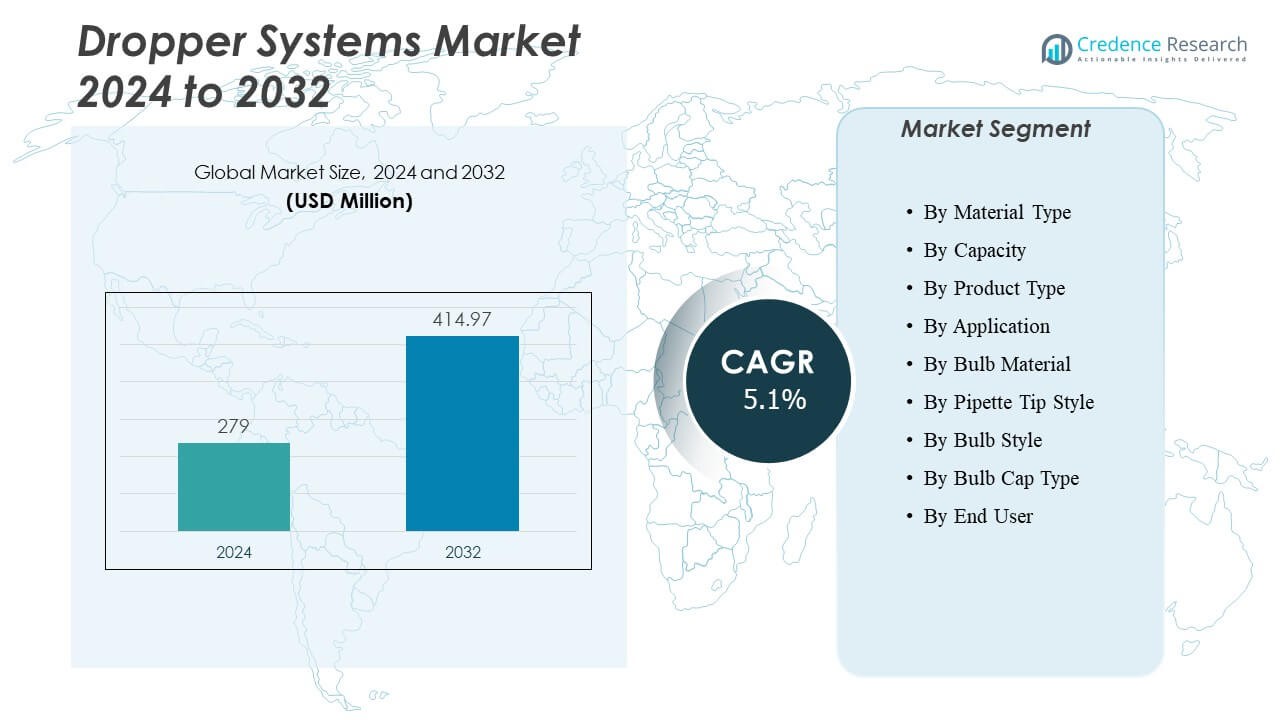
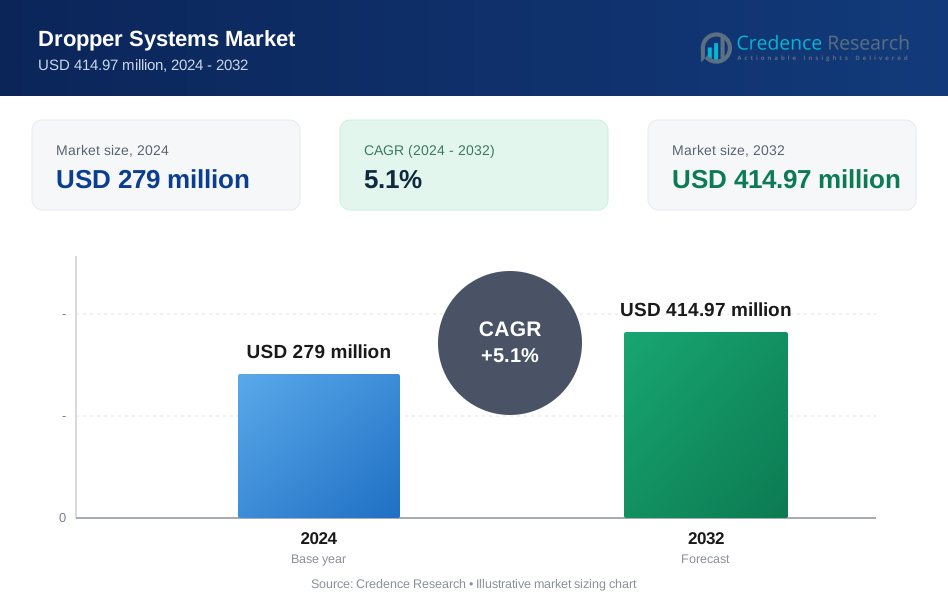
The Dropper Systems Market is projected to grow from USD 279 million in 2024 to an estimated USD 414.97 million by 2032, with a compound annual growth rate (CAGR) of 5.1% from 2024 to 2032.
| REPORT ATTRIBUTE | DETAILS |
|---|---|
| Historical Period | 2020-2023 |
| Base Year | 2024 |
| Forecast Period | 2025-2032 |
| Dropper Systems Market Size 2024 | USD 279 Million |
| Dropper Systems Market, CAGR | 5.1% |
| Dropper Systems Market Size 2032 | USD 414.97 Million |
Rising demand for precise liquid dispensing across pharmaceuticals, cosmetics, and nutraceuticals drives market growth. Manufacturers develop user-friendly, contamination-free designs that ensure dosing accuracy and product safety. Increasing adoption of droppers for serums, essential oils, and pediatric medicines supports market expansion. Sustainability trends encourage the use of recyclable glass and biopolymers. Technological innovations in tip, bulb, and cap designs enhance usability and extend product shelf life. It also benefits from growing health-conscious consumer segments globally.
North America leads the Dropper Systems Market due to advanced pharmaceutical production and high cosmetic packaging demand. Europe follows with strong cosmetic innovation and strict regulatory standards for child-resistant and tamper-evident designs. Asia-Pacific is emerging rapidly, supported by growing healthcare infrastructure, increasing disposable income, and rising cosmetic consumption in China, Japan, and India. LAMEA shows potential growth through expanding healthcare access and consumer product adoption. It reflects regional investment trends and evolving consumer behavior driving long-term market development.
Market Insights:
- The Dropper Systems Market is projected to grow from USD 279 million in 2024 to USD 414.97 million by 2032, at a CAGR of 5.1%.
- Rising demand for precise liquid dispensing in pharmaceuticals, cosmetics, and nutraceuticals drives market growth.
- Manufacturers focus on contamination-free designs and ergonomic droppers to enhance dosing accuracy and user safety.
- Sustainability trends support adoption of recyclable glass and biopolymer materials in dropper packaging.
- Technological innovations in tip, bulb, and cap designs improve functionality, shelf life, and user convenience.
- North America leads the market due to advanced pharmaceutical and cosmetic production, holding the largest share.
- Asia-Pacific and LAMEA show emerging potential through growing healthcare infrastructure, disposable income, and expanding cosmetic consumption.
Market Drivers
Growing Demand for Precision in Pharmaceutical and Cosmetic Applications
The need for accurate liquid dispensing drives strong adoption across pharmaceutical and cosmetic sectors. The Dropper Systems Market benefits from demand for controlled dosage and hygiene assurance in medication and skincare products. Pharmaceutical companies rely on droppers for pediatric and ophthalmic formulations that need precise delivery. Cosmetic brands use them for serums and essential oils to improve consumer convenience. Rising consumer awareness toward safe and hygienic packaging enhances the system’s usage. Companies introduce advanced droppers with anti-leak and tamper-evident features. It helps strengthen product integrity and user trust.
Shift Toward Sustainable and Eco-Friendly Packaging Materials
Growing preference for sustainable packaging solutions supports market expansion. Consumers and regulatory bodies increasingly promote recyclable glass and bio-based plastic droppers. Manufacturers respond by integrating eco-friendly materials that reduce environmental impact. The Dropper Systems Market sees growing collaboration between packaging firms and cosmetic brands to create biodegradable solutions. Glass droppers with aluminum caps replace single-use plastics in several applications. It supports both brand reputation and compliance with sustainability goals. The adoption of green materials improves supply chain appeal for environmentally conscious buyers.
Technological Advancements in Dropper Design and Dispensing Efficiency
Continuous product innovations improve functionality, durability, and precision. Automated filling lines and advanced sealing systems enhance production efficiency. The Dropper Systems Market benefits from integration of smart dispensing mechanisms ensuring accurate volume release. Manufacturers develop ergonomic designs for easier handling and better user experience. Anti-clog and airless technology help extend product shelf life and prevent contamination. Research and development teams work toward customized solutions suited for viscous or sensitive formulations. It enables brands to differentiate their offerings in a competitive packaging landscape.
- For instance, Berry Global’s Rispharm™ R2 multidose eye dropper features a tamper-evident ring designed to remain attached after opening, ensuring dosage accuracy and enhancing user safety, in compliance with FDA recommendations for eye dropper packaging.
Rising Penetration in Nutraceutical and Aromatherapy Applications
Increased consumption of liquid-based nutraceuticals and essential oils supports product adoption. Droppers provide safe and accurate dosage delivery, essential for wellness formulations. Manufacturers focus on droppers that preserve oil integrity and prevent oxidation. The Dropper Systems Market benefits from expansion of health-conscious consumer segments. Small and mid-sized companies introduce personalized packaging formats to attract premium users. Growth in aromatherapy centers and e-commerce channels widens the product’s accessibility. It allows companies to target multiple customer groups with flexible packaging solutions.
- For instance, Comar’s SecureCap® Child-Resistant/Senior-Friendly dropper tip caps are manufactured in compliance with U.S. Consumer Product Safety Commission (CPSC) Title 16 CFR 1700.2 regulations, as published directly by Comar and referenced in product documentation, guaranteeing strict child safety standards for pharmaceutical and nutraceutical liquids.
Market Trends
Adoption of Smart and Connected Dropper Systems for Advanced Functionality
Smart droppers with digital volume indicators and IoT-enabled monitoring gain popularity. The Dropper Systems Market is evolving toward connected packaging for precise medical dosing. Integration of sensors helps ensure consistency and accuracy in pharmaceutical formulations. Brands use digital droppers to improve patient compliance and monitor usage behavior. The technology also supports clinical research by tracking dispensing data. Compact and lightweight materials make smart droppers suitable for portable use. It increases reliability and customer engagement for healthcare and wellness products.
- For instance, Aptar Beauty’s NeoDropper features improved formula protection and controlled application for high-precision dosing, as announced in their official company news in May 2024
Growing Popularity of Customizable Dropper Designs Across Premium Brands
Luxury cosmetic and skincare companies prefer personalized dropper solutions to align with brand identity. Manufacturers focus on aesthetic appeal through color, finish, and texture customization. The Dropper Systems Market experiences demand for unique shapes and material combinations to enhance shelf visibility. High-end consumers associate customization with exclusivity and trust. Glass and metal droppers dominate this segment for their premium feel and recyclability. Brands collaborate with designers to create ergonomic structures ensuring ease of use. It strengthens product positioning in competitive beauty and personal care markets.
Expansion of E-Commerce and Direct-to-Consumer Sales Channels
Online retail growth reshapes distribution patterns and purchasing behavior. Brands leverage e-commerce platforms to reach global customers quickly. The Dropper Systems Market gains from increasing demand for safe packaging during transit. Companies prioritize leak-proof and compact droppers suited for shipment durability. Direct-to-consumer brands adopt minimalist packaging styles for convenience and branding. Subscription models promote consistent product replenishment and encourage customer loyalty. It enhances market exposure for small manufacturers competing with established brands.
- For instance, The Ordinary reported strong e-commerce growth in 2024, driven by online direct sales of its skincare products, including those using dropper packaging, reflecting increasing consumer preference for convenient and precise liquid formulations.
Rising Use of Refillable and Multi-Use Dropper Packaging
Growing sustainability goals inspire brands to introduce refillable dropper solutions. Consumers prefer reusable containers to reduce waste and cost. The Dropper Systems Market supports refill systems compatible with both skincare and pharmaceutical products. Manufacturers design droppers with reinforced glass and detachable components for easy cleaning. Refillable formats lower production waste and boost customer retention through eco-conscious practices. Major beauty brands integrate refill stations in stores to enhance engagement. It aligns with global sustainability and resource efficiency initiatives.
Market Challenges Analysis
Stringent Regulatory Compliance and Material Safety Standards
Packaging materials must meet strict safety and labeling regulations. The Dropper Systems Market faces complexity in meeting international pharmaceutical and cosmetic packaging standards. Certification processes for chemical compatibility and sterilization increase production costs. Variations in FDA, EMA, and ISO requirements complicate global distribution. Small manufacturers find it difficult to sustain compliance without costly testing facilities. Failure to meet standards risks product recalls and reputational damage. It creates operational pressure and limits market entry for emerging companies.
High Production Costs and Supply Chain Constraints
Rising costs of raw materials such as glass, bioplastics, and metals affect profitability. The Dropper Systems Market experiences challenges from fluctuating energy and transport expenses. Supply chain disruptions delay component sourcing and increase lead times. Manufacturers struggle to maintain affordability while ensuring quality and performance. Limited availability of sustainable material suppliers adds complexity. Automated production setup demands high capital investment. It restricts scalability and delays innovation among small and mid-sized producers.
Market Opportunities
Expansion in Biopharmaceutical and Precision Medicine Applications
Growing investment in precision therapeutics opens new opportunities for advanced dispensing tools. The Dropper Systems Market can support next-generation biologics requiring accurate dosage control. Biopharmaceutical firms explore droppers for liquid vaccines and controlled drug delivery systems. Integration of sterilized and tamper-evident components enhances reliability. Packaging partnerships between pharma companies and design specialists create specialized dropper formats. It supports better patient adherence and simplifies drug administration in clinical environments. Demand for user-centric packaging continues to shape new innovations.
Growing Penetration Across Emerging Healthcare and Cosmetic Markets
Rising disposable incomes and healthcare awareness in Asia-Pacific, Latin America, and the Middle East generate strong prospects. Local manufacturers invest in affordable dropper solutions catering to small-scale pharmaceutical and cosmetic producers. The Dropper Systems Market benefits from expanding infrastructure and retail presence in these regions. Consumers seek functional yet aesthetically appealing packaging. Global brands entering these markets adopt localized strategies to meet cultural preferences. Regulatory reforms supporting import flexibility also encourage new investments. It widens the market’s geographic scope and strengthens long-term growth potential.
Market Segmentation Analysis:
By Material Type
The Dropper Systems Market includes glass and plastic pipettes, each serving specific industry needs. Glass pipettes, including Type I borosilicate and Type III soda lime glass, dominate pharmaceutical and laboratory applications due to chemical resistance and precision. Plastic pipettes such as HDPE, LDPE, PP, PET, and other polymers offer cost-efficiency and flexibility for consumer healthcare and cosmetics. It supports diverse packaging requirements while maintaining durability and product integrity. Manufacturers prioritize material selection based on chemical compatibility, product viscosity, and user convenience.
- For instance, Corning Incorporated’s 2024 annual report states that its Specialty Materials segment achieved USD 2.0 billion in sales, marking an 8% year-over-year increase, driven by growth in premium glass products across multiple industries, including pharmaceuticals.
By Capacity
Dropper systems cater to various capacities, ranging from under 2 ml to above 60 ml. Small-volume droppers up to 2 ml serve pediatric, cosmetic, and essential oil applications. Medium capacities from 2 ml to 30 ml cover hair oils, serums, and liquid medicines, ensuring controlled dosing. Larger volumes between 31 ml and 60 ml and above support industrial and laboratory dispensing. It enables manufacturers to meet precise dosing requirements across multiple sectors while maintaining consistent product performance.
- For instance, Gerresheimer AG offers dropper bottles in multiple sizes made of LDPE, HDPE, and PET, designed for pharmaceutical and laboratory applications, with production adhering to strict quality and hygiene standards as outlined in their official product catalogue.
By Product Type
The market offers Child Resistant Closure (CRC) droppers, non-CRC droppers, tamper-evident caps, and combined CRC/tamper-evident variants. CRC droppers dominate pharmaceuticals and household chemicals due to safety compliance. Tamper-evident solutions gain traction in cosmetics and nutraceuticals. It allows manufacturers to enhance product security, regulatory adherence, and consumer confidence. Non-CRC droppers remain popular in low-risk personal care and home applications.
By Application
Dropper systems serve liquid medicines, essential oils, serums, lotions, hair oils, edible flavors, laboratory auxiliaries, and precision dosing equipment. It ensures accurate delivery, hygiene, and consistency in sensitive formulations. Pharmaceutical and consumer healthcare applications lead demand due to strict dosing requirements. Cosmetic and personal care products adopt droppers for premium packaging and ease of use.
By Bulb Material
Bulb materials include natural rubber, thermoplastic elastomers, thermoset polymers, and others. Natural rubber dominates traditional pharmaceutical droppers due to elasticity and chemical stability. Thermoplastic elastomers and thermoset polymers provide durability, temperature resistance, and compatibility with various liquids. It supports precise control and extends product shelf life across applications.
By Pipette Tip Style
Tip styles include straight, bent, blunt, ball, and bent ball. Straight tips serve general dispensing needs, while bent and ball tips enhance accuracy for specific applications. It allows end-users to select droppers based on formulation viscosity and precision requirements, improving usability and dosing efficiency.
By Bulb Style
Bulb styles consist of skirt, ring, and straight designs. Skirt and ring styles provide ergonomic handling for laboratory and personal care usage. Straight bulbs suit compact packaging and portability needs. It enables manufacturers to address diverse handling preferences and enhance user experience.
By Bulb Cap Type
Cap types include regular, tamper-evident, child-resistant, and combined CRC/tamper-evident designs. Tamper-evident and CRC caps dominate pharmaceutical and high-value cosmetic packaging. It ensures product safety, regulatory compliance, and consumer trust across markets.
By End User
End users include pharmaceuticals, medical, consumer healthcare, cosmetics, home care, food and beverage, and laboratory auxiliaries. Pharmaceuticals and healthcare applications hold a significant share due to high safety and dosing standards. Consumer healthcare and cosmetics drive growth with premium and sustainable packaging preferences. It supports broad adoption across regulated and emerging markets, enhancing overall market penetration.
Segmentation:
By Material Type
- Glass Pipette
- Type I (Borosilicate Glass)
- Type III (Regular Soda Lime Glass)
- Plastic Pipette
- High-Density Polyethylene (HDPE)
- Low-Density Polyethylene (LDPE)
- Polypropylene (PP)
- Polyethylene Terephthalate (PET)
- Others
By Capacity
- Up to 2 ml
- 2 ml – 6 ml
- 6 ml – 10 ml
- 11 ml – 15 ml
- 16 ml – 30 ml
- 31 ml – 60 ml
- Above 60 ml
By Product Type
- Child Resistant Closure (CRC) Droppers
- Non-CRC Droppers
- Tamper Evident Cap Droppers
- Child Resistant / Tamper Evident Cap Droppers
By Application
- Liquid Medicines Packaging
- Essential Oil, Serum & Lotions Packaging
- Hair Oil Packaging
- Laboratory Test & Measurement Auxiliaries
- Edible Flavor Packaging
- Precision Dosing Equipment
- Others
By Bulb Material
- Natural Rubber
- Thermoplastic Elastomer (Monoprene, Santoprene)
- Thermoset Polymers (Neoprene, Nitrile, Silicone)
- Others
By Pipette Tip Style
- Straight
- Bent
- Blunt
- Ball
- Bent Ball
By Bulb Style
- Skirt
- Ring
- Straight
By Bulb Cap Type
- Regular Cap
- Tamper Evident Cap
- Child Resistant Cap
- Child Resistant / Tamper Evident Cap
By End User
- Pharmaceuticals
- Medical
- Consumer Healthcare
- Cosmetics & Personal Care
- Home Care
- Food & Beverage
- Laboratory Test & Measurement Auxiliaries
- Others
By Region
- North America
- U.S.
- Canada
- Mexico
- Europe
- Germany
- France
- U.K.
- Italy
- Spain
- Rest of Europe
- Asia Pacific
- China
- Japan
- India
- South Korea
- South-east Asia
- Rest of Asia Pacific
- Latin America
- Brazil
- Argentina
- Rest of Latin America
- Middle East & Africa
- GCC Countries
- South Africa
- Rest of the Middle East and Africa
Regional Analysis:
North America dominates the Dropper Systems Market with a 37.4% share, driven by strong pharmaceutical and cosmetic manufacturing capabilities. The region’s advanced healthcare infrastructure supports widespread use of droppers for precision liquid dosage. The U.S. remains the leading contributor due to high adoption in drug formulations and personal care products. Cosmetic brands in the U.S. and Canada invest in premium dropper packaging to enhance consumer experience. Regulatory compliance for packaging safety further strengthens demand across both sectors. It continues to benefit from innovation in material science and product design that enhance durability and user convenience.
Europe holds a 31.6% market share, supported by its well-established cosmetic and personal care industry. Countries such as Germany, France, and Italy lead due to strong pharmaceutical production and sustainability-driven packaging regulations. Manufacturers focus on eco-friendly and recyclable materials to align with EU environmental policies. The region also benefits from advanced glass manufacturing capabilities, which improve dropper quality and precision. Rising demand for child-resistant and tamper-evident packaging contributes to market growth. It maintains a robust position due to ongoing innovation and stringent quality standards across key end-use industries.
Asia-Pacific accounts for a 23.8% market share and exhibits the fastest growth potential globally. Expanding pharmaceutical sectors in China and India drive significant adoption of droppers in healthcare packaging. Increasing consumer awareness of personal care and wellness products also fuels demand. Local manufacturers invest in cost-efficient production methods to serve both domestic and export markets. Japan and South Korea contribute with technological advancements in lightweight and sustainable packaging. It gains momentum from strong e-commerce distribution and rising disposable income across developing nations. Latin America, the Middle East, and Africa collectively represent 7.2%, showing emerging opportunities through healthcare expansion and consumer product diversification.
Key Player Analysis:
- AptarGroup, Inc.
- Comar LLC
- Gerresheimer AG
- Berry Global Group, Inc.
- SGD Pharma
- Virospack SL
- RPC Group PLC
- Amcor plc
- Berk Company
- Adelphi Healthcare Packaging
- Nipro Corporation
- SONE Products Ltd
- HCP Packaging Co. Ltd
- Albéa Group
- Quadpack SA
Competitive Analysis:
The Dropper Systems Market features a moderately consolidated competitive landscape with key players focusing on innovation, material efficiency, and product differentiation. Leading companies such as Gerresheimer AG, Bormioli Pharma, Virospack, DWK Life Sciences, and AptarGroup, Inc. dominate through advanced design and strong global distribution. These players invest heavily in automation, glass processing, and biopolymer technology to enhance manufacturing precision. Smaller firms compete by offering custom designs and sustainable packaging solutions for niche segments. It emphasizes partnerships between pharmaceutical packaging suppliers and cosmetic brands to strengthen long-term market positioning. Continuous mergers and acquisitions enhance production capabilities and geographic reach, ensuring sustained competitiveness across major regional markets.
Recent Developments:
- In July 2025, AptarGroup, Inc. launched the ninth generation of the iconic Double Serum in collaboration with Clarins. This new eco-designed packaging solution features two power-packed hydric and lipidic serums combined into a double-chamber dispensing system, showcasing Aptar's advanced industrial power and innovation capacity.
Report Coverage:
The research report offers an in-depth analysis based on Material Type, Capacity, Product Type, Application, Bulb Material, Pipette Tip Style, Bulb Style, Bulb Cap Type and End User. It details leading market players, providing an overview of their business, product offerings, investments, revenue streams, and key applications. Additionally, the report includes insights into the competitive environment, SWOT analysis, current market trends, as well as the primary drivers and constraints. Furthermore, it discusses various factors that have driven market expansion in recent years. The report also explores market dynamics, regulatory scenarios, and technological advancements that are shaping the industry. It assesses the impact of external factors and global economic changes on market growth. Lastly, it provides strategic recommendations for new entrants and established companies to navigate the complexities of the market.
Future Outlook:
- Increasing demand for precise liquid dosing will drive adoption across pharmaceuticals and cosmetics.
- Development of eco-friendly and recyclable materials will expand sustainable packaging solutions.
- Smart and connected dropper systems will gain traction for improved accuracy and monitoring.
- Growth in e-commerce and direct-to-consumer channels will enhance market reach globally.
- Expansion in emerging regions will provide opportunities for local and international manufacturers.
- Technological innovations in tip and bulb design will improve user convenience and product reliability.
- Premium and customized droppers will attract high-end cosmetic and personal care brands.
- Integration in nutraceutical and wellness products will boost overall consumption.
- Partnerships between packaging companies and pharmaceutical firms will strengthen market positioning.
- Regulatory compliance for child-resistant and tamper-evident designs will maintain product safety standards.
Request a Free Sample
Fill in your details and we'll send you a free sample report.
- Sample data tables & charts
- Research methodology
Need a Custom Version of This Report?
Tailor the scope, geography, or segments to your exact requirements.
- Custom geography or segment scope
- Direct access to our analyst team
Frequently Asked Questions
What is the current market size for Dropper Systems Market, and what is its projected size in 2032?
At what Compound Annual Growth Rate is the Dropper Systems Market projected to grow between 2024 and 2032?
Which Dropper Systems Market segment held the largest share in 2024?
What are the primary factors fueling the growth of the Dropper Systems Market?
Who are the leading companies in the Dropper Systems Market?
Which region commanded the largest share of the Dropper Systems Market in 2024?
Table of Content
Chapter 1. Report Introduction
- 1.1 Report Description & Purpose
- 1.1.1 Report Title & Market Definition
- 1.1.2 Unique Selling Propositions (USP) & Key Differentiators
- 1.1.3 Value Proposition for Stakeholders
- 1.2 Research Objectives
- 1.2.1 Market Sizing Objectives (Volume & Revenue) (Volume Where Applicable)
- 1.2.2 Segmentation Objectives
- 1.2.3 Competitive Intelligence Objectives
- 1.2.4 Forecast & Scenario Objectives
- 1.3 Report Scope
- 1.3.1 Dropper Systems Scope – Segments & Subsegments Covered
- 1.3.2 Geographic Scope – Regions & Countries Covered
- 1.3.3 Historical Period, Base Year & Forecast Period (2024; forecast to 2032)
- 1.3.4 Inclusions & Exclusions
- 1.4 Industry Classification & Applicable Codes
- 1.5 Currency, Measurement Units & Valuation Basis
- 1.6 Target Stakeholders
- 1.7 Limitations & Assumptions
Chapter 2. Executive Summary
- 2.1 Global Dropper Systems Market Snapshot
- 2.1.1 Market Size – Historical (2024) & Forecast (2024-2032) (2024: USD 279 million → 2032: USD 414.97 million)
- 2.1.2 Volume & Revenue – Global Totals (Volume Where Applicable)
- 2.1.3 Key Market Highlights – Top Five Facts
- 2.2 Dropper Systems Market Segmentation Snapshot
- 2.2.1 Market Split by Region – 2024 vs. 2032
- 2.3 Competitive Snapshot
- 2.3.1 Top 10 Players by Revenue Share – 2024
- 2.3.2 Top 10 Players by Volume Share – 2024 (Volume Where Applicable)
- 2.3.3 Recent Strategic Developments (18-Month Summary)
- 2.4 Key Investment Highlights & Strategic Conclusions
Chapter 3. Dropper Systems Market Dynamics & Industry Analysis
- 3.1 Market Overview & Context
- 3.1.1 Dropper Systems Market Position in the Broader Industry Value Chain
- 3.1.2 Demand Structure & Purchasing Dynamics
- 3.1.3 Market Maturity & Development Stage by Region
- 3.2 Dropper Systems Market Drivers
- 3.3 Dropper Systems Market Restraints & Challenges
- 3.4 Dropper Systems Market Opportunities
- 3.5 Porter's Five Forces Analysis
- 3.5.1 Threat of New Entrants
- 3.5.2 Bargaining Power of Suppliers
- 3.5.3 Bargaining Power of Buyers
- 3.5.4 Threat of Substitutes
- 3.5.5 Competitive Rivalry – Intensity Assessment
- 3.6 Dropper Systems Value Chain Analysis
- 3.6.1 Upstream – Key Inputs, Resources & Suppliers
- 3.6.1.1 Key Input/Resource 1
- 3.6.1.2 Key Input/Resource 2
- 3.6.1.3 Key Input/Resource 3
- 3.6.2 Midstream – Core Operations & Value Creation
- 3.6.2.1 Operating Model & Process Overview
- 3.6.2.2 Key Operating Locations & Capabilities by Company
- 3.6.3 Downstream – Market Channels & End Users
- 3.6.3.1 Direct Sales & Customer Engagement Channels
- 3.6.3.2 Indirect Sales, Intermediaries & Partner Channels
- 3.6.4 Value Chain Profitability Analysis
- 3.6.1 Upstream – Key Inputs, Resources & Suppliers
- 3.7 PESTEL Analysis
- 3.7.1 Political Factors
- 3.7.2 Economic Factors
- 3.7.3 Social Factors
- 3.7.4 Technological Factors
- 3.7.5 Environmental Factors
- 3.7.6 Legal Factors
- 3.8 Dropper Systems Supply Chain Analysis
- 3.8.1 Critical Input & Resource Availability Risk Assessment
- 3.8.2 Supplier & Operational Concentration Risk (Geographic Exposure)
- 3.8.3 Supply & Service Disruption Impact Analysis
- 3.9 Regulatory & Policy Landscape
Note: The regulatory and policy landscape section covers regulations based on their applicability to the market, Dropper Systems category, geography, and scope of the study. Only regulatory frameworks with a material impact on operations, compliance, trade, sustainability, or market access are analyzed in detail.
Chapter 4. Key Investment Pockets & Opportunity Analysis
- 4.1 Dropper Systems Market Attractiveness Analysis
- 4.1.1 By Region – Investment Attractiveness Matrix (Market Size × CAGR)
- 4.2 Absolute Revenue Growth Opportunity
- 4.2.1 By Region – Absolute Revenue Growth Through 2032
- 4.3 Incremental Demand Opportunity
- 4.3.1 By Region – Incremental Demand Through 2032
- 4.3.2 Segment – Incremental Demand
- 4.4 Emerging Submarket Opportunity Deep Dive (Subject to Applicability)
- 4.5 Priority Market Opportunity Scorecards
- 4.5.1 United States
- 4.5.2 Europe
- 4.5.3 Asia
- 4.5.4 Middle East & Africa
Note: Priority market opportunity scorecards reflect the geographic scope and strategic relevance of the study. Listed markets are indicative and may be adapted to the industry.
Chapter 5. Dropper Systems Cross-Border Trade & Market Access Analysis
- 5.1 International Trade & Cross-Border Activity Overview
- 5.1.1 Global Export Value by Country (2024)
- 5.1.2 Global Export Volume by Country (2024) (Volume Where Applicable)
- 5.1.3 Global Import Value by Country (2024)
- 5.1.4 Global Import Volume by Country (2024) (Volume Where Applicable)
- 5.1.5 Net Trade Balance by Country (2024)
- 5.2 Export Analysis – Segment
- 5.2.1 Category 1 (Applicable Classification Code)
- 5.2.2 Category 2 (Applicable Classification Code)
- 5.2.3 Category 3 (Applicable Classification Code)
- 5.2.4 Category 4 (Applicable Classification Code)
- 5.2.5 Category 5 (Applicable Classification Code)
- 5.3 Import Analysis – Segment
- 5.3.1 Category 1 (Applicable Classification Code)
- 5.3.2 Category 2 (Applicable Classification Code)
- 5.3.3 Category 3 (Applicable Classification Code)
- 5.3.4 Category 4 (Applicable Classification Code)
- 5.3.5 Category 5 (Applicable Classification Code)
- 5.4 Cross-Border Pricing & Transaction Benchmarks
- 5.4.1 Export Pricing – Segment & Country
- 5.4.2 Import Pricing – Segment & Source Country
- 5.4.3 Price Trends (2024)
- 5.5 Key Cross-Border Trade & Delivery Routes
- 5.5.1 Cross-Border Trade/Delivery Route 1
- 5.5.2 Cross-Border Trade/Delivery Route 2
- 5.5.3 Cross-Border Trade/Delivery Route 3
- 5.5.4 Cross-Border Trade/Delivery Route 4
- 5.5.5 Cross-Border Trade/Delivery Route 5
- 5.6 Trade Policy & Market Access Impact Assessment
- 5.6.1 Tariff & Non-Tariff Barriers
- 5.6.2 Regional Trade & Economic Integration Frameworks
- 5.6.3 Bilateral & Multilateral Trade Agreements
- 5.6.4 Cross-Border Operating, Licensing & Localization Requirements
Note: This chapter applies where cross-border trade or delivery is relevant to Dropper Systems. Goods, services, and digital offerings are assessed using applicable classifications and transaction measures. Import-export volumes, trade balances, and route analyses are included only where meaningful to the market.
Chapter 6. Competitive Landscape & Company Benchmarking
- 6.1 Dropper Systems Market Concentration & Structure
- 6.1.1 Herfindahl-Hirschman Index (HHI) – vs. 2024
- 6.1.2 Leading, Mid-Sized & Emerging Player Structure
- 6.1.3 Global, Regional & Local Player Dynamics
- 6.2 Dropper Systems Market Share Analysis – 2024
- 6.2.1 Global Revenue Share by Company
- 6.2.2 Global Volume Share by Company (Volume Where Applicable)
- 6.2.3 Regional Revenue Share
- 6.2.4 Market Share Evolution ( vs. 2024)
- 6.2.5 Company Market Share by Key Segment
- 6.2.6 Company Market Share by Customer Group
- 6.3 Operating Scale, Capacity & Infrastructure Analysis
- 6.3.1 Global Operating Scale & Supply Capacity
- 6.3.2 Resource Utilization & Operating Efficiency
- 6.3.3 Output, Service Delivery & Activity Metrics
- 6.3.4 Operating Footprint & Infrastructure Map
- 6.3.5 Planned Operational & Capacity Expansion
- 6.4 Dropper Systems Competitive Benchmarking Matrix
- 6.4.1 Revenue, Growth, Profitability & Operating Metric Comparison
- 6.4.2 Channel Revenue Mix
- 6.4.3 Geographic Revenue Exposure
- 6.4.4 R&D Intensity
- 6.4.5 Sustainability Maturity
- 6.5 Strategic Developments in Dropper Systems (Last 24 Months)
- 6.5.1 Mergers, Acquisitions & Divestments
- 6.5.2 New Products, Services & Solutions in Dropper Systems
- 6.5.3 Operational & Infrastructure Expansions
- 6.5.4 Strategic Alliances, Joint Ventures & Partnerships
- 6.5.5 Distribution Expansion & Market Entry
- 6.5.6 Sustainability & ESG Initiatives
- 6.6 Competitive Strategy Mapping
- 6.6.1 Leader, Challenger, Follower & Niche Classification
- 6.6.2 Pricing Strategy Comparison
- 6.6.3 Channel Strategy Matrix
Note: Strategic developments are included based on their materiality and the availability of reliable information.
Chapter 7. Global Dropper Systems Market – By Sales & Delivery Channel
- 7.1 Segment Overview
- 7.1.1 Volume & Revenue Split by Channel (2024 & 2032) (Volume Where Applicable)
- 7.1.2 Channel Mix Evolution (2024-2032)
Chapter 8. Regional Market Analysis – Global Overview
- 8.1 Global Regional Overview
- 8.1.1 Regional Volume Share (Volume Where Applicable)
- 8.1.2 Regional Revenue Share
- 8.1.3 Regional Volume by Region (Volume Where Applicable)
- 8.1.4 Regional Revenue by Region
- 8.1.5 Regional Forecast Through 2032
- 8.2 Cross-Regional Segment Analysis
- 8.2.1 By Sales & Delivery Channel
- 8.2.2 By Competitive Positioning & Price Tier
Chapter 9. North America Dropper Systems Market
- 9.1 United States
- 9.2 Canada
- 9.3 Mexico
Chapter 10. Europe Dropper Systems Market
- 10.1 Germany
- 10.2 France
- 10.3 Italy
- 10.4 United Kingdom
- 10.5 Spain
- 10.6 Poland
- 10.7 Russia
- 10.8 Netherlands
- 10.9 Belgium
- 10.10 Sweden
- 10.11 Denmark
- 10.12 Norway
- 10.13 Rest of Europe
Chapter 11. Asia Pacific Dropper Systems Market
- 11.1 China
- 11.2 India
- 11.3 Japan
- 11.4 South Korea
- 11.5 Thailand
- 11.6 Indonesia
- 11.7 Vietnam
- 11.8 Malaysia
- 11.9 Australia
- 11.10 Rest of Asia Pacific
Chapter 12. Latin America Dropper Systems Market
- 12.1 Brazil
- 12.2 Argentina
- 12.3 Colombia
- 12.4 Chile
- 12.5 Rest of Latin America
Chapter 13. Middle East Dropper Systems Market
- 13.1 Saudi Arabia
- 13.2 United Arab Emirates
- 13.3 Turkey
- 13.4 Israel
- 13.5 Iran
- 13.6 Rest of the Middle East
Chapter 14. Africa Dropper Systems Market
- 14.1 South Africa
- 14.2 Egypt
- 14.3 Nigeria
- 14.4 Morocco
- 14.5 Rest of Africa
Chapter 15. Dropper Systems Company Profiles
- 15.1 [Company 01]
- 15.1.1 Company Overview
- 15.1.2 Key Management Personnel
- 15.1.3 Products & Services Portfolio
- 15.1.4 Financial Performance
- 15.1.5 Key Market Focus & Geographic Presence
- 15.1.6 Recent Developments & Strategic Initiatives
Note: The company profile list is preliminary and may change based on research findings, market developments, data availability, and client requirements.
Chapter 16. Appendices
- Appendix A – List of Abbreviations & Acronyms
- Appendix B – Industry Classification Code Reference – Full Series
- Appendix C – Supply, Output & Operating Capacity Data Tables
- Appendix D – End-Use & Demand Base Tables
- Appendix E – Demand, Adoption & Usage Assumptions
- Appendix F – Pricing & Revenue Metric Reference Tables
- Appendix G – Company Operations & Infrastructure Database
- Appendix H – Cross-Border Trade & Activity Data Tables (Where Applicable)
- Appendix I – Regulatory Summary Tables
- Appendix J – Primary Research Participant List (Anonymized)
- Appendix K – Primary Research Questionnaire Framework
- Appendix L – Data Sources & Bibliography
- Appendix M – Market Size Divergence & Source Comparison
Chapter 17. Research Methodology
- 17.1 Research Framework & Philosophy
- 17.2 Secondary Research – Sources, Hierarchy & Data Extraction
- 17.3 Data Modeling – Bottom-Up & Top-Down Market Sizing
- 17.4 Primary Research – Stakeholder Framework, LOI & Sample Sizes
- 17.5 Forecast Methodology – Regression, Scenario & Sensitivity Analysis
- 17.6 Quality Control – Four-Layer Validation Framework
- 17.7 Limitations & Standard Assumptions
- 17.8 Disclaimer
