
Market Overview:
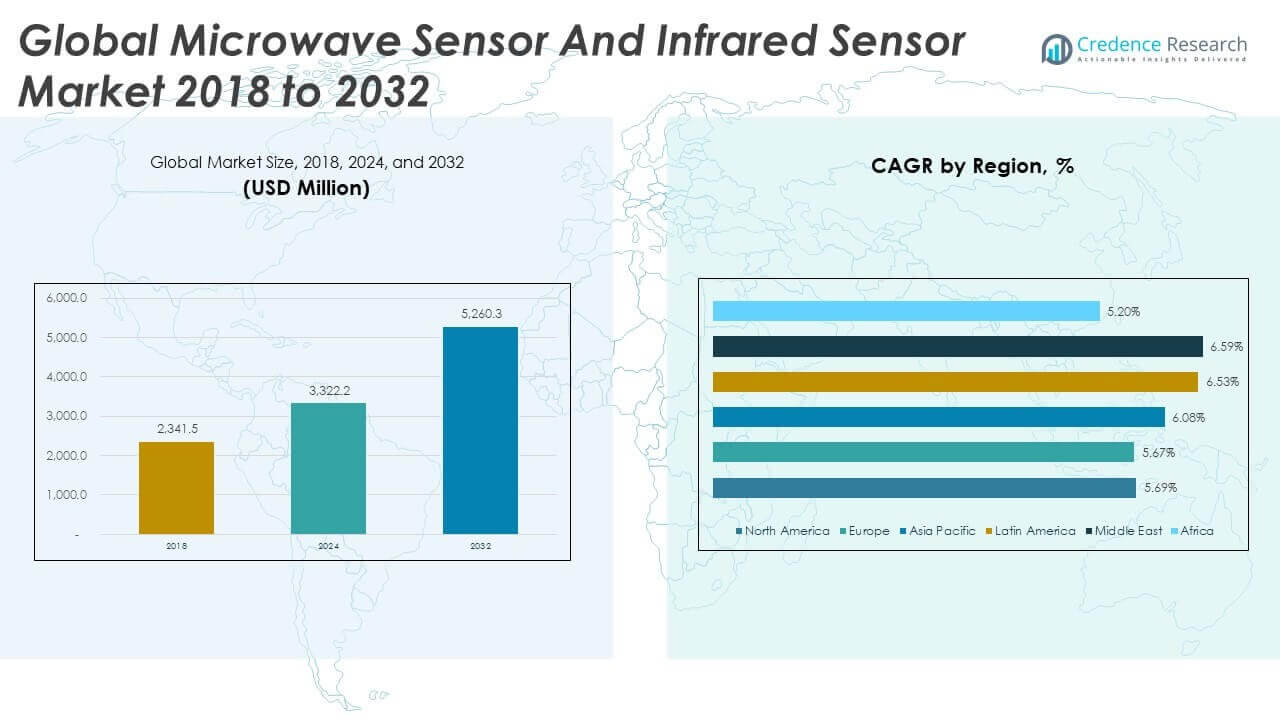
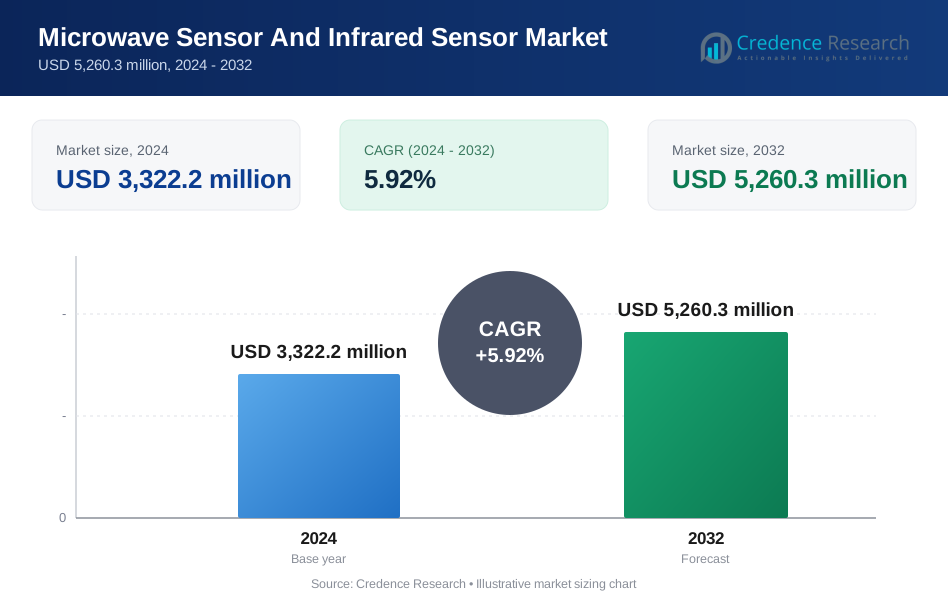
The Global Microwave Sensor and Infrared Sensor Market size was valued at USD 2,341.50 million in 2018 to USD 3,322.20 million in 2024 and is anticipated to reach USD 5,260.30 million by 2032, at a CAGR of 5.92% during the forecast period.
| REPORT ATTRIBUTE | DETAILS |
|---|---|
| Historical Period | 2020-2023 |
| Base Year | 2024 |
| Forecast Period | 2025-2032 |
| Microwave Sensor and Infrared Sensor Market Size 2024 | USD 3,322.20 million |
| Microwave Sensor and Infrared Sensor Market, CAGR | 5.92% |
| Microwave Sensor and Infrared Sensor Market Size 2032 | USD 5,260.30 million |
The market is growing due to increasing demand for automation, security, and energy-efficient systems across sectors. Microwave sensors offer strong detection performance in harsh environments, while infrared sensors support contactless and precise thermal sensing. Industrial automation, smart homes, automotive safety, and public safety systems drive sensor deployments. Vendors are expanding portfolios with AI-integrated sensing and multi-sensor modules. Demand is further fueled by investments in robotics, defense surveillance, and intelligent infrastructure. The market benefits from rising emphasis on non-contact monitoring and predictive maintenance in smart factories. Innovation and miniaturization also support adoption in wearables and consumer devices.
Asia Pacific leads the global market due to strong electronics manufacturing, urbanization, and smart city initiatives in countries like China, Japan, and South Korea. North America follows, supported by defense, industrial automation, and ADAS adoption. Europe maintains solid growth with regulatory support for energy efficiency and smart infrastructure. Latin America, Middle East, and Africa represent emerging opportunities driven by modernization and security upgrades. Each region shows unique drivers, but all contribute to expanding sensor use in public, private, and industrial domains.
Market Insights:
- The Global Microwave Sensor and Infrared Sensor Market was valued at USD 2,341.5 million in 2018, grew to USD 3,322.2 million in 2024, and is projected to reach USD 5,260.3 million by 2032, expanding at a CAGR of 5.92%.
- Asia Pacific held the largest regional share at 33%, driven by electronics manufacturing, urbanization, and smart infrastructure. Europe followed with 26.6% share due to industrial automation and energy mandates, while North America captured 23.8% through ADAS, defense, and smart home applications.
- The Middle East is the fastest-growing region at 6.59% CAGR, fueled by smart city initiatives, border surveillance systems, and energy automation across GCC nations.
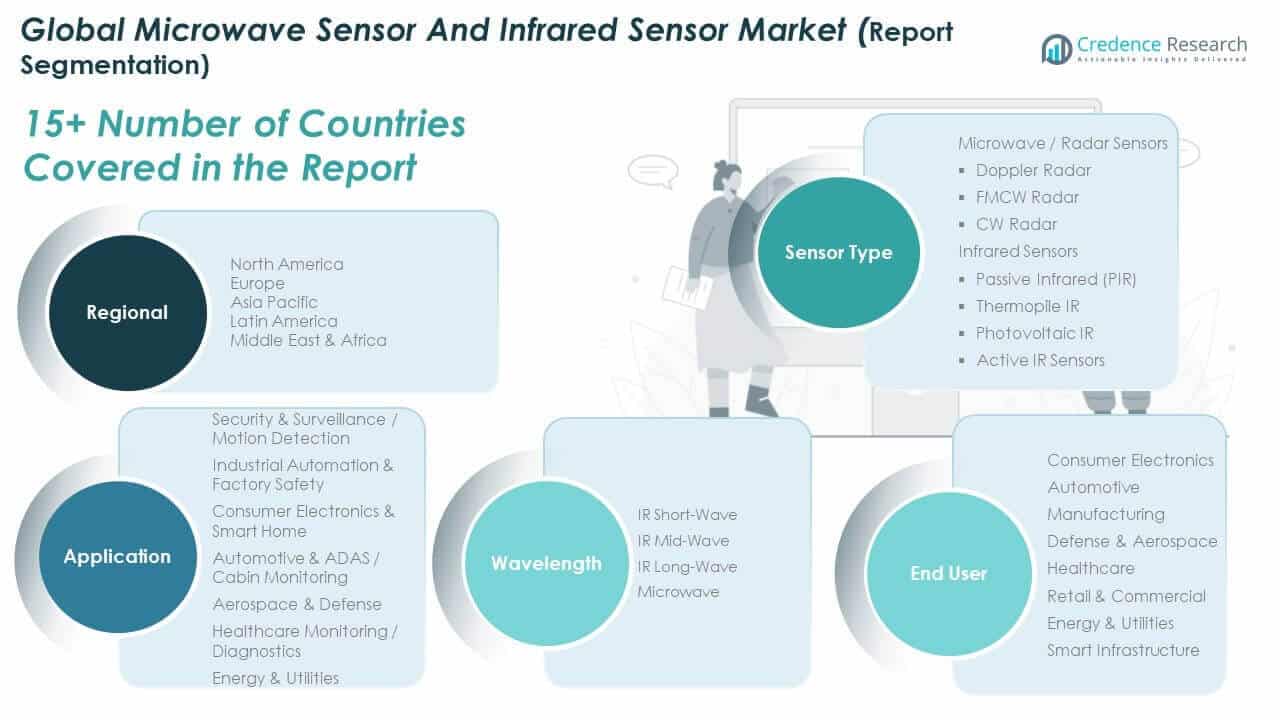
- In 2024, IR Mid-Wave held the largest wavelength segment share at approximately 28%, supporting thermal detection in defense and industrial applications.
- Microwave wavelength sensors accounted for roughly 25% of the 2024 market, favored in automotive, factory safety, and long-range surveillance solutions.
Market Drivers
Rising Demand for Advanced Motion Detection Across Security and Automation Applications
The Global Microwave Sensor and Infrared Sensor Market is driven by demand for high-precision motion sensing. Security systems increasingly require sensors with better range, sensitivity, and environmental resistance. Microwave sensors offer superior accuracy in detecting motion through walls, smoke, or dust. Infrared sensors remain vital in passive detection for indoor surveillance and consumer electronics. Industrial automation relies on both technologies to enhance safety and operational efficiency. Smart home integration has also surged, pushing sensor adoption in lighting, intrusion alarms, and occupancy monitoring. It benefits from the growing need for intelligent infrastructure. The rise in theft, trespassing, and smart surveillance continues to push deployments.
- For instance, Optex’s REDWALL SIP series includes outdoor dual-technology PIR/microwave detectors designed for wide-area perimeter protection with high stability in harsh conditions.
Integration in Automotive Safety Systems and Advanced Driver Assistance Platforms
Automotive manufacturers integrate microwave and infrared sensors for blind-spot detection, adaptive cruise control, and pedestrian detection. These technologies ensure real-time monitoring of surroundings, improving road safety. The Global Microwave Sensor and Infrared Sensor Market benefits from vehicle electrification and ADAS expansion. Microwave sensors detect motion and object distance, crucial for autonomous features. Infrared sensors support night vision and obstacle tracking. Vehicle safety regulations in North America, Europe, and Asia further support adoption. Automakers deploy sensor fusion to combine outputs for more reliable decisions. It ensures efficient data capture under diverse driving conditions.
- For instance, Continental’s ARS540 is a 77 GHz long‑range 4D imaging radar that measures object range, relative speed, and direction to support advanced driver‑assistance and automated driving systems. The sensor offers high‑resolution detection up to several hundred meters and enhances vehicle environment perception for functions like adaptive cruise control and collision avoidance.
Growing Adoption in Energy-Efficient Smart Building Technologies
Commercial and residential buildings adopt infrared and microwave sensors for lighting control, HVAC automation, and access management. These systems improve energy savings and occupant comfort. Governments promote smart infrastructure through green building standards, supporting sensor demand. The Global Microwave Sensor and Infrared Sensor Market gains from integration into intelligent lighting, fire alarms, and space utilization systems. Microwave sensors detect motion in large or partitioned spaces, while infrared models optimize temperature sensing. Office complexes, malls, and institutions rely on sensors to automate low-use zones. It enhances sustainability metrics for facility operators. Retrofit upgrades in older buildings also fuel uptake.
Industrial Automation and Robotics Driving Sensor Integration in Manufacturing
Factories use sensors for machine monitoring, process control, and asset tracking. Microwave sensors excel in harsh industrial environments due to their resilience to dust, vibration, and temperature. Infrared sensors assist in material identification, fault detection, and thermal profiling. The Global Microwave Sensor and Infrared Sensor Market sees increasing demand from robotics and warehouse automation. Sensors enable autonomous guided vehicles and cobots to navigate and interact safely. Manufacturing plants adopt predictive maintenance strategies supported by sensor data. It helps reduce downtime and improve throughput. Growth of smart factories under Industry 4.0 supports deeper sensor penetration.
Market Trends
Miniaturization of Sensor Modules to Enable Integration in Compact and Portable Devices
Manufacturers develop smaller sensors with equal or improved performance to meet space-constrained applications. This trend supports wearables, drones, and IoT nodes requiring lightweight and compact sensing solutions. The Global Microwave Sensor and Infrared Sensor Market benefits from advances in MEMS and packaging technologies. Portable consumer devices embed motion and proximity detection to enable gesture control and screen optimization. Healthcare monitors, fitness devices, and smart accessories use integrated sensors for real-time tracking. It allows multi-sensor combinations in compact devices. Demand for miniaturized components in AR/VR headsets and compact robotics continues to expand use cases.
- For instance, Sony’s IMX500 intelligent vision sensor integrates a stacked CMOS image sensor with on‑chip AI processing, enabling real‑time inference directly at the sensor level without external processors.
Dual-Technology Sensor Development to Improve Reliability in Diverse Environments
Vendors are combining microwave and infrared sensors into hybrid units to leverage strengths of both technologies. Dual sensors deliver better accuracy by mitigating false alarms due to temperature shifts or obstructions. The Global Microwave Sensor and Infrared Sensor Market gains traction through such innovations. These modules enable smarter decisions for lighting control, intrusion detection, and occupancy monitoring. Commercial buildings and public spaces favor hybrid sensors for consistent performance. It reduces maintenance calls by ensuring accuracy across lighting, weather, or airflow conditions. Demand for fail-safe sensing grows across utilities, metros, and high-traffic buildings.
- For instance, Bosch Security Systems’ TriTech motion detectors combine passive infrared with microwave Doppler sensing and are specified to detect movement across coverage areas up to 12 m by 12 m while reducing nuisance alarms by more than 35% compared with single‑technology PIR units in internal validation tests.
Use of Wireless and Battery-Powered Sensors to Support Flexible Deployments
The shift to wireless sensor networks reduces installation complexity and extends monitoring to remote or hard-to-wire areas. The Global Microwave Sensor and Infrared Sensor Market sees rising preference for battery-operated modules with long-life and low-power design. Smart city initiatives deploy these sensors across parking lots, parks, and transit systems. Wireless sensors support easier retrofitting and scalable installation. It enables cost-effective expansion without large infrastructure changes. Applications in perimeter security, energy monitoring, and public facilities benefit from fast and flexible deployments. Demand for sustainable sensors aligns with green design principles.
Integration with Edge Computing and AI for Real-Time Sensing and Analytics
Edge-enabled sensors process data locally to reduce latency and improve responsiveness. The Global Microwave Sensor and Infrared Sensor Market shifts toward intelligent modules that pair with AI algorithms. Real-time decision-making improves efficiency in traffic control, retail analytics, and smart agriculture. Infrared sensors paired with thermal imaging support predictive maintenance and process optimization. Microwave sensors improve anomaly detection and behavioral tracking in sensitive environments. It supports privacy-focused monitoring without capturing identity details. Localized processing also reduces cloud dependency and bandwidth use.
Market Challenges Analysis
Sensor Accuracy Affected by Environmental Interference and External Operating Conditions
Microwave and infrared sensors face challenges in maintaining precision across varied conditions. Infrared sensors may underperform in environments with high heat or reflective surfaces. Microwave sensors can trigger false positives due to interference from metal surfaces or high-frequency noise. The Global Microwave Sensor and Infrared Sensor Market must overcome design limitations to ensure reliability in critical applications. Dust, fog, smoke, and temperature shifts reduce sensing accuracy. Manufacturers need better shielding, calibration, and filtering to meet end-user expectations. It affects deployments in industrial, outdoor, or high-traffic areas. Poor signal discrimination in complex settings impacts system trust.
Cost Pressures, IP Licensing, and Compatibility with Legacy Infrastructure
Market adoption is limited by pricing concerns in low-margin verticals. Integration into legacy systems increases the need for backward compatibility and custom interfaces. The Global Microwave Sensor and Infrared Sensor Market must address challenges in interoperability across platforms. Product development incurs high R&D and compliance costs, especially for automotive and defense-grade models. Licensing fees for patented sensing technologies also raise total costs. It affects uptake in budget-constrained municipal or public-sector projects. Vendors must balance performance, cost, and ecosystem compatibility. Long sales cycles in institutional procurement slow deployment pace.
Market Opportunities
Expansion of Smart City Projects and Public Infrastructure Modernization Globally
Smart cities incorporate intelligent sensors for lighting, traffic, waste, and crowd management. These applications rely on real-time detection, automation, and low maintenance. The Global Microwave Sensor and Infrared Sensor Market can scale across parking zones, transit hubs, and surveillance posts. Governments prioritize digitized infrastructure to improve urban living standards. It offers volume opportunities for sensor makers with durable and energy-efficient solutions. Growth in Asia, Middle East, and Latin America creates new deployment zones.
Rise of AI-Powered Surveillance, Retail Analytics, and Building Intelligence Advanced analytics enhances value of sensor data for security and facility management. AI integration supports behavior tracking, people counting, and anomaly detection. The Global Microwave Sensor and Infrared Sensor Market can grow by serving next-gen smart retail, airports, and commercial campuses. It meets demand for automated insights without compromising privacy. These trends open new revenue streams for OEMs and platform providers.
Market Segmentation Analysis:
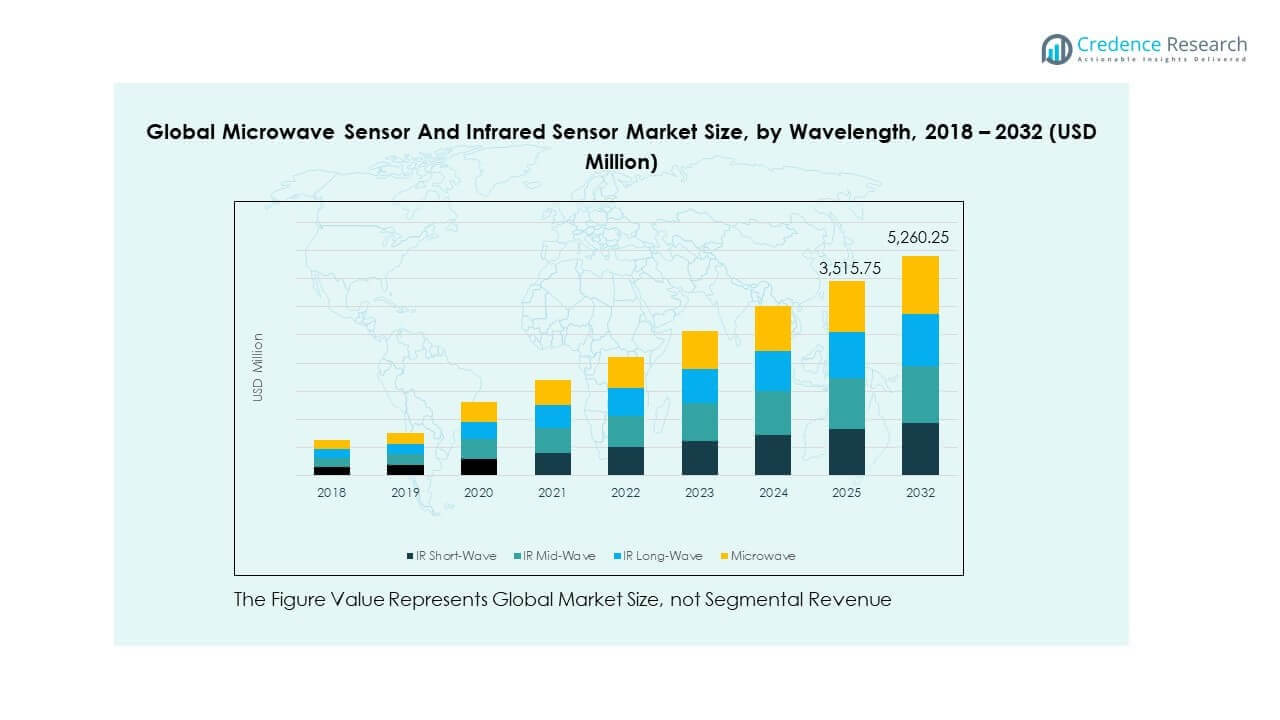
By Sensor Type
Microwave/Radar sensors dominate due to their reliability in challenging conditions like fog, dust, or glass obstructions. Doppler radar remains popular for motion detection and speed measurement in security and automotive systems. FMCW radar supports short- and long-range detection, enabling safer ADAS functionality. CW radar suits low-cost motion-sensing applications. Infrared sensors also hold strong share. PIR sensors lead in occupancy detection for smart homes. Thermopile IR supports temperature measurement and industrial safety. Photovoltaic and active IR sensors offer niche uses in flame detection and gesture control. The Global Microwave Sensor and Infrared Sensor Market benefits from varied sensor types across cost and performance needs.
- For instance, Texas Instruments' IWR6843 mmWave sensor operates at 60-64 GHz with 4 receive and 3 transmit channels for industrial motion detection.
By Application
Security and surveillance represent the largest application due to the demand for reliable motion detection and intrusion control. Industrial automation leverages sensors for safety, process optimization, and robot navigation. Consumer electronics continue to integrate IR sensors in wearables, smartphones, and home automation. Automotive applications grow with ADAS, in-cabin sensing, and driver monitoring. Aerospace and defense use sensors for perimeter security and missile guidance. Healthcare uses them for contactless patient monitoring. Energy and utilities benefit from sensors in predictive maintenance and fault detection. It supports diverse applications across personal, industrial, and mission-critical domains.
By Wavelength
Microwave band dominates in industrial, automotive, and security use due to high penetration and long-range detection. IR long-wave sensors see adoption in surveillance and temperature-sensing systems due to their thermal imaging capability. Mid-wave IR is used in high-end defense and scientific instrumentation. Short-wave IR sensors are favored in spectroscopy, semiconductor inspection, and chemical analysis. The Global Microwave Sensor and Infrared Sensor Market leverages different wavelengths based on application complexity, response time, and range requirements. It creates a layered adoption pattern across price-performance tiers.
By End User
Consumer electronics remains a key end-user segment, driven by the integration of sensors in phones, appliances, and wearables. Automotive firms adopt both microwave and infrared sensors to meet evolving safety and automation goals. Manufacturing facilities use sensors for robotics, equipment health monitoring, and safety compliance. Defense and aerospace demand highly precise and rugged sensors for security and tactical systems. Healthcare providers adopt contactless sensors for real-time diagnostics. Retail and commercial segments adopt them for space optimization and customer tracking. Smart infrastructure and utilities adopt sensors for intelligent lighting, grid monitoring, and energy efficiency. It supports a wide end-user base with both volume and high-value opportunities.
- For instance, Texas Instruments’ IWR6843 mmWave sensor, based on FMCW radar technology, supports industrial safety applications such as presence detection and machine guard systems that stop equipment when operators enter hazardous zones.
Segmentation:
By Sensor Type
- Microwave / Radar Sensors
- Doppler Radar
- FMCW Radar
- CW Radar
- Infrared Sensors
- Passive Infrared (PIR)
- Thermopile IR
- Photovoltaic IR
- Active IR Sensors
By Application
- Security & Surveillance / Motion Detection
- Industrial Automation & Factory Safety
- Consumer Electronics & Smart Home
- Automotive & ADAS / Cabin Monitoring
- Aerospace & Defense
- Healthcare Monitoring / Diagnostics
- Energy & Utilities
By Wavelength
- IR Short-Wave
- IR Mid-Wave
- IR Long-Wave
- Microwave
By End User
- Consumer Electronics
- Automotive
- Manufacturing
- Defense & Aerospace
- Healthcare
- Retail & Commercial
- Energy & Utilities
- Smart Infrastructure
By Region
- North America (U.S., Canada, Mexico)
- Europe (UK, France, Germany, Italy, Spain, Russia, Rest of Europe)
- Asia Pacific (China, Japan, South Korea, India, Australia, Southeast Asia, Rest of APAC)
- Latin America (Brazil, Argentina, Rest of Latin America)
- Middle East (GCC, Israel, Turkey, Rest of Middle East)
- Africa (South Africa, Egypt, Rest of Africa)
Regional Analysis:
North America
The North America Global Microwave Sensor and Infrared Sensor Market size was valued at USD 564.55 million in 2018 to USD 790.74 million in 2024 and is anticipated to reach USD 1,230.37 million by 2032, at a CAGR of 5.69% during the forecast period. North America accounted for 23.8% of the global market in 2024. The region benefits from strong adoption across industrial automation, homeland security, and connected vehicles. U.S.-based manufacturers integrate radar and IR sensors into advanced driver-assistance systems (ADAS) and smart infrastructure. High deployment in smart homes, perimeter control, and commercial monitoring supports demand. The defense sector contributes significantly through drone vision, missile systems, and border surveillance. The Global Microwave Sensor and Infrared Sensor Market in North America is shaped by advanced R&D, supportive government funding, and mature supply chains. It continues to see steady integration into both consumer and enterprise applications. Urban modernization and data-driven building systems enhance the long-term outlook.
Europe
The Europe Global Microwave Sensor and Infrared Sensor Market size was valued at USD 632.22 million in 2018 to USD 884.19 million in 2024 and is anticipated to reach USD 1,372.93 million by 2032, at a CAGR of 5.67% during the forecast period. Europe represented 26.6% of the global market in 2024. The region shows high demand in automotive, industrial robotics, and energy management. Leading OEMs adopt sensors to comply with emissions, safety, and sustainability mandates. Germany, France, and the UK lead adoption across electric vehicles and smart factories. Building automation also drives uptake of PIR and thermopile IR sensors. The Global Microwave Sensor and Infrared Sensor Market in Europe benefits from EU’s focus on energy efficiency and circular economy. Defense modernization and airport upgrades contribute to stable sensor deployments. Growth remains anchored by precision manufacturing, strong regulatory frameworks, and digital transformation.
Asia Pacific
The Asia Pacific Global Microwave Sensor and Infrared Sensor Market size was valued at USD 764.98 million in 2018 to USD 1,094.91 million in 2024 and is anticipated to reach USD 1,753.77 million by 2032, at a CAGR of 6.08% during the forecast period. Asia Pacific held the 33% share of the global market in 2024, making it the largest regional contributor. China, Japan, South Korea, and India fuel demand through expanding electronics manufacturing and urbanization. Smart city initiatives, 5G rollouts, and automotive electrification contribute to large-scale sensor deployment. PIR and radar modules are embedded in home appliances, lighting systems, and public surveillance. The Global Microwave Sensor and Infrared Sensor Market in Asia Pacific grows with OEM innovation and economies of scale. Government programs drive localization of production and next-gen semiconductor investment. Competitive pricing and rising disposable income further support volume growth.
Latin America
The Latin America Global Microwave Sensor and Infrared Sensor Market size was valued at USD 205.12 million in 2018 to USD 301.56 million in 2024 and is anticipated to reach USD 499.72 million by 2032, at a CAGR of 6.53% during the forecast period. Latin America contributed 9.1% to the global revenue in 2024. Brazil and Mexico lead adoption across automotive and industrial zones. Energy utilities and transport infrastructure use sensors to improve safety and monitoring. PIR sensors are gaining ground in commercial security systems and consumer devices. The Global Microwave Sensor and Infrared Sensor Market in Latin America benefits from import substitution and infrastructure digitization. Government contracts in urban lighting and traffic management present near-term opportunities. Cost-effective sensor integration remains key for broader regional uptake. Investments in automation and smart building retrofits will gradually expand adoption.
Middle East
The Middle East Global Microwave Sensor and Infrared Sensor Market size was valued at USD 111.93 million in 2018 to USD 165.21 million in 2024 and is anticipated to reach USD 275.11 million by 2032, at a CAGR of 6.59% during the forecast period. Middle East held a 5% share of the global market in 2024. Gulf countries deploy sensors across smart city projects, border surveillance, and oilfield automation. Infrared sensors are widely used for fire detection, temperature tracking, and energy monitoring. The Global Microwave Sensor and Infrared Sensor Market in this region gains traction through security upgrades and AI-led infrastructure. Demand is growing in commercial buildings, airports, and utilities. Public safety projects and renewable energy grids create steady demand. Sensor manufacturers benefit from high-spec project requirements and technology-neutral procurement.
Africa
The Africa Global Microwave Sensor and Infrared Sensor Market size was valued at USD 62.75 million in 2018 to USD 85.62 million in 2024 and is anticipated to reach USD 128.35 million by 2032, at a CAGR of 5.20% during the forecast period. Africa accounted for 2.6% of the global market in 2024. Sensor deployment is expanding in urban safety, renewable energy, and healthcare applications. South Africa and Egypt lead in adoption due to infrastructure modernization and growing electronics imports. The Global Microwave Sensor and Infrared Sensor Market in Africa remains nascent but shows potential in energy, mining, and telecom sectors. Off-grid solar installations use motion and thermal sensors for automation and theft prevention. Public health and diagnostics create demand for infrared-based non-contact solutions. Strategic partnerships and government-backed digitization programs will help expand regional access.
Key Player Analysis:
- Honeywell International Inc.
- Murata Manufacturing Co., Ltd.
- STMicroelectronics
- Omron Corporation
- Panasonic Corporation
- Hamamatsu Photonics K.K.
- Texas Instruments Incorporated
- Raytheon Technologies Corporation
- Other Key Players
Competitive Analysis:
The Global Microwave Sensor and Infrared Sensor Market features a mix of global electronics giants and niche sensor specialists. Key players include Honeywell, STMicroelectronics, Murata, Omron, Panasonic, and Texas Instruments. These firms compete on accuracy, power efficiency, range, and integration capability. It remains highly competitive due to rapid innovation and falling sensor costs. Companies invest in AI-enabled modules, hybrid technologies, and application-specific customization. Mergers, partnerships, and regional expansions strengthen market reach and production flexibility. Leading vendors secure contracts in automotive, industrial, and defense sectors, where performance and reliability are critical. Competitive advantage depends on product miniaturization, interoperability, and supply chain agility.
Recent Developments:
- In October 2025, LightPath Technologies received a $4.8 million purchase order from a returning customer for advanced infrared camera systems tailored for public safety applications.
Report Coverage:
The research report offers an in-depth analysis based on Sensor Type, Application, Wavelength, and End User. It details leading market players, providing an overview of their business, product offerings, investments, revenue streams, and key applications. Additionally, the report includes insights into the competitive environment, SWOT analysis, current market trends, as well as the primary drivers and constraints. Furthermore, it discusses various factors that have driven market expansion in recent years. The report also explores market dynamics, regulatory scenarios, and technological advancements that are shaping the industry. It assesses the impact of external factors and global economic changes on market growth. Lastly, it provides strategic recommendations for new entrants and established companies to navigate the complexities of the market.
Future Outlook:
- The market will benefit from deeper penetration of sensors in smart homes and connected buildings worldwide.
- Automotive adoption will expand with stronger focus on cabin monitoring and driver safety systems.
- Industrial automation will rely more on robust sensors for safety compliance and machine intelligence.
- Defense and aerospace demand will remain steady due to surveillance and threat detection needs.
- Healthcare adoption will rise through contactless diagnostics and patient monitoring solutions.
- Smart infrastructure projects will create long-term demand for motion and thermal sensing.
- Sensor fusion will gain importance to improve accuracy and reduce false detection events.
- Miniaturized and low-power designs will support integration in compact electronics.
- Regional manufacturing hubs will strengthen supply chains and reduce dependency risks.
- Ongoing innovation will push wider adoption across emerging and cost-sensitive markets.
Request a Free Sample
Fill in your details and we'll send you a free sample report.
- Sample data tables & charts
- Research methodology
Need a Custom Version of This Report?
Tailor the scope, geography, or segments to your exact requirements.
- Custom geography or segment scope
- Direct access to our analyst team
Frequently Asked Questions
What is the current market size for Global Microwave Sensor And Infrared Sensor Market, and what is its projected size in 2032?
At what Compound Annual Growth Rate is the Global Microwave Sensor And Infrared Sensor Market projected to grow between 2024 and 2032?
Which Global Microwave Sensor And Infrared Sensor Market segment held the largest share in 2024?
What are the primary factors fueling the growth of the Global Microwave Sensor And Infrared Sensor Market?
Who are the leading companies in the Global Microwave Sensor And Infrared Sensor Market?
Which region commanded the largest share of the Global Microwave Sensor And Infrared Sensor Market in 2024?
Table of Content
Chapter 1. Report Introduction
- 1.1 Report Description & Purpose
- 1.1.1 Report Title & Market Definition
- 1.1.2 Unique Selling Propositions (USP) & Key Differentiators
- 1.1.3 Value Proposition for Stakeholders
- 1.2 Research Objectives
- 1.2.1 Market Sizing Objectives (Volume & Revenue)
- 1.2.2 Segmentation Objectives
- 1.2.3 Competitive Intelligence Objectives
- 1.2.4 Forecast & Scenario Objectives
- 1.3 Report Scope
- 1.3.1 Microwave Sensor And Infrared Sensor Scope – Types & Subtypes Covered
- 1.3.2 Geographic Scope – Regions & Countries Covered
- 1.3.3 Historical Period, Base Year & Forecast Period (2024; forecast to 2032)
- 1.3.4 Inclusions & Exclusions
- 1.4 HS Code & Classification Framework
- 1.5 Currency, Units & Pricing Basis
- 1.6 Target Stakeholders
- 1.7 Limitations & Assumptions
Chapter 2. Executive Summary
- 2.1 Global Microwave Sensor And Infrared Sensor Market Snapshot
- 2.1.1 Market Size – Historical (2024) & Forecast (2024-2032) (2024: USD 3,322.2 million → 2032: USD 5,260.3 million)
- 2.1.2 Volume & Revenue – Global Totals
- 2.1.3 Key Market Highlights – Top Five Facts
- 2.2 Microwave Sensor And Infrared Sensor Market Segmentation Snapshot
- 2.2.1 Market Split by Region – 2024 vs. 2032
- 2.3 Competitive Snapshot
- 2.3.1 Top 10 Players by Revenue Share – 2024
- 2.3.2 Top 10 Players by Volume Share – 2024
- 2.3.3 Recent Strategic Developments (18-Month Summary)
- 2.4 Key Investment Highlights & Strategic Conclusions
Chapter 3. Microwave Sensor And Infrared Sensor Market Dynamics & Industry Analysis
- 3.1 Market Overview & Context
- 3.1.1 Microwave Sensor And Infrared Sensor Market Position in the Broader Automotive Value Chain
- 3.1.2 OEM vs. Replacement Market Dynamics
- 3.1.3 Market Maturity & Development Stage by Region
- 3.2 Microwave Sensor And Infrared Sensor Market Drivers
- 3.3 Microwave Sensor And Infrared Sensor Market Restraints & Challenges
- 3.4 Microwave Sensor And Infrared Sensor Market Opportunities
- 3.5 Porter's Five Forces Analysis
- 3.5.1 Threat of New Entrants
- 3.5.2 Bargaining Power of Suppliers
- 3.5.3 Bargaining Power of Buyers
- 3.5.4 Threat of Substitutes
- 3.5.5 Competitive Rivalry – Intensity Assessment
- 3.6 Microwave Sensor And Infrared Sensor Value Chain Analysis
- 3.6.1 Upstream – Raw Material/Input Suppliers
- 3.6.1.1 Raw Material/Input 1
- 3.6.1.2 Raw Material/Input 2
- 3.6.1.3 Raw Material/Input 3
- 3.6.2 Midstream – Production/Manufacturing/Service Delivery
- 3.6.2.1 Production/Process Overview
- 3.6.2.2 Key Facility Locations & Capacity by Manufacturer
- 3.6.3 Downstream – Distribution & End Consumer
- 3.6.3.1 Primary Channel – B2B/OEM
- 3.6.3.2 Secondary Channels – Dealer, Retail, Online, Direct
- 3.6.4 Value Chain Profitability Analysis
- 3.6.1 Upstream – Raw Material/Input Suppliers
- 3.7 PESTEL Analysis
- 3.7.1 Political Factors
- 3.7.2 Economic Factors
- 3.7.3 Social Factors
- 3.7.4 Technological Factors
- 3.7.5 Environmental Factors
- 3.7.6 Legal Factors
- 3.8 Microwave Sensor And Infrared Sensor Supply Chain Analysis
- 3.8.1 Raw Material/Input Supply Risk Assessment
- 3.8.2 Manufacturing Concentration Risk (Geographic Exposure)
- 3.8.3 Trade Disruption Impact Analysis
- 3.9 Regulatory & Policy Landscape
Note: The regulatory and policy landscape section covers regulations based on their applicability to the market, Microwave Sensor And Infrared Sensor category, geography, and scope of the study. Only regulatory frameworks with a material impact on operations, compliance, trade, sustainability, or market access are analyzed in detail.
Chapter 4. Key Investment Pockets & Opportunity Analysis
- 4.1 Microwave Sensor And Infrared Sensor Market Attractiveness Analysis
- 4.1.1 By Region – Investment Attractiveness Matrix (Volume × CAGR)
- 4.2 Absolute Revenue Growth Opportunity
- 4.2.1 By Region – Absolute USD Growth Through 2032
- 4.3 Incremental Volume Opportunity
- 4.3.1 By Region – Incremental Volume Through 2032
- 4.3.2 Segment – Incremental Volume
- 4.4 Emerging Submarket Opportunity Deep Dive (Subject to Applicability)
- 4.5 Emerging Market Opportunity Scorecards
- 4.5.1 United States
- 4.5.2 Europe
- 4.5.3 Asia
- 4.5.4 Middle East & Africa
Note: Emerging Market Opportunity Scorecards will be included based on relevance and strategic importance. Regions listed are indicative and may vary depending on data availability and market dynamics.
Chapter 5. Microwave Sensor And Infrared Sensor Import-Export Analysis & Trade Flows
- 5.1 Global Trade Overview
- 5.1.1 Global Export Value by Country (2024)
- 5.1.2 Global Export Volume by Country (2024)
- 5.1.3 Global Import Value by Country (2024)
- 5.1.4 Global Import Volume by Country (2024)
- 5.1.5 Net Trade Balance by Country (2024)
- 5.2 Export Analysis – Segment
- 5.2.1 Type 1 (HS Code)
- 5.2.2 Type 2 (HS Code)
- 5.2.3 Type 3 (HS Code)
- 5.2.4 Type 4 (HS Code)
- 5.2.5 Type 5 (HS Code)
- 5.3 Import Analysis – Segment
- 5.3.1 Type 1 (HS Code)
- 5.3.2 Type 2 (HS Code)
- 5.3.3 Type 3 (HS Code)
- 5.3.4 Type 4 (HS Code)
- 5.3.5 Type 5 (HS Code)
- 5.4 Average Unit Trade Prices
- 5.4.1 Average Export Price – Segment & Country
- 5.4.2 Average Import Price – Segment & Source Country
- 5.4.3 Price Trends (2024)
- 5.5 Key Trade Route Analysis
- 5.5.1 Trade Route 1
- 5.5.2 Trade Route 2
- 5.5.3 Trade Route 3
- 5.5.4 Trade Route 4
- 5.5.5 Trade Route 5
- 5.6 Trade Policy Impact Assessment
- 5.6.1 US Anti-Dumping & Section 301 Tariffs
- 5.6.2 EU Customs Union Impact
- 5.6.3 Major Free Trade Agreements
- 5.6.4 USMCA Rules of Origin
Note: Trade policy analysis will be included only where relevant to the Microwave Sensor And Infrared Sensor market.
Chapter 6. Competitive Landscape & Company Benchmarking
- 6.1 Microwave Sensor And Infrared Sensor Market Concentration & Structure
- 6.1.1 Herfindahl-Hirschman Index (HHI) – vs. 2024
- 6.1.2 Tier 1, Tier 2 & Tier 3 Market Structure
- 6.1.3 Global, Regional & Local Player Dynamics
- 6.2 Microwave Sensor And Infrared Sensor Market Share Analysis – 2024
- 6.2.1 Global Revenue Share by Company
- 6.2.2 Global Volume Share by Company
- 6.2.3 Regional Revenue Share
- 6.2.4 Market Share Evolution ( vs. 2024)
- 6.2.5 OEM Segment Share by Company
- 6.2.6 Replacement Segment Share by Company
- 6.3 Production/Delivery Capacity & Facility Analysis
- 6.3.1 Global Installed Capacity
- 6.3.2 Capacity Utilization Rates
- 6.3.3 Production/Output Volume
- 6.3.4 Facility Locations & Capacity Map
- 6.3.5 Planned Capacity Additions
- 6.4 Microwave Sensor And Infrared Sensor Competitive Benchmarking Matrix
- 6.4.1 Revenue, Volume, CAGR & Profitability Comparison
- 6.4.2 Channel Revenue Mix
- 6.4.3 Geographic Revenue Exposure
- 6.4.4 R&D Intensity
- 6.4.5 Sustainability Maturity
- 6.5 Strategic Developments in Microwave Sensor And Infrared Sensor (Last 24 Months)
- 6.5.1 Mergers, Acquisitions & Divestments
- 6.5.2 New Microwave Sensor And Infrared Sensor Launches
- 6.5.3 Facility Expansions
- 6.5.4 Strategic Alliances, Joint Ventures & Partnerships
- 6.5.5 Distribution Expansion & Market Entry
- 6.5.6 Sustainability & ESG Initiatives
- 6.6 Competitive Strategy Mapping
- 6.6.1 Leader, Challenger, Follower & Niche Classification
- 6.6.2 Pricing Strategy Comparison
- 6.6.3 Channel Strategy Matrix
Note: Strategic developments are included based on their materiality and the availability of reliable information.
Chapter 7. Global Microwave Sensor And Infrared Sensor Market – By Distribution Channel
- 7.1 Segment Overview
- 7.1.1 Volume & Revenue Split by Channel (2024 & 2032)
- 7.1.2 Channel Mix Evolution (2024-2032)
Chapter 8. Regional Market Analysis – Global Overview
- 8.1 Global Regional Overview
- 8.1.1 Regional Volume Share
- 8.1.2 Regional Revenue Share
- 8.1.3 Regional Volume by Region
- 8.1.4 Regional Revenue by Region
- 8.1.5 Regional Forecast Through 2032
- 8.2 Cross-Regional Segment Analysis
- 8.2.1 By Distribution Channel
- 8.2.2 By Brand/Price Tier
Chapter 9. North America Microwave Sensor And Infrared Sensor Market
- 9.1 United States
- 9.2 Canada
- 9.3 Mexico
Chapter 10. Europe Microwave Sensor And Infrared Sensor Market
- 10.1 Germany
- 10.2 France
- 10.3 Italy
- 10.4 United Kingdom
- 10.5 Spain
- 10.6 Poland
- 10.7 Russia
- 10.8 Netherlands
- 10.9 Belgium
- 10.10 Sweden
- 10.11 Denmark
- 10.12 Norway
- 10.13 Rest of Europe
Chapter 11. Asia Pacific Microwave Sensor And Infrared Sensor Market
- 11.1 China
- 11.2 India
- 11.3 Japan
- 11.4 South Korea
- 11.5 Thailand
- 11.6 Indonesia
- 11.7 Vietnam
- 11.8 Malaysia
- 11.9 Australia
- 11.10 Rest of Asia Pacific
Chapter 12. Latin America Microwave Sensor And Infrared Sensor Market
- 12.1 Brazil
- 12.2 Argentina
- 12.3 Colombia
- 12.4 Chile
- 12.5 Rest of Latin America
Chapter 13. Middle East Microwave Sensor And Infrared Sensor Market
- 13.1 Saudi Arabia
- 13.2 United Arab Emirates
- 13.3 Turkey
- 13.4 Israel
- 13.5 Iran
- 13.6 Rest of the Middle East
Chapter 14. Africa Microwave Sensor And Infrared Sensor Market
- 14.1 South Africa
- 14.2 Egypt
- 14.3 Nigeria
- 14.4 Morocco
- 14.5 Rest of Africa
Chapter 15. Microwave Sensor And Infrared Sensor Company Profiles
- 15.1 [Company 01]
- 15.1.1 Company Overview
- 15.1.2 Key Management Personnel
- 15.1.3 Products & Services Portfolio
- 15.1.4 Financial Performance
- 15.1.5 Key Market Focus & Geographic Presence
- 15.1.6 Recent Developments & Strategic Initiatives
Note: The company profile list is preliminary and may change based on research findings, market developments, data availability, and client requirements.
Chapter 16. Appendices
- Appendix A – List of Abbreviations & Acronyms
- Appendix B – Industry Classification Code Reference – Full Series
- Appendix C – Production & Capacity Data Tables
- Appendix D – End-Use & Demand Base Tables
- Appendix E – Consumption & Replacement Rate Assumptions
- Appendix F – ASP Reference Tables
- Appendix G – Manufacturing & Facility Database
- Appendix H – Import-Export Data Tables
- Appendix I – Regulatory Summary Tables
- Appendix J – Primary Research Participant List (Anonymized)
- Appendix K – Primary Research Questionnaire Framework
- Appendix L – Data Sources & Bibliography
- Appendix M – Market Size Divergence & Source Comparison
Chapter 17. Research Methodology
- 17.1 Research Framework & Philosophy
- 17.2 Secondary Research – Sources, Hierarchy & Data Extraction
- 17.3 Data Modeling – Bottom-Up & Top-Down Market Sizing
- 17.4 Primary Research – Stakeholder Framework, LOI & Sample Sizes
- 17.5 Forecast Methodology – Regression, Scenario & Sensitivity Analysis
- 17.6 Quality Control – Four-Layer Validation Framework
- 17.7 Limitations & Standard Assumptions
- 17.8 Disclaimer
