
Market Insights
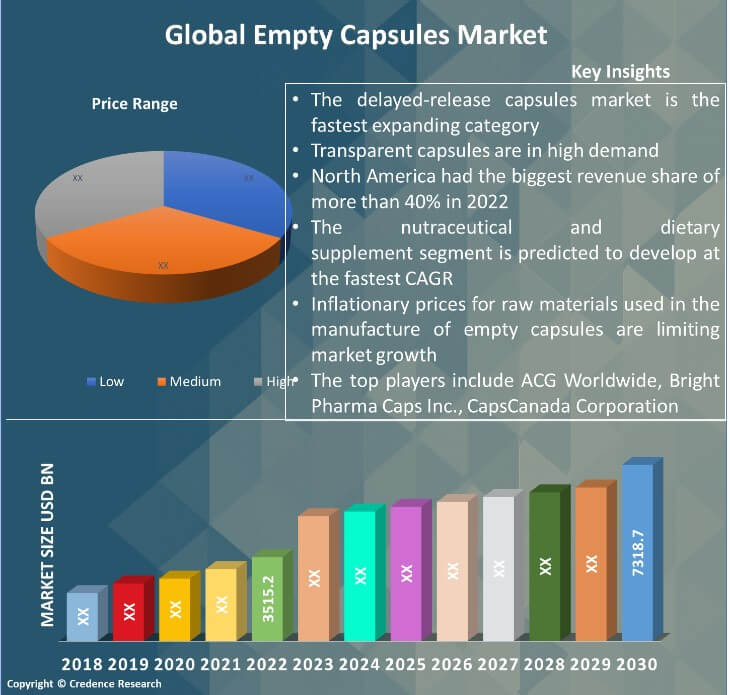
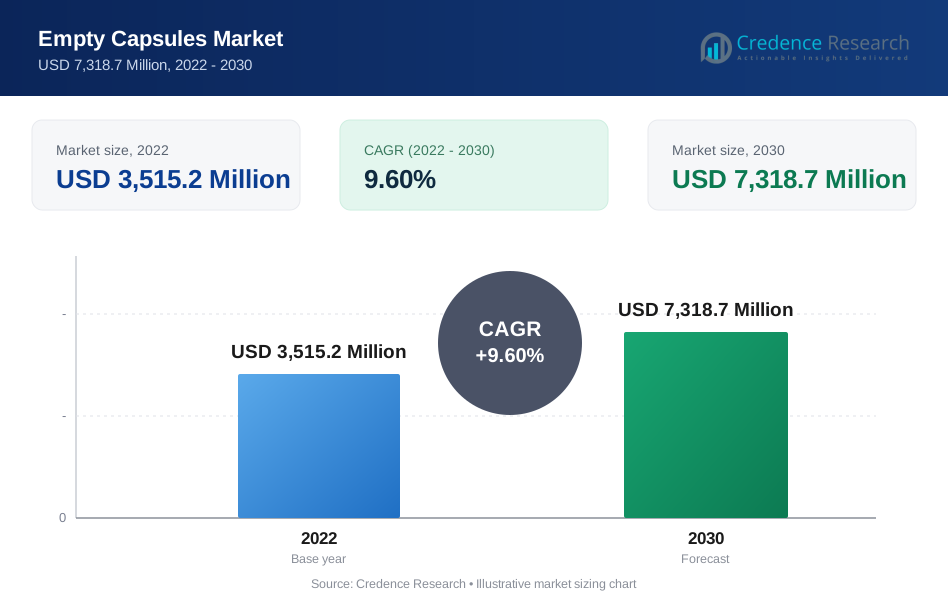
- The global demand for empty capsules was valued at USD 3515.2 Million in 2022 and is expected to reach USD 7318.7 Million in 2030, growing at a CAGR of 9.60% between 2023 and 2030.
- In 2022, the gelatin capsules segment led the empty capsules market, while the vegetable capsules (HPMC) category accounted for the second-largest share of revenue growth in the empty capsules Market.
- The pharmaceutical industry is predicted to have the biggest revenue share, while the beauty sector is expected to grow the fastest.
- Pharmaceutical companies are expected to lead the market in 2022, while the nutraceutical and dietary supplement segment is expected to grow at the quickest CAGR.
- Transparent capsules are very popular.
- The market for delayed-release capsules is the fastest growing.
- North America is expected to have the highest revenue share of more than 40% in 2022, with the Asia Pacific market growing at the fastest rate during the forecast period.
- Acquisition of competitor players as an expansion strategy, as well as the launch of new products, is propelling market growth.
- Inflationary raw material prices utilized in the manufacture of empty capsules are constraining market expansion.
Executive Summary
Market Definition
The empty capsules market refers to the industry that manufactures and sells empty capsules, which are often made of gelatin or vegetarian materials. These capsules are utilized in the pharmaceutical and nutraceutical industries to encapsulate numerous drugs, vitamins, and herbal products. Empty capsules are a convenient and effective way to give oral medications and dietary supplements to patients. Capsules of various sizes, colours, and varieties are available on the market to fulfill the diversified needs of the healthcare and pharmaceutical industries.
Market Overview
It is anticipated that between 2023 and 2030, the worldwide Empty Capsules Market will expand at a compound annual growth rate (CAGR) of 9.60%. From USD 3515.2 million in 2022, the market is projected to be worth USD 7318.7 million by 2030.
Empty capsules are used to protect pharmaceutical medications, chemicals, and powders. Furthermore, the increased prevalence of infectious and viral disorders, as well as the increasing use of empty capsules in industries such as pharmaceutical, nutraceutical, cosmetic, and research laboratories, are expected to drive demand for empty capsules. Furthermore, the rising number of R&D activities aimed at improving pharmaceutical industries, as well as rising government and public spending on healthcare, will drive the expansion of the empty capsules market in the approaching years.
Segmentation by Capsule Type
- The gelatincapsules segment led the empty capsules market in 2022, and this trend is likely to continue during the forecast period, owing to developments in healthcare R&D activities and the advantages of gelatin capsules over other drug delivery forms. Gelatin capsules have several advantages, including thermo-reversibility and tableting, non-allergenicity, viscoelasticity, and biocompatibility.
- In 2022, the Vegetable Capsules (HPMC) category accounted for the second majority of revenue growth in the Empty Capsules Market.
Segmentation by Application
- The pharmaceutical industry is expected to have the highest revenue share. The expanding older population is more vulnerable to a wide range of ailments, creating a strong need for empty capsules in the coming years.
- The cosmetic sector segment is expected to grow at the fastest rate in the coming years. With changing lifestyles and increased disposable income, the populace is more likely to adopt skincare products, fueling category expansion. Another important aspect driving segment growth is growing expenditure on beauty items and cosmetics.
Segmentation by End Users
- In 2022, pharmaceutical companies dominated the market. The primary reason for the increasing number of patients is the increased disease prevalence in the general population. Most domestic pharmaceutical businesses concentrate on regulated markets since the demand for capsules with high quality and dissolve properties will increase as they become more popular in the regulated market.
- The nutraceutical and dietary supplement segment is predicted to develop at the fastest CAGR due to rising global demand for nutraceutical products.
Segmentation by Color and Transparency
- Transparent capsules are in high demand. Transparent capsules provide easy visual identification of the contents, which is especially crucial for drugs and supplements that must be evaluated visually.
- On the other hand, Opaque capsules are typically employed for items that require light protection or for formulations where the colour or look of the contents is unimportant.
Segmentation by Gastrointestinal Performance
- The delayed-release capsules market is the fastest expanding category. These capsules are engineered to release their contents at a precise time or location in the digestive system, ensuring optimal absorption and effectiveness.
- Enteric-coated capsules feature a unique coating that resists disintegration in the stomach and allows for targeted release in the intestines.
Segmentation by Region
- North America had the biggest revenue share of more than 40% in 2022.
- The Asia Pacific market is estimated to grow at the fastest rate during the forecast period.
- The rest of the world, including Latin America, the Middle East, and Africa, supplies the remaining demand for Empty Capsules.
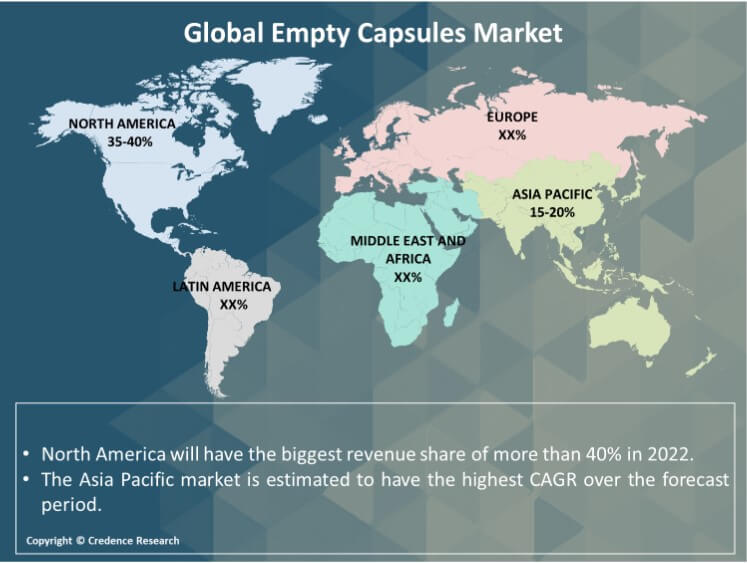
In the global empty capsules market, North America had the highest revenue share. Rapid technical improvements in healthcare and pharmaceutical industries, as well as increased government investments in public health care, are important reasons driving the need for empty tablets. According to Health Affairs, US government spending would increase to 9.7 percent in 2021 and reach USD 4.1 trillion in 2020, a 4.3 percent increase from 2019.
In addition, the US government places a high priority on improving healthcare infrastructure, reducing disease spread, and raising public health awareness. Furthermore, the presence of major organizations in the region is expected to propel the expansion of the empty capsules market.
Additionally, the Asia Pacific market is expected to display the greatest CAGR over the projected years due to rising disposable income and increased awareness of the benefits of adding additive supplements to diets. And, as a result of changing climatic circumstances and an increasing working population, people are becoming more concerned of skincare, which boosts the region's empty capsules sector growth.
Key Highlights of the Report
The global Empty Capsules Market is segmented by Capsule Type, Application, End Users, Color and Transparency, Gastrointestinal Performance and region. In 2022, In 2022, the gelatin capsules category led the empty capsules market. Transparent capsules are in high demand, and the pharmaceutical industry is likely to have the highest revenue share. In addition, the delayed-release capsules market is the fastest growing segment, with North America leading the market growth.
The rising popularity of self-administered pharmaceuticals and nutritional supplements In the pharmaceutical sector, there is a growing acceptance of capsule-based drug delivery systems. Consumers' growing demand for vegetarian and vegan capsules is one of the market's primary drivers. In addition, Strict restrictions and quality standards for capsule production, a scarcity of raw materials for capsule production, and The main commercial barriers are potential allergies or religious restrictions associated to gelatin capsules.
Nonetheless, North America had the biggest revenue share in the worldwide empty capsules market. Rapid technological advances in the healthcare and pharmaceutical industries, as well as growing government investments in public health care, are pushing the demand for empty pills. In addition, due to rising disposable income and greater awareness of the benefits of adding nutritional supplements to diets, the Asia Pacific market is likely to exhibit the highest CAGR over the forecasted years.
What Elements Are Driving the Global Market for Empty Capsules?
The rising demand for self-administered pharmaceuticals and dietary supplements is one of the primary factors driving the growth of the empty capsules market. With a rising emphasis on patient-centered healthcare, people are looking for simple and accessible ways to take their medications and supplements. This has resulted in an increase in the usage of capsule-based drug delivery systems, which provide a convenient and efficient approach to administer oral drugs. Moreover, as customers become more conscious of dietary limitations and ethical concerns, there is a growing preference for vegetarian and vegan capsules.
What Are The Main Obstacles That The Global Empty Capsules MarketFaces?
While the empty capsules market is showing promising growth, there are certain factors to consider. Stringent restrictions and quality standards for capsule production present a challenge to industry participants. Compliance with these rules protects the capsules' safety and efficacy, but it necessitates large investments in quality control systems. Another constraint is the scarcity of raw materials for capsule manufacture. Obtaining high-quality gelatin or vegetarian materials might be difficult, influencing the supply chain and consequently increasing expenses. Furthermore, there may be allergies or religious restrictions associated with gelatin capsules, which could limit their use in particular regions.
What Market Development Prospects Are There For Empty Capsules Globally?
The market for empty capsules offers numerous prospects for growth and innovation. Empty capsules are increasingly being used in the nutraceutical and cosmeceutical industries. Capsules are an ideal delivery strategy for a wide variety of nutritional supplements and beauty products, fueling demand for customized capsules catering to these industries. Also, the increasing demand for customized and specialty capsules provides an opportunity for producers to create bespoke solutions for personalized medicine. This comprises capsules with customized release profiles, sizes, and colours to match the demands of individual patients.
Market Drivers
The global Empty Capsules Market is driven by several factors. The following are the key drivers of the global Empty Capsules Market:
Acquisition Of Competitor Players As An Expansion Strategy, As Well As The Launch Of New Products, Is Driving Market Growth
The aging population is increasing the prevalence of health issues related to joint, bone, skin, hair, gut, and liver functions, contributing to an increase in the global geriatric patient population.
For instance, according to World Health Organization (WHO) statistics published in July 2022, approximately 1.71 billion people worldwide suffer from a musculoskeletal condition, with 528 million suffering from osteoarthritis and 222 million suffering from neck pain being the leading causes.
According to the International Foundation for Gastrointestinal Disorders, Inc. (IFFGD) statistics published in March 2021, irritable bowel syndrome (IBS) affects around 5.0% to 10% of the global population, with 2.4 million to 3.5 million persons in the United States.
Market Restraints
The global Empty Capsules Market faces some challenges that may hinder its growth. These include the following:
Inflationary Prices For Raw Materials Used In The Manufacture Of Empty Capsules Are Limiting Market Growth
Global demand for gelatin in the pharmaceutical, nutraceutical, cosmeceutical, and food industries is still increasing. The global capsule market is expanding, and gelatin is an unavoidable element. With its numerous applications in food, pharmaceutical, and nutritional products, raw gelatin is in high demand. Furthermore, the increasing use of capsule formulation, as well as increased R&D activities and clinical trials, are contributing to an increase in the pricing of gelatin as a raw material from manufacturers. Despite the fact that demand for gelatin was low under the COVID-19 ban, market prices remained on the high side.
Opportunities
The global Empty Capsules Market offers significant growth opportunities. These include the following:
Growing Demand For Nutraceutical Products In The Form Of Capsules Is Propelling The Market Forward
People seeking higher protection to prevent illness have paid close attention to the pandemic. Many people have recognized that taking dietary supplements can help them stay healthy. Many patients and consumers have begun to favour dietary and natural therapy alternatives for chronic diseases due to their long-term tolerability and safety.
According to a July 2021 article published by Franchise India Holdings Ltd, the need for nutraceutical products is spurred by the fact that 15.0% of the population in several developing countries, including India, is malnourished.
According to ETHealthworld.com, ACG launched the 'ACG loves nothing' campaign in November 2021 to demonstrate its dedication for manufacturing high-quality capsules for pharmaceutical and nutraceutical products.
Competitive Landscape
Key Players
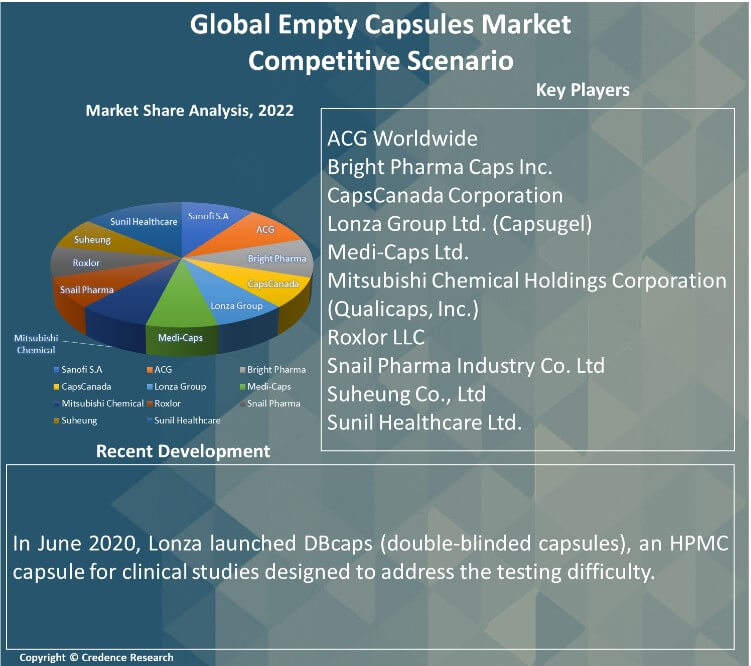
The global Empty Capsules Market is highly competitive, with several key players. Some of the major players in the market and their market share are as follows:
- ACG Worldwide
- Bright Pharma Caps Inc.
- CapsCanada Corporation
- Lonza Group Ltd. (Capsugel)
- Medi-Caps Ltd.
- Mitsubishi Chemical Holdings Corporation (Qualicaps, Inc.)
- Roxlor LLC
- Snail Pharma Industry Co. Ltd
- Suheung Co., Ltd
- Sunil Healthcare Ltd.
These organizations prioritize product innovation, Disease Area expansion, and mergers and acquisitions to stay competitive.
The global Empty Capsules Market's key players continually seek to stay ahead by offering new Capsule Types and developments.
In March 2023, VANTAGE NUTRITION, an ACG company, bought ComboCap, Inc. in the United States and BioCap in South Africa with the intention of expanding their technology and footprint in North America and globally.
In January 2022, In Europe, Xi'an Le-Nutra Ingredients Inc. sold 8.0 million HPMC capsules to Latvia. These capsules lacked titanium dioxide (Ti02), reflecting the company's efforts to meet the region's demand for the product.
In July 2020, QUALICAPS Group, which was previously part of Mitsubishi Chemical Holdings Corporation (MCHC), has been moved to Mitsubishi Chemical Corporation (MCC). This transition enables QUALICAPS to better leverage its network and increase its capsule business.
Summary of Key Findings
- The rising demand for nutraceutical items in capsule form is moving the industry ahead.
- Market segmented by Capsule Type, Application, End Users, Product Form, Gastrointestinal Performance and region
- Pharmaceutical companies are expected to lead the market in 2022
- In 2022, Transparent capsules are very popular in the market.
- North America is leading market growth; the market is highly competitive with key players including ACG Worldwide, Bright Pharma Caps Inc., CapsCanada Corporation,Lonza Group Ltd. (Capsugel), Medi-Caps Ltd.
Future Outlook
- Growing acceptance of capsule-based medication delivery methods
- The pharmaceutical and nutraceutical sectors are expanding.
- Technological advancements in capsule production
- Increasing demand for customized and specialized capsules
- Increasing emphasis on patient-centered healthcare solutions
- Raising awareness of the advantages of capsule-based drugs
- Untapped markets and emerging markets
Segmentation
- By Capsule Type:
- Gelatin Capsules
- Vegetable Capsules (HPMC)
- Pullulan Capsules
- By Application:
- Pharmaceuticals
- Dietary Supplements
- Nutraceuticals
- Cosmetics
- Animal Health
- Research and Development
- By End Users:
- Pharmaceutical Companies
- Nutraceutical and Dietary Supplement Companies
- Cosmetic Companies
- Contract Manufacturing Organizations (CMOs)
- Research and Development Institutions
- By Color and Transparency:
- Opaque Capsules
- Transparent Capsules
- Color Options
- By Gastrointestinal Performance:
- Delayed-Release Capsules
- Enteric-Coated Capsules
- By Region
- North America
- Canada
- Mexico
- Europe
- Germany
- France
- K.
- Italy
- Spain
- Rest of Europe
- Asia Pacific
- China
- Japan
- India
- South Korea
- South-east Asia
- Rest of Asia Pacific
- Latin America
- Brazil
- Argentina
- Rest of Latin America
- Middle East & Africa
- GCC Countries
- South Africa
- Rest of Middle East and Africa
- North America
Request a Free Sample
Fill in your details and we'll send you a free sample report.
- Sample data tables & charts
- Research methodology
Need a Custom Version of This Report?
Tailor the scope, geography, or segments to your exact requirements.
- Custom geography or segment scope
- Direct access to our analyst team
Frequently Asked Questions
What is the current Capsule Type of the worldwide Empty Capsules Market?
What is the predicted growth rate of the Empty Capsules Market between 2023 and 2030?
Which segment has the most market share in terms of capsules type?
Which application segment governs the market demand for Empty Capsules?
Table of Content
Chapter 1. Report Introduction
- 1.1 Report Description & Purpose
- 1.1.1 Report Title & Market Definition
- 1.1.2 Unique Selling Propositions (USP) & Key Differentiators
- 1.1.3 Value Proposition for Stakeholders
- 1.2 Research Objectives
- 1.2.1 Market Sizing Objectives (Volume & Revenue) (Volume Where Applicable)
- 1.2.2 Segmentation Objectives
- 1.2.3 Competitive Intelligence Objectives
- 1.2.4 Forecast & Scenario Objectives
- 1.3 Report Scope
- 1.3.1 Empty Capsules Scope – Segments & Subsegments Covered
- 1.3.2 Geographic Scope – Regions & Countries Covered
- 1.3.3 Historical Period, Base Year & Forecast Period (2022; forecast to 2030)
- 1.3.4 Inclusions & Exclusions
- 1.4 Industry Classification & Applicable Codes
- 1.5 Currency, Measurement Units & Valuation Basis
- 1.6 Target Stakeholders
- 1.7 Limitations & Assumptions
Chapter 2. Executive Summary
- 2.1 Global Empty Capsules Market Snapshot
- 2.1.1 Market Size – Historical (2022) & Forecast (2022-2030) (2022: USD 3,515.2 Million → 2030: USD 7,318.7 Million)
- 2.1.2 Volume & Revenue – Global Totals (Volume Where Applicable)
- 2.1.3 Key Market Highlights – Top Five Facts
- 2.2 Empty Capsules Market Segmentation Snapshot
- 2.2.1 Market Split by Region – 2022 vs. 2030
- 2.3 Competitive Snapshot
- 2.3.1 Top 10 Players by Revenue Share – 2022
- 2.3.2 Top 10 Players by Volume Share – 2022 (Volume Where Applicable)
- 2.3.3 Recent Strategic Developments (18-Month Summary)
- 2.4 Key Investment Highlights & Strategic Conclusions
Chapter 3. Empty Capsules Market Dynamics & Industry Analysis
- 3.1 Market Overview & Context
- 3.1.1 Empty Capsules Market Position in the Broader Industry Value Chain
- 3.1.2 Demand Structure & Purchasing Dynamics
- 3.1.3 Market Maturity & Development Stage by Region
- 3.2 Empty Capsules Market Drivers
- 3.3 Empty Capsules Market Restraints & Challenges
- 3.4 Empty Capsules Market Opportunities
- 3.5 Porter's Five Forces Analysis
- 3.5.1 Threat of New Entrants
- 3.5.2 Bargaining Power of Suppliers
- 3.5.3 Bargaining Power of Buyers
- 3.5.4 Threat of Substitutes
- 3.5.5 Competitive Rivalry – Intensity Assessment
- 3.6 Empty Capsules Value Chain Analysis
- 3.6.1 Upstream – Key Inputs, Resources & Suppliers
- 3.6.1.1 Key Input/Resource 1
- 3.6.1.2 Key Input/Resource 2
- 3.6.1.3 Key Input/Resource 3
- 3.6.2 Midstream – Core Operations & Value Creation
- 3.6.2.1 Operating Model & Process Overview
- 3.6.2.2 Key Operating Locations & Capabilities by Company
- 3.6.3 Downstream – Market Channels & End Users
- 3.6.3.1 Direct Sales & Customer Engagement Channels
- 3.6.3.2 Indirect Sales, Intermediaries & Partner Channels
- 3.6.4 Value Chain Profitability Analysis
- 3.6.1 Upstream – Key Inputs, Resources & Suppliers
- 3.7 PESTEL Analysis
- 3.7.1 Political Factors
- 3.7.2 Economic Factors
- 3.7.3 Social Factors
- 3.7.4 Technological Factors
- 3.7.5 Environmental Factors
- 3.7.6 Legal Factors
- 3.8 Empty Capsules Supply Chain Analysis
- 3.8.1 Critical Input & Resource Availability Risk Assessment
- 3.8.2 Supplier & Operational Concentration Risk (Geographic Exposure)
- 3.8.3 Supply & Service Disruption Impact Analysis
- 3.9 Regulatory & Policy Landscape
Note: The regulatory and policy landscape section covers regulations based on their applicability to the market, Empty Capsules category, geography, and scope of the study. Only regulatory frameworks with a material impact on operations, compliance, trade, sustainability, or market access are analyzed in detail.
Chapter 4. Key Investment Pockets & Opportunity Analysis
- 4.1 Empty Capsules Market Attractiveness Analysis
- 4.1.1 By Region – Investment Attractiveness Matrix (Market Size × CAGR)
- 4.2 Absolute Revenue Growth Opportunity
- 4.2.1 By Region – Absolute Revenue Growth Through 2030
- 4.3 Incremental Demand Opportunity
- 4.3.1 By Region – Incremental Demand Through 2030
- 4.3.2 Segment – Incremental Demand
- 4.4 Emerging Submarket Opportunity Deep Dive (Subject to Applicability)
- 4.5 Priority Market Opportunity Scorecards
- 4.5.1 United States
- 4.5.2 Europe
- 4.5.3 Asia
- 4.5.4 Middle East & Africa
Note: Priority market opportunity scorecards reflect the geographic scope and strategic relevance of the study. Listed markets are indicative and may be adapted to the industry.
Chapter 5. Empty Capsules Cross-Border Trade & Market Access Analysis
- 5.1 International Trade & Cross-Border Activity Overview
- 5.1.1 Global Export Value by Country (2022)
- 5.1.2 Global Export Volume by Country (2022) (Volume Where Applicable)
- 5.1.3 Global Import Value by Country (2022)
- 5.1.4 Global Import Volume by Country (2022) (Volume Where Applicable)
- 5.1.5 Net Trade Balance by Country (2022)
- 5.2 Export Analysis – Segment
- 5.2.1 Category 1 (Applicable Classification Code)
- 5.2.2 Category 2 (Applicable Classification Code)
- 5.2.3 Category 3 (Applicable Classification Code)
- 5.2.4 Category 4 (Applicable Classification Code)
- 5.2.5 Category 5 (Applicable Classification Code)
- 5.3 Import Analysis – Segment
- 5.3.1 Category 1 (Applicable Classification Code)
- 5.3.2 Category 2 (Applicable Classification Code)
- 5.3.3 Category 3 (Applicable Classification Code)
- 5.3.4 Category 4 (Applicable Classification Code)
- 5.3.5 Category 5 (Applicable Classification Code)
- 5.4 Cross-Border Pricing & Transaction Benchmarks
- 5.4.1 Export Pricing – Segment & Country
- 5.4.2 Import Pricing – Segment & Source Country
- 5.4.3 Price Trends (2022)
- 5.5 Key Cross-Border Trade & Delivery Routes
- 5.5.1 Cross-Border Trade/Delivery Route 1
- 5.5.2 Cross-Border Trade/Delivery Route 2
- 5.5.3 Cross-Border Trade/Delivery Route 3
- 5.5.4 Cross-Border Trade/Delivery Route 4
- 5.5.5 Cross-Border Trade/Delivery Route 5
- 5.6 Trade Policy & Market Access Impact Assessment
- 5.6.1 Tariff & Non-Tariff Barriers
- 5.6.2 Regional Trade & Economic Integration Frameworks
- 5.6.3 Bilateral & Multilateral Trade Agreements
- 5.6.4 Cross-Border Operating, Licensing & Localization Requirements
Note: This chapter applies where cross-border trade or delivery is relevant to Empty Capsules. Goods, services, and digital offerings are assessed using applicable classifications and transaction measures. Import-export volumes, trade balances, and route analyses are included only where meaningful to the market.
Chapter 6. Competitive Landscape & Company Benchmarking
- 6.1 Empty Capsules Market Concentration & Structure
- 6.1.1 Herfindahl-Hirschman Index (HHI) – vs. 2022
- 6.1.2 Leading, Mid-Sized & Emerging Player Structure
- 6.1.3 Global, Regional & Local Player Dynamics
- 6.2 Empty Capsules Market Share Analysis – 2022
- 6.2.1 Global Revenue Share by Company
- 6.2.2 Global Volume Share by Company (Volume Where Applicable)
- 6.2.3 Regional Revenue Share
- 6.2.4 Market Share Evolution ( vs. 2022)
- 6.2.5 Company Market Share by Key Segment
- 6.2.6 Company Market Share by Customer Group
- 6.3 Operating Scale, Capacity & Infrastructure Analysis
- 6.3.1 Global Operating Scale & Supply Capacity
- 6.3.2 Resource Utilization & Operating Efficiency
- 6.3.3 Output, Service Delivery & Activity Metrics
- 6.3.4 Operating Footprint & Infrastructure Map
- 6.3.5 Planned Operational & Capacity Expansion
- 6.4 Empty Capsules Competitive Benchmarking Matrix
- 6.4.1 Revenue, Growth, Profitability & Operating Metric Comparison
- 6.4.2 Channel Revenue Mix
- 6.4.3 Geographic Revenue Exposure
- 6.4.4 R&D Intensity
- 6.4.5 Sustainability Maturity
- 6.5 Strategic Developments in Empty Capsules (Last 24 Months)
- 6.5.1 Mergers, Acquisitions & Divestments
- 6.5.2 New Products, Services & Solutions in Empty Capsules
- 6.5.3 Operational & Infrastructure Expansions
- 6.5.4 Strategic Alliances, Joint Ventures & Partnerships
- 6.5.5 Distribution Expansion & Market Entry
- 6.5.6 Sustainability & ESG Initiatives
- 6.6 Competitive Strategy Mapping
- 6.6.1 Leader, Challenger, Follower & Niche Classification
- 6.6.2 Pricing Strategy Comparison
- 6.6.3 Channel Strategy Matrix
Note: Strategic developments are included based on their materiality and the availability of reliable information.
Chapter 7. Global Empty Capsules Market – By Sales & Delivery Channel
- 7.1 Segment Overview
- 7.1.1 Volume & Revenue Split by Channel (2022 & 2030) (Volume Where Applicable)
- 7.1.2 Channel Mix Evolution (2022-2030)
Chapter 8. Regional Market Analysis – Global Overview
- 8.1 Global Regional Overview
- 8.1.1 Regional Volume Share (Volume Where Applicable)
- 8.1.2 Regional Revenue Share
- 8.1.3 Regional Volume by Region (Volume Where Applicable)
- 8.1.4 Regional Revenue by Region
- 8.1.5 Regional Forecast Through 2030
- 8.2 Cross-Regional Segment Analysis
- 8.2.1 By Sales & Delivery Channel
- 8.2.2 By Competitive Positioning & Price Tier
Chapter 9. North America Empty Capsules Market
- 9.1 United States
- 9.2 Canada
- 9.3 Mexico
Chapter 10. Europe Empty Capsules Market
- 10.1 Germany
- 10.2 France
- 10.3 Italy
- 10.4 United Kingdom
- 10.5 Spain
- 10.6 Poland
- 10.7 Russia
- 10.8 Netherlands
- 10.9 Belgium
- 10.10 Sweden
- 10.11 Denmark
- 10.12 Norway
- 10.13 Rest of Europe
Chapter 11. Asia Pacific Empty Capsules Market
- 11.1 China
- 11.2 India
- 11.3 Japan
- 11.4 South Korea
- 11.5 Thailand
- 11.6 Indonesia
- 11.7 Vietnam
- 11.8 Malaysia
- 11.9 Australia
- 11.10 Rest of Asia Pacific
Chapter 12. Latin America Empty Capsules Market
- 12.1 Brazil
- 12.2 Argentina
- 12.3 Colombia
- 12.4 Chile
- 12.5 Rest of Latin America
Chapter 13. Middle East Empty Capsules Market
- 13.1 Saudi Arabia
- 13.2 United Arab Emirates
- 13.3 Turkey
- 13.4 Israel
- 13.5 Iran
- 13.6 Rest of the Middle East
Chapter 14. Africa Empty Capsules Market
- 14.1 South Africa
- 14.2 Egypt
- 14.3 Nigeria
- 14.4 Morocco
- 14.5 Rest of Africa
Chapter 15. Empty Capsules Company Profiles
- 15.1 [Company 01]
- 15.1.1 Company Overview
- 15.1.2 Key Management Personnel
- 15.1.3 Products & Services Portfolio
- 15.1.4 Financial Performance
- 15.1.5 Key Market Focus & Geographic Presence
- 15.1.6 Recent Developments & Strategic Initiatives
Note: The company profile list is preliminary and may change based on research findings, market developments, data availability, and client requirements.
Chapter 16. Appendices
- Appendix A – List of Abbreviations & Acronyms
- Appendix B – Industry Classification Code Reference – Full Series
- Appendix C – Supply, Output & Operating Capacity Data Tables
- Appendix D – End-Use & Demand Base Tables
- Appendix E – Demand, Adoption & Usage Assumptions
- Appendix F – Pricing & Revenue Metric Reference Tables
- Appendix G – Company Operations & Infrastructure Database
- Appendix H – Cross-Border Trade & Activity Data Tables (Where Applicable)
- Appendix I – Regulatory Summary Tables
- Appendix J – Primary Research Participant List (Anonymized)
- Appendix K – Primary Research Questionnaire Framework
- Appendix L – Data Sources & Bibliography
- Appendix M – Market Size Divergence & Source Comparison
Chapter 17. Research Methodology
- 17.1 Research Framework & Philosophy
- 17.2 Secondary Research – Sources, Hierarchy & Data Extraction
- 17.3 Data Modeling – Bottom-Up & Top-Down Market Sizing
- 17.4 Primary Research – Stakeholder Framework, LOI & Sample Sizes
- 17.5 Forecast Methodology – Regression, Scenario & Sensitivity Analysis
- 17.6 Quality Control – Four-Layer Validation Framework
- 17.7 Limitations & Standard Assumptions
- 17.8 Disclaimer
