
Market Overview
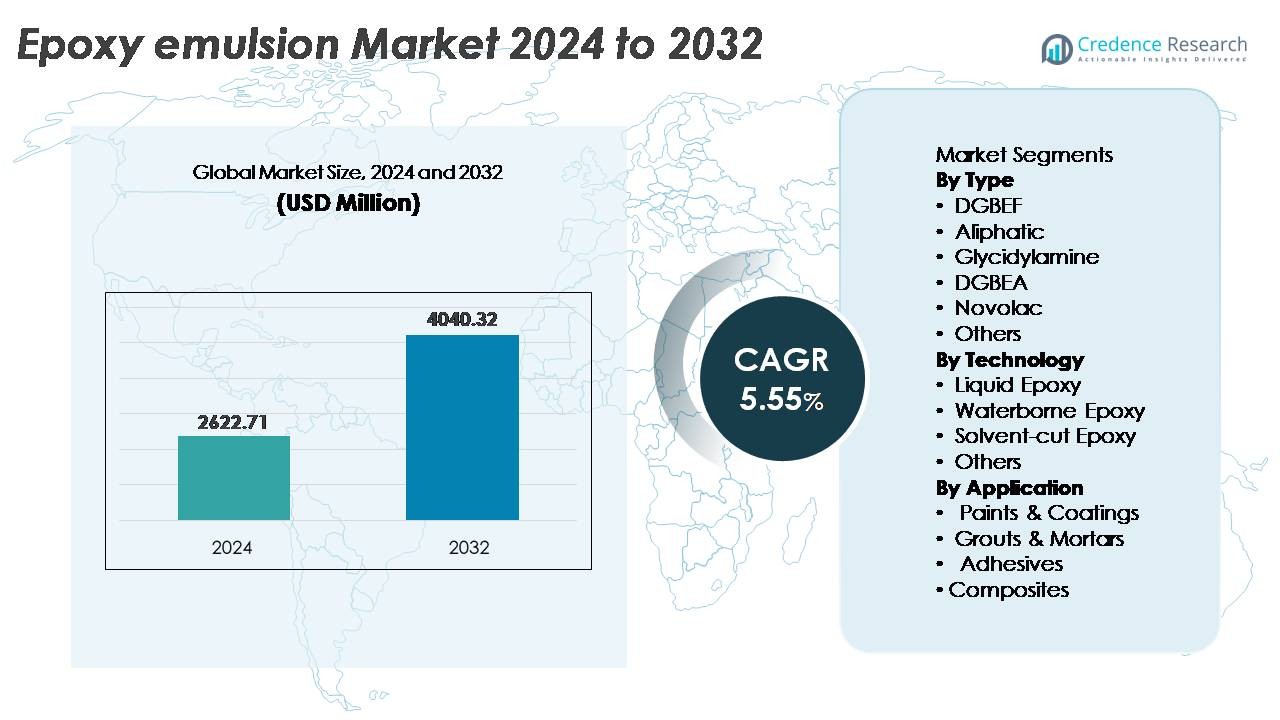
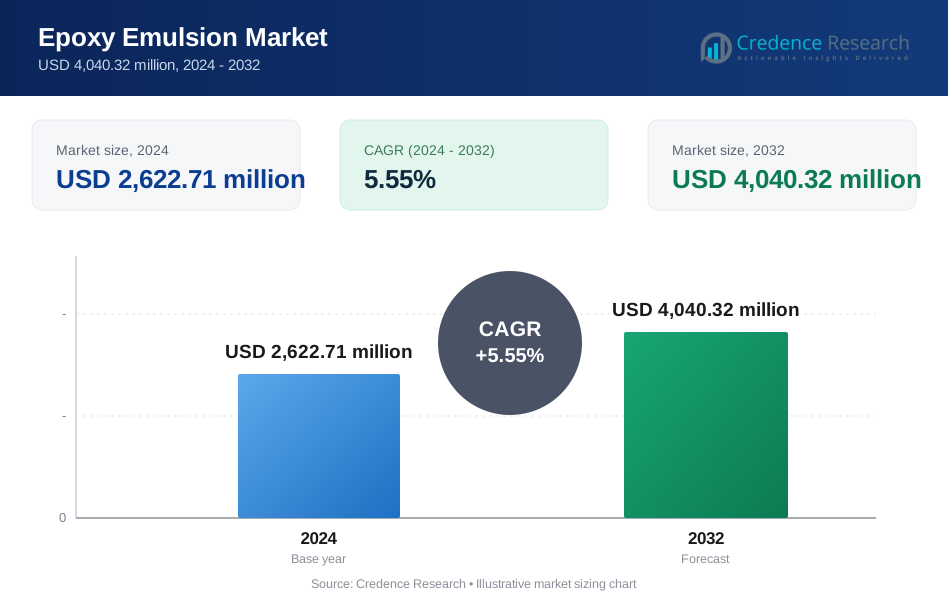
The global epoxy emulsion market size was valued at USD 2,622.71 million in 2024 and is projected to reach USD 4,040.32 million by 2032, registering a CAGR of 5.55% during the forecast period.
| REPORT ATTRIBUTE | DETAILS |
|---|---|
| Historical Period | 2020-2023 |
| Base Year | 2024 |
| Forecast Period | 2025-2032 |
| Epoxy Emulsion Market Size 2024 | USD 2,622.71 Million |
| Epoxy Emulsion Market, CAGR | 5.55% |
| Epoxy Emulsion Market Size 2032 | USD 4,040.32 Million |
The epoxy emulsion market is moderately consolidated, with leading competition driven by capacity scale, resin innovation, and regional distribution strength. Major players include Huntsman International Ltd., Kolon Industries Inc., Atul Ltd., Olin Corporation, Nan Ya Plastics Corporation, Spolchemie, Aditya Birla Chemicals, Chang Chun Group, Ciech S.A., and China Petrochemical & Chemical Corp. (SINOPEC), each focusing on waterborne formulations tailored for coatings, adhesives, and construction chemicals. Asia-Pacific leads the market with approximately 34% share, supported by robust manufacturing ecosystems and infrastructure investments, while North America and Europe follow, driven by adoption of low-VOC industrial coatings and regulatory compliance initiatives.
Market Insights
- The global epoxy emulsion market was valued at USD 2,622.71 million in 2024 and is projected to reach USD 4,040.32 million by 2032, expanding at a CAGR of 5.55% during the forecast period.
- Increasing demand for low-VOC and waterborne coating systems across construction and industrial applications serves as the primary market driver, supported by sustainability regulations and infrastructure rehabilitation investments.
- Market trends include rising adoption of bio-based emulsions and customized resin systems designed for moisture-rich and high-adhesion environments in flooring, adhesives, and composite components.
- Competitive activity focuses on expansion of environmentally compliant product portfolios and capacity additions in growth-oriented regions, though raw material price volatility continues to restrain profit margins for mid-scale players.
- Asia-Pacific leads with 34% share, followed by North America at 32% and Europe at 28%, while paints and coatings remain the dominant segment, holding the largest share due to broad architectural and industrial usage.
Market Segmentation Analysis:
By Type
DGBEA remains the dominant sub-segment in the epoxy emulsion market, accounting for the largest share owing to its versatility, strong adhesion, and compatibility with a wide range of curing agents. It is widely used in protective coatings, adhesives, and construction chemicals, driven by its superior mechanical properties and cost-effectiveness. Growing demand for durable and chemically resistant coatings in industrial flooring and marine applications further reinforces adoption. Meanwhile, novolac-based emulsions are gaining traction due to higher crosslink density and heat resistance, supporting specialized applications in electronics and high-temperature environments.
- For instance, Huntsman’s ARALDITE® GY 257epoxy resin, when formulated into a cured system (e.g., as a mortar with a standard hardener like Aradur® 140), exhibits typical mechanical properties, such as a flexural strength of approximately 44–54 MPa (450–550 kg/cm²) and is suitable for demanding industrial flooring applications. The specific properties can vary widely depending on the exact composition of the final mix.
By Technology
Waterborne epoxy technology represents the leading share in the epoxy emulsion market, driven by the shift toward low-VOC coatings and compliance with global environmental regulations. Its strong adhesion, reduced toxicity, and improved moisture resistance make it well-suited for architectural and industrial coatings. Growing adoption in flooring systems and infrastructure rehabilitation projects accelerates demand. Liquid epoxy systems hold notable adoption in heavy-duty applications requiring enhanced chemical resistance and mechanical performance. Increasing restrictions on solvent-based formulations continue to push manufacturers toward eco-efficient and high-performance waterborne alternatives.
- For instance, Westlake Epoxy's EPI-REZ™ Resin 7520-WD-52is a high-performance, low-VOC, waterborne epoxy dispersion. This resin is formulated for use in concrete flooring and structural coatings applications where it demonstrates excellent adhesion and superior corrosion resistance, supporting long-term performance.
By Application
Paints and coatings constitute the dominant application segment, capturing the largest share due to extensive use in construction, automotive refinishing, industrial equipment, and metal protection. Epoxy emulsions are preferred for their corrosion resistance, durability, and low odor, making them suitable for both interior and exterior surfaces. Expanding infrastructure development and refurbishment activities significantly support segment growth. Adhesives and composites are also expanding steadily as manufacturers replace solvent-based formulations with greener alternatives. The rising need for lightweight materials in transportation and consumer goods enhances epoxy emulsion penetration in composite manufacturing.
Key Growth Drivers:
Growing Demand for Low-VOC and Environmentally Compliant Coatings
Increasing regulatory pressure toward reducing volatile organic compound (VOC) emissions is a primary growth catalyst for the epoxy emulsion market. Government-led environmental frameworks in North America, Europe, and parts of Asia are accelerating the transition from solvent-based to waterborne formulations. Epoxy emulsions offer superior adhesion, mechanical strength, and chemical resistance while fulfilling sustainability requirements for green construction and industrial coatings. Manufacturers across paints, flooring, and maintenance chemicals are adopting these compliant alternatives to remain relevant in tenders and industrial buyer procurement programs. Additionally, corporate ESG commitments and the decarbonization of building materials strengthen preference for waterborne epoxies. The convergence of performance and compliance benefits positions epoxy emulsions as a preferred solution for next-generation protective coatings.
- For instance, EPI-REZ™ 7520-WD-52 from Westlake Epoxy is a waterborne epoxy dispersion for concrete coatings. The resin supports low-VOC formulations, typically below 50 g/L, depending on system design. End-use performance depends on the curing agent and final coating formulation.
Infrastructure Expansion and Public Investment in Repair and Rehabilitation
Global infrastructure upgrades and refurbishment activities across aging bridges, ports, tunnels, and industrial facilities continue to drive epoxy emulsion consumption. These formulations are extensively used in grouts, mortars, concrete repair compounds, and anti-corrosive coatings to enhance structural longevity and moisture resistance. Industrial flooring systems for logistics hubs, food processing units, pharmaceuticals, and electronics manufacturing also rely on epoxy emulsions due to their abrasion resistance and hygiene benefits. Emerging countries are prioritizing infrastructure modernization as part of national development agendas, boosting coatings and repair materials consumption. Public-private partnerships and rising investments in smart city development reinforce long-term demand, particularly for durable, eco-friendly, and cost-efficient epoxy-based solutions.
- For instance, Sika’s Sikadur®-52 is a low-viscosity epoxy injection resin for structural crack repair.The system achieves compressive strength around 80–90 MPa after full curing. Penetration performance depends on crack width and injection conditions.
Surge in Adoption Across Adhesives and Composite Manufacturing
The increasing use of epoxy emulsions in high-strength adhesives and fiber-reinforced composites is another significant growth driver. Industries such as transportation, electricals, sports equipment, and consumer goods are replacing metal with lightweight composite structures without compromising durability. Epoxy emulsions improve bonding strength while offering reduced odor and lower toxicity during application. In packaging and woodworking, waterborne epoxy adhesives are replacing solvent-based solutions to meet safety and sustainability standards. Advancements in composite manufacturing processes, including resin transfer molding and automated curing systems, reinforce epoxy emulsion adoption. As OEMs prioritize lightweight design and energy efficiency, epoxy emulsions are expected to play a critical role across adhesive-backed and composite-intensive applications.
Key Trends and Opportunities
Rising Shift Toward Bio-Based and Circular Chemistry Resin Systems
Innovation in bio-based epoxy emulsions derived from lignin, plant oils, and industrial biomass waste is emerging as a transformative opportunity. Chemical producers are expanding research into renewable feedstocks to minimize carbon footprint and reduce dependence on bisphenol-A and petrochemical derivatives. Circular chemistry initiatives and waste-to-resin programs offer long-term strategic differentiation for coatings and adhesives manufacturers. Co-branding opportunities with sustainable construction products and green building certification pathways strengthen market adoption. As buyers in construction, automotive, and consumer goods align with climate-linked procurement policies, bio-based epoxy emulsions gain prominence as non-toxic, recyclable, and ethically sourced materials.
- For instance, Westlake Epoxy (formerly the epoxy business of Hexion) actively develops sustainable, bio-based epoxy solutions.The company has achieved ISCC+ certification at its Pernis, Netherlands, site, allowing for the use of mass-balanced bio-based raw materials, such as phenol and acetone, in the production of liquid epoxy resins.
Digital Formulation Platforms and Custom-Engineered Performance Solutions
The development of digitally simulated formulation platforms supports rapid customization of epoxy emulsions based on viscosity, curing time, chemical resistance, and thermal stability. Industries are increasingly demanding application-specific formulations for niche uses such as food-grade floor coatings, anti-graffiti surfaces, and electrostatic discharge protection. This trend is creating new revenue streams for specialty chemical manufacturers providing tailored product development support. Opportunities expand further through collaborative product development with OEMs and construction chemical brands. Data-driven performance modeling and predictive material testing reduce time-to-market and enhance success rates for technically demanding industrial applications.
- For instance, Covestro utilizes proprietary foaming simulation solutions and digital platforms to predict material behavior, such as flow patterns and curing in polyurethane (PU) systems, to help customers optimize production processes and reduce the need for physical trials.
Key Challenges
Fluctuations in Raw Material Supply and Sensitivity to Petrochemical Feedstock Costs
The epoxy emulsion market remains vulnerable to volatility in epoxy resin intermediates, including bisphenol derivatives and epichlorohydrin, which are influenced by crude oil price fluctuations and regional supply constraints. Disruptions in petrochemical manufacturing clusters significantly impact production costs and lead times. This results in pricing uncertainties for coatings and adhesive manufacturers that operate under fixed-contract procurement cycles. Limited backward integration among mid-size formulators restricts supply security and affects competitiveness. Companies are compelled to explore localized sourcing, alternative chemistries, and bio-based substitutes to mitigate raw material risk and cost instability.
Technical Limitations in Extreme-Performance and Highly Specialized Applications
Despite strong adoption, epoxy emulsions face performance limitations in segments requiring ultra-high chemical resistance, prolonged thermal exposure, or rapid curing under adverse environments. Solvent-based epoxies and advanced hybrid chemistries still dominate these niche categories, particularly within marine, aerospace, and high-temperature electrical components. End-user hesitation to switch from proven legacy formulations delays conversion rates for mission-critical applications. Overcoming this challenge requires material innovations, targeted certifications, and long-term field performance data to satisfy engineering, safety, and regulatory requirements. Manufacturers that fail to address performance gaps risk exclusion from high-value specialty markets.
Regional Analysis
North America
North America holds approximately 32% of the epoxy emulsion market, supported by strong demand for waterborne coatings across infrastructure refurbishment, industrial maintenance, and protective applications. The United States leads adoption, driven by stringent EPA VOC regulations pushing the shift from solvent-based systems to sustainable alternatives. Rapid growth in composite usage and advanced adhesive technologies strengthens demand across automotive, aerospace, and construction sectors. Canada’s rising investment in green building standards further accelerates acceptance of eco-compliant resin formulations. Increasing conversions to low-odor and moisture-resistant systems continues to reinforce market expansion in North America.
Europe
Europe accounts for nearly 28% of global revenue, fueled by early adoption of sustainable coatings and stringent EU environmental frameworks regulating industrial solvents and emissions. Germany, France, and the Nordics lead market activity, supported by mature automotive, marine, and flooring manufacturing ecosystems. Extensive renovation across aging infrastructure, along with energy-efficient building retrofits, boosts epoxy emulsion consumption in concrete repair and insulation coatings. The region also drives innovation in bio-based epoxy emulsions, creating new opportunities for specialty chemical producers. However, cost sensitivity and compliance requirements present operational complexities for manufacturers.
Asia-Pacific
Asia-Pacific dominates the market with approximately 34% share, driven by rapid urbanization, industrial expansion, and infrastructure development across China, India, and Southeast Asia. The region’s construction boom significantly increases demand for epoxy-based grouts, waterproofing systems, and floor coatings. Local manufacturing clusters in China support cost-effective production of epoxy emulsions for paints, packaging adhesives, and electronics composite applications. Government initiatives promoting low-emission construction materials strengthen the shift to waterborne epoxy formulations. Rising investment in industrial flooring and automotive manufacturing further positions Asia-Pacific as the fastest-growing regional contributor.
Latin America
Latin America represents around 4% of the market, with adoption steadily progressing across building renovation, marine coatings, and industrial repair applications. Brazil and Mexico remain primary demand centers due to expanding logistics hubs, food processing units, and warehousing infrastructure. Increasing recognition of moisture-resistant and anti-corrosive properties supports the transition from solvent-based to waterborne epoxies. However, dependence on imported raw materials and economic fluctuations influence price stability. Despite challenges, government-backed public infrastructure programs and growth in manufacturing clusters provide moderate long-term growth opportunities in the region.
Middle East & Africa
The Middle East & Africa collectively capture roughly 2% market share, driven by ongoing development of commercial properties, industrial zones, and transportation infrastructure. Epoxy emulsions are increasingly deployed in protective coatings for oil and gas facilities, desalination plants, and port expansions. The UAE and Saudi Arabia lead adoption, supported by large-scale smart city and megaproject investments. Africa’s emerging construction sector offers gradual growth, although cost barriers persist due to limited local production capacity. The region presents future potential as sustainability directives and material efficiency policies gain momentum.
Market Segmentations:
By Type
- DGBEF
- Aliphatic
- Glycidylamine
- DGBEA
- Novolac
- Others
By Technology
- Liquid Epoxy
- Waterborne Epoxy
- Solvent-cut Epoxy
- Others
By Application
- Paints & Coatings
- Grouts & Mortars
- Adhesives
- Composites
By Geography
- North America
- Europe
- Asia Pacific
- Latin America
- Middle East
- Africa
Competitive Landscape
The competitive landscape of the epoxy emulsion market is characterized by a mix of global chemical manufacturers, regional formulators, and specialized resin innovators competing on performance differentiation, regulatory compliance, and customization capabilities. Leading players focus on expanding their waterborne and low-VOC epoxy portfolios to align with sustainability-driven demand across coatings, construction materials, and adhesives. Strategic priorities include capacity expansion near high-growth manufacturing hubs, long-term supply agreements with construction chemical brands, and investments in bio-based resin technologies. Companies increasingly offer application-specific formulations for industrial flooring, electronics encapsulation, and corrosion protection to strengthen customer retention. Partnerships with OEMs and infrastructure contractors, combined with R&D advancements in curing agents and high-crosslink emulsions, reinforce market positioning. Competitive dynamics remain influenced by raw material pricing volatility, scale-driven cost advantages, and technical service capabilities that support specialized end-use requirements.
Key Player Analysis
- Huntsman International Ltd. (U.S.)
- Olin Corporation (U.S.)
- Nan Ya Plastics Corporation (Taiwan)
- Spolchemie (Czech Republic)
- Aditya Birla Chemicals (India)
- Chang Chun Group (Taiwan)
- Ciech S.A. (Poland)
Recent Developments
- In September 2025, Huntsman launched a newly reformulated range of ARALDITE® epoxy adhesives that are free from intentionally added BPA and CMR-classified substances.
- In April 2025, Nan Ya Plastics Corporation (Taiwan) the U.S. Department of Commerce finalised countervailing-duty determinations on epoxy resins from Taiwan, including Nan Ya. As part of that determination, Nan Ya was assigned a net countervailable subsidy rate of 3.38% for the period January–December 2023, reflecting scrutiny of its export practices.
- In February 2024, Olin was named co-winner of the 2024 JEC Composites Innovation Awards for its wind-blade circularity solution, a novel process that breaks down epoxy resins into virgin-grade materials to support a circular economy for composites.
Report Coverage
The research report offers an in-depth analysis based on Type, Technology, Application and Geography. It details leading market players, providing an overview of their business, product offerings, investments, revenue streams, and key applications. Additionally, the report includes insights into the competitive environment, SWOT analysis, current market trends, as well as the primary drivers and constraints. Furthermore, it discusses various factors that have driven market expansion in recent years. The report also explores market dynamics, regulatory scenarios, and technological advancements that are shaping the industry. It assesses the impact of external factors and global economic changes on market growth. Lastly, it provides strategic recommendations for new entrants and established companies to navigate the complexities of the market.
Future Outlook
- Demand for waterborne epoxy emulsions will accelerate as industries continue transitioning away from solvent-based formulations.
- Bio-based resin development will emerge as a strategic priority for manufacturers pursuing circular and low-carbon material portfolios.
- Adoption of epoxy emulsion technology in industrial flooring and protective coatings will expand with rising infrastructure rehabilitation projects.
- Customized formulations optimized for humidity, corrosion protection, and chemical resistance will drive niche application growth.
- Partnerships between resin suppliers and construction chemical brands will strengthen value chain integration.
- Digital simulation tools will reduce formulation time and enhance performance predictability.
- Adhesives and composite manufacturing will increase adoption due to lightweight material trends in transportation and consumer goods.
- New environmental regulations will continue to influence product innovation and production planning.
- Regional capacity expansions will reduce dependence on imported raw materials and improve price stability.
- Technical advancements in curing agents will extend the performance window of waterborne epoxy systems for extreme environments.
Request a Free Sample
Fill in your details and we'll send you a free sample report.
- Sample data tables & charts
- Research methodology
Need a Custom Version of This Report?
Tailor the scope, geography, or segments to your exact requirements.
- Custom geography or segment scope
- Direct access to our analyst team
Frequently Asked Questions
What is the current market size for the Epoxy Emulsion Market, and what is its projected size in 2032?
At what Compound Annual Growth Rate is the Epoxy Emulsion Market projected to grow between 2024 and 2032?
Which Epoxy Emulsion segment held the largest share in 2024?
What are the primary factors fueling the growth of the Epoxy Emulsion Market?
Who are the leading companies in the Epoxy Emulsion Market?
Which region commanded the largest share of the Epoxy Emulsion Market in 2024?
Table of Content
Chapter 1. Report Introduction
- 1.1 Report Description & Purpose
- 1.1.1 Report Title & Market Definition
- 1.1.2 Unique Selling Propositions (USP) & Key Differentiators
- 1.1.3 Value Proposition for Stakeholders
- 1.2 Research Objectives
- 1.2.1 Market Sizing Objectives (Volume & Revenue)
- 1.2.2 Segmentation Objectives
- 1.2.3 Competitive Intelligence Objectives
- 1.2.4 Forecast & Scenario Objectives
- 1.3 Report Scope
- 1.3.1 Epoxy Emulsion Scope – Types & Subtypes Covered
- 1.3.2 Geographic Scope – Regions & Countries Covered
- 1.3.3 Historical Period, Base Year & Forecast Period (2024; forecast to 2032)
- 1.3.4 Inclusions & Exclusions
- 1.4 HS Code & Classification Framework
- 1.5 Currency, Units & Pricing Basis
- 1.6 Target Stakeholders
- 1.7 Limitations & Assumptions
Chapter 2. Executive Summary
- 2.1 Global Epoxy Emulsion Market Snapshot
- 2.1.1 Market Size – Historical (2024) & Forecast (2024-2032) (2024: USD 2,622.71 million → 2032: USD 4,040.32 million)
- 2.1.2 Volume & Revenue – Global Totals
- 2.1.3 Key Market Highlights – Top Five Facts
- 2.2 Epoxy Emulsion Market Segmentation Snapshot
- 2.2.1 Market Split by Region – 2024 vs. 2032
- 2.3 Competitive Snapshot
- 2.3.1 Top 10 Players by Revenue Share – 2024
- 2.3.2 Top 10 Players by Volume Share – 2024
- 2.3.3 Recent Strategic Developments (18-Month Summary)
- 2.4 Key Investment Highlights & Strategic Conclusions
Chapter 3. Epoxy Emulsion Market Dynamics & Industry Analysis
- 3.1 Market Overview & Context
- 3.1.1 Epoxy Emulsion Market Position in the Broader Automotive Value Chain
- 3.1.2 OEM vs. Replacement Market Dynamics
- 3.1.3 Market Maturity & Development Stage by Region
- 3.2 Epoxy Emulsion Market Drivers
- 3.3 Epoxy Emulsion Market Restraints & Challenges
- 3.4 Epoxy Emulsion Market Opportunities
- 3.5 Porter's Five Forces Analysis
- 3.5.1 Threat of New Entrants
- 3.5.2 Bargaining Power of Suppliers
- 3.5.3 Bargaining Power of Buyers
- 3.5.4 Threat of Substitutes
- 3.5.5 Competitive Rivalry – Intensity Assessment
- 3.6 Epoxy Emulsion Value Chain Analysis
- 3.6.1 Upstream – Raw Material/Input Suppliers
- 3.6.1.1 Raw Material/Input 1
- 3.6.1.2 Raw Material/Input 2
- 3.6.1.3 Raw Material/Input 3
- 3.6.2 Midstream – Production/Manufacturing/Service Delivery
- 3.6.2.1 Production/Process Overview
- 3.6.2.2 Key Facility Locations & Capacity by Manufacturer
- 3.6.3 Downstream – Distribution & End Consumer
- 3.6.3.1 Primary Channel – B2B/OEM
- 3.6.3.2 Secondary Channels – Dealer, Retail, Online, Direct
- 3.6.4 Value Chain Profitability Analysis
- 3.6.1 Upstream – Raw Material/Input Suppliers
- 3.7 PESTEL Analysis
- 3.7.1 Political Factors
- 3.7.2 Economic Factors
- 3.7.3 Social Factors
- 3.7.4 Technological Factors
- 3.7.5 Environmental Factors
- 3.7.6 Legal Factors
- 3.8 Epoxy Emulsion Supply Chain Analysis
- 3.8.1 Raw Material/Input Supply Risk Assessment
- 3.8.2 Manufacturing Concentration Risk (Geographic Exposure)
- 3.8.3 Trade Disruption Impact Analysis
- 3.9 Regulatory & Policy Landscape
Note: The regulatory and policy landscape section covers regulations based on their applicability to the market, Epoxy Emulsion category, geography, and scope of the study. Only regulatory frameworks with a material impact on operations, compliance, trade, sustainability, or market access are analyzed in detail.
Chapter 4. Key Investment Pockets & Opportunity Analysis
- 4.1 Epoxy Emulsion Market Attractiveness Analysis
- 4.1.1 By Region – Investment Attractiveness Matrix (Volume × CAGR)
- 4.2 Absolute Revenue Growth Opportunity
- 4.2.1 By Region – Absolute USD Growth Through 2032
- 4.3 Incremental Volume Opportunity
- 4.3.1 By Region – Incremental Volume Through 2032
- 4.3.2 Segment – Incremental Volume
- 4.4 Emerging Submarket Opportunity Deep Dive (Subject to Applicability)
- 4.5 Emerging Market Opportunity Scorecards
- 4.5.1 United States
- 4.5.2 Europe
- 4.5.3 Asia
- 4.5.4 Middle East & Africa
Note: Emerging Market Opportunity Scorecards will be included based on relevance and strategic importance. Regions listed are indicative and may vary depending on data availability and market dynamics.
Chapter 5. Epoxy Emulsion Import-Export Analysis & Trade Flows
- 5.1 Global Trade Overview
- 5.1.1 Global Export Value by Country (2024)
- 5.1.2 Global Export Volume by Country (2024)
- 5.1.3 Global Import Value by Country (2024)
- 5.1.4 Global Import Volume by Country (2024)
- 5.1.5 Net Trade Balance by Country (2024)
- 5.2 Export Analysis – Segment
- 5.2.1 Type 1 (HS Code)
- 5.2.2 Type 2 (HS Code)
- 5.2.3 Type 3 (HS Code)
- 5.2.4 Type 4 (HS Code)
- 5.2.5 Type 5 (HS Code)
- 5.3 Import Analysis – Segment
- 5.3.1 Type 1 (HS Code)
- 5.3.2 Type 2 (HS Code)
- 5.3.3 Type 3 (HS Code)
- 5.3.4 Type 4 (HS Code)
- 5.3.5 Type 5 (HS Code)
- 5.4 Average Unit Trade Prices
- 5.4.1 Average Export Price – Segment & Country
- 5.4.2 Average Import Price – Segment & Source Country
- 5.4.3 Price Trends (2024)
- 5.5 Key Trade Route Analysis
- 5.5.1 Trade Route 1
- 5.5.2 Trade Route 2
- 5.5.3 Trade Route 3
- 5.5.4 Trade Route 4
- 5.5.5 Trade Route 5
- 5.6 Trade Policy Impact Assessment
- 5.6.1 US Anti-Dumping & Section 301 Tariffs
- 5.6.2 EU Customs Union Impact
- 5.6.3 Major Free Trade Agreements
- 5.6.4 USMCA Rules of Origin
Note: Trade policy analysis will be included only where relevant to the Epoxy Emulsion market.
Chapter 6. Competitive Landscape & Company Benchmarking
- 6.1 Epoxy Emulsion Market Concentration & Structure
- 6.1.1 Herfindahl-Hirschman Index (HHI) – vs. 2024
- 6.1.2 Tier 1, Tier 2 & Tier 3 Market Structure
- 6.1.3 Global, Regional & Local Player Dynamics
- 6.2 Epoxy Emulsion Market Share Analysis – 2024
- 6.2.1 Global Revenue Share by Company
- 6.2.2 Global Volume Share by Company
- 6.2.3 Regional Revenue Share
- 6.2.4 Market Share Evolution ( vs. 2024)
- 6.2.5 OEM Segment Share by Company
- 6.2.6 Replacement Segment Share by Company
- 6.3 Production/Delivery Capacity & Facility Analysis
- 6.3.1 Global Installed Capacity
- 6.3.2 Capacity Utilization Rates
- 6.3.3 Production/Output Volume
- 6.3.4 Facility Locations & Capacity Map
- 6.3.5 Planned Capacity Additions
- 6.4 Epoxy Emulsion Competitive Benchmarking Matrix
- 6.4.1 Revenue, Volume, CAGR & Profitability Comparison
- 6.4.2 Channel Revenue Mix
- 6.4.3 Geographic Revenue Exposure
- 6.4.4 R&D Intensity
- 6.4.5 Sustainability Maturity
- 6.5 Strategic Developments in Epoxy Emulsion (Last 24 Months)
- 6.5.1 Mergers, Acquisitions & Divestments
- 6.5.2 New Epoxy Emulsion Launches
- 6.5.3 Facility Expansions
- 6.5.4 Strategic Alliances, Joint Ventures & Partnerships
- 6.5.5 Distribution Expansion & Market Entry
- 6.5.6 Sustainability & ESG Initiatives
- 6.6 Competitive Strategy Mapping
- 6.6.1 Leader, Challenger, Follower & Niche Classification
- 6.6.2 Pricing Strategy Comparison
- 6.6.3 Channel Strategy Matrix
Note: Strategic developments are included based on their materiality and the availability of reliable information.
Chapter 7. Global Epoxy Emulsion Market – By Distribution Channel
- 7.1 Segment Overview
- 7.1.1 Volume & Revenue Split by Channel (2024 & 2032)
- 7.1.2 Channel Mix Evolution (2024-2032)
Chapter 8. Regional Market Analysis – Global Overview
- 8.1 Global Regional Overview
- 8.1.1 Regional Volume Share
- 8.1.2 Regional Revenue Share
- 8.1.3 Regional Volume by Region
- 8.1.4 Regional Revenue by Region
- 8.1.5 Regional Forecast Through 2032
- 8.2 Cross-Regional Segment Analysis
- 8.2.1 By Distribution Channel
- 8.2.2 By Brand/Price Tier
Chapter 9. North America Epoxy Emulsion Market
- 9.1 United States
- 9.2 Canada
- 9.3 Mexico
Chapter 10. Europe Epoxy Emulsion Market
- 10.1 Germany
- 10.2 France
- 10.3 Italy
- 10.4 United Kingdom
- 10.5 Spain
- 10.6 Poland
- 10.7 Russia
- 10.8 Netherlands
- 10.9 Belgium
- 10.10 Sweden
- 10.11 Denmark
- 10.12 Norway
- 10.13 Rest of Europe
Chapter 11. Asia Pacific Epoxy Emulsion Market
- 11.1 China
- 11.2 India
- 11.3 Japan
- 11.4 South Korea
- 11.5 Thailand
- 11.6 Indonesia
- 11.7 Vietnam
- 11.8 Malaysia
- 11.9 Australia
- 11.10 Rest of Asia Pacific
Chapter 12. Latin America Epoxy Emulsion Market
- 12.1 Brazil
- 12.2 Argentina
- 12.3 Colombia
- 12.4 Chile
- 12.5 Rest of Latin America
Chapter 13. Middle East Epoxy Emulsion Market
- 13.1 Saudi Arabia
- 13.2 United Arab Emirates
- 13.3 Turkey
- 13.4 Israel
- 13.5 Iran
- 13.6 Rest of the Middle East
Chapter 14. Africa Epoxy Emulsion Market
- 14.1 South Africa
- 14.2 Egypt
- 14.3 Nigeria
- 14.4 Morocco
- 14.5 Rest of Africa
Chapter 15. Epoxy Emulsion Company Profiles
- 15.1 [Company 01]
- 15.1.1 Company Overview
- 15.1.2 Key Management Personnel
- 15.1.3 Products & Services Portfolio
- 15.1.4 Financial Performance
- 15.1.5 Key Market Focus & Geographic Presence
- 15.1.6 Recent Developments & Strategic Initiatives
Note: The company profile list is preliminary and may change based on research findings, market developments, data availability, and client requirements.
Chapter 16. Appendices
- Appendix A – List of Abbreviations & Acronyms
- Appendix B – Industry Classification Code Reference – Full Series
- Appendix C – Production & Capacity Data Tables
- Appendix D – End-Use & Demand Base Tables
- Appendix E – Consumption & Replacement Rate Assumptions
- Appendix F – ASP Reference Tables
- Appendix G – Manufacturing & Facility Database
- Appendix H – Import-Export Data Tables
- Appendix I – Regulatory Summary Tables
- Appendix J – Primary Research Participant List (Anonymized)
- Appendix K – Primary Research Questionnaire Framework
- Appendix L – Data Sources & Bibliography
- Appendix M – Market Size Divergence & Source Comparison
Chapter 17. Research Methodology
- 17.1 Research Framework & Philosophy
- 17.2 Secondary Research – Sources, Hierarchy & Data Extraction
- 17.3 Data Modeling – Bottom-Up & Top-Down Market Sizing
- 17.4 Primary Research – Stakeholder Framework, LOI & Sample Sizes
- 17.5 Forecast Methodology – Regression, Scenario & Sensitivity Analysis
- 17.6 Quality Control – Four-Layer Validation Framework
- 17.7 Limitations & Standard Assumptions
- 17.8 Disclaimer
