Solid Waste Management Market Overview:
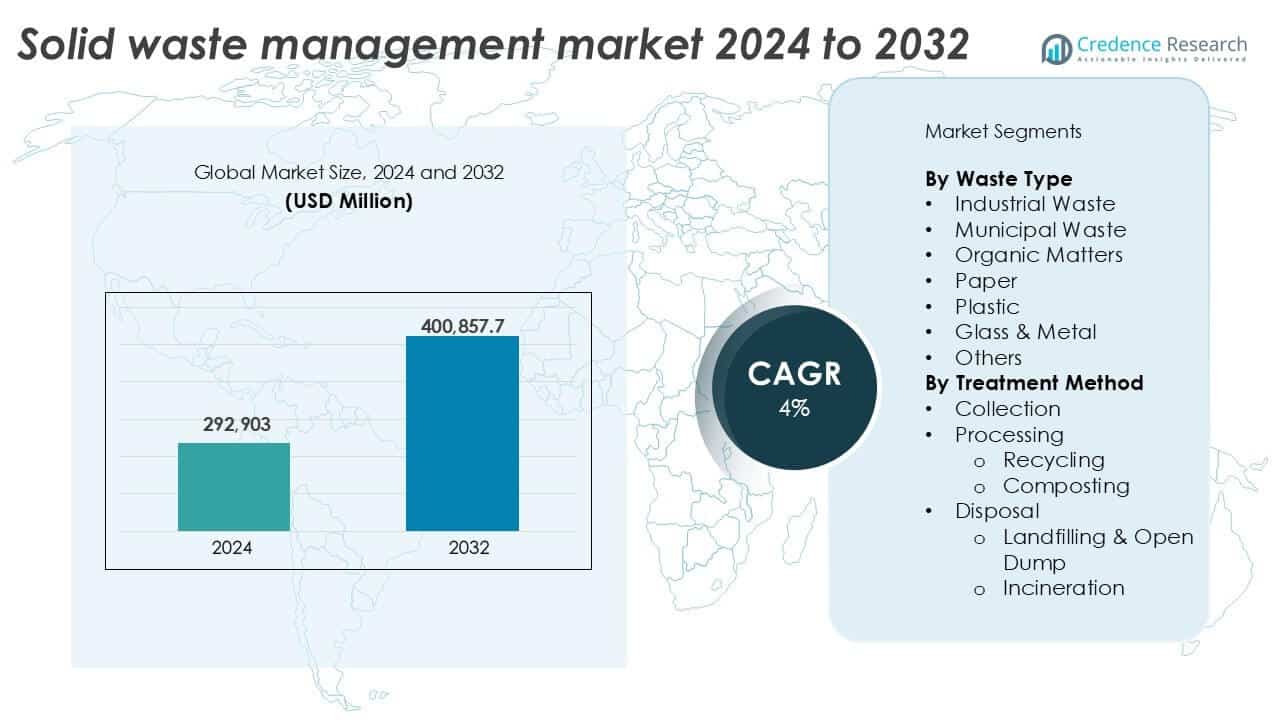
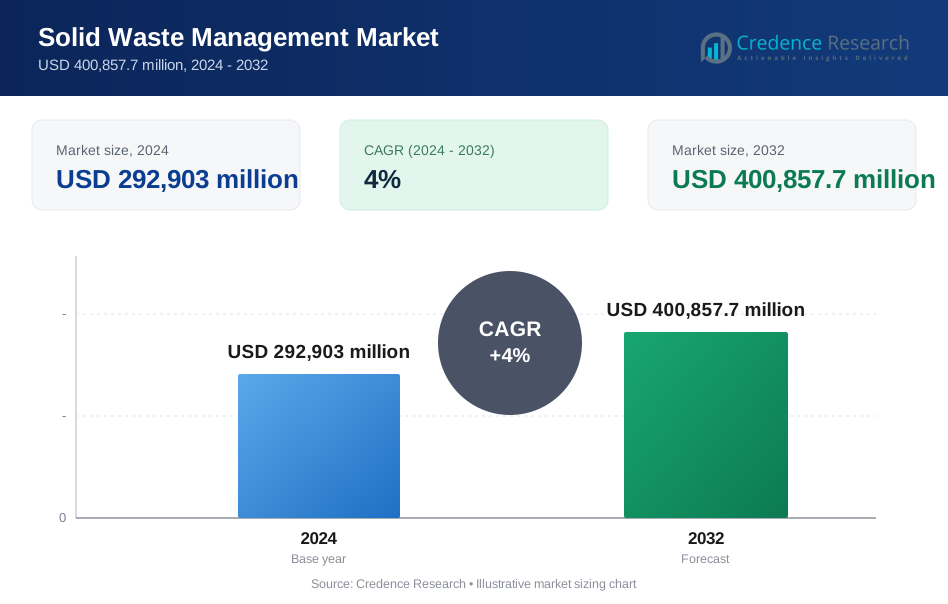
The Solid Waste Management market size was valued at USD 292,903 million in 2024 and is anticipated to reach USD 400,857.7 million by 2032, growing at a CAGR of 4% during the forecast period.
| REPORT ATTRIBUTE | DETAILS |
|---|---|
| Historical Period | 2020-2023 |
| Base Year | 2024 |
| Forecast Period | 2025-2032 |
| Solid Waste Management Market Size 2024 | USD 292,903 million |
| Solid Waste Management Market, CAGR | 4% |
| Solid Waste Management Market Size 2032 | USD 400,857.7 million |
Leading players in the solid waste management market include Veolia Environment S.A., Waste Management Inc., Republic Services Inc., SUEZ Group, and Remondis AG & Co. Kg. These companies offer end-to-end services, including collection, recycling, treatment, and disposal, supported by advanced technologies and large-scale infrastructure. Waste Management Inc. and Republic Services dominate the North American market, while Veolia and SUEZ lead operations across Europe and parts of Asia. The Asia-Pacific region holds the highest market share at 32%, driven by rapid urbanization, population growth, and expanding industrial activity. North America and Europe follow with 28% and 26% shares, respectively, supported by strict environmental regulations and mature waste treatment systems. These regions remain strongholds for global players due to stable demand, regulatory incentives, and public-private partnerships.
Solid Waste Management Market Insights
- The solid waste management market was valued at USD 292,903 million in 2024 and is expected to reach USD 400,857.7 million by 2032, growing at a CAGR of 4% during the forecast period.
- Rapid urbanization and rising municipal waste generation across developing nations are key drivers, pushing demand for advanced collection and treatment solutions.
- Smart waste systems, including IoT-based bins and AI-powered sorting, are gaining traction, supporting efficiency and sustainability goals across cities.
- Leading players such as Veolia, Waste Management Inc., and Republic Services focus on end-to-end services and circular economy strategies, supported by public-private partnerships.
- Asia-Pacific leads the market with 32% share, followed by North America (28%) and Europe (26%); municipal waste holds the dominant segment share at over 40%, while collection remains the top treatment method with 35% share, although high capital costs and poor source segregation limit faster adoption in some regions.
Solid Waste Management Market Segmentation Analysis:
By Waste Type
The municipal waste segment holds the largest share in the solid waste management market, accounting for over 40% in 2024. Rapid urbanization, population growth, and expanding city infrastructure drive higher municipal waste generation. Rising consumerism and household discards further increase waste volumes across urban and semi-urban areas. Governments focus on municipal solid waste segregation, doorstep collection, and smart bin technologies to enhance management efficiency. Municipal waste also receives significant funding under public-private partnership models, reinforcing its dominance in the waste type category. The plastic waste sub-segment is growing steadily, driven by rising packaging and consumer goods consumption. Single-use plastics contribute heavily to landfill loads and marine pollution. Countries are introducing bans, recycling mandates, and circular economy initiatives to curb plastic waste. Advanced recycling technologies such as chemical recycling and mechanical sorting systems are gaining traction. The growing pressure from environmental agencies and global treaties continues to push investment into plastic waste management infrastructure.
- For instance, Bengaluru Solid Waste Management Ltd diverts 100–150 tonnes of refuse‑derived plastic daily to energy and recycling under Extended Producer Responsibility frameworks.
By Treatment Method
The collection segment dominates the treatment method category with over 35% market share in 2024. Effective waste collection remains the first critical step in any waste management cycle. Local bodies and private players deploy smart bins, GPS-equipped trucks, and IoT-based systems to improve collection efficiency. Door-to-door services and increased waste coverage in rural and peri-urban regions have expanded operational scope. The rise of integrated waste collection contracts has further boosted this segment's value. Recycling follows as a key segment, backed by sustainability mandates and resource recovery goals. It accounts for over 25% market share in 2024, supported by growing recycling rates for paper, plastic, and metals. Several nations incentivize recycling through extended producer responsibility (EPR) and recycling credits. Automated material recovery facilities (MRFs) and AI-based sorting technologies improve output efficiency. The rise of green packaging and recycled-content products continues to drive recycling investments globally.
- For instance, Gurgaon's civic body hired teams with GPS‑equipped trucks for solid waste pickup across zones.
Solid Waste Management Market Key Growth Drivers
Rapid Urbanization and Waste Generation in Developing Economies
Urban population growth significantly drives demand for solid waste management services. Developing economies across Asia-Pacific, Latin America, and Africa experience rising municipal waste volumes due to expanding cities and unplanned settlements. Increased consumption of packaged goods, food, and disposable items adds pressure on already strained waste infrastructure. According to UN estimates, urban dwellers will make up over 68% of the global population by 2050. This shift requires scalable and efficient collection, transport, and disposal systems. Governments invest in smart city initiatives, boosting adoption of waste segregation, sensor-equipped bins, and automated collection systems. Urban growth also fosters demand for private waste management operators and public-private partnerships to bridge service delivery gaps. Consequently, urbanization is not only raising waste volumes but also transforming waste management into a critical urban utility, making it a strong market driver.
- For instance, daily municipal waste in Noida is 800–1,000 TPD, expected to rise with population growth, prompting new processing plants.
Rising Environmental Regulations and Circular Economy Push
Stringent regulations around waste disposal, landfill reduction, and emissions are propelling the solid waste management market forward. Governments worldwide implement legislation to improve recycling rates and minimize environmental impact. The EU’s Circular Economy Action Plan and the U.S. Resource Conservation and Recovery Act are prime examples of regulatory frameworks driving industry compliance and innovation. Extended Producer Responsibility (EPR) policies mandate manufacturers to manage post-consumer waste, especially in sectors like electronics and packaging. Landfill taxes and bans on single-use plastics further encourage alternative treatment methods like recycling and composting. As a result, both private and public entities invest in material recovery facilities (MRFs), anaerobic digesters, and composting units. Compliance with environmental norms is not only a legal requirement but also a competitive advantage, strengthening demand for sustainable and technologically advanced waste management solutions.
- For instance, Extended Producer Responsibility laws require manufacturers to manage post‑consumer waste collection and recycling streams.
Government Funding and Public-Private Partnerships (PPPs)
Increasing financial support through government schemes and partnerships significantly boosts infrastructure development in the waste sector. Emerging economies witness higher allocation toward municipal solid waste (MSW) programs under Swachh Bharat (India), National Waste Management Strategy (South Africa), and others. These initiatives cover fleet expansion, composting units, landfill closures, and waste-to-energy projects. In parallel, governments promote PPP models to attract private investment and operational efficiency. For example, cities like Jakarta and Nairobi have awarded collection and processing contracts to private firms, integrating digital tracking and performance-linked incentives. Multilateral agencies such as the World Bank and ADB fund sustainable waste programs with low-interest loans. This infusion of capital and collaboration ensures faster rollout of organized waste services, especially in underserved regions. Such funding mechanisms directly improve collection coverage, recycling capacity, and treatment innovation, acting as a vital growth driver.
Solid Waste Management Market Key Trends & Opportunities
Growing Adoption of Smart Waste Management Technologies
The solid waste management market is rapidly integrating digital and automation technologies to boost operational efficiency. Smart bins with fill-level sensors, GPS-tracked waste trucks, and route optimization tools are becoming standard in urban collection networks. IoT platforms enable real-time monitoring of bin capacity and vehicle movement, reducing fuel costs and improving service frequency. AI and robotics now assist in material sorting at recycling centers, enhancing throughput and purity levels. Blockchain solutions support transparency in waste tracking and carbon credit trading. Cities like Singapore and San Francisco have adopted data-driven waste management platforms, significantly improving waste diversion rates. The integration of these technologies creates new opportunities for solution providers, while municipalities gain improved cost control and service performance. Smart systems also support compliance with recycling and emissions targets, reinforcing their long-term role in sustainable urban planning.
- For instance, Singapore has deployed smart waste bin systems where IoT sensors notify collection teams when bins are full, improving route scheduling and reducing unnecessary pick‑ups.
Waste-to-Energy (WTE) as a Sustainable Disposal Solution
Waste-to-energy technologies present a growing opportunity for countries aiming to reduce landfill dependency and recover energy. Incineration, anaerobic digestion, and gasification methods allow conversion of organic and non-recyclable waste into electricity and heat. With urban areas running out of landfill space, WTE serves as an environmentally sound alternative that meets both waste reduction and renewable energy goals. Nations like Sweden, Japan, and Singapore already convert a major share of municipal waste to energy. In India and China, government subsidies and energy tariffs are promoting new WTE plants. Modern WTE facilities now integrate emissions controls, complying with environmental standards. This segment attracts growing investment from energy firms and technology developers. The dual benefit of waste disposal and energy recovery makes WTE a promising growth avenue, especially in cities with high population density and limited land resources.
Solid Waste Management Market Key Challenges
High Capital Costs and Low ROI in Infrastructure Projects
Setting up solid waste processing infrastructure requires substantial capital investment. Landfills, recycling plants, waste-to-energy units, and composting facilities demand not only high initial costs but also complex approvals and long gestation periods. In developing regions, lack of guaranteed waste feedstock or stable tipping fees often deters private investment. Furthermore, maintenance costs, workforce training, and periodic technology upgrades add financial burden. Small municipalities struggle to finance collection and transport networks due to limited budgets. As a result, many infrastructure projects face delays or operate below optimal capacity. Return on investment remains a concern for private players, particularly when waste volumes are inconsistent or user charges are politically sensitive. This capital-intensive nature hampers rapid deployment and restricts the market’s reach in underserved areas.
Inadequate Waste Segregation and Public Participation
Effective solid waste management relies on proper segregation at the source, yet this remains a major challenge in most regions. Mixed waste streams limit the efficiency of recycling and composting processes, often leading to more waste being landfilled or incinerated. Public awareness about waste types, disposal practices, and environmental impact is still low in many countries. Cultural habits, lack of incentives, and inconsistent enforcement of segregation laws hinder progress. Informal waste pickers further complicate collection logistics without integration into formal systems. Urban slums and rural areas often lack basic collection services, widening the waste service gap. This challenge undermines the effectiveness of downstream treatment technologies and adds to operational costs. Addressing behavioral change, education, and policy enforcement is crucial to solving this persistent issue.
Solid Waste Management Market Regional Analysis
North America
North America accounts for nearly 28% of the global solid waste management market in 2024. The U.S. and Canada maintain mature infrastructure with high waste collection coverage and strict environmental regulations. Landfill diversion initiatives and growing recycling mandates drive the adoption of advanced sorting and processing systems. Government-backed waste-to-energy (WTE) projects and Extended Producer Responsibility (EPR) programs boost sustainable treatment methods. The region also invests in smart waste solutions, supported by digital infrastructure and private sector participation. Strong focus on circular economy practices ensures continued modernization across municipal and industrial waste services, keeping North America among the top contributors.
Europe
Europe holds around 26% of the global solid waste management market share in 2024. EU directives on landfill bans, recycling targets, and carbon neutrality drive transformation across the region. Countries like Germany, Sweden, and the Netherlands lead in recycling and WTE adoption, with municipal recycling rates exceeding 50%. Policy frameworks such as the European Green Deal and Circular Economy Action Plan push for material recovery, packaging reduction, and bio-waste composting. Strong regulatory enforcement and public awareness contribute to high source segregation levels. Technological integration and circular waste streams position Europe as a mature and sustainability-led regional market.
Asia-Pacific
Asia-Pacific dominates the global solid waste management market with over 32% share in 2024. Rapid urbanization, industrial growth, and population expansion generate large volumes of municipal and industrial waste. China, India, and Japan lead in infrastructure investments, supported by national waste management strategies and urban development missions. The region is witnessing increased adoption of integrated waste management models, including recycling, composting, and energy recovery. Governments promote public-private partnerships and foreign investments to scale operations. Despite challenges in collection and segregation, Asia-Pacific shows strong growth potential due to rising environmental awareness and evolving regulatory frameworks.
Latin America
Latin America accounts for approximately 7% of the global solid waste management market in 2024. Urban centers in Brazil, Mexico, and Colombia face mounting municipal waste volumes, stressing collection and landfill capacities. Informal recycling networks play a significant role, especially in low-income areas. Regional governments are gradually implementing integrated solid waste management systems to improve recycling and reduce illegal dumping. Development banks and aid agencies support infrastructure upgrades, particularly in secondary cities. While adoption of advanced treatment remains low, public education campaigns and pilot WTE projects indicate a slow but steady shift toward sustainable waste practices.
Middle East & Africa (MEA)
The Middle East & Africa region represents nearly 7% of the global solid waste management market in 2024. Rapid urban expansion, construction activities, and changing consumption patterns contribute to increasing waste generation. GCC countries like the UAE and Saudi Arabia invest in WTE and recycling facilities as part of their sustainability goals. However, several African nations still struggle with basic collection and open dumping. Donor-funded programs and PPPs help improve service delivery in select cities. The region holds untapped potential, but low awareness, weak enforcement, and infrastructure gaps remain key hurdles to comprehensive waste management development.
Solid Waste Management Market Segmentations:
By Waste Type
- Industrial Waste
- Municipal Waste
- Organic Matters
- Paper
- Plastic
- Glass & Metal
- Others
By Treatment Method
- Collection
- Processing
- Recycling
- Composting
- Disposal
- Landfilling & Open Dump
- Incineration
By Geography
- North America
- U.S.
- Canada
- Mexico
- Europe
- Germany
- France
- U.K.
- Italy
- Spain
- Rest of Europe
- Asia Pacific
- China
- Japan
- India
- South Korea
- South-east Asia
- Rest of Asia Pacific
- Latin America
- Brazil
- Argentina
- Rest of Latin America
- Middle East & Africa
- GCC Countries
- South Africa
- Rest of the Middle East and Africa
Competitive Landscape
The solid waste management market features a moderately consolidated competitive landscape, with key players focusing on service expansion, technological upgrades, and strategic partnerships. Companies such as Veolia Environment S.A., Waste Management Inc., and Republic Services Inc. dominate due to their broad geographic reach and integrated waste handling capabilities. These players invest in smart collection systems, automated sorting, and waste-to-energy technologies to enhance operational efficiency and meet regulatory standards. Mid-sized firms like Biffa PLC, ALBA Group, and Remondis AG strengthen regional presence through targeted acquisitions and public-private collaborations. Competitive strategies increasingly emphasize circular economy integration and sustainability metrics. Companies also engage in long-term municipal contracts, securing recurring revenues and market stability. Innovation in AI-powered sorting, IoT-based monitoring, and data-driven logistics helps differentiate offerings. With rising environmental compliance demands and growing urban waste volumes, the competitive focus is shifting toward sustainable practices, digital transformation, and end-to-end waste solutions that align with evolving global regulations.
Key Player Analysis
- Veolia Environment S.A. (France)
- Stericycle Inc. (USA)
- ALBA Group (Germany)
- Envac Group (Sweden)
- Republic Services Inc. (USA)
- Hitachi Zosen Corporation (Japan)
- Remondis AG & Co. Kg (Germany)
- Waste Management Inc. (USA)
- Covanta Holdings Corporation (USA)
- TANA Oy (Finland)
- SUEZ Group (France)
- Recology (USA)
- Clean Harbors Inc. (USA)
- Biffa PLC (U.K.)
- Advanced Disposal Services Inc. (USA)
Recent Developments
- In March 2025, Pune became the first city in India to implement the central government's 'NAMASTE' scheme for waste pickers. This initiative officially recognizes waste pickers as workers, offering them social security, improved working conditions, and access to government welfare schemes. The scheme aims to uplift waste pickers and integrate them into the formal solid waste management system, ensuring a dignified and safer work environment.
- In July 2024, the Asian Development Bank (ADB) signed a $200 million loan agreement with the Government of India to enhance solid waste management and sanitation in 100 cities under the Swachh Bharat Mission 2.0. The program aimed to improve waste segregation, collection, and disposal while incorporating climate-resilient and gender-inclusive features.
Report Coverage
The research report offers an in-depth analysis based on Waste Type, Treatment Method and Geography. It details leading market players, providing an overview of their business, product offerings, investments, revenue streams, and key applications. Additionally, the report includes insights into the competitive environment, SWOT analysis, current market trends, as well as the primary drivers and constraints. Furthermore, it discusses various factors that have driven market expansion in recent years. The report also explores market dynamics, regulatory scenarios, and technological advancements that are shaping the industry. It assesses the impact of external factors and global economic changes on market growth. Lastly, it provides strategic recommendations for new entrants and established companies to navigate the complexities of the market.
Future Outlook
- Smart waste monitoring systems will become standard across urban collection networks.
- Investment in waste-to-energy plants will rise to reduce landfill dependence.
- Public-private partnerships will expand to improve service efficiency and coverage.
- Recycling infrastructure will grow with stricter regulations on material recovery.
- Composting of organic waste will gain traction in both rural and urban setups.
- Digital platforms will enable real-time tracking and analytics in waste operations.
- Government subsidies will support adoption of sustainable treatment technologies.
- Segregation-at-source awareness programs will strengthen public participation.
- Circular economy models will drive innovation in waste reuse and resource recovery.
- Emerging economies will see faster infrastructure development and market penetration.
Request a Free Sample
Fill in your details and we'll send you a free sample report.
- Sample data tables & charts
- Research methodology
Need a Custom Version of This Report?
Tailor the scope, geography, or segments to your exact requirements.
- Custom geography or segment scope
- Direct access to our analyst team
Frequently Asked Questions
What is the current market size for the Solid Waste Management market, and what is its projected size in 2032?
At what Compound Annual Growth Rate is the Solid Waste Management market projected to grow between 2024 and 2032?
Which Solid Waste Management market segment held the largest share in 2024?
What are the primary factors fueling the growth of the Solid Waste Management market?
Who are the leading companies in the Solid Waste Management market?
Which region commanded the largest share of the Solid Waste Management market in 2024?
Table of Content
Chapter 1 Market Segmentation
- 1.1 Segmentation Framework
- 1.1.1 Product and Service Classification
- 1.1.2 Application and End-Use Classification
- 1.1.3 Technology and Solution Classification
- 1.1.4 Customer and Distribution Channel Classification
- 1.1.5 Geographic Segmentation
- 1.1.6 Market Segment Definitions and Boundaries
Chapter 2 Introduction
- 2.1 Report Objectives and Scope
- 2.2 Product Definition and Industry Terminology
- 2.3 Market Inclusions and Exclusions
- 2.4 Research Process
- 2.4.1 Primary Research and Expert Interviews
- 2.4.2 Secondary Research and Source Review
- 2.4.3 Top-Down and Bottom-Up Estimation
- 2.4.4 Data Triangulation and Verification
- 2.5 Market Size Measurement Basis
- 2.5.1 2024: USD 292,903 million → 2032: USD 400,857.7 million
- 2.6 Historical and Forecast Reference Periods
- 2.6.1 Base Year: 2024
- 2.6.2 Forecast Period: 2024-2032
- 2.7 Research Assumptions and Limitations
Chapter 3 Executive Summary
- 3.1 Market Snapshot and Key Findings
- 3.2 Base-Year Market Size, 2024
- 3.3 Forecast Market Size, 2032
- 3.4 Revenue and Volume Growth Outlook
- 3.5 Key Demand and Supply Indicators
- 3.6 Leading Market Segments
- 3.7 Fastest-Growing Market Opportunities
- 3.8 Regional Performance Highlights
- 3.9 Technology and Industry Transformation
- 3.10 Competitive Landscape Summary
- 3.11 Analyst View and Strategic Implications
Chapter 4 Global Solid Waste Management Market Trends and Developments
- 4.1 Historical Industry Development
- 4.2 Recent Market Trends and Developments
- 4.3 Demand and Customer Behavior Trends
- 4.4 Technology and Product Innovation
- 4.5 Artificial Intelligence, Automation and Digitalization
- 4.6 Local Manufacturing and Supply Chain Realignment
- 4.7 Industry Partnerships, Mergers and Acquisitions
- 4.8 Sustainability and Circular Economy Developments
- 4.9 Government and Private Sector Investment Trends
- 4.10 Emerging Business Models and Commercialization
- 4.11 Industry Developments and Announcements
Chapter 5 Global Solid Waste Management Market Production, Supply and Demand Analysis
- 5.1 Demand Trend and Consumption Analysis
- 5.2 Demand Forecast, 2024-2032
- 5.3 Production and Output Trend
- 5.4 Production and Output Forecast, 2024-2032
- 5.5 Installed Capacity and Capacity Utilization
- 5.6 Company-Wise Production Plants and Statistics
- 5.6.1 Installed Production Capacity
- 5.6.2 Actual Production
- 5.6.3 Planned Capacity and Expansion Targets
- 5.7 Supply Chain Structure and Procurement Trends
- 5.8 Supply-Demand Gap and Bottlenecks
- 5.9 Import Dependence and Sourcing Structure
- 5.10 Contract Manufacturing and Outsourcing
- 5.11 Regional Supply and Demand Concentration
Chapter 6 Global Solid Waste Management Market Pricing Analysis
- 6.1 Pricing Structure and Measurement
- 6.2 Historical Pricing Trends
- 6.3 Pricing Outlook, 2024-2032
- 6.4 Average Selling Price and Unit Economics
- 6.5 Pricing by Product and Market Segment
- 6.6 Geographic Pricing Differences
- 6.7 Key Input, Energy, Labor and Logistics Costs
- 6.8 Contract Pricing and Purchasing Models
- 6.9 Pricing Sensitivity and Competitive Positioning
- 6.10 Price, Margin and Profitability Implications
Chapter 7 Global Solid Waste Management Market Dynamics
- 7.1 Market Growth Drivers
- 7.1.1 Demand-Side Drivers
- 7.1.2 Technology and Innovation Drivers
- 7.1.3 Infrastructure and Investment Drivers
- 7.1.4 Regulatory and Policy Drivers
- 7.2 Market Restraints
- 7.2.1 Cost and Affordability Constraints
- 7.2.2 Technology and Adoption Barriers
- 7.2.3 Supply Chain and Operational Constraints
- 7.3 Market Challenges
- 7.3.1 Competitive Pressure and Margin Erosion
- 7.3.2 Skills, Infrastructure and Implementation Gaps
- 7.4 Emerging Market Opportunities
- 7.5 Market Dynamics Impact and Time-Horizon Assessment
Chapter 8 Global Solid Waste Management Value Chain Analysis
- 8.1 Industry Value Chain Overview
- 8.2 Upstream Suppliers and Critical Inputs
- 8.3 Technology and Component Providers
- 8.4 Manufacturing or Service Delivery
- 8.5 Distribution, Channel Partners and Integrators
- 8.6 Downstream Applications and End Users
- 8.7 Value Addition and Profit Pools
- 8.8 Vertical Integration and Outsourcing
- 8.9 Supplier Concentration and Risk
- 8.10 Supply Chain Localization and Resilience
Chapter 9 Global Solid Waste Management Market Regulations and Policies
- 9.1 Relevant Laws, Standards and Compliance Frameworks
- 9.2 Product, Service, Safety and Quality Requirements
- 9.3 Government Policies, Incentives and Subsidies
- 9.4 Imports, Exports and Trade Barriers
- 9.5 Public Procurement and Local Content Requirements
- 9.6 Environmental and Sustainability Compliance
- 9.7 Upcoming Policy Changes and Market Implications
Chapter 10 Global Solid Waste Management Market Hotspots and Opportunities
- 10.1 Market Opportunity Mapping and Growth Hotspots
- 10.2 High-Growth Applications and Customer Groups
- 10.3 Underserved Markets and White-Space Opportunities
- 10.4 Emerging Technology and Product Opportunities
- 10.5 New Capacity and Investment Hotspots
- 10.6 Market Entry and Expansion Opportunities
- 10.7 Distribution and Partnership Opportunities
- 10.8 Near-Term and Long-Term Commercial Potential
- 10.9 Opportunity Attractiveness and Execution Risks
Chapter 11 Global Solid Waste Management Market Outlook, 2024-2032
- 11.1 Market Size and Analysis
- 11.1.1 Revenue (Market Measurement: 2024: USD 292,903 million → 2032: USD 400,857.7 million)
- 11.1.2 Market Volume and Quantity Sold
- 11.1.3 Historical Market Size
- 11.1.4 Base-Year Market Size, 2024
- 11.2 Market Forecast, 2024-2032
- 11.2.1 Revenue Forecast to 2032
- 11.2.2 Volume Forecast to 2032
- 11.2.3 CAGR and Year-on-Year Growth
- 11.2.4 Incremental Revenue Opportunity
- 11.3 Forecast Assumptions and Scenario Analysis
- 11.3.1 Base-Case Forecast
- 11.3.2 Optimistic and Conservative Scenarios
- 11.3.3 Technology, Pricing and Policy Sensitivities
- 11.4 Market Attractiveness and Growth Outlook
Chapter 12 Global Solid Waste Management Market Segmentation and Outlook
- 12.1 Segmentation Summary and Market Shares, 2024
- 12.2 Largest and Fastest-Growing Segments
- 12.3 Segment Growth Comparison
- 12.4 Segment Attractiveness and Priority Matrix
Chapter 13 Global Solid Waste Management Geographic Market Outlook, 2024-2032
- 13.1 Regional Market Size and Share, 2024
- 13.2 Regional Market Forecast, 2024-2032
- 13.3 Regional Pricing, Production and Demand Differences
- 13.4 North America
- 13.4.1 United States
- 13.4.2 Canada
- 13.4.3 Mexico
- 13.5 Europe
- 13.5.1 Germany
- 13.5.2 France
- 13.5.3 Italy
- 13.5.4 United Kingdom
- 13.5.5 Spain
- 13.5.6 Poland
- 13.5.7 Russia
- 13.5.8 Netherlands
- 13.5.9 Belgium
- 13.5.10 Sweden
- 13.5.11 Denmark
- 13.5.12 Norway
- 13.5.13 Rest of Europe
- 13.6 Asia Pacific
- 13.6.1 China
- 13.6.2 India
- 13.6.3 Japan
- 13.6.4 South Korea
- 13.6.5 Thailand
- 13.6.6 Indonesia
- 13.6.7 Vietnam
- 13.6.8 Malaysia
- 13.6.9 Australia
- 13.6.10 Rest of Asia Pacific
- 13.7 Latin America
- 13.7.1 Brazil
- 13.7.2 Argentina
- 13.7.3 Colombia
- 13.7.4 Chile
- 13.7.5 Rest of Latin America
- 13.8 Middle East
- 13.8.1 Saudi Arabia
- 13.8.2 United Arab Emirates
- 13.8.3 Turkey
- 13.8.4 Israel
- 13.8.5 Iran
- 13.8.6 Rest of the Middle East
- 13.9 Africa
- 13.9.1 South Africa
- 13.9.2 Egypt
- 13.9.3 Nigeria
- 13.9.4 Morocco
- 13.9.5 Rest of Africa
- 13.10 Regional Investment, Policy and Supply Chain Differences
- 13.11 Regional Competitive Landscape
- 13.12 Geographic Growth Hotspots
Chapter 14 Global Solid Waste Management Technology, Innovation and Sustainability Outlook
- 14.1 Technology Landscape and Maturity
- 14.2 Product, Process and Service Innovation
- 14.3 AI, Automation and Digital Tools in the Industry
- 14.4 Technology Adoption and Performance Benchmarking
- 14.5 Innovation Pipeline and R&D Investment
- 14.6 Patent and Intellectual Property Trends
- 14.7 Energy Efficiency and Resource Management
- 14.8 Sustainability, Recycling and Circularity
- 14.9 Technology Roadmap, 2024-2032
- 14.10 Risks of Obsolescence and Technology Substitution
Chapter 15 Global Solid Waste Management Market Key Strategic Imperatives
- 15.1 Growth and Market Entry Priorities
- 15.2 High-Return Products and Segments
- 15.3 Pricing, Profitability and Cost Optimization
- 15.4 Technology Investment and Product Differentiation
- 15.5 Supply Chain Localization and Resilience
- 15.6 Distribution and Customer Acquisition
- 15.7 Partnership, Acquisition and Capacity Strategy
- 15.8 Regional Expansion Priorities
- 15.9 Short-, Medium- and Long-Term Actions
Chapter 16 Competition Outlook
- 16.1 Industry Competition Characteristics
- 16.2 Market Structure and Concentration
- 16.3 Market Share and Competitive Positioning, 2024
- 16.4 Company-Wise Revenue and Product Benchmarking
- 16.5 Production and Service Capacity Benchmarking
- 16.6 Technology, Pricing and Differentiation
- 16.7 Regional Footprint and Distribution Strength
- 16.8 Mergers, Acquisitions and Strategic Alliances
- 16.9 New Entrants and Competitive Threats
- 16.10 Porter's Five Forces and Industry Attractiveness
- 16.11 Competitive Outlook, 2024-2032
Chapter 17 Company Profiles
- 17.1 Company Coverage and Selection Criteria
- 17.2 Leading Market Participants – Standard Profile Structure
- 17.2.1 Business Description
- 17.2.2 Company Ownership and Geographic Presence
- 17.2.3 Product and Service Portfolio
- 17.2.4 Manufacturing and Operating Footprint
- 17.2.5 Production Capacity and Expansion Plans
- 17.2.6 Financial Performance and Investment
- 17.2.7 Market Share and Competitive Position
- 17.2.8 Technology and Innovation Capabilities
- 17.2.9 Strategic Alliances or Partnerships
- 17.2.10 Recent Developments
- 17.2.11 Growth Strategy and Outlook
- 17.3 Other Relevant Market Participants
Note: Every listed company is profiled on the structure shown under the first company. The company list is preliminary and may change based on research findings, market developments, data availability and client requirements.
Chapter 18 Disclaimer
- 18.1 Research and Forecast Disclaimer
- 18.2 Data Source and Estimation Limitations
Note: The depth of individual sections depends on data availability for this market. Volume, capacity, trade and other unit-based metrics are included where applicable.