
Market Overview:
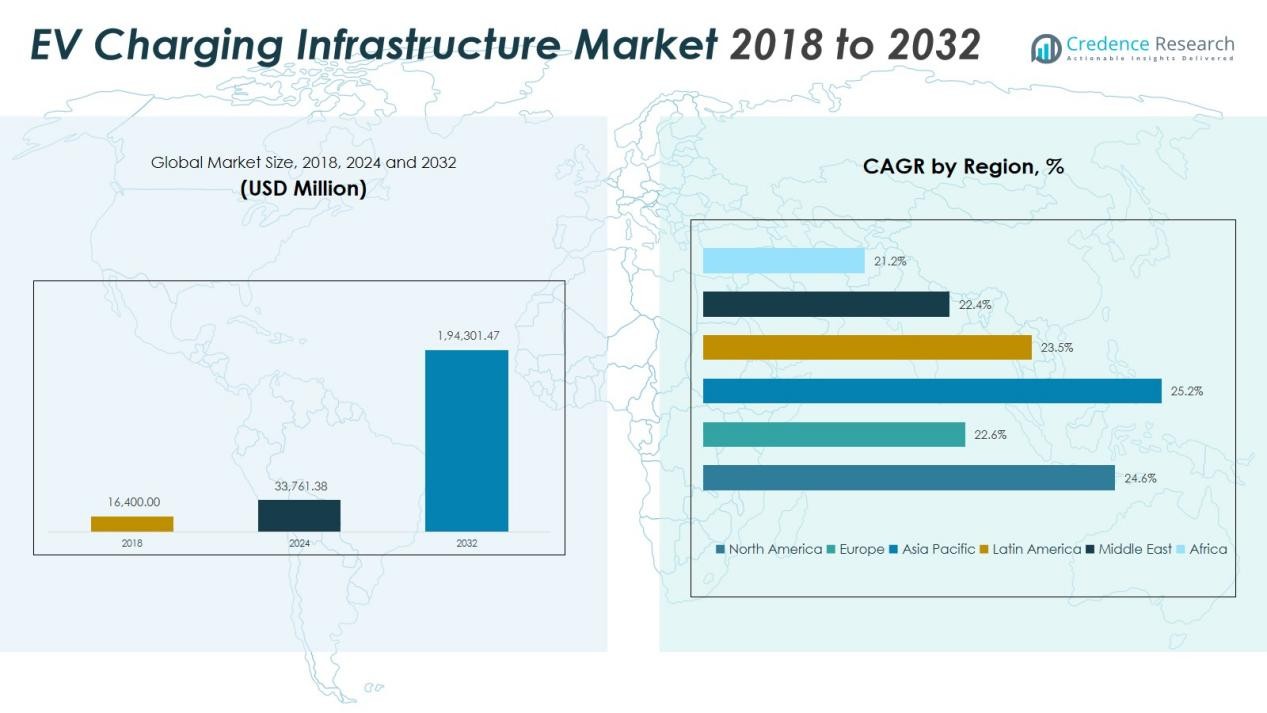
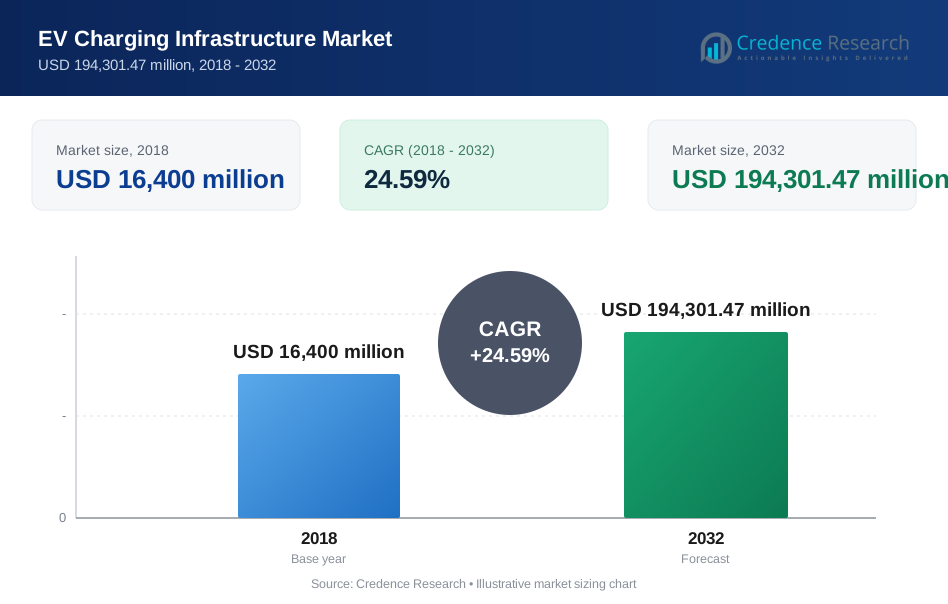
The Global EV Charging Infrastructure Market size was valued at USD 16,400 million in 2018 to USD 33,761.38 million in 2024 and is anticipated to reach USD 1,94,301.47 million by 2032, at a CAGR of 24.59% during the forecast period.
| REPORT ATTRIBUTE | DETAILS |
|---|---|
| Historical Period | 2020-2023 |
| Base Year | 2024 |
| Forecast Period | 2025-2032 |
| EV Charging Infrastructure Market Size 2024 | USD 33,761.38 Million |
| EV Charging Infrastructure Market, CAGR | 24.59% |
| EV Charging Infrastructure Market Size 2032 | USD 1,94,301.47 Million |
Growth in this market is driven by strong government incentives, emission-reduction mandates, and increasing infrastructure spending by both public and private sectors. The demand for fast-charging solutions continues to rise as consumers seek reduced charging times and higher convenience. Expanding electric vehicle ownership and the integration of renewable energy sources further enhance market development, creating opportunities for new entrants and established energy players alike.
Asia-Pacific dominates the Global EV Charging Infrastructure Market, accounting for over two-thirds of installations in 2024, led by large-scale deployments in China, Japan, and South Korea. Europe follows, supported by strict emission regulations and cross-border charging initiatives. North America is witnessing rapid growth, with expanding urban infrastructure and government funding programs promoting nationwide EV adoption.
Market Insights:
- The Global EV Charging Infrastructure Market was valued at USD 16,400 million in 2018, reached USD 33,761.38 million in 2024, and is projected to reach USD 1,94,301.47 million by 2032, growing at a CAGR of 24.59% during the forecast period.
- Asia-Pacific holds the largest share at over 67%, led by China, Japan, and South Korea, driven by large-scale government investments and strong EV adoption programs.
- Europe accounts for about 18% of the market, supported by stringent emission regulations, renewable energy integration, and cross-border charging network expansion.
- North America represents approximately 10% of the global share, driven by government initiatives like NEVI and expanding DC fast-charging corridors across the U.S. and Canada.
- Asia-Pacific remains the fastest-growing region, supported by national electrification plans, rapid urbanization, and private investments in smart grid infrastructure.
Market Drivers:
Government Incentives and Policy Support Accelerating Infrastructure Deployment
The Global EV Charging Infrastructure Market benefits from strong government incentives, subsidies, and regulatory mandates promoting clean mobility. Policies such as tax credits, reduced import duties, and public-private partnerships encourage large-scale infrastructure expansion. It gains further support from initiatives like the U.S. National Electric Vehicle Infrastructure (NEVI) program and the European Union’s Green Deal, which prioritize zero-emission transport. These efforts ensure financial backing for charging network developers and create a favorable environment for long-term market growth.
- For instance, the U.S. NEVI program has a total of $5 billion in federal funding allocated from 2022 to 2026. The amount allocated specifically for fiscal years 2022 to 2025 was approximately $3.3 billion [1, 2].
Rising Electric Vehicle Adoption Driving Infrastructure Expansion
Increasing global electric vehicle adoption is a core driver of the charging infrastructure market. Growing consumer awareness of sustainability and declining battery costs have accelerated EV sales, creating a pressing need for reliable charging solutions. It is also supported by automakers’ commitments to fully electric fleets, which boost demand for high-capacity and fast-charging systems. The expansion of both passenger and commercial EV segments strengthens the need for accessible charging facilities across urban and highway locations.
- For instance, Uber India partnered with fleet operators to deploy 25,000 electric vehicles for ride-hailing by 2025-2026, directly increasing the requirement for urban and intercity charging stations to support its EV operations.
Technological Advancements Enhancing Efficiency and Accessibility
Rapid technological innovation in fast charging, connectivity, and smart grid integration is transforming the industry landscape. The development of ultra-fast chargers with outputs exceeding 350 kW reduces charging times and enhances user convenience. It also benefits from software-enabled energy management systems that optimize grid usage and support dynamic pricing. Interoperability advancements allow multiple charging standards to coexist, improving accessibility and customer satisfaction.
Growing Investment from Private Sector and Energy Companies
Rising private investment from utilities, oil majors, and technology firms fuels market expansion. Companies are building integrated charging networks to secure strategic positions in the evolving e-mobility ecosystem. It witnesses significant collaboration between automotive OEMs and energy providers to ensure coverage continuity and performance reliability. Continuous funding and infrastructure partnerships reinforce competitiveness and drive sustained growth across regional and global markets.
Market Trends:
Integration of Smart Charging Technologies and Digital Platforms
The Global EV Charging Infrastructure Market is witnessing rapid adoption of smart charging systems that combine real-time monitoring, dynamic load management, and data analytics. These systems enable efficient power distribution and grid stability while minimizing energy costs. It benefits from the integration of Internet of Things (IoT) sensors, mobile applications, and AI-based platforms that enhance user experience and operational efficiency. Demand for networked charging solutions continues to rise across commercial fleets and public stations. The growth of vehicle-to-grid (V2G) technology further supports grid resilience by allowing bidirectional energy flow. Charging operators are investing in digital platforms that support remote diagnostics, predictive maintenance, and seamless payment systems. These developments are transforming traditional charging networks into intelligent and user-centric infrastructure ecosystems.
- For instance, Electrify America’s network has demonstrated rapid adoption of high-power charging, with stations capable of delivering up to 350 kW per stall in some deployments, enabling substantial reductions in typical charging times for long-range EVs
Expansion of Fast and Ultra-Fast Charging Networks Globally
Growing emphasis on reducing charging time drives significant investment in fast and ultra-fast charging stations worldwide. Automakers and infrastructure developers are deploying chargers with power outputs exceeding 150 kW to cater to next-generation electric vehicles. It is also influenced by advancements in battery technology and thermal management systems that support higher charging speeds. Highway corridors, urban centers, and logistics hubs are emerging as priority locations for deployment. The trend toward modular and scalable charger designs enables flexible installation and cost efficiency. Energy companies are expanding partnerships to establish nationwide fast-charging corridors that enhance long-distance travel convenience. These networks are becoming a key competitive differentiator in the global e-mobility landscape.
- For instance, Hyundai Motor Group announced a strategy with SK On to expand high-power charging corridors that include 400 kW-capable units at select sites, enabling rapid top-ups for long-distance trips. 400 kW units deployed at pilot sites.
Market Challenges Analysis:
High Installation Costs and Limited Grid Capacity
The Global EV Charging Infrastructure Market faces major challenges from high setup and maintenance costs, which restrict widespread adoption. Developing fast-charging stations requires significant investment in hardware, land, and electrical upgrades. It often depends on grid availability, and many regions lack the power capacity to support large-scale deployment. Upgrading distribution networks and transformers adds further financial strain to utilities and operators. The imbalance between EV growth and grid readiness creates operational inefficiencies. Cost-sensitive markets find it difficult to justify large infrastructure projects without sustained policy or private investment support. These constraints slow the pace of charging network expansion in emerging economies.
Standardization and Interoperability Barriers
A lack of standardization in charging connectors, payment systems, and communication protocols remains a key obstacle. Users often encounter compatibility issues across networks, leading to inconsistent charging experiences. It requires collaboration among automakers, regulators, and technology providers to establish universal standards. Varying regional regulations complicate cross-border operations and infrastructure planning. Operators face challenges in integrating hardware and software systems from multiple vendors. Limited interoperability discourages consumer confidence and affects overall network utilization rates. Harmonized policies and open protocols are essential to achieve a seamless and unified charging ecosystem.
Market Opportunities:
Expansion of Renewable Energy Integration and Smart Grid Synergies
The Global EV Charging Infrastructure Market holds strong opportunities through integration with renewable energy and smart grids. The shift toward solar- and wind-powered charging stations supports carbon-neutral transportation goals. It benefits from advancements in energy storage systems that balance load demands and reduce grid stress. The adoption of smart grids enhances charging efficiency and enables real-time energy optimization. Governments are funding green energy projects to link EV charging with distributed energy resources. The alignment of EV infrastructure with renewable energy ecosystems creates sustainable business models and long-term profitability.
Emergence of Fleet Electrification and Commercial Charging Networks
Fleet electrification across logistics, ride-sharing, and delivery services opens major growth avenues for charging infrastructure providers. Companies are investing in depot-based and on-route charging hubs to support large electric fleets. It gains momentum from operational cost advantages and corporate commitments to sustainability targets. The expansion of electric buses and commercial vans increases the need for fast and reliable charging points. Energy and mobility service providers are forming alliances to build specialized fleet-charging platforms. The growing preference for managed charging services and subscription-based business models creates recurring revenue potential and strengthens market competitiveness.
Market Segmentation Analysis:
By Charger Type
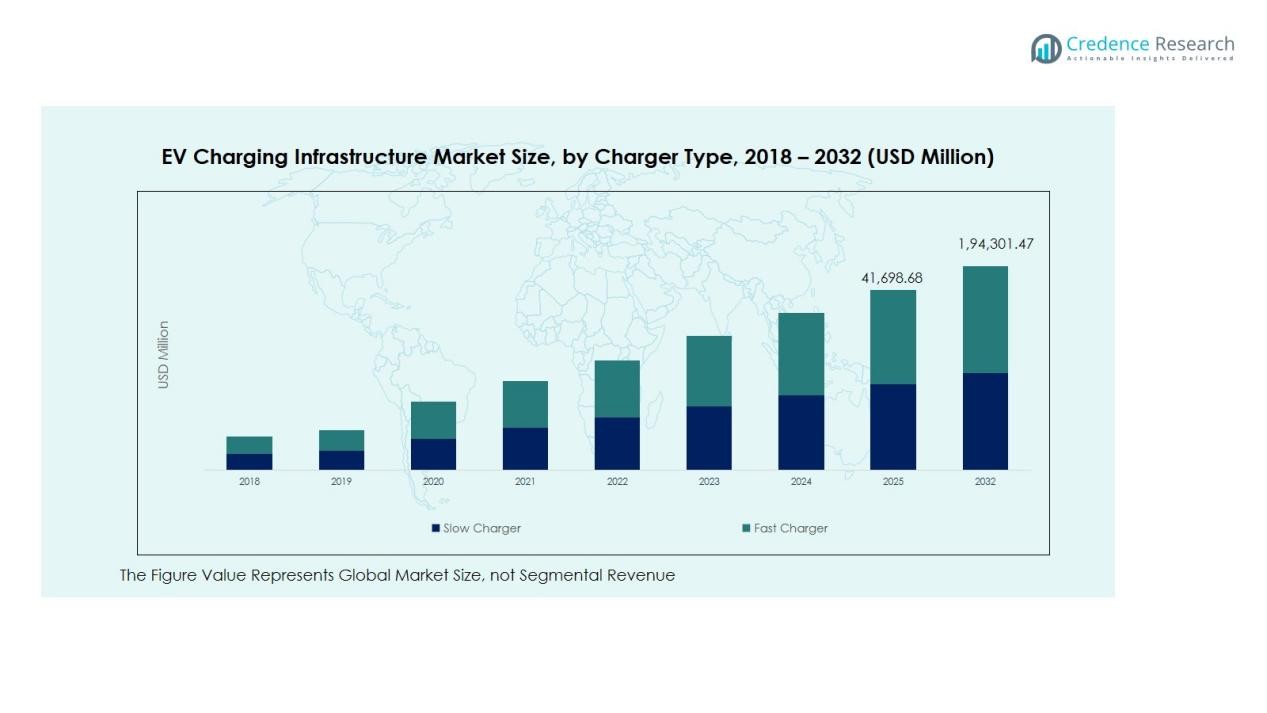
The Global EV Charging Infrastructure Market is segmented into slow and fast chargers. Fast chargers dominate due to rising consumer demand for quick turnaround and growing deployment across highways and commercial hubs. It benefits from expanding urban mobility and the adoption of high-capacity batteries in electric vehicles. Slow chargers continue to serve residential applications due to their cost-effectiveness and compatibility with standard power outlets. Continuous upgrades in charging speed and safety standards are reinforcing technological advancements in both segments.
- For instance, in 2024, EVgo and General Motors surpassed the milestone of 2,000 existing fast-charging stalls across more than 30 U.S. states as part of their collaboration, with each stall delivering up to 350 kW of power
By Application
The market covers commercial and residential applications. Commercial installations lead due to large-scale adoption across public parking areas, fleet depots, and transportation corridors. It gains traction from the growth of destination and highway charging networks supporting long-distance EV travel. Residential charging remains vital for daily home use, supported by incentives promoting private charger installation. Increasing integration of smart home technologies is enhancing convenience and energy efficiency in residential setups.
- For Instance, New York City's Metropolitan Transportation Authority (MTA) is actively deploying EV charging infrastructure across its depots as part of its plan to convert its entire bus fleet to zero-emissions vehicles by 2040.
By Connector Type
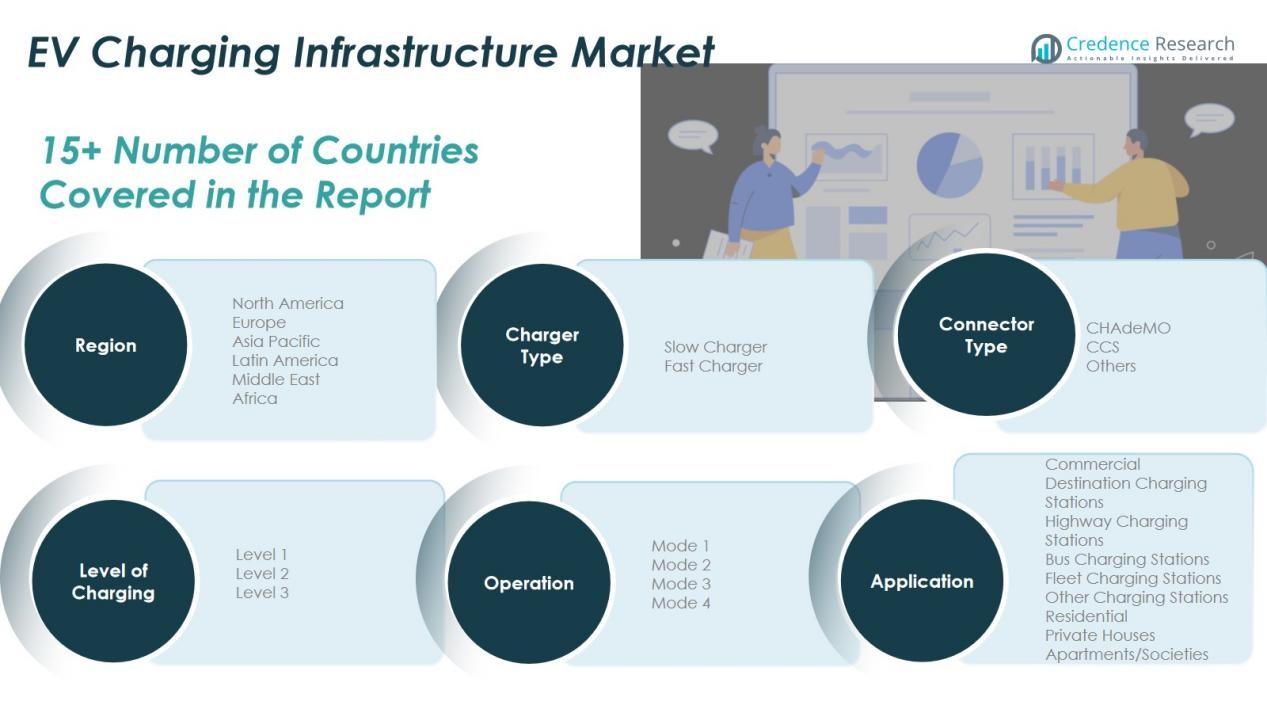
The market is segmented into CHAdeMO, CCS, and others. CCS holds the largest share due to its compatibility with most new-generation electric vehicles and rapid-charging capabilities. It benefits from strong adoption across Europe and North America, driven by regulatory standardization. CHAdeMO continues to maintain relevance in Asia, particularly in Japan. Other connectors, including proprietary and Type 2 formats, contribute to market diversity and support varying regional infrastructure policies.
Segmentations:
By Charger Type
- Slow Charger
- Fast Charger
By Application
- Commercial
- Destination Charging Stations
- Highway Charging Stations
- Bus Charging Stations
- Fleet Charging Stations
- Other Charging Stations
- Residential
- Private Houses
- Apartments/Societies
By Connector Type
- CHAdeMO
- CCS
- Others
By Level of Charging
- Level 1
- Level 2
- Level 3
By Operation
- Mode 1
- Mode 2
- Mode 3
- Mode 4
By Region
- North America
- U.S.
- Canada
- Mexico
- Europe
- Germany
- France
- U.K.
- Italy
- Spain
- Rest of Europe
- Asia Pacific
- China
- Japan
- India
- South Korea
- South-east Asia
- Rest of Asia Pacific
- Latin America
- Brazil
- Argentina
- Rest of Latin America
- Middle East & Africa
- GCC Countries
- South Africa
- Rest of the Middle East and Africa
Regional Analysis:
North America
The North America EV Charging Infrastructure Market size was valued at USD 2,525.60 million in 2018 to USD 5,050.50 million in 2024 and is anticipated to reach USD 28,970.70 million by 2032, at a CAGR of 24.6% during the forecast period. North America holds a significant market share of the Global EV Charging Infrastructure Market, driven by strong policy incentives and rapid EV adoption across the United States and Canada. It benefits from federal and state programs such as NEVI, which support large-scale fast-charging network expansion. The U.S. leads regional growth with extensive private and public sector investments in DC fast-charging corridors. Canada follows, emphasizing sustainability goals and smart city programs. Strategic alliances among automakers and utilities are improving charging accessibility across major urban routes. Continuous infrastructure upgrades strengthen the region’s leadership in next-generation charging technology.
Europe
The Europe EV Charging Infrastructure Market size was valued at USD 2,017.20 million in 2018 to USD 3,807.36 million in 2024 and is anticipated to reach USD 19,187.79 million by 2032, at a CAGR of 22.6% during the forecast period. Europe accounts for a strong share of the global market, supported by emission regulations and the European Green Deal’s e-mobility targets. It emphasizes interoperable networks, cross-border connectivity, and standardized payment systems. The UK, Germany, France, and the Netherlands lead deployment, supported by large public investment programs. Growing adoption of electric buses and fleet electrification further accelerates demand. The region’s focus on renewable integration into charging networks enhances energy sustainability and long-term efficiency.
Asia Pacific
The Asia Pacific EV Charging Infrastructure Market size was valued at USD 10,069.60 million in 2018 to USD 21,095.66 million in 2024 and is anticipated to reach USD 126,548.70 million by 2032, at a CAGR of 25.2% during the forecast period. Asia Pacific dominates the global market with the largest regional share, led by China, Japan, and South Korea. It benefits from strong government mandates, national electrification plans, and mass-scale public infrastructure projects. China continues to account for the majority of installed charging stations, followed by rapid growth in India and Southeast Asia. The expansion of EV fleets and urban charging networks is transforming transportation systems. Increasing private investment and smart grid integration further strengthen the regional market structure.
Latin America
The Latin America EV Charging Infrastructure Market size was valued at USD 1,049.60 million in 2018 to USD 2,140.13 million in 2024 and is anticipated to reach USD 11,438.53 million by 2032, at a CAGR of 23.5% during the forecast period. Latin America shows emerging growth potential supported by urban electrification initiatives and regional emission policies. Brazil and Mexico are the key contributors with strong automotive sector support and pilot EV infrastructure programs. It gains momentum from partnerships between energy providers and public agencies focusing on green mobility. The commercial fleet segment is driving early adoption across logistics and municipal transport. Gradual grid modernization and renewable energy integration will strengthen the region’s EV ecosystem.
Middle East
The Middle East EV Charging Infrastructure Market size was valued at USD 459.20 million in 2018 to USD 864.07 million in 2024 and is anticipated to reach USD 4,295.13 million by 2032, at a CAGR of 22.4% during the forecast period. The Middle East market is expanding through government sustainability initiatives and diversification of the energy mix. It is driven by EV adoption in GCC nations such as the UAE and Saudi Arabia. Dubai’s Green Mobility Strategy and Saudi Vision 2030 are key accelerators of infrastructure rollout. Increasing private investment from oil and energy majors supports large-scale charging projects. Regional expansion of smart city projects and public charging corridors improves accessibility across key transport routes.
Africa
The Africa EV Charging Infrastructure Market size was valued at USD 278.80 million in 2018 to USD 803.66 million in 2024 and is anticipated to reach USD 3,860.62 million by 2032, at a CAGR of 21.2% during the forecast period. Africa remains a developing market with growing attention toward clean mobility and energy access. South Africa leads adoption with pilot EV charging corridors supported by renewable energy. It benefits from the rising participation of private players in urban charging networks. Limited grid capacity and affordability constraints currently slow expansion across other countries. International collaborations and donor-funded projects are expected to improve infrastructure readiness. Continuous government support and renewable integration will play a key role in scaling adoption.
Key Player Analysis:
- ABB Ltd.
- ChargePoint, Inc.
- Leviton Manufacturing Co., Inc.
- Blink Charging Co.
- Tesla Inc.
- Webasto Group
- Eaton Corporation plc
- Schneider Electric
- Siemens
- Broadband TelCom Power, Inc.
- Delta Electronics, Inc.
- Tritium DCFC Limited
Competitive Analysis:
The Global EV Charging Infrastructure Market is characterized by strong competition among established global and regional players. ABB Ltd. leads in high-power charging systems and turnkey infrastructure solutions for public and fleet applications. ChargePoint, Inc. maintains a dominant position in North America with extensive public charging networks and advanced cloud-based management platforms. Leviton Manufacturing Co., Inc. focuses on residential and workplace chargers supported by robust energy management solutions. Blink Charging Co. emphasizes strategic partnerships and network expansion through public installations. Tesla Inc. continues to strengthen its proprietary Supercharger network while integrating open-access capabilities for non-Tesla vehicles. Webasto Group expands through innovative home and commercial charging systems with modular and smart functionalities. The market remains dynamic, driven by continuous product innovation, cross-industry alliances, and government-backed infrastructure initiatives that enhance global competitiveness and accelerate sustainable mobility adoption.
Recent Developments:
- In October 2025, SoftBank Group enters into a definitive agreement to acquire ABB’s robotics business, with closing anticipated mid-to-late 2026.
- In August 2025, ABB India reports a ₹173.6 crore order from Siemens Gamesa for wind turbine components, highlighting a major client win and collaboration in renewable energy deployment.
Report Coverage:
The research report offers an in-depth analysis based on Charger Type, Application, Connector Type, Level of Charging, Operation and Region. It details leading market players, providing an overview of their business, product offerings, investments, revenue streams, and key applications. Additionally, the report includes insights into the competitive environment, SWOT analysis, current market trends, as well as the primary drivers and constraints. Furthermore, it discusses various factors that have driven market expansion in recent years. The report also explores market dynamics, regulatory scenarios, and technological advancements that are shaping the industry. It assesses the impact of external factors and global economic changes on market growth. Lastly, it provides strategic recommendations for new entrants and established companies to navigate the complexities of the market.
Future Outlook:
- The Global EV Charging Infrastructure Market is expected to experience rapid network expansion supported by global sustainability mandates and green energy transitions.
- Growing adoption of electric vehicles across passenger and commercial segments will drive continuous demand for public and private charging stations.
- Integration of renewable energy sources into charging infrastructure will strengthen grid resilience and reduce operational costs.
- The shift toward ultra-fast and high-capacity chargers will improve convenience and shorten charging durations significantly.
- Smart and connected charging systems using AI and IoT technologies will enhance efficiency and real-time energy management.
- Fleet electrification across logistics, public transport, and ride-sharing sectors will create long-term infrastructure demand.
- Private investments and public-private partnerships will accelerate large-scale charging network deployment in urban and highway locations.
- Interoperability advancements and unified payment systems will simplify user experience and promote standardization globally.
- Emerging economies in Asia, the Middle East, and Latin America will become key growth centers due to government support and EV incentives.
- The market will continue to evolve toward sustainable, intelligent, and service-based charging ecosystems driving the global transition to clean mobility.
Request a Free Sample
Fill in your details and we'll send you a free sample report.
- Sample data tables & charts
- Research methodology
Need a Custom Version of This Report?
Tailor the scope, geography, or segments to your exact requirements.
- Custom geography or segment scope
- Direct access to our analyst team
Frequently Asked Questions
What is the current market size for the Global EV Charging Infrastructure Market, and what is its projected size in 2032?
At what Compound Annual Growth Rate is the Global EV Charging Infrastructure Market projected to grow between 2024 and 2032?
Which segment held the largest share of the Global EV Charging Infrastructure Market in 2024?
What are the primary factors fueling the growth of the Global EV Charging Infrastructure Market?
Who are the leading companies in the Global EV Charging Infrastructure Market?
Which region commanded the largest share of the Global EV Charging Infrastructure Market in 2024?
Table of Content
Chapter 1. Report Introduction
- 1.1 Report Description & Purpose
- 1.1.1 Report Title & Market Definition
- 1.1.2 Unique Selling Propositions (USP) & Key Differentiators
- 1.1.3 Value Proposition for Stakeholders
- 1.2 Research Objectives
- 1.2.1 Market Sizing Objectives (Volume & Revenue) (Volume Where Applicable)
- 1.2.2 Segmentation Objectives
- 1.2.3 Competitive Intelligence Objectives
- 1.2.4 Forecast & Scenario Objectives
- 1.3 Report Scope
- 1.3.1 EV Charging Infrastructure Scope – Segments & Subsegments Covered
- 1.3.2 Geographic Scope – Regions & Countries Covered
- 1.3.3 Historical Period, Base Year & Forecast Period (2018; forecast to 2032)
- 1.3.4 Inclusions & Exclusions
- 1.4 Industry Classification & Applicable Codes
- 1.5 Currency, Measurement Units & Valuation Basis
- 1.6 Target Stakeholders
- 1.7 Limitations & Assumptions
Chapter 2. Executive Summary
- 2.1 Global EV Charging Infrastructure Market Snapshot
- 2.1.1 Market Size – Historical (2018) & Forecast (2018-2032) (2018: USD 16,400 million → 2032: USD 194,301.47 million)
- 2.1.2 Volume & Revenue – Global Totals (Volume Where Applicable)
- 2.1.3 Key Market Highlights – Top Five Facts
- 2.2 EV Charging Infrastructure Market Segmentation Snapshot
- 2.2.1 Market Split by Region – 2018 vs. 2032
- 2.3 Competitive Snapshot
- 2.3.1 Top 10 Players by Revenue Share – 2018
- 2.3.2 Top 10 Players by Volume Share – 2018 (Volume Where Applicable)
- 2.3.3 Recent Strategic Developments (18-Month Summary)
- 2.4 Key Investment Highlights & Strategic Conclusions
Chapter 3. EV Charging Infrastructure Market Dynamics & Industry Analysis
- 3.1 Market Overview & Context
- 3.1.1 EV Charging Infrastructure Market Position in the Broader Industry Value Chain
- 3.1.2 Demand Structure & Purchasing Dynamics
- 3.1.3 Market Maturity & Development Stage by Region
- 3.2 EV Charging Infrastructure Market Drivers
- 3.3 EV Charging Infrastructure Market Restraints & Challenges
- 3.4 EV Charging Infrastructure Market Opportunities
- 3.5 Porter's Five Forces Analysis
- 3.5.1 Threat of New Entrants
- 3.5.2 Bargaining Power of Suppliers
- 3.5.3 Bargaining Power of Buyers
- 3.5.4 Threat of Substitutes
- 3.5.5 Competitive Rivalry – Intensity Assessment
- 3.6 EV Charging Infrastructure Value Chain Analysis
- 3.6.1 Upstream – Key Inputs, Resources & Suppliers
- 3.6.1.1 Key Input/Resource 1
- 3.6.1.2 Key Input/Resource 2
- 3.6.1.3 Key Input/Resource 3
- 3.6.2 Midstream – Core Operations & Value Creation
- 3.6.2.1 Operating Model & Process Overview
- 3.6.2.2 Key Operating Locations & Capabilities by Company
- 3.6.3 Downstream – Market Channels & End Users
- 3.6.3.1 Direct Sales & Customer Engagement Channels
- 3.6.3.2 Indirect Sales, Intermediaries & Partner Channels
- 3.6.4 Value Chain Profitability Analysis
- 3.6.1 Upstream – Key Inputs, Resources & Suppliers
- 3.7 PESTEL Analysis
- 3.7.1 Political Factors
- 3.7.2 Economic Factors
- 3.7.3 Social Factors
- 3.7.4 Technological Factors
- 3.7.5 Environmental Factors
- 3.7.6 Legal Factors
- 3.8 EV Charging Infrastructure Supply Chain Analysis
- 3.8.1 Critical Input & Resource Availability Risk Assessment
- 3.8.2 Supplier & Operational Concentration Risk (Geographic Exposure)
- 3.8.3 Supply & Service Disruption Impact Analysis
- 3.9 Regulatory & Policy Landscape
Note: The regulatory and policy landscape section covers regulations based on their applicability to the market, EV Charging Infrastructure category, geography, and scope of the study. Only regulatory frameworks with a material impact on operations, compliance, trade, sustainability, or market access are analyzed in detail.
Chapter 4. Key Investment Pockets & Opportunity Analysis
- 4.1 EV Charging Infrastructure Market Attractiveness Analysis
- 4.1.1 By Region – Investment Attractiveness Matrix (Market Size × CAGR)
- 4.2 Absolute Revenue Growth Opportunity
- 4.2.1 By Region – Absolute Revenue Growth Through 2032
- 4.3 Incremental Demand Opportunity
- 4.3.1 By Region – Incremental Demand Through 2032
- 4.3.2 Segment – Incremental Demand
- 4.4 Emerging Submarket Opportunity Deep Dive (Subject to Applicability)
- 4.5 Priority Market Opportunity Scorecards
- 4.5.1 United States
- 4.5.2 Europe
- 4.5.3 Asia
- 4.5.4 Middle East & Africa
Note: Priority market opportunity scorecards reflect the geographic scope and strategic relevance of the study. Listed markets are indicative and may be adapted to the industry.
Chapter 5. EV Charging Infrastructure Cross-Border Trade & Market Access Analysis
- 5.1 International Trade & Cross-Border Activity Overview
- 5.1.1 Global Export Value by Country (2018)
- 5.1.2 Global Export Volume by Country (2018) (Volume Where Applicable)
- 5.1.3 Global Import Value by Country (2018)
- 5.1.4 Global Import Volume by Country (2018) (Volume Where Applicable)
- 5.1.5 Net Trade Balance by Country (2018)
- 5.2 Export Analysis – Segment
- 5.2.1 Category 1 (Applicable Classification Code)
- 5.2.2 Category 2 (Applicable Classification Code)
- 5.2.3 Category 3 (Applicable Classification Code)
- 5.2.4 Category 4 (Applicable Classification Code)
- 5.2.5 Category 5 (Applicable Classification Code)
- 5.3 Import Analysis – Segment
- 5.3.1 Category 1 (Applicable Classification Code)
- 5.3.2 Category 2 (Applicable Classification Code)
- 5.3.3 Category 3 (Applicable Classification Code)
- 5.3.4 Category 4 (Applicable Classification Code)
- 5.3.5 Category 5 (Applicable Classification Code)
- 5.4 Cross-Border Pricing & Transaction Benchmarks
- 5.4.1 Export Pricing – Segment & Country
- 5.4.2 Import Pricing – Segment & Source Country
- 5.4.3 Price Trends (2018)
- 5.5 Key Cross-Border Trade & Delivery Routes
- 5.5.1 Cross-Border Trade/Delivery Route 1
- 5.5.2 Cross-Border Trade/Delivery Route 2
- 5.5.3 Cross-Border Trade/Delivery Route 3
- 5.5.4 Cross-Border Trade/Delivery Route 4
- 5.5.5 Cross-Border Trade/Delivery Route 5
- 5.6 Trade Policy & Market Access Impact Assessment
- 5.6.1 Tariff & Non-Tariff Barriers
- 5.6.2 Regional Trade & Economic Integration Frameworks
- 5.6.3 Bilateral & Multilateral Trade Agreements
- 5.6.4 Cross-Border Operating, Licensing & Localization Requirements
Note: This chapter applies where cross-border trade or delivery is relevant to EV Charging Infrastructure. Goods, services, and digital offerings are assessed using applicable classifications and transaction measures. Import-export volumes, trade balances, and route analyses are included only where meaningful to the market.
Chapter 6. Competitive Landscape & Company Benchmarking
- 6.1 EV Charging Infrastructure Market Concentration & Structure
- 6.1.1 Herfindahl-Hirschman Index (HHI) – vs. 2018
- 6.1.2 Leading, Mid-Sized & Emerging Player Structure
- 6.1.3 Global, Regional & Local Player Dynamics
- 6.2 EV Charging Infrastructure Market Share Analysis – 2018
- 6.2.1 Global Revenue Share by Company
- 6.2.2 Global Volume Share by Company (Volume Where Applicable)
- 6.2.3 Regional Revenue Share
- 6.2.4 Market Share Evolution ( vs. 2018)
- 6.2.5 Company Market Share by Key Segment
- 6.2.6 Company Market Share by Customer Group
- 6.3 Operating Scale, Capacity & Infrastructure Analysis
- 6.3.1 Global Operating Scale & Supply Capacity
- 6.3.2 Resource Utilization & Operating Efficiency
- 6.3.3 Output, Service Delivery & Activity Metrics
- 6.3.4 Operating Footprint & Infrastructure Map
- 6.3.5 Planned Operational & Capacity Expansion
- 6.4 EV Charging Infrastructure Competitive Benchmarking Matrix
- 6.4.1 Revenue, Growth, Profitability & Operating Metric Comparison
- 6.4.2 Channel Revenue Mix
- 6.4.3 Geographic Revenue Exposure
- 6.4.4 R&D Intensity
- 6.4.5 Sustainability Maturity
- 6.5 Strategic Developments in EV Charging Infrastructure (Last 24 Months)
- 6.5.1 Mergers, Acquisitions & Divestments
- 6.5.2 New Products, Services & Solutions in EV Charging Infrastructure
- 6.5.3 Operational & Infrastructure Expansions
- 6.5.4 Strategic Alliances, Joint Ventures & Partnerships
- 6.5.5 Distribution Expansion & Market Entry
- 6.5.6 Sustainability & ESG Initiatives
- 6.6 Competitive Strategy Mapping
- 6.6.1 Leader, Challenger, Follower & Niche Classification
- 6.6.2 Pricing Strategy Comparison
- 6.6.3 Channel Strategy Matrix
Note: Strategic developments are included based on their materiality and the availability of reliable information.
Chapter 7. Global EV Charging Infrastructure Market – By Sales & Delivery Channel
- 7.1 Segment Overview
- 7.1.1 Volume & Revenue Split by Channel (2018 & 2032) (Volume Where Applicable)
- 7.1.2 Channel Mix Evolution (2018-2032)
Chapter 8. Regional Market Analysis – Global Overview
- 8.1 Global Regional Overview
- 8.1.1 Regional Volume Share (Volume Where Applicable)
- 8.1.2 Regional Revenue Share
- 8.1.3 Regional Volume by Region (Volume Where Applicable)
- 8.1.4 Regional Revenue by Region
- 8.1.5 Regional Forecast Through 2032
- 8.2 Cross-Regional Segment Analysis
- 8.2.1 By Sales & Delivery Channel
- 8.2.2 By Competitive Positioning & Price Tier
Chapter 9. North America EV Charging Infrastructure Market
- 9.1 United States
- 9.2 Canada
- 9.3 Mexico
Chapter 10. Europe EV Charging Infrastructure Market
- 10.1 Germany
- 10.2 France
- 10.3 Italy
- 10.4 United Kingdom
- 10.5 Spain
- 10.6 Poland
- 10.7 Russia
- 10.8 Netherlands
- 10.9 Belgium
- 10.10 Sweden
- 10.11 Denmark
- 10.12 Norway
- 10.13 Rest of Europe
Chapter 11. Asia Pacific EV Charging Infrastructure Market
- 11.1 China
- 11.2 India
- 11.3 Japan
- 11.4 South Korea
- 11.5 Thailand
- 11.6 Indonesia
- 11.7 Vietnam
- 11.8 Malaysia
- 11.9 Australia
- 11.10 Rest of Asia Pacific
Chapter 12. Latin America EV Charging Infrastructure Market
- 12.1 Brazil
- 12.2 Argentina
- 12.3 Colombia
- 12.4 Chile
- 12.5 Rest of Latin America
Chapter 13. Middle East EV Charging Infrastructure Market
- 13.1 Saudi Arabia
- 13.2 United Arab Emirates
- 13.3 Turkey
- 13.4 Israel
- 13.5 Iran
- 13.6 Rest of the Middle East
Chapter 14. Africa EV Charging Infrastructure Market
- 14.1 South Africa
- 14.2 Egypt
- 14.3 Nigeria
- 14.4 Morocco
- 14.5 Rest of Africa
Chapter 15. EV Charging Infrastructure Company Profiles
- 15.1 [Company 01]
- 15.1.1 Company Overview
- 15.1.2 Key Management Personnel
- 15.1.3 Products & Services Portfolio
- 15.1.4 Financial Performance
- 15.1.5 Key Market Focus & Geographic Presence
- 15.1.6 Recent Developments & Strategic Initiatives
Note: The company profile list is preliminary and may change based on research findings, market developments, data availability, and client requirements.
Chapter 16. Appendices
- Appendix A – List of Abbreviations & Acronyms
- Appendix B – Industry Classification Code Reference – Full Series
- Appendix C – Supply, Output & Operating Capacity Data Tables
- Appendix D – End-Use & Demand Base Tables
- Appendix E – Demand, Adoption & Usage Assumptions
- Appendix F – Pricing & Revenue Metric Reference Tables
- Appendix G – Company Operations & Infrastructure Database
- Appendix H – Cross-Border Trade & Activity Data Tables (Where Applicable)
- Appendix I – Regulatory Summary Tables
- Appendix J – Primary Research Participant List (Anonymized)
- Appendix K – Primary Research Questionnaire Framework
- Appendix L – Data Sources & Bibliography
- Appendix M – Market Size Divergence & Source Comparison
Chapter 17. Research Methodology
- 17.1 Research Framework & Philosophy
- 17.2 Secondary Research – Sources, Hierarchy & Data Extraction
- 17.3 Data Modeling – Bottom-Up & Top-Down Market Sizing
- 17.4 Primary Research – Stakeholder Framework, LOI & Sample Sizes
- 17.5 Forecast Methodology – Regression, Scenario & Sensitivity Analysis
- 17.6 Quality Control – Four-Layer Validation Framework
- 17.7 Limitations & Standard Assumptions
- 17.8 Disclaimer
