
Market Overview
The consumer electronics extended warranty market has experienced significant growth in recent years, a trend expected to continue in the foreseeable future. Extended warranties, also known as service contracts or protection plans, offer consumers additional warranty coverage beyond the manufacturer's standard warranty. This sector has become increasingly relevant as consumer electronics, from smartphones and tablets to home appliances and entertainment systems, have become central to everyday life. These products not only represent a substantial financial investment for consumers but also play a crucial role in their daily routines, making the extended warranty market more critical than ever.
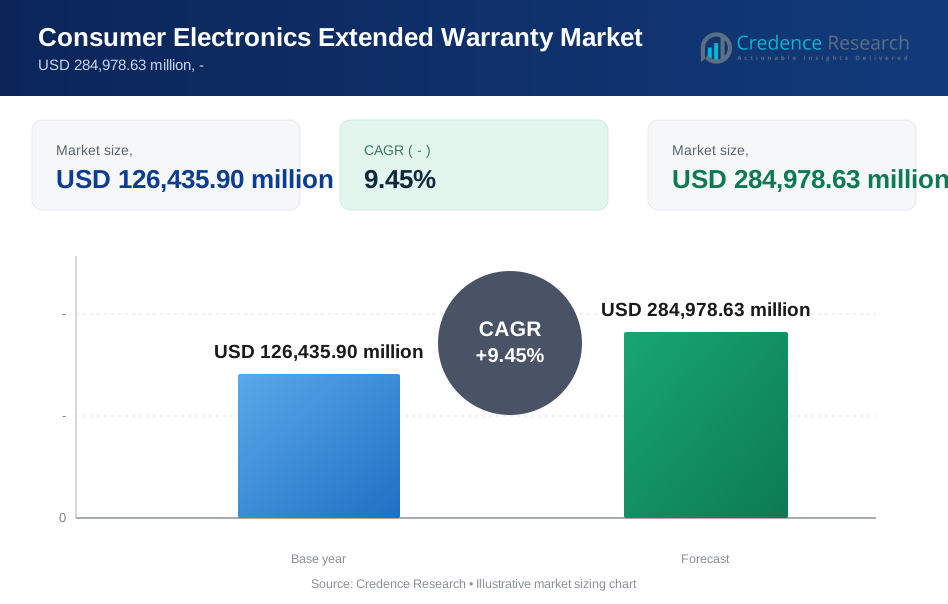
The consumer electronics extended warranty market is set to grow from USD 126,435.90 million in 2023 to USD 284,978.63 million by 2032, marking a Compound Annual Growth Rate (CAGR) of 9.45%. This surge highlights the rising demand for extended warranties, driven by the increasing complexity and cost of consumer electronics, alongside a greater consumer awareness of repair and replacement expenses.
The market is characterized by a variety of coverage options, ranging from basic protection plans that cover mechanical failures and defects to comprehensive plans that include accidental damage, loss, and theft. Pricing and coverage terms vary widely across products and providers, reflecting the diverse needs and preferences of consumers.
Key Market Drivers
Rising costs and increasing product complexity
The consumer electronics market is undergoing significant changes with the rising costs and increasing complexity of high-end appliances and gadgets. As electronics incorporate more sophisticated features and intricate components, the cost of repairs after the warranty period can escalate. This makes extended warranties an attractive option for consumers looking to safeguard their investments.
Heightened consumer awareness and risk aversion
In today’s market, consumers are more aware than ever of the potential for electronic device breakdowns and malfunctions. This awareness has led to about 28% of consumers purchasing extended warranties on electronics. Such warranties act as a safety net by mitigating the risk of facing unexpected repair costs and are particularly appealing to risk-averse consumers who place a high priority on protecting their investment in valuable electronics.
Manufacturer Strategies and Profit Potential
For manufacturers, extended warranties represent an opportunity to generate lucrative revenue streams beyond the initial sale of products. These warranties are often priced strategically to attract consumers, providing an additional income source for manufacturers with an average profit margin of 50%. Moreover, they encourage responsible product ownership and can result in fewer returns and replacements during the standard warranty period, benefiting both consumers and manufacturers.
Evolving Technologies and Shorter Lifespans
The rapid pace of technological advancements often leads to shorter lifespans for electronic products, prompting consumers to consider extended warranties more seriously. These warranties provide a safety net that bridges the gap between the potential early failure of a product and the release of new technology, ensuring that consumers remain content with their purchases for a longer period of time.
Increased Focus on Value and Convenience
Modern consumers value convenience and a hassle-free experience, aspects that extended warranties can enhance by offering benefits such as priority repairs, door-to-door service, and access to manufacturer-approved technicians. About 60% of extended warranty claims are approved, compared to 85% of manufacturer’s warranty claims, increasing the overall value of the product purchase and appealing to consumers who prioritize an effortless repair process in case of a breakdown.
Emerging Markets and Untapped Potential
The expansion of the consumer electronics market into developing economies presents significant growth opportunities for the extended warranty market. As disposable incomes rise, so does the propensity to purchase high-end electronics, driving the demand for extended warranties. This trend highlights the untapped potential in these markets and underscores the increasing importance of extended warranties in the global consumer electronics industry.
Key Market Restraints
One of the major restraints facing the consumer electronics extended warranty market is the perception of limited value. Many consumers remain skeptical about the actual benefits of extended warranties, viewing them as unnecessary expenses. This skepticism is often fueled by the fine print of warranty contracts, which can exclude common issues or make the claims process cumbersome. Moreover, with the rapid pace of technological advancement, many consumers prefer to upgrade to newer models rather than repair outdated ones, diminishing the perceived value of extended warranties.
Market Opportunities
- Technological Integration: Leveraging technology to streamline the claims process and improve customer service can significantly enhance the attractiveness of extended warranties. For example, implementing AI for instant claim processing and using chatbots for customer inquiries can improve the overall customer experience.
- Customizable Plans: Offering customizable warranty plans that allow consumers to select coverage based on their specific needs and budget can tap into a broader market segment. For instance, tiered coverage levels and à la carte options for accidental damage or theft protection can cater to diverse consumer preferences.
- Expansion into Emerging Markets: Many emerging economies are witnessing a surge in consumer electronics purchases, yet the penetration of extended warranties in these regions is relatively low. Tailoring warranty products to the economic and cultural contexts of these markets presents a significant growth opportunity.
- Partnerships with Manufacturers and Retailers: Strengthening partnerships with electronics manufacturers and retailers can facilitate the direct offering of extended warranties at the point of sale, improving convenience for consumers and increasing uptake.
- Inclusion of Additional Services: Adding value to extended warranties with additional services, such as tech support, data recovery, and regular maintenance checks, can make these plans more appealing to consumers.
- Marketing and Education: Effective marketing strategies that educate consumers on the benefits and coverage specifics of extended warranties can help mitigate skepticism and increase market penetration.
- Digital Platforms: Developing easy-to-use digital platforms for purchasing and managing extended warranties can enhance customer engagement and satisfaction, making it easier for consumers to access and use their warranties.
Interesting Facts About the Market
- Consumers who have used their extended warranty services once are significantly more likely to renew or purchase warranties for new devices, indicating high customer satisfaction among claimants.
- Consumer awareness of extended warranties varies significantly by region and country, with higher awareness in North America and Western Europe compared to emerging markets.
- The rise of online sales channels has increased the availability and convenience of purchasing extended warranties, contributing to market growth.
- Certain consumer electronics categories, such as smartphones and laptops, have higher rates of extended warranty purchases compared to others like kitchen appliances.
- Consumers tend to trust and prefer extended warranties offered directly by manufacturers over third-party providers.
- Positive reviews and recommendations from trusted sources can significantly influence consumers' decisions to purchase extended warranties.
- Some providers are exploring subscription-based models for extended warranties, offering continuous coverage for a monthly fee instead of a one-time payment.
- The extended warranty market is subject to varying regulations across different jurisdictions, affecting how warranties can be marketed and sold.
- Advances in diagnostics and repair technologies have improved the efficiency of warranty service fulfillment, enhancing customer satisfaction.
- The growing market for refurbished electronics has created opportunities for extended warranties tailored to these devices, expanding the potential customer base.
Top Leading Players
The market is characterized by a mix of large insurance companies, specialized warranty providers, and electronics manufacturers offering extended warranty services. Some of the top players include
- Amazon.com Inc.
- AmTrust Financial
- ASSURANT Inc.
- Asurion
- AXA
- Go Warranty & Services LLP
- OneAssist Consumer Solutions Pvt. Ltd.
- OnPoint Warranty
- Securranty and SquareTrade Inc.
These companies have established strong brand recognition and extensive service networks, enabling them to offer comprehensive coverage options and efficient claim processing.
Competitive Landscape
The competitive landscape of the consumer electronics extended warranty market is marked by intense competition among insurers, warranty service providers, and manufacturers. Companies compete on factors such as price, coverage options, service quality, and convenience of the claims process. Many players are investing in technology to improve customer experience, including mobile apps for warranty management and AI-driven systems for claims processing. Strategic partnerships with electronics retailers and manufacturers are also a key competitive strategy, allowing companies to offer extended warranties directly to consumers at the point of sale.
Recent Developments:
- In February 2024, AmTrust revealed shifts in automotive warranty program claim severity as the industry landscape changed gears. They have also been focusing on customer engagement with previous customers.
- In March 2024, ASSURANT Inc. launched a new AI-powered claims chat bot that can help customers quickly and easily file claims.
- As of April 2024, Asurion has partnered with electric scooter brand Okinawa Autotech to introduce an extended warranty initiative in India, covering key powertrain components.
- In June 2024, GoWarranty introduced an innovative product line, including extended warranty plans for various appliances and gadgets. They also launched a new website that offers AMC (Annual Maintenance Contract) services along with thorough extended warranty plans for gadgets and appliances.
- In July 2024, OneAssist expanded its team with warranty industry veterans. They have also been focusing on enhancing the customer experience.
- In August 2024, OnPoint Warranty completed a strategic transaction with a private equity vehicle managed by Waterfall Asset Management, LLC (“Waterfall”) and Atalaya Capital Management (“Atalaya”). They have also expanded their team with warranty industry veterans.
- As of September 2024, Securranty offers custom, comprehensive protection plans with coverage for “why won’t this work” situations, “oops” moments, and “you’ll never believe what happened” incidents.
- In October 2024, SquareTrade launched a subscription-based extended warranty for electronics, offering accidental damage and malfunction coverage for smartphones, tablets, and laptops.
Segmentation of Global Consumer Electronics Extended Warranty Market-
Global Consumer Electronics Extended Warranty Market – By Product Types
- Laptops & PCs
- Mobiles & Tablets
- Home Entertainment Devices
- Heating & Cooling equipment
- Kitchen equipment
- Others
Global Consumer Electronics Extended Warranty Market – By Distribution Channel
- Manufacturers
- Retailers
- Others
Global Consumer Electronics Extended Warranty Market – By Coverage Types
- Standard Protection Plan
- Accidental Protection Plan
Regional Analysis
North America and Europe are the largest markets for consumer electronics extended warranties, driven by high consumer electronics ownership rates and consumers' willingness to invest in protection plans. These regions benefit from well-established retail networks and partnerships between warranty providers and electronics manufacturers, facilitating easy access to warranty services for consumers.
Asia-Pacific is the fastest-growing market, fueled by rising disposable incomes, increasing consumer electronics purchases, and expanding retail and online sales channels. Countries like China and India are key growth drivers in the region, with rapidly expanding middle-class populations and growing awareness of warranty products.
Latin America and the Middle East & Africa are emerging markets with significant growth potential. Increasing urbanization, rising consumer spending on electronics, and the growing presence of international warranty providers are expected to drive market expansion in these regions.
Future Outlook
- Increased Penetration in Emerging Markets: Continued economic growth in emerging markets is expected to drive increased consumer electronics purchases and, by extension, demand for extended warranties.
- Integration with IoT Devices: As the Internet of Things (IoT) continues to expand, extended warranties for connected devices will become more complex and necessary, presenting new opportunities for warranty providers.
- Growth of Subscription Models: Subscription-based extended warranties are likely to gain popularity, offering consumers more flexibility and ongoing coverage.
- Enhanced Digital Experience: Investments in digital platforms and technologies will continue to improve the purchase and management of extended warranties, enhancing customer satisfaction.
- Expansion of Coverage Options: Consumers will demand more customizable and comprehensive coverage options, driving innovation in warranty products.
- Increased Focus on Customer Education: Efforts to educate consumers on the benefits and features of extended warranties will be crucial in overcoming skepticism and driving market growth.
- Regulatory Evolution: Changes in regulations and consumer protection laws will shape the extended warranty market, potentially opening up new opportunities or imposing constraints.
- Adoption of Green Repair Practices: Sustainability concerns will lead to the adoption of eco-friendly repair and replacement practices within the warranty industry.
- Collaborations with Fintech Companies: Partnerships with fintech companies could introduce new payment and management solutions for extended warranties.
- Technological Innovations in Service Delivery: Continued advancements in technology will streamline warranty service delivery, from diagnostics to repair and replacement processes, further enhancing the value proposition of extended warranties.
Request a Free Sample
Fill in your details and we'll send you a free sample report.
- Sample data tables & charts
- Research methodology
Need a Custom Version of This Report?
Tailor the scope, geography, or segments to your exact requirements.
- Custom geography or segment scope
- Direct access to our analyst team
Frequently Asked Questions
What is an extended warranty in the consumer electronics sector?
Why is the extended warranty market growing so rapidly?
What types of coverage do extended warranties offer?
What are the key factors driving the demand for extended warranties?
Table of Content
Chapter 1. Report Introduction
- 1.1 Report Description & Purpose
- 1.1.1 Report Title & Market Definition
- 1.1.2 Unique Selling Propositions (USP) & Key Differentiators
- 1.1.3 Value Proposition for Stakeholders
- 1.2 Research Objectives
- 1.2.1 Market Sizing Objectives (Volume & Revenue)
- 1.2.2 Segmentation Objectives
- 1.2.3 Competitive Intelligence Objectives
- 1.2.4 Forecast & Scenario Objectives
- 1.3 Report Scope
- 1.3.1 Consumer Electronics Extended Warranty Scope – Types & Subtypes Covered
- 1.3.2 Geographic Scope – Regions & Countries Covered
- 1.3.3 Historical Period, Base Year & Forecast Period (the historical period; forecast to the forecast period)
- 1.3.4 Inclusions & Exclusions
- 1.4 HS Code & Classification Framework
- 1.5 Currency, Units & Pricing Basis
- 1.6 Target Stakeholders
- 1.7 Limitations & Assumptions
Chapter 2. Executive Summary
- 2.1 Global Consumer Electronics Extended Warranty Market Snapshot
- 2.1.1 Market Size – Historical (the historical period) & Forecast (the forecast period) (base year: USD 126,435.90 million → forecast year: USD 284,978.63 million)
- 2.1.2 Volume & Revenue – Global Totals
- 2.1.3 Key Market Highlights – Top Five Facts
- 2.2 Consumer Electronics Extended Warranty Market Segmentation Snapshot
- 2.2.1 Market Split by Region – vs.
- 2.3 Competitive Snapshot
- 2.3.1 Top 10 Players by Revenue Share –
- 2.3.2 Top 10 Players by Volume Share –
- 2.3.3 Recent Strategic Developments (18-Month Summary)
- 2.4 Key Investment Highlights & Strategic Conclusions
Chapter 3. Consumer Electronics Extended Warranty Market Dynamics & Industry Analysis
- 3.1 Market Overview & Context
- 3.1.1 Consumer Electronics Extended Warranty Market Position in the Broader Automotive Value Chain
- 3.1.2 OEM vs. Replacement Market Dynamics
- 3.1.3 Market Maturity & Development Stage by Region
- 3.2 Consumer Electronics Extended Warranty Market Drivers
- 3.3 Consumer Electronics Extended Warranty Market Restraints & Challenges
- 3.4 Consumer Electronics Extended Warranty Market Opportunities
- 3.5 Porter's Five Forces Analysis
- 3.5.1 Threat of New Entrants
- 3.5.2 Bargaining Power of Suppliers
- 3.5.3 Bargaining Power of Buyers
- 3.5.4 Threat of Substitutes
- 3.5.5 Competitive Rivalry – Intensity Assessment
- 3.6 Consumer Electronics Extended Warranty Value Chain Analysis
- 3.6.1 Upstream – Raw Material/Input Suppliers
- 3.6.1.1 Raw Material/Input 1
- 3.6.1.2 Raw Material/Input 2
- 3.6.1.3 Raw Material/Input 3
- 3.6.2 Midstream – Production/Manufacturing/Service Delivery
- 3.6.2.1 Production/Process Overview
- 3.6.2.2 Key Facility Locations & Capacity by Manufacturer
- 3.6.3 Downstream – Distribution & End Consumer
- 3.6.3.1 Primary Channel – B2B/OEM
- 3.6.3.2 Secondary Channels – Dealer, Retail, Online, Direct
- 3.6.4 Value Chain Profitability Analysis
- 3.6.1 Upstream – Raw Material/Input Suppliers
- 3.7 PESTEL Analysis
- 3.7.1 Political Factors
- 3.7.2 Economic Factors
- 3.7.3 Social Factors
- 3.7.4 Technological Factors
- 3.7.5 Environmental Factors
- 3.7.6 Legal Factors
- 3.8 Consumer Electronics Extended Warranty Supply Chain Analysis
- 3.8.1 Raw Material/Input Supply Risk Assessment
- 3.8.2 Manufacturing Concentration Risk (Geographic Exposure)
- 3.8.3 Trade Disruption Impact Analysis
- 3.9 Regulatory & Policy Landscape
Note: The regulatory and policy landscape section covers regulations based on their applicability to the market, Consumer Electronics Extended Warranty category, geography, and scope of the study. Only regulatory frameworks with a material impact on operations, compliance, trade, sustainability, or market access are analyzed in detail.
Chapter 4. Key Investment Pockets & Opportunity Analysis
- 4.1 Consumer Electronics Extended Warranty Market Attractiveness Analysis
- 4.1.1 By Region – Investment Attractiveness Matrix (Volume × CAGR)
- 4.2 Absolute Revenue Growth Opportunity
- 4.2.1 By Region – Absolute USD Growth Through the forecast period
- 4.3 Incremental Volume Opportunity
- 4.3.1 By Region – Incremental Volume Through the forecast period
- 4.3.2 Segment – Incremental Volume
- 4.4 Emerging Submarket Opportunity Deep Dive (Subject to Applicability)
- 4.5 Emerging Market Opportunity Scorecards
- 4.5.1 United States
- 4.5.2 Europe
- 4.5.3 Asia
- 4.5.4 Middle East & Africa
Note: Emerging Market Opportunity Scorecards will be included based on relevance and strategic importance. Regions listed are indicative and may vary depending on data availability and market dynamics.
Chapter 5. Consumer Electronics Extended Warranty Import-Export Analysis & Trade Flows
- 5.1 Global Trade Overview
- 5.1.1 Global Export Value by Country (the historical period)
- 5.1.2 Global Export Volume by Country (the historical period)
- 5.1.3 Global Import Value by Country (the historical period)
- 5.1.4 Global Import Volume by Country (the historical period)
- 5.1.5 Net Trade Balance by Country (the historical period)
- 5.2 Export Analysis – Segment
- 5.2.1 Type 1 (HS Code)
- 5.2.2 Type 2 (HS Code)
- 5.2.3 Type 3 (HS Code)
- 5.2.4 Type 4 (HS Code)
- 5.2.5 Type 5 (HS Code)
- 5.3 Import Analysis – Segment
- 5.3.1 Type 1 (HS Code)
- 5.3.2 Type 2 (HS Code)
- 5.3.3 Type 3 (HS Code)
- 5.3.4 Type 4 (HS Code)
- 5.3.5 Type 5 (HS Code)
- 5.4 Average Unit Trade Prices
- 5.4.1 Average Export Price – Segment & Country
- 5.4.2 Average Import Price – Segment & Source Country
- 5.4.3 Price Trends (the historical period)
- 5.5 Key Trade Route Analysis
- 5.5.1 Trade Route 1
- 5.5.2 Trade Route 2
- 5.5.3 Trade Route 3
- 5.5.4 Trade Route 4
- 5.5.5 Trade Route 5
- 5.6 Trade Policy Impact Assessment
- 5.6.1 US Anti-Dumping & Section 301 Tariffs
- 5.6.2 EU Customs Union Impact
- 5.6.3 Major Free Trade Agreements
- 5.6.4 USMCA Rules of Origin
Note: Trade policy analysis will be included only where relevant to the Consumer Electronics Extended Warranty market.
Chapter 6. Competitive Landscape & Company Benchmarking
- 6.1 Consumer Electronics Extended Warranty Market Concentration & Structure
- 6.1.1 Herfindahl-Hirschman Index (HHI) – vs.
- 6.1.2 Tier 1, Tier 2 & Tier 3 Market Structure
- 6.1.3 Global, Regional & Local Player Dynamics
- 6.2 Consumer Electronics Extended Warranty Market Share Analysis –
- 6.2.1 Global Revenue Share by Company
- 6.2.2 Global Volume Share by Company
- 6.2.3 Regional Revenue Share
- 6.2.4 Market Share Evolution ( vs. )
- 6.2.5 OEM Segment Share by Company
- 6.2.6 Replacement Segment Share by Company
- 6.3 Production/Delivery Capacity & Facility Analysis
- 6.3.1 Global Installed Capacity
- 6.3.2 Capacity Utilization Rates
- 6.3.3 Production/Output Volume
- 6.3.4 Facility Locations & Capacity Map
- 6.3.5 Planned Capacity Additions
- 6.4 Consumer Electronics Extended Warranty Competitive Benchmarking Matrix
- 6.4.1 Revenue, Volume, CAGR & Profitability Comparison
- 6.4.2 Channel Revenue Mix
- 6.4.3 Geographic Revenue Exposure
- 6.4.4 R&D Intensity
- 6.4.5 Sustainability Maturity
- 6.5 Strategic Developments in Consumer Electronics Extended Warranty (Last 24 Months)
- 6.5.1 Mergers, Acquisitions & Divestments
- 6.5.2 New Consumer Electronics Extended Warranty Launches
- 6.5.3 Facility Expansions
- 6.5.4 Strategic Alliances, Joint Ventures & Partnerships
- 6.5.5 Distribution Expansion & Market Entry
- 6.5.6 Sustainability & ESG Initiatives
- 6.6 Competitive Strategy Mapping
- 6.6.1 Leader, Challenger, Follower & Niche Classification
- 6.6.2 Pricing Strategy Comparison
- 6.6.3 Channel Strategy Matrix
Note: Strategic developments are included based on their materiality and the availability of reliable information.
Chapter 7. Global Consumer Electronics Extended Warranty Market – By Distribution Channel
- 7.1 Segment Overview
- 7.1.1 Volume & Revenue Split by Channel ( & )
- 7.1.2 Channel Mix Evolution (the forecast period)
Chapter 8. Regional Market Analysis – Global Overview
- 8.1 Global Regional Overview
- 8.1.1 Regional Volume Share
- 8.1.2 Regional Revenue Share
- 8.1.3 Regional Volume by Region
- 8.1.4 Regional Revenue by Region
- 8.1.5 Regional Forecast Through the forecast period
- 8.2 Cross-Regional Segment Analysis
- 8.2.1 By Distribution Channel
- 8.2.2 By Brand/Price Tier
Chapter 9. North America Consumer Electronics Extended Warranty Market
- 9.1 United States
- 9.2 Canada
- 9.3 Mexico
Chapter 10. Europe Consumer Electronics Extended Warranty Market
- 10.1 Germany
- 10.2 France
- 10.3 Italy
- 10.4 United Kingdom
- 10.5 Spain
- 10.6 Poland
- 10.7 Russia
- 10.8 Netherlands
- 10.9 Belgium
- 10.10 Sweden
- 10.11 Denmark
- 10.12 Norway
- 10.13 Rest of Europe
Chapter 11. Asia Pacific Consumer Electronics Extended Warranty Market
- 11.1 China
- 11.2 India
- 11.3 Japan
- 11.4 South Korea
- 11.5 Thailand
- 11.6 Indonesia
- 11.7 Vietnam
- 11.8 Malaysia
- 11.9 Australia
- 11.10 Rest of Asia Pacific
Chapter 12. Latin America Consumer Electronics Extended Warranty Market
- 12.1 Brazil
- 12.2 Argentina
- 12.3 Colombia
- 12.4 Chile
- 12.5 Rest of Latin America
Chapter 13. Middle East Consumer Electronics Extended Warranty Market
- 13.1 Saudi Arabia
- 13.2 United Arab Emirates
- 13.3 Turkey
- 13.4 Israel
- 13.5 Iran
- 13.6 Rest of the Middle East
Chapter 14. Africa Consumer Electronics Extended Warranty Market
- 14.1 South Africa
- 14.2 Egypt
- 14.3 Nigeria
- 14.4 Morocco
- 14.5 Rest of Africa
Chapter 15. Consumer Electronics Extended Warranty Company Profiles
- 15.1 [Company 01]
- 15.1.1 Company Overview
- 15.1.2 Key Management Personnel
- 15.1.3 Products & Services Portfolio
- 15.1.4 Financial Performance
- 15.1.5 Key Market Focus & Geographic Presence
- 15.1.6 Recent Developments & Strategic Initiatives
Note: The company profile list is preliminary and may change based on research findings, market developments, data availability, and client requirements.
Chapter 16. Appendices
- Appendix A – List of Abbreviations & Acronyms
- Appendix B – Industry Classification Code Reference – Full Series
- Appendix C – Production & Capacity Data Tables
- Appendix D – End-Use & Demand Base Tables
- Appendix E – Consumption & Replacement Rate Assumptions
- Appendix F – ASP Reference Tables
- Appendix G – Manufacturing & Facility Database
- Appendix H – Import-Export Data Tables
- Appendix I – Regulatory Summary Tables
- Appendix J – Primary Research Participant List (Anonymized)
- Appendix K – Primary Research Questionnaire Framework
- Appendix L – Data Sources & Bibliography
- Appendix M – Market Size Divergence & Source Comparison
Chapter 17. Research Methodology
- 17.1 Research Framework & Philosophy
- 17.2 Secondary Research – Sources, Hierarchy & Data Extraction
- 17.3 Data Modeling – Bottom-Up & Top-Down Market Sizing
- 17.4 Primary Research – Stakeholder Framework, LOI & Sample Sizes
- 17.5 Forecast Methodology – Regression, Scenario & Sensitivity Analysis
- 17.6 Quality Control – Four-Layer Validation Framework
- 17.7 Limitations & Standard Assumptions
- 17.8 Disclaimer
