
Market Overview:
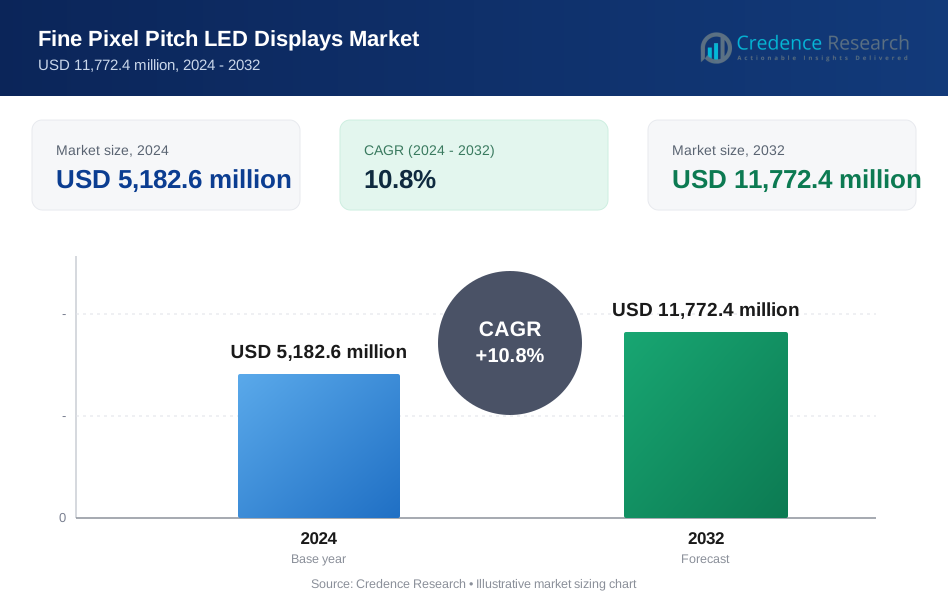
The Fine Pixel Pitch Led Displays Market size was valued at USD 5182.6 million in 2024 and is anticipated to reach USD 11772.4 million by 2032, at a CAGR of 10.8% during the forecast period (2024-2032).
| REPORT ATTRIBUTE | DETAILS |
|---|---|
| Historical Period | 2020-2023 |
| Base Year | 2024 |
| Forecast Period | 2025-2032 |
| Fine Pixel Pitch LED Displays Market Size 2024 | SD 5182.6 million |
| Fine Pixel Pitch LED Displays Market, CAGR | 10.8% |
| Fine Pixel Pitch LED Displays Market Size 2032 | USD 11772.4 million |
Key drivers of market growth include the rising adoption of digital signage, the increasing need for energy-efficient display solutions, and advancements in LED technology. These displays offer significant advantages, such as lower power consumption, longer lifespan, and the ability to produce sharp, detailed visuals even at close viewing distances. Additionally, the growing trend of using fine pixel pitch LED displays in control rooms, broadcasting, and live events is driving demand. The growing emphasis on creating immersive and interactive customer experiences is also contributing to the market's expansion.
Regionally, North America dominates the Fine Pixel Pitch LED Displays Market, driven by the increasing adoption of digital signage and the presence of leading technology players. Europe follows closely, supported by significant investments in smart cities and infrastructure development. The Asia-Pacific region is expected to witness the highest growth, with expanding urbanization, technological advancements, and increasing demand from emerging markets like China and India. The region's rapid adoption of digital technologies and ongoing infrastructure upgrades further boost the market's growth prospects.

Market Insights:
- The Fine Pixel Pitch LED Displays Market is valued at USD 5,182.6 million in 2024 and is expected to reach USD 11,772.4 million by 2032, growing at a CAGR of 10.8%.
- Rising adoption of digital signage in retail, transportation, and corporate sectors is driving the market as it enhances customer engagement with superior image quality.
- The need for energy-efficient solutions boosts demand for fine pixel pitch LED displays, offering power savings while maintaining high-quality visuals.
- Advancements in LED technology, such as micro-LED and OLED integration, enhance brightness, color accuracy, and durability, fueling market growth.
- Increasing use of fine pixel pitch LED displays in control rooms, live events, and broadcasting drives demand for high-resolution, real-time visuals.
- North America holds a 35% market share, driven by high adoption of digital signage and a strong presence of technology companies.
- The Asia-Pacific region holds 25% of the market share, with rapid urbanization and rising disposable income in countries like China and India boosting growth.
Market Drivers:
Growing Adoption of Digital Signage
The Fine Pixel Pitch LED Displays Market is experiencing significant growth due to the increasing adoption of digital signage across multiple sectors, including retail, transportation, and corporate environments. These displays offer superior image quality, enhancing customer engagement and providing a dynamic way to convey information. As businesses seek more impactful advertising solutions, the demand for high-resolution, fine pixel pitch displays has risen, driving market expansion. Digital signage's ability to display vibrant and sharp visuals at close viewing distances makes it an attractive option for businesses looking to improve the customer experience.
- For instance, Samsung's "The Wall" leverages Micro-LED technology to achieve an exceptionally fine pixel pitch of 0.84mm.
Need for Energy-Efficient Solutions
Energy efficiency plays a pivotal role in the growing adoption of fine pixel pitch LED displays. These displays consume less power compared to traditional lighting or display technologies, helping businesses reduce operational costs. The rising focus on sustainability and lowering carbon footprints has led industries to opt for energy-efficient alternatives, further boosting demand for fine pixel pitch LED displays. Their ability to deliver high-quality images while minimizing power consumption is a key factor driving the market.
- For instance, a 55-inch prototype of Sony's Crystal LED Display technology demonstrated significant efficiency by achieving a power consumption of under 70 watts while producing high-contrast, high-realism imagery.
Advancements in LED Technology
Continuous advancements in LED technology have significantly contributed to the growth of the Fine Pixel Pitch LED Displays Market. Innovations such as improved brightness, color accuracy, and durability have enhanced the overall performance of these displays. The integration of cutting-edge technologies, such as micro-LED and OLED, has made fine pixel pitch LED displays more efficient, cost-effective, and adaptable to a wide range of applications. These improvements in technology further drive their adoption across various industries.
Expansion in Control Rooms and Live Events
The increasing use of fine pixel pitch LED displays in control rooms and live events is another crucial driver of market growth. These displays provide sharp, detailed visuals that are essential for monitoring, surveillance, and live broadcasting. Their ability to deliver real-time, high-resolution content in dynamic environments such as sports events, concerts, and command centers makes them indispensable for both operational efficiency and audience engagement. The growing demand for high-quality visuals in such settings is a significant factor driving the Fine Pixel Pitch LED Displays Market.
Market Trends:
Increasing Demand for Interactive and Immersive Experiences
A prominent trend in the Fine Pixel Pitch LED Displays Market is the growing demand for interactive and immersive experiences, particularly in retail and entertainment sectors. Fine pixel pitch displays provide high-resolution visuals that enhance consumer interaction and engagement. Retailers are increasingly leveraging these displays to create interactive environments, enabling customers to experience products in new and dynamic ways. This trend is also evident in entertainment venues, where large-scale LED screens are used to create immersive environments for concerts, sports events, and exhibitions. The ability to deliver crisp, detailed visuals at close viewing distances is driving the adoption of these displays in applications requiring high image quality and interaction.
- For instance, Samsung's The Wall enhances the immersive experience through its advanced display technology, which includes 20-bit processing to deliver exact color mapping with outstanding accuracy.
Shift Towards Modular and Scalable Solutions
Another key trend in the Fine Pixel Pitch LED Displays Market is the shift toward modular and scalable display solutions. Businesses are increasingly opting for customizable and flexible systems that can be adapted to meet specific needs. Fine pixel pitch LED displays are highly modular, allowing for easy scaling from small installations to large, complex systems. This flexibility is particularly beneficial for companies that require displays of various sizes and configurations. With the growing trend of digital signage across various industries, the ability to easily expand and reconfigure display systems makes fine pixel pitch LED displays an attractive solution. The increasing demand for scalable solutions further fuels growth in the market, as it meets the evolving needs of modern enterprises.
- For instance, Leyard's DirectLight X system showcases advanced modularity with its EasyAlign Mounting System, which allows for perfect adjustment of its display cabinets using six-axis alignment features.
Market Challenges Analysis:
High Initial Costs and Installation Complexities
One of the significant challenges in the Fine Pixel Pitch LED Displays Market is the high initial costs associated with purchasing and installing these advanced systems. The sophisticated technology and high-resolution features of fine pixel pitch displays come at a premium price, which may be prohibitive for smaller businesses or organizations with limited budgets. Moreover, the installation process can be complex, requiring skilled labor and specialized equipment, which further adds to the overall expense. These high upfront costs can deter potential buyers from adopting fine pixel pitch LED displays, particularly in price-sensitive markets.
Maintenance and Long-Term Sustainability Issues
Another challenge faced by the Fine Pixel Pitch LED Displays Market is the maintenance and long-term sustainability of these systems. While the technology offers durability, fine pixel pitch displays may still require periodic maintenance to ensure optimal performance over time. Dust, temperature fluctuations, and humidity can impact the longevity and functionality of these displays, leading to increased operational costs. As these systems are deployed in demanding environments, the need for ongoing support, repairs, and replacements can limit their appeal, particularly for industries where long-term operational efficiency is critical.
Market Opportunities:
Expanding Use in Corporate and Control Room Applications
The Fine Pixel Pitch LED Displays Market offers significant opportunities in corporate environments and control rooms. As businesses seek enhanced visual communication tools, fine pixel pitch displays are becoming crucial in monitoring operations, surveillance, and decision-making processes. These displays provide exceptional resolution and clarity, allowing organizations to display detailed data and real-time information in a highly visible manner. Their use in high-end control rooms, financial institutions, and security monitoring applications continues to expand, driven by the need for efficient and accurate information visualization. The growing demand for advanced, high-quality display solutions in critical environments creates substantial growth potential for the market.
Rising Adoption in Smart Cities and Infrastructure Projects
The increasing focus on smart cities and large-scale infrastructure projects presents another opportunity for the Fine Pixel Pitch LED Displays Market. These displays can play a vital role in urban development, providing clear, dynamic information in public spaces, transportation hubs, and smart buildings. Fine pixel pitch displays are particularly well-suited for digital signage in outdoor environments, offering high visibility and weather resistance. With government investments in urbanization and infrastructure upgrades, the demand for advanced display systems in public spaces is set to rise, further driving market growth. As smart city projects continue to gain momentum globally, fine pixel pitch LED displays present a key opportunity for businesses to integrate cutting-edge technology into these developments.
Market Segmentation Analysis:
By Technology
The Fine Pixel Pitch LED Displays Market is segmented by technology, with advancements in micro-LED and OLED playing a critical role in driving market growth. Micro-LED technology offers superior brightness, color accuracy, and efficiency, making it a preferred choice for high-performance displays. OLED technology, known for its deep blacks and vibrant colors, is gaining traction in premium applications where visual quality is paramount. Both technologies contribute to the increasing adoption of fine pixel pitch LED displays, particularly in sectors that demand high-resolution and energy-efficient solutions.
- For instance, LG's LAPE series showcases innovation with a flexible LED display module that supports a curvature up to 1000R, allowing for creatively designed, immersive installations.
By Application
The Fine Pixel Pitch LED Displays Market is widely used in various applications, including retail, corporate environments, control rooms, broadcasting, and live events. In retail, digital signage solutions enhance customer experience through dynamic content. Control rooms benefit from high-resolution displays for monitoring and decision-making. Broadcasting and live events use these displays to provide real-time, sharp visuals for large audiences. As the demand for immersive and interactive experiences grows, these applications continue to expand, further driving market demand.
- For instance, Barco's OverView NSL-5521 display for control rooms is engineered to provide a full HD native resolution of 1920 x 1080 pixels.
By Size
The Fine Pixel Pitch LED Displays Market is also segmented by size, ranging from small to large-format displays. Small and medium-sized displays are commonly used for indoor applications, such as retail stores, exhibition halls, and corporate offices. Large-format displays are increasingly used for outdoor digital signage and large-scale events where visibility from a distance is crucial. The demand for both small and large formats is rising as businesses seek to improve their visibility and engagement with audiences across different environments.
Segmentations:
By Technology
- Micro-LED
- OLED
By Application
- Digital Signage
- Control Rooms
- Broadcasting
- Live Events
- Retail
- Corporate Environments
By Size
- Small-Size Displays
- Medium-Size Displays
- Large-Size Displays
By End-User Industry
- Retail
- Transportation
- Corporate
- Entertainment
- Government
- Healthcare
- Education
By Region
- North America
- U.S.
- Canada
- Mexico
- Europe
- Germany
- France
- U.K.
- Italy
- Spain
- Rest of Europe
- Asia Pacific
- China
- Japan
- India
- South Korea
- South-east Asia
- Rest of Asia Pacific
- Latin America
- Brazil
- Argentina
- Rest of Latin America
- Middle East & Africa
- GCC Countries
- South Africa
- Rest of the Middle East and Africa
Regional Analysis:
North America: Technological Adoption Driving Growth
North America accounts for a significant share of the Fine Pixel Pitch LED Displays Market, holding 35% of the total market value. This dominance is driven by early adoption of advanced technologies and high demand for digital signage solutions. The region benefits from a well-established infrastructure and a strong presence of leading technology companies. The growing need for high-quality visual displays in sectors such as retail, transportation, and entertainment fuels market growth. With a focus on enhancing customer engagement and operational efficiency, businesses across the U.S. and Canada are increasingly integrating fine pixel pitch LED displays into their systems. The demand is expected to remain strong as both public and private sectors continue investing in digital signage and innovative display technologies.
Europe: Smart Infrastructure and Commercial Sector Expansion
Europe holds a 30% share of the Fine Pixel Pitch LED Displays Market, driven by increasing investments in smart cities and commercial infrastructure. The region is witnessing significant demand for high-resolution, fine pixel pitch displays in digital signage applications across airports, shopping malls, and corporate environments. As governments and businesses focus on enhancing public spaces and urban infrastructure, fine pixel pitch LED displays offer a valuable solution for providing clear and dynamic content. The ongoing adoption of these displays in control rooms, transportation hubs, and commercial venues further supports their increasing presence in the market.
Asia-Pacific: Rapid Growth in Emerging Economies
Asia-Pacific is the fastest-growing region in the Fine Pixel Pitch LED Displays Market, with a market share of 25%. This growth is driven by rapid urbanization, technological advancements, and increasing demand for high-quality display systems in emerging markets such as China, India, and Japan. The expanding middle class and rising disposable income contribute to the growing adoption of fine pixel pitch LED displays. Furthermore, the region's infrastructure development, particularly in smart cities and public spaces, presents significant opportunities for the market. With technological capabilities improving, Asia-Pacific is expected to lead the market's expansion in the coming years.
Key Player Analysis:
- Leyard
- GQY
- Unilumin
- Liantronics
- Absen
- Barco
- VTRON
- SANSI
- AOTO Electronics
- Kingsun Optoelectronic (Coleder)
- Chip Optech
- Elec-Tech Inteational (Retop)
- Triolion
Competitive Analysis:
The Fine Pixel Pitch LED Displays Market is competitive, with key players like Samsung Electronics, LG Electronics, Leyard, and Unilumin leading the industry through innovation and robust product portfolios. These companies focus on advancing micro-LED and OLED technologies to offer high-resolution, energy-efficient displays that meet the growing demand across various sectors, including retail, entertainment, and control rooms. Smaller players are gaining traction in niche markets, but larger companies dominate with significant investments in R&D and strategic partnerships. Mergers and acquisitions are common strategies to expand market share and enter new regions, intensifying competition. The rising need for high-quality displays continues to drive innovation and competition within the market.
Recent Developments:
- In July 2025, Leyard and the Saudi EHG Group officially launched Leyard Middle East, a new joint venture focused on high-end LED displays.
- In April 2025, Liantronics announced a new UK distribution partnership with Solstice AV to make its indoor and outdoor LED products available to resellers in the region.
- In June 2025, Absen announced it would unveil a new product for rental and staging display technologies at InfoComm 2025 in Orlando, Florida.
Market Concentration & Characteristics:
The Fine Pixel Pitch LED Displays Market is moderately concentrated, with a few dominant players holding significant market share. Companies such as Samsung Electronics, LG Electronics, Leyard, and Unilumin lead the industry due to their technological advancements and extensive distribution networks. These players focus on offering high-quality, energy-efficient products tailored to various applications, from retail to entertainment. The market is characterized by rapid technological innovation, particularly in micro-LED and OLED technologies, and a growing demand for high-resolution displays. Smaller players target niche markets and regional applications, but larger companies continue to set the pace through significant investments in R&D and strategic collaborations. The competitive landscape is dynamic, with ongoing mergers, acquisitions, and partnerships shaping the market's evolution.
Report Coverage:
The research report offers an in-depth analysis based on Technology, Application, Size, End-User Industry and Region. It details leading market players, providing an overview of their business, product offerings, investments, revenue streams, and key applications. Additionally, the report includes insights into the competitive environment, SWOT analysis, current market trends, as well as the primary drivers and constraints. Furthermore, it discusses various factors that have driven market expansion in recent years. The report also explores market dynamics, regulatory scenarios, and technological advancements that are shaping the industry. It assesses the impact of external factors and global economic changes on market growth. Lastly, it provides strategic recommendations for new entrants and established companies to navigate the complexities of the market.
Future Outlook:
- The Fine Pixel Pitch LED Displays Market is expected to witness significant growth as demand for high-resolution displays continues to rise across multiple industries.
- Advancements in micro-LED and OLED technologies will enhance display brightness, color accuracy, and energy efficiency, driving innovation in the market.
- The increasing adoption of digital signage solutions in retail, corporate environments, and transportation will fuel the demand for fine pixel pitch LED displays.
- Fine pixel pitch displays will see greater use in control rooms, live events, and broadcasting, where high-quality, real-time visuals are essential.
- The growing trend of creating immersive and interactive customer experiences will further expand market opportunities.
- Energy efficiency and sustainability concerns will lead to higher adoption rates of fine pixel pitch LED displays, offering businesses an eco-friendly solution.
- The market will continue to grow as industries like healthcare, education, and government seek more efficient visual communication solutions.
- The demand for large-format displays in outdoor environments and large-scale events will increase, expanding the application scope of fine pixel pitch LED technology.
- Asia-Pacific will emerge as a key growth region, driven by urbanization and increasing disposable incomes in emerging markets like China and India.
- Strategic partnerships, mergers, and acquisitions will shape the competitive landscape, as companies look to expand their technological capabilities and regional reach.
Request a Free Sample
Fill in your details and we'll send you a free sample report.
- Sample data tables & charts
- Research methodology
Market Dynamics
Growing Adoption of Digital Signage
The increasing use of digital signage in retail, transportation, and corporate sectors is driving demand for fine pixel pitch LED displays, as these solutions offer superior image quality and enhance customer engagement through dynamic, high-resolution visuals.
Need for Energy-Efficient Solutions
Businesses are seeking display technologies that reduce operational costs and support sustainability goals; fine pixel pitch LED displays consume less power than traditional alternatives while maintaining high-quality output, making them attractive for energy-conscious organizations.
Advancements in LED Technology
Continuous improvements in micro-LED and OLED technologies have enhanced brightness, color accuracy, and durability, making fine pixel pitch LED displays more efficient and suitable for a wider range of high-performance applications.
Expansion in Control Rooms and Live Events
The demand for real-time, high-resolution visuals in control rooms, live events, and broadcasting is fueling market growth, as these environments require sharp, detailed displays for monitoring, surveillance, and audience engagement.
Increasing Demand for Immersive and Interactive Experiences
Retailers and entertainment venues are leveraging fine pixel pitch LED displays to create interactive and immersive environments, driving adoption as businesses seek to differentiate customer experiences with high-quality, close-viewing visuals.
Need a Custom Version of This Report?
Tailor the scope, geography, or segments to your exact requirements.
- Custom geography or segment scope
- Direct access to our analyst team
Frequently Asked Questions
What is the current market size for Fine Pixel Pitch LED Displays, and what is its projected size in 2032?
At what Compound Annual Growth Rate is the Fine Pixel Pitch LED Displays market projected to grow between 2024 and 2032?
What are the primary factors fueling the growth of the Fine Pixel Pitch LED Displays market?
Who are the leading companies in the Fine Pixel Pitch LED Displays market?
Table of Content
Chapter 1 Market Segmentation
- 1.1 Segmentation Framework
- 1.1.1 Product and Service Classification
- 1.1.2 Application and End-Use Classification
- 1.1.3 Technology and Solution Classification
- 1.1.4 Customer and Distribution Channel Classification
- 1.1.5 Geographic Segmentation
- 1.1.6 Market Segment Definitions and Boundaries
- 1.2 By Size
- 1.2.1 Small-Size Displays
- 1.2.2 Medium-Size Displays
- 1.2.3 Large-Size Displays
- 1.3 By Technology
- 1.3.1 Micro-LED
- 1.3.2 OLED
- 1.4 By Application
- 1.4.1 Digital Signage
- 1.4.2 Control Rooms
- 1.4.3 Broadcasting
- 1.4.4 Live Events
- 1.4.5 Retail
- 1.4.6 Corporate Environments
- 1.5 By End-User Industry
- 1.5.1 Retail
- 1.5.2 Transportation
- 1.5.3 Corporate
- 1.5.4 Entertainment
- 1.5.5 Government
- 1.5.6 Healthcare
- 1.5.7 Education
Chapter 2 Introduction
- 2.1 Report Objectives and Scope
- 2.2 Product Definition and Industry Terminology
- 2.3 Market Inclusions and Exclusions
- 2.4 Research Process
- 2.4.1 Primary Research and Expert Interviews
- 2.4.2 Secondary Research and Source Review
- 2.4.3 Top-Down and Bottom-Up Estimation
- 2.4.4 Data Triangulation and Verification
- 2.5 Market Size Measurement Basis
- 2.5.1 2024: USD 5,182.6 million → 2032: USD 11,772.4 million
- 2.6 Historical and Forecast Reference Periods
- 2.6.1 Base Year: 2024
- 2.6.2 Forecast Period: 2024-2032
- 2.7 Research Assumptions and Limitations
Chapter 3 Executive Summary
- 3.1 Market Snapshot and Key Findings
- 3.2 Base-Year Market Size, 2024
- 3.3 Forecast Market Size, 2032
- 3.4 Revenue and Volume Growth Outlook
- 3.5 Key Demand and Supply Indicators
- 3.6 Leading Market Segments
- 3.7 Fastest-Growing Market Opportunities
- 3.8 Regional Performance Highlights
- 3.9 Technology and Industry Transformation
- 3.10 Competitive Landscape Summary
- 3.11 Analyst View and Strategic Implications
Chapter 4 Global Fine Pixel Pitch LED Displays Market Trends and Developments
- 4.1 Historical Industry Development
- 4.2 Recent Market Trends and Developments
- 4.3 Demand and Customer Behavior Trends
- 4.4 Technology and Product Innovation
- 4.5 Artificial Intelligence, Automation and Digitalization
- 4.6 Local Manufacturing and Supply Chain Realignment
- 4.7 Industry Partnerships, Mergers and Acquisitions
- 4.8 Sustainability and Circular Economy Developments
- 4.9 Government and Private Sector Investment Trends
- 4.10 Emerging Business Models and Commercialization
- 4.11 Industry Developments and Announcements
Chapter 5 Global Fine Pixel Pitch LED Displays Market Production, Supply and Demand Analysis
- 5.1 Demand Trend and Consumption Analysis
- 5.2 Demand Forecast, 2024-2032
- 5.3 Production and Output Trend
- 5.4 Production and Output Forecast, 2024-2032
- 5.5 Installed Capacity and Capacity Utilization
- 5.6 Company-Wise Production Plants and Statistics
- 5.6.1 Installed Production Capacity
- 5.6.2 Actual Production
- 5.6.3 Planned Capacity and Expansion Targets
- 5.7 Supply Chain Structure and Procurement Trends
- 5.8 Supply-Demand Gap and Bottlenecks
- 5.9 Import Dependence and Sourcing Structure
- 5.10 Contract Manufacturing and Outsourcing
- 5.11 Regional Supply and Demand Concentration
Chapter 6 Global Fine Pixel Pitch LED Displays Market Pricing Analysis
- 6.1 Pricing Structure and Measurement
- 6.2 Historical Pricing Trends
- 6.3 Pricing Outlook, 2024-2032
- 6.4 Average Selling Price and Unit Economics
- 6.5 Pricing by Product and Market Segment
- 6.6 Geographic Pricing Differences
- 6.7 Key Input, Energy, Labor and Logistics Costs
- 6.8 Contract Pricing and Purchasing Models
- 6.9 Pricing Sensitivity and Competitive Positioning
- 6.10 Price, Margin and Profitability Implications
Chapter 7 Global Fine Pixel Pitch LED Displays Market Dynamics
- 7.1 Market Growth Drivers
- 7.1.1 Demand-Side Drivers
- 7.1.2 Technology and Innovation Drivers
- 7.1.3 Infrastructure and Investment Drivers
- 7.1.4 Regulatory and Policy Drivers
- 7.2 Market Restraints
- 7.2.1 Cost and Affordability Constraints
- 7.2.2 Technology and Adoption Barriers
- 7.2.3 Supply Chain and Operational Constraints
- 7.3 Market Challenges
- 7.3.1 Competitive Pressure and Margin Erosion
- 7.3.2 Skills, Infrastructure and Implementation Gaps
- 7.4 Emerging Market Opportunities
- 7.5 Market Dynamics Impact and Time-Horizon Assessment
Chapter 8 Global Fine Pixel Pitch LED Displays Value Chain Analysis
- 8.1 Industry Value Chain Overview
- 8.2 Upstream Suppliers and Critical Inputs
- 8.3 Technology and Component Providers
- 8.4 Manufacturing or Service Delivery
- 8.5 Distribution, Channel Partners and Integrators
- 8.6 Downstream Applications and End Users
- 8.7 Value Addition and Profit Pools
- 8.8 Vertical Integration and Outsourcing
- 8.9 Supplier Concentration and Risk
- 8.10 Supply Chain Localization and Resilience
Chapter 9 Global Fine Pixel Pitch LED Displays Market Regulations and Policies
- 9.1 Relevant Laws, Standards and Compliance Frameworks
- 9.2 Product, Service, Safety and Quality Requirements
- 9.3 Government Policies, Incentives and Subsidies
- 9.4 Imports, Exports and Trade Barriers
- 9.5 Public Procurement and Local Content Requirements
- 9.6 Environmental and Sustainability Compliance
- 9.7 Upcoming Policy Changes and Market Implications
Chapter 10 Global Fine Pixel Pitch LED Displays Market Hotspots and Opportunities
- 10.1 Market Opportunity Mapping and Growth Hotspots
- 10.2 High-Growth Applications and Customer Groups
- 10.3 Underserved Markets and White-Space Opportunities
- 10.4 Emerging Technology and Product Opportunities
- 10.5 New Capacity and Investment Hotspots
- 10.6 Market Entry and Expansion Opportunities
- 10.7 Distribution and Partnership Opportunities
- 10.8 Near-Term and Long-Term Commercial Potential
- 10.9 Opportunity Attractiveness and Execution Risks
Chapter 11 Global Fine Pixel Pitch LED Displays Market Outlook, 2024-2032
- 11.1 Market Size and Analysis
- 11.1.1 Revenue (Market Measurement: 2024: USD 5,182.6 million → 2032: USD 11,772.4 million)
- 11.1.2 Market Volume and Quantity Sold
- 11.1.3 Historical Market Size
- 11.1.4 Base-Year Market Size, 2024
- 11.2 Market Forecast, 2024-2032
- 11.2.1 Revenue Forecast to 2032
- 11.2.2 Volume Forecast to 2032
- 11.2.3 CAGR and Year-on-Year Growth
- 11.2.4 Incremental Revenue Opportunity
- 11.3 Forecast Assumptions and Scenario Analysis
- 11.3.1 Base-Case Forecast
- 11.3.2 Optimistic and Conservative Scenarios
- 11.3.3 Technology, Pricing and Policy Sensitivities
- 11.4 Market Attractiveness and Growth Outlook
Chapter 12 Global Fine Pixel Pitch LED Displays Market Segmentation and Outlook
- 12.1 Segmentation Summary and Market Shares, 2024
- 12.2 Largest and Fastest-Growing Segments
- 12.3 By Size - Market Size and Forecast, 2024-2032
- 12.3.1 Segment Definition and Scope
- 12.3.2 Historical Market Size
- 12.3.3 Revenue Forecast, 2024-2032
- 12.3.4 Volume Forecast, 2024-2032
- 12.3.5 Base-Year Market Share, 2024
- 12.3.6 Segment CAGR and Growth Drivers
- 12.3.7 Subsegment Market Size and Forecast
- 12.3.7.1 Small-Size Displays
- 12.3.7.2 Medium-Size Displays
- 12.3.7.3 Large-Size Displays
- 12.3.8 Subsegment Pricing and Adoption Trends
- 12.3.9 Leading Suppliers and Competition
- 12.3.10 Regional Demand and Opportunities
- 12.4 By Technology - Market Size and Forecast, 2024-2032
- 12.4.1 Segment Definition and Scope
- 12.4.2 Historical Market Size
- 12.4.3 Revenue Forecast, 2024-2032
- 12.4.4 Volume Forecast, 2024-2032
- 12.4.5 Base-Year Market Share, 2024
- 12.4.6 Segment CAGR and Growth Drivers
- 12.4.7 Subsegment Market Size and Forecast
- 12.4.7.1 Micro-LED
- 12.4.7.2 OLED
- 12.4.8 Subsegment Pricing and Adoption Trends
- 12.4.9 Leading Suppliers and Competition
- 12.4.10 Regional Demand and Opportunities
- 12.5 By Application - Market Size and Forecast, 2024-2032
- 12.5.1 Segment Definition and Scope
- 12.5.2 Historical Market Size
- 12.5.3 Revenue Forecast, 2024-2032
- 12.5.4 Volume Forecast, 2024-2032
- 12.5.5 Base-Year Market Share, 2024
- 12.5.6 Segment CAGR and Growth Drivers
- 12.5.7 Subsegment Market Size and Forecast
- 12.5.7.1 Digital Signage
- 12.5.7.2 Control Rooms
- 12.5.7.3 Broadcasting
- 12.5.7.4 Live Events
- 12.5.7.5 Retail
- 12.5.7.6 Corporate Environments
- 12.5.8 Subsegment Pricing and Adoption Trends
- 12.5.9 Leading Suppliers and Competition
- 12.5.10 Regional Demand and Opportunities
- 12.6 By End-User Industry - Market Size and Forecast, 2024-2032
- 12.6.1 Segment Definition and Scope
- 12.6.2 Historical Market Size
- 12.6.3 Revenue Forecast, 2024-2032
- 12.6.4 Volume Forecast, 2024-2032
- 12.6.5 Base-Year Market Share, 2024
- 12.6.6 Segment CAGR and Growth Drivers
- 12.6.7 Subsegment Market Size and Forecast
- 12.6.7.1 Retail
- 12.6.7.2 Transportation
- 12.6.7.3 Corporate
- 12.6.7.4 Entertainment
- 12.6.7.5 Government
- 12.6.7.6 Healthcare
- 12.6.7.7 Education
- 12.6.8 Subsegment Pricing and Adoption Trends
- 12.6.9 Leading Suppliers and Competition
- 12.6.10 Regional Demand and Opportunities
- 12.7 Segment Growth Comparison
- 12.8 Segment Attractiveness and Priority Matrix
Chapter 13 Global Fine Pixel Pitch LED Displays End-Use and Application Market Outlook
- 13.1 End-Use Industry and Customer Demand Structure
- 13.2 Leading Applications and Customer Groups
- 13.3 End-Use Market Size, Share and Forecast
- 13.4 Major End-Use Industry Deep Dives
- 13.4.1 Customer Requirements and Use Cases
- 13.4.2 Demand and Replacement Cycles
- 13.4.3 Technical and Regulatory Considerations
- 13.4.4 Purchasing and Procurement Models
- 13.4.5 Leading Vendors and Distribution Channels
- 13.4.6 Forecast and Commercial Opportunities
- 13.5 Emerging Applications and Cross-Segment Demand
- 13.6 End-Use Industry Investment Priorities
Chapter 14 Global Fine Pixel Pitch LED Displays Geographic Market Outlook, 2024-2032
- 14.1 Regional Market Size and Share, 2024
- 14.2 Regional Market Forecast, 2024-2032
- 14.3 Regional Pricing, Production and Demand Differences
- 14.4 North America
- 14.4.1 United States
- 14.4.2 Canada
- 14.4.3 Mexico
- 14.5 Europe
- 14.5.1 Germany
- 14.5.2 France
- 14.5.3 Italy
- 14.5.4 United Kingdom
- 14.5.5 Spain
- 14.5.6 Poland
- 14.5.7 Russia
- 14.5.8 Netherlands
- 14.5.9 Belgium
- 14.5.10 Sweden
- 14.5.11 Denmark
- 14.5.12 Norway
- 14.5.13 Rest of Europe
- 14.6 Asia Pacific
- 14.6.1 China
- 14.6.2 India
- 14.6.3 Japan
- 14.6.4 South Korea
- 14.6.5 Thailand
- 14.6.6 Indonesia
- 14.6.7 Vietnam
- 14.6.8 Malaysia
- 14.6.9 Australia
- 14.6.10 Rest of Asia Pacific
- 14.7 Latin America
- 14.7.1 Brazil
- 14.7.2 Argentina
- 14.7.3 Colombia
- 14.7.4 Chile
- 14.7.5 Rest of Latin America
- 14.8 Middle East
- 14.8.1 Saudi Arabia
- 14.8.2 United Arab Emirates
- 14.8.3 Turkey
- 14.8.4 Israel
- 14.8.5 Iran
- 14.8.6 Rest of the Middle East
- 14.9 Africa
- 14.9.1 South Africa
- 14.9.2 Egypt
- 14.9.3 Nigeria
- 14.9.4 Morocco
- 14.9.5 Rest of Africa
- 14.10 Regional Investment, Policy and Supply Chain Differences
- 14.11 Regional Competitive Landscape
- 14.12 Geographic Growth Hotspots
Chapter 15 Global Fine Pixel Pitch LED Displays Technology, Innovation and Sustainability Outlook
- 15.1 Technology Landscape and Maturity
- 15.2 Product, Process and Service Innovation
- 15.3 AI, Automation and Digital Tools in the Industry
- 15.4 Technology Adoption and Performance Benchmarking
- 15.5 Innovation Pipeline and R&D Investment
- 15.6 Patent and Intellectual Property Trends
- 15.7 Energy Efficiency and Resource Management
- 15.8 Sustainability, Recycling and Circularity
- 15.9 Technology Roadmap, 2024-2032
- 15.10 Risks of Obsolescence and Technology Substitution
Chapter 16 Global Fine Pixel Pitch LED Displays Market Key Strategic Imperatives
- 16.1 Growth and Market Entry Priorities
- 16.2 High-Return Products and Segments
- 16.3 Pricing, Profitability and Cost Optimization
- 16.4 Technology Investment and Product Differentiation
- 16.5 Supply Chain Localization and Resilience
- 16.6 Distribution and Customer Acquisition
- 16.7 Partnership, Acquisition and Capacity Strategy
- 16.8 Regional Expansion Priorities
- 16.9 Short-, Medium- and Long-Term Actions
Chapter 17 Competition Outlook
- 17.1 Industry Competition Characteristics
- 17.2 Market Structure and Concentration
- 17.3 Market Share and Competitive Positioning, 2024
- 17.4 Company-Wise Revenue and Product Benchmarking
- 17.5 Production and Service Capacity Benchmarking
- 17.6 Technology, Pricing and Differentiation
- 17.7 Regional Footprint and Distribution Strength
- 17.8 Mergers, Acquisitions and Strategic Alliances
- 17.9 New Entrants and Competitive Threats
- 17.10 Porter's Five Forces and Industry Attractiveness
- 17.11 Competitive Outlook, 2024-2032
Chapter 18 Company Profiles
- 18.1 Company Coverage and Selection Criteria
- 18.2 Samsung Electronics
- 18.2.1 Business Description
- 18.2.2 Company Ownership and Geographic Presence
- 18.2.3 Product and Service Portfolio
- 18.2.4 Manufacturing and Operating Footprint
- 18.2.5 Production Capacity and Expansion Plans
- 18.2.6 Financial Performance and Investment
- 18.2.7 Market Share and Competitive Position
- 18.2.8 Technology and Innovation Capabilities
- 18.2.9 Strategic Alliances or Partnerships
- 18.2.10 Recent Developments
- 18.2.11 Growth Strategy and Outlook
- 18.3 LG Electronics
- 18.4 Leyard
- 18.5 Unilumin
- 18.6 Liantronics
- 18.7 Absen
- 18.8 Barco
- 18.9 AOTO Electronics
- 18.10 VTRON
- 18.11 SANSI
- 18.12 Other Relevant Market Participants
Note: Every listed company is profiled on the structure shown under the first company. The company list is preliminary and may change based on research findings, market developments, data availability and client requirements.
Chapter 19 Disclaimer
- 19.1 Research and Forecast Disclaimer
- 19.2 Data Source and Estimation Limitations
Note: The depth of individual sections depends on data availability for this market. Volume, capacity, trade and other unit-based metrics are included where applicable.

