Market Overview:
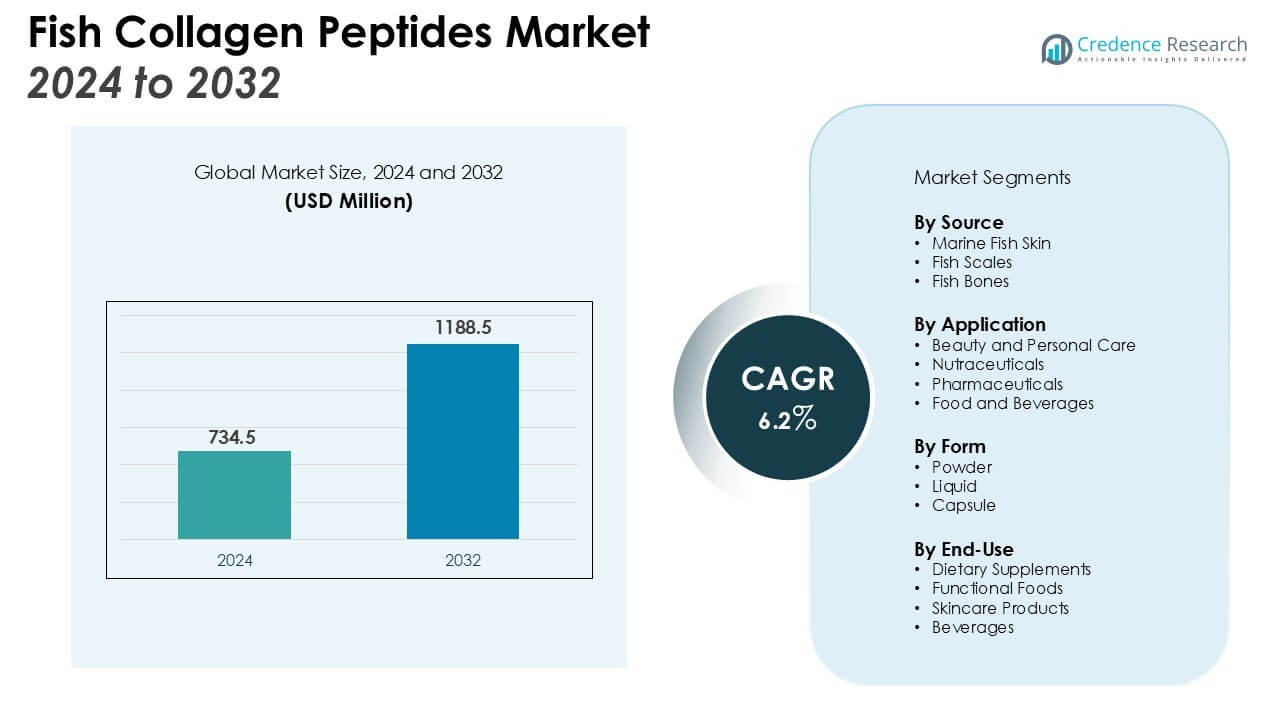
The Fish Collagen Peptides Market size was valued at USD 734.5 million in 2024 and is anticipated to reach USD 1188.5 million by 2032, at a CAGR of 6.2% during the forecast period (2024-2032).
| REPORT ATTRIBUTE | DETAILS |
|---|---|
| Historical Period | 2020-2023 |
| Base Year | 2024 |
| Forecast Period | 2025-2032 |
| Fish Collagen Peptides Market Size 2024 | USD 734.5 Million |
| Fish Collagen Peptides Market, CAGR | 6.2% |
| Fish Collagen Peptides Market Size 2032 | USD 1188.5 Million |
Key drivers of the market include the growing trend of health and wellness, particularly in the beauty and personal care industries, where fish collagen peptides are utilized for their anti-aging and skin-enhancing properties. Additionally, the demand for natural and sustainable sources of collagen is boosting market growth, with fish collagen being preferred over bovine or porcine alternatives due to its bioavailability and sustainability. The increasing popularity of collagen-based supplements further accelerates market expansion. Moreover, fish collagen peptides are gaining traction in the nutraceutical and pharmaceutical sectors for their joint health benefits.
Regionally, North America and Europe hold significant shares in the Fish Collagen Peptides Market, driven by a high demand for collagen supplements in the U.S., Canada, Germany, and the UK. The Asia-Pacific region is expected to experience the highest growth, with increasing disposable income, rising awareness of collagen benefits, and a growing interest in beauty and wellness trends, particularly in countries like China and Japan. The expanding presence of key market players in this region further fuels growth prospects.
Market Insights:
- The Fish Collagen Peptides Market was valued at USD 734.5 million in 2024 and is expected to reach USD 1188.5 million by 2032, growing at a CAGR of 6.2%.
- The market is driven by increasing demand for beauty products, as fish collagen peptides improve skin elasticity and reduce wrinkles.
- Rising health and wellness awareness boosts the demand for collagen-based supplements, supporting joint health and overall well-being.
- The preference for sustainable, bioavailable fish collagen over bovine or porcine alternatives strengthens the market’s growth.
- Fish collagen peptides are gaining traction in nutraceuticals and pharmaceuticals, particularly in joint health supplements and treatments for osteoarthritis.
- North America holds a 35% market share, driven by high demand for collagen products in the U.S. and Canada for beauty and health benefits.
- The Asia-Pacific region, with a 25% market share, is expected to grow rapidly due to rising disposable income and increasing health consciousness.
Market Drivers:
Growing Demand for Beauty and Personal Care Products
The Fish Collagen Peptides Market benefits from the increasing consumer demand for beauty and personal care products. Consumers increasingly seek natural and effective ingredients to enhance skin health, combat signs of aging, and improve overall appearance. Fish collagen peptides are favored in this space due to their ability to promote skin elasticity, reduce wrinkles, and provide a youthful appearance. These benefits contribute to the growing preference for collagen-based products in skincare, cosmetics, and anti-aging treatments.
- For instance, the company Vital Proteins provides a Marine Collagen product which delivers 12 grams of collagen peptides per serving, formulated to support skin hydration and elasticity.
Rising Awareness of Health and Wellness Benefits
Consumers are becoming more health-conscious, driving the demand for functional foods and supplements. Fish collagen peptides are recognized for their positive effects on joint health, bone strength, and overall well-being. As individuals adopt healthier lifestyles, the need for high-quality, bioavailable collagen has increased. This trend in health and wellness continues to expand the market for collagen-based products, further reinforcing its growth.
Preference for Natural and Sustainable Sources
Sustainability plays a crucial role in the Fish Collagen Peptides Market. With growing concerns over the environmental impact of animal-derived collagen sources, consumers are opting for fish collagen as a more sustainable and ethical alternative. Fish collagen peptides have superior bioavailability, making them more effective and easily absorbed by the body compared to bovine or porcine collagen. This preference for natural and sustainable products strengthens its market presence.
Expanding Use in Nutraceuticals and Pharmaceuticals
The growing recognition of the health benefits of fish collagen peptides has expanded its use beyond beauty and wellness sectors. It is now gaining traction in the nutraceutical and pharmaceutical industries, particularly in joint health supplements and treatments for osteoarthritis. Its ability to support cartilage regeneration and reduce inflammation makes it highly sought after for both preventive and therapeutic purposes, fueling growth in these sectors.
- For instance, on March 18, 2023, PB Leiner held the inauguration for its fish collagen peptides plant in Hainan, China, to produce its SOLUGEL® peptides and meet the rising demand from 2 key sectors, pharmaceuticals and nutraceuticals.
Market Trends:
Increasing Adoption of Collagen-Based Supplements for Joint Health
The Fish Collagen Peptides Market is witnessing an increasing trend in the adoption of collagen-based supplements for joint health. These peptides are becoming a key ingredient in supplements aimed at improving joint mobility, flexibility, and reducing the symptoms of osteoarthritis. With rising awareness of the benefits of collagen in preventing and treating joint-related issues, particularly among aging populations, there is a growing demand for these products. Fish collagen peptides, due to their high bioavailability, are particularly effective in improving joint health and supporting cartilage regeneration, which further propels their market demand.
- For instance, a clinical study on Naticol®, a fish collagen peptide product, used a daily oral dose of 10g for 8 weeks in individuals with knee osteoarthritis, noting the supplement's potential to alleviate pain and enhance lower body function.
Expansion of Collagen-Based Products in the Functional Foods Sector
Functional foods are increasingly incorporating fish collagen peptides due to their health benefits and consumer demand for natural, bioactive ingredients. These peptides are being used in a variety of functional foods, including beverages, snacks, and protein bars, providing an easy way for consumers to integrate collagen into their daily diet. The growing trend of personalized nutrition and the focus on preventive healthcare has also accelerated this shift, with more consumers opting for foods that offer both nutritional value and additional health benefits. The expanding presence of collagen peptides in this sector supports the Fish Collagen Peptides Market's growth as manufacturers innovate to meet changing consumer preferences.
- For instance, Nitta Gelatin Inc. provides high-quality fish collagen peptides for health foods with a low average molecular weight of 5,000, which improves absorption and effectiveness in functional food and beverage applications.
Market Challenges Analysis:
High Cost of Fish Collagen Peptides Production
One of the significant challenges facing the Fish Collagen Peptides Market is the high cost of production. The process of extracting collagen peptides from fish, particularly from high-quality sources, involves complex steps that contribute to elevated costs. This expense can limit the affordability of fish collagen products, particularly in emerging markets where price sensitivity is higher. Despite its popularity in premium markets, the high production cost could hinder widespread adoption and limit market penetration in price-sensitive regions.
Regulatory and Ethical Concerns Around Sourcing
The Fish Collagen Peptides Market faces challenges related to the ethical and regulatory concerns surrounding the sourcing of raw materials. Consumers and regulatory bodies are increasingly focused on the sustainability and traceability of fish-derived products. Overfishing, environmental impact, and the need for transparency in sourcing practices are prominent issues that could restrict the growth of the market. Companies must ensure responsible sourcing practices and comply with increasing regulatory standards, which may lead to higher operational costs and affect market dynamics.
Market Opportunities:
Expansion in Emerging Markets with Growing Health Consciousness
The Fish Collagen Peptides Market has significant growth opportunities in emerging markets, where rising disposable incomes and increasing health consciousness are driving demand for functional ingredients. Consumers in regions such as Asia-Pacific, Latin America, and Africa are becoming more aware of the benefits of collagen for skin, joint, and overall health. This trend presents an opportunity for companies to expand their product offerings and cater to the growing middle-class population seeking natural and effective wellness solutions. The rising demand for collagen-based supplements and functional foods in these regions further supports market expansion.
Innovation in Product Offerings and Applications
There is an opportunity for growth in the Fish Collagen Peptides Market through product innovation and the exploration of new applications. Companies can focus on developing new delivery formats, such as beverages, snacks, and cosmetics, to appeal to a wider consumer base. The use of fish collagen peptides in personalized nutrition and beauty regimens presents untapped potential. As consumer preferences shift toward natural and sustainable products, the market has opportunities to offer innovative, bioactive ingredients that meet these evolving demands, providing a competitive edge in the expanding wellness industry.
Market Segmentation Analysis:
By Source
The market is primarily driven by marine-based sources, which include fish skin, scales, and bones. These sources are preferred due to their higher collagen content and superior bioavailability compared to other animal-derived collagen. Marine collagen offers better absorption rates, making it a popular choice for consumers seeking effective health benefits. It is expected that the demand for fish-derived collagen will continue to rise, driven by its sustainable sourcing and effectiveness.
- For instance, the Japanese producer Nippi Collagen is known for its TruMarine™ Collagen, which is produced from 100% fish skin and scales, ensuring a pure and traceable marine source.
By Application
The Fish Collagen Peptides Market finds its primary applications in the beauty and personal care sectors, particularly for anti-aging and skin health. Collagen is also widely used in the nutraceutical industry for joint health and bone strength. The increasing trend of preventive healthcare has pushed the market growth in supplements for improving skin elasticity and reducing wrinkles. Additionally, its application in pharmaceutical products for osteoarthritis and other joint-related issues is expanding, with greater adoption seen across various demographics.
- For instance, a clinical study on GELITA's FORTIGEL® involved 180 physically active individuals and found that a daily supplement of just 5 grams significantly reduced activity-related knee joint pain.
By Form
The market is segmented into powdered, liquid, and capsule forms. Powdered collagen is the most widely used format due to its versatility and easy integration into beverages and food products. Liquid collagen follows as it offers quicker absorption, while capsules are favored by consumers seeking convenience. Each form addresses different consumer preferences, contributing to the overall growth of the Fish Collagen Peptides Market.
Segmentations:
By Source
- Marine Fish Skin
- Fish Scales
- Fish Bones
By Application
- Beauty and Personal Care
- Nutraceuticals
- Pharmaceuticals
- Food and Beverages
By Form
- Powder
- Liquid
- Capsule
By End-Use
- Dietary Supplements
- Functional Foods
- Skincare Products
- Beverages
By Region
- North America
- U.S.
- Canada
- Mexico
- Europe
- Germany
- France
- U.K.
- Italy
- Spain
- Rest of Europe
- Asia Pacific
- China
- Japan
- India
- South Korea
- South-east Asia
- Rest of Asia Pacific
- Latin America
- Brazil
- Argentina
- Rest of Latin America
- Middle East & Africa
- GCC Countries
- South Africa
- Rest of the Middle East and Africa
Regional Analysis:
North America: Leading Market with Strong Demand for Health and Beauty Products
North America holds a dominant share of 35% in the Fish Collagen Peptides Market, driven by the high demand for health and beauty products. The U.S. and Canada have well-established markets for dietary supplements and skincare products, where collagen peptides are increasingly used for anti-aging and joint health benefits. The region’s strong consumer awareness about the importance of collagen in maintaining skin elasticity and joint health further supports market growth. North America's advanced healthcare systems and high disposable income levels enable consumers to prioritize wellness and invest in premium, bioavailable ingredients like fish collagen peptides.
Europe: Steady Market Expansion with Focus on Sustainable Ingredients
Europe holds a 30% share of the Fish Collagen Peptides Market, with growing adoption driven by a strong demand for sustainable and natural ingredients in the beauty and nutraceutical industries. Countries such as Germany, the U.K., and France are leading the market, where consumers increasingly prefer collagen sourced from fish due to its sustainability compared to bovine or porcine alternatives. The trend of natural and clean-label products in the European market is expanding, particularly among health-conscious consumers. Stringent regulatory standards and an emphasis on sustainable sourcing practices are key factors influencing the market dynamics in this region.
Asia-Pacific: Rapid Growth Driven by Urbanization and Increasing Disposable Income
The Asia-Pacific region holds a 25% share of the Fish Collagen Peptides Market and is expected to experience the highest growth. Rapid urbanization, increasing disposable income, and a rising focus on health and wellness are driving demand for collagen-based products. Countries like China, Japan, and South Korea are witnessing increasing consumer interest in beauty and wellness products that incorporate collagen peptides. With a growing middle class and more individuals adopting preventive healthcare, the demand for fish collagen peptides in dietary supplements and skincare applications is expanding. As consumers become more aware of the benefits of collagen for skin health and joint care, market opportunities in this region continue to grow.
Key Player Analysis:
- Rousselot
- Vital Proteins
- Norland Products
- PB Gelatins
- Gelita AG
- Eliya
- Gelnex
- Marine Colloids
- Kewpie Corporation
- FMC Corporation
- Collagen Solutions
- Seagarden
Competitive Analysis:
The Fish Collagen Peptides Market is highly competitive, with leading players focusing on innovation, product diversification, and expanding market reach. Key companies emphasize sustainable sourcing and bioavailability, with marine collagen peptides being preferred for their effectiveness. These players are actively developing new collagen forms and applications for the beauty, nutraceutical, and food sectors. Sustainability is a key differentiator, with several companies obtaining certifications for eco-friendly practices. Furthermore, strategic investments in production facilities and expanding global presence contribute to market growth. As the demand for natural, effective health solutions increases, these companies continue to innovate and strengthen their positions in the market.
Recent Developments:
- In August 2025, Rousselot entered into a partnership with Cellbricks Therapeutics, a German biotech startup, to use its medical-grade biomaterials for 3D-bioprinted tissue constructs in regenerative medicine.
- In May 2024, Rousselot launched Nextida™, a new platform of collagen peptide compositions designed to support health benefits, with its first product, Nextida GC, aimed at managing post-meal blood sugar levels.
- In August 2025, Vital Proteins launched its first-ever ready-to-drink product, the Collagen & Protein Shake.
Report Coverage:
The research report offers an in-depth analysis based on Source, Application, Form, End-Use and Region. It details leading market players, providing an overview of their business, product offerings, investments, revenue streams, and key applications. Additionally, the report includes insights into the competitive environment, SWOT analysis, current market trends, as well as the primary drivers and constraints. Furthermore, it discusses various factors that have driven market expansion in recent years. The report also explores market dynamics, regulatory scenarios, and technological advancements that are shaping the industry. It assesses the impact of external factors and global economic changes on market growth. Lastly, it provides strategic recommendations for new entrants and established companies to navigate the complexities of the market.
Future Outlook:
- The Fish Collagen Peptides Market is expected to experience significant growth due to the increasing consumer awareness of health and beauty benefits.
- Growing demand for natural and sustainable ingredients in beauty and wellness products will further drive the market.
- The expansion of collagen-based supplements, particularly for joint health and skin care, will fuel market demand across various regions.
- Marine collagen peptides will continue to dominate the market due to their superior bioavailability and effectiveness.
- Technological advancements in collagen extraction and processing will improve product quality and cost efficiency, making fish collagen more accessible.
- Key players will focus on expanding their product portfolios with innovative formats such as beverages, snacks, and functional foods.
- The Asia-Pacific region will witness rapid growth, driven by urbanization, increasing disposable income, and a growing focus on health and wellness.
- The rise in preventive healthcare, especially among aging populations, will boost the adoption of collagen supplements for joint and skin health.
- Consumer preference for clean-label and ethically sourced products will lead companies to adopt more sustainable and transparent sourcing practices.
- The nutraceutical and pharmaceutical sectors will continue to explore new applications for fish collagen peptides, particularly in joint health and anti-aging treatments.

Request a Free Sample
Fill in your details and we'll send you a free sample report.
- Sample data tables & charts
- Research methodology
Need a Custom Version of This Report?
Tailor the scope, geography, or segments to your exact requirements.
- Custom geography or segment scope
- Direct access to our analyst team
Frequently Asked Questions
What is the current market size for Fish Collagen Peptides, and what is its projected size in 2032?
At what Compound Annual Growth Rate is the Fish Collagen Peptides market projected to grow between 2024 and 2032?
Which Fish Collagen Peptides market segment held the largest share in 2024?
What are the primary factors fueling the growth of the Fish Collagen Peptides market?
Who are the leading companies in the Fish Collagen Peptides market?
Which region commanded the largest share of the Fish Collagen Peptides market in 2024?
Table of Content
Chapter 1. Report Introduction
- 1.1 Report Description & Purpose
- 1.1.1 Report Title & Market Definition
- 1.1.2 Unique Selling Propositions (USP) & Key Differentiators
- 1.1.3 Value Proposition for Stakeholders
- 1.2 Research Objectives
- 1.2.1 Market Sizing Objectives (Volume & Revenue) (Volume Where Applicable)
- 1.2.2 Segmentation Objectives
- 1.2.3 Competitive Intelligence Objectives
- 1.2.4 Forecast & Scenario Objectives
- 1.3 Report Scope
- 1.3.1 Fish Collagen Peptides Scope – Segments & Subsegments Covered
- 1.3.2 Geographic Scope – Regions & Countries Covered
- 1.3.3 Historical Period, Base Year & Forecast Period (2024; forecast to 2032)
- 1.3.4 Inclusions & Exclusions
- 1.4 Industry Classification & Applicable Codes
- 1.5 Currency, Measurement Units & Valuation Basis
- 1.6 Target Stakeholders
- 1.7 Limitations & Assumptions
Chapter 2. Executive Summary
- 2.1 Global Fish Collagen Peptides Market Snapshot
- 2.1.1 Market Size – Historical (2024) & Forecast (2024-2032) (2024: USD 734.5 million → 2032: USD 1188.5 million)
- 2.1.2 Volume & Revenue – Global Totals (Volume Where Applicable)
- 2.1.3 Key Market Highlights – Top Five Facts
- 2.2 Fish Collagen Peptides Market Segmentation Snapshot
- 2.2.1 Market Split by Region – 2024 vs. 2032
- 2.3 Competitive Snapshot
- 2.3.1 Top 10 Players by Revenue Share – 2024
- 2.3.2 Top 10 Players by Volume Share – 2024 (Volume Where Applicable)
- 2.3.3 Recent Strategic Developments (18-Month Summary)
- 2.4 Key Investment Highlights & Strategic Conclusions
Chapter 3. Fish Collagen Peptides Market Dynamics & Industry Analysis
- 3.1 Market Overview & Context
- 3.1.1 Fish Collagen Peptides Market Position in the Broader Industry Value Chain
- 3.1.2 Demand Structure & Purchasing Dynamics
- 3.1.3 Market Maturity & Development Stage by Region
- 3.2 Fish Collagen Peptides Market Drivers
- 3.3 Fish Collagen Peptides Market Restraints & Challenges
- 3.4 Fish Collagen Peptides Market Opportunities
- 3.5 Porter's Five Forces Analysis
- 3.5.1 Threat of New Entrants
- 3.5.2 Bargaining Power of Suppliers
- 3.5.3 Bargaining Power of Buyers
- 3.5.4 Threat of Substitutes
- 3.5.5 Competitive Rivalry – Intensity Assessment
- 3.6 Fish Collagen Peptides Value Chain Analysis
- 3.6.1 Upstream – Key Inputs, Resources & Suppliers
- 3.6.1.1 Key Input/Resource 1
- 3.6.1.2 Key Input/Resource 2
- 3.6.1.3 Key Input/Resource 3
- 3.6.2 Midstream – Core Operations & Value Creation
- 3.6.2.1 Operating Model & Process Overview
- 3.6.2.2 Key Operating Locations & Capabilities by Company
- 3.6.3 Downstream – Market Channels & End Users
- 3.6.3.1 Direct Sales & Customer Engagement Channels
- 3.6.3.2 Indirect Sales, Intermediaries & Partner Channels
- 3.6.4 Value Chain Profitability Analysis
- 3.6.1 Upstream – Key Inputs, Resources & Suppliers
- 3.7 PESTEL Analysis
- 3.7.1 Political Factors
- 3.7.2 Economic Factors
- 3.7.3 Social Factors
- 3.7.4 Technological Factors
- 3.7.5 Environmental Factors
- 3.7.6 Legal Factors
- 3.8 Fish Collagen Peptides Supply Chain Analysis
- 3.8.1 Critical Input & Resource Availability Risk Assessment
- 3.8.2 Supplier & Operational Concentration Risk (Geographic Exposure)
- 3.8.3 Supply & Service Disruption Impact Analysis
- 3.9 Regulatory & Policy Landscape
Note: The regulatory and policy landscape section covers regulations based on their applicability to the market, Fish Collagen Peptides category, geography, and scope of the study. Only regulatory frameworks with a material impact on operations, compliance, trade, sustainability, or market access are analyzed in detail.
Chapter 4. Key Investment Pockets & Opportunity Analysis
- 4.1 Fish Collagen Peptides Market Attractiveness Analysis
- 4.1.1 By Region – Investment Attractiveness Matrix (Market Size × CAGR)
- 4.2 Absolute Revenue Growth Opportunity
- 4.2.1 By Region – Absolute Revenue Growth Through 2032
- 4.3 Incremental Demand Opportunity
- 4.3.1 By Region – Incremental Demand Through 2032
- 4.3.2 Segment – Incremental Demand
- 4.4 Emerging Submarket Opportunity Deep Dive (Subject to Applicability)
- 4.5 Priority Market Opportunity Scorecards
- 4.5.1 United States
- 4.5.2 Europe
- 4.5.3 Asia
- 4.5.4 Middle East & Africa
Note: Priority market opportunity scorecards reflect the geographic scope and strategic relevance of the study. Listed markets are indicative and may be adapted to the industry.
Chapter 5. Fish Collagen Peptides Cross-Border Trade & Market Access Analysis
- 5.1 International Trade & Cross-Border Activity Overview
- 5.1.1 Global Export Value by Country (2024)
- 5.1.2 Global Export Volume by Country (2024) (Volume Where Applicable)
- 5.1.3 Global Import Value by Country (2024)
- 5.1.4 Global Import Volume by Country (2024) (Volume Where Applicable)
- 5.1.5 Net Trade Balance by Country (2024)
- 5.2 Export Analysis – Segment
- 5.2.1 Category 1 (Applicable Classification Code)
- 5.2.2 Category 2 (Applicable Classification Code)
- 5.2.3 Category 3 (Applicable Classification Code)
- 5.2.4 Category 4 (Applicable Classification Code)
- 5.2.5 Category 5 (Applicable Classification Code)
- 5.3 Import Analysis – Segment
- 5.3.1 Category 1 (Applicable Classification Code)
- 5.3.2 Category 2 (Applicable Classification Code)
- 5.3.3 Category 3 (Applicable Classification Code)
- 5.3.4 Category 4 (Applicable Classification Code)
- 5.3.5 Category 5 (Applicable Classification Code)
- 5.4 Cross-Border Pricing & Transaction Benchmarks
- 5.4.1 Export Pricing – Segment & Country
- 5.4.2 Import Pricing – Segment & Source Country
- 5.4.3 Price Trends (2024)
- 5.5 Key Cross-Border Trade & Delivery Routes
- 5.5.1 Cross-Border Trade/Delivery Route 1
- 5.5.2 Cross-Border Trade/Delivery Route 2
- 5.5.3 Cross-Border Trade/Delivery Route 3
- 5.5.4 Cross-Border Trade/Delivery Route 4
- 5.5.5 Cross-Border Trade/Delivery Route 5
- 5.6 Trade Policy & Market Access Impact Assessment
- 5.6.1 Tariff & Non-Tariff Barriers
- 5.6.2 Regional Trade & Economic Integration Frameworks
- 5.6.3 Bilateral & Multilateral Trade Agreements
- 5.6.4 Cross-Border Operating, Licensing & Localization Requirements
Note: This chapter applies where cross-border trade or delivery is relevant to Fish Collagen Peptides. Goods, services, and digital offerings are assessed using applicable classifications and transaction measures. Import-export volumes, trade balances, and route analyses are included only where meaningful to the market.
Chapter 6. Competitive Landscape & Company Benchmarking
- 6.1 Fish Collagen Peptides Market Concentration & Structure
- 6.1.1 Herfindahl-Hirschman Index (HHI) – vs. 2024
- 6.1.2 Leading, Mid-Sized & Emerging Player Structure
- 6.1.3 Global, Regional & Local Player Dynamics
- 6.2 Fish Collagen Peptides Market Share Analysis – 2024
- 6.2.1 Global Revenue Share by Company
- 6.2.2 Global Volume Share by Company (Volume Where Applicable)
- 6.2.3 Regional Revenue Share
- 6.2.4 Market Share Evolution ( vs. 2024)
- 6.2.5 Company Market Share by Key Segment
- 6.2.6 Company Market Share by Customer Group
- 6.3 Operating Scale, Capacity & Infrastructure Analysis
- 6.3.1 Global Operating Scale & Supply Capacity
- 6.3.2 Resource Utilization & Operating Efficiency
- 6.3.3 Output, Service Delivery & Activity Metrics
- 6.3.4 Operating Footprint & Infrastructure Map
- 6.3.5 Planned Operational & Capacity Expansion
- 6.4 Fish Collagen Peptides Competitive Benchmarking Matrix
- 6.4.1 Revenue, Growth, Profitability & Operating Metric Comparison
- 6.4.2 Channel Revenue Mix
- 6.4.3 Geographic Revenue Exposure
- 6.4.4 R&D Intensity
- 6.4.5 Sustainability Maturity
- 6.5 Strategic Developments in Fish Collagen Peptides (Last 24 Months)
- 6.5.1 Mergers, Acquisitions & Divestments
- 6.5.2 New Products, Services & Solutions in Fish Collagen Peptides
- 6.5.3 Operational & Infrastructure Expansions
- 6.5.4 Strategic Alliances, Joint Ventures & Partnerships
- 6.5.5 Distribution Expansion & Market Entry
- 6.5.6 Sustainability & ESG Initiatives
- 6.6 Competitive Strategy Mapping
- 6.6.1 Leader, Challenger, Follower & Niche Classification
- 6.6.2 Pricing Strategy Comparison
- 6.6.3 Channel Strategy Matrix
Note: Strategic developments are included based on their materiality and the availability of reliable information.
Chapter 7. Global Fish Collagen Peptides Market – By Sales & Delivery Channel
- 7.1 Segment Overview
- 7.1.1 Volume & Revenue Split by Channel (2024 & 2032) (Volume Where Applicable)
- 7.1.2 Channel Mix Evolution (2024-2032)
Chapter 8. Regional Market Analysis – Global Overview
- 8.1 Global Regional Overview
- 8.1.1 Regional Volume Share (Volume Where Applicable)
- 8.1.2 Regional Revenue Share
- 8.1.3 Regional Volume by Region (Volume Where Applicable)
- 8.1.4 Regional Revenue by Region
- 8.1.5 Regional Forecast Through 2032
- 8.2 Cross-Regional Segment Analysis
- 8.2.1 By Sales & Delivery Channel
- 8.2.2 By Competitive Positioning & Price Tier
Chapter 9. North America Fish Collagen Peptides Market
- 9.1 United States
- 9.2 Canada
- 9.3 Mexico
Chapter 10. Europe Fish Collagen Peptides Market
- 10.1 Germany
- 10.2 France
- 10.3 Italy
- 10.4 United Kingdom
- 10.5 Spain
- 10.6 Poland
- 10.7 Russia
- 10.8 Netherlands
- 10.9 Belgium
- 10.10 Sweden
- 10.11 Denmark
- 10.12 Norway
- 10.13 Rest of Europe
Chapter 11. Asia Pacific Fish Collagen Peptides Market
- 11.1 China
- 11.2 India
- 11.3 Japan
- 11.4 South Korea
- 11.5 Thailand
- 11.6 Indonesia
- 11.7 Vietnam
- 11.8 Malaysia
- 11.9 Australia
- 11.10 Rest of Asia Pacific
Chapter 12. Latin America Fish Collagen Peptides Market
- 12.1 Brazil
- 12.2 Argentina
- 12.3 Colombia
- 12.4 Chile
- 12.5 Rest of Latin America
Chapter 13. Middle East Fish Collagen Peptides Market
- 13.1 Saudi Arabia
- 13.2 United Arab Emirates
- 13.3 Turkey
- 13.4 Israel
- 13.5 Iran
- 13.6 Rest of the Middle East
Chapter 14. Africa Fish Collagen Peptides Market
- 14.1 South Africa
- 14.2 Egypt
- 14.3 Nigeria
- 14.4 Morocco
- 14.5 Rest of Africa
Chapter 15. Fish Collagen Peptides Company Profiles
- 15.1 [Company 01]
- 15.1.1 Company Overview
- 15.1.2 Key Management Personnel
- 15.1.3 Products & Services Portfolio
- 15.1.4 Financial Performance
- 15.1.5 Key Market Focus & Geographic Presence
- 15.1.6 Recent Developments & Strategic Initiatives
Note: The company profile list is preliminary and may change based on research findings, market developments, data availability, and client requirements.
Chapter 16. Appendices
- Appendix A – List of Abbreviations & Acronyms
- Appendix B – Industry Classification Code Reference – Full Series
- Appendix C – Supply, Output & Operating Capacity Data Tables
- Appendix D – End-Use & Demand Base Tables
- Appendix E – Demand, Adoption & Usage Assumptions
- Appendix F – Pricing & Revenue Metric Reference Tables
- Appendix G – Company Operations & Infrastructure Database
- Appendix H – Cross-Border Trade & Activity Data Tables (Where Applicable)
- Appendix I – Regulatory Summary Tables
- Appendix J – Primary Research Participant List (Anonymized)
- Appendix K – Primary Research Questionnaire Framework
- Appendix L – Data Sources & Bibliography
- Appendix M – Market Size Divergence & Source Comparison
Chapter 17. Research Methodology
- 17.1 Research Framework & Philosophy
- 17.2 Secondary Research – Sources, Hierarchy & Data Extraction
- 17.3 Data Modeling – Bottom-Up & Top-Down Market Sizing
- 17.4 Primary Research – Stakeholder Framework, LOI & Sample Sizes
- 17.5 Forecast Methodology – Regression, Scenario & Sensitivity Analysis
- 17.6 Quality Control – Four-Layer Validation Framework
- 17.7 Limitations & Standard Assumptions
- 17.8 Disclaimer