Market Overview
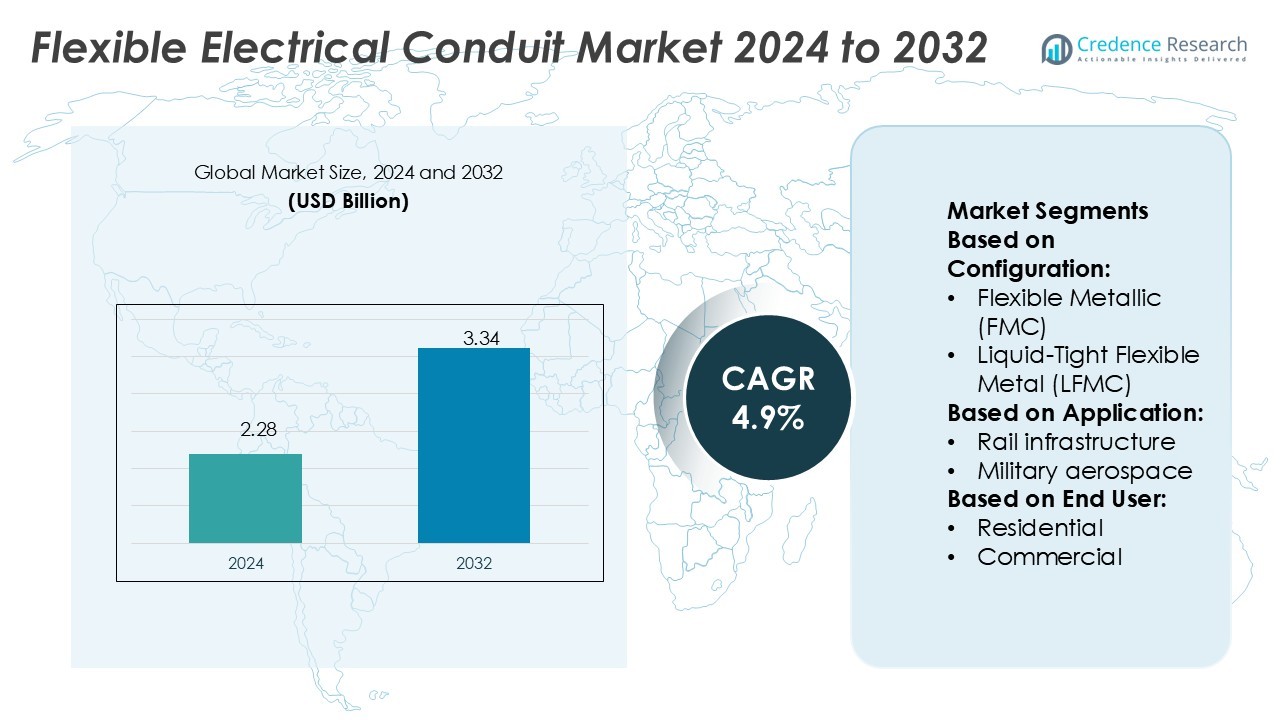
Flexible Electrical Conduit Market size was valued USD 2.28 billion in 2024 and is anticipated to reach USD 3.34 billion by 2032, at a CAGR of 4.9% during the forecast period.
| REPORT ATTRIBUTE | DETAILS |
|---|---|
| Historical Period | 2020-2023 |
| Base Year | 2024 |
| Forecast Period | 2025-2032 |
| Flexible Electrical Conduit Market Size 2024 | USD 2.28 Billion |
| Flexible Electrical Conduit Market, CAGR | 4.9% |
| Flexible Electrical Conduit Market Size 2032 | USD 3.34 Billion |
The flexible electrical conduit market is shaped by prominent players including ABB, Atkore, Legrand, Hubbell, Electri-Flex Company, Anamet Electrical, HellermannTyton, CANTEX, Kaiphone Technology, and Dongguan FlexGlory Machinery Accessories. These companies compete through product innovation, compliance with safety standards, and expansion into emerging markets. Global leaders emphasize sustainable materials, advanced conduit designs, and automation-ready solutions to strengthen their market positions. Regionally, Asia-Pacific leads the market with a 35% share, driven by rapid urbanization, infrastructure investments, and strong manufacturing capabilities in countries such as China, India, and Japan. This dominance reflects both scale and growth momentum, positioning the region as the key driver of global demand.
Market Insights
- The flexible electrical conduit market was valued at USD 2.28 billion in 2024 and is projected to reach USD 3.34 billion by 2032, growing at a CAGR of 4.9%.
- Market growth is driven by rising infrastructure development, industrial automation, and stringent safety regulations that increase the adoption of advanced conduit systems across industries.
- Trends such as the use of sustainable, halogen-free materials and the emergence of smart conduits with monitoring capabilities are reshaping product innovation and boosting long-term adoption.
- Competition is strong, with key players including ABB, Atkore, Legrand, Hubbell, Electri-Flex Company, Anamet Electrical, HellermannTyton, CANTEX, Kaiphone Technology, and Dongguan FlexGlory Machinery Accessories, each focusing on product differentiation and global expansion.
- Asia-Pacific leads the market with a 35% share, followed by North America and Europe, while the industrial end-user segment dominates overall adoption due to high demand from manufacturing, process plants, and energy infrastructure.
Market Segmentation Analysis:
By Configuration
Flexible Metallic Conduit (FMC) dominates the configuration segment with the largest market share, supported by widespread use in commercial and industrial facilities. FMC’s durability, ease of installation, and strong mechanical protection drive its preference in electrical wiring systems. Liquid-Tight Flexible Metal Conduit (LFMC) follows, mainly used in wet or outdoor environments due to its moisture-resistant jacket. Flexible Metallic Tubing (FMT) and Liquid-Tight Flexible Non-Metallic Conduit (LFNC) serve niche applications where lightweight, corrosion resistance, and cost-effectiveness are critical. Increasing safety standards and construction demand further strengthen FMC’s dominance in this segment.
- For instance, CANTEX manufactures Schedule 40 and Schedule 80 PVC conduits, which are certified to UL 651 standards. These products undergo standardized impact resistance testing and are durable for many industrial applications.
By Application
The process plants segment leads with the highest share in application, reflecting strict requirements for safety, reliability, and corrosion resistance in industrial operations. Extensive use of conduits in oil, gas, and chemical facilities highlights their role in protecting electrical circuits from harsh environments. Rail infrastructure and energy sectors also represent significant demand, driven by modernization projects and rising investments in renewable energy. Healthcare facilities and military aerospace adopt conduits to meet compliance and safety standards. Overall, process plants dominate due to their high operational risks and continuous expansion in global industrial sectors.
- For instance, Kaiphone's production facilities deploy ISO 9001-certified processes, and the company supplies flexible conduit globally for industrial applications, including industrial automation, transportation, and construction.
By End User
The industrial sector holds the largest share by end user, driven by extensive use of conduits in manufacturing, process plants, and heavy industries. Growth in automation and the need for reliable wiring protection in harsh operating conditions further support demand. Commercial usage follows, supported by the rise of smart buildings, office complexes, and retail infrastructure requiring efficient cabling management. Residential adoption continues to expand with urbanization and new housing developments, though at a smaller scale. Utilities also contribute steadily, driven by investments in grid modernization. Industrial dominance stems from its scale, compliance needs, and safety-driven adoption.
Key Growth Drivers
Rising Infrastructure Development and Urbanization
The growing demand for modern infrastructure drives the adoption of flexible electrical conduits. Expanding urban housing projects, commercial complexes, and industrial facilities require efficient wiring solutions that ensure durability and safety. Governments worldwide are investing heavily in smart city projects, rail networks, and energy infrastructure, which boosts conduit installations. Flexible conduits offer adaptability, quick installation, and reliable protection against environmental factors, making them preferred for large-scale projects. This ongoing infrastructure expansion directly accelerates market growth across residential, commercial, and industrial sectors.
- For instance, Electri-Flex manufactures the Shield-Flex® series of EMI/RFI Shielded Conduits, including types SLA, EMS, and EMCS. The description for Type SLA states it offers "good" shielding and uses a tinned copper braid with a minimum of 90% coverage.
Stringent Safety Standards and Regulatory Compliance
Global emphasis on workplace safety and regulatory compliance has become a major growth driver. Flexible electrical conduits protect wiring from abrasion, moisture, and chemical exposure, reducing risks of short circuits and fire hazards. Regulatory bodies in North America, Europe, and Asia enforce strict codes for electrical installations, encouraging higher adoption of certified conduit systems. Industries such as healthcare, aerospace, and energy prioritize advanced conduit solutions to ensure operational safety. Compliance-driven demand ensures steady growth, as businesses upgrade legacy wiring systems to meet evolving safety benchmarks.
- For instance, Anamet Electrical, Inc. manufactures UL-listed liquid-tight conduits, including non-metallic Type B (LFNC-B), which conforms to the UL 1660 standard, and metallic Type A (LFMC-A), which conforms to the UL 360 standard.
Expansion of Industrial Automation and Energy Projects
The rapid rise of industrial automation and renewable energy projects fuels significant demand for flexible conduits. Manufacturing plants and process industries require robust wiring protection to support automated systems and high-voltage applications. Similarly, renewable energy projects, including solar and wind farms, demand conduits that withstand harsh weather and mechanical stress. Utilities also rely on conduits to safeguard transmission and distribution networks. The combined momentum from industrial automation and clean energy transition creates sustained opportunities, positioning flexible conduits as vital components in energy-efficient and resilient infrastructure.
Key Trends & Opportunities
Adoption of Smart and Sustainable Materials
Manufacturers are focusing on eco-friendly and high-performance materials for conduit production. Lightweight, halogen-free, and recyclable materials are gaining attention due to sustainability goals and stricter environmental regulations. Smart conduits with embedded sensors are emerging, allowing real-time monitoring of wiring conditions and predictive maintenance. This trend aligns with the global shift toward sustainable construction practices and smart infrastructure. Companies investing in material innovation and smart technology integration are expected to gain a competitive edge in meeting evolving customer and regulatory expectations.
- For instance, Legrand's LCS³ conduit systems utilize halogen-free, low-smoke (LSZH) materials that are tested to meet IEC standards, such as IEC 60754-2, for resistance to fire and emission of corrosive gases.
Growth of E-Commerce Distribution and Aftermarket Demand
The expansion of e-commerce platforms has created new opportunities for conduit manufacturers to reach wider customer bases. Online distribution channels make flexible conduits more accessible for contractors, small businesses, and individual users, especially in emerging economies. The aftermarket segment is also growing, as retrofitting projects in older buildings drive demand for easy-to-install solutions. E-commerce simplifies bulk procurement for industrial buyers while enabling manufacturers to showcase product innovation directly to end-users. This trend enhances market visibility and accelerates global adoption of flexible conduit solutions.
- For instance, HellermannTyton manufactures HelaGuard® corrugated conduits that are certified to EN 61386 standards. The products are tested for characteristics such as crush resistance, but the specific performance ratings vary depending on the product series.
Key Challenges
Volatility in Raw Material Prices
The flexible conduit market faces challenges from fluctuations in raw material prices, particularly steel, aluminum, and PVC. Rising costs directly impact manufacturing margins, forcing companies to adjust pricing strategies. Smaller players find it difficult to absorb price hikes, reducing competitiveness against larger manufacturers with stronger supply chains. Currency fluctuations and trade restrictions further add to cost instability. This price volatility poses a barrier to steady growth, compelling companies to focus on alternative materials and efficiency-driven production methods to mitigate risks.
Competition from Substitutes and Low-Cost Alternatives
Flexible conduits face strong competition from alternative wiring protection methods, including rigid conduits and cable trays, which often provide cost-effective solutions. Low-cost, locally manufactured products in emerging markets further intensify price pressure. These alternatives can limit adoption, particularly in cost-sensitive residential and small-scale commercial projects. Additionally, the availability of counterfeit products undermines brand reliability and creates safety risks. To counter this challenge, established players are investing in quality certification, product differentiation, and awareness campaigns to highlight the long-term benefits of flexible conduit systems.
Regional Analysis
North America
North America holds a significant share of the flexible electrical conduit market, accounting for nearly 32% of the global revenue. The region’s dominance is supported by strict safety regulations, robust construction activity, and advanced industrial infrastructure. The U.S. leads due to ongoing investments in smart buildings, data centers, and renewable energy projects, while Canada shows steady demand from commercial and residential sectors. The adoption of automation in industrial facilities further drives usage. Continuous retrofitting of outdated wiring systems also supports growth, reinforcing North America’s leadership in safety-focused and technologically advanced conduit applications.
Europe
Europe represents 27% of the flexible electrical conduit market, driven by strong regulatory frameworks emphasizing safety, sustainability, and energy efficiency. Countries such as Germany, the UK, and France dominate with large-scale investments in rail infrastructure, renewable energy, and healthcare facilities. Demand for halogen-free and recyclable conduit solutions aligns with the EU’s strict environmental policies. The region’s focus on modernization of military and aerospace facilities also adds to growth. With established construction practices and sustainability initiatives, Europe remains a mature yet steadily growing market for high-performance conduit systems across diverse end-use sectors.
Asia-Pacific
Asia-Pacific leads the global flexible electrical conduit market with the largest share of 35%, fueled by rapid urbanization, industrialization, and infrastructure expansion. China, India, and Japan drive demand through large-scale investments in housing, commercial complexes, and manufacturing facilities. The region’s booming e-commerce, data center growth, and energy projects further boost adoption. Increasing disposable incomes and government-backed smart city projects add momentum. Asia-Pacific also benefits from a strong manufacturing base, enabling cost-efficient production. The region’s high growth potential makes it the most dynamic market, with expanding opportunities in both residential and industrial applications.
Latin America
Latin America holds 4% of the global flexible electrical conduit market, supported by gradual improvements in construction and energy infrastructure. Brazil and Mexico lead adoption, with growing investments in industrial facilities, oil and gas plants, and urban development projects. Economic reforms and regional government initiatives to modernize utilities encourage steady demand. However, limited local manufacturing capacity and reliance on imports constrain faster growth. The aftermarket segment, driven by retrofitting of outdated electrical systems, offers notable opportunities. With increasing urbanization and energy diversification, Latin America continues to emerge as a niche yet promising market for conduit systems.
Middle East & Africa
The Middle East & Africa account for 2% of the global market share, primarily driven by large-scale energy and infrastructure projects. The Gulf countries, particularly the UAE and Saudi Arabia, lead demand due to smart city developments, industrial diversification, and high investments in utilities. Africa is witnessing growth from rising urban housing and expanding energy grids. However, limited awareness, price sensitivity, and infrastructural challenges hinder broader adoption. Despite these constraints, government-backed mega projects and increasing focus on renewable energy create long-term opportunities for flexible conduit adoption in this region.
Market Segmentations:
By Configuration:
- Flexible Metallic (FMC)
- Liquid-Tight Flexible Metal (LFMC)
By Application:
- Rail infrastructure
- Military aerospace
By End User:
- Residential
- Commercial
By Geography
- North America
- U.S.
- Canada
- Mexico
- Europe
- Germany
- France
- U.K.
- Italy
- Spain
- Rest of Europe
- Asia Pacific
- China
- Japan
- India
- South Korea
- South-east Asia
- Rest of Asia Pacific
- Latin America
- Brazil
- Argentina
- Rest of Latin America
- Middle East & Africa
- GCC Countries
- South Africa
- Rest of the Middle East and Africa
Competitive Landscape
The competitive landscape of the flexible electrical conduit market features key players such as Hubbell, CANTEX, Kaiphone Technology, Electri-Flex Company, Anamet Electrical, Legrand, HellermannTyton, ABB, Dongguan FlexGlory Machinery Accessories, and Atkore. The flexible electrical conduit market is defined by strong emphasis on innovation, regulatory compliance, and regional expansion strategies. Companies compete by developing advanced conduit systems that enhance safety, durability, and flexibility, while also aligning with sustainability goals. The market is influenced by rising demand across industrial, commercial, and residential applications, encouraging manufacturers to expand product portfolios and strengthen supply chains. Strategic initiatives such as mergers, acquisitions, and partnerships are widely adopted to gain a competitive edge. Additionally, growing investments in smart materials, automation-ready solutions, and eco-friendly designs are shaping future competition.
Key Player Analysis
- Hubbell
- CANTEX
- Kaiphone Technology
- Electri-Flex Company
- Anamet Electrical
- Legrand
- HellermannTyton
- ABB
- Dongguan FlexGlory Machinery Accessories
- Atkore
Recent Developments
- In July 2025, Scientists at KAIST and Seoul National University developed an electronic ink” that can be printed into circuits that switch between hard and soft, simply by changing the temperature.
- In October 2024, Caparo Middle East inaugurated a fully integrated manufacturing plant in Dammam, Saudi Arabia, in collaboration with Engineer Sinan Ali Ahmed Bukhamseen. This 30,000-sq-ft facility, built with an investment of SAR 25 million, aims to produce half a million electrical conduits monthly to meet regional demand and support Saudi Arabia's goal of self-sufficiency in industrial products.
- In March 2024, CANTEX INC. announced C.C. Pierce Company as their new sales representative for PVC electrical pipe, fittings, and boxes for the northern region of the state of NY. Pierce Company represents its line of PVC electrical products due to their admirable levels of service, amazing longevity, and established relationships.
- In February 2024, ABB announced that it has entered into a partnership to acquire SEAM Group, a major provider of energized asset management and advisory services to clients across industrial and commercial building markets.
Report Coverage
The research report offers an in-depth analysis based on Configuration, Application, End-User and Geography. It details leading market players, providing an overview of their business, product offerings, investments, revenue streams, and key applications. Additionally, the report includes insights into the competitive environment, SWOT analysis, current market trends, as well as the primary drivers and constraints. Furthermore, it discusses various factors that have driven market expansion in recent years. The report also explores market dynamics, regulatory scenarios, and technological advancements that are shaping the industry. It assesses the impact of external factors and global economic changes on market growth. Lastly, it provides strategic recommendations for new entrants and established companies to navigate the complexities of the market.
Future Outlook
- The market will grow steadily with rising investments in infrastructure and smart cities.
- Demand for eco-friendly and recyclable conduit solutions will continue to increase.
- Industrial automation will drive adoption of high-performance conduit systems.
- Renewable energy projects will expand conduit usage in solar and wind installations.
- Strict safety regulations will encourage modernization of legacy electrical systems.
- Emerging economies will witness rapid demand growth from urbanization and construction.
- Smart conduit systems with monitoring features will gain market traction.
- E-commerce distribution will expand access to conduit products globally.
- Strategic partnerships and acquisitions will strengthen competitive positioning.
- Continuous innovation in materials and designs will define long-term growth.Top of Form

Request a Free Sample
Fill in your details and we'll send you a free sample report.
- Sample data tables & charts
- Research methodology
Market Dynamics
Rising Infrastructure Development and Urbanization
Expanding urban housing, commercial complexes, and industrial facilities are increasing the need for durable and safe wiring solutions, driving demand for flexible electrical conduits in large-scale infrastructure projects worldwide.
Stringent Safety Standards and Regulatory Compliance
Global enforcement of strict electrical safety codes and regulations is pushing industries to adopt certified flexible conduit systems, ensuring protection against abrasion, moisture, and fire hazards, and supporting market growth.
Expansion of Industrial Automation and Energy Projects
The surge in industrial automation and renewable energy installations requires robust conduit systems to protect complex wiring in harsh environments, fueling steady demand from manufacturing plants, process industries, and utility networks.
Adoption of Smart and Sustainable Materials
Manufacturers are innovating with eco-friendly, halogen-free, and recyclable materials, as well as smart conduits with monitoring capabilities, to meet sustainability goals and evolving customer and regulatory expectations, boosting market adoption.
Growth of E-Commerce Distribution and Aftermarket Demand
The rise of e-commerce platforms and retrofitting projects in older buildings are making flexible conduits more accessible and increasing aftermarket demand, especially in emerging economies and for easy-to-install solutions.
Need a Custom Version of This Report?
Tailor the scope, geography, or segments to your exact requirements.
- Custom geography or segment scope
- Direct access to our analyst team
Frequently Asked Questions
What is the current market size for Flexible Electrical Conduit Market, and what is its projected size in 2032?
At what Compound Annual Growth Rate is the Flexible Electrical Conduit Market projected to grow between 2025 and 2032?
Which Flexible Electrical Conduit Market segment held the largest share in 2024?
What are the primary factors fueling the growth of the Flexible Electrical Conduit Market?
Who are the leading companies in the Flexible Electrical Conduit Market?
Which region commanded the largest share of the Flexible Electrical Conduit Market in 2024?
Table of Content
Chapter 1 Market Segmentation
- 1.1 Segmentation Framework
- 1.1.1 Product and Service Classification
- 1.1.2 Application and End-Use Classification
- 1.1.3 Technology and Solution Classification
- 1.1.4 Customer and Distribution Channel Classification
- 1.1.5 Geographic Segmentation
- 1.1.6 Market Segment Definitions and Boundaries
- 1.2 By End User
- 1.2.1 Industrial
- 1.2.2 Commercial
- 1.2.3 Residential
- 1.2.4 Utilities
- 1.3 By Application
- 1.3.1 Process Plants
- 1.3.2 Rail Infrastructure
- 1.3.3 Energy Sector
- 1.3.4 Healthcare Facilities
- 1.3.5 Military Aerospace
- 1.4 By Configuration
- 1.4.1 Flexible Metallic Conduit (FMC)
- 1.4.2 Liquid-Tight Flexible Metal Conduit (LFMC)
- 1.4.3 Flexible Metallic Tubing (FMT)
- 1.4.4 Liquid-Tight Flexible Non-Metallic Conduit (LFNC)
Chapter 2 Introduction
- 2.1 Report Objectives and Scope
- 2.2 Product Definition and Industry Terminology
- 2.3 Market Inclusions and Exclusions
- 2.4 Research Process
- 2.4.1 Primary Research and Expert Interviews
- 2.4.2 Secondary Research and Source Review
- 2.4.3 Top-Down and Bottom-Up Estimation
- 2.4.4 Data Triangulation and Verification
- 2.5 Market Size Measurement Basis
- 2.5.1 2024: USD 2.28 billion → 2032: USD 3.34 billion
- 2.6 Historical and Forecast Reference Periods
- 2.6.1 Base Year: 2024
- 2.6.2 Forecast Period: 2024-2032
- 2.7 Research Assumptions and Limitations
Chapter 3 Executive Summary
- 3.1 Market Snapshot and Key Findings
- 3.2 Base-Year Market Size, 2024
- 3.3 Forecast Market Size, 2032
- 3.4 Revenue and Volume Growth Outlook
- 3.5 Key Demand and Supply Indicators
- 3.6 Leading Market Segments
- 3.7 Fastest-Growing Market Opportunities
- 3.8 Regional Performance Highlights
- 3.9 Technology and Industry Transformation
- 3.10 Competitive Landscape Summary
- 3.11 Analyst View and Strategic Implications
Chapter 4 Global Flexible Electrical Conduit Market Trends and Developments
- 4.1 Historical Industry Development
- 4.2 Recent Market Trends and Developments
- 4.3 Demand and Customer Behavior Trends
- 4.4 Technology and Product Innovation
- 4.5 Artificial Intelligence, Automation and Digitalization
- 4.6 Local Manufacturing and Supply Chain Realignment
- 4.7 Industry Partnerships, Mergers and Acquisitions
- 4.8 Sustainability and Circular Economy Developments
- 4.9 Government and Private Sector Investment Trends
- 4.10 Emerging Business Models and Commercialization
- 4.11 Industry Developments and Announcements
Chapter 5 Global Flexible Electrical Conduit Market Production, Supply and Demand Analysis
- 5.1 Demand Trend and Consumption Analysis
- 5.2 Demand Forecast, 2024-2032
- 5.3 Production and Output Trend
- 5.4 Production and Output Forecast, 2024-2032
- 5.5 Installed Capacity and Capacity Utilization
- 5.6 Company-Wise Production Plants and Statistics
- 5.6.1 Installed Production Capacity
- 5.6.2 Actual Production
- 5.6.3 Planned Capacity and Expansion Targets
- 5.7 Supply Chain Structure and Procurement Trends
- 5.8 Supply-Demand Gap and Bottlenecks
- 5.9 Import Dependence and Sourcing Structure
- 5.10 Contract Manufacturing and Outsourcing
- 5.11 Regional Supply and Demand Concentration
Chapter 6 Global Flexible Electrical Conduit Market Pricing Analysis
- 6.1 Pricing Structure and Measurement
- 6.2 Historical Pricing Trends
- 6.3 Pricing Outlook, 2024-2032
- 6.4 Average Selling Price and Unit Economics
- 6.5 Pricing by Product and Market Segment
- 6.6 Geographic Pricing Differences
- 6.7 Key Input, Energy, Labor and Logistics Costs
- 6.8 Contract Pricing and Purchasing Models
- 6.9 Pricing Sensitivity and Competitive Positioning
- 6.10 Price, Margin and Profitability Implications
Chapter 7 Global Flexible Electrical Conduit Market Dynamics
- 7.1 Market Growth Drivers
- 7.1.1 Demand-Side Drivers
- 7.1.2 Technology and Innovation Drivers
- 7.1.3 Infrastructure and Investment Drivers
- 7.1.4 Regulatory and Policy Drivers
- 7.2 Market Restraints
- 7.2.1 Cost and Affordability Constraints
- 7.2.2 Technology and Adoption Barriers
- 7.2.3 Supply Chain and Operational Constraints
- 7.3 Market Challenges
- 7.3.1 Competitive Pressure and Margin Erosion
- 7.3.2 Skills, Infrastructure and Implementation Gaps
- 7.4 Emerging Market Opportunities
- 7.5 Market Dynamics Impact and Time-Horizon Assessment
Chapter 8 Global Flexible Electrical Conduit Value Chain Analysis
- 8.1 Industry Value Chain Overview
- 8.2 Upstream Suppliers and Critical Inputs
- 8.3 Technology and Component Providers
- 8.4 Manufacturing or Service Delivery
- 8.5 Distribution, Channel Partners and Integrators
- 8.6 Downstream Applications and End Users
- 8.7 Value Addition and Profit Pools
- 8.8 Vertical Integration and Outsourcing
- 8.9 Supplier Concentration and Risk
- 8.10 Supply Chain Localization and Resilience
Chapter 9 Global Flexible Electrical Conduit Market Regulations and Policies
- 9.1 Relevant Laws, Standards and Compliance Frameworks
- 9.2 Product, Service, Safety and Quality Requirements
- 9.3 Government Policies, Incentives and Subsidies
- 9.4 Imports, Exports and Trade Barriers
- 9.5 Public Procurement and Local Content Requirements
- 9.6 Environmental and Sustainability Compliance
- 9.7 Upcoming Policy Changes and Market Implications
Chapter 10 Global Flexible Electrical Conduit Market Hotspots and Opportunities
- 10.1 Market Opportunity Mapping and Growth Hotspots
- 10.2 High-Growth Applications and Customer Groups
- 10.3 Underserved Markets and White-Space Opportunities
- 10.4 Emerging Technology and Product Opportunities
- 10.5 New Capacity and Investment Hotspots
- 10.6 Market Entry and Expansion Opportunities
- 10.7 Distribution and Partnership Opportunities
- 10.8 Near-Term and Long-Term Commercial Potential
- 10.9 Opportunity Attractiveness and Execution Risks
Chapter 11 Global Flexible Electrical Conduit Market Outlook, 2024-2032
- 11.1 Market Size and Analysis
- 11.1.1 Revenue (Market Measurement: 2024: USD 2.28 billion → 2032: USD 3.34 billion)
- 11.1.2 Market Volume and Quantity Sold
- 11.1.3 Historical Market Size
- 11.1.4 Base-Year Market Size, 2024
- 11.2 Market Forecast, 2024-2032
- 11.2.1 Revenue Forecast to 2032
- 11.2.2 Volume Forecast to 2032
- 11.2.3 CAGR and Year-on-Year Growth
- 11.2.4 Incremental Revenue Opportunity
- 11.3 Forecast Assumptions and Scenario Analysis
- 11.3.1 Base-Case Forecast
- 11.3.2 Optimistic and Conservative Scenarios
- 11.3.3 Technology, Pricing and Policy Sensitivities
- 11.4 Market Attractiveness and Growth Outlook
Chapter 12 Global Flexible Electrical Conduit Market Segmentation and Outlook
- 12.1 Segmentation Summary and Market Shares, 2024
- 12.2 Largest and Fastest-Growing Segments
- 12.3 By End User - Market Size and Forecast, 2024-2032
- 12.3.1 Segment Definition and Scope
- 12.3.2 Historical Market Size
- 12.3.3 Revenue Forecast, 2024-2032
- 12.3.4 Volume Forecast, 2024-2032
- 12.3.5 Base-Year Market Share, 2024
- 12.3.6 Segment CAGR and Growth Drivers
- 12.3.7 Subsegment Market Size and Forecast
- 12.3.7.1 Industrial
- 12.3.7.2 Commercial
- 12.3.7.3 Residential
- 12.3.7.4 Utilities
- 12.3.8 Subsegment Pricing and Adoption Trends
- 12.3.9 Leading Suppliers and Competition
- 12.3.10 Regional Demand and Opportunities
- 12.4 By Application - Market Size and Forecast, 2024-2032
- 12.4.1 Segment Definition and Scope
- 12.4.2 Historical Market Size
- 12.4.3 Revenue Forecast, 2024-2032
- 12.4.4 Volume Forecast, 2024-2032
- 12.4.5 Base-Year Market Share, 2024
- 12.4.6 Segment CAGR and Growth Drivers
- 12.4.7 Subsegment Market Size and Forecast
- 12.4.7.1 Process Plants
- 12.4.7.2 Rail Infrastructure
- 12.4.7.3 Energy Sector
- 12.4.7.4 Healthcare Facilities
- 12.4.7.5 Military Aerospace
- 12.4.8 Subsegment Pricing and Adoption Trends
- 12.4.9 Leading Suppliers and Competition
- 12.4.10 Regional Demand and Opportunities
- 12.5 By Configuration - Market Size and Forecast, 2024-2032
- 12.5.1 Segment Definition and Scope
- 12.5.2 Historical Market Size
- 12.5.3 Revenue Forecast, 2024-2032
- 12.5.4 Volume Forecast, 2024-2032
- 12.5.5 Base-Year Market Share, 2024
- 12.5.6 Segment CAGR and Growth Drivers
- 12.5.7 Subsegment Market Size and Forecast
- 12.5.7.1 Flexible Metallic Conduit (FMC)
- 12.5.7.2 Liquid-Tight Flexible Metal Conduit (LFMC)
- 12.5.7.3 Flexible Metallic Tubing (FMT)
- 12.5.7.4 Liquid-Tight Flexible Non-Metallic Conduit (LFNC)
- 12.5.8 Subsegment Pricing and Adoption Trends
- 12.5.9 Leading Suppliers and Competition
- 12.5.10 Regional Demand and Opportunities
- 12.6 Segment Growth Comparison
- 12.7 Segment Attractiveness and Priority Matrix
Chapter 13 Global Flexible Electrical Conduit End-Use and Application Market Outlook
- 13.1 End-Use Industry and Customer Demand Structure
- 13.2 Leading Applications and Customer Groups
- 13.3 End-Use Market Size, Share and Forecast
- 13.4 Major End-Use Industry Deep Dives
- 13.4.1 Customer Requirements and Use Cases
- 13.4.2 Demand and Replacement Cycles
- 13.4.3 Technical and Regulatory Considerations
- 13.4.4 Purchasing and Procurement Models
- 13.4.5 Leading Vendors and Distribution Channels
- 13.4.6 Forecast and Commercial Opportunities
- 13.5 Emerging Applications and Cross-Segment Demand
- 13.6 End-Use Industry Investment Priorities
Chapter 14 Global Flexible Electrical Conduit Geographic Market Outlook, 2024-2032
- 14.1 Regional Market Size and Share, 2024
- 14.2 Regional Market Forecast, 2024-2032
- 14.3 Regional Pricing, Production and Demand Differences
- 14.4 North America
- 14.4.1 United States
- 14.4.2 Canada
- 14.4.3 Mexico
- 14.5 Europe
- 14.5.1 Germany
- 14.5.2 France
- 14.5.3 Italy
- 14.5.4 United Kingdom
- 14.5.5 Spain
- 14.5.6 Poland
- 14.5.7 Russia
- 14.5.8 Netherlands
- 14.5.9 Belgium
- 14.5.10 Sweden
- 14.5.11 Denmark
- 14.5.12 Norway
- 14.5.13 Rest of Europe
- 14.6 Asia Pacific
- 14.6.1 China
- 14.6.2 India
- 14.6.3 Japan
- 14.6.4 South Korea
- 14.6.5 Thailand
- 14.6.6 Indonesia
- 14.6.7 Vietnam
- 14.6.8 Malaysia
- 14.6.9 Australia
- 14.6.10 Rest of Asia Pacific
- 14.7 Latin America
- 14.7.1 Brazil
- 14.7.2 Argentina
- 14.7.3 Colombia
- 14.7.4 Chile
- 14.7.5 Rest of Latin America
- 14.8 Middle East
- 14.8.1 Saudi Arabia
- 14.8.2 United Arab Emirates
- 14.8.3 Turkey
- 14.8.4 Israel
- 14.8.5 Iran
- 14.8.6 Rest of the Middle East
- 14.9 Africa
- 14.9.1 South Africa
- 14.9.2 Egypt
- 14.9.3 Nigeria
- 14.9.4 Morocco
- 14.9.5 Rest of Africa
- 14.10 Regional Investment, Policy and Supply Chain Differences
- 14.11 Regional Competitive Landscape
- 14.12 Geographic Growth Hotspots
Chapter 15 Global Flexible Electrical Conduit Technology, Innovation and Sustainability Outlook
- 15.1 Technology Landscape and Maturity
- 15.2 Product, Process and Service Innovation
- 15.3 AI, Automation and Digital Tools in the Industry
- 15.4 Technology Adoption and Performance Benchmarking
- 15.5 Innovation Pipeline and R&D Investment
- 15.6 Patent and Intellectual Property Trends
- 15.7 Energy Efficiency and Resource Management
- 15.8 Sustainability, Recycling and Circularity
- 15.9 Technology Roadmap, 2024-2032
- 15.10 Risks of Obsolescence and Technology Substitution
Chapter 16 Global Flexible Electrical Conduit Market Key Strategic Imperatives
- 16.1 Growth and Market Entry Priorities
- 16.2 High-Return Products and Segments
- 16.3 Pricing, Profitability and Cost Optimization
- 16.4 Technology Investment and Product Differentiation
- 16.5 Supply Chain Localization and Resilience
- 16.6 Distribution and Customer Acquisition
- 16.7 Partnership, Acquisition and Capacity Strategy
- 16.8 Regional Expansion Priorities
- 16.9 Short-, Medium- and Long-Term Actions
Chapter 17 Competition Outlook
- 17.1 Industry Competition Characteristics
- 17.2 Market Structure and Concentration
- 17.3 Market Share and Competitive Positioning, 2024
- 17.4 Company-Wise Revenue and Product Benchmarking
- 17.5 Production and Service Capacity Benchmarking
- 17.6 Technology, Pricing and Differentiation
- 17.7 Regional Footprint and Distribution Strength
- 17.8 Mergers, Acquisitions and Strategic Alliances
- 17.9 New Entrants and Competitive Threats
- 17.10 Porter's Five Forces and Industry Attractiveness
- 17.11 Competitive Outlook, 2024-2032
Chapter 18 Company Profiles
- 18.1 Company Coverage and Selection Criteria
- 18.2 ABB
- 18.2.1 Business Description
- 18.2.2 Company Ownership and Geographic Presence
- 18.2.3 Product and Service Portfolio
- 18.2.4 Manufacturing and Operating Footprint
- 18.2.5 Production Capacity and Expansion Plans
- 18.2.6 Financial Performance and Investment
- 18.2.7 Market Share and Competitive Position
- 18.2.8 Technology and Innovation Capabilities
- 18.2.9 Strategic Alliances or Partnerships
- 18.2.10 Recent Developments
- 18.2.11 Growth Strategy and Outlook
- 18.3 Atkore
- 18.4 Legrand
- 18.5 Hubbell
- 18.6 Electri-Flex Company
- 18.7 Anamet Electrical
- 18.8 HellermannTyton
- 18.9 CANTEX
- 18.10 Kaiphone Technology
- 18.11 Dongguan FlexGlory Machinery Accessories
- 18.12 Other Relevant Market Participants
Note: Every listed company is profiled on the structure shown under the first company. The company list is preliminary and may change based on research findings, market developments, data availability and client requirements.
Chapter 19 Disclaimer
- 19.1 Research and Forecast Disclaimer
- 19.2 Data Source and Estimation Limitations
Note: The depth of individual sections depends on data availability for this market. Volume, capacity, trade and other unit-based metrics are included where applicable.