
Market Overview:
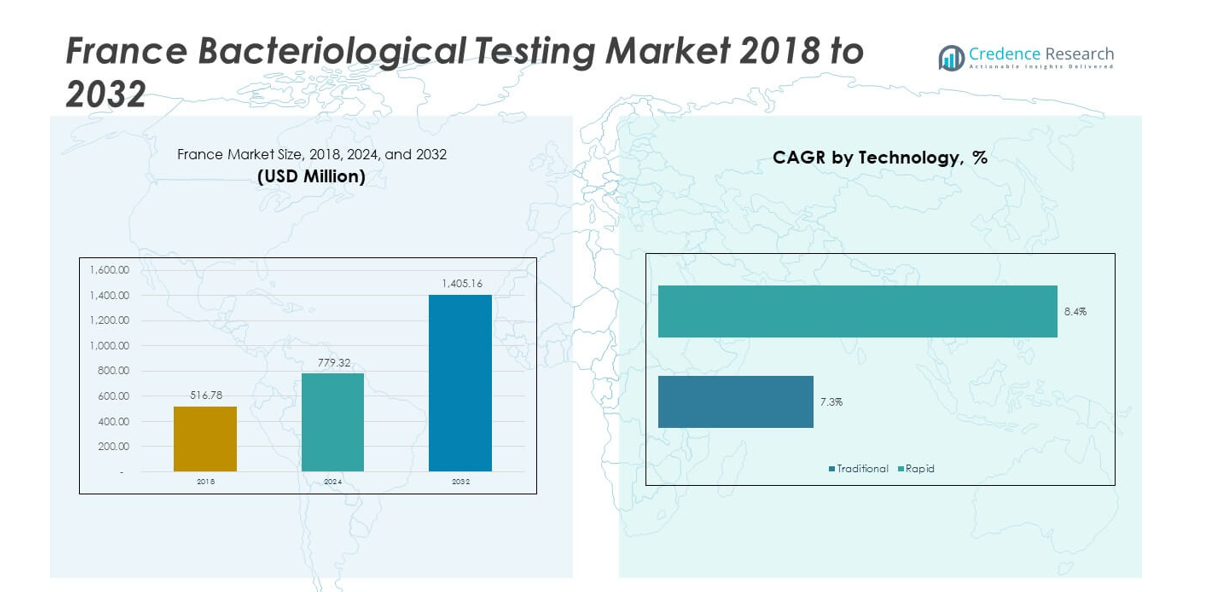
The France Bacteriological Testing Market size was valued at USD 516.78 million in 2018, reached USD 779.32 million in 2024, and is anticipated to reach USD 1,405.16 million by 2032, at a CAGR of 7.49% during the forecast period. These figures highlight consistent growth driven by rising demand across key end-use industries.
| REPORT ATTRIBUTE | DETAILS |
|---|---|
| Historical Period | 2020-2023 |
| Base Year | 2024 |
| Forecast Period | 2025-2032 |
| France Bacteriological Testing Market Size 2024 | USD 779.32 million |
| France Bacteriological Testing Market, CAGR | 7.49% |
| France Bacteriological Testing Market Size 2032 | USD 1,405.16 million |
Growth in the market is fueled by stricter food safety regulations, rising healthcare diagnostics demand, and the need for high-quality testing in pharmaceuticals and water treatment. Increased awareness of foodborne illnesses has also strengthened adoption. Technology advancements, particularly in rapid testing kits and molecular methods, provide faster, reliable results, improving efficiency for laboratories and end users. Industrial expansion across food, beverage, and personal care further sustains growth momentum.
Geographically, France plays a central role in Europe due to its developed healthcare system, strong regulatory framework, and significant food and beverage industry. Regions with dense industrial and urban infrastructure lead adoption, while rural areas show emerging opportunities with growing water quality initiatives. The market benefits from both domestic companies and global players expanding their footprint, making France a strategic hub for bacteriological testing solutions.
Market Insights:
- The France Bacteriological Testing Market was valued at USD 516.78 million in 2018, reached USD 779.32 million in 2024, and is projected to hit USD 1,405.16 million by 2032, growing at a CAGR of 7.49%.
- Europe led the market with 42% share in 2024, supported by strong regulations and established testing infrastructure, followed by North America at 29% with advanced technologies, and Asia Pacific at 18%, driven by industrial growth.
- Asia Pacific remains the fastest-growing region with rising demand from healthcare, food safety, and water testing initiatives.
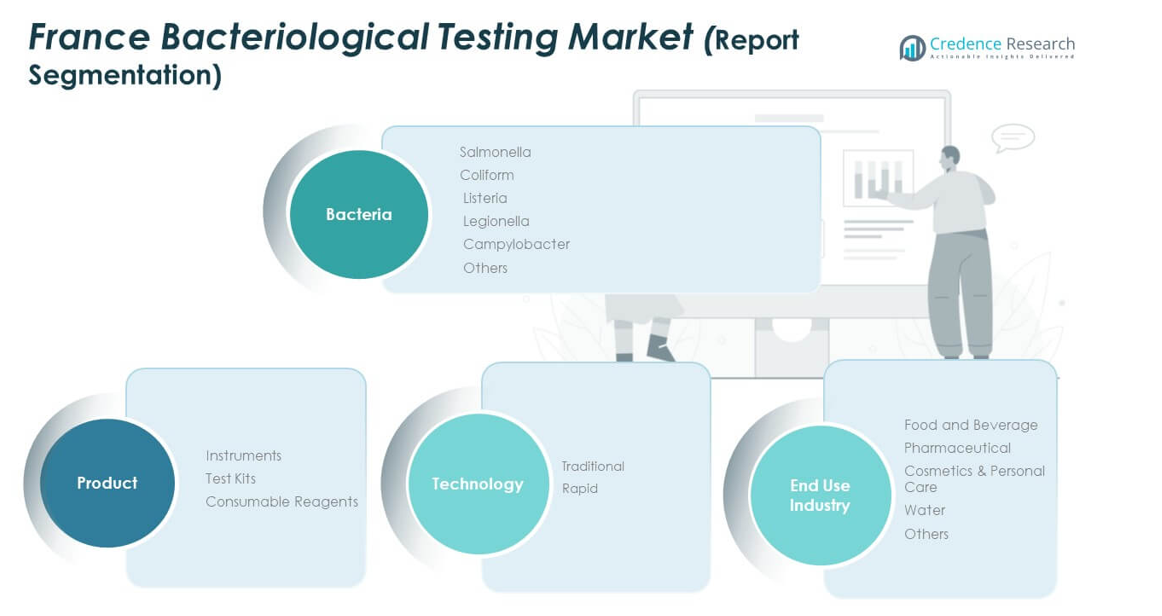
- Test Kits captured the largest share of the market in 2024, reflecting their widespread adoption across industries due to faster turnaround and ease of use.
- Consumable Reagents accounted for a significant share, supported by recurring demand in laboratories, while Instruments continued to play a critical role in detailed testing.
Market Drivers:
Rising Food Safety Regulations and Stringent Compliance Standards
The France Bacteriological Testing Market is driven by strict food safety regulations and compliance measures. Regulatory bodies mandate consistent testing for pathogens in food and beverages to prevent outbreaks. It supports manufacturers in maintaining brand credibility and consumer trust. The demand for frequent testing across production cycles ensures adoption of advanced technologies. Laboratories invest heavily in rapid kits to meet compliance standards and reduce turnaround time. Consumer awareness of contamination risks increases testing adoption further. Food exports from France also strengthen the need for rigorous bacteriological checks. The regulatory landscape remains a powerful driver for sustained growth.
- For instance, bioMérieux SA offers various AOAC-validated assays for its GENE-UP® platform. One such assay, GENE-UP® ENVIROPRO™, is an AOAC-certified method for simultaneously detecting Salmonellaand Listeria from environmental swabbing, with results possible after 24–28 hours of enrichment. A different test, the GENE-UP® TYPER, is a specific real-time PCR solution for rapidly characterizing Listeria monocytogenes
Expanding Healthcare Diagnostics and Public Health Awareness
Rising demand for healthcare diagnostics contributes significantly to growth in the France Bacteriological Testing Market. Hospitals, diagnostic centers, and public health institutions require efficient testing solutions for early detection of infections. Growing emphasis on preventive healthcare ensures constant investment in bacteriological testing infrastructure. Increased prevalence of bacterial infections in Europe raises testing volumes across medical facilities. Advances in clinical microbiology and automation streamline workflows for laboratories. Pharmaceutical R&D also depends on high-quality testing for drug development and safety trials. Public health initiatives and awareness campaigns further highlight the importance of effective bacteriological monitoring.
Strong Growth in Food, Beverage, and Pharmaceutical Industries
Expanding end-user industries such as food, beverage, and pharmaceuticals strongly support the France Bacteriological Testing Market. Manufacturers require precise testing to guarantee product safety and comply with export regulations. Large-scale facilities implement continuous testing protocols to manage production risks. Pharmaceutical companies use bacteriological tests for raw material inspection and process validation. Cosmetics and personal care sectors also increasingly adopt testing to comply with consumer safety requirements. Water treatment plants integrate bacteriological monitoring to ensure safe drinking water. Industrial demand aligns with consumer preferences for quality and safety, reinforcing testing adoption across diverse applications.
Technological Advancements in Rapid and Molecular Testing
Innovations in technology act as a major growth catalyst in the France Bacteriological Testing Market. Rapid test kits reduce turnaround times, allowing faster decisions for industries and healthcare facilities. Molecular methods such as PCR deliver accurate detection of bacteria at early stages. Automation improves laboratory efficiency and minimizes human error in complex testing processes. Digital integration enables real-time monitoring and traceability of results. Increased R&D investments bring forward cost-effective solutions with improved sensitivity. End users benefit from scalable technologies suitable for small laboratories as well as large enterprises. Such advancements ensure broad adoption and industry transformation.
Market Trends:
Growing Preference for Rapid Testing Methods Across Industries
The France Bacteriological Testing Market is witnessing a strong trend toward rapid testing solutions. Industries require quick results to make immediate safety decisions. Rapid kits reduce downtime for manufacturers and improve operational efficiency. Healthcare providers adopt these tools to accelerate patient treatment. Portable devices expand field testing applications in water and food safety. Companies prioritize convenience and speed without compromising accuracy. Advances in microfluidics and biosensors strengthen this trend further. The demand for time-efficient methods reshapes the competitive landscape of the industry.
- For instance, in February 2024, Thermo Fisher Scientific launched its SureTect Salmonella Species PCR Assay in France, which delivers results in under 75 minutes and has been adopted by over 120 food production facilities for batch-level screening.
Rising Integration of Digital Platforms in Testing Workflows
Digitalization is transforming the France Bacteriological Testing Market. Laboratories integrate software platforms for data management and analysis. Real-time result sharing enhances decision-making for healthcare and industry stakeholders. Cloud-based platforms support remote monitoring and collaboration across geographies. Automation links with digital tools to reduce manual handling errors. Artificial intelligence is increasingly applied for predictive analysis of contamination risks. Companies benefit from enhanced traceability and compliance documentation. This integration marks a significant shift toward data-driven bacteriological testing.
- For instance, SGS has implemented a new LIMS system as part of a significant digitalization strategy across its global laboratory network, achieving a key target ahead of schedule by late 2023.
Expansion of Customized Testing Solutions for End-User Needs
Customization in testing solutions emerges as a clear trend in the France Bacteriological Testing Market. Food and pharmaceutical companies demand tailored testing protocols for specific bacteria. Laboratories design solutions addressing niche safety challenges. Cosmetics and personal care sectors require specialized kits to align with product formulations. Water testing systems are customized for municipal and industrial settings. This flexibility enhances adoption across diverse sectors. Manufacturers focus on end-user collaboration to create application-specific solutions. It drives stronger partnerships and sustained market growth.
Sustainability and Eco-Friendly Testing Practices
Sustainability shapes new practices in the France Bacteriological Testing Market. Companies innovate eco-friendly reagents and consumables to minimize waste. Green chemistry approaches reduce environmental impact during testing processes. Laboratories adopt energy-efficient equipment to align with sustainability goals. Regulatory authorities encourage eco-compliant practices across testing facilities. The shift toward reusable materials lowers operational costs and supports green initiatives. Sustainable solutions resonate with corporate social responsibility strategies. The focus on environmental impact integrates deeply into the growth narrative of bacteriological testing.
Market Challenges Analysis:
High Testing Costs and Limited Accessibility
The France Bacteriological Testing Market faces the challenge of high testing costs, especially for advanced technologies. Smaller laboratories and emerging facilities often struggle with budget limitations. High expenses restrict access to rapid kits and molecular testing. This creates disparities between large enterprises and smaller operators. Limited reimbursement policies in healthcare further burden diagnostic centers. Operational costs increase with the demand for compliance documentation and specialized training. Affordability remains a barrier for widespread adoption. Addressing cost concerns is essential for ensuring equitable market penetration.
Complexity in Regulatory Compliance and Standardization
The regulatory environment presents challenges in the France Bacteriological Testing Market. Compliance requirements vary across industries, complicating operational strategies for companies. Laboratories face the burden of maintaining updated certifications and standards. Differences in testing protocols across geographies increase complexity for exporters. Lengthy approval processes delay adoption of new testing technologies. Regulatory audits add pressure on operational efficiency. Companies must balance compliance with innovation to remain competitive. Standardization across testing frameworks remains a key hurdle. These challenges create friction in market scalability and innovation deployment.
Market Opportunities:
Expansion in Food and Pharmaceutical Exports
The France Bacteriological Testing Market presents strong opportunities in food and pharmaceutical exports. Global demand for safe, high-quality products strengthens testing adoption. Exporters rely on advanced bacteriological solutions to meet international standards. Rapid kits and molecular tools enhance credibility in foreign markets. This creates value for manufacturers and strengthens trade competitiveness. France’s established reputation in these industries provides a platform for expansion. Testing companies can capitalize by offering specialized export-focused solutions. The alignment of export growth and safety compliance fuels opportunities.
Emerging Demand for Advanced Testing in Water and Cosmetics
Growing applications in water and cosmetics provide new growth avenues for the France Bacteriological Testing Market. Municipal water systems require robust monitoring to ensure public safety. Cosmetic companies need tailored bacteriological tests to guarantee safe consumer products. Rising awareness of contamination risks strengthens adoption in these segments. Rapid innovations in portable testing tools create opportunities for smaller operators. Partnerships with municipal authorities and cosmetic brands drive solution adoption. These emerging applications broaden the market base significantly. Companies that adapt solutions to these needs secure long-term growth potential.
Market Segmentation Analysis:
Product and Technology Segmentation
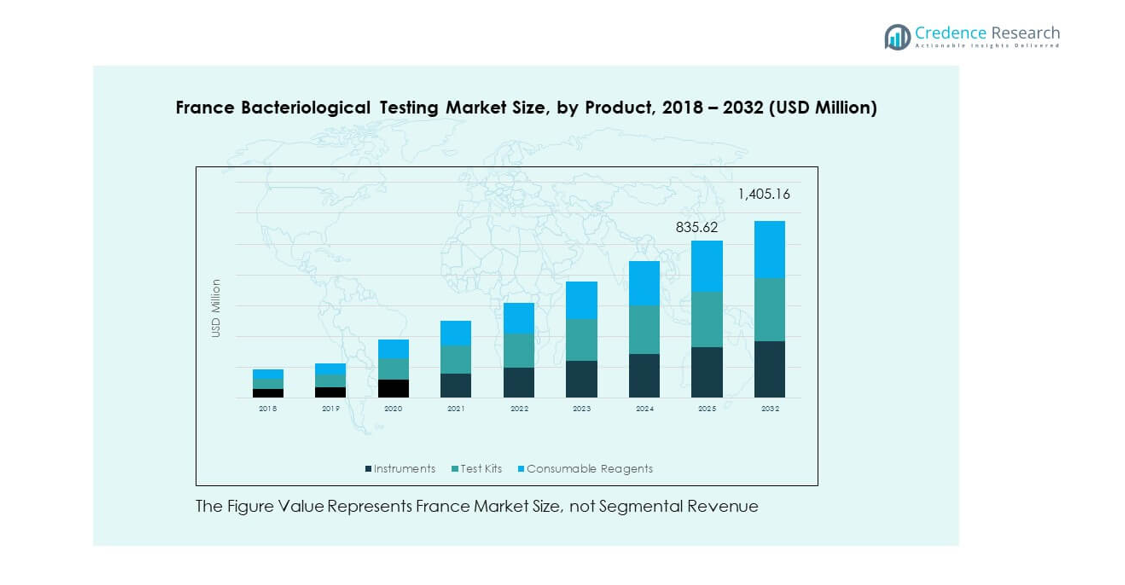
The France Bacteriological Testing Market is structured across instruments, test kits, and consumable reagents. Test kits dominate due to their widespread adoption in food, healthcare, and water testing. Instruments and reagents provide critical support for laboratory operations. The technology segment highlights a transition from traditional methods to rapid testing solutions. Rapid kits deliver time efficiency and accuracy, making them highly attractive for industries requiring immediate results. Traditional methods maintain relevance in detailed and confirmatory testing. This balanced adoption ensures broad applications across industries.
- For instance, Merck, a major supplier in the life science industry, offers rapid water testing technologies as part of its broad portfolio, such as the Spectroquant® systems for analyzing water quality. These and similar technologies can provide faster results compared to traditional lab methods.
End User and Bacteria Segmentation
End users drive demand through diverse needs in food, beverage, pharmaceuticals, cosmetics, and water sectors. Food and beverage maintain a leading share due to strict safety regulations and consumer awareness. Pharmaceuticals integrate testing into R&D and compliance processes. Cosmetics and personal care industries adopt bacteriological testing to safeguard brand image and consumer trust. Water quality testing becomes critical for municipalities and industrial operators. The bacteria segment includes Salmonella, Listeria, Coliform, and others, with foodborne pathogens remaining a central focus. This segmentation highlights the market’s adaptability to varied industry demands.
Segmentation:
By Product- Instruments
- Test Kits
- Consumable Reagents
- Salmonella
- Coliform
- Listeria
- Legionella
- Campylobacter
- Others
- Traditional
- Rapid
- Food and Beverage
- Pharmaceutical
- Cosmetics & Personal Care
- Water
- Others
Regional Analysis:
Europe – Leading Shareholder
Europe held the dominant share of the France Bacteriological Testing Market with 42% in 2024. Strong regulatory frameworks and high awareness of foodborne diseases sustain demand across industries. France benefits from being a central hub within the EU, exporting food, beverages, and pharmaceuticals under strict safety guidelines. Healthcare institutions across Europe also integrate advanced bacteriological testing solutions to maintain patient safety standards. It is supported by well-established infrastructure, continuous technological adoption, and strong collaboration between regulatory authorities and private laboratories. These factors secure Europe’s leadership in the market.
North America – Significant Contributor
North America captured 29% of the market share in 2024, driven by advanced testing technologies and strong public health systems. The region emphasizes rapid bacteriological detection in food safety, pharmaceuticals, and healthcare applications. The U.S. leads with high adoption rates of molecular testing methods, while Canada focuses on water and foodborne pathogen monitoring. France’s trade ties with North America strengthen the demand for standardized testing aligned with regional regulations. It reflects steady growth supported by investments in laboratory automation and innovation. Strong partnerships between French and North American companies enhance market connectivity.
Asia Pacific – Fastest Growing Region
Asia Pacific accounted for 18% of the market share in 2024 and represents the fastest-growing regional segment. Rising industrialization in China, India, and Japan boosts demand for bacteriological testing across food, water, and healthcare sectors. Governments enforce stricter regulations to manage contamination risks, creating opportunities for international companies. It benefits from French exports and technology collaborations aimed at meeting expanding demand. Rapid adoption of portable and cost-efficient testing solutions makes Asia Pacific a critical growth driver. The region is expected to narrow the gap with leading markets over the forecast period.
Key Player Analysis:
- Bertin Technologies
- Thermo Fisher Scientific Inc.
- Eurofins
- Agilent Technologies Inc.
- Bio-Rad Laboratories Inc.
- Intertek
- Merck KGaA
- Diamidex
- Avantor
- BioMérieux
Competitive Analysis:
The France Bacteriological Testing Market is defined by strong competition among multinational and domestic players. Eurofins and BioMérieux lead with extensive networks and specialized capabilities. Thermo Fisher Scientific and Agilent Technologies enhance the market with advanced instruments and molecular solutions. Merck and Bio-Rad contribute through innovative reagents and consumables. Bertin Technologies and Diamidex strengthen domestic expertise with tailored offerings. It is characterized by continuous investment in R&D, sustainability, and partnerships to expand service capabilities. Companies compete on accuracy, speed, compliance support, and adaptability across end-use sectors. Strategic acquisitions and collaborations further intensify the competitive landscape.
Recent Developments:
- In July 2025, Thermo Fisher Scientific announced an expanded strategic partnership with Sanofi, acquiring the latter's state-of-the-art sterile manufacturing site in Ridgefield, New Jersey. While primarily a U.S. deal, this move enables Thermo Fisher to enhance manufacturing capacity for pharmaceutical customers globally, reinforcing its capabilities in serving international markets including France for critical drug product manufacturing and pharmaceutical services.
- In January 2025, Bertin Technologies completed the acquisition of VF Nuclear, a Czech manufacturer specializing in radiation protection and monitoring systems. This strategic move positions Bertin Technologies as a leader in nuclear measurement instrumentation and expands its presence in high-end critical applications relevant to health and life sciences, with plans to make France a key European center for radiation detection for the nuclear industry.
Report Coverage:
The research report offers an in-depth analysis based on product, bacteria, technology, and end user segments. It details leading market players, providing an overview of their business, product offerings, investments, revenue streams, and key applications. Additionally, the report includes insights into the competitive environment, SWOT analysis, current market trends, as well as the primary drivers and constraints. Furthermore, it discusses various factors that have driven market expansion in recent years. The report also explores market dynamics, regulatory scenarios, and technological advancements that are shaping the industry. It assesses the impact of external factors and global economic changes on market growth. Lastly, it provides strategic recommendations for new entrants and established companies to navigate the complexities of the market.
Future Outlook:
- Rapid testing technologies will expand across food, pharmaceutical, and water applications.
- Molecular diagnostics will gain wider adoption due to their accuracy and reliability.
- AI-enabled platforms will transform bacteriological data management and decision-making.
- Hospitals and clinics will increase investment in testing for early infection control.
- Food exports will reinforce demand for testing aligned with global standards.
- Pharmaceutical research will rely more on advanced bacteriological testing.
- Water quality monitoring will expand with government-led safety initiatives.
- Cosmetics and personal care industries will adopt specialized testing for consumer safety.
- Collaborations between French firms and international players will strengthen innovation.
- Sustainability goals will drive eco-friendly reagents and testing practices.

Request a Free Sample
Fill in your details and we'll send you a free sample report.
- Sample data tables & charts
- Research methodology
Market Dynamics
Stricter Food Safety Regulations
France enforces rigorous food safety standards, requiring frequent bacteriological testing to prevent contamination and ensure compliance for both domestic consumption and exports. This regulatory pressure drives continuous investment in advanced testing solutions across the food and beverage sector.
Rising Healthcare Diagnostics Demand
Hospitals, clinics, and public health institutions in France are increasingly adopting bacteriological testing for early infection detection and control, fueled by heightened awareness of bacterial diseases and the need for rapid, reliable diagnostics.
Technological Advancements in Rapid and Molecular Testing
Innovations such as rapid test kits and molecular diagnostics (e.g., PCR) are enabling faster, more accurate detection of pathogens, improving laboratory efficiency and supporting broader adoption across industries that require immediate results.
Expansion of Food, Beverage, and Pharmaceutical Industries
Growth in France’s food, beverage, and pharmaceutical sectors increases the need for high-quality bacteriological testing to ensure product safety, comply with export regulations, and maintain consumer trust, further fueling market demand.
Increased Public Awareness of Foodborne Illnesses
Greater consumer awareness and media coverage of foodborne outbreaks have led to higher expectations for safety, prompting manufacturers and regulators to adopt more comprehensive and frequent bacteriological testing protocols.
Need a Custom Version of This Report?
Tailor the scope, geography, or segments to your exact requirements.
- Custom geography or segment scope
- Direct access to our analyst team
Frequently Asked Questions
What is the current market size for France Bacteriological Testing Market, and what is its projected size in 2032?
At what Compound Annual Growth Rate is the France Bacteriological Testing Market projected to grow between 2024 and 2032?
Which France Bacteriological Testing Market segment held the largest share in 2024?
What are the primary factors fueling the growth of the France Bacteriological Testing Market?
Who are the leading companies in the France Bacteriological Testing Market?
Table of Content
Chapter 1 Market Segmentation
- 1.1 Segmentation Framework
- 1.1.1 Product and Service Classification
- 1.1.2 Application and End-Use Classification
- 1.1.3 Technology and Solution Classification
- 1.1.4 Customer and Distribution Channel Classification
- 1.1.5 Geographic Segmentation
- 1.1.6 Market Segment Definitions and Boundaries
- 1.2 By Product
- 1.2.1 Instruments
- 1.2.2 Test Kits
- 1.2.3 Consumable Reagents
- 1.3 By Bacteria
- 1.3.1 Salmonella
- 1.3.2 Coliform
- 1.3.3 Listeria
- 1.3.4 Legionella
- 1.3.5 Campylobacter
- 1.3.6 Others
- 1.4 By End User
- 1.4.1 Food and Beverage
- 1.4.2 Pharmaceutical
- 1.4.3 Cosmetics & Personal Care
- 1.4.4 Water
- 1.4.5 Others
- 1.5 By Technology
- 1.5.1 Traditional
- 1.5.2 Rapid
Chapter 2 Introduction
- 2.1 Report Objectives and Scope
- 2.2 Product Definition and Industry Terminology
- 2.3 Market Inclusions and Exclusions
- 2.4 Research Process
- 2.4.1 Primary Research and Expert Interviews
- 2.4.2 Secondary Research and Source Review
- 2.4.3 Top-Down and Bottom-Up Estimation
- 2.4.4 Data Triangulation and Verification
- 2.5 Market Size Measurement Basis
- 2.5.1 2024: USD 779.32 million → 2032: USD 1,405.16 million
- 2.6 Historical and Forecast Reference Periods
- 2.6.1 Base Year: 2024
- 2.6.2 Forecast Period: 2024-2032
- 2.7 Research Assumptions and Limitations
Chapter 3 Executive Summary
- 3.1 Market Snapshot and Key Findings
- 3.2 Base-Year Market Size, 2024
- 3.3 Forecast Market Size, 2032
- 3.4 Revenue and Volume Growth Outlook
- 3.5 Key Demand and Supply Indicators
- 3.6 Leading Market Segments
- 3.7 Fastest-Growing Market Opportunities
- 3.8 Regional Performance Highlights
- 3.9 Technology and Industry Transformation
- 3.10 Competitive Landscape Summary
- 3.11 Analyst View and Strategic Implications
Chapter 4 France Bacteriological Testing Market Trends and Developments
- 4.1 Historical Industry Development
- 4.2 Recent Market Trends and Developments
- 4.3 Demand and Customer Behavior Trends
- 4.4 Technology and Product Innovation
- 4.5 Artificial Intelligence, Automation and Digitalization
- 4.6 Local Manufacturing and Supply Chain Realignment
- 4.7 Industry Partnerships, Mergers and Acquisitions
- 4.8 Sustainability and Circular Economy Developments
- 4.9 Government and Private Sector Investment Trends
- 4.10 Emerging Business Models and Commercialization
- 4.11 Industry Developments and Announcements
Chapter 5 France Bacteriological Testing Market Production, Supply and Demand Analysis
- 5.1 Demand Trend and Consumption Analysis
- 5.2 Demand Forecast, 2024-2032
- 5.3 Production and Output Trend
- 5.4 Production and Output Forecast, 2024-2032
- 5.5 Installed Capacity and Capacity Utilization
- 5.6 Company-Wise Production Plants and Statistics
- 5.6.1 Installed Production Capacity
- 5.6.2 Actual Production
- 5.6.3 Planned Capacity and Expansion Targets
- 5.7 Supply Chain Structure and Procurement Trends
- 5.8 Supply-Demand Gap and Bottlenecks
- 5.9 Import Dependence and Sourcing Structure
- 5.10 Contract Manufacturing and Outsourcing
- 5.11 Regional Supply and Demand Concentration
Chapter 6 France Bacteriological Testing Market Pricing Analysis
- 6.1 Pricing Structure and Measurement
- 6.2 Historical Pricing Trends
- 6.3 Pricing Outlook, 2024-2032
- 6.4 Average Selling Price and Unit Economics
- 6.5 Pricing by Product and Market Segment
- 6.6 Geographic Pricing Differences
- 6.7 Key Input, Energy, Labor and Logistics Costs
- 6.8 Contract Pricing and Purchasing Models
- 6.9 Pricing Sensitivity and Competitive Positioning
- 6.10 Price, Margin and Profitability Implications
Chapter 7 France Bacteriological Testing Market Dynamics
- 7.1 Market Growth Drivers
- 7.1.1 Demand-Side Drivers
- 7.1.2 Technology and Innovation Drivers
- 7.1.3 Infrastructure and Investment Drivers
- 7.1.4 Regulatory and Policy Drivers
- 7.2 Market Restraints
- 7.2.1 Cost and Affordability Constraints
- 7.2.2 Technology and Adoption Barriers
- 7.2.3 Supply Chain and Operational Constraints
- 7.3 Market Challenges
- 7.3.1 Competitive Pressure and Margin Erosion
- 7.3.2 Skills, Infrastructure and Implementation Gaps
- 7.4 Emerging Market Opportunities
- 7.5 Market Dynamics Impact and Time-Horizon Assessment
Chapter 8 France Bacteriological Testing Value Chain Analysis
- 8.1 Industry Value Chain Overview
- 8.2 Upstream Suppliers and Critical Inputs
- 8.3 Technology and Component Providers
- 8.4 Manufacturing or Service Delivery
- 8.5 Distribution, Channel Partners and Integrators
- 8.6 Downstream Applications and End Users
- 8.7 Value Addition and Profit Pools
- 8.8 Vertical Integration and Outsourcing
- 8.9 Supplier Concentration and Risk
- 8.10 Supply Chain Localization and Resilience
Chapter 9 France Bacteriological Testing Market Regulations and Policies
- 9.1 Relevant Laws, Standards and Compliance Frameworks
- 9.2 Product, Service, Safety and Quality Requirements
- 9.3 Government Policies, Incentives and Subsidies
- 9.4 Imports, Exports and Trade Barriers
- 9.5 Public Procurement and Local Content Requirements
- 9.6 Environmental and Sustainability Compliance
- 9.7 Upcoming Policy Changes and Market Implications
Chapter 10 France Bacteriological Testing Market Hotspots and Opportunities
- 10.1 Market Opportunity Mapping and Growth Hotspots
- 10.2 High-Growth Applications and Customer Groups
- 10.3 Underserved Markets and White-Space Opportunities
- 10.4 Emerging Technology and Product Opportunities
- 10.5 New Capacity and Investment Hotspots
- 10.6 Market Entry and Expansion Opportunities
- 10.7 Distribution and Partnership Opportunities
- 10.8 Near-Term and Long-Term Commercial Potential
- 10.9 Opportunity Attractiveness and Execution Risks
Chapter 11 France Bacteriological Testing Market Outlook, 2024-2032
- 11.1 Market Size and Analysis
- 11.1.1 Revenue (Market Measurement: 2024: USD 779.32 million → 2032: USD 1,405.16 million)
- 11.1.2 Market Volume and Quantity Sold
- 11.1.3 Historical Market Size
- 11.1.4 Base-Year Market Size, 2024
- 11.2 Market Forecast, 2024-2032
- 11.2.1 Revenue Forecast to 2032
- 11.2.2 Volume Forecast to 2032
- 11.2.3 CAGR and Year-on-Year Growth
- 11.2.4 Incremental Revenue Opportunity
- 11.3 Forecast Assumptions and Scenario Analysis
- 11.3.1 Base-Case Forecast
- 11.3.2 Optimistic and Conservative Scenarios
- 11.3.3 Technology, Pricing and Policy Sensitivities
- 11.4 Market Attractiveness and Growth Outlook
Chapter 12 France Bacteriological Testing Market Segmentation and Outlook
- 12.1 Segmentation Summary and Market Shares, 2024
- 12.2 Largest and Fastest-Growing Segments
- 12.3 By Product - Market Size and Forecast, 2024-2032
- 12.3.1 Segment Definition and Scope
- 12.3.2 Historical Market Size
- 12.3.3 Revenue Forecast, 2024-2032
- 12.3.4 Volume Forecast, 2024-2032
- 12.3.5 Base-Year Market Share, 2024
- 12.3.6 Segment CAGR and Growth Drivers
- 12.3.7 Subsegment Market Size and Forecast
- 12.3.7.1 Instruments
- 12.3.7.2 Test Kits
- 12.3.7.3 Consumable Reagents
- 12.3.8 Subsegment Pricing and Adoption Trends
- 12.3.9 Leading Suppliers and Competition
- 12.3.10 Regional Demand and Opportunities
- 12.4 By Bacteria - Market Size and Forecast, 2024-2032
- 12.4.1 Segment Definition and Scope
- 12.4.2 Historical Market Size
- 12.4.3 Revenue Forecast, 2024-2032
- 12.4.4 Volume Forecast, 2024-2032
- 12.4.5 Base-Year Market Share, 2024
- 12.4.6 Segment CAGR and Growth Drivers
- 12.4.7 Subsegment Market Size and Forecast
- 12.4.7.1 Salmonella
- 12.4.7.2 Coliform
- 12.4.7.3 Listeria
- 12.4.7.4 Legionella
- 12.4.7.5 Campylobacter
- 12.4.7.6 Others
- 12.4.8 Subsegment Pricing and Adoption Trends
- 12.4.9 Leading Suppliers and Competition
- 12.4.10 Regional Demand and Opportunities
- 12.5 By End User - Market Size and Forecast, 2024-2032
- 12.5.1 Segment Definition and Scope
- 12.5.2 Historical Market Size
- 12.5.3 Revenue Forecast, 2024-2032
- 12.5.4 Volume Forecast, 2024-2032
- 12.5.5 Base-Year Market Share, 2024
- 12.5.6 Segment CAGR and Growth Drivers
- 12.5.7 Subsegment Market Size and Forecast
- 12.5.7.1 Food and Beverage
- 12.5.7.2 Pharmaceutical
- 12.5.7.3 Cosmetics & Personal Care
- 12.5.7.4 Water
- 12.5.7.5 Others
- 12.5.8 Subsegment Pricing and Adoption Trends
- 12.5.9 Leading Suppliers and Competition
- 12.5.10 Regional Demand and Opportunities
- 12.6 By Technology - Market Size and Forecast, 2024-2032
- 12.6.1 Segment Definition and Scope
- 12.6.2 Historical Market Size
- 12.6.3 Revenue Forecast, 2024-2032
- 12.6.4 Volume Forecast, 2024-2032
- 12.6.5 Base-Year Market Share, 2024
- 12.6.6 Segment CAGR and Growth Drivers
- 12.6.7 Subsegment Market Size and Forecast
- 12.6.7.1 Traditional
- 12.6.7.2 Rapid
- 12.6.8 Subsegment Pricing and Adoption Trends
- 12.6.9 Leading Suppliers and Competition
- 12.6.10 Regional Demand and Opportunities
- 12.7 Segment Growth Comparison
- 12.8 Segment Attractiveness and Priority Matrix
Chapter 13 France Bacteriological Testing End-Use and Application Market Outlook
- 13.1 End-Use Industry and Customer Demand Structure
- 13.2 Leading Applications and Customer Groups
- 13.3 End-Use Market Size, Share and Forecast
- 13.4 Major End-Use Industry Deep Dives
- 13.4.1 Customer Requirements and Use Cases
- 13.4.2 Demand and Replacement Cycles
- 13.4.3 Technical and Regulatory Considerations
- 13.4.4 Purchasing and Procurement Models
- 13.4.5 Leading Vendors and Distribution Channels
- 13.4.6 Forecast and Commercial Opportunities
- 13.5 Emerging Applications and Cross-Segment Demand
- 13.6 End-Use Industry Investment Priorities
Chapter 14 France Bacteriological Testing Geographic Market Outlook, 2024-2032
- 14.1 Domestic Market Distribution and Demand Clusters
- 14.2 State- or Province-Wise Market Size and Forecast, 2024-2032
- 14.3 City and Metropolitan Market Outlook
- 14.4 Industrial, Manufacturing and Commercial Clusters
- 14.5 Geographic Concentration of Key End Users
- 14.6 Local Pricing and Purchasing Differences
- 14.7 Domestic Production Facilities and Capacity Map
- 14.8 Local Infrastructure and Project Pipeline
- 14.9 State-Level Policy and Incentive Differences
- 14.10 Subnational Investment Hotspots and Opportunities
- 14.11 Distribution and Logistics Networks
- 14.12 Domestic Competitive Footprint
Chapter 15 France Bacteriological Testing Technology, Innovation and Sustainability Outlook
- 15.1 Technology Landscape and Maturity
- 15.2 Product, Process and Service Innovation
- 15.3 AI, Automation and Digital Tools in the Industry
- 15.4 Technology Adoption and Performance Benchmarking
- 15.5 Innovation Pipeline and R&D Investment
- 15.6 Patent and Intellectual Property Trends
- 15.7 Energy Efficiency and Resource Management
- 15.8 Sustainability, Recycling and Circularity
- 15.9 Technology Roadmap, 2024-2032
- 15.10 Risks of Obsolescence and Technology Substitution
Chapter 16 France Bacteriological Testing Market Key Strategic Imperatives
- 16.1 Growth and Market Entry Priorities
- 16.2 High-Return Products and Segments
- 16.3 Pricing, Profitability and Cost Optimization
- 16.4 Technology Investment and Product Differentiation
- 16.5 Supply Chain Localization and Resilience
- 16.6 Distribution and Customer Acquisition
- 16.7 Partnership, Acquisition and Capacity Strategy
- 16.8 Regional Expansion Priorities
- 16.9 Short-, Medium- and Long-Term Actions
Chapter 17 Competition Outlook
- 17.1 Industry Competition Characteristics
- 17.2 Market Structure and Concentration
- 17.3 Market Share and Competitive Positioning, 2024
- 17.4 Company-Wise Revenue and Product Benchmarking
- 17.5 Production and Service Capacity Benchmarking
- 17.6 Technology, Pricing and Differentiation
- 17.7 Regional Footprint and Distribution Strength
- 17.8 Mergers, Acquisitions and Strategic Alliances
- 17.9 New Entrants and Competitive Threats
- 17.10 Porter's Five Forces and Industry Attractiveness
- 17.11 Competitive Outlook, 2024-2032
Chapter 18 Company Profiles
- 18.1 Company Coverage and Selection Criteria
- 18.2 Bertin Technologies
- 18.2.1 Business Description
- 18.2.2 Company Ownership and Geographic Presence
- 18.2.3 Product and Service Portfolio
- 18.2.4 Manufacturing and Operating Footprint
- 18.2.5 Production Capacity and Expansion Plans
- 18.2.6 Financial Performance and Investment
- 18.2.7 Market Share and Competitive Position
- 18.2.8 Technology and Innovation Capabilities
- 18.2.9 Strategic Alliances or Partnerships
- 18.2.10 Recent Developments
- 18.2.11 Growth Strategy and Outlook
- 18.3 Thermo Fisher Scientific Inc.
- 18.4 Eurofins
- 18.5 Agilent Technologies Inc.
- 18.6 Bio-Rad Laboratories Inc.
- 18.7 Intertek
- 18.8 Merck KGaA
- 18.9 Diamidex
- 18.10 Avantor
- 18.11 BioMérieux
- 18.12 Other Relevant Market Participants
Note: Every listed company is profiled on the structure shown under the first company. The company list is preliminary and may change based on research findings, market developments, data availability and client requirements.
Chapter 19 Disclaimer
- 19.1 Research and Forecast Disclaimer
- 19.2 Data Source and Estimation Limitations
Note: The depth of individual sections depends on data availability for this market. Volume, capacity, trade and other unit-based metrics are included where applicable.

