Market Overview
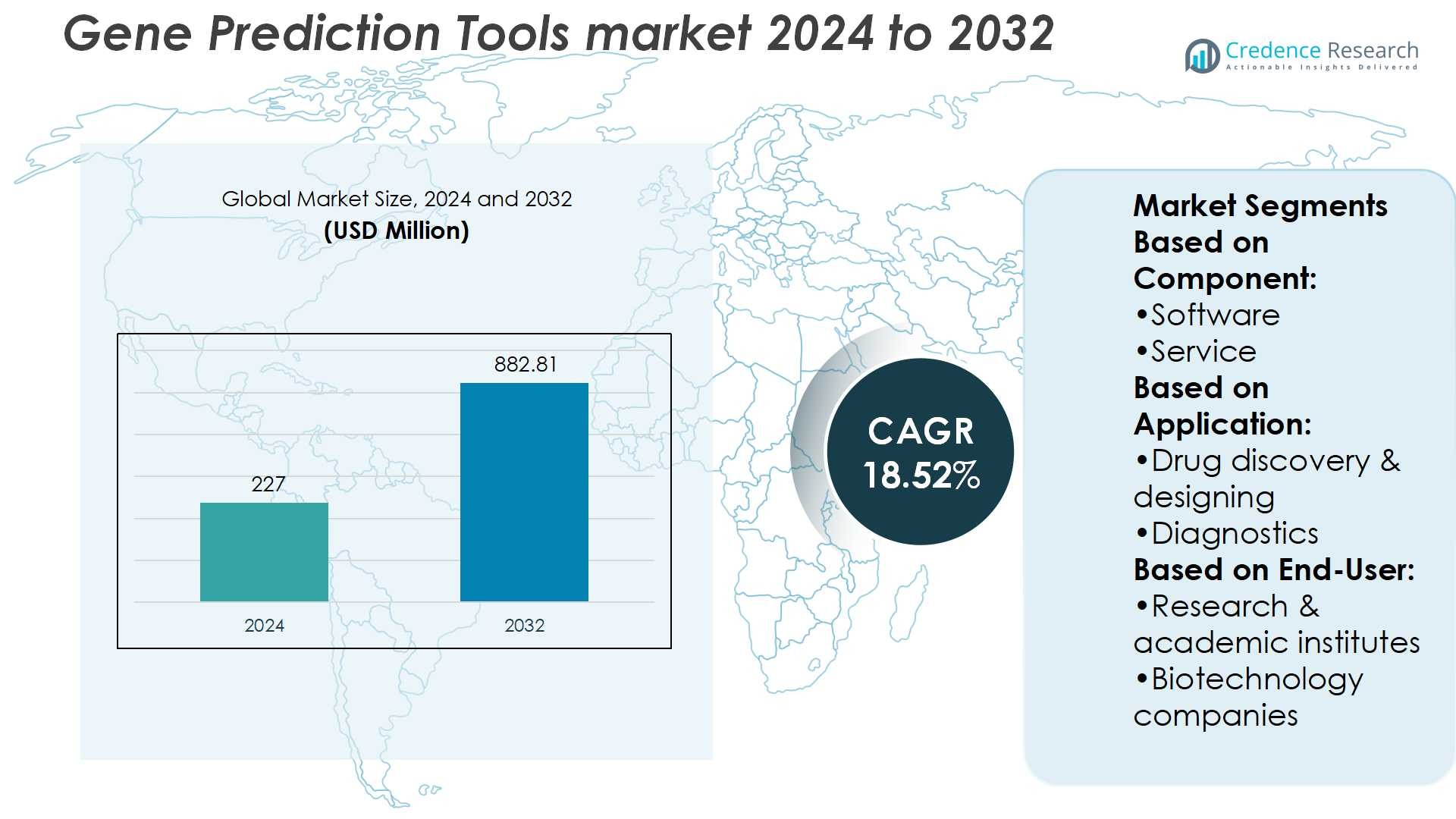
Gene Prediction Tools market size was valued at USD 227 million in 2024 and is anticipated to reach USD 882.81 million by 2032, at a CAGR of 18.52% during the forecast period.
| REPORT ATTRIBUTE |
DETAILS |
| Historical Period |
2020-2023 |
| Base Year |
2024 |
| Forecast Period |
2025-2032 |
| Gene Prediction Tools Market Size 2024 |
USD 227 Million |
| Gene Prediction Tools Market, CAGR |
18.52% |
| Gene Prediction Tools Market Size 2032 |
USD 882.81 Million |
The Gene Prediction Tools market is driven by the rising demand for precision medicine, increasing focus on rare disease research, and the growing need for efficient drug discovery solutions. It benefits from strong adoption in research institutes and healthcare facilities that require accurate annotation and functional analysis of genes. The market trends highlight rapid integration of artificial intelligence, cloud-based platforms, and multi-omics data analysis, which enhance accuracy and scalability. Expanding applications in agriculture and industrial biotechnology further broaden adoption. Continuous innovation and cross-sector collaborations strengthen its role as a critical enabler of genomic research and clinical advancements worldwide.
The Gene Prediction Tools market shows strong geographical presence with North America leading due to advanced healthcare infrastructure and research investments, followed by Europe with extensive genomics initiatives and Asia Pacific as the fastest-growing region. Latin America and the Middle East & Africa are gradually expanding through healthcare modernization and academic research. Key players such as Thermo Fisher Scientific, Illumina, Qiagen, BGI Genomics, Geneious, DNASTAR, Softberry Technologies, Exiqon, Genscript, and AzoLifeScience strengthen the market through innovation, partnerships, and advanced genomic solutions.
Access crucial information at unmatched prices!
Request your sample report today & start making informed decisions powered by Credence Research Inc.!
Download Sample
Market Insights
- The Gene Prediction Tools market was valued at USD 227 million in 2024 and is projected to reach USD 882.81 million by 2032, growing at a CAGR of 18.52%.
- Rising demand for precision medicine and rare disease research drives strong adoption of predictive platforms.
- Integration of artificial intelligence, cloud solutions, and multi-omics data analysis enhances accuracy and scalability.
- Competition is shaped by innovation and strategies from leading players across biotechnology and software domains.
- High complexity of genomic data and elevated costs of advanced platforms act as restraints.
- North America leads the market, Europe follows with strong genomics initiatives, and Asia Pacific shows the fastest growth.
- Latin America and Middle East & Africa expand steadily, while continuous collaborations and government-backed projects sustain momentum globally.
Market Drivers
Rising Demand for Precision in Genomic Research
The Gene Prediction Tools market benefits from increasing adoption of precision medicine initiatives. Healthcare organizations require accurate identification of coding and non-coding sequences to support disease mapping and therapeutic development. These tools provide reliable data for personalized treatment strategies, strengthening their adoption in academic and clinical settings. Pharmaceutical firms use them to shorten drug discovery timelines while improving accuracy in target identification. Government-backed genomic research projects also create new opportunities by supporting advanced computational platforms. It remains a critical enabler of precise genetic interpretation across multiple disciplines.
- For instance, Geneious Prime software has been adopted by over 4,000 research institutions and biotech firms worldwide and is capable of analyzing large-scale datasets, such as those generated by Next-Generation Sequencing (NGS), with high computational accuracy.
Expanding Role of Artificial Intelligence and Machine Learning
The Gene Prediction Tools market is driven by advances in artificial intelligence and machine learning integration. Predictive algorithms improve efficiency in gene structure annotation and functional analysis. These innovations deliver enhanced speed, accuracy, and scalability compared to traditional approaches. Research institutions adopt such tools to manage large genomic datasets and optimize outcomes. Pharmaceutical developers leverage AI-powered solutions for biomarker discovery and pathway analysis. It reinforces the market’s growth by enabling automation and predictive insights at scale.
- For instance, Thermo Fisher Scientific’s Ion Torrent Genexus Sequencer automates genomic workflows and can deliver results in as little as 24 hours, significantly accelerating clinical and research applications.
Increasing Focus on Rare and Complex Diseases
The Gene Prediction Tools market gains momentum from rising focus on rare and complex genetic disorders. Research teams depend on prediction software to uncover novel mutations and regulatory elements. The ability to pinpoint genetic contributors aids diagnostic accuracy and treatment development. Hospitals and clinics adopt these solutions to improve early detection and intervention strategies. Collaborative studies between universities and biotech firms enhance understanding of disease mechanisms. It strengthens the role of predictive platforms in addressing unmet medical needs.
Expanding Applications Across Agricultural and Industrial Genomics
The Gene Prediction Tools market grows beyond healthcare by supporting agriculture and industrial biotechnology. Agricultural researchers rely on prediction platforms to identify traits linked to yield, resistance, and nutritional content. Industrial biotechnology companies integrate such tools to optimize microbial strains for biofuels and enzymes. Governments invest in agricultural genomics projects to ensure food security and sustainable farming. It creates demand for flexible and domain-specific software solutions. The ability to serve both medical and non-medical applications strengthens market adoption.
Market Trends
Integration of Cloud-Based Platforms for Scalable Genomic Research
The Gene Prediction Tools market is witnessing rapid integration of cloud-based platforms that allow large-scale genomic data analysis. Cloud deployment enables real-time collaboration among global research teams and reduces infrastructure costs. It provides scalability for handling massive sequencing datasets generated in clinical and research environments. Healthcare organizations adopt cloud solutions to streamline workflows and improve accessibility. Pharmaceutical firms use them to accelerate drug development pipelines by enabling faster processing. This trend strengthens efficiency and broadens the reach of predictive genomic technologies.
- For instance, Illumina’s NextSeq 2000 equipped with the P4 flow cell and XLEAP-SBS chemistry delivers up to 540 gigabases of output per run and produces up to 1.8 billion single-end reads.
Growing Adoption of Multi-Omics Data in Gene Prediction
The Gene Prediction Tools market benefits from rising adoption of multi-omics approaches that combine genomics, transcriptomics, and proteomics. This integration improves accuracy in identifying gene functions and regulatory networks. It creates opportunities for holistic insights into complex biological systems. Research groups and pharmaceutical developers increasingly demand solutions that integrate diverse data streams. Software vendors expand features to support visualization and analysis of cross-omics datasets. This trend reflects a shift toward more comprehensive and informed genetic prediction models.
- For instance, Qiagen QIAseq NGS panels have already processed 4,000,000 sample. Qiagen Digital Insights solutions process 850,000 clinical samples per year via national precision medicine programs.
Rising Focus on Automation and AI-Powered Annotation
The Gene Prediction Tools market is advancing through adoption of automation and AI-driven annotation systems. Artificial intelligence enhances prediction accuracy by reducing manual errors and time-intensive processes. It supports adaptive learning, enabling tools to improve performance with new datasets. Academic and commercial research groups prefer AI-powered systems for their scalability and reliability. Companies invest in algorithms capable of handling varied genome complexities across species. This trend underlines the market’s movement toward smarter, automated prediction ecosystems.
Increasing Application in Non-Medical Domains
The Gene Prediction Tools market is expanding into agriculture, food science, and industrial biotechnology. It supports crop improvement programs by identifying genetic traits related to productivity and resistance. Food scientists rely on prediction platforms to enhance nutritional content and safety standards. Industrial biotechnology companies use them for optimizing microorganisms in enzyme and biofuel production. Government initiatives encourage agricultural genomics for food security and sustainability. This trend highlights the broadening role of predictive tools beyond healthcare and pharmaceutical domains.
Market Challenges Analysis
High Complexity of Genomic Data and Accuracy Concerns
The Gene Prediction Tools market faces challenges due to the complexity of genomic datasets and accuracy limitations. Identifying gene structures across diverse species requires advanced algorithms, yet errors in annotation remain common. It creates uncertainty in research outcomes and slows adoption in clinical environments where precision is critical. Variability in sequencing quality further complicates prediction reliability and increases dependence on computational expertise. Researchers often require extensive validation processes, which add cost and time to projects. This challenge highlights the need for stronger algorithmic frameworks and standardized validation methods.
Limited Accessibility and High Cost of Advanced Platforms
The Gene Prediction Tools market also struggles with limited accessibility and high costs of advanced solutions. Smaller laboratories and developing regions often face barriers in adopting premium platforms. It restricts the democratization of genomic research and limits contributions from diverse scientific communities. High licensing fees, combined with the requirement for skilled bioinformaticians, increase financial strain. Data security concerns in cloud-based platforms also reduce confidence in widespread adoption. These challenges emphasize the importance of cost-effective, secure, and user-friendly solutions to expand market reach.
Market Opportunities
Expansion into Precision Medicine and Personalized Healthcare
The Gene Prediction Tools market holds strong opportunities through its role in precision medicine and personalized healthcare. Growing demand for individualized treatment strategies requires accurate gene annotation and mutation detection. It supports pharmaceutical firms in tailoring therapies for specific patient groups, enhancing treatment outcomes. Hospitals and clinics adopt these tools to enable early diagnosis and improve clinical decision-making. Public and private funding for genomic projects further expands opportunities for innovation in healthcare. This direction strengthens the position of prediction platforms within mainstream medical practice.
Emerging Applications in Agriculture and Industrial Biotechnology
The Gene Prediction Tools market also presents opportunities across agriculture and industrial biotechnology sectors. Crop scientists use prediction platforms to identify genetic traits that improve yield, resistance, and nutritional value. It supports industrial biotechnology companies in designing optimized microbial strains for enzyme and biofuel production. Expanding global initiatives in food security and sustainable farming create further demand for such solutions. Cross-sector collaborations drive new use cases beyond healthcare, broadening the market’s reach. This trend highlights the potential for predictive tools to shape both medical and non-medical industries.
Market Segmentation Analysis:
By Component
The Gene Prediction Tools market is segmented into software and services. Software dominates the segment due to the growing demand for advanced platforms that enable efficient gene annotation, structure prediction, and functional analysis. It supports scalability, automation, and integration with multi-omics data, making it critical for large research projects. Service offerings are also expanding as organizations require consulting, customization, and technical support. It helps laboratories and clinical facilities reduce the burden of implementation and ensures optimal use of advanced tools. Both segments together reinforce the ecosystem by balancing technological innovation with specialized expertise.
- For instance, BGI Genomics’ DNBSEQ-T7, specifically with the latest V3.0 sequencing reagent kit, can produce up to 7 terabases (Tb) of high-quality data within 24 hours.
By Application
The Gene Prediction Tools market shows strong application in drug discovery and designing, diagnostics, and other fields. Drug discovery holds a prominent share, with pharmaceutical companies relying on predictive platforms to identify new targets and accelerate therapeutic development. Diagnostics is gaining momentum as hospitals adopt these tools for early disease detection and mutation analysis. It supports precision healthcare by improving diagnostic accuracy and reducing turnaround time. Other applications include agricultural genomics, microbial engineering, and food science, where predictive models drive efficiency and innovation. This segmentation highlights the market’s capacity to serve both clinical and non-clinical applications.
- For instance, Horizon’s Dharmacon Edit-R sgRNA algorithm was trained using more than 1,100 synthetic crRNAs across multiple gene targets in proteasome pathways in U2OS cells, enabling predictive scoring for both specificity and functionality.
By End-user
The Gene Prediction Tools market is also segmented by end-users, including research and academic institutes, biotechnology companies, and hospitals and clinics. Research institutes remain the largest users due to the need for accurate predictive models in large-scale genomic projects. Biotechnology companies leverage these tools for product innovation, biomarker discovery, and therapeutic development. Hospitals and clinics increasingly adopt them to support precision medicine and improve patient outcomes. It shows expanding adoption across both academic and commercial domains, driven by the need for advanced genomic solutions. This broad end-user base ensures steady demand and long-term market growth.
Segments:
Based on Component:
Based on Application:
- Drug discovery & designing
- Diagnostics
Based on End-User:
- Research & academic institutes
- Biotechnology companies
Based on the Geography:
- North America
- Europe
- Germany
- France
- U.K.
- Italy
- Spain
- Rest of Europe
- Asia Pacific
- China
- Japan
- India
- South Korea
- South-east Asia
- Rest of Asia Pacific
- Latin America
- Brazil
- Argentina
- Rest of Latin America
- Middle East & Africa
- GCC Countries
- South Africa
- Rest of the Middle East and Africa
Regional Analysis
North America
North America holds the largest share of the Gene Prediction Tools market, accounting for 38% of global revenue. The region benefits from advanced healthcare infrastructure, strong biotechnology presence, and high adoption of precision medicine. Research institutes and pharmaceutical companies across the United States and Canada invest heavily in genomic platforms to accelerate innovation. Government-backed initiatives such as the All of Us Research Program in the U.S. further stimulate demand for predictive tools. It also gains strength from the presence of major technology providers and strong venture capital funding. The combination of industry leadership and advanced R&D facilities secures North America’s dominant position.
Europe
Europe represents the second-largest share of the Gene Prediction Tools market with 27% of global revenue. The region’s strong focus on genomics research and increasing investments in precision healthcare fuel adoption. Countries like Germany, the United Kingdom, and France remain key contributors, supported by advanced clinical research networks. The Horizon Europe program and other EU-backed projects create opportunities for integrating AI-driven genomic platforms. It is further supported by collaborations between academic institutions and biotech firms. Growing emphasis on rare disease research and agricultural genomics also expands the scope of applications in Europe.
Asia Pacific
Asia Pacific accounts for 22% of the Gene Prediction Tools market and is the fastest-growing region. Expanding genomic research in China, Japan, India, and South Korea drives significant adoption. Governments across the region launch national genomics initiatives to advance healthcare and biotechnology sectors. Pharmaceutical and biotech companies use predictive platforms to strengthen drug discovery and clinical trial processes. It benefits from rising healthcare expenditure, growing patient populations, and rapid adoption of AI in life sciences. Expanding research collaborations with Western institutions further boost regional growth. Asia Pacific is expected to continue gaining share in the coming years.
Latin America
Latin America holds a smaller but notable share of 7% in the Gene Prediction Tools market. Brazil and Mexico lead adoption due to their growing biotechnology sectors and expanding academic research. Hospitals and clinics in the region gradually integrate predictive platforms into diagnostic workflows. It faces challenges such as limited infrastructure and higher costs, but government support for healthcare digitization is improving conditions. Partnerships with global players are also helping bridge technological gaps. The region shows promise as investments in precision medicine and agricultural genomics expand.
Middle East and Africa
The Middle East and Africa collectively account for 6% of the Gene Prediction Tools market. Adoption remains limited compared to other regions but is growing steadily. The United Arab Emirates and Saudi Arabia lead regional initiatives by investing in healthcare modernization and advanced research centers. South Africa also contributes through its genomic research programs. It faces barriers such as high costs and limited expertise, but strategic investments in biotechnology create growth potential. International collaborations and knowledge-sharing programs are expected to accelerate adoption in the coming years.
Shape Your Report to Specific Countries or Regions & Enjoy 30% Off!
Key Player Analysis
- Geneious
- Thermo Fisher Scientific, Inc.
- Exiqon
- DNASTAR
- Qiagen NV
- Illumina, Inc.
- Softberry Technologies
- BGI Genomics
- Genscript
- AzoLifeScience
Competitive Analysis
The Gene Prediction Tools market players such as Geneious, Thermo Fisher Scientific, Inc., Exiqon, DNASTAR, Qiagen NV, Illumina, Inc., Softberry Technologies, BGI Genomics, Genscript, and AzoLifeScience. The Gene Prediction Tools market is defined by rapid technological progress and strong demand across healthcare, research, and industrial applications. Companies compete by enhancing software capabilities, improving algorithmic accuracy, and integrating artificial intelligence for more reliable predictions. The market also benefits from rising investments in multi-omics research, which require advanced tools to interpret complex datasets. Strategic collaborations between biotechnology firms, academic institutes, and healthcare providers create opportunities for broader adoption. Focus on precision medicine, diagnostics, and agricultural genomics further accelerates growth by expanding use cases. Continuous innovation in predictive platforms strengthens their role as essential components of modern genomic research.
Recent Developments
- In March 2024, PharmaKure partnered with Sheffield Hallam University to develop epigenetic biomarkers that can predict Alzheimer’s disease risk and enable earlier interventions. Such collaborations are expected to expand the applications of gene prediction tools.
- In February 2024, Inherent Biosciences and Genomic Prediction have formed a commercial partnership to integrate Inherent Biosciences’ Epigenetic Sperm Quality Test (Sperm) into Genomic Prediction clinical laboratory tests, with a focus on advancing male reproductive health. The initiative is anticipated to open new growth opportunities for gene prediction tools.
- In September 2023, Google DeepMind introduced an AI tool that predicts the potential harm of genetic mutations, particularly missense mutations. These mutations, which can disrupt protein function and cause diseases like cystic fibrosis, cancer, and brain development issues, are often harmless but can disrupt protein function, potentially aiding research into rare diseases.
- In June 2023, Illumina, Inc. disclosed the AI software for predicting disease-causing genetic mutations in patients. Through this, the company has enhanced its product portfolio and revenue growth.
Report Coverage
The research report offers an in-depth analysis based on Component, Application, End-User and Geography. It details leading market players, providing an overview of their business, product offerings, investments, revenue streams, and key applications. Additionally, the report includes insights into the competitive environment, SWOT analysis, current market trends, as well as the primary drivers and constraints. Furthermore, it discusses various factors that have driven market expansion in recent years. The report also explores market dynamics, regulatory scenarios, and technological advancements that are shaping the industry. It assesses the impact of external factors and global economic changes on market growth. Lastly, it provides strategic recommendations for new entrants and established companies to navigate the complexities of the market.
Future Outlook
- Demand for precision medicine will drive adoption of advanced predictive tools.
- Artificial intelligence will improve accuracy and reduce manual errors in gene annotation.
- Cloud-based platforms will expand accessibility and support large-scale genomic projects.
- Multi-omics integration will strengthen predictive insights across diverse biological systems.
- Diagnostic applications will grow with rising focus on early disease detection.
- Agricultural genomics will create opportunities for food security and crop improvement.
- Industrial biotechnology will adopt predictive tools for enzyme and biofuel optimization.
- Research collaborations will accelerate innovation and expand the tool ecosystem.
- Cost-effective solutions will improve accessibility in developing regions.
- Regulatory support and government funding will enhance global market expansion.



