| REPORT ATTRIBUTE | DETAILS |
|---|---|
| Historical Period | 2019-2022 |
| Base Year | 2023 |
| Forecast Period | 2024-2032 |
| Halal Packaging Market Size 2023 | USD 271841.50 Million |
| Halal Packaging Market, CAGR | 7.50% |
| Halal Packaging Market Size 2032 | USD 521185.03 Million |
Market Insights
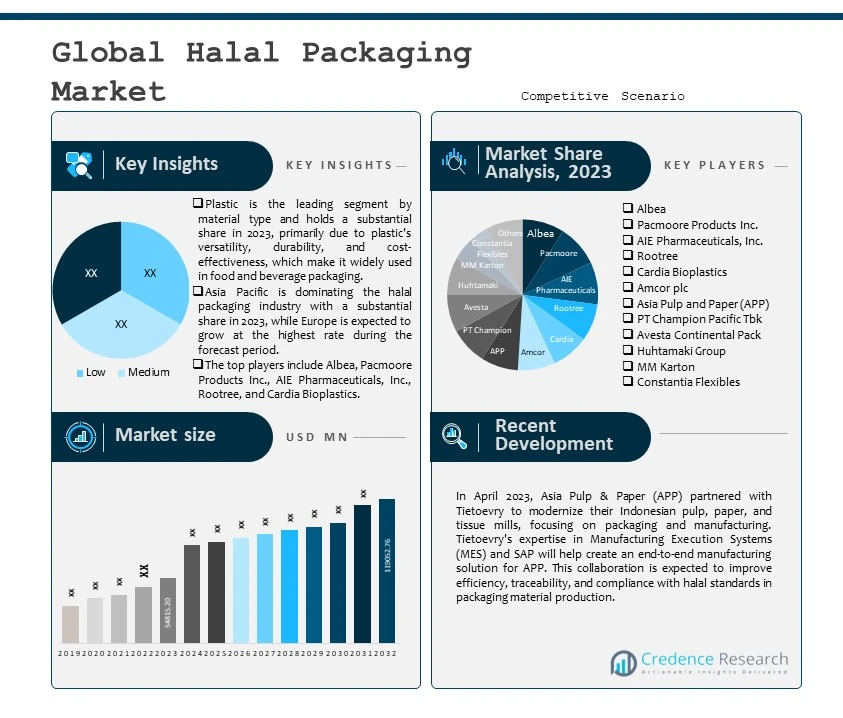
- The global demand for halal packaging was valued at USD 271841.50 million in 2023 and is expected to reach USD 521185.03 million in 2032, growing at a CAGR of 7.50% between 2024 and 2032.
- In 2023, plastic material is the market leader by material type, accounting for the highest share in value 2023, while the paper and paperboard segment is expected to grow rapidly throughout the forecast period.
- The food & beverage products dominate the global need for halal packaging, accounting for a significant in 2023 and is predicted to expand at a high CAGR.
- The modified atmosphere packaging (MAP) segment is predicted to grow fastest over the projection period, while the sealing segment had the smallest market share in terms of packaging technique in 2023.
- Over the projection period, the online retail distribution channel is expected to expand at the highest rate, while the retail store's category dominated the market in 2023 with the highest share.
- Asia Pacific is fueling the growth of the halal packaging industry with over one-third share in 2023.
- The market's primary possibilities include the significant growth potential driven by innovation in sustainable and eco-friendly packaging solutions that comply with halal requirements.
Executive Summary
Market Definition
Halal packaging is a type of packaging designed to ensure that the contents meet Islamic dietary laws and are free from any non-halal substances. It is made by using materials and processes that comply with halal standards, such as avoiding contact with alcohol, pork derivatives, and other prohibited substances. Halal packaging provides assurance of product integrity and adherence to religious principles. Additionally, halal packaging focuses on cleanliness and quality, which can appeal to a broader audience concerned with product safety and hygiene.
Market Overview
The global halal packaging market has witnessed steady growth in recent years and is expected to grow at a CAGR of 7.50% between 2024 and 2032. The market was valued at USD 271841.50 million in 2023 and is expected to reach USD 521185.03 million in 2032.
The key driver boosting the growth rate of the halal packaging market is the increasing consumer demand for ethical and transparent product labeling. With heightened awareness about food origins and production processes, consumers are prioritizing products that align with their ethical and religious values. Moreover, the expansion of the global halal food industry requires appropriate packaging solutions to maintain halal integrity from production to consumption.
Furthermore, robust regulatory frameworks and certifications issued by government halal authorities boost consumer trust, thereby driving market growth. These certifications act as seals of approval, signifying that products and packaging adhere to strict halal principles, and this transparency increases confidence among new consumers unfamiliar with specific brands.
Governments and regulatory bodies worldwide are significantly contributing to the growth of the halal packaging market by implementing measures to support the halal industry and standardize certification processes. For example, in Brazil, Instituto Halal serves as a certification and inspection body, offering certification services across various industries, including food and beverage, cosmetics and personal care, and pharmaceuticals. They ensure that packaging solutions and materials comply with halal standards, providing clarity and assurance to consumers and businesses.
Additionally, the growth of e-commerce and international trade in halal goods is increasing the demand for reliable and compliant packaging solutions, further driving market growth. As consumer buying habits shift towards online platforms, packaging must meet a diverse set of demands, including ensuring product integrity during transportation over long distances, maintaining compliance with international regulations, and offering tamper-evident features to build trust with consumers making remote purchases.
However, the halal packaging market faces challenges from high costs and fragmented certification standards. Obtaining and maintaining halal certification can be financially strenuous for manufacturers, especially SMEs. Also, the absence of a widely recognized halal certification standard creates confusion among consumers, making it difficult for consumers to distinguish genuine halal products from misleading claims. This, in turn, restraints the growth of the market,
On the other hand, the adoption of robotics technology in the halal packaging market presents a significant opportunity. Robotics technology enables precise handling and segregation of halal-certified products, enhances hygiene through advanced sensors that detect defects, and ensures compliance with halal standards.
Segmentation by Material Type
- Plastic is the leading segment by material type and held the dominant share in value in 2023, attributable to plastic's versatility, durability, and cost-effectiveness, which make it widely used in food and beverage packaging.
- The paper and paperboard segment will likely exhibit the highest CAGR during the forecast period. This growth is driven by increasing consumer demand for sustainable and eco-friendly packaging solutions. The shift towards paper-based packaging is also supported by regulatory pressures and growing environmental awareness, particularly in regions such as Europe and North America.
- Other segments, such as metal and glass, contribute very little to the global halal packaging market compared to plastic, which is expected to grow at a moderate CAGR.
Segmentation by Product Type
- The food & beverages segment holds the largest market share in terms of value in 2023. This dominance is driven by the substantial global demand for halal food products among Muslim consumers, particularly in regions with significant Muslim populations, such as the Middle East, Africa, and Southeast Asia. The growing consumer awareness regarding food safety and the ethical preparation of halal food further boosts this segment's market share.
- The pharmaceuticals and cosmetics segment is anticipated to have the highest CAGR, which is attributed to the increasing consumer demand for halal-certified personal care and cosmetic products alongside pharmaceuticals. The heightened awareness about the ingredients in these products and the rising disposable incomes in various regions contribute significantly to the growth of this segment.
- Personal Care & Toiletries and other segments are anticipated to grow at a moderate CAGR and hold a lower share compared to the food & beverages segment
Segmentation by Packaging Technique
- The Sealing subsegment held the largest value share in 2023. Sealing is a fundamental technique used across various industries to ensure the integrity and safety of packaged goods. It is crucial for maintaining product quality and preventing contamination, making it a dominant method in halal packaging.
- The Modified Atmosphere Packaging (MAP) segment is anticipated to register the highest CAGR during the projection period. MAP technology is increasingly adopted due to its ability to extend shelf life and maintain the freshness of food products, which is particularly important in the halal food industry. The growing demand for high-quality, fresh, and long-lasting halal products drives the rapid growth of this packaging technique.
Segmentation by Distribution Channel
- The online retail segment is anticipated to register the highest CAGR during the projection period.
- With a significant market share in 2023, the retail stores category is currently in the lead in terms of distribution channels.
- The Food Service Outlets segment is anticipated to grow at a moderate CAGR during the projection period.
Segmentation by Region
- Asia Pacific drove the growth of the halal packaging industry in 2023, claiming over one-third of the market share, fueled by the region's expanding consumer base and increasing awareness of halal products.
- Europe is anticipated to showcase the highest growth rate during the forecasted period due to evolving regulatory frameworks supporting halal standards and increasing multicultural demographics.
- The rest of the world, including Latin America, the Middle East, and Africa, supplies the remaining demand for halal packaging.
The Asia Pacific region dominates the halal packaging market due to the significant Muslim population in countries such as Indonesia, Pakistan, Bangladesh, and Afghanistan, coupled with growing consumer awareness of halal products. According to the World Population Review, about 62% of the world's Muslim population resides in the Asia Pacific region. Indonesia, with its vast Muslim population of around 231 million, comprising 86.7% of its total population and nearly 13% of the global Muslim population, is driving the market growth in this region.
Additionally, various initiatives and programs undertaken by governments in the region are crucial in driving market growth. For instance, the Thailand government has established a national halal industry committee and the Thai Halal Industry Centre to promote Thai food products and goods internationally while aiming to boost tourism. Thailand currently boasts 15,043 halal food producers and over 3,500 halal food establishments, highlighting the government's commitment to supporting the halal industry and facilitating its growth.
These initiatives and programs provide a conducive environment for the halal packaging market to thrive, further propelling its expansion in the Asia Pacific region and beyond.
On the other hand, the demand for halal packaging in Europe is experiencing significant growth as consumers increasingly prioritize product reliability and hygiene. This trend has prompted renowned food manufacturers such as Nestlé and Ferrero to obtain halal certification for their products. This surge in demand reflects the preferences of Muslim consumers and resonates with broader consumer concerns regarding product integrity and safety.
Also, to ensure compliance with European halal standards, regulatory bodies such as Halal Certification Europe (HCE) play a crucial role by providing halal certification for various products, including packaging. Their rigorous certification process ensures that packaging materials and processes adhere to the required halal criteria, thereby instilling confidence among consumers and bolstering the growth of the halal packaging market in Europe.
Furthermore, the increasing multicultural demographics in the region are contributing to the growth of the halal packaging market. As Europe becomes more diverse, with a growing population of Muslims and individuals from other culturally diverse backgrounds, the demand for halal-certified products is rising. This demographic shift highlights the need for food manufacturers and packaging companies to cater to the preferences and dietary requirements of diverse consumer segments, thereby driving the expansion of the halal packaging market in the region.
Key Highlights of the Report
The global halal packaging market is segmented by material type, product type, packaging technique, distribution channel, and region. Plastic packaging will dominate the market in 2023, holding the largest value share. However, paper and paperboard are expected to see the fastest growth, and food and beverage remains the primary product type, with Asia Pacific leading the market growth.
The halal packaging market is driven by rising consumer demand for ethical product labeling and the global expansion of the halal food industry, which requires compliant packaging solutions to maintain integrity. Regulatory support and the growth of e-commerce further contribute to market expansion by enhancing consumer trust and meeting diverse market needs.
Nonetheless, While Asia Pacific is expected to hold the largest market share due to its growing population and rising halal awareness, Europe is anticipated to see the fastest growth driven by evolving regulatory frameworks supporting halal standards and its increasingly multicultural demographics.
What Are The Main Drivers Of The Global Halal Packaging Market?
The key driver boosting the growth rate of the halal packaging market is the increasing consumer demand for ethical and transparent product labeling, as heightened awareness about food origins and production processes leads consumers to prioritize products aligning with their ethical and religious values. Additionally, the expansion of the global halal food industry necessitates appropriate packaging solutions to maintain halal integrity from production to consumption. In contrast, regulatory support and certifications from halal authorities bolster consumer trust and drive market growth. Furthermore, the rise of e-commerce and international trade in halal products demands reliable and compliant packaging to meet diverse market requirements.
What are The Major Challenges Faced By The Global Halal Packaging Market?
The high costs associated with obtaining and maintaining halal certification, coupled with fragmented certification standards across the industry, present significant challenges for the halal packaging market. Additionally, the absence of a unified and universally accepted halal certification standard complicates consumer decision-making processes, in turn restraining the market's growth.
What Are The Growth Opportunities In The Global Halal Packaging Market?
The adoption of robotics technology in the halal packaging market offers a significant opportunity to enhance hygiene and prevent cross-contamination in production facilities. Robots can accurately handle and segregate halal-certified products based on criteria such as expiry dates and quality control parameters, equipped with advanced sensors to detect defects and ensure adherence to halal requirements, thereby elevating product quality and reliability.
Market Drivers
Several factors drive the global halal packaging market. The following are the key drivers of the global halal packaging market:
Increasing Awareness for Halal-Certified Products
A significant factor driving the growth of the halal packaging market is the rising global awareness and demand for halal-certified products. The exponential growth of the Muslim population in this region fuels this demand. As the Muslim population expands, so does the demand for halal-compliant products, including food, beverages, and pharmaceuticals, in both Muslim-majority countries and regions with significant Muslim minorities.
Moreover, non-Muslim consumers who seek high-quality, ethically sourced products and transparency in food production processes are increasingly aware of halal standards. Halal-certified products meet these criteria, leading to broader market acceptance. This growing preference among diverse consumer groups drives the expansion of the halal packaging market as manufacturers strive to meet the rising expectations for integrity, safety, and quality in their products.
Market Restraints
The global halal packaging market faces some challenges that may hinder its growth. These include the following:
Cost Volatility and Fragmented Certification Standards
High costs and fragmented certification standards pose significant restraints on the growth of the halal packaging market. Obtaining and maintaining halal certification can be financially burdensome for manufacturers, particularly for small and medium-sized enterprises (SMEs) operating within the industry.
Additionally, the lack of a unified and widely recognized halal certification standard poses challenges for consumers, who may face difficulties in identifying genuine halal products amidst several potentially misleading claims. This uncertainty can erode consumer confidence and slow the adoption of halal-certified products, particularly among non-Muslim consumers who may be less familiar with halal principles, hindering market growth.
Opportunities
The global halal packaging market offers significant growth opportunities. These include the following:
Adoption of Robotics Packaging Technology
The adoption of robotics technology presents a significant opportunity for the future growth of the halal packaging market. Robots offer a significant solution for handling and packaging halal-certified products, thereby ensuring hygiene and preventing cross-contamination in production facilities. Robots can be programmed to accurately sort and segregate products based on various criteria, including halal certification, expiry dates, and quality control parameters. Equipped with advanced vision sensors and grippers, robotic systems can identify and handle products with precision, significantly reducing the risk of errors and enhancing the efficiency of the packaging process.
Moreover, integrated with vision systems, robots can detect defects such as discoloration and foreign particles, ensuring proper packaging and adherence to halal requirements. Additionally, robotic systems can verify halal certification labels, enhancing reliability and accuracy while ensuring compliance with halal standards. By elevating the quality and trustworthiness of halal-certified products, robotics technology opens up new avenues for market expansion and product diversification in the halal packaging industry.
Competitive Landscape
Key Players
The global halal packaging market is highly competitive, with several key players. Some of the major players in the market and their market share are as follows:
- Albea
- Pacmoore Products Inc.
- AIE Pharmaceuticals, Inc.
- Rootree
- Cardia Bioplastics
- Amcor plc
- Asia Pulp and Paper (APP) Indonesia
- PT Champion Pacific Indonesia Tbk
- Avesta Continental Pack
- Huhtamaki Group
- MM Karton
- Constantia Flexibles
These organizations prioritize product innovation, distribution channel expansion, and mergers and acquisitions to stay competitive.
The global halal packaging market's key players continually seek to stay ahead by collaborating and launching new products.
In April 2023, Asia Pulp & Paper (APP) partnered with Tietoevry to modernize their Indonesian pulp, paper, and tissue mills, focusing on packaging and manufacturing. Tietoevry's expertise in Manufacturing Execution Systems (MES) and SAP will help create an end-to-end manufacturing solution for APP. This collaboration is expected to improve efficiency, traceability, and compliance with halal standards in packaging material production.
How are Companies Performing in the Halal Packaging Market?
The global halal packaging market is highly competitive, with several key players.
Startups are making substantial contributions to the halal packaging market by introducing innovative solutions, enhancing sustainability, and improving certification processes. Startups such as Halal Chain are utilizing blockchain technology to enhance transparency and traceability in the halal certification process. These startups are developing blockchain-based platforms that track every stage of the packaging process, from raw material sourcing to final product delivery.
This technology guarantees that each step complies with halal standards, providing consumers and manufacturers with a reliable method to verify the authenticity of halal-certified products. The transparency offered by blockchain helps build trust and ensures the integrity of the halal supply chain. Moreover, Startups are leveraging the Internet of Things (IoT) to create smart packaging solutions.
These solutions include sensors embedded in the packaging that monitor and record storage conditions, ensuring that products remain halal-compliant throughout the supply chain. This technology improves food safety by preventing contamination and maintains consumer confidence by ensuring that halal standards are upheld from production to consumption.
Furthermore, several startups are focusing on sustainability by developing packaging solutions that use plant-based materials and non-toxic inks. These products are designed to meet stringent halal requirements while minimizing environmental impact. This approach appeals to health-conscious and environmentally aware consumers who seek halal-certified products that are eco-friendly. By integrating sustainability into their packaging solutions, these startups address both religious and environmental considerations. By enhancing the quality and trustworthiness of halal packaging, these startups are expanding market opportunities and positioning the halal packaging market for continued growth and success.
Summary of Key Findings
- The halal packaging market's growth is driven by increasing consumer demand for ethical labeling and a booming halal food sector that requires compliant packaging.
- Market segmented by material type, product type, packaging technique, distribution channel, and region.
- Plastic packaging is the most popular, with food and beverages remaining the primary product type.
- Asia Pacific is leading market growth; the market is highly competitive with key players including Albea, Pacmoore Products Inc., AIE Pharmaceuticals, Inc., Rootree, Cardia Bioplastics, Amcor plc, Asia Pulp and Paper (APP) Indonesia, PT Champion Pacific Indonesia Tbk, Avesta Continental Pack, Huhtamaki Group, MM Karton, Constantia and Others.
Future Outlook
- Positive outlook for the global halal packaging market with significant growth potential in the Europe region
- The key drivers accelerating the growth of the halal packaging market include rising consumer demand for ethically labeled products, driven by heightened awareness of food sourcing and production
- During the forecast period, high costs and fragmented certification standards will continue to pose significant restraints on the growth of the halal packaging market.
- Key firms must focus on product innovation, growing market reach, and maintaining competitive pricing to keep ahead of the competition.
How CXOs Can Benefit from the Credence Research Halal Packaging Market Report
The Credence Research Halal Packaging Market Report provides CXOs with a comprehensive overview of the market, including:
- Market size and growth forecast:The report provides detailed estimates of the global halal packaging market size, segmented by material type, product type, packaging technique, distribution channel, and region. It also includes forecasts for the market through 2032 based on key trends and drivers.
- Market segmentation:The report segments the halal packaging market by material type, product type, packaging technique, distribution channel, and region. This segmentation provides CXOs with a granular understanding of the market and the opportunities in each segment.
- Competitive Landscape:The report profiles the key players in the halal packaging market and provides insights into their strategies, product offerings, and financial performance. This information can help CXOs to identify and assess their competition.
- Key trends and drivers:The report identifies and analyzes the key trends and drivers shaping the halal packaging market. This information can help CXOs make informed decisions about their investments and strategies.
CXOs can use the insights from the Credence Research Halal Packaging Market Report to:
- Identify growth opportunities:The report can help CXOs identify new growth opportunities in the halal packaging market. For example, it identifies the growing demand for halal packaging from the pharmaceutical and cosmetics industry as a key opportunity.
- Make informed investment decisions:The report can help CXOs make informed investment decisions about halal packaging. For example, the report provides insights into the key factors to consider when evaluating halal packaging providers.
- Develop competitive strategies:The report can help CXOs develop competitive strategies for their halal packaging businesses. For example, the report identifies the key strategies that halal packaging providers are using to differentiate themselves from their competitors.
- Track market developments:The report can help CXOs monitor market developments and stay ahead of the curve. For example, it provides insights into the latest trends and innovations in the halal packaging market.
Overall, the Credence Research Halal Packaging Market Report is a valuable resource for CXOs who are looking to gain a deeper understanding of the market and identify opportunities for growth.
Segmentation
- By Material Type
- Plastic
- Paper & Paperboard
- Metal
- Glass
- By Product Type
- Food & Beverages
- Pharmaceuticals & Cosmetics
- Personal Care & Toiletries
- Others
- By Packaging Technique
- Sealing
- Labelling
- Tamper-Evident Packaging
- Modified Atmosphere Packaging (MAP)
- By Distribution Channel
- Retail Stores
- Online Retail
- Food Service Outlets
- By Region
- North America
- The U.S.
- Canada
- Mexico
- Europe
- Germany
- France
- The U.K.
- Italy
- Spain
- Rest of Europe
- Asia Pacific
- China
- Japan
- India
- South Korea
- South-east Asia
- Rest of Asia Pacific
- Latin America
- Brazil
- Argentina
- Rest of Latin America
- Middle East & Africa
- GCC Countries
- South Africa
- Rest of the Middle East and Africa
- North America
Adjacent Markets
In the halal packaging market, several adjacent markets have high revenue growth opportunities. The key adjacent markets for halal packaging market -
Adjacent Markets |
||
| Antimicrobial Packaging Market | Smart Packaging Market | Organic Food Packaging Market |
| Clean Label Food Market | Functional Food Packaging Market | Biodegradable Packaging Market |
| Sustainable Packaging Market | Halal Cosmetics and Personal Care Market | Halal Certification and Compliance Services Market |

Request a Free Sample
Fill in your details and we'll send you a free sample report.
- Sample data tables & charts
- Research methodology
Market Dynamics
Ethical and Transparent Product Labeling
Consumers are increasingly seeking products that align with their ethical and religious values, driving demand for halal packaging that guarantees compliance with Islamic dietary laws and provides clear labeling.
Expansion of the Global Halal Food Industry
The rapid growth of the halal food sector worldwide necessitates packaging solutions that maintain halal integrity from production to consumption, boosting the need for certified halal packaging.
Regulatory Support and Certification Frameworks
Government initiatives and standardized halal certification processes enhance consumer trust and facilitate market growth by ensuring packaging materials and processes meet strict halal requirements.
Growth of E-commerce and International Trade
The rise in online retail and cross-border trade of halal products increases the need for reliable, tamper-evident, and compliant packaging that can maintain product integrity during long-distance transportation.
Innovation in Sustainable and Eco-Friendly Packaging
Growing environmental awareness and regulatory pressures are driving the adoption of sustainable materials like paper and bioplastics in halal packaging, appealing to both eco-conscious and halal-focused consumers.
Need a Custom Version of This Report?
Tailor the scope, geography, or segments to your exact requirements.
- Custom geography or segment scope
- Direct access to our analyst team
Frequently Asked Questions
What is the current size of the global halal packaging market?
What is the expected growth rate of the halal packaging market between 2024 and 2032?
Which segment is leading the market share in terms of material type?
Which product type governs the demand for halal packaging in the world?
Which package technique is expected to post the highest CAGR during the forecast period?
Which region is fueling the growth of the halal packaging industry?
Who are the major players in the global halal packaging market?
What are the major market drivers of the halal packaging industry?
What are the major market restraints of the halal packaging industry?
What are the major market opportunities of the halal packaging industry?
Table of Content
Chapter 1 Market Segmentation
- 1.1 Segmentation Framework
- 1.1.1 Product and Service Classification
- 1.1.2 Application and End-Use Classification
- 1.1.3 Technology and Solution Classification
- 1.1.4 Customer and Distribution Channel Classification
- 1.1.5 Geographic Segmentation
- 1.1.6 Market Segment Definitions and Boundaries
- 1.2 By Product Type
- 1.2.1 Food & Beverages
- 1.2.2 Pharmaceuticals & Cosmetics
- 1.2.3 Personal Care & Toiletries
- 1.2.4 Others
- 1.3 By Material Type
- 1.3.1 Plastic
- 1.3.2 Paper & Paperboard
- 1.3.3 Metal
- 1.3.4 Glass
- 1.4 By Packaging Technique
- 1.4.1 Sealing
- 1.4.2 Labelling
- 1.4.3 Tamper-Evident Packaging
- 1.4.4 Modified Atmosphere Packaging (MAP)
Chapter 2 Introduction
- 2.1 Report Objectives and Scope
- 2.2 Product Definition and Industry Terminology
- 2.3 Market Inclusions and Exclusions
- 2.4 Research Process
- 2.4.1 Primary Research and Expert Interviews
- 2.4.2 Secondary Research and Source Review
- 2.4.3 Top-Down and Bottom-Up Estimation
- 2.4.4 Data Triangulation and Verification
- 2.5 Market Size Measurement Basis
- 2.5.1 2023: USD 271841.50 Million → 2032: USD 521,185.03 million
- 2.6 Historical and Forecast Reference Periods
- 2.6.1 Base Year: 2023
- 2.6.2 Forecast Period: 2023-2032
- 2.7 Research Assumptions and Limitations
Chapter 3 Executive Summary
- 3.1 Market Snapshot and Key Findings
- 3.2 Base-Year Market Size, 2023
- 3.3 Forecast Market Size, 2032
- 3.4 Revenue and Volume Growth Outlook
- 3.5 Key Demand and Supply Indicators
- 3.6 Leading Market Segments
- 3.7 Fastest-Growing Market Opportunities
- 3.8 Regional Performance Highlights
- 3.9 Technology and Industry Transformation
- 3.10 Competitive Landscape Summary
- 3.11 Analyst View and Strategic Implications
Chapter 4 Global Halal Packaging Market Trends and Developments
- 4.1 Historical Industry Development
- 4.2 Recent Market Trends and Developments
- 4.3 Demand and Customer Behavior Trends
- 4.4 Technology and Product Innovation
- 4.5 Artificial Intelligence, Automation and Digitalization
- 4.6 Local Manufacturing and Supply Chain Realignment
- 4.7 Industry Partnerships, Mergers and Acquisitions
- 4.8 Sustainability and Circular Economy Developments
- 4.9 Government and Private Sector Investment Trends
- 4.10 Emerging Business Models and Commercialization
- 4.11 Industry Developments and Announcements
Chapter 5 Global Halal Packaging Market Production, Supply and Demand Analysis
- 5.1 Demand Trend and Consumption Analysis
- 5.2 Demand Forecast, 2023-2032
- 5.3 Production and Output Trend
- 5.4 Production and Output Forecast, 2023-2032
- 5.5 Installed Capacity and Capacity Utilization
- 5.6 Company-Wise Production Plants and Statistics
- 5.6.1 Installed Production Capacity
- 5.6.2 Actual Production
- 5.6.3 Planned Capacity and Expansion Targets
- 5.7 Supply Chain Structure and Procurement Trends
- 5.8 Supply-Demand Gap and Bottlenecks
- 5.9 Import Dependence and Sourcing Structure
- 5.10 Contract Manufacturing and Outsourcing
- 5.11 Regional Supply and Demand Concentration
Chapter 6 Global Halal Packaging Market Pricing Analysis
- 6.1 Pricing Structure and Measurement
- 6.2 Historical Pricing Trends
- 6.3 Pricing Outlook, 2023-2032
- 6.4 Average Selling Price and Unit Economics
- 6.5 Pricing by Product and Market Segment
- 6.6 Geographic Pricing Differences
- 6.7 Key Input, Energy, Labor and Logistics Costs
- 6.8 Contract Pricing and Purchasing Models
- 6.9 Pricing Sensitivity and Competitive Positioning
- 6.10 Price, Margin and Profitability Implications
Chapter 7 Global Halal Packaging Market Dynamics
- 7.1 Market Growth Drivers
- 7.1.1 Demand-Side Drivers
- 7.1.2 Technology and Innovation Drivers
- 7.1.3 Infrastructure and Investment Drivers
- 7.1.4 Regulatory and Policy Drivers
- 7.2 Market Restraints
- 7.2.1 Cost and Affordability Constraints
- 7.2.2 Technology and Adoption Barriers
- 7.2.3 Supply Chain and Operational Constraints
- 7.3 Market Challenges
- 7.3.1 Competitive Pressure and Margin Erosion
- 7.3.2 Skills, Infrastructure and Implementation Gaps
- 7.4 Emerging Market Opportunities
- 7.5 Market Dynamics Impact and Time-Horizon Assessment
Chapter 8 Global Halal Packaging Value Chain Analysis
- 8.1 Industry Value Chain Overview
- 8.2 Upstream Suppliers and Critical Inputs
- 8.3 Technology and Component Providers
- 8.4 Manufacturing or Service Delivery
- 8.5 Distribution, Channel Partners and Integrators
- 8.6 Downstream Applications and End Users
- 8.7 Value Addition and Profit Pools
- 8.8 Vertical Integration and Outsourcing
- 8.9 Supplier Concentration and Risk
- 8.10 Supply Chain Localization and Resilience
Chapter 9 Global Halal Packaging Market Regulations and Policies
- 9.1 Relevant Laws, Standards and Compliance Frameworks
- 9.2 Product, Service, Safety and Quality Requirements
- 9.3 Government Policies, Incentives and Subsidies
- 9.4 Imports, Exports and Trade Barriers
- 9.5 Public Procurement and Local Content Requirements
- 9.6 Environmental and Sustainability Compliance
- 9.7 Upcoming Policy Changes and Market Implications
Chapter 10 Global Halal Packaging Market Hotspots and Opportunities
- 10.1 Market Opportunity Mapping and Growth Hotspots
- 10.2 High-Growth Applications and Customer Groups
- 10.3 Underserved Markets and White-Space Opportunities
- 10.4 Emerging Technology and Product Opportunities
- 10.5 New Capacity and Investment Hotspots
- 10.6 Market Entry and Expansion Opportunities
- 10.7 Distribution and Partnership Opportunities
- 10.8 Near-Term and Long-Term Commercial Potential
- 10.9 Opportunity Attractiveness and Execution Risks
Chapter 11 Global Halal Packaging Market Outlook, 2023-2032
- 11.1 Market Size and Analysis
- 11.1.1 Revenue (Market Measurement: 2023: USD 271841.50 Million → 2032: USD 521,185.03 million)
- 11.1.2 Market Volume and Quantity Sold
- 11.1.3 Historical Market Size
- 11.1.4 Base-Year Market Size, 2023
- 11.2 Market Forecast, 2023-2032
- 11.2.1 Revenue Forecast to 2032
- 11.2.2 Volume Forecast to 2032
- 11.2.3 CAGR and Year-on-Year Growth
- 11.2.4 Incremental Revenue Opportunity
- 11.3 Forecast Assumptions and Scenario Analysis
- 11.3.1 Base-Case Forecast
- 11.3.2 Optimistic and Conservative Scenarios
- 11.3.3 Technology, Pricing and Policy Sensitivities
- 11.4 Market Attractiveness and Growth Outlook
Chapter 12 Global Halal Packaging Market Segmentation and Outlook
- 12.1 Segmentation Summary and Market Shares, 2023
- 12.2 Largest and Fastest-Growing Segments
- 12.3 By Product Type - Market Size and Forecast, 2023-2032
- 12.3.1 Segment Definition and Scope
- 12.3.2 Historical Market Size
- 12.3.3 Revenue Forecast, 2023-2032
- 12.3.4 Volume Forecast, 2023-2032
- 12.3.5 Base-Year Market Share, 2023
- 12.3.6 Segment CAGR and Growth Drivers
- 12.3.7 Subsegment Market Size and Forecast
- 12.3.7.1 Food & Beverages
- 12.3.7.2 Pharmaceuticals & Cosmetics
- 12.3.7.3 Personal Care & Toiletries
- 12.3.7.4 Others
- 12.3.8 Subsegment Pricing and Adoption Trends
- 12.3.9 Leading Suppliers and Competition
- 12.3.10 Regional Demand and Opportunities
- 12.4 By Material Type - Market Size and Forecast, 2023-2032
- 12.4.1 Segment Definition and Scope
- 12.4.2 Historical Market Size
- 12.4.3 Revenue Forecast, 2023-2032
- 12.4.4 Volume Forecast, 2023-2032
- 12.4.5 Base-Year Market Share, 2023
- 12.4.6 Segment CAGR and Growth Drivers
- 12.4.7 Subsegment Market Size and Forecast
- 12.4.7.1 Plastic
- 12.4.7.2 Paper & Paperboard
- 12.4.7.3 Metal
- 12.4.7.4 Glass
- 12.4.8 Subsegment Pricing and Adoption Trends
- 12.4.9 Leading Suppliers and Competition
- 12.4.10 Regional Demand and Opportunities
- 12.5 By Packaging Technique - Market Size and Forecast, 2023-2032
- 12.5.1 Segment Definition and Scope
- 12.5.2 Historical Market Size
- 12.5.3 Revenue Forecast, 2023-2032
- 12.5.4 Volume Forecast, 2023-2032
- 12.5.5 Base-Year Market Share, 2023
- 12.5.6 Segment CAGR and Growth Drivers
- 12.5.7 Subsegment Market Size and Forecast
- 12.5.7.1 Sealing
- 12.5.7.2 Labelling
- 12.5.7.3 Tamper-Evident Packaging
- 12.5.7.4 Modified Atmosphere Packaging (MAP)
- 12.5.8 Subsegment Pricing and Adoption Trends
- 12.5.9 Leading Suppliers and Competition
- 12.5.10 Regional Demand and Opportunities
- 12.6 Segment Growth Comparison
- 12.7 Segment Attractiveness and Priority Matrix
Chapter 13 Global Halal Packaging Geographic Market Outlook, 2023-2032
- 13.1 Regional Market Size and Share, 2023
- 13.2 Regional Market Forecast, 2023-2032
- 13.3 Regional Pricing, Production and Demand Differences
- 13.4 North America
- 13.4.1 United States
- 13.4.2 Canada
- 13.4.3 Mexico
- 13.5 Europe
- 13.5.1 Germany
- 13.5.2 France
- 13.5.3 Italy
- 13.5.4 United Kingdom
- 13.5.5 Spain
- 13.5.6 Poland
- 13.5.7 Russia
- 13.5.8 Netherlands
- 13.5.9 Belgium
- 13.5.10 Sweden
- 13.5.11 Denmark
- 13.5.12 Norway
- 13.5.13 Rest of Europe
- 13.6 Asia Pacific
- 13.6.1 China
- 13.6.2 India
- 13.6.3 Japan
- 13.6.4 South Korea
- 13.6.5 Thailand
- 13.6.6 Indonesia
- 13.6.7 Vietnam
- 13.6.8 Malaysia
- 13.6.9 Australia
- 13.6.10 Rest of Asia Pacific
- 13.7 Latin America
- 13.7.1 Brazil
- 13.7.2 Argentina
- 13.7.3 Colombia
- 13.7.4 Chile
- 13.7.5 Rest of Latin America
- 13.8 Middle East
- 13.8.1 Saudi Arabia
- 13.8.2 United Arab Emirates
- 13.8.3 Turkey
- 13.8.4 Israel
- 13.8.5 Iran
- 13.8.6 Rest of the Middle East
- 13.9 Africa
- 13.9.1 South Africa
- 13.9.2 Egypt
- 13.9.3 Nigeria
- 13.9.4 Morocco
- 13.9.5 Rest of Africa
- 13.10 Regional Investment, Policy and Supply Chain Differences
- 13.11 Regional Competitive Landscape
- 13.12 Geographic Growth Hotspots
Chapter 14 Global Halal Packaging Technology, Innovation and Sustainability Outlook
- 14.1 Technology Landscape and Maturity
- 14.2 Product, Process and Service Innovation
- 14.3 AI, Automation and Digital Tools in the Industry
- 14.4 Technology Adoption and Performance Benchmarking
- 14.5 Innovation Pipeline and R&D Investment
- 14.6 Patent and Intellectual Property Trends
- 14.7 Energy Efficiency and Resource Management
- 14.8 Sustainability, Recycling and Circularity
- 14.9 Technology Roadmap, 2023-2032
- 14.10 Risks of Obsolescence and Technology Substitution
Chapter 15 Global Halal Packaging Market Key Strategic Imperatives
- 15.1 Growth and Market Entry Priorities
- 15.2 High-Return Products and Segments
- 15.3 Pricing, Profitability and Cost Optimization
- 15.4 Technology Investment and Product Differentiation
- 15.5 Supply Chain Localization and Resilience
- 15.6 Distribution and Customer Acquisition
- 15.7 Partnership, Acquisition and Capacity Strategy
- 15.8 Regional Expansion Priorities
- 15.9 Short-, Medium- and Long-Term Actions
Chapter 16 Competition Outlook
- 16.1 Industry Competition Characteristics
- 16.2 Market Structure and Concentration
- 16.3 Market Share and Competitive Positioning, 2023
- 16.4 Company-Wise Revenue and Product Benchmarking
- 16.5 Production and Service Capacity Benchmarking
- 16.6 Technology, Pricing and Differentiation
- 16.7 Regional Footprint and Distribution Strength
- 16.8 Mergers, Acquisitions and Strategic Alliances
- 16.9 New Entrants and Competitive Threats
- 16.10 Porter's Five Forces and Industry Attractiveness
- 16.11 Competitive Outlook, 2023-2032
Chapter 17 Company Profiles
- 17.1 Company Coverage and Selection Criteria
- 17.2 Amcor plc
- 17.2.1 Business Description
- 17.2.2 Company Ownership and Geographic Presence
- 17.2.3 Product and Service Portfolio
- 17.2.4 Manufacturing and Operating Footprint
- 17.2.5 Production Capacity and Expansion Plans
- 17.2.6 Financial Performance and Investment
- 17.2.7 Market Share and Competitive Position
- 17.2.8 Technology and Innovation Capabilities
- 17.2.9 Strategic Alliances or Partnerships
- 17.2.10 Recent Developments
- 17.2.11 Growth Strategy and Outlook
- 17.3 Asia Pulp and Paper (APP) Indonesia
- 17.4 Huhtamaki Group
- 17.5 Constantia Flexibles
- 17.6 Albea
- 17.7 Pacmoore Products Inc.
- 17.8 Cardia Bioplastics
- 17.9 PT Champion Pacific Indonesia Tbk
- 17.10 Rootree
- 17.11 MM Karton
- 17.12 Other Relevant Market Participants
Note: Every listed company is profiled on the structure shown under the first company. The company list is preliminary and may change based on research findings, market developments, data availability and client requirements.
Chapter 18 Disclaimer
- 18.1 Research and Forecast Disclaimer
- 18.2 Data Source and Estimation Limitations
Note: The depth of individual sections depends on data availability for this market. Volume, capacity, trade and other unit-based metrics are included where applicable.