Market Overview:
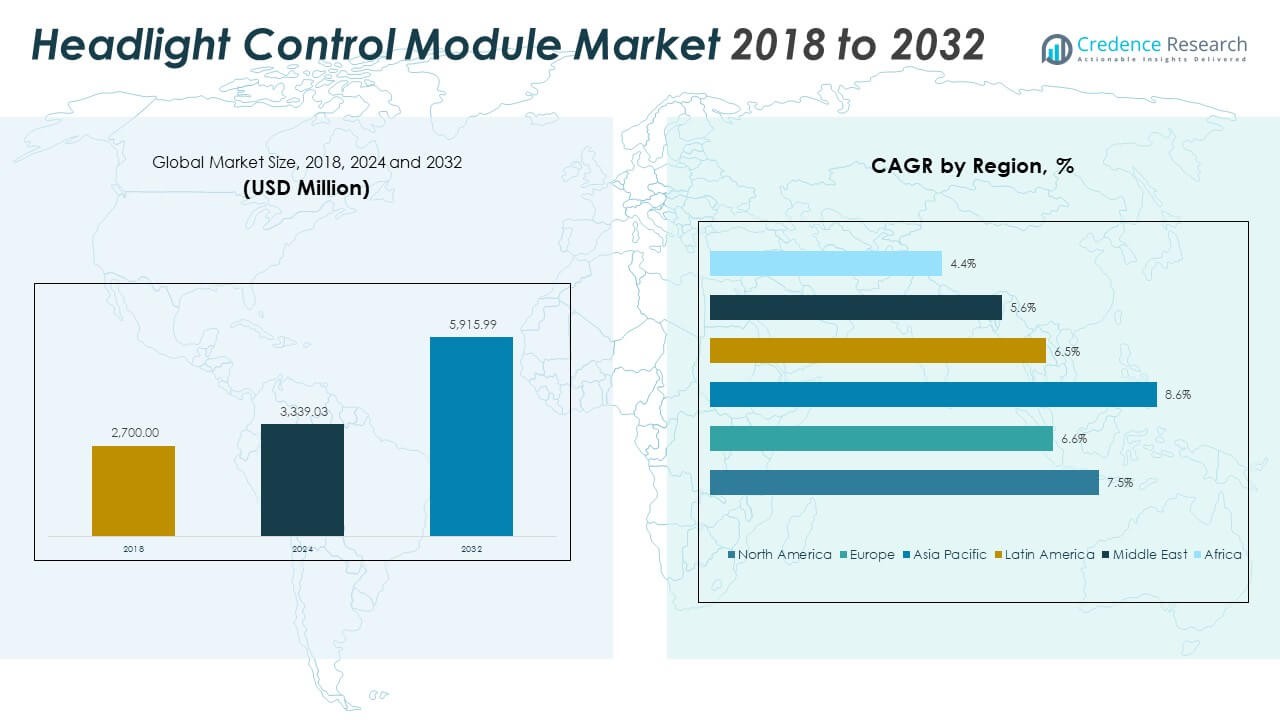
The Headlight Control Module Market size was valued at USD 2,700.00 million in 2018 to USD 3,339.03 million in 2024 and is anticipated to reach USD 5,915.99 million by 2032, at a CAGR of 7.47% during the forecast period.
| REPORT ATTRIBUTE | DETAILS |
|---|---|
| Historical Period | 2020-2023 |
| Base Year | 2024 |
| Forecast Period | 2025-2032 |
| Headlight Control Module Market Size 2024 | USD 3,339.03 Million |
| Headlight Control Module Market, CAGR | 7.47% |
| Headlight Control Module Market Size 2032 | USD 5,915.99 Million |
Growth in vehicle production, rising adoption of adaptive lighting systems, and the increasing penetration of LED and matrix headlights are key market drivers. Automakers are focusing on intelligent lighting integration to enhance road safety and compliance with global regulations. The shift toward connected vehicles and electric mobility further accelerates demand, as energy-efficient and software-controlled headlight systems play a crucial role in next-generation automotive design and performance.
Europe leads the market due to its advanced automotive manufacturing base and stringent lighting safety standards. North America follows with high adoption of adaptive and LED headlight systems in luxury and electric vehicles. The Asia Pacific region is emerging rapidly, driven by large-scale vehicle production in China, Japan, and India. Strong growth in electric and hybrid vehicle sales, supported by government incentives and expanding smart infrastructure, strengthens regional market potential and fosters long-term development opportunities.
Market Insights:
- The Headlight Control Module Market was valued at USD 2,700.00 million in 2018, reached USD 3,339.03 million in 2024, and is projected to achieve USD 5,915.99 million by 2032, growing at a CAGR of 7.47%.
- North America leads with a 36.9% share, driven by advanced automotive technology, regulatory mandates, and high luxury vehicle adoption. Europe follows with 20.1%, supported by strong OEM presence and strict safety standards, while Asia Pacific holds 33.1% due to large-scale vehicle production.
- Asia Pacific is the fastest-growing region, supported by rapid EV adoption, cost-efficient manufacturing, and government-backed safety and efficiency initiatives.
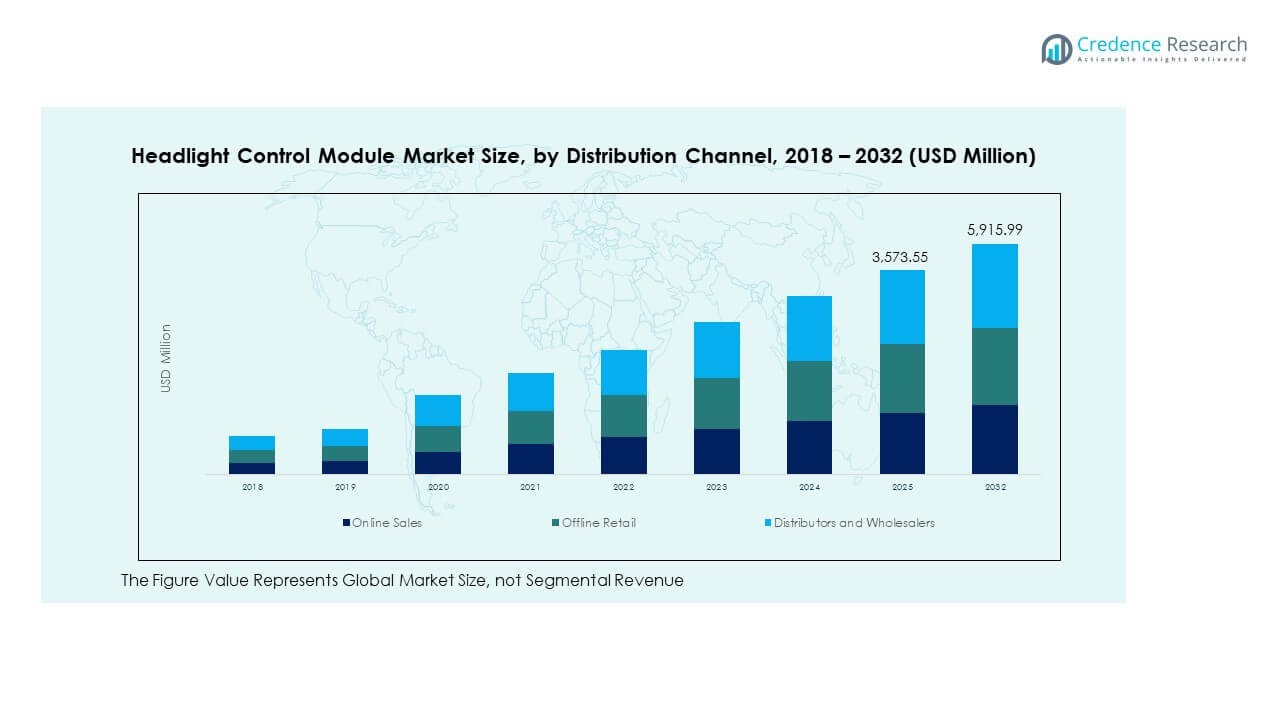
- Offline retail and distributor channels collectively account for around 70% of total sales, driven by installation support and established supply networks.
- Online sales contribute nearly 30%, reflecting growing e-commerce access and digital purchasing convenience for OEM and aftermarket customers.
Market Drivers
Increasing Integration of Advanced Driver Assistance Systems (ADAS) Enhancing Vehicle Lighting Control
Automotive manufacturers are adopting advanced driver assistance systems to enhance driving safety and comfort. The integration of ADAS technologies such as adaptive cruise control and lane-keeping assistance increases demand for headlight control modules capable of automatic light adjustment. These modules improve road illumination and reduce glare for oncoming vehicles. The rise in night-time driving safety awareness also supports greater implementation across premium and mid-range models. Government initiatives promoting vehicle safety standards drive automakers toward intelligent lighting solutions. It benefits from growing consumer expectations for advanced visibility systems. Continuous R&D in lighting sensors and camera-based control technology supports performance improvements. The market continues to gain momentum through integration with automated vehicle systems.
- For instance, Valeo's MatrixBeam technology is deployed by BMW in its 2023 i7 and 7 Series models, where the adaptive LED headlamps feature precisely segmented beams controlled by onboard cameras and ADAS systems. These headlamps automatically turn off segments directed toward oncoming vehicles and are capable of dynamic light adaptation, reducing glare and improving nighttime visibility.
Shift Toward Energy-Efficient and Intelligent LED Lighting Solutions
Manufacturers are transitioning from halogen to LED and laser-based headlights to enhance efficiency and performance. LED technology offers lower energy consumption, longer lifespan, and superior brightness. This shift accelerates the use of control modules that manage adaptive lighting functions, including high-beam assist and dynamic range adjustment. Consumers prefer energy-saving lighting systems that ensure enhanced visibility and design appeal. The regulatory push for sustainable lighting systems encourages automakers to adopt smart control modules. It drives steady replacement of conventional technologies in new vehicle models. The demand for precise illumination control promotes innovation in driver-assist lighting platforms. Integration with vehicle electronics and digital communication systems enhances system reliability and responsiveness.
- For instance, FORVIA HELLA and Volkswagen co-developed the IQ.LIGHT HD Matrix headlights for the 2023 VW Touareg, featuring 19,200 individually controllable micro-LEDs per headlamp. These advanced headlights deliver precise adaptive illumination, reduce glare for oncoming drivers, and enhance visibility under varying road conditions, marking a significant step in high-definition automotive lighting technology.
Rising Production of Electric and Hybrid Vehicles Boosting Smart Lighting Demand
The global rise in electric and hybrid vehicle production creates new demand for intelligent headlight systems. Electric vehicles emphasize energy efficiency, leading to adoption of advanced LED and adaptive lighting solutions. Smart headlight control modules play a key role in optimizing battery usage and ensuring driving safety. Automakers focus on integrating these modules with digital communication systems for better control accuracy. The Headlight Control Module Market benefits from ongoing electrification trends in passenger and commercial vehicles. Consumers expect connected lighting systems that align with eco-friendly and autonomous driving technologies. Integration with onboard sensors allows seamless adaptation to environmental and traffic conditions. It continues to expand its role as part of smart vehicle architecture worldwide.
Government Regulations Promoting Automotive Lighting Safety Standards
Stringent road safety regulations across major economies are driving wider adoption of adaptive headlight control technologies. Agencies such as the European Commission and NHTSA encourage deployment of advanced front-lighting systems. These rules require headlights to adjust beam patterns automatically for improved visibility and reduced glare. Compliance with such standards supports consistent demand for control modules across vehicle categories. Automakers invest heavily in R&D to meet emission and lighting efficiency benchmarks. The rising enforcement of UN ECE regulations accelerates implementation of intelligent lighting controls. It ensures a steady revenue stream for technology suppliers and system integrators. Strong policy support complements consumer-driven adoption of safer, smarter lighting systems.
Market Trends
Growing Adoption of Matrix and Laser Lighting Technologies in Premium Vehicles
Premium automotive brands increasingly adopt matrix LED and laser lighting systems to enhance performance and visual appeal. These technologies require complex headlight control modules capable of precise illumination mapping. Matrix systems automatically deactivate certain LED segments to prevent glare for oncoming drivers. Laser lighting delivers higher intensity and longer beam distance while conserving power. Automakers use advanced control algorithms to improve real-time response in varying traffic conditions. It benefits from growing use in luxury segments and sports models. Partnerships between lighting suppliers and chip manufacturers support next-generation innovation. The market shows steady expansion as intelligent lighting becomes a key differentiator for premium brands.
- For instance, Audi’s Digital Matrix LED headlights incorporate a chip containing approximately 1.3 million micromirrors per headlamp, enabling highly precise adaptive light distribution and pattern projection on the road. These systems dynamically adjust beam direction to improve visibility and reduce glare for oncoming vehicles, representing a key advancement in Audi’s high-resolution lighting technology.
Integration of Internet of Things (IoT) and Cloud Connectivity in Headlight Systems
Smart headlight modules now feature IoT connectivity, enabling real-time monitoring and diagnostics. Cloud-linked control platforms allow remote updates, fault detection, and system calibration. Manufacturers employ predictive maintenance features to improve reliability and reduce downtime. This connectivity strengthens data synchronization between vehicle systems and external infrastructure. The Headlight Control Module Market benefits from the integration of 5G and AI-based vehicle communication networks. OEMs prioritize connected lighting platforms to align with future mobility standards. IoT-based monitoring supports improved fleet management for commercial operators. It strengthens the evolution of connected automotive ecosystems and enhances user convenience.
- For instance, at CES 2024, Valeo showcased its connected and cloud-enabled automotive lighting technologies, featuring modules capable of real-time diagnostics, remote firmware updates, and seamless integration with vehicle telematics systems. These innovations highlight Valeo’s commitment to advancing intelligent lighting solutions for next-generation connected vehicles.
Emergence of Compact and Modular Design Architecture for Lighting Systems
Manufacturers develop compact, modular headlight control units that simplify installation and reduce component weight. These systems support multiple lighting configurations, including adaptive, cornering, and automatic high-beam functions. Compact modules optimize space utilization and thermal performance within vehicle structures. Automakers seek modular designs that streamline assembly processes and reduce maintenance complexity. The integration of miniaturized sensors and high-performance microcontrollers improves accuracy and power management. It drives adoption among mid-range and electric vehicle manufacturers seeking cost efficiency. The growing use of silicon carbide and gallium nitride components enhances switching speed and durability. This trend improves scalability and customization for diverse vehicle models.
Adoption of Adaptive Lighting in Commercial and Off-Highway Vehicles
Adaptive lighting technology expands beyond passenger cars into commercial and off-highway vehicles. Fleet operators adopt smart headlights to enhance visibility and driver safety in low-light environments. These vehicles require control modules capable of handling vibrations, temperature variations, and heavy-duty performance demands. The use of AI-based algorithms supports dynamic beam control across varied terrains. Manufacturers develop durable, weather-resistant lighting systems tailored for logistics, mining, and agricultural vehicles. The Headlight Control Module Market benefits from growing demand in these specialized applications. It creates opportunities for customized, high-performance solutions. Enhanced safety expectations across fleet operations further reinforce the long-term trend.
Market Challenges Analysis
High Production Costs and Complex Integration Limiting Mass Adoption
The advanced technology embedded in intelligent lighting systems significantly increases manufacturing costs. Control modules require high-quality sensors, processors, and communication interfaces that raise vehicle production expenses. Automakers face challenges in balancing cost efficiency with the need for advanced functionality. Integration with vehicle electronic control units and safety systems adds complexity to design and testing phases. The Headlight Control Module Market experiences slower adoption among budget vehicle categories due to these constraints. Suppliers must streamline manufacturing and optimize design to meet OEM cost targets. Limited scalability across diverse vehicle models restricts rapid market penetration. It continues to face pricing pressure from OEMs focused on affordability.
Lack of Standardization and Compatibility Across Automotive Platforms
The absence of uniform standards for communication protocols and system architecture complicates module interoperability. Automakers use varied software ecosystems, making cross-platform integration difficult for suppliers. Compatibility issues delay deployment of adaptive lighting technologies across vehicle lines. Regional regulatory differences further complicate design specifications and homologation processes. It faces challenges in achieving global uniformity in lighting performance and safety standards. Frequent updates in autonomous driving software require module recalibration, increasing maintenance costs. Suppliers invest heavily in ensuring backward compatibility with existing electrical systems. The lack of unified standards slows innovation and limits economies of scale across the industry.
Market Opportunity
Expansion of Smart and Adaptive Lighting in Mid-Range Vehicle Segments
The growing inclusion of adaptive lighting features in mid-range vehicles creates strong opportunities for market expansion. Automakers target broader customer bases by offering intelligent lighting functions at affordable prices. Suppliers design simplified, cost-effective headlight control modules to fit various models. The Headlight Control Module Market benefits from modular designs that support scalable integration. Smart lighting adoption aligns with global trends toward enhanced safety and energy efficiency. It allows OEMs to differentiate vehicle offerings and comply with regulatory norms. The transition from conventional to adaptive systems supports long-term revenue growth. Emerging markets show high potential due to increasing vehicle ownership and improved safety awareness.
Integration of AI and Sensor Fusion for Predictive Illumination Control
Artificial intelligence and sensor fusion technologies enable predictive illumination that adapts to real-time driving conditions. Headlight control modules analyze input from cameras, radar, and GPS to adjust lighting automatically. These systems enhance driver comfort and safety under varied environmental conditions. AI-enabled modules help reduce glare and improve beam precision on curved or uneven roads. It leverages advanced computing capabilities for instant decision-making and system adaptation. OEM collaborations with semiconductor firms accelerate innovation in smart lighting platforms. The opportunity for integrating lighting intelligence with autonomous vehicle frameworks strengthens future growth. Continuous software advancement expands applications across electric and connected vehicle ecosystems.
Market Segmentation Analysis:
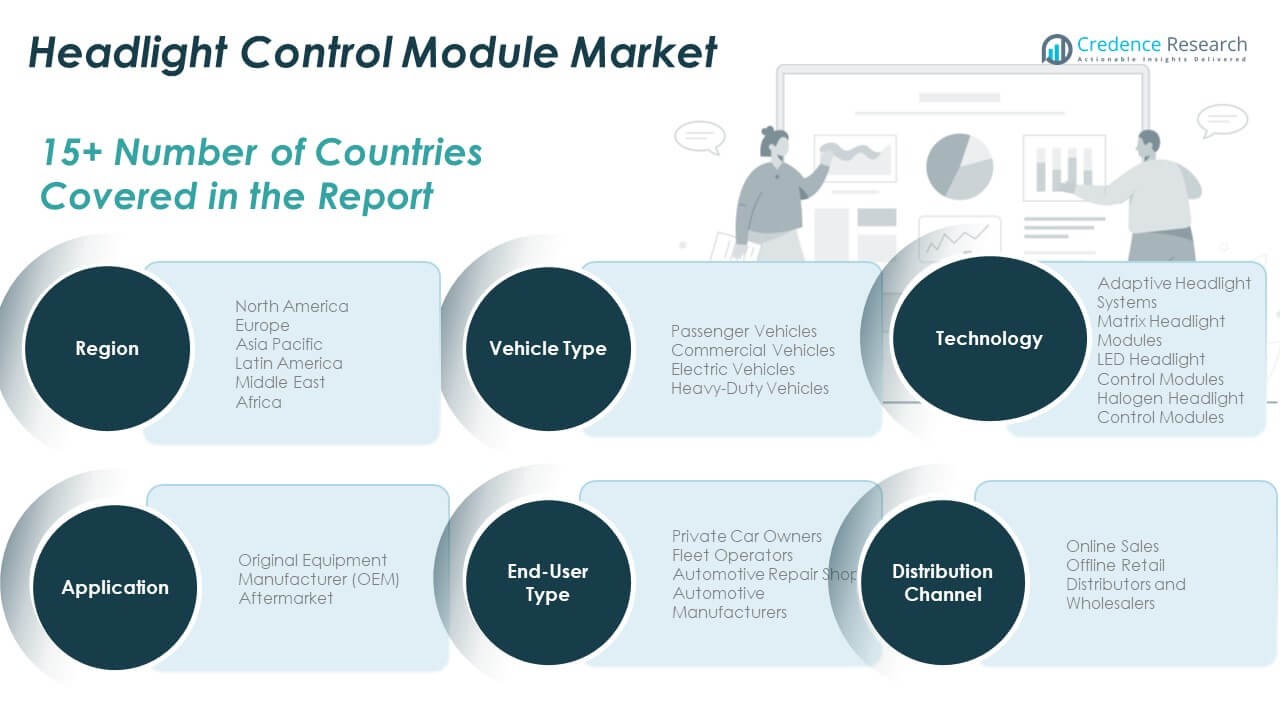
By vehicle type, the Headlight Control Module Market demonstrates strong diversity across vehicle types, applications, technologies, and distribution networks. Passenger vehicles account for the largest share due to the growing integration of adaptive and LED lighting systems in mid-range and luxury cars. Commercial and heavy-duty vehicles are witnessing steady adoption driven by safety regulations and long-haul visibility requirements. Electric vehicles create new opportunities for energy-efficient headlight modules that optimize battery usage while supporting smart automation features.
By application, OEMs dominate the application segment, supported by increasing demand for factory-installed adaptive lighting systems in new vehicles. The aftermarket segment continues to expand with the replacement of conventional headlights and the upgrade to intelligent lighting technologies.
- For instance, General Motors and Ford expanded deployment of matrix LED and adaptive front lighting systems across multiple model platforms in 2024 to enhance nighttime safety per NHTSA standards, aligning with statements in automotive industry analysis.
By end-users, automotive manufacturers and fleet operators lead adoption due to high safety compliance and growing preference for advanced illumination systems that enhance driver visibility and comfort.
By technology, LED and adaptive headlight control modules hold a dominant position, driven by superior brightness, longer lifespan, and intelligent beam adjustment capabilities. Matrix modules are gaining traction for their ability to deliver precision-controlled illumination without dazzling oncoming traffic. Halogen systems remain relevant in budget vehicle categories where cost efficiency is prioritized.
By distribution, offline retail and distributor networks remain key due to their established service networks and installation support. Online channels are expanding rapidly with the rise of digital automotive component sales. It continues to benefit from increasing e-commerce accessibility and global supply chain integration across all major regions.
- For instance, in 2024, sales via leading e-commerce marketplaces such as Amazon, Alibaba, Flipkart, and eBay allows lighting brands like Philips Hue and Yeelight to reach millions of prospective automotive and residential lighting customers, as quantified in lighting industry e-commerce analysis.
Segmentation:
By Vehicle Type:
- Passenger Vehicles
- Commercial Vehicles
- Electric Vehicles
- Heavy-Duty Vehicles
By Application:
- Original Equipment Manufacturer (OEM)
- Aftermarket
By End-User:
- Private Car Owners
- Fleet Operators
- Automotive Repair Shops
- Automotive Manufacturers
By Technology:
- Adaptive Headlight Systems
- Matrix Headlight Modules
- LED Headlight Control Modules
- Halogen Headlight Control Modules
By Distribution Channel:
- Online Sales
- Offline Retail
- Distributors and Wholesalers
By Region:
- North America (U.S., Canada, Mexico)
- Europe (UK, France, Germany, Italy, Spain, Russia, Rest of Europe)
- Asia Pacific (China, Japan, South Korea, India, Australia, Southeast Asia, Rest of Asia Pacific)
- Latin America (Brazil, Argentina, Rest of Latin America)
- Middle East (GCC Countries, Israel, Turkey, Rest of Middle East)
- Africa (South Africa, Egypt, Rest of Africa)
Regional Analysis:
North America
The North America Headlight Control Module Market size was valued at USD 1,009.80 million in 2018 to USD 1,234.09 million in 2024 and is anticipated to reach USD 2,183.60 million by 2032, at a CAGR of 7.5% during the forecast period. North America holds a 36.9% share of the global market, driven by advanced automotive technology adoption and strong consumer preference for safety features. The U.S. dominates the region, supported by high penetration of premium and electric vehicles integrating adaptive lighting. Canada and Mexico contribute through manufacturing expansions and OEM collaborations. Stringent vehicle safety regulations issued by NHTSA and increasing demand for connected vehicles strengthen growth prospects. The region shows consistent investments in R&D for adaptive LED and matrix systems. It continues to benefit from major automakers’ integration of AI-based lighting controls and energy-efficient modules.
Europe
The Europe Headlight Control Module Market size was valued at USD 609.12 million in 2018 to USD 719.14 million in 2024 and is anticipated to reach USD 1,191.20 million by 2032, at a CAGR of 6.6% during the forecast period. Europe captures a 20.1% share, supported by its strong automotive base and regulatory focus on lighting efficiency. Germany, France, and Italy remain primary contributors due to their leadership in luxury and electric vehicles. Strict European Union standards on adaptive front-lighting systems drive OEMs toward innovation. The region’s emphasis on sustainability encourages rapid adoption of LED and laser-based lighting modules. Automotive suppliers in Germany and the UK invest in intelligent control systems that integrate with ADAS. It benefits from established R&D ecosystems and high consumer acceptance of safety technologies. The transition to electric mobility continues to create new opportunities for module optimization.
Asia Pacific
The Asia Pacific Headlight Control Module Market size was valued at USD 793.80 million in 2018 to USD 1,017.89 million in 2024 and is anticipated to reach USD 1,959.97 million by 2032, at a CAGR of 8.6% during the forecast period. Asia Pacific holds a 33.1% share, driven by rising vehicle production and expanding EV adoption in China, Japan, and India. The region experiences rapid adoption of smart automotive technologies due to growing urbanization and government incentives. Japan leads in technological innovation, while China focuses on mass-scale adoption across vehicle categories. Strong domestic manufacturing and low production costs support global supply chains. OEM partnerships in South Korea and India enhance technology transfer and localization. It benefits from increasing consumer awareness about road safety and lighting performance. Continuous product launches by regional suppliers reinforce market growth momentum.
Latin America
The Latin America Headlight Control Module Market size was valued at USD 165.24 million in 2018 to USD 202.31 million in 2024 and is anticipated to reach USD 331.71 million by 2032, at a CAGR of 6.5% during the forecast period. Latin America accounts for a 5.6% share, supported by steady vehicle sales recovery and modernization of transport fleets. Brazil remains the leading market, with growing adoption of LED and adaptive headlights in passenger cars. Mexico and Argentina show improving demand through assembly plant expansions and import-based module sales. Regional governments encourage the use of energy-efficient lighting components for safety compliance. Local manufacturing collaborations between OEMs and suppliers improve availability of intelligent systems. It benefits from cost-effective production environments and expanding aftermarket potential. The gradual transition toward advanced lighting in mid-range vehicles fuels consistent regional progress.
Middle East
The Middle East Headlight Control Module Market size was valued at USD 78.03 million in 2018 to USD 88.46 million in 2024 and is anticipated to reach USD 136.10 million by 2032, at a CAGR of 5.6% during the forecast period. The Middle East represents a 2.3% share, with strong demand from GCC countries led by Saudi Arabia and the UAE. Rising luxury vehicle imports and infrastructure development contribute to adoption growth. Local automotive workshops and distributors expand product availability through aftermarket channels. Manufacturers target the region with durable control modules suited for high-temperature conditions. The focus on road safety and visibility improvements strengthens system integration. It benefits from increasing interest in connected lighting and EV-compatible technologies. Ongoing investment in vehicle modernization supports long-term opportunities across the region.
Africa
The Africa Headlight Control Module Market size was valued at USD 44.01 million in 2018 to USD 77.15 million in 2024 and is anticipated to reach USD 113.41 million by 2032, at a CAGR of 4.4% during the forecast period. Africa holds a 2.0% share, supported by gradual vehicle fleet expansion and urban mobility initiatives. South Africa leads with established automotive assembly operations and growing aftermarket services. Egypt and Nigeria show increasing interest in safety-compliant headlight technologies. Economic reforms and import policies create openings for international suppliers. Local demand focuses on affordable, durable modules suitable for challenging road conditions. It remains at an early growth stage but shows promise through partnerships with OEMs. Investment in infrastructure and electric mobility could accelerate technology adoption in coming years.
Key Player Analysis:
- Hella GmbH & Co. KGaA
- Valeo S.A.
- Denso Corporation
- Hyundai Mobis Co., Ltd.
- Magneti Marelli S.p.A.
- ZKW Group GmbH
- Renesas Electronics Corporation
- Lear Corporation
- Keetec
Competitive Analysis:
The Headlight Control Module Market features intense competition driven by technological innovation and expanding global demand for intelligent lighting solutions. Major players such as Hella, Valeo, Denso, Hyundai Mobis, and Magneti Marelli focus on product advancement through adaptive, LED, and matrix module integration. These companies invest heavily in R&D to enhance precision, energy efficiency, and compatibility with driver assistance systems. ZKW, Renesas, and Lear Corporation emphasize electronic control optimization and partnerships with OEMs for platform-wide deployment. Keetec and regional suppliers strengthen presence through cost-effective aftermarket solutions. Strategic mergers, acquisitions, and production expansion across Asia and Europe enhance global supply capabilities. It maintains steady consolidation as manufacturers compete through design innovation, performance reliability, and software-driven lighting intelligence. The growing focus on safety compliance and autonomous vehicle readiness continues to shape competitive differentiation in this evolving market landscape.
Recent Developments:
- In September 2025, FORVIA HELLA announced the launch of its Intelligent Power Distribution Module (iPDM), featuring the industry’s first electronic fuse integrated with advanced software. The production is scheduled in Romania, reinforcing the company’s leadership in intelligent automotive control electronics for future mobility applications, including automated driving and electric vehicles.
- In June 2025, Marelli received the “Collaborative Partnership of the Year” award with OLEDWorks at the AutoTech Awards, following their work on digital OLED rear lighting for Audi’s Q6 e-tron. This partnership highlighted advancements in automotive lighting modules and set industry benchmarks for rear lighting technology.
- In April 2025, Valeo entered a strategic partnership with Appotronics to develop next-generation front lighting systems for vehicles. These advanced headlights will use Appotronics’ laser projection technology and are designed to deliver high-performance adaptive lighting, enhance vehicle safety, and even enable outdoor cinematic projection functionalities.
- In January 2024, ZKW, in collaboration with LG, presented their high-tech microZ-LED headlights at CES, capable of high-definition projections and adaptable lighting. These innovations are integral to dynamic and intelligent vehicle lighting systems for global automotive leaders.
Report Coverage:
The research report offers an in-depth analysis based on Vehicle Type, Application, End-User, Technology and Distribution Channel. It details leading market players, providing an overview of their business, product offerings, investments, revenue streams, and key applications. Additionally, the report includes insights into the competitive environment, SWOT analysis, current market trends, as well as the primary drivers and constraints. Furthermore, it discusses various factors that have driven market expansion in recent years. The report also explores market dynamics, regulatory scenarios, and technological advancements that are shaping the industry. It assesses the impact of external factors and global economic changes on market growth. Lastly, it provides strategic recommendations for new entrants and established companies to navigate the complexities of the market.
Future Outlook:
- The Headlight Control Module Market will experience steady expansion driven by the integration of intelligent and adaptive lighting systems in modern vehicles.
- Electric and hybrid vehicle production will strengthen demand for energy-efficient lighting modules with precise power management features.
- OEMs will continue to dominate sales due to advanced installations in new vehicle models equipped with driver-assistance systems.
- The aftermarket will expand rapidly as consumers upgrade conventional headlights with LED and matrix control technologies.
- AI-enabled lighting systems and sensor fusion will redefine automation, supporting predictive illumination capabilities.
- Partnerships between semiconductor firms and automotive suppliers will boost innovation in digital lighting electronics.
- Asia Pacific will emerge as the manufacturing and innovation hub due to cost advantages and large-scale vehicle output.
- Technological standardization across OEM platforms will improve compatibility and reduce system complexity.
- Smart connectivity through IoT and cloud integration will enhance diagnostics, maintenance, and performance optimization.
- It will gain from global safety regulations promoting adaptive lighting, driving consistent adoption across all vehicle classes.

Request a Free Sample
Fill in your details and we'll send you a free sample report.
- Sample data tables & charts
- Research methodology
Market Dynamics
Integration of Advanced Driver Assistance Systems (ADAS)
Automotive manufacturers are increasingly incorporating ADAS features such as adaptive cruise control and lane-keeping assistance, which require sophisticated headlight control modules for automatic light adjustment, enhancing road safety and visibility.
Shift Toward Energy-Efficient and Intelligent LED Lighting
The transition from halogen to LED and laser-based headlights is accelerating, as these technologies offer lower energy consumption, longer lifespan, and superior brightness, driving demand for advanced control modules that enable adaptive and dynamic lighting functions.
Rising Production of Electric and Hybrid Vehicles
The growth in electric and hybrid vehicle production emphasizes the need for energy-efficient and smart headlight systems, with control modules playing a critical role in optimizing battery usage and integrating with digital vehicle architectures.
Stringent Automotive Lighting Safety Regulations
Global regulatory bodies are mandating adaptive lighting and automatic beam adjustment to improve nighttime visibility and reduce glare, compelling automakers to adopt intelligent headlight control modules to ensure compliance and enhance safety.
Expansion of Smart Lighting in Mid-Range Vehicles
Automakers are increasingly offering adaptive and intelligent lighting features in mid-range vehicles, broadening the market for headlight control modules beyond luxury segments and supporting mass adoption through cost-effective, modular solutions.
Need a Custom Version of This Report?
Tailor the scope, geography, or segments to your exact requirements.
- Custom geography or segment scope
- Direct access to our analyst team
Frequently Asked Questions
What is the current market size for the Headlight Control Module Market, and what is its projected size in 2032?
At what Compound Annual Growth Rate is the Headlight Control Module Market projected to grow between 2024 and 2032?
Which Headlight Control Module Market segment held the largest share in 2024?
What are the primary factors fueling the growth of the Headlight Control Module Market?
Who are the leading companies in the Headlight Control Module Market?
Which region commanded the largest share of the Headlight Control Module Market in 2024?
Table of Content
Chapter 1 Market Segmentation
- 1.1 Segmentation Framework
- 1.1.1 Product and Service Classification
- 1.1.2 Application and End-Use Classification
- 1.1.3 Technology and Solution Classification
- 1.1.4 Customer and Distribution Channel Classification
- 1.1.5 Geographic Segmentation
- 1.1.6 Market Segment Definitions and Boundaries
- 1.2 By Technology
- 1.2.1 Adaptive Headlight Systems
- 1.2.2 Matrix Headlight Modules
- 1.2.3 LED Headlight Control Modules
- 1.2.4 Halogen Headlight Control Modules
- 1.3 By Application
- 1.3.1 Original Equipment Manufacturer (OEM)
- 1.3.2 Aftermarket
- 1.4 By Vehicle Type
- 1.4.1 Passenger Vehicles
- 1.4.2 Commercial Vehicles
- 1.4.3 Electric Vehicles
- 1.4.4 Heavy-Duty Vehicles
Chapter 2 Introduction
- 2.1 Report Objectives and Scope
- 2.2 Product Definition and Industry Terminology
- 2.3 Market Inclusions and Exclusions
- 2.4 Research Process
- 2.4.1 Primary Research and Expert Interviews
- 2.4.2 Secondary Research and Source Review
- 2.4.3 Top-Down and Bottom-Up Estimation
- 2.4.4 Data Triangulation and Verification
- 2.5 Market Size Measurement Basis
- 2.5.1 2024: USD 3,339.03 million → 2032: USD 5,915.99 million
- 2.6 Historical and Forecast Reference Periods
- 2.6.1 Base Year: 2024
- 2.6.2 Forecast Period: 2024-2032
- 2.7 Research Assumptions and Limitations
Chapter 3 Executive Summary
- 3.1 Market Snapshot and Key Findings
- 3.2 Base-Year Market Size, 2024
- 3.3 Forecast Market Size, 2032
- 3.4 Revenue and Volume Growth Outlook
- 3.5 Key Demand and Supply Indicators
- 3.6 Leading Market Segments
- 3.7 Fastest-Growing Market Opportunities
- 3.8 Regional Performance Highlights
- 3.9 Technology and Industry Transformation
- 3.10 Competitive Landscape Summary
- 3.11 Analyst View and Strategic Implications
Chapter 4 Global Headlight Control Module Market Trends and Developments
- 4.1 Historical Industry Development
- 4.2 Recent Market Trends and Developments
- 4.3 Demand and Customer Behavior Trends
- 4.4 Technology and Product Innovation
- 4.5 Artificial Intelligence, Automation and Digitalization
- 4.6 Local Manufacturing and Supply Chain Realignment
- 4.7 Industry Partnerships, Mergers and Acquisitions
- 4.8 Sustainability and Circular Economy Developments
- 4.9 Government and Private Sector Investment Trends
- 4.10 Emerging Business Models and Commercialization
- 4.11 Industry Developments and Announcements
Chapter 5 Global Headlight Control Module Market Production, Supply and Demand Analysis
- 5.1 Demand Trend and Consumption Analysis
- 5.2 Demand Forecast, 2024-2032
- 5.3 Production and Output Trend
- 5.4 Production and Output Forecast, 2024-2032
- 5.5 Installed Capacity and Capacity Utilization
- 5.6 Company-Wise Production Plants and Statistics
- 5.6.1 Installed Production Capacity
- 5.6.2 Actual Production
- 5.6.3 Planned Capacity and Expansion Targets
- 5.7 Supply Chain Structure and Procurement Trends
- 5.8 Supply-Demand Gap and Bottlenecks
- 5.9 Import Dependence and Sourcing Structure
- 5.10 Contract Manufacturing and Outsourcing
- 5.11 Regional Supply and Demand Concentration
Chapter 6 Global Headlight Control Module Market Pricing Analysis
- 6.1 Pricing Structure and Measurement
- 6.2 Historical Pricing Trends
- 6.3 Pricing Outlook, 2024-2032
- 6.4 Average Selling Price and Unit Economics
- 6.5 Pricing by Product and Market Segment
- 6.6 Geographic Pricing Differences
- 6.7 Key Input, Energy, Labor and Logistics Costs
- 6.8 Contract Pricing and Purchasing Models
- 6.9 Pricing Sensitivity and Competitive Positioning
- 6.10 Price, Margin and Profitability Implications
Chapter 7 Global Headlight Control Module Market Dynamics
- 7.1 Market Growth Drivers
- 7.1.1 Demand-Side Drivers
- 7.1.2 Technology and Innovation Drivers
- 7.1.3 Infrastructure and Investment Drivers
- 7.1.4 Regulatory and Policy Drivers
- 7.2 Market Restraints
- 7.2.1 Cost and Affordability Constraints
- 7.2.2 Technology and Adoption Barriers
- 7.2.3 Supply Chain and Operational Constraints
- 7.3 Market Challenges
- 7.3.1 Competitive Pressure and Margin Erosion
- 7.3.2 Skills, Infrastructure and Implementation Gaps
- 7.4 Emerging Market Opportunities
- 7.5 Market Dynamics Impact and Time-Horizon Assessment
Chapter 8 Global Headlight Control Module Value Chain Analysis
- 8.1 Industry Value Chain Overview
- 8.2 Upstream Suppliers and Critical Inputs
- 8.3 Technology and Component Providers
- 8.4 Manufacturing or Service Delivery
- 8.5 Distribution, Channel Partners and Integrators
- 8.6 Downstream Applications and End Users
- 8.7 Value Addition and Profit Pools
- 8.8 Vertical Integration and Outsourcing
- 8.9 Supplier Concentration and Risk
- 8.10 Supply Chain Localization and Resilience
Chapter 9 Global Headlight Control Module Market Regulations and Policies
- 9.1 Relevant Laws, Standards and Compliance Frameworks
- 9.2 Product, Service, Safety and Quality Requirements
- 9.3 Government Policies, Incentives and Subsidies
- 9.4 Imports, Exports and Trade Barriers
- 9.5 Public Procurement and Local Content Requirements
- 9.6 Environmental and Sustainability Compliance
- 9.7 Upcoming Policy Changes and Market Implications
Chapter 10 Global Headlight Control Module Market Hotspots and Opportunities
- 10.1 Market Opportunity Mapping and Growth Hotspots
- 10.2 High-Growth Applications and Customer Groups
- 10.3 Underserved Markets and White-Space Opportunities
- 10.4 Emerging Technology and Product Opportunities
- 10.5 New Capacity and Investment Hotspots
- 10.6 Market Entry and Expansion Opportunities
- 10.7 Distribution and Partnership Opportunities
- 10.8 Near-Term and Long-Term Commercial Potential
- 10.9 Opportunity Attractiveness and Execution Risks
Chapter 11 Global Headlight Control Module Market Outlook, 2024-2032
- 11.1 Market Size and Analysis
- 11.1.1 Revenue (Market Measurement: 2024: USD 3,339.03 million → 2032: USD 5,915.99 million)
- 11.1.2 Market Volume and Quantity Sold
- 11.1.3 Historical Market Size
- 11.1.4 Base-Year Market Size, 2024
- 11.2 Market Forecast, 2024-2032
- 11.2.1 Revenue Forecast to 2032
- 11.2.2 Volume Forecast to 2032
- 11.2.3 CAGR and Year-on-Year Growth
- 11.2.4 Incremental Revenue Opportunity
- 11.3 Forecast Assumptions and Scenario Analysis
- 11.3.1 Base-Case Forecast
- 11.3.2 Optimistic and Conservative Scenarios
- 11.3.3 Technology, Pricing and Policy Sensitivities
- 11.4 Market Attractiveness and Growth Outlook
Chapter 12 Global Headlight Control Module Market Segmentation and Outlook
- 12.1 Segmentation Summary and Market Shares, 2024
- 12.2 Largest and Fastest-Growing Segments
- 12.3 By Technology - Market Size and Forecast, 2024-2032
- 12.3.1 Segment Definition and Scope
- 12.3.2 Historical Market Size
- 12.3.3 Revenue Forecast, 2024-2032
- 12.3.4 Volume Forecast, 2024-2032
- 12.3.5 Base-Year Market Share, 2024
- 12.3.6 Segment CAGR and Growth Drivers
- 12.3.7 Subsegment Market Size and Forecast
- 12.3.7.1 Adaptive Headlight Systems
- 12.3.7.2 Matrix Headlight Modules
- 12.3.7.3 LED Headlight Control Modules
- 12.3.7.4 Halogen Headlight Control Modules
- 12.3.8 Subsegment Pricing and Adoption Trends
- 12.3.9 Leading Suppliers and Competition
- 12.3.10 Regional Demand and Opportunities
- 12.4 By Application - Market Size and Forecast, 2024-2032
- 12.4.1 Segment Definition and Scope
- 12.4.2 Historical Market Size
- 12.4.3 Revenue Forecast, 2024-2032
- 12.4.4 Volume Forecast, 2024-2032
- 12.4.5 Base-Year Market Share, 2024
- 12.4.6 Segment CAGR and Growth Drivers
- 12.4.7 Subsegment Market Size and Forecast
- 12.4.7.1 Original Equipment Manufacturer (OEM)
- 12.4.7.2 Aftermarket
- 12.4.8 Subsegment Pricing and Adoption Trends
- 12.4.9 Leading Suppliers and Competition
- 12.4.10 Regional Demand and Opportunities
- 12.5 By Vehicle Type - Market Size and Forecast, 2024-2032
- 12.5.1 Segment Definition and Scope
- 12.5.2 Historical Market Size
- 12.5.3 Revenue Forecast, 2024-2032
- 12.5.4 Volume Forecast, 2024-2032
- 12.5.5 Base-Year Market Share, 2024
- 12.5.6 Segment CAGR and Growth Drivers
- 12.5.7 Subsegment Market Size and Forecast
- 12.5.7.1 Passenger Vehicles
- 12.5.7.2 Commercial Vehicles
- 12.5.7.3 Electric Vehicles
- 12.5.7.4 Heavy-Duty Vehicles
- 12.5.8 Subsegment Pricing and Adoption Trends
- 12.5.9 Leading Suppliers and Competition
- 12.5.10 Regional Demand and Opportunities
- 12.6 Segment Growth Comparison
- 12.7 Segment Attractiveness and Priority Matrix
Chapter 13 Global Headlight Control Module End-Use and Application Market Outlook
- 13.1 End-Use Industry and Customer Demand Structure
- 13.2 Leading Applications and Customer Groups
- 13.3 End-Use Market Size, Share and Forecast
- 13.4 Major End-Use Industry Deep Dives
- 13.4.1 Customer Requirements and Use Cases
- 13.4.2 Demand and Replacement Cycles
- 13.4.3 Technical and Regulatory Considerations
- 13.4.4 Purchasing and Procurement Models
- 13.4.5 Leading Vendors and Distribution Channels
- 13.4.6 Forecast and Commercial Opportunities
- 13.5 Emerging Applications and Cross-Segment Demand
- 13.6 End-Use Industry Investment Priorities
Chapter 14 Global Headlight Control Module Geographic Market Outlook, 2024-2032
- 14.1 Regional Market Size and Share, 2024
- 14.2 Regional Market Forecast, 2024-2032
- 14.3 Regional Pricing, Production and Demand Differences
- 14.4 North America
- 14.4.1 United States
- 14.4.2 Canada
- 14.4.3 Mexico
- 14.5 Europe
- 14.5.1 Germany
- 14.5.2 France
- 14.5.3 Italy
- 14.5.4 United Kingdom
- 14.5.5 Spain
- 14.5.6 Poland
- 14.5.7 Russia
- 14.5.8 Netherlands
- 14.5.9 Belgium
- 14.5.10 Sweden
- 14.5.11 Denmark
- 14.5.12 Norway
- 14.5.13 Rest of Europe
- 14.6 Asia Pacific
- 14.6.1 China
- 14.6.2 India
- 14.6.3 Japan
- 14.6.4 South Korea
- 14.6.5 Thailand
- 14.6.6 Indonesia
- 14.6.7 Vietnam
- 14.6.8 Malaysia
- 14.6.9 Australia
- 14.6.10 Rest of Asia Pacific
- 14.7 Latin America
- 14.7.1 Brazil
- 14.7.2 Argentina
- 14.7.3 Colombia
- 14.7.4 Chile
- 14.7.5 Rest of Latin America
- 14.8 Middle East
- 14.8.1 Saudi Arabia
- 14.8.2 United Arab Emirates
- 14.8.3 Turkey
- 14.8.4 Israel
- 14.8.5 Iran
- 14.8.6 Rest of the Middle East
- 14.9 Africa
- 14.9.1 South Africa
- 14.9.2 Egypt
- 14.9.3 Nigeria
- 14.9.4 Morocco
- 14.9.5 Rest of Africa
- 14.10 Regional Investment, Policy and Supply Chain Differences
- 14.11 Regional Competitive Landscape
- 14.12 Geographic Growth Hotspots
Chapter 15 Global Headlight Control Module Technology, Innovation and Sustainability Outlook
- 15.1 Technology Landscape and Maturity
- 15.2 Product, Process and Service Innovation
- 15.3 AI, Automation and Digital Tools in the Industry
- 15.4 Technology Adoption and Performance Benchmarking
- 15.5 Innovation Pipeline and R&D Investment
- 15.6 Patent and Intellectual Property Trends
- 15.7 Energy Efficiency and Resource Management
- 15.8 Sustainability, Recycling and Circularity
- 15.9 Technology Roadmap, 2024-2032
- 15.10 Risks of Obsolescence and Technology Substitution
Chapter 16 Global Headlight Control Module Market Key Strategic Imperatives
- 16.1 Growth and Market Entry Priorities
- 16.2 High-Return Products and Segments
- 16.3 Pricing, Profitability and Cost Optimization
- 16.4 Technology Investment and Product Differentiation
- 16.5 Supply Chain Localization and Resilience
- 16.6 Distribution and Customer Acquisition
- 16.7 Partnership, Acquisition and Capacity Strategy
- 16.8 Regional Expansion Priorities
- 16.9 Short-, Medium- and Long-Term Actions
Chapter 17 Competition Outlook
- 17.1 Industry Competition Characteristics
- 17.2 Market Structure and Concentration
- 17.3 Market Share and Competitive Positioning, 2024
- 17.4 Company-Wise Revenue and Product Benchmarking
- 17.5 Production and Service Capacity Benchmarking
- 17.6 Technology, Pricing and Differentiation
- 17.7 Regional Footprint and Distribution Strength
- 17.8 Mergers, Acquisitions and Strategic Alliances
- 17.9 New Entrants and Competitive Threats
- 17.10 Porter's Five Forces and Industry Attractiveness
- 17.11 Competitive Outlook, 2024-2032
Chapter 18 Company Profiles
- 18.1 Company Coverage and Selection Criteria
- 18.2 Hella GmbH & Co. KGaA
- 18.2.1 Business Description
- 18.2.2 Company Ownership and Geographic Presence
- 18.2.3 Product and Service Portfolio
- 18.2.4 Manufacturing and Operating Footprint
- 18.2.5 Production Capacity and Expansion Plans
- 18.2.6 Financial Performance and Investment
- 18.2.7 Market Share and Competitive Position
- 18.2.8 Technology and Innovation Capabilities
- 18.2.9 Strategic Alliances or Partnerships
- 18.2.10 Recent Developments
- 18.2.11 Growth Strategy and Outlook
- 18.3 Valeo S.A.
- 18.4 Denso Corporation
- 18.5 Hyundai Mobis Co., Ltd.
- 18.6 Magneti Marelli S.p.A.
- 18.7 ZKW Group GmbH
- 18.8 Renesas Electronics Corporation
- 18.9 Lear Corporation
- 18.10 Keetec
- 18.11 Other Relevant Market Participants
Note: Every listed company is profiled on the structure shown under the first company. The company list is preliminary and may change based on research findings, market developments, data availability and client requirements.
Chapter 19 Disclaimer
- 19.1 Research and Forecast Disclaimer
- 19.2 Data Source and Estimation Limitations
Note: The depth of individual sections depends on data availability for this market. Volume, capacity, trade and other unit-based metrics are included where applicable.