Market Overview:
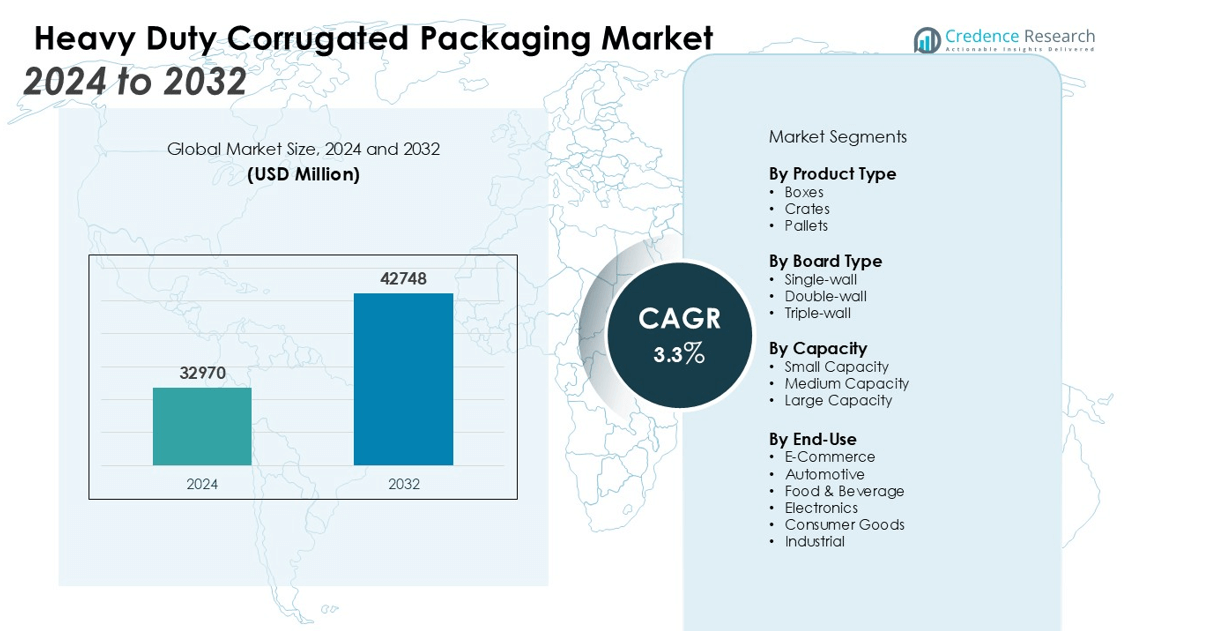
The Heavy Duty Corrugated Packaging Market size was valued at USD 32970 million in 2024 and is anticipated to reach USD 42748 million by 2032, at a CAGR of 3.3% during the forecast period (2024-2032).
| REPORT ATTRIBUTE | DETAILS |
|---|---|
| Historical Period | 2020-2023 |
| Base Year | 2024 |
| Forecast Period | 2025-2032 |
| Heavy Duty Corrugated Packaging Market Size 2024 | USD 32970 million |
| Heavy Duty Corrugated Packaging Market, CAGR | 3.3% |
| Heavy Duty Corrugated Packaging Market Size 2032 | USD 42748 million |
Key drivers of the market include the rising emphasis on sustainability, as heavy-duty corrugated packaging is recyclable and environmentally friendly. The growth of e-commerce has also boosted demand, as online retail relies heavily on protective packaging to ensure product safety during transit. Additionally, the ability of heavy-duty corrugated packaging to offer customization, improved stacking strength, and protection against physical damage drives its adoption in sectors requiring robust packaging solutions. The market is further supported by advancements in manufacturing technologies, which enhance the efficiency and quality of corrugated packaging.
Regionally, North America dominates the Heavy Duty Corrugated Packaging Market due to its established manufacturing base, technological advancements, and high demand for packaging solutions in sectors such as automotive and electronics. Europe follows closely, supported by stringent environmental regulations and growing consumer demand for eco-friendly products. The Asia-Pacific region is expected to exhibit the highest growth rate during the forecast period, driven by rapid industrialization, urbanization, and expanding e-commerce activities. China and India are anticipated to be key contributors to the market's growth in this region.
Market Insights:
- The Heavy Duty Corrugated Packaging Market was valued at USD 32,970 million in 2024 and is anticipated to reach USD 42,748 million by 2032, growing at a CAGR of 3.3% during the forecast period.
- The rising emphasis on sustainability drives demand for eco-friendly, recyclable heavy-duty corrugated packaging solutions across various industries.
- The rapid growth of e-commerce boosts the need for protective packaging to ensure safe product delivery, fueling the market's expansion.
- Heavy-duty corrugated packaging offers superior strength and protection, making it ideal for safeguarding fragile and heavy products, contributing to market growth.
- Technological advancements in packaging manufacturing have enhanced the efficiency and customization of heavy-duty corrugated packaging, supporting market development.
- Volatility in raw material prices, particularly for paper and wood pulp, puts pressure on manufacturers to maintain quality while managing costs.
- Stricter environmental regulations and limited recycling infrastructure present challenges for the widespread adoption of heavy-duty corrugated packaging.
Market Drivers:
Growing Demand for Sustainable Packaging Solutions
The increasing emphasis on sustainability is a significant driver for the Heavy Duty Corrugated Packaging Market. Consumers and businesses alike are prioritizing eco-friendly packaging solutions, with corrugated packaging being highly recyclable and biodegradable. This growing awareness of environmental impact is pushing companies to adopt packaging solutions that align with their sustainability goals. As industries face mounting pressure to reduce their carbon footprint, corrugated packaging stands out as a cost-effective, sustainable alternative.
- For instance, International Paper provides end-to-end circularity by collecting, sorting, and processing over 7 million tons of recovered paper annually.
Expansion of E-Commerce and Online Retail
The rapid growth of e-commerce has significantly boosted the demand for heavy-duty corrugated packaging. Online retail businesses require durable, reliable packaging to ensure products reach customers in excellent condition. Heavy-duty corrugated packaging provides optimal protection during transit, reducing the risk of damage and returns. The surge in online shopping has created a continuous need for innovative, protective packaging, driving the expansion of the Heavy Duty Corrugated Packaging Market.
Enhanced Durability and Protection in Packaging
Heavy-duty corrugated packaging offers superior strength and protection compared to traditional packaging materials. It ensures the safe transportation of heavy and fragile products, including electronics, automotive parts, and industrial goods. Its ability to resist crushing, moisture, and physical damage makes it highly sought after by industries requiring robust packaging solutions. This inherent strength positions the market for continued growth as businesses seek reliable packaging to safeguard their products.
- For instance, DS Smith Tecnicarton developed a heavy-duty corrugated container made of a 10-wave board construction that can safely store and transport up to 1,000 liters of bulk liquid, offering certified resistance to crushing and extreme conditions for industrial use.
Advancements in Manufacturing Technologies
Technological advancements in packaging manufacturing have improved the efficiency and cost-effectiveness of heavy-duty corrugated packaging. Automation and innovations in material science have enabled manufacturers to produce stronger, lighter, and more customizable packaging solutions. These advancements allow for optimized production processes and cater to the growing demand for tailored packaging. The continual evolution of manufacturing technologies supports the long-term growth of the Heavy Duty Corrugated Packaging Market.
Market Trends:
Increasing Adoption of Digital Printing and Customization
One of the key trends driving the Heavy Duty Corrugated Packaging Market is the growing adoption of digital printing technologies. Companies are increasingly turning to digital printing to enhance packaging customization, allowing for high-quality, cost-effective prints on corrugated materials. This trend is particularly prevalent in industries such as retail and consumer goods, where personalized packaging can strengthen brand identity and improve consumer engagement. The ability to produce small print runs with greater flexibility in design also caters to the demand for unique packaging solutions. As brands strive to differentiate themselves in competitive markets, customized corrugated packaging has become a powerful marketing tool, further boosting demand in the market.
- For instance, Stora Enso delivers customized digitally printed corrugated boxes with no minimum order quantities and production lead times starting from 2 days.
Shift Towards Sustainable and Eco-Friendly Packaging
Sustainability continues to be a driving force behind developments in the Heavy Duty Corrugated Packaging Market. With increasing environmental concerns, businesses are opting for packaging materials that minimize environmental impact. The shift towards recyclable, biodegradable, and renewable materials is accelerating, particularly in industries that emphasize sustainability. Consumer demand for eco-friendly packaging has prompted companies to innovate and find new ways to reduce waste, such as using recycled content in packaging or optimizing packaging design to minimize material usage. This focus on sustainability is shaping the future of the market, as it not only meets consumer expectations but also aligns with global environmental regulations.
- For instance, DS Smith surpassed its 2025 target sixteen months early by replacing over 1.2 billion pieces of plastic with fiber-based packaging alternatives across its European and North American markets, showcasing measurable progress in plastic reduction strategies.
Market Challenges Analysis:
Rising Raw Material Costs and Supply Chain Disruptions
A key challenge in the Heavy Duty Corrugated Packaging Market is the volatility in raw material prices, particularly for paper and wood pulp. The fluctuation in the cost of these materials, driven by global supply chain disruptions and increasing demand, puts pressure on manufacturers' profit margins. As these costs rise, companies face difficulties in maintaining competitive pricing while ensuring product quality. Supply chain disruptions, often due to geopolitical tensions or natural disasters, further complicate the procurement of raw materials, leading to delays and increased production costs. These challenges can hinder the market's growth as businesses seek cost-effective alternatives while maintaining packaging performance.
Environmental Regulations and Recycling Limitations
The increasing emphasis on sustainability and stricter environmental regulations present challenges for the Heavy Duty Corrugated Packaging Market. While corrugated packaging is considered eco-friendly, the limitations of recycling systems in certain regions complicate its widespread adoption. Inadequate recycling infrastructure and contamination of packaging materials during disposal can reduce the effectiveness of recycling efforts. These limitations create barriers for companies aiming to meet both regulatory requirements and consumer demands for sustainable solutions. As the market shifts toward more sustainable practices, overcoming these challenges will be crucial for continued growth and compliance with evolving environmental standards.
Market Opportunities:
Growing Demand for E-Commerce and Online Retail
The ongoing expansion of e-commerce presents significant opportunities for the Heavy Duty Corrugated Packaging Market. With online retail booming globally, there is an increasing need for packaging that ensures product safety during transportation. Heavy-duty corrugated packaging offers superior protection for a variety of products, making it ideal for e-commerce businesses that prioritize customer satisfaction. As more industries adopt online sales channels, the demand for durable, sustainable, and cost-effective packaging solutions will continue to rise. This presents an opportunity for packaging manufacturers to innovate and meet the specific requirements of e-commerce brands, contributing to market growth.
Technological Advancements in Packaging Materials and Design
Advancements in packaging materials and design offer a promising opportunity for the Heavy Duty Corrugated Packaging Market. New technologies, such as smart packaging and improved printing techniques, enable manufacturers to offer more efficient, customizable, and functional packaging solutions. These innovations not only enhance product appeal but also improve logistical efficiency, reducing overall transportation costs. The growing trend toward eco-friendly and recyclable materials opens avenues for companies to meet sustainability goals while offering high-performance packaging. By leveraging these technological advancements, companies can differentiate themselves in a competitive market, driving demand and expanding market share.
Market Segmentation Analysis:
By Product Type
The market is segmented into boxes, crates, and pallets. Boxes dominate the segment due to their versatility, used widely for packaging in the e-commerce, automotive, and consumer goods industries. Crates and pallets follow, with high demand in the agriculture and logistics sectors for storing and transporting large or heavy items. These products are chosen for their strength and protection capabilities.
- For instance, Sealed Air’s StealthWrap solution enables packaging operations to wrap products at speeds of up to 20 packs per minute, helping e-commerce companies increase throughput.
By Board Type
The board type segment includes single-wall, double-wall, and triple-wall corrugated packaging. Double-wall corrugated packaging holds the largest market share due to its balanced strength and flexibility. It is widely used for shipping heavy goods and products that require extra protection. Triple-wall packaging, although less common, is utilized for the most demanding applications, such as industrial equipment or electronics, offering exceptional strength and durability.
By Capacity
The capacity segment is categorized into small, medium, and large capacity packaging. Medium capacity packaging dominates the market, as it accommodates the bulk of consumer and industrial packaging needs. Small capacity packaging is increasingly popular in retail applications, particularly for lighter products, while large capacity packaging is preferred for heavy-duty applications in industries like automotive and construction.
- For instance, Hero Packaging HEROPACK compostable mailers have replaced 20 million plastic mailers globally, with these plant-based, home-compostable alternatives being adopted by hundreds of e-commerce brands worldwide.
Segmentations:
- By Product Type
- Boxes
- Crates
- Pallets
- By Board Type
- Single-wall
- Double-wall
- Triple-wall
- By Capacity
- Small Capacity
- Medium Capacity
- Large Capacity
- By End-Use
- E-Commerce
- Automotive
- Food & Beverage
- Electronics
- Consumer Goods
- Industrial
- By Region
- North America
- U.S.
- Canada
- Mexico
- Europe
- Germany
- France
- U.K.
- Italy
- Spain
- Rest of Europe
- Asia Pacific
- China
- Japan
- India
- South Korea
- South-east Asia
- Rest of Asia Pacific
- Latin America
- Brazil
- Argentina
- Rest of Latin America
- Middle East & Africa
- GCC Countries
- South Africa
- Rest of the Middle East and Africa
- North America
Regional Analysis:
North America
The Heavy Duty Corrugated Packaging Market in North America holds 38% of the global market share. This dominance is driven by a well-established industrial base and rapid growth in e-commerce. The United States is a key contributor, with significant demand for packaging in industries such as automotive, electronics, and food and beverages. The growing trend of online shopping has spurred demand for durable packaging solutions, making heavy-duty corrugated packaging the preferred choice for many retailers. Furthermore, advancements in packaging technology and a strong focus on sustainability have increased the adoption of eco-friendly packaging options across the region.
Europe
Europe captures 29% of the global Heavy Duty Corrugated Packaging Market share, bolstered by stringent environmental regulations and increasing consumer demand for sustainable products. The European Union has implemented strict guidelines on packaging waste and recyclability, pushing businesses to adopt more eco-friendly solutions. Countries like Germany, France, and the UK are leading the charge in adopting sustainable packaging practices, with many companies transitioning to corrugated packaging due to its recyclability and biodegradability. This focus on environmental responsibility, combined with strong industrial activity, has solidified Europe’s position as a key market for heavy-duty corrugated packaging.
Asia-Pacific
The Asia-Pacific region holds 23% of the global Heavy Duty Corrugated Packaging Market share, with rapid industrialization, urbanization, and expanding e-commerce activities fueling its growth. The rise of consumer goods and electronics manufacturing in these regions has led to a higher demand for durable and cost-effective packaging solutions. Additionally, increased government support for sustainable packaging practices is likely to boost the adoption of heavy-duty corrugated packaging. The Asia-Pacific market’s growth potential makes it a critical region for manufacturers seeking expansion opportunities.
Key Player Analysis:
- Mondi Group
- VPK Packaging Group
- International Paper Company
- WestRock Company
- Georgia Pacific LLC
- Pratt Industries Inc.
- Smurfit Kappa Group Plc.
- DS Smith Packaging Limited
- Sonoco Products Company
- Elsons International
- SCG Packaging Public Company Limited
- Felbro Inc.
Competitive Analysis:
The Heavy Duty Corrugated Packaging Market is highly competitive, with key players focusing on innovation, sustainability, and cost-efficiency to maintain market share. Leading companies such as International Paper, Smurfit Kappa, and WestRock are investing in advanced manufacturing technologies to produce stronger, lighter, and more customizable packaging solutions. These companies leverage their global presence and robust distribution networks to cater to industries like e-commerce, automotive, and food and beverage. To stay competitive, firms are also emphasizing sustainability by adopting recyclable and biodegradable materials in their packaging offerings. Strategic acquisitions and partnerships are common among key players, enabling them to expand their product portfolios and geographic reach. Regional players also contribute to the market’s competitive landscape, focusing on localized production to cater to specific regional demands. Competitive pricing and continuous innovation in packaging designs further intensify rivalry in this growing market.
Recent Developments:
- In June 2025, Mondi Grouplaunched the re/cycle PaperPlus Bag Advanced, a high-barrier recyclable paper bag for humidity-sensitive products, which won Bronze at the 2025 EUROSAC Grand Prix.
- In June 2025, Mondi Group partnered with French pet food maker Saga Nutrition to introduce mono-material recyclable dry pet food packaging for enhanced sustainability.
- In July 2025, Sonoco announced a $30 million investment to expand adhesive and sealant cartridge production at three U.S. sites, adding 100 million annual units of capacity.
Market Concentration & Characteristics:
The Heavy Duty Corrugated Packaging Market is moderately concentrated, with a few large players dominating the industry. Companies like International Paper, Smurfit Kappa, and WestRock hold significant market shares, benefiting from strong manufacturing capabilities and extensive distribution networks. Smaller regional players also contribute, focusing on niche markets and localized production. The market is characterized by intense competition, driven by the need for sustainable solutions and cost-effective packaging. Companies are continuously investing in technology and innovation to differentiate their products, particularly through the use of recyclable materials and advanced manufacturing processes. The presence of multiple players across various regions ensures a competitive landscape, with firms vying for market share through pricing strategies, product differentiation, and enhanced customer service.
Report Coverage:
The research report offers an in-depth analysis based on Product Type, Board Type, Capacity, End-Use and Region. It details leading market players, providing an overview of their business, product offerings, investments, revenue streams, and key applications. Additionally, the report includes insights into the competitive environment, SWOT analysis, current market trends, as well as the primary drivers and constraints. Furthermore, it discusses various factors that have driven market expansion in recent years. The report also explores market dynamics, regulatory scenarios, and technological advancements that are shaping the industry. It assesses the impact of external factors and global economic changes on market growth. Lastly, it provides strategic recommendations for new entrants and established companies to navigate the complexities of the market.
Future Outlook:
- E-commerce expansion continues to increase demand for durable packaging solutions to ensure safe delivery of goods.
- Consumer preference for sustainable and recyclable packaging materials is influencing industry trends.
- Advancements in manufacturing technologies are enhancing the efficiency and customization of packaging solutions.
- The automotive and electronics industries are driving the need for heavy-duty packaging to protect sensitive components.
- Food and beverage sectors are adopting corrugated packaging for its protective and eco-friendly properties.
- Logistics and supply chain developments are increasing the demand for robust packaging solutions.
- Regulatory pressures are encouraging companies to adopt sustainable packaging practices.
- Regional markets, particularly in Asia-Pacific, are experiencing rapid industrialization, boosting packaging needs.
- Collaborations and mergers among key players are enhancing product offerings and market reach.
- Investment in research and development is fostering innovation in packaging materials and designs.

Request a Free Sample
Fill in your details and we'll send you a free sample report.
- Sample data tables & charts
- Research methodology
Market Dynamics
Growing Demand for Sustainable Packaging Solutions
The increasing focus on sustainability is driving adoption of heavy-duty corrugated packaging, as it is recyclable and biodegradable, helping companies meet environmental goals and regulatory requirements.
Expansion of E-Commerce and Online Retail
The rapid growth of e-commerce is fueling demand for robust packaging that protects goods during transit, making heavy-duty corrugated packaging essential for safe delivery and reducing product returns.
Enhanced Durability and Protection
Heavy-duty corrugated packaging offers superior strength and resistance to crushing and moisture, making it ideal for transporting heavy, fragile, or high-value products in industries such as automotive, electronics, and industrial goods.
Advancements in Manufacturing Technologies
Innovations in automation and material science are enabling the production of stronger, lighter, and more customizable corrugated packaging, improving efficiency and meeting diverse customer requirements.
Stringent Environmental Regulations
Tighter regulations on packaging waste and recyclability, especially in regions like Europe, are pushing businesses to adopt corrugated packaging solutions that comply with eco-friendly standards.
Need a Custom Version of This Report?
Tailor the scope, geography, or segments to your exact requirements.
- Custom geography or segment scope
- Direct access to our analyst team
Frequently Asked Questions
What is the current size of the Heavy Duty Corrugated Packaging Market?
What factors are driving the growth of the Heavy Duty Corrugated Packaging Market?
What are the key segments within the Heavy Duty Corrugated Packaging Market?
Who are the major players in the Heavy Duty Corrugated Packaging Market?
Table of Content
Chapter 1 Market Segmentation
- 1.1 Segmentation Framework
- 1.1.1 Product and Service Classification
- 1.1.2 Application and End-Use Classification
- 1.1.3 Technology and Solution Classification
- 1.1.4 Customer and Distribution Channel Classification
- 1.1.5 Geographic Segmentation
- 1.1.6 Market Segment Definitions and Boundaries
- 1.2 By End-Use
- 1.2.1 E-Commerce
- 1.2.2 Automotive
- 1.2.3 Food & Beverage
- 1.2.4 Electronics
- 1.2.5 Consumer Goods
- 1.2.6 Industrial
- 1.3 By Capacity
- 1.3.1 Small Capacity
- 1.3.2 Medium Capacity
- 1.3.3 Large Capacity
- 1.4 By Board Type
- 1.4.1 Single-wall
- 1.4.2 Double-wall
- 1.4.3 Triple-wall
- 1.5 By Product Type
- 1.5.1 Boxes
- 1.5.2 Crates
- 1.5.3 Pallets
Chapter 2 Introduction
- 2.1 Report Objectives and Scope
- 2.2 Product Definition and Industry Terminology
- 2.3 Market Inclusions and Exclusions
- 2.4 Research Process
- 2.4.1 Primary Research and Expert Interviews
- 2.4.2 Secondary Research and Source Review
- 2.4.3 Top-Down and Bottom-Up Estimation
- 2.4.4 Data Triangulation and Verification
- 2.5 Market Size Measurement Basis
- 2.5.1 2024: USD 32,970 million → 2032: USD 42,748 million
- 2.6 Historical and Forecast Reference Periods
- 2.6.1 Base Year: 2024
- 2.6.2 Forecast Period: 2024-2032
- 2.7 Research Assumptions and Limitations
Chapter 3 Executive Summary
- 3.1 Market Snapshot and Key Findings
- 3.2 Base-Year Market Size, 2024
- 3.3 Forecast Market Size, 2032
- 3.4 Revenue and Volume Growth Outlook
- 3.5 Key Demand and Supply Indicators
- 3.6 Leading Market Segments
- 3.7 Fastest-Growing Market Opportunities
- 3.8 Regional Performance Highlights
- 3.9 Technology and Industry Transformation
- 3.10 Competitive Landscape Summary
- 3.11 Analyst View and Strategic Implications
Chapter 4 Global Heavy Duty Corrugated Packaging Market Trends and Developments
- 4.1 Historical Industry Development
- 4.2 Recent Market Trends and Developments
- 4.3 Demand and Customer Behavior Trends
- 4.4 Technology and Product Innovation
- 4.5 Artificial Intelligence, Automation and Digitalization
- 4.6 Local Manufacturing and Supply Chain Realignment
- 4.7 Industry Partnerships, Mergers and Acquisitions
- 4.8 Sustainability and Circular Economy Developments
- 4.9 Government and Private Sector Investment Trends
- 4.10 Emerging Business Models and Commercialization
- 4.11 Industry Developments and Announcements
Chapter 5 Global Heavy Duty Corrugated Packaging Market Production, Supply and Demand Analysis
- 5.1 Demand Trend and Consumption Analysis
- 5.2 Demand Forecast, 2024-2032
- 5.3 Production and Output Trend
- 5.4 Production and Output Forecast, 2024-2032
- 5.5 Installed Capacity and Capacity Utilization
- 5.6 Company-Wise Production Plants and Statistics
- 5.6.1 Installed Production Capacity
- 5.6.2 Actual Production
- 5.6.3 Planned Capacity and Expansion Targets
- 5.7 Supply Chain Structure and Procurement Trends
- 5.8 Supply-Demand Gap and Bottlenecks
- 5.9 Import Dependence and Sourcing Structure
- 5.10 Contract Manufacturing and Outsourcing
- 5.11 Regional Supply and Demand Concentration
Chapter 6 Global Heavy Duty Corrugated Packaging Market Pricing Analysis
- 6.1 Pricing Structure and Measurement
- 6.2 Historical Pricing Trends
- 6.3 Pricing Outlook, 2024-2032
- 6.4 Average Selling Price and Unit Economics
- 6.5 Pricing by Product and Market Segment
- 6.6 Geographic Pricing Differences
- 6.7 Key Input, Energy, Labor and Logistics Costs
- 6.8 Contract Pricing and Purchasing Models
- 6.9 Pricing Sensitivity and Competitive Positioning
- 6.10 Price, Margin and Profitability Implications
Chapter 7 Global Heavy Duty Corrugated Packaging Market Dynamics
- 7.1 Market Growth Drivers
- 7.1.1 Demand-Side Drivers
- 7.1.2 Technology and Innovation Drivers
- 7.1.3 Infrastructure and Investment Drivers
- 7.1.4 Regulatory and Policy Drivers
- 7.2 Market Restraints
- 7.2.1 Cost and Affordability Constraints
- 7.2.2 Technology and Adoption Barriers
- 7.2.3 Supply Chain and Operational Constraints
- 7.3 Market Challenges
- 7.3.1 Competitive Pressure and Margin Erosion
- 7.3.2 Skills, Infrastructure and Implementation Gaps
- 7.4 Emerging Market Opportunities
- 7.5 Market Dynamics Impact and Time-Horizon Assessment
Chapter 8 Global Heavy Duty Corrugated Packaging Value Chain Analysis
- 8.1 Industry Value Chain Overview
- 8.2 Upstream Suppliers and Critical Inputs
- 8.3 Technology and Component Providers
- 8.4 Manufacturing or Service Delivery
- 8.5 Distribution, Channel Partners and Integrators
- 8.6 Downstream Applications and End Users
- 8.7 Value Addition and Profit Pools
- 8.8 Vertical Integration and Outsourcing
- 8.9 Supplier Concentration and Risk
- 8.10 Supply Chain Localization and Resilience
Chapter 9 Global Heavy Duty Corrugated Packaging Market Regulations and Policies
- 9.1 Relevant Laws, Standards and Compliance Frameworks
- 9.2 Product, Service, Safety and Quality Requirements
- 9.3 Government Policies, Incentives and Subsidies
- 9.4 Imports, Exports and Trade Barriers
- 9.5 Public Procurement and Local Content Requirements
- 9.6 Environmental and Sustainability Compliance
- 9.7 Upcoming Policy Changes and Market Implications
Chapter 10 Global Heavy Duty Corrugated Packaging Market Hotspots and Opportunities
- 10.1 Market Opportunity Mapping and Growth Hotspots
- 10.2 High-Growth Applications and Customer Groups
- 10.3 Underserved Markets and White-Space Opportunities
- 10.4 Emerging Technology and Product Opportunities
- 10.5 New Capacity and Investment Hotspots
- 10.6 Market Entry and Expansion Opportunities
- 10.7 Distribution and Partnership Opportunities
- 10.8 Near-Term and Long-Term Commercial Potential
- 10.9 Opportunity Attractiveness and Execution Risks
Chapter 11 Global Heavy Duty Corrugated Packaging Market Outlook, 2024-2032
- 11.1 Market Size and Analysis
- 11.1.1 Revenue (Market Measurement: 2024: USD 32,970 million → 2032: USD 42,748 million)
- 11.1.2 Market Volume and Quantity Sold
- 11.1.3 Historical Market Size
- 11.1.4 Base-Year Market Size, 2024
- 11.2 Market Forecast, 2024-2032
- 11.2.1 Revenue Forecast to 2032
- 11.2.2 Volume Forecast to 2032
- 11.2.3 CAGR and Year-on-Year Growth
- 11.2.4 Incremental Revenue Opportunity
- 11.3 Forecast Assumptions and Scenario Analysis
- 11.3.1 Base-Case Forecast
- 11.3.2 Optimistic and Conservative Scenarios
- 11.3.3 Technology, Pricing and Policy Sensitivities
- 11.4 Market Attractiveness and Growth Outlook
Chapter 12 Global Heavy Duty Corrugated Packaging Market Segmentation and Outlook
- 12.1 Segmentation Summary and Market Shares, 2024
- 12.2 Largest and Fastest-Growing Segments
- 12.3 By End-Use - Market Size and Forecast, 2024-2032
- 12.3.1 Segment Definition and Scope
- 12.3.2 Historical Market Size
- 12.3.3 Revenue Forecast, 2024-2032
- 12.3.4 Volume Forecast, 2024-2032
- 12.3.5 Base-Year Market Share, 2024
- 12.3.6 Segment CAGR and Growth Drivers
- 12.3.7 Subsegment Market Size and Forecast
- 12.3.7.1 E-Commerce
- 12.3.7.2 Automotive
- 12.3.7.3 Food & Beverage
- 12.3.7.4 Electronics
- 12.3.7.5 Consumer Goods
- 12.3.7.6 Industrial
- 12.3.8 Subsegment Pricing and Adoption Trends
- 12.3.9 Leading Suppliers and Competition
- 12.3.10 Regional Demand and Opportunities
- 12.4 By Capacity - Market Size and Forecast, 2024-2032
- 12.4.1 Segment Definition and Scope
- 12.4.2 Historical Market Size
- 12.4.3 Revenue Forecast, 2024-2032
- 12.4.4 Volume Forecast, 2024-2032
- 12.4.5 Base-Year Market Share, 2024
- 12.4.6 Segment CAGR and Growth Drivers
- 12.4.7 Subsegment Market Size and Forecast
- 12.4.7.1 Small Capacity
- 12.4.7.2 Medium Capacity
- 12.4.7.3 Large Capacity
- 12.4.8 Subsegment Pricing and Adoption Trends
- 12.4.9 Leading Suppliers and Competition
- 12.4.10 Regional Demand and Opportunities
- 12.5 By Board Type - Market Size and Forecast, 2024-2032
- 12.5.1 Segment Definition and Scope
- 12.5.2 Historical Market Size
- 12.5.3 Revenue Forecast, 2024-2032
- 12.5.4 Volume Forecast, 2024-2032
- 12.5.5 Base-Year Market Share, 2024
- 12.5.6 Segment CAGR and Growth Drivers
- 12.5.7 Subsegment Market Size and Forecast
- 12.5.7.1 Single-wall
- 12.5.7.2 Double-wall
- 12.5.7.3 Triple-wall
- 12.5.8 Subsegment Pricing and Adoption Trends
- 12.5.9 Leading Suppliers and Competition
- 12.5.10 Regional Demand and Opportunities
- 12.6 By Product Type - Market Size and Forecast, 2024-2032
- 12.6.1 Segment Definition and Scope
- 12.6.2 Historical Market Size
- 12.6.3 Revenue Forecast, 2024-2032
- 12.6.4 Volume Forecast, 2024-2032
- 12.6.5 Base-Year Market Share, 2024
- 12.6.6 Segment CAGR and Growth Drivers
- 12.6.7 Subsegment Market Size and Forecast
- 12.6.7.1 Boxes
- 12.6.7.2 Crates
- 12.6.7.3 Pallets
- 12.6.8 Subsegment Pricing and Adoption Trends
- 12.6.9 Leading Suppliers and Competition
- 12.6.10 Regional Demand and Opportunities
- 12.7 Segment Growth Comparison
- 12.8 Segment Attractiveness and Priority Matrix
Chapter 13 Global Heavy Duty Corrugated Packaging End-Use and Application Market Outlook
- 13.1 End-Use Industry and Customer Demand Structure
- 13.2 Leading Applications and Customer Groups
- 13.3 End-Use Market Size, Share and Forecast
- 13.4 Major End-Use Industry Deep Dives
- 13.4.1 Customer Requirements and Use Cases
- 13.4.2 Demand and Replacement Cycles
- 13.4.3 Technical and Regulatory Considerations
- 13.4.4 Purchasing and Procurement Models
- 13.4.5 Leading Vendors and Distribution Channels
- 13.4.6 Forecast and Commercial Opportunities
- 13.5 Emerging Applications and Cross-Segment Demand
- 13.6 End-Use Industry Investment Priorities
Chapter 14 Global Heavy Duty Corrugated Packaging Geographic Market Outlook, 2024-2032
- 14.1 Regional Market Size and Share, 2024
- 14.2 Regional Market Forecast, 2024-2032
- 14.3 Regional Pricing, Production and Demand Differences
- 14.4 North America
- 14.4.1 United States
- 14.4.2 Canada
- 14.4.3 Mexico
- 14.5 Europe
- 14.5.1 Germany
- 14.5.2 France
- 14.5.3 Italy
- 14.5.4 United Kingdom
- 14.5.5 Spain
- 14.5.6 Poland
- 14.5.7 Russia
- 14.5.8 Netherlands
- 14.5.9 Belgium
- 14.5.10 Sweden
- 14.5.11 Denmark
- 14.5.12 Norway
- 14.5.13 Rest of Europe
- 14.6 Asia Pacific
- 14.6.1 China
- 14.6.2 India
- 14.6.3 Japan
- 14.6.4 South Korea
- 14.6.5 Thailand
- 14.6.6 Indonesia
- 14.6.7 Vietnam
- 14.6.8 Malaysia
- 14.6.9 Australia
- 14.6.10 Rest of Asia Pacific
- 14.7 Latin America
- 14.7.1 Brazil
- 14.7.2 Argentina
- 14.7.3 Colombia
- 14.7.4 Chile
- 14.7.5 Rest of Latin America
- 14.8 Middle East
- 14.8.1 Saudi Arabia
- 14.8.2 United Arab Emirates
- 14.8.3 Turkey
- 14.8.4 Israel
- 14.8.5 Iran
- 14.8.6 Rest of the Middle East
- 14.9 Africa
- 14.9.1 South Africa
- 14.9.2 Egypt
- 14.9.3 Nigeria
- 14.9.4 Morocco
- 14.9.5 Rest of Africa
- 14.10 Regional Investment, Policy and Supply Chain Differences
- 14.11 Regional Competitive Landscape
- 14.12 Geographic Growth Hotspots
Chapter 15 Global Heavy Duty Corrugated Packaging Technology, Innovation and Sustainability Outlook
- 15.1 Technology Landscape and Maturity
- 15.2 Product, Process and Service Innovation
- 15.3 AI, Automation and Digital Tools in the Industry
- 15.4 Technology Adoption and Performance Benchmarking
- 15.5 Innovation Pipeline and R&D Investment
- 15.6 Patent and Intellectual Property Trends
- 15.7 Energy Efficiency and Resource Management
- 15.8 Sustainability, Recycling and Circularity
- 15.9 Technology Roadmap, 2024-2032
- 15.10 Risks of Obsolescence and Technology Substitution
Chapter 16 Global Heavy Duty Corrugated Packaging Market Key Strategic Imperatives
- 16.1 Growth and Market Entry Priorities
- 16.2 High-Return Products and Segments
- 16.3 Pricing, Profitability and Cost Optimization
- 16.4 Technology Investment and Product Differentiation
- 16.5 Supply Chain Localization and Resilience
- 16.6 Distribution and Customer Acquisition
- 16.7 Partnership, Acquisition and Capacity Strategy
- 16.8 Regional Expansion Priorities
- 16.9 Short-, Medium- and Long-Term Actions
Chapter 17 Competition Outlook
- 17.1 Industry Competition Characteristics
- 17.2 Market Structure and Concentration
- 17.3 Market Share and Competitive Positioning, 2024
- 17.4 Company-Wise Revenue and Product Benchmarking
- 17.5 Production and Service Capacity Benchmarking
- 17.6 Technology, Pricing and Differentiation
- 17.7 Regional Footprint and Distribution Strength
- 17.8 Mergers, Acquisitions and Strategic Alliances
- 17.9 New Entrants and Competitive Threats
- 17.10 Porter's Five Forces and Industry Attractiveness
- 17.11 Competitive Outlook, 2024-2032
Chapter 18 Company Profiles
- 18.1 Company Coverage and Selection Criteria
- 18.2 Mondi Group
- 18.2.1 Business Description
- 18.2.2 Company Ownership and Geographic Presence
- 18.2.3 Product and Service Portfolio
- 18.2.4 Manufacturing and Operating Footprint
- 18.2.5 Production Capacity and Expansion Plans
- 18.2.6 Financial Performance and Investment
- 18.2.7 Market Share and Competitive Position
- 18.2.8 Technology and Innovation Capabilities
- 18.2.9 Strategic Alliances or Partnerships
- 18.2.10 Recent Developments
- 18.2.11 Growth Strategy and Outlook
- 18.3 VPK Packaging Group
- 18.4 International Paper Company
- 18.5 WestRock Company
- 18.6 Georgia Pacific LLC
- 18.7 Pratt Industries Inc.
- 18.8 Smurfit Kappa Group Plc.
- 18.9 DS Smith Packaging Limited
- 18.10 Sonoco Products Company
- 18.11 SCG Packaging Public Company Limited
- 18.12 Other Relevant Market Participants
Note: Every listed company is profiled on the structure shown under the first company. The company list is preliminary and may change based on research findings, market developments, data availability and client requirements.
Chapter 19 Disclaimer
- 19.1 Research and Forecast Disclaimer
- 19.2 Data Source and Estimation Limitations
Note: The depth of individual sections depends on data availability for this market. Volume, capacity, trade and other unit-based metrics are included where applicable.