Market Overview:
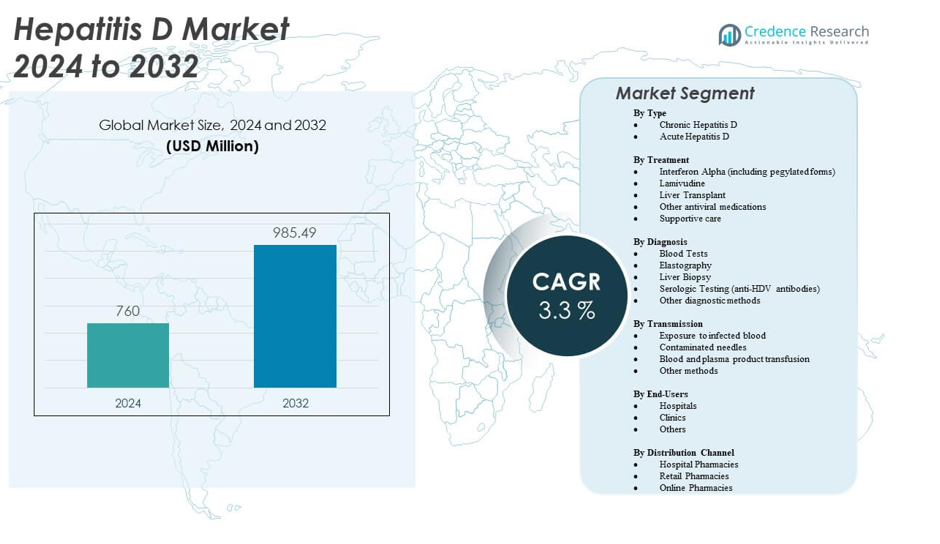
The Hepatitis D Market is projected to grow from USD 760 million in 2024 to an estimated USD 985.49 million by 2032, with a compound annual growth rate (CAGR) of 3.3% from 2024 to 2032.
| REPORT ATTRIBUTE | DETAILS |
|---|---|
| Historical Period | 2020-2023 |
| Base Year | 2024 |
| Forecast Period | 2025-2032 |
| Hepatitis D Market Size 2024 | USD 760 million |
| Hepatitis D Market, CAGR | 3.3% |
| Hepatitis D Market Size 2032 | USD 985.49 million |
The Hepatitis D Market is driven by the increasing prevalence of Hepatitis B virus (HBV) co-infection, as HDV relies on HBV for replication. Rising awareness of Hepatitis D, improved diagnostic techniques, and advancements in antiviral therapies contribute to the market's growth. Government initiatives focused on HBV/HDV screening and prevention further propel demand for HDV treatment options, expanding the market potential globally.
North America currently leads the Hepatitis D Market due to its advanced healthcare infrastructure, robust diagnostic capabilities, and high rates of treatment adoption. Europe follows closely, with countries like Germany and the U.K. leading in screening programs. The Asia-Pacific region is emerging as a key growth area, driven by a large HBV carrier population and expanding healthcare access in nations like China and India. These regions show growing awareness and improved diagnostic networks, making them vital for the market's future expansion.
Market Insights:
- The Hepatitis D Market is projected to grow from USD 760 million in 2024 to an estimated USD 985.49 million by 2032, with a CAGR of 3.3%.
- Increasing prevalence of Hepatitis B co-infection, which drives the demand for Hepatitis D treatments.
- Advancements in diagnostic methods, such as PCR-based tests, have improved early detection, fueling market growth.
- The lack of effective universal treatment options for Hepatitis D continues to limit market expansion.
- Rising awareness campaigns and government initiatives to tackle Hepatitis B/HDV co-infections will support market growth.
- North America leads the market due to strong healthcare infrastructure, with emerging opportunities in Asia-Pacific and Latin America.
- Expanding access to healthcare in regions with high HBV carrier populations will drive market adoption in developing nations.
Market Drivers:
Increasing Prevalence of Hepatitis B Infection
The Hepatitis D market is significantly driven by the rising prevalence of Hepatitis B virus (HBV) infection, which is a necessary condition for HDV infection. As the primary co-factor for the development of Hepatitis D, the ongoing global burden of HBV increases the risk of Hepatitis D transmission. Countries with high HBV infection rates, particularly in Asia-Pacific and Sub-Saharan Africa, have a larger pool of individuals susceptible to HDV. The efforts in reducing HBV infections indirectly fuel the demand for Hepatitis D diagnostics and treatments, highlighting the direct link between these two viral infections.
- For instance, China’s national HBV vaccination program has resulted in a drastic reduction in HBV prevalence among children under five years old, from 9.67% in 1992 to 0.30% in 2020, according to national survey data summarized in a January 2025 report.
Advancements in Diagnostic Methods
The market benefits from advancements in diagnostic methods for Hepatitis D, which contribute to its early detection. Newer diagnostic technologies, such as advanced PCR-based tests and RNA-based tests, have improved the sensitivity and specificity of HDV detection. These improvements help healthcare providers identify the virus more accurately, even in its early stages, facilitating timely interventions. This shift towards more reliable and efficient testing methods has driven the demand for Hepatitis D diagnostic kits, spurring growth in the market.
- For example, Roche Diagnostics offers the LightMix® Kit Hepatitis D Virus (HDV), which detects HDV genotype 1 from cDNA. It delivers highly specific results by amplifying a 113 bp fragment of the HDV delta antigen gene, providing precise diagnostic capabilities for HDV detection.
Therapeutic Advancements and Drug Development
Hepatitis D treatment options have expanded due to advancements in drug development, significantly impacting the market. The availability of antiviral therapies targeting both HBV and HDV has increased the treatment options available to patients. For instance, the introduction of interferon-free therapies and antiviral drugs designed specifically for HDV has led to more effective treatment regimens. Pharmaceutical companies' ongoing research efforts to develop more effective and less toxic therapies continue to shape the market, with a growing pipeline of promising drugs.
Government Initiatives and Healthcare Funding
Government policies and healthcare funding play a crucial role in driving the growth of the Hepatitis D market. Increased public health funding has enabled governments to implement widespread HBV and Hepatitis D screening programs. These initiatives, particularly in endemic regions, are aimed at reducing the transmission rates of both diseases and improving treatment access. As the awareness of Hepatitis D grows, governments are allocating more resources towards preventing and treating viral hepatitis, ultimately boosting market growth.
Market Trends:
Integration of Telemedicine in Hepatitis D Management
Telemedicine has emerged as a growing trend in the Hepatitis D market, offering patients more accessible treatment options. The increased use of telehealth services enables patients, especially in rural and underserved areas, to consult specialists and access diagnostic tests remotely. This trend has become more pronounced due to the COVID-19 pandemic, which accelerated the adoption of digital health technologies. It has particularly benefitted patients with chronic conditions like Hepatitis D, who need regular monitoring and consultations but may not have easy access to healthcare facilities.
- For example, Amwell documented over 1.8 million telehealth visits in Q1 2022, showcasing the growing adoption of telemedicine. During the COVID-19 pandemic, video visits became essential, with significant utilization in chronic liver disease management, including hepatitis patients, in large academic hepatology clinics.
Shift Towards Personalized Medicine
There is a growing trend towards personalized medicine in the treatment of Hepatitis D, focusing on tailoring treatment plans based on individual genetic profiles. Personalized approaches help in identifying the most effective therapies for patients, improving treatment outcomes and minimizing adverse effects. This trend is driven by the increasing availability of genomic testing and the understanding of how genetics influence the response to antiviral drugs. Hepatitis D treatment regimens are becoming more customized, leading to improved patient care and outcomes in the long run.
Rise in Vaccine Development for Hepatitis D
Vaccine development for Hepatitis D is a prominent trend shaping the future of the market. Several pharmaceutical companies are working on developing vaccines that not only prevent HBV but also offer protection against Hepatitis D. The global efforts to combat viral hepatitis have shifted towards integrating Hepatitis D into the larger Hepatitis B vaccination programs. These vaccines, once developed, could reduce the incidence of HDV infections significantly, presenting a potential game-changer for the Hepatitis D market by reducing the overall burden of the disease.
- For example, VBI Vaccines, in collaboration with Brii Biosciences, conducted an interim analysis of its Phase 2 trial for BRII-179 (VBI-2601), an HBV immunotherapeutic candidate. The study showed promising immune responses, with enhanced antibody and T-cell activity in patients with chronic HBV infection.
Increased Collaborations and Partnerships in Research
Collaborations between pharmaceutical companies, research institutions, and government agencies are driving innovation in the Hepatitis D market. Partnerships focused on finding new therapeutic options, improving diagnostic techniques, and enhancing prevention strategies are gaining momentum. These collaborations allow for the pooling of resources, knowledge, and expertise, leading to faster advancements in Hepatitis D treatment. The collective efforts of these organizations are accelerating the development of novel therapies and vaccines, which are crucial for the market's future growth.
Market Challenges Analysis:
Limited Treatment Options and Drug Resistance
One of the main challenges in the Hepatitis D market is the limited availability of effective treatment options. While antiviral therapies have improved, there is still a lack of universal, long-term treatments for Hepatitis D. Many patients experience poor responses to existing therapies, and drug resistance can develop over time, making treatment management more difficult. This challenge results in ongoing efforts to develop new, more effective therapies, but the market remains constrained by these limitations.
High Treatment Costs and Accessibility Issues
High treatment costs pose a significant challenge for the Hepatitis D market, particularly in low- and middle-income countries. The cost of newer antiviral drugs and diagnostic tests is often prohibitive for many patients, limiting their access to care. Healthcare systems in these regions may struggle to allocate the necessary funds to provide widespread access to treatments and screening programs. This issue results in an inequitable distribution of resources and hinders the overall effectiveness of global efforts to combat Hepatitis D.
Market Opportunities:
Growth Potential in Emerging Markets
The Hepatitis D market presents significant growth opportunities in emerging markets, especially in regions with high HBV prevalence. Countries in Asia-Pacific, Africa, and Latin America represent untapped markets for Hepatitis D diagnostics and treatments. These regions have large populations affected by HBV, making them prime candidates for expanded Hepatitis D screening and treatment programs. As healthcare infrastructure improves and awareness of Hepatitis D increases, these markets are expected to witness substantial growth.
Focus on Research and Development of Novel Therapies
There is a growing opportunity in the market for companies to invest in research and development of novel therapies for Hepatitis D. The lack of a comprehensive treatment option creates a high demand for innovative antiviral drugs and vaccines. Companies investing in this space have the potential to develop breakthrough treatments that could dominate the market. Continued R&D efforts, coupled with increasing governmental and institutional support, present a strong opportunity for companies to establish leadership in this niche yet crucial market.
Market Segmentation Analysis:
By Type
The Hepatitis D Market is primarily divided into Chronic and Acute Hepatitis D. Chronic Hepatitis D holds the largest market share due to its higher prevalence and ongoing need for management. This type of infection leads to long-term complications, such as liver cirrhosis and hepatocellular carcinoma, which demand continuous monitoring and treatment. Acute Hepatitis D, on the other hand, is less common and typically results in severe illness but is manageable with prompt intervention. The distinct treatment and management requirements of both types drive separate segments within the market.
- For instance, Gilead Sciences published in May 2025 the final data from the Phase 3 MYR301 study of bulevirtide (Hepcludex) for chronic Hepatitis D, confirming that 36% of patients achieved virological suppression (HDV RNA undetectable) after 48 weeks, with durable off-treatment efficacy at 72 weeks.
By Treatment
In the Hepatitis D Market, the primary treatments include Interferon Alpha (including pegylated forms), Lamivudine, liver transplant, other antiviral medications, and supportive care. Interferon Alpha remains the main FDA-approved therapy, with its usage aimed at suppressing HDV replication. Lamivudine and other antiviral drugs contribute to managing the disease by targeting viral replication processes. Liver transplants are increasingly needed due to the progression of liver damage in chronic cases. Supportive care remains essential to managing symptoms and improving quality of life.
By Diagnosis
Diagnosis in the Hepatitis D Market relies on methods such as blood tests, elastography, liver biopsy, serologic testing (anti-HDV antibodies), and other diagnostic techniques. Blood tests and serologic testing are the primary tools for early and accurate detection, while elastography and liver biopsy help assess the extent of liver damage. These diagnostic methods enable clinicians to effectively monitor HDV infection progression and guide treatment plans.
- For example, The Abbott ARCHITECT Anti-HDV IgM/IgG assay, used globally in clinical settings, offers high specificity (99.5%) for serologic HDV antibody detection. It is capable of large-scale, automated throughput on the ARCHITECT platform, providing efficient, high-volume diagnostics for Hepatitis D.
By Transmission
Hepatitis D is predominantly transmitted through exposure to infected blood, contaminated needles, blood, and plasma product transfusions. The main mode of transmission remains direct blood exposure, which is common among intravenous drug users and in healthcare settings with insufficient safety measures. Awareness and prevention measures, such as needle exchange programs and safe blood transfusion practices, remain key factors in controlling transmission.
By End-Users
Hospitals are the primary end-users in the Hepatitis D Market, given their advanced diagnostic and treatment capabilities. Clinics also play a significant role, offering more accessible care options for routine management and monitoring. Other end-users include specialized care centers and research institutions that contribute to diagnosis, treatment, and the development of new therapeutic options.
By Distribution Channel
The distribution channels in the Hepatitis D Market include hospital pharmacies, retail pharmacies, and online pharmacies. Hospital pharmacies are the most prevalent distribution point due to their direct connection with patient care and treatment regimens. Retail pharmacies offer convenience for patients requiring regular medication refills. The rise of online pharmacies has further expanded access, allowing patients to conveniently order medications from home.
Segmentation:
By Type
- Chronic Hepatitis D
- Acute Hepatitis D
By Treatment
- Interferon Alpha (including pegylated forms)
- Lamivudine
- Liver Transplant
- Other antiviral medications
- Supportive care
By Diagnosis
- Blood Tests
- Elastography
- Liver Biopsy
- Serologic Testing (anti‑HDV antibodies)
- Other diagnostic methods
By Transmission
- Exposure to infected blood
- Contaminated needles
- Blood and plasma product transfusion
- Other methods
By End‑Users
- Hospitals
- Clinics
- Others
By Distribution Channel
- Hospital Pharmacies
- Retail Pharmacies
- Online Pharmacies
By Region
- North America
- U.S.
- Canada
- Mexico
- Europe
- Germany
- France
- U.K.
- Italy
- Spain
- Rest of Europe
- Asia Pacific
- China
- Japan
- India
- South Korea
- South-east Asia
- Rest of Asia Pacific
- Latin America
- Brazil
- Argentina
- Rest of Latin America
- Middle East & Africa
- GCC Countries
- South Africa
- Rest of the Middle East and Africa
Regional Analysis:
North America dominates the Hepatitis D Market with a 26.8% share in 2024, thanks to strong healthcare infrastructure, high awareness of HBV/HDV co‑infections and early access to novel therapies. The U.S. market holds the bulk of this regional share, driven by proactive screening programs, specialised hepatology centres and reimbursement policies favouring HDV treatment. High healthcare spending and clinical trial activity reinforce North America’s position, enabling rapid adoption of diagnostics and interventions tailored to HDV.
Europe contributes approximately 24.7% of the market in 2024, supported by mature healthcare systems and increasing HBV/HDV co‑infection awareness. Countries such as Germany, the U.K., France and Italy lead in screening programmes, guidelines and therapeutic uptake. The presence of strong research networks, regional regulatory alignment and growing clinical activity in Eastern Europe further bolster Europe’s significance in the market landscape.
Asia‑Pacific accounts for roughly 22.3% of the market in 2024 and emerging nations within this region are gaining momentum due to a high prevalence of HBV, improving healthcare access and rising diagnostic capability. China, India and Mongolia particularly stand out for their disease burden and investment in public‑health efforts. While the regional share is lower than North America and Europe now, the growth rate prospects remain strong, positioning Asia‑Pacific as a critical growth front in the global market.
Key Player Analysis:
- Gilead Sciences, Inc.
- Eiger BioPharmaceuticals, Inc.
- Janssen Pharmaceuticals, Inc.
- Vir Biotechnology, Inc.
- Antios Therapeutics, Inc.
- PharmaEssentia Corporation
- Hepion Pharmaceuticals, Inc.
- BIOSIDUS S.A.
- Hoffmann-La Roche Ltd.
- Zydus Lifesciences
- Rhein-Minapharm
- PROBIOMED S.A. de C.V.
- 3SBio Group
- Apotex Corp.
- Viatris
Competitive Analysis:
The competitive landscape of the Hepatitis D Market features a blend of large pharmaceutical firms and biotech entrants advancing HDV‑specific therapies. Key players such as Gilead Sciences, Inc., GSK plc and Janssen Pharmaceuticals, Inc. lead with strategic pipelines targeting HDV viral replication, entry inhibition and RNA‑based approaches. Smaller firms and biotech companies complement the field by focusing on novel mechanisms, combination therapies and underserved geographies. It engages firms in partnerships, acquisitions and licensing deals to enhance their HDV portfolios. It contends with limited treatment options, high development cost and regulatory complexity, which yields opportunities for differentiation through innovation and geographic expansion. Firms with robust diagnostic‑to‑treatment capabilities gain competitive advantage in this evolving market.
Recent Developments:
- In September 2025, Bluejay Therapeutics enrolled the first patient in their global Phase 3 AZURE-2 trial assessing the antibody brelovitug for Hepatitis D treatment, marking a critical step in advancing this novel therapy in late-stage clinical development.
- In May 2025, Gilead Sciences, Inc. announced final results from its Phase 3 MYR301 study. The data showed that patients with chronic hepatitis D who received long‑term treatment with the entry‑inhibitor Bulevirtide sustained undetectable HDV RNA levels for nearly two years after stopping therapy.
Report Coverage:
The research report offers an in-depth analysis based on Type, Treatment, Diagnosis, Transmission, End Users and Distribution Channel. It details leading market players, providing an overview of their business, product offerings, investments, revenue streams, and key applications. Additionally, the report includes insights into the competitive environment, SWOT analysis, current market trends, as well as the primary drivers and constraints. Furthermore, it discusses various factors that have driven market expansion in recent years. The report also explores market dynamics, regulatory scenarios, and technological advancements that are shaping the industry. It assesses the impact of external factors and global economic changes on market growth. Lastly, it provides strategic recommendations for new entrants and established companies to navigate the complexities of the market.
Future Outlook:
- Ongoing advancements in diagnostics will improve early detection, driving market growth.
- Continued innovation in antiviral therapies and personalized medicine will shape treatment paradigms.
- Governments’ increased focus on HBV and HDV co-infection awareness will drive screening programs.
- Growing demand for liver transplants will spur medical infrastructure investment and related services.
- Emerging economies will see increased market adoption as healthcare access improves.
- Expansion of telemedicine and remote healthcare solutions will increase patient access to care.
- Strategic collaborations between biopharmaceutical companies and research institutions will foster innovation.
- Increased funding for hepatitis research will accelerate drug discovery and clinical trials.
- The growing focus on sustainable and affordable treatment options will open new market opportunities.
- Public health initiatives targeting prevention and treatment will contribute to market expansion.

Request a Free Sample
Fill in your details and we'll send you a free sample report.
- Sample data tables & charts
- Research methodology
Market Dynamics
Increasing Prevalence of Hepatitis B Infection
Hepatitis D relies on Hepatitis B virus (HBV) for replication, so rising HBV infection rates, especially in Asia-Pacific and Sub-Saharan Africa, directly increase the pool of individuals at risk for HDV, driving demand for diagnostics and treatments.
Advancements in Diagnostic Methods
Improved diagnostic technologies, such as PCR-based and RNA-based tests, have enhanced early and accurate detection of Hepatitis D, enabling timely intervention and increasing the uptake of diagnostic kits and related services.
Therapeutic Advancements and Drug Development
The introduction of new antiviral therapies, including interferon-free regimens and drugs specifically targeting HDV, has expanded treatment options and improved patient outcomes, fueling market growth as more effective and less toxic therapies become available.
Government Initiatives and Healthcare Funding
Public health policies and increased funding for HBV/HDV screening and prevention programs, particularly in endemic regions, are expanding access to diagnosis and treatment, supporting overall market expansion.
Growth Potential in Emerging Markets
Emerging economies with high HBV prevalence, such as those in Asia-Pacific, Africa, and Latin America, present significant opportunities for market growth as healthcare infrastructure improves and awareness of Hepatitis D increases.
Need a Custom Version of This Report?
Tailor the scope, geography, or segments to your exact requirements.
- Custom geography or segment scope
- Direct access to our analyst team
Frequently Asked Questions
What is the current market size for Hepatitis D Market, and what is its projected size in 2032?
At what Compound Annual Growth Rate is the Hepatitis D Market projected to grow between 2024 and 2032?
Which Hepatitis D Market segment held the largest share in 2024?
What are the primary factors fueling the growth of the Hepatitis D Market?
Who are the key participants in the market for hepatitis D globally?
Table of Content
Chapter 1 Market Segmentation
- 1.1 Segmentation Framework
- 1.1.1 Product and Service Classification
- 1.1.2 Application and End-Use Classification
- 1.1.3 Technology and Solution Classification
- 1.1.4 Customer and Distribution Channel Classification
- 1.1.5 Geographic Segmentation
- 1.1.6 Market Segment Definitions and Boundaries
- 1.2 By Type
- 1.2.1 Chronic Hepatitis D
- 1.2.2 Acute Hepatitis D
- 1.3 By Diagnosis
- 1.3.1 Blood Tests
- 1.3.2 Elastography
- 1.3.3 Liver Biopsy
- 1.3.4 Serologic Testing (anti‑HDV antibodies)
- 1.3.5 Other diagnostic methods
- 1.4 By Treatment
- 1.4.1 Interferon Alpha (including pegylated forms)
- 1.4.2 Lamivudine
- 1.4.3 Liver Transplant
- 1.4.4 Other antiviral medications
- 1.4.5 Supportive care
Chapter 2 Introduction
- 2.1 Report Objectives and Scope
- 2.2 Product Definition and Industry Terminology
- 2.3 Market Inclusions and Exclusions
- 2.4 Research Process
- 2.4.1 Primary Research and Expert Interviews
- 2.4.2 Secondary Research and Source Review
- 2.4.3 Top-Down and Bottom-Up Estimation
- 2.4.4 Data Triangulation and Verification
- 2.5 Market Size Measurement Basis
- 2.5.1 2024: USD 760 million → 2032: USD 985.49 million
- 2.6 Historical and Forecast Reference Periods
- 2.6.1 Base Year: 2024
- 2.6.2 Forecast Period: 2024-2032
- 2.7 Research Assumptions and Limitations
Chapter 3 Executive Summary
- 3.1 Market Snapshot and Key Findings
- 3.2 Base-Year Market Size, 2024
- 3.3 Forecast Market Size, 2032
- 3.4 Revenue and Volume Growth Outlook
- 3.5 Key Demand and Supply Indicators
- 3.6 Leading Market Segments
- 3.7 Fastest-Growing Market Opportunities
- 3.8 Regional Performance Highlights
- 3.9 Technology and Industry Transformation
- 3.10 Competitive Landscape Summary
- 3.11 Analyst View and Strategic Implications
Chapter 4 Global Hepatitis D Market Trends and Developments
- 4.1 Historical Industry Development
- 4.2 Recent Market Trends and Developments
- 4.3 Demand and Customer Behavior Trends
- 4.4 Technology and Product Innovation
- 4.5 Artificial Intelligence, Automation and Digitalization
- 4.6 Local Manufacturing and Supply Chain Realignment
- 4.7 Industry Partnerships, Mergers and Acquisitions
- 4.8 Sustainability and Circular Economy Developments
- 4.9 Government and Private Sector Investment Trends
- 4.10 Emerging Business Models and Commercialization
- 4.11 Industry Developments and Announcements
Chapter 5 Global Hepatitis D Market Production, Supply and Demand Analysis
- 5.1 Demand Trend and Consumption Analysis
- 5.2 Demand Forecast, 2024-2032
- 5.3 Production and Output Trend
- 5.4 Production and Output Forecast, 2024-2032
- 5.5 Installed Capacity and Capacity Utilization
- 5.6 Company-Wise Production Plants and Statistics
- 5.6.1 Installed Production Capacity
- 5.6.2 Actual Production
- 5.6.3 Planned Capacity and Expansion Targets
- 5.7 Supply Chain Structure and Procurement Trends
- 5.8 Supply-Demand Gap and Bottlenecks
- 5.9 Import Dependence and Sourcing Structure
- 5.10 Contract Manufacturing and Outsourcing
- 5.11 Regional Supply and Demand Concentration
Chapter 6 Global Hepatitis D Market Pricing Analysis
- 6.1 Pricing Structure and Measurement
- 6.2 Historical Pricing Trends
- 6.3 Pricing Outlook, 2024-2032
- 6.4 Average Selling Price and Unit Economics
- 6.5 Pricing by Product and Market Segment
- 6.6 Geographic Pricing Differences
- 6.7 Key Input, Energy, Labor and Logistics Costs
- 6.8 Contract Pricing and Purchasing Models
- 6.9 Pricing Sensitivity and Competitive Positioning
- 6.10 Price, Margin and Profitability Implications
Chapter 7 Global Hepatitis D Market Dynamics
- 7.1 Market Growth Drivers
- 7.1.1 Demand-Side Drivers
- 7.1.2 Technology and Innovation Drivers
- 7.1.3 Infrastructure and Investment Drivers
- 7.1.4 Regulatory and Policy Drivers
- 7.2 Market Restraints
- 7.2.1 Cost and Affordability Constraints
- 7.2.2 Technology and Adoption Barriers
- 7.2.3 Supply Chain and Operational Constraints
- 7.3 Market Challenges
- 7.3.1 Competitive Pressure and Margin Erosion
- 7.3.2 Skills, Infrastructure and Implementation Gaps
- 7.4 Emerging Market Opportunities
- 7.5 Market Dynamics Impact and Time-Horizon Assessment
Chapter 8 Global Hepatitis D Value Chain Analysis
- 8.1 Industry Value Chain Overview
- 8.2 Upstream Suppliers and Critical Inputs
- 8.3 Technology and Component Providers
- 8.4 Manufacturing or Service Delivery
- 8.5 Distribution, Channel Partners and Integrators
- 8.6 Downstream Applications and End Users
- 8.7 Value Addition and Profit Pools
- 8.8 Vertical Integration and Outsourcing
- 8.9 Supplier Concentration and Risk
- 8.10 Supply Chain Localization and Resilience
Chapter 9 Global Hepatitis D Market Regulations and Policies
- 9.1 Relevant Laws, Standards and Compliance Frameworks
- 9.2 Product, Service, Safety and Quality Requirements
- 9.3 Government Policies, Incentives and Subsidies
- 9.4 Imports, Exports and Trade Barriers
- 9.5 Public Procurement and Local Content Requirements
- 9.6 Environmental and Sustainability Compliance
- 9.7 Upcoming Policy Changes and Market Implications
Chapter 10 Global Hepatitis D Market Hotspots and Opportunities
- 10.1 Market Opportunity Mapping and Growth Hotspots
- 10.2 High-Growth Applications and Customer Groups
- 10.3 Underserved Markets and White-Space Opportunities
- 10.4 Emerging Technology and Product Opportunities
- 10.5 New Capacity and Investment Hotspots
- 10.6 Market Entry and Expansion Opportunities
- 10.7 Distribution and Partnership Opportunities
- 10.8 Near-Term and Long-Term Commercial Potential
- 10.9 Opportunity Attractiveness and Execution Risks
Chapter 11 Global Hepatitis D Market Outlook, 2024-2032
- 11.1 Market Size and Analysis
- 11.1.1 Revenue (Market Measurement: 2024: USD 760 million → 2032: USD 985.49 million)
- 11.1.2 Market Volume and Quantity Sold
- 11.1.3 Historical Market Size
- 11.1.4 Base-Year Market Size, 2024
- 11.2 Market Forecast, 2024-2032
- 11.2.1 Revenue Forecast to 2032
- 11.2.2 Volume Forecast to 2032
- 11.2.3 CAGR and Year-on-Year Growth
- 11.2.4 Incremental Revenue Opportunity
- 11.3 Forecast Assumptions and Scenario Analysis
- 11.3.1 Base-Case Forecast
- 11.3.2 Optimistic and Conservative Scenarios
- 11.3.3 Technology, Pricing and Policy Sensitivities
- 11.4 Market Attractiveness and Growth Outlook
Chapter 12 Global Hepatitis D Market Segmentation and Outlook
- 12.1 Segmentation Summary and Market Shares, 2024
- 12.2 Largest and Fastest-Growing Segments
- 12.3 By Type - Market Size and Forecast, 2024-2032
- 12.3.1 Segment Definition and Scope
- 12.3.2 Historical Market Size
- 12.3.3 Revenue Forecast, 2024-2032
- 12.3.4 Volume Forecast, 2024-2032
- 12.3.5 Base-Year Market Share, 2024
- 12.3.6 Segment CAGR and Growth Drivers
- 12.3.7 Subsegment Market Size and Forecast
- 12.3.7.1 Chronic Hepatitis D
- 12.3.7.2 Acute Hepatitis D
- 12.3.8 Subsegment Pricing and Adoption Trends
- 12.3.9 Leading Suppliers and Competition
- 12.3.10 Regional Demand and Opportunities
- 12.4 By Diagnosis - Market Size and Forecast, 2024-2032
- 12.4.1 Segment Definition and Scope
- 12.4.2 Historical Market Size
- 12.4.3 Revenue Forecast, 2024-2032
- 12.4.4 Volume Forecast, 2024-2032
- 12.4.5 Base-Year Market Share, 2024
- 12.4.6 Segment CAGR and Growth Drivers
- 12.4.7 Subsegment Market Size and Forecast
- 12.4.7.1 Blood Tests
- 12.4.7.2 Elastography
- 12.4.7.3 Liver Biopsy
- 12.4.7.4 Serologic Testing (anti‑HDV antibodies)
- 12.4.7.5 Other diagnostic methods
- 12.4.8 Subsegment Pricing and Adoption Trends
- 12.4.9 Leading Suppliers and Competition
- 12.4.10 Regional Demand and Opportunities
- 12.5 By Treatment - Market Size and Forecast, 2024-2032
- 12.5.1 Segment Definition and Scope
- 12.5.2 Historical Market Size
- 12.5.3 Revenue Forecast, 2024-2032
- 12.5.4 Volume Forecast, 2024-2032
- 12.5.5 Base-Year Market Share, 2024
- 12.5.6 Segment CAGR and Growth Drivers
- 12.5.7 Subsegment Market Size and Forecast
- 12.5.7.1 Interferon Alpha (including pegylated forms)
- 12.5.7.2 Lamivudine
- 12.5.7.3 Liver Transplant
- 12.5.7.4 Other antiviral medications
- 12.5.7.5 Supportive care
- 12.5.8 Subsegment Pricing and Adoption Trends
- 12.5.9 Leading Suppliers and Competition
- 12.5.10 Regional Demand and Opportunities
- 12.6 Segment Growth Comparison
- 12.7 Segment Attractiveness and Priority Matrix
Chapter 13 Global Hepatitis D Geographic Market Outlook, 2024-2032
- 13.1 Regional Market Size and Share, 2024
- 13.2 Regional Market Forecast, 2024-2032
- 13.3 Regional Pricing, Production and Demand Differences
- 13.4 North America
- 13.4.1 United States
- 13.4.2 Canada
- 13.4.3 Mexico
- 13.5 Europe
- 13.5.1 Germany
- 13.5.2 France
- 13.5.3 Italy
- 13.5.4 United Kingdom
- 13.5.5 Spain
- 13.5.6 Poland
- 13.5.7 Russia
- 13.5.8 Netherlands
- 13.5.9 Belgium
- 13.5.10 Sweden
- 13.5.11 Denmark
- 13.5.12 Norway
- 13.5.13 Rest of Europe
- 13.6 Asia Pacific
- 13.6.1 China
- 13.6.2 India
- 13.6.3 Japan
- 13.6.4 South Korea
- 13.6.5 Thailand
- 13.6.6 Indonesia
- 13.6.7 Vietnam
- 13.6.8 Malaysia
- 13.6.9 Australia
- 13.6.10 Rest of Asia Pacific
- 13.7 Latin America
- 13.7.1 Brazil
- 13.7.2 Argentina
- 13.7.3 Colombia
- 13.7.4 Chile
- 13.7.5 Rest of Latin America
- 13.8 Middle East
- 13.8.1 Saudi Arabia
- 13.8.2 United Arab Emirates
- 13.8.3 Turkey
- 13.8.4 Israel
- 13.8.5 Iran
- 13.8.6 Rest of the Middle East
- 13.9 Africa
- 13.9.1 South Africa
- 13.9.2 Egypt
- 13.9.3 Nigeria
- 13.9.4 Morocco
- 13.9.5 Rest of Africa
- 13.10 Regional Investment, Policy and Supply Chain Differences
- 13.11 Regional Competitive Landscape
- 13.12 Geographic Growth Hotspots
Chapter 14 Global Hepatitis D Technology, Innovation and Sustainability Outlook
- 14.1 Technology Landscape and Maturity
- 14.2 Product, Process and Service Innovation
- 14.3 AI, Automation and Digital Tools in the Industry
- 14.4 Technology Adoption and Performance Benchmarking
- 14.5 Innovation Pipeline and R&D Investment
- 14.6 Patent and Intellectual Property Trends
- 14.7 Energy Efficiency and Resource Management
- 14.8 Sustainability, Recycling and Circularity
- 14.9 Technology Roadmap, 2024-2032
- 14.10 Risks of Obsolescence and Technology Substitution
Chapter 15 Global Hepatitis D Market Key Strategic Imperatives
- 15.1 Growth and Market Entry Priorities
- 15.2 High-Return Products and Segments
- 15.3 Pricing, Profitability and Cost Optimization
- 15.4 Technology Investment and Product Differentiation
- 15.5 Supply Chain Localization and Resilience
- 15.6 Distribution and Customer Acquisition
- 15.7 Partnership, Acquisition and Capacity Strategy
- 15.8 Regional Expansion Priorities
- 15.9 Short-, Medium- and Long-Term Actions
Chapter 16 Competition Outlook
- 16.1 Industry Competition Characteristics
- 16.2 Market Structure and Concentration
- 16.3 Market Share and Competitive Positioning, 2024
- 16.4 Company-Wise Revenue and Product Benchmarking
- 16.5 Production and Service Capacity Benchmarking
- 16.6 Technology, Pricing and Differentiation
- 16.7 Regional Footprint and Distribution Strength
- 16.8 Mergers, Acquisitions and Strategic Alliances
- 16.9 New Entrants and Competitive Threats
- 16.10 Porter's Five Forces and Industry Attractiveness
- 16.11 Competitive Outlook, 2024-2032
Chapter 17 Company Profiles
- 17.1 Company Coverage and Selection Criteria
- 17.2 Gilead Sciences, Inc.
- 17.2.1 Business Description
- 17.2.2 Company Ownership and Geographic Presence
- 17.2.3 Product and Service Portfolio
- 17.2.4 Manufacturing and Operating Footprint
- 17.2.5 Production Capacity and Expansion Plans
- 17.2.6 Financial Performance and Investment
- 17.2.7 Market Share and Competitive Position
- 17.2.8 Technology and Innovation Capabilities
- 17.2.9 Strategic Alliances or Partnerships
- 17.2.10 Recent Developments
- 17.2.11 Growth Strategy and Outlook
- 17.3 Eiger BioPharmaceuticals, Inc.
- 17.4 Janssen Pharmaceuticals, Inc.
- 17.5 Vir Biotechnology, Inc.
- 17.6 Antios Therapeutics, Inc.
- 17.7 PharmaEssentia Corporation
- 17.8 Hoffmann-La Roche Ltd.
- 17.9 Zydus Lifesciences
- 17.10 Viatris
- 17.11 3SBio Group
- 17.12 Other Relevant Market Participants
Note: Every listed company is profiled on the structure shown under the first company. The company list is preliminary and may change based on research findings, market developments, data availability and client requirements.
Chapter 18 Disclaimer
- 18.1 Research and Forecast Disclaimer
- 18.2 Data Source and Estimation Limitations
Note: The depth of individual sections depends on data availability for this market. Volume, capacity, trade and other unit-based metrics are included where applicable.