Market Overview:
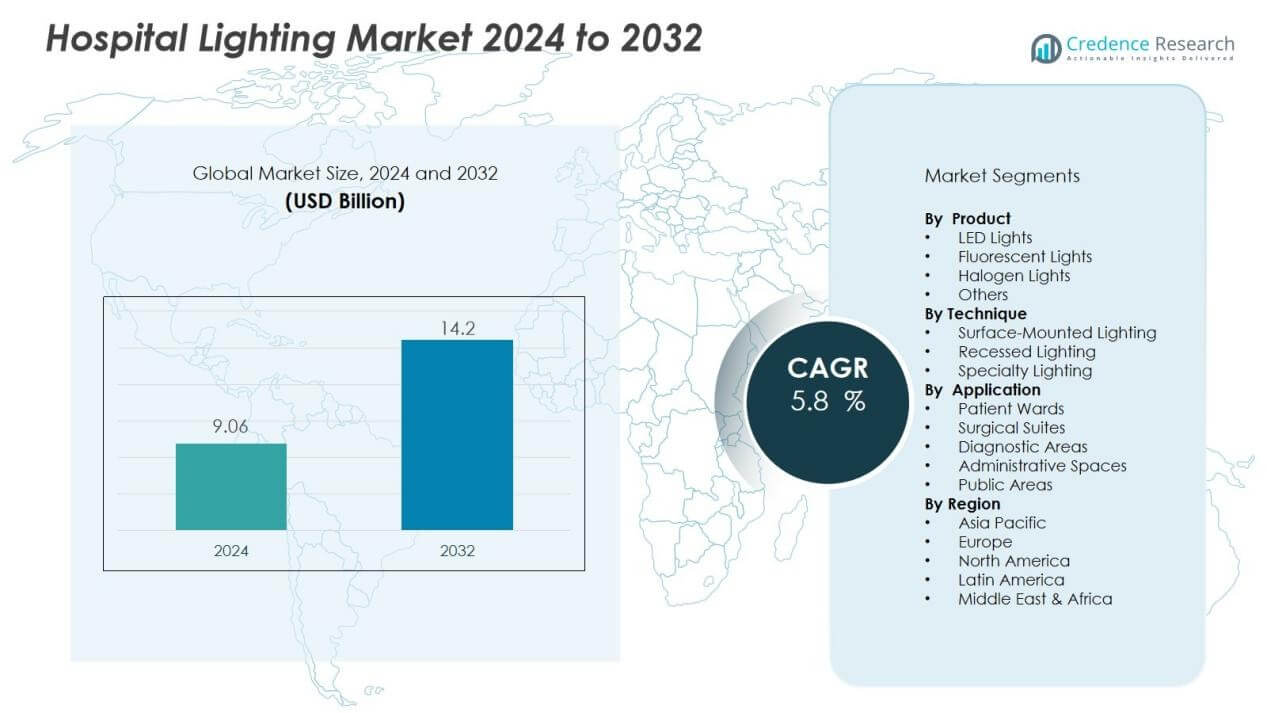
The hospital lighting market size was valued at USD 9.06 billion in 2024 and is anticipated to reach USD 14.2 billion by 2032, at a CAGR of 5.8 % during the forecast period (2024-2032).
| REPORT ATTRIBUTE |
DETAILS |
| Historical Period |
2020-2023 |
| Base Year |
2024 |
| Forecast Period |
2025-2032 |
| Hospital Lighting Market Size 2024 |
USD 9.06 Billion |
| Hospital Lighting Market, CAGR |
5.8 % |
| Hospital Lighting Market Size 2032 |
USD 14.2 Billion |
Market drivers include the growing focus on infection control and patient comfort. Energy-efficient lighting systems help reduce operational costs while improving clinical accuracy in surgical and diagnostic settings. Smart lighting solutions with automated controls, adjustable brightness, and circadian rhythm support are increasingly integrated to enhance patient recovery and staff productivity. Furthermore, regulatory mandates promoting energy conservation and sustainable hospital infrastructure further encourage investment in modern lighting technologies.
Regionally, North America holds the largest share due to advanced healthcare infrastructure, strict regulatory standards, and early adoption of LED technology. Europe follows with strong sustainability policies and modernization of healthcare facilities. Asia-Pacific is expected to record the fastest growth, fueled by expanding hospital networks, rising healthcare expenditure, and rapid urbanization in countries such as China and India. Emerging markets in Latin America and the Middle East & Africa also show potential through ongoing healthcare infrastructure development and government-led investments.
Access crucial information at unmatched prices!
Request your sample report today & start making informed decisions powered by Credence Research Inc.!
Download Sample
Market Insights:
- The hospital lighting market was valued at USD 9.06 billion in 2024 and will reach USD 14.2 billion by 2032, growing at a CAGR of 5.8%.
- Rising focus on infection control and patient comfort is driving steady demand for advanced lighting systems.
- LED technology leads adoption due to energy efficiency, long lifespan, and reduced maintenance costs.
- Smart lighting with automated controls, circadian rhythm support, and adaptive brightness is gaining traction in hospitals.
- High installation costs and budget constraints remain barriers, particularly for smaller facilities and developing regions.
- North America held 38% share in 2024, followed by Europe at 30%, supported by modernization and sustainability goals.
- Asia-Pacific, with 22% share, is the fastest-growing region, driven by urbanization, government spending, and expanding hospital networks.
Market Drivers:
Rising Demand for Energy-Efficient Solutions:
The hospital lighting market is driven by the shift toward energy-efficient solutions, primarily LED technology. Hospitals aim to reduce operating costs while maintaining reliable performance in critical environments. LEDs offer longer lifespans, lower energy use, and reduced maintenance, making them an attractive replacement for traditional lighting. It benefits both hospital administrators and sustainability goals, aligning with global energy conservation policies.
- For instance, in partnership with Philips, Royal United Hospital in Bath retrofitted all interior lighting to LED, reducing carbon emissions by 2700 tons annually.
Focus on Patient Comfort and Recovery:
Healthcare facilities are increasingly investing in lighting that enhances patient comfort and supports recovery. The hospital lighting market is shaped by demand for circadian lighting systems, which mimic natural daylight cycles to promote healing. Adjustable brightness and color tones help reduce stress, improve sleep, and support mental well-being. It ensures patient rooms and recovery spaces contribute to better overall outcomes.
- For instance, Henry County Hospital in Indiana deployed dimmable LED lighting in their Advanced Wound Care Center, allowing patients to adjust light intensity in hyperbaric chambers during treatments lasting up to 60 days, which directly improved patient comfort levels reported by clinical staff managing the facility.
Enhanced Clinical Accuracy and Staff Efficiency:
Precise illumination is essential for surgical theaters, diagnostic labs, and emergency areas. The hospital lighting market benefits from advanced lighting solutions that reduce errors and improve visibility for healthcare staff. High-quality, glare-free lighting enhances clinical accuracy during procedures and diagnostic tasks. It also improves workplace safety and staff efficiency, ensuring reliable performance in critical care areas.
Impact of Regulations and Sustainable Infrastructure Goals:
Government mandates and green building standards strongly influence hospital investments in modern lighting systems. The hospital lighting market is supported by policies promoting sustainability, reduced carbon footprints, and efficient energy use. Hospitals are adopting intelligent lighting with automated controls to meet compliance requirements. It drives widespread modernization efforts, ensuring healthcare facilities remain both eco-friendly and cost-effective.
Market Trends:
Integration of Smart and Connected Lighting Systems:
The hospital lighting market is witnessing strong adoption of smart and connected solutions. Hospitals are incorporating IoT-enabled lighting that allows remote monitoring, automated controls, and predictive maintenance. It supports energy savings, reduces downtime, and improves operational efficiency across large facilities. Adaptive lighting systems with motion sensors and daylight harvesting features are becoming standard in modern healthcare infrastructure. These solutions provide flexibility by adjusting intensity based on occupancy and time of day. It ensures improved patient comfort, better energy management, and alignment with smart hospital initiatives.
- For instance, McLaren Health Care upgraded 25,000 indoor and outdoor Cree LED fixtures, including over 12,000 intelligent Cree SmartCast® lighting fixtures, which contributed to $1.25 million in annual energy savings alone and enhanced operational efficiency across their 3,096-bed hospital system.
Shift Toward Human-Centric and Sustainable Designs:
The hospital lighting market is increasingly shaped by demand for human-centric and sustainable solutions. Healthcare facilities are investing in circadian rhythm-based lighting to enhance recovery and well-being. It improves patient sleep cycles, reduces anxiety, and enhances staff productivity during long shifts. Designers are focusing on eco-friendly materials, reduced heat emissions, and compliance with green building standards. Hospitals also prioritize lighting designs that support hygiene by reducing touchpoints through automated systems. It reflects a broader trend toward creating healing environments that balance functionality, patient care, and sustainability.
- For instance, Philips HealWell lighting system increased patient sleep duration by nearly 30 minutes during hospitalization by mimicking natural daylight patterns to support biological clocks.
Market Challenges Analysis:
High Installation Costs and Budget Constraints:
The hospital lighting market faces challenges due to high upfront installation and replacement costs. Many healthcare facilities operate with limited budgets, making large-scale lighting upgrades difficult. It restricts adoption of advanced LED and smart systems, especially in smaller hospitals and developing regions. Maintenance costs and training requirements for staff to handle new technologies further add to financial pressure. Hospitals often delay modernization projects to prioritize core medical equipment purchases. It creates a gap between technological availability and actual adoption rates in the sector.
Complex Integration and Regulatory Compliance Issues:
The hospital lighting market is also challenged by complex integration with existing infrastructure and strict regulatory demands. Healthcare facilities often struggle to align new lighting systems with legacy building designs. It slows down implementation and raises compatibility issues with other hospital technologies. Meeting energy efficiency standards, safety norms, and hygiene-related requirements increases compliance costs. Hospitals must ensure that lighting upgrades do not disrupt ongoing operations, which requires detailed planning. It makes adoption of advanced solutions a time-consuming and resource-intensive process.
Market Opportunities:
Growing Adoption of Smart and IoT-Enabled Solutions:
The hospital lighting market holds significant opportunity through the expansion of smart and IoT-enabled systems. Hospitals are investing in connected lighting that enables real-time monitoring, automated controls, and predictive maintenance. It reduces operational costs while enhancing efficiency across wards, operating rooms, and diagnostic facilities. Integration with hospital information systems allows seamless energy management and workflow optimization. Demand for intelligent solutions with features like occupancy sensing and adaptive brightness is expected to rise. It creates strong prospects for technology providers offering scalable and energy-efficient lighting systems.
Rising Focus on Patient-Centric and Sustainable Designs:
The hospital lighting market is also supported by the rising emphasis on patient well-being and sustainability. Hospitals are exploring circadian rhythm lighting that promotes healing and supports recovery. It improves sleep cycles, reduces stress, and enhances staff focus during long shifts. Green building standards and government incentives for energy conservation further expand opportunities for eco-friendly lighting. Manufacturers offering sustainable materials, low-heat emission systems, and touchless control options stand to gain. It positions lighting innovation as a central element of modern healthcare infrastructure.
Market Segmentation Analysis:
By Product:
The hospital lighting market by product is segmented into LED, fluorescent, halogen, and others. LED lights dominate due to their energy efficiency, durability, and lower maintenance requirements. It offers hospitals cost savings while ensuring consistent illumination in critical environments. Fluorescent lighting remains in use in some facilities but is gradually being replaced by LED systems. Halogen lights are limited to specific applications requiring high-intensity brightness. It reflects the clear transition toward LED adoption across healthcare infrastructure.
By Technique:
The hospital lighting market by technique includes surface-mounted, recessed, and other specialized installations. Surface-mounted systems are common in patient rooms and general areas due to ease of installation. Recessed lighting is preferred in surgical suites and diagnostic labs where precision and aesthetics are critical. It provides uniform brightness without glare, supporting accuracy during medical procedures. Specialized installations such as task lighting continue to expand with demand for flexible solutions. It highlights the role of technique in optimizing efficiency and usability.
- For example, the HST LED recessed surgical troffer by Boston Light Source delivers lumen outputs ranging from approximately 2,500 to 9,000 lumens, ensuring shadow reduction and minimizing eye strain for surgical teams.
By Application:
The hospital lighting market by application covers patient wards, surgical suites, diagnostic areas, and administrative spaces. Surgical and diagnostic applications demand advanced illumination to support clinical accuracy and safety. Patient wards increasingly adopt circadian lighting to promote comfort and recovery. It enhances patient outcomes by aligning with natural sleep and wake cycles. Administrative and public areas focus on energy efficiency and cost control. It ensures every hospital zone benefits from tailored lighting solutions.
- For Instances, Cree Lighting’s LED upgrades at McLaren Health Care provide warm, inviting light that improves comfort and security while delivering $1.6 million in annual savings.
Segmentations:
By Product:
- LED Lights
- Fluorescent Lights
- Halogen Lights
- Others
By Technique:
- Surface-Mounted Lighting
- Recessed Lighting
- Specialty Lighting
By Application:
- Patient Wards
- Surgical Suites
- Diagnostic Areas
- Administrative Spaces
- Public Areas
By Region:
- North America
- Europe
- UK
- France
- Germany
- Italy
- Spain
- Russia
- Belgium
- Netherlands
- Austria
- Sweden
- Poland
- Denmark
- Switzerland
- Rest of Europe
- Asia Pacific
- China
- Japan
- South Korea
- India
- Australia
- Thailand
- Indonesia
- Vietnam
- Malaysia
- Philippines
- Taiwan
- Rest of Asia Pacific
- Latin America
- Brazil
- Argentina
- Peru
- Chile
- Colombia
- Rest of Latin America
- Middle East
- UAE
- KSA
- Israel
- Turkey
- Iran
- Rest of Middle East
- Africa
- Egypt
- Nigeria
- Algeria
- Morocco
- Rest of Africa
Regional Analysis:
North America:
North America accounted for 38% market share in 2024, supported by advanced healthcare systems. The hospital lighting market in this region benefits from strong regulatory standards and early adoption of LED technologies. It is driven by the presence of major manufacturers and government programs promoting energy-efficient infrastructure. Hospitals focus heavily on patient comfort and staff efficiency, encouraging the integration of smart and human-centric lighting systems. The region also invests in modernization of older facilities to meet sustainability goals. It ensures steady growth supported by both public and private healthcare investments.
Europe:
Europe held 30% market share in 2024, supported by strict environmental policies and modernization initiatives. The hospital lighting market in this region is driven by green building standards and strong adoption of smart hospital concepts. It reflects the influence of government incentives for energy conservation and renewable integration. Countries such as Germany, the UK, and France lead in advanced lighting adoption within healthcare infrastructure. Hospitals are focusing on circadian rhythm-based designs to enhance patient recovery environments. It ensures continued growth supported by innovation in energy-efficient and eco-friendly systems.
Asia-Pacific:
Asia-Pacific accounted for 22% market share in 2024, supported by rapid urbanization and rising healthcare investments. The hospital lighting market in this region benefits from expanding hospital networks and rising government spending on infrastructure. It is driven by large-scale healthcare projects in countries such as China and India. Growing demand for advanced healthcare facilities is encouraging adoption of LED and smart lighting solutions. Rising awareness of patient-centric designs is further shaping hospital investments in the region. It positions Asia-Pacific as the fastest-growing region with strong long-term growth potential.
Key Player Analysis:
- Acuity Brands Lighting Inc.
- Eaton Corporation PLC
- Cree IncCree Inc.
- Hubbell Incorporated
- Zumtobel Group AG
- Herbert Waldmann GmbH & Co. KG
- Koninklijke Philips N.V.
- KLS Martin Group
- Dragеrwеrk АG & Со
- Trilux Lighting Ltd
- КGаА
- Ніll-Rоm Ноldіngѕ
Competitive Analysis:
The hospital lighting market is highly competitive with a mix of global and regional players driving innovation. Key companies include Acuity Brands Lighting Inc., Eaton Corporation PLC, Cree Inc., Hubbell Incorporated, Zumtobel Group AG, Herbert Waldmann GmbH & Co. KG, and Koninklijke Philips N.V. It is defined by strong investments in energy-efficient solutions, IoT-enabled systems, and human-centric lighting designs. Companies focus on expanding product portfolios that meet regulatory standards and enhance patient comfort. Strategic partnerships with healthcare providers help strengthen market presence and improve adoption rates. It reflects a market where differentiation comes through technological innovation, sustainability, and tailored solutions for critical medical environments. Leading firms continue to compete on design flexibility, durability, and integration with smart hospital systems.
Recent Developments:
- In May 2025, Acuity Brands Lighting Inc. acquired M3 Innovation, an innovative sports lighting startup, to enhance its sports lighting solutions portfolio.
- In June 2025, Eaton Corporation PLC signed an agreement to acquire Ultra PCS Limited to strengthen its aerospace systems portfolio, with the deal expected to close in early 2026.
- In August 2025, Acuity Brands Lighting Inc. launched new lighting products including the Lacuna Switchable Flush Mount by Juno Lighting and the Animate Controller by nLight.
Report Coverage:
The research report offers an in-depth analysis based on Product,Technique, Application and Region. It details leading Market players, providing an overview of their business, product offerings, investments, revenue streams, and key applications. Additionally, the report includes insights into the competitive environment, SWOT analysis, current Market trends, as well as the primary drivers and constraints. Furthermore, it discusses various factors that have driven Market expansion in recent years. The report also explores Market dynamics, regulatory scenarios, and technological advancements that are shaping the industry. It assesses the impact of external factors and global economic changes on Market growth. Lastly, it provides strategic recommendations for new entrants and established companies to navigate the complexities of the Market.
Future Outlook:
- The hospital lighting market will continue to expand with growing demand for energy-efficient systems.
- LED-based lighting will dominate due to longer lifespan, reduced maintenance, and superior energy performance.
- Smart and IoT-enabled lighting solutions will gain traction for real-time monitoring and control.
- Human-centric lighting designed to support circadian rhythms will see higher adoption in patient rooms.
- Hospitals will prioritize sustainable designs to align with green building standards and regulatory requirements.
- Integration of automated lighting with hospital information systems will improve workflow efficiency.
- Demand for touchless and sensor-based lighting will rise to support hygiene and infection control.
- Governments will strengthen incentives and policies promoting modern lighting in healthcare facilities.
- Emerging markets will witness rapid adoption driven by large-scale hospital infrastructure development.
- Collaboration between lighting manufacturers and healthcare providers will drive innovations in design and application.



