
| REPORT ATTRIBUTE | DETAILS |
|---|---|
| Historical Period | 2019-2022 |
| Base Year | 2023 |
| Forecast Period | 2024-2032 |
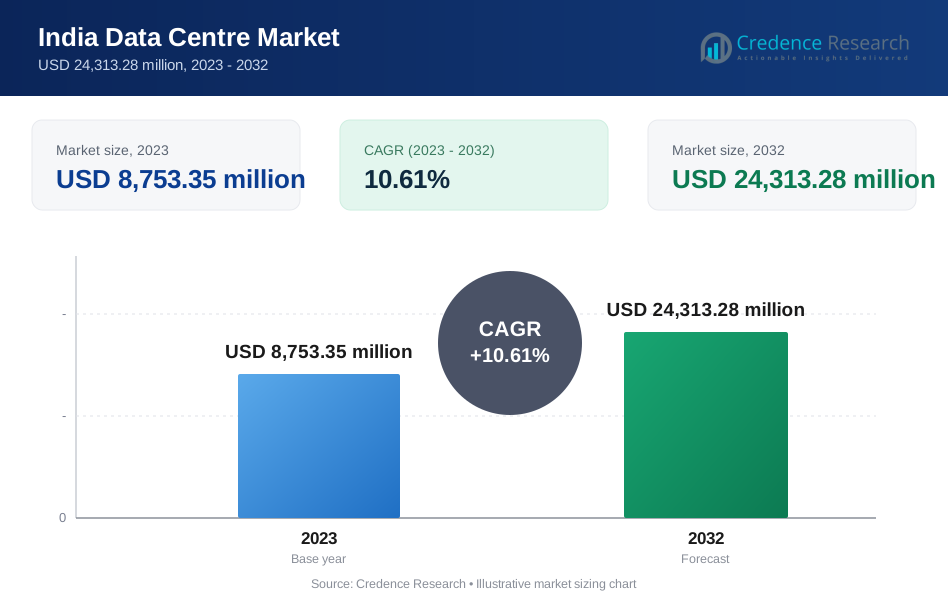
| India Data Centre Market Size 2023 | USD 8,753.35 million |
| India Data Centre Market, CAGR | 10.61% |
| India Data Centre Market Size 2032 | USD 24,313.28 million |
Market Overview
The India Data Centre Market is projected to grow from USD 8,753.35 million in 2023 to USD 24,313.28 million by 2032, reflecting a compound annual growth rate (CAGR) of 10.61%.
The India Data Centre Market is driven by rapid digital transformation, increased adoption of cloud computing, and a surge in data generation from IoT devices and online services. Government initiatives promoting digitalization, such as Digital India, are fostering a favorable environment for data centre growth. Additionally, the rise of e-commerce, fintech, and online education platforms further boosts demand for robust data storage and processing solutions. Trends towards sustainability are also influencing the market, with operators increasingly adopting energy-efficient technologies and renewable energy sources to reduce their carbon footprint and meet the growing demand for environmentally responsible data infrastructure.
The India Data Centre Market is primarily concentrated in the Western and Southern regions, which together account for a significant portion of the market share due to their robust digital infrastructure, favorable climate conditions, and strategic locations. Mumbai, in the Western region, serves as a key data hub, attracting investments from both domestic and international players. Major players in the market include CtrlS Datacenters Ltd, Equinix Inc., NTT Ltd, and Reliance, leveraging their advanced technologies and extensive networks to provide reliable and scalable data centre solutions. These companies play a pivotal role in meeting the growing demand for data storage and processing across various industries.
Market Drivers
Rapid Economic Growth
India's robust economic growth has spurred industrialization and urbanization, significantly driving demand for data centre services. As the country continues to urbanize, the need for reliable data infrastructure to support the expanding digital economy has become critical. For instance, the Reserve Bank of India (RBI) reported that net FDI flows in India for FY24 were substantial, reflecting the confidence of global investors in the Indian market. Additionally, India's favorable investment climate has attracted substantial foreign direct investment (FDI), with numerous global companies establishing operations in the country. These companies require advanced data centre facilities to manage and secure their vast data, further boosting the market. The combination of economic expansion and increasing FDI underscores the growing importance of data centres in supporting India's dynamic economy.
Digital Transformation
The Indian government's strong focus on digital transformation is a key driver of the data centre market. Initiatives such as Digital India and other policy measures are promoting the development of digital infrastructure across the country. For instance, the Digital India initiative aims to transform India into a digitally empowered society and knowledge economy by improving online infrastructure and enhancing internet connectivity. The rapid growth of e-commerce, online education, and other digital services has created an urgent need for robust data centres to support these activities. As more consumers and businesses move online, the demand for data storage, processing, and security is escalating, making data centres a vital component of India's digital ecosystem. This trend is expected to continue as the country advances in its digital journey.
Cloud Computing Adoption
The widespread adoption of cloud computing in India is another major factor driving the data centre market. As businesses increasingly shift to cloud-based solutions to enhance flexibility, scalability, and cost-efficiency, the demand for data centres capable of supporting cloud infrastructure has surged. Cloud service providers require extensive data storage and processing capabilities, which are provided by state-of-the-art data centres. This shift towards cloud computing is not only reshaping business operations but also reinforcing the need for advanced data centre infrastructure to meet the growing digital demands of various industries in India.
Connectivity Improvements and Investment Climate
India's expanding fiber-optic networks and rising internet penetration have significantly improved connectivity, making the country an attractive location for data centres. Improved connectivity facilitates faster and more reliable data transfer, essential for supporting the growing digital economy. Moreover, the Indian government has implemented various incentives, such as tax breaks and land concessions, to attract foreign investment in the data centre sector. Combined with relatively lower labor costs, these factors make India a cost-effective and strategic destination for data centre operations. As a result, the country is poised to become a key player in the global data centre market, driven by both domestic growth and international investment.
Market trends
Emphasis on Sustainability and the Rise of Hyperscale Data Centres
In the India data centre market, there is a growing emphasis on sustainability and energy efficiency, reflecting a broader global shift towards reducing environmental impact. Data centre operators are increasingly focusing on building green data centres that prioritize sustainable practices. This includes exploring the use of renewable energy sources such as solar and wind power to reduce their carbon footprint. By integrating energy-efficient technologies, such as advanced cooling systems and power management solutions, these facilities aim to minimize energy consumption and operational costs. For instance, major players are investing in green infrastructure to align with corporate social responsibility goals and meet regulatory requirements. For example, Yotta’s first data centre building in Navi Mumbai has a power capacity of 50MW and claims to have the lowest PUE of 1.4, with a solar power plant and natural gas-based power generation plant adjacent to the data centre. STT GDC India’s facilities derive 34 percent of their power from renewable sources and aim to cross 50% in the next four years. These large-scale facilities, often developed by major cloud providers, are crucial for supporting the vast data storage and processing needs driven by the rise in cloud computing and big data analytics. Hyperscale data centres are strategically located in regions with abundant energy resources and robust connectivity, ensuring efficient operations. The development of such facilities in India highlights the market’s readiness to cater to the growing demand for scalable and high-performance data services, making the country a pivotal hub for digital transformation.
Edge Computing, Modular Construction, and Focus on Security and Resilience
The rise of edge computing is significantly transforming the India data centre landscape, driving the demand for smaller, decentralized data centres positioned closer to end-users. These edge data centres help reduce latency and improve the efficiency of data processing, which is vital for real-time, data-intensive applications such as IoT, AI, and machine learning. By bringing data storage and processing capabilities closer to the source, edge computing reduces network congestion and enhances the user experience. Additionally, there is an increasing trend towards modular and prefabricated construction methods in the data centre industry. These approaches allow for faster deployment of data centre facilities, reducing construction times and costs. Modular solutions provide scalability, enabling data centres to expand and adapt to changing business needs, which is essential in a rapidly evolving digital market. Moreover, there is a heightened focus on security and resilience, as data centre operators invest in robust cybersecurity measures to protect against growing cyber threats. Ensuring resilience against natural disasters and other disruptions is also a priority, leading to the development of data centres that can maintain continuous operations even under adverse conditions. This comprehensive approach to security and resilience is vital for maintaining trust and reliability in India’s data centre infrastructure, supporting the needs of businesses and consumers in an increasingly digital world.
Market Challenges Analysis
Land Acquisition, Energy Costs, and Infrastructure Constraints
One of the significant challenges in the India data centre market is land acquisition and the associated costs. Finding suitable land for large-scale data centres, particularly in urban areas, is increasingly difficult due to zoning restrictions, limited availability, and competition for space. High land prices in prime locations can substantially inflate the overall project cost, impacting the financial feasibility of new developments. For instance, in major cities like Mumbai and Delhi, the competition for space and high real estate prices make it challenging to secure appropriate sites for data centre operations. These issues are compounded by rising energy costs, which directly impact the operating expenses of data centres. As data centres are energy-intensive, fluctuations in energy prices can significantly affect their profitability. Additionally, the push towards sustainability adds another layer of complexity. Stricter environmental regulations, aimed at reducing carbon emissions, require data centres to adopt green technologies and practices, which can involve substantial upfront investments. Balancing the need for economic efficiency with sustainability goals remains a complex issue, necessitating innovative solutions and strategic planning.
Talent Shortage, Regulatory Uncertainty, and Market Competition
The India data centre market faces a notable talent shortage, which is a significant challenge for the industry. The specialized nature of data centre operations requires skilled professionals in areas such as design, maintenance, and cybersecurity. The demand for these skills often outpaces supply, leading to intense competition for qualified talent, especially in technology hubs. This shortage can slow down the development of new projects and impact the operational efficiency of existing facilities. Companies must invest in training and development to build a skilled workforce capable of supporting the growing demands of the data centre industry. In addition to talent shortages, regulatory and policy uncertainty presents another significant challenge. Changes in government policies, such as alterations to tax incentives or planning regulations, can create an unpredictable environment for investors and developers. Navigating the complex regulatory landscape can be time-consuming and costly, adding layers of bureaucracy that delay project approvals and increase risks. These uncertainties can deter investment, slowing down the growth of the data centre market.
Market Segmentation Analysis:
By Type:
The India Data Centre Market is segmented into various types, including Enterprise, Edge, Colocation, Hyperscale, Managed, and Modular data centres. Enterprise data centres cater to large organizations, providing dedicated infrastructure to support critical IT operations. Edge data centres are smaller facilities positioned closer to end-users, offering low latency and supporting real-time applications, which are crucial for services like IoT and AI. Colocation centres provide shared space, power, and cooling, making them a cost-effective solution for businesses looking to outsource their data management needs. Hyperscale data centres, driven by the increasing demand for cloud services, are large-scale facilities used by major cloud providers to handle massive data volumes. Managed data centres offer third-party management of IT infrastructure, allowing businesses to focus on their core operations. Modular data centres provide flexible and scalable solutions that can be rapidly deployed and adapted to meet the evolving needs of businesses, ensuring agility in a dynamic market environment.
By Component:
The market is also segmented based on components, including Hardware, Data Centre Infrastructure Management Software, and Services. The Hardware segment encompasses essential components such as Power Systems, Cooling Systems, Racks, Servers, Networking Devices, and other critical infrastructure necessary for the efficient operation of data centres. Effective power and cooling systems are vital to maintaining optimal conditions, while racks, servers, and networking devices ensure seamless data processing and management. Data Centre Infrastructure Management Software is categorized into Cloud-based and On-premises solutions, offering flexibility and control over data centre operations. The Services segment includes a variety of offerings such as Professional Services, Integration & Implementation, Consulting, Support & Maintenance, and Managed Services. These services are crucial for the design, deployment, and ongoing management of data centres, ensuring they operate at peak performance and security. This comprehensive segmentation allows the India Data Centre Market to cater to diverse business requirements, providing tailored solutions that enhance data management, operational efficiency, and security in a rapidly evolving digital landscape.
Segments:
Based on Type:
- Enterprise
- Edge
- Colocation
- Hyperscale
- Managed
- Modular
Based on Component:
- Hardware
- Power Systems
- Cooling Systems
- Racks
- Servers
- Networking Devices
- Others
- India Data Centre Infrastructure Management Software
- Cloud-based
- On-premises
- Service
- Professional Services
- Integration & Implementation
- Consulting
- Support & Maintenance
- Managed Services
Based on Size:
- Small
- Mid-Sized
- Large
Based on Tire:
- Tier 1
- Tier 2
- Tier 3
- Tier 4
Based on Industry:
- IT & Telecom
- BFSI
- Manufacturing
- Healthcare
- Government
- Others
Based on the Geography:
- Northern
- Western
- Southern
- Eastern
Regional Analysis
Northern Region
The Northern region of India holds a significant share of the data centre market, accounting for approximately 25% of the market. This dominance is driven by key cities such as Delhi-NCR, which serve as major hubs for business, government, and IT services. The region benefits from robust infrastructure, including well-established power grids and expanding fiber-optic networks, which are essential for the efficient operation of data centres. The presence of multiple industries, ranging from finance and telecom to e-commerce and IT, further fuels the demand for data centre services. Additionally, the Northern region is home to several government agencies and multinational corporations that require secure and reliable data storage solutions, driving the need for advanced data centre infrastructure. Government initiatives to promote digital transformation and smart city projects in this region also contribute to the market's growth, making it a key area for data centre investment.
Western Region
The Western region, encompassing major cities like Mumbai and Pune, commands a substantial market share of approximately 35% in the India Data Centre Market. Mumbai, as the financial capital of India, serves as a critical hub for banking, finance, and corporate sectors, which demand extensive data storage and processing capabilities. The region's strategic location, with proximity to undersea cable landing stations, enhances its connectivity, making it a preferred choice for data centre operators. Moreover, the Western region is witnessing significant investments from both domestic and international players looking to capitalize on the growing demand for cloud services and digital transformation initiatives. The region's well-developed infrastructure, availability of skilled workforce, and supportive government policies further bolster its position in the data centre market. The focus on sustainability and the adoption of green technologies are also prominent in this region, aligning with global trends towards energy efficiency and environmental responsibility.
Key Player Analysis
- CtrlS Datacenters Ltd
- Equinix Inc.
- ESDS Software Solution Ltd
- Go4hosting
- NTT Ltd
- Nxtra Data Ltd
- Pi Datacenters Pvt Ltd
- Reliance
- Sify Technologies Ltd
- STT GDC Pte Ltd
- WebWerks
- Yotta Infrastructure Solutions
Competitive Analysis
The India Data Centre Market is highly competitive, with leading players like CtrlS Datacenters Ltd, Equinix Inc., and NTT Ltd driving market growth through extensive infrastructure and advanced technology offerings. These companies leverage their strong market presence, robust service portfolios, and strategic locations to provide scalable and secure data centre solutions that cater to the increasing demand for cloud services, data storage, and processing capabilities. Additionally, their focus on energy efficiency and sustainability, combined with continuous investment in expanding capacity and upgrading technology, allows them to maintain a competitive edge. The market is characterized by intense competition, with players striving to differentiate themselves through innovative service offerings, strategic partnerships, and customer-centric solutions, ensuring they meet the diverse needs of businesses across various sectors in India.
Recent Developments
- In August 2023, Equinix announced an investment of $42 million for its fourth International Business Exchange (IBX) data center in Mumbai, called MB4.
- In June 2024, CtrlS announced plans to develop a data center campus in Kolkata with an investment of Rs 2,200 crore ($264m). The first phase of the 60MW site is set to go live this year.
- In June 2024, ESDS announced plans to establish two more data centers in Noida and Kolkata over the next two years and expand its existing centers in Mumbai and Bangalore.
- In January 2024, NTT launched its new data center campus, Noida 2, with a planned capacity of 52.8 MW.
Market Concentration & Characteristics
The India Data Centre Market exhibits moderate to high market concentration, with a few key players dominating a significant portion of the market share. Companies such as CtrlS Datacenters Ltd, Equinix Inc., and NTT Ltd lead the market, benefiting from their extensive infrastructure, advanced technological capabilities, and strategic locations in major urban centers. These established players leverage their substantial investments in data centre facilities, robust service offerings, and strong customer relationships to maintain a competitive advantage. The market is characterized by high entry barriers, including significant capital requirements, the need for specialized technical expertise, and stringent compliance with data privacy and security regulations. Additionally, the market's focus on scalability, energy efficiency, and resilience reflects the growing demand for cloud services, big data analytics, and digital transformation initiatives. These characteristics make the India Data Centre Market a critical component of the country’s digital infrastructure, supporting its rapid economic growth and ongoing digitalization efforts.
Report Coverage
The research report offers an in-depth analysis based on Type, Component, Size, Tire, Industry and Geography. It details leading market players, providing an overview of their business, product offerings, investments, revenue streams, and key applications. Additionally, the report includes insights into the competitive environment, SWOT analysis, current market trends, as well as the primary drivers and constraints. Furthermore, it discusses various factors that have driven market expansion in recent years. The report also explores market dynamics, regulatory scenarios, and technological advancements that are shaping the industry. It assesses the impact of external factors and global economic changes on market growth. Lastly, it provides strategic recommendations for new entrants and established companies to navigate the complexities of the market.
Future Outlook
- The India Data Centre Market is expected to experience significant growth, driven by increasing digitalization across various sectors.
- Rising adoption of cloud computing services will continue to boost demand for advanced data centre infrastructure.
- Investment in edge computing will increase to support low-latency applications and bring data processing closer to end-users.
- There will be a greater focus on sustainability, with more data centres adopting renewable energy sources and energy-efficient technologies.
- Enhanced cybersecurity measures will become critical as data security concerns grow alongside the expansion of digital services.
- Government initiatives and supportive policies will attract more domestic and foreign investment in data centre development.
- Modular and prefabricated construction methods will be increasingly adopted to allow for faster deployment and scalability of data centres.
- Expansion of fiber-optic networks will improve connectivity, enhancing India’s position as a key data centre hub in the region.
- Compliance with data sovereignty and localization requirements will drive demand for local data centres, ensuring data remains within India.
- Advances in artificial intelligence and automation will improve data centre management, enhancing operational efficiency and reducing costs.
Request a Free Sample
Fill in your details and we'll send you a free sample report.
- Sample data tables & charts
- Research methodology
Need a Custom Version of This Report?
Tailor the scope, geography, or segments to your exact requirements.
- Custom geography or segment scope
- Direct access to our analyst team
Frequently Asked Questions
What is the current size of the India Data Centre Market?
What factors are driving the growth of the India Data Centre Market?
What are the key segments within the India Data Centre Market?
Who are the major players in the India Data Centre Market?
Table of Content
Chapter 1. Report Introduction
- 1.1 Report Description & Purpose
- 1.1.1 Report Title & Market Definition
- 1.1.2 Unique Selling Propositions (USP) & Key Differentiators
- 1.1.3 Value Proposition for Stakeholders
- 1.2 Research Objectives
- 1.2.1 Market Sizing Objectives (Volume & Revenue)
- 1.2.2 Segmentation Objectives
- 1.2.3 Competitive Intelligence Objectives
- 1.2.4 Forecast & Scenario Objectives
- 1.3 Report Scope
- 1.3.1 India Data Centre Scope – Types & Subtypes Covered
- 1.3.2 Geographic Scope – Regions & Countries Covered
- 1.3.3 Historical Period, Base Year & Forecast Period (2023; forecast to 2032)
- 1.3.4 Inclusions & Exclusions
- 1.4 HS Code & Classification Framework
- 1.5 Currency, Units & Pricing Basis
- 1.6 Target Stakeholders
- 1.7 Limitations & Assumptions
Chapter 2. Executive Summary
- 2.1 Global India Data Centre Market Snapshot
- 2.1.1 Market Size – Historical (2023) & Forecast (2023-2032) (2023: USD 8,753.35 million → 2032: USD 24,313.28 million)
- 2.1.2 Volume & Revenue – Global Totals
- 2.1.3 Key Market Highlights – Top Five Facts
- 2.2 India Data Centre Market Segmentation Snapshot
- 2.2.1 Market Split by Region – 2023 vs. 2032
- 2.3 Competitive Snapshot
- 2.3.1 Top 10 Players by Revenue Share – 2023
- 2.3.2 Top 10 Players by Volume Share – 2023
- 2.3.3 Recent Strategic Developments (18-Month Summary)
- 2.4 Key Investment Highlights & Strategic Conclusions
Chapter 3. India Data Centre Market Dynamics & Industry Analysis
- 3.1 Market Overview & Context
- 3.1.1 India Data Centre Market Position in the Broader Automotive Value Chain
- 3.1.2 OEM vs. Replacement Market Dynamics
- 3.1.3 Market Maturity & Development Stage by Region
- 3.2 India Data Centre Market Drivers
- 3.3 India Data Centre Market Restraints & Challenges
- 3.4 India Data Centre Market Opportunities
- 3.5 Porter's Five Forces Analysis
- 3.5.1 Threat of New Entrants
- 3.5.2 Bargaining Power of Suppliers
- 3.5.3 Bargaining Power of Buyers
- 3.5.4 Threat of Substitutes
- 3.5.5 Competitive Rivalry – Intensity Assessment
- 3.6 India Data Centre Value Chain Analysis
- 3.6.1 Upstream – Raw Material/Input Suppliers
- 3.6.1.1 Raw Material/Input 1
- 3.6.1.2 Raw Material/Input 2
- 3.6.1.3 Raw Material/Input 3
- 3.6.2 Midstream – Production/Manufacturing/Service Delivery
- 3.6.2.1 Production/Process Overview
- 3.6.2.2 Key Facility Locations & Capacity by Manufacturer
- 3.6.3 Downstream – Distribution & End Consumer
- 3.6.3.1 Primary Channel – B2B/OEM
- 3.6.3.2 Secondary Channels – Dealer, Retail, Online, Direct
- 3.6.4 Value Chain Profitability Analysis
- 3.6.1 Upstream – Raw Material/Input Suppliers
- 3.7 PESTEL Analysis
- 3.7.1 Political Factors
- 3.7.2 Economic Factors
- 3.7.3 Social Factors
- 3.7.4 Technological Factors
- 3.7.5 Environmental Factors
- 3.7.6 Legal Factors
- 3.8 India Data Centre Supply Chain Analysis
- 3.8.1 Raw Material/Input Supply Risk Assessment
- 3.8.2 Manufacturing Concentration Risk (Geographic Exposure)
- 3.8.3 Trade Disruption Impact Analysis
- 3.9 Regulatory & Policy Landscape
Note: The regulatory and policy landscape section covers regulations based on their applicability to the market, India Data Centre category, geography, and scope of the study. Only regulatory frameworks with a material impact on operations, compliance, trade, sustainability, or market access are analyzed in detail.
Chapter 4. Key Investment Pockets & Opportunity Analysis
- 4.1 India Data Centre Market Attractiveness Analysis
- 4.1.1 By Region – Investment Attractiveness Matrix (Volume × CAGR)
- 4.2 Absolute Revenue Growth Opportunity
- 4.2.1 By Region – Absolute USD Growth Through 2032
- 4.3 Incremental Volume Opportunity
- 4.3.1 By Region – Incremental Volume Through 2032
- 4.3.2 Segment – Incremental Volume
- 4.4 Emerging Submarket Opportunity Deep Dive (Subject to Applicability)
- 4.5 Emerging Market Opportunity Scorecards
- 4.5.1 United States
- 4.5.2 Europe
- 4.5.3 Asia
- 4.5.4 Middle East & Africa
Note: Emerging Market Opportunity Scorecards will be included based on relevance and strategic importance. Regions listed are indicative and may vary depending on data availability and market dynamics.
Chapter 5. India Data Centre Import-Export Analysis & Trade Flows
- 5.1 Global Trade Overview
- 5.1.1 Global Export Value by Country (2023)
- 5.1.2 Global Export Volume by Country (2023)
- 5.1.3 Global Import Value by Country (2023)
- 5.1.4 Global Import Volume by Country (2023)
- 5.1.5 Net Trade Balance by Country (2023)
- 5.2 Export Analysis – Segment
- 5.2.1 Type 1 (HS Code)
- 5.2.2 Type 2 (HS Code)
- 5.2.3 Type 3 (HS Code)
- 5.2.4 Type 4 (HS Code)
- 5.2.5 Type 5 (HS Code)
- 5.3 Import Analysis – Segment
- 5.3.1 Type 1 (HS Code)
- 5.3.2 Type 2 (HS Code)
- 5.3.3 Type 3 (HS Code)
- 5.3.4 Type 4 (HS Code)
- 5.3.5 Type 5 (HS Code)
- 5.4 Average Unit Trade Prices
- 5.4.1 Average Export Price – Segment & Country
- 5.4.2 Average Import Price – Segment & Source Country
- 5.4.3 Price Trends (2023)
- 5.5 Key Trade Route Analysis
- 5.5.1 Trade Route 1
- 5.5.2 Trade Route 2
- 5.5.3 Trade Route 3
- 5.5.4 Trade Route 4
- 5.5.5 Trade Route 5
- 5.6 Trade Policy Impact Assessment
- 5.6.1 US Anti-Dumping & Section 301 Tariffs
- 5.6.2 EU Customs Union Impact
- 5.6.3 Major Free Trade Agreements
- 5.6.4 USMCA Rules of Origin
Note: Trade policy analysis will be included only where relevant to the India Data Centre market.
Chapter 6. Competitive Landscape & Company Benchmarking
- 6.1 India Data Centre Market Concentration & Structure
- 6.1.1 Herfindahl-Hirschman Index (HHI) – vs. 2023
- 6.1.2 Tier 1, Tier 2 & Tier 3 Market Structure
- 6.1.3 Global, Regional & Local Player Dynamics
- 6.2 India Data Centre Market Share Analysis – 2023
- 6.2.1 Global Revenue Share by Company
- 6.2.2 Global Volume Share by Company
- 6.2.3 Regional Revenue Share
- 6.2.4 Market Share Evolution ( vs. 2023)
- 6.2.5 OEM Segment Share by Company
- 6.2.6 Replacement Segment Share by Company
- 6.3 Production/Delivery Capacity & Facility Analysis
- 6.3.1 Global Installed Capacity
- 6.3.2 Capacity Utilization Rates
- 6.3.3 Production/Output Volume
- 6.3.4 Facility Locations & Capacity Map
- 6.3.5 Planned Capacity Additions
- 6.4 India Data Centre Competitive Benchmarking Matrix
- 6.4.1 Revenue, Volume, CAGR & Profitability Comparison
- 6.4.2 Channel Revenue Mix
- 6.4.3 Geographic Revenue Exposure
- 6.4.4 R&D Intensity
- 6.4.5 Sustainability Maturity
- 6.5 Strategic Developments in India Data Centre (Last 24 Months)
- 6.5.1 Mergers, Acquisitions & Divestments
- 6.5.2 New India Data Centre Launches
- 6.5.3 Facility Expansions
- 6.5.4 Strategic Alliances, Joint Ventures & Partnerships
- 6.5.5 Distribution Expansion & Market Entry
- 6.5.6 Sustainability & ESG Initiatives
- 6.6 Competitive Strategy Mapping
- 6.6.1 Leader, Challenger, Follower & Niche Classification
- 6.6.2 Pricing Strategy Comparison
- 6.6.3 Channel Strategy Matrix
Note: Strategic developments are included based on their materiality and the availability of reliable information.
Chapter 7. Global India Data Centre Market – By Distribution Channel
- 7.1 Segment Overview
- 7.1.1 Volume & Revenue Split by Channel (2023 & 2032)
- 7.1.2 Channel Mix Evolution (2023-2032)
Chapter 8. Regional Market Analysis – Global Overview
- 8.1 Global Regional Overview
- 8.1.1 Regional Volume Share
- 8.1.2 Regional Revenue Share
- 8.1.3 Regional Volume by Region
- 8.1.4 Regional Revenue by Region
- 8.1.5 Regional Forecast Through 2032
- 8.2 Cross-Regional Segment Analysis
- 8.2.1 By Distribution Channel
- 8.2.2 By Brand/Price Tier
Chapter 9. North America India Data Centre Market
- 9.1 United States
- 9.2 Canada
- 9.3 Mexico
Chapter 10. Europe India Data Centre Market
- 10.1 Germany
- 10.2 France
- 10.3 Italy
- 10.4 United Kingdom
- 10.5 Spain
- 10.6 Poland
- 10.7 Russia
- 10.8 Netherlands
- 10.9 Belgium
- 10.10 Sweden
- 10.11 Denmark
- 10.12 Norway
- 10.13 Rest of Europe
Chapter 11. Asia Pacific India Data Centre Market
- 11.1 China
- 11.2 India
- 11.3 Japan
- 11.4 South Korea
- 11.5 Thailand
- 11.6 Indonesia
- 11.7 Vietnam
- 11.8 Malaysia
- 11.9 Australia
- 11.10 Rest of Asia Pacific
Chapter 12. Latin America India Data Centre Market
- 12.1 Brazil
- 12.2 Argentina
- 12.3 Colombia
- 12.4 Chile
- 12.5 Rest of Latin America
Chapter 13. Middle East India Data Centre Market
- 13.1 Saudi Arabia
- 13.2 United Arab Emirates
- 13.3 Turkey
- 13.4 Israel
- 13.5 Iran
- 13.6 Rest of the Middle East
Chapter 14. Africa India Data Centre Market
- 14.1 South Africa
- 14.2 Egypt
- 14.3 Nigeria
- 14.4 Morocco
- 14.5 Rest of Africa
Chapter 15. India Data Centre Company Profiles
- 15.1 [Company 01]
- 15.1.1 Company Overview
- 15.1.2 Key Management Personnel
- 15.1.3 Products & Services Portfolio
- 15.1.4 Financial Performance
- 15.1.5 Key Market Focus & Geographic Presence
- 15.1.6 Recent Developments & Strategic Initiatives
Note: The company profile list is preliminary and may change based on research findings, market developments, data availability, and client requirements.
Chapter 16. Appendices
- Appendix A – List of Abbreviations & Acronyms
- Appendix B – Industry Classification Code Reference – Full Series
- Appendix C – Production & Capacity Data Tables
- Appendix D – End-Use & Demand Base Tables
- Appendix E – Consumption & Replacement Rate Assumptions
- Appendix F – ASP Reference Tables
- Appendix G – Manufacturing & Facility Database
- Appendix H – Import-Export Data Tables
- Appendix I – Regulatory Summary Tables
- Appendix J – Primary Research Participant List (Anonymized)
- Appendix K – Primary Research Questionnaire Framework
- Appendix L – Data Sources & Bibliography
- Appendix M – Market Size Divergence & Source Comparison
Chapter 17. Research Methodology
- 17.1 Research Framework & Philosophy
- 17.2 Secondary Research – Sources, Hierarchy & Data Extraction
- 17.3 Data Modeling – Bottom-Up & Top-Down Market Sizing
- 17.4 Primary Research – Stakeholder Framework, LOI & Sample Sizes
- 17.5 Forecast Methodology – Regression, Scenario & Sensitivity Analysis
- 17.6 Quality Control – Four-Layer Validation Framework
- 17.7 Limitations & Standard Assumptions
- 17.8 Disclaimer
