
Market Overview
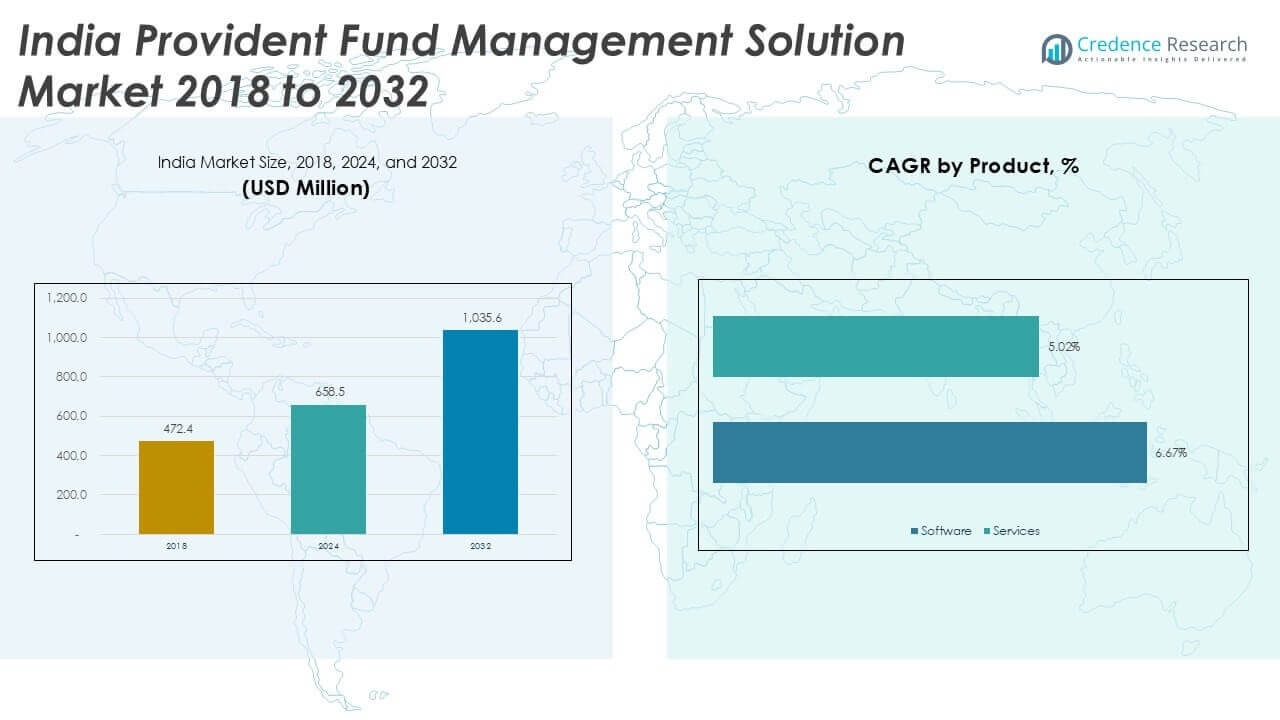
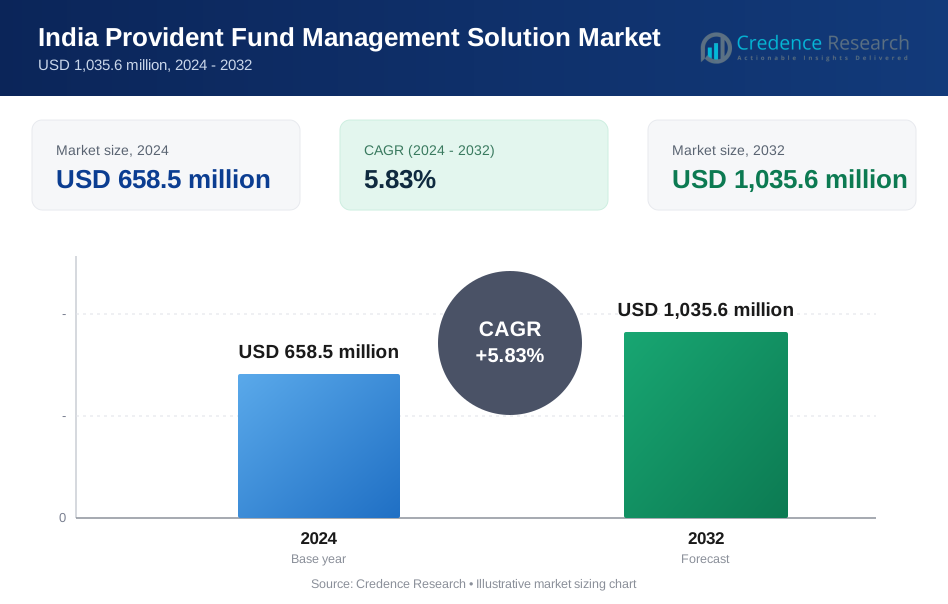
India Provident Fund Management Solution Market size was valued at USD 472.4 million in 2018 to USD 658.5 million in 2024 and is anticipated to reach USD 1035.6 million by 2032, at a CAGR of 5.83% during the forecast period.
| REPORT ATTRIBUTE | DETAILS |
|---|---|
| Historical Period | 2020-2023 |
| Base Year | 2024 |
| Forecast Period | 2025-2032 |
| India Provident Fund Management Solution Market Size 2024 | USD 658.5 Million |
| India Provident Fund Management Solution Market, CAGR | 5.83% |
| India Provident Fund Management Solution Market Size 2032 | USD 1035.6 Million |
The India Provident Fund Management Solution market is led by key players including Kalpak Solutions, Renessa Info Systems Limited, Ray Computech Pvt. Ltd., Workday, C-Quel India, Vitech Systems Group, and Andolasoft, Inc. These companies focus on compliance automation, seamless payroll integration, and employee self-service platforms to improve accuracy and efficiency. West India leads the market with 31% share, driven by strong adoption across IT hubs and BFSI sectors, followed by South India with 30% share, supported by its large tech and manufacturing base. North India accounts for 29% share, anchored by PSU and automotive demand, while East India holds 10% share, showing steady growth as companies digitize fund management operations.
 Market Insights
- The India Provident Fund Management Solution market was valued at USD 658.5 million in 2024 and is projected to reach USD 1,035.6 million by 2032, growing at a CAGR of 5.83%.
- Growth is fueled by rising regulatory compliance requirements, automation adoption, and increased focus on employee benefit transparency, driving demand for digital PF management platforms.
- Key trends include rapid migration to cloud-based and mobile-first solutions, integration with HRMS and payroll systems, and deployment of AI-driven workflows to improve efficiency and reduce manual errors.
- The market is moderately competitive with players like Kalpak Solutions, Renessa Info Systems, Ray Computech, Workday, C-Quel India, and Vitech Systems focusing on compliance automation, cybersecurity, and scalable SaaS offerings.
- West India leads with 31% share, followed by South India at 30%, North India at 29%, and East India at 10%; software holds the dominant product share, supported by strong adoption among large enterprises.
Market Segmentation Analysis:
By Product
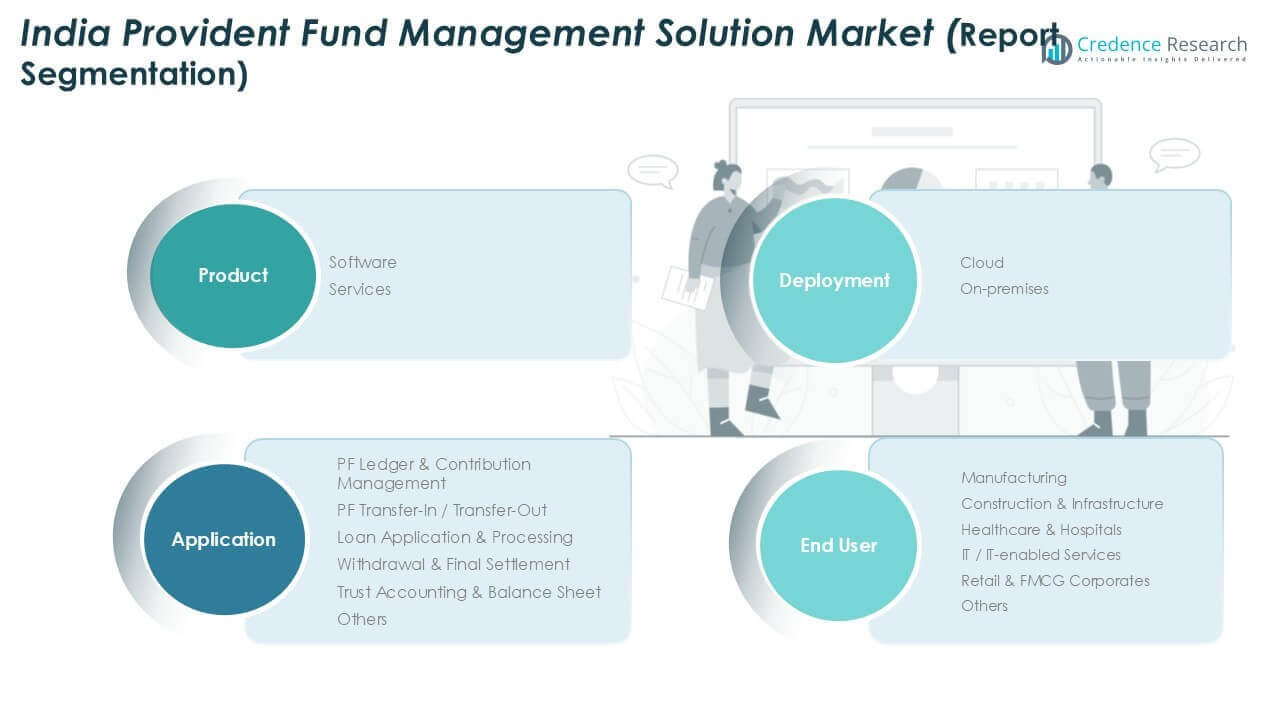
Software dominated the India Provident Fund Management Solution market in 2024, holding over 60% of the market share. This growth is driven by the rising adoption of automated payroll integration, real-time compliance updates, and user-friendly interfaces that improve fund tracking accuracy. Organizations are investing in scalable software solutions to reduce manual errors and streamline contribution processing. Services follow as a complementary segment, with demand driven by outsourcing requirements for fund administration, advisory, and compliance audits. Growing awareness of digital transformation is expected to keep software the preferred choice during the forecast period.
- For instance, greytHR processed provident fund contributions for over 1.2 million employees monthly in 2024, automating filings for more than 18,000 Indian businesses.
By Application
PF Ledger & Contribution Management was the leading application segment, capturing more than 35% share in 2024. Companies rely on this function for accurate record-keeping, timely contributions, and compliance with statutory norms. Increasing digitization and automation initiatives have boosted adoption, reducing human intervention and processing delays. Loan Application & Processing and Withdrawal & Final Settlement are growing segments as employees seek faster digital approvals and transparent settlement processes. Trust Accounting & Balance Sheet solutions are also witnessing steady uptake, particularly among large enterprises managing multiple employee benefit trusts efficiently.
- For instance, in 2024, RazorpayX Payroll analyzed payroll data for over 4 lakh (400,000+) employees and ensured real-time EPF compliance for over 10,000 organizations across India.
By Deployment
Cloud deployment held the dominant share of over 55% in 2024, supported by the need for scalable, cost-effective, and secure fund management platforms. SMEs and large enterprises prefer cloud-based solutions for their real-time accessibility, low infrastructure costs, and easy updates. The growth of remote work and mobile access requirements has further accelerated the adoption of cloud platforms. On-premises solutions remain relevant for organizations with strict data security policies and in-house IT infrastructure but are experiencing slower growth as businesses migrate to cloud-based models for better flexibility and compliance management.
Key Growth Drivers
Rising Regulatory Compliance Requirements
The India Provident Fund Management Solution market is driven by strict compliance mandates from the Employees’ Provident Fund Organisation (EPFO) and government authorities. Companies are adopting digital fund management systems to ensure timely contributions, automated reporting, and error-free compliance. Frequent updates to labor laws and contribution rules are pushing enterprises to invest in solutions that offer real-time updates and regulatory alerts. This adoption minimizes penalties and improves audit readiness, making compliance a significant growth driver for solution providers.
- For instance, ADP's services are designed to improve compliance and minimize the risk of penalties, which have been significantly simplified by recent EPFO changes.
Digital Transformation and Automation Adoption
The shift toward automation is a major driver for market growth. Organizations are increasingly implementing AI-enabled and cloud-based platforms to streamline payroll processing, contribution tracking, and withdrawal settlements. Automated workflows reduce manual errors, improve data accuracy, and speed up processing time. This digital transformation supports real-time employee self-service portals and ensures better transparency in fund management. The trend aligns with India’s broader digitalization initiatives, encouraging both SMEs and large enterprises to adopt modern provident fund management solutions.
- For instance, HROne's own "Our Story" timeline, Google Play store page, and LinkedIn page, which provides a more accurate picture of the company's growth as of September 2024.
Growing Workforce and Employee Benefit Awareness
India’s expanding formal workforce and rising awareness about employee welfare benefits are boosting demand for provident fund management solutions. Companies seek efficient systems to manage contributions for a growing number of employees while maintaining transparency and trust. Enhanced focus on employee financial security, especially post-pandemic, has driven organizations to prioritize robust fund management processes. This shift supports better employee retention and satisfaction, encouraging corporates to adopt scalable and efficient fund management platforms.
 Key Trends & Opportunities
Cloud-Based and Mobile-First Solutions
The adoption of cloud-based and mobile-friendly provident fund management solutions is a key market trend. Businesses are shifting toward SaaS platforms that provide remote access, real-time data synchronization, and easy integration with HR and payroll systems. Mobile-first solutions allow employees to view balances, request withdrawals, and track contributions on the go. This trend offers solution providers opportunities to expand their offerings with advanced security features, API integrations, and analytics capabilities, meeting the growing demand for flexibility and accessibility.
- For instance, according to the HR tech company Keka, its mobile PF module processed over 3 million withdrawal and balance check requests in 2024. Keka also states it serves employees across more than 10,000 Indian businesses.
Integration with Payroll and HRMS Platforms
There is a growing trend of integrating provident fund management systems with existing HR and payroll software. This integration streamlines operations by enabling automated deduction, seamless reconciliation, and instant compliance reporting. Vendors offering plug-and-play solutions that work with popular HRMS platforms gain a competitive edge. The opportunity lies in developing highly interoperable systems that reduce administrative burdens and deliver end-to-end visibility of employee benefits, particularly for large enterprises managing diverse workforces across multiple locations.
- For instance, Zoho Payroll features integrated PF compliance modules for companies in India, automating monthly contributions for their employees. It integrates with other Zoho products like Zoho People and Zoho Books for seamless data transfer, and as of 2024, it helps process payroll for over 17,000 employees monthly.
Key Challenges
Data Security and Privacy Concerns
Data security remains a major challenge in the India Provident Fund Management Solution market. The storage and transfer of sensitive employee financial information make these systems prime targets for cyberattacks. Organizations must comply with strict data protection regulations, requiring vendors to invest heavily in encryption, secure hosting, and compliance frameworks. Failure to secure data can lead to financial loss, legal penalties, and reputational damage, making security a critical barrier to adoption for some enterprises.
Limited Adoption Among Small Enterprises
Small and medium enterprises (SMEs) often face budget constraints and limited awareness regarding advanced provident fund management solutions. Many rely on manual processes or basic software that lacks automation and compliance features. High upfront costs, training requirements, and resistance to change hinder adoption in this segment. Vendors need to offer affordable, user-friendly solutions with flexible pricing models to penetrate the SME market and encourage wider adoption across India’s diverse business landscape.
Regional Analysis
North India
North India accounted for around 29% of the India Provident Fund Management Solution market in 2024, driven by strong adoption in Delhi NCR, Punjab, and Haryana where manufacturing, automotive, and government PSUs dominate. Organizations increasingly implement integrated payroll and PF management platforms to ensure compliance with EPFO norms and to streamline ledger reconciliation across multiple facilities. Hybrid deployments are popular, addressing strict data security policies while enabling real-time access for HR teams. Demand is also rising in tier-2 cities as SMEs and MSMEs adopt automated solutions to reduce manual errors and ensure timely contribution submissions and settlements.
West India
West India led the market with 31% share in 2024, supported by a strong base of IT hubs, BFSI companies, and industrial clusters in Maharashtra and Gujarat. Enterprises in this region favor cloud-based SaaS models for scalability, cost efficiency, and faster deployment. Advanced analytics and AI-driven reconciliation tools are gaining popularity, enabling early detection of compliance gaps. Vendors also benefit from a mature regulatory ecosystem and digital-friendly corporate culture, which encourages automated reporting and paperless workflows. Regional demand is further strengthened by startups and fintech players seeking seamless integration between payroll, compliance, and employee self-service systems.
South India
South India held a 30% share in 2024, driven by its large IT, healthcare, and electronics manufacturing base across Bengaluru, Hyderabad, and Chennai. Companies in the region prioritize AI-enabled workflows, chatbots for employee queries, and automated loan or withdrawal approvals to improve turnaround times. Cloud deployment remains the dominant model, supporting remote teams and distributed workforce management. Enterprises invest heavily in platforms with strong cybersecurity compliance such as SOC-2 and ISO certifications. Vendor presence and local implementation partners play a key role in driving adoption, offering training, integration support, and ongoing system optimization for large enterprises.
East India
East India contributed 10% share in 2024, with growing adoption among manufacturing, steel, mining, and logistics companies across Odisha, Jharkhand, and West Bengal. Many businesses are transitioning from manual spreadsheets to modular PF management platforms for the first time, focusing on error-free ledger maintenance and automated transfer-in processes. On-premises deployments are still common due to strict internal IT policies, though cloud adoption is accelerating with affordable subscription models. Regional vendors emphasize vernacular interfaces and localized training to boost employee participation. Government-led digital initiatives and compliance drives are also fueling adoption in public and cooperative sector organizations.
 Market Segmentations:
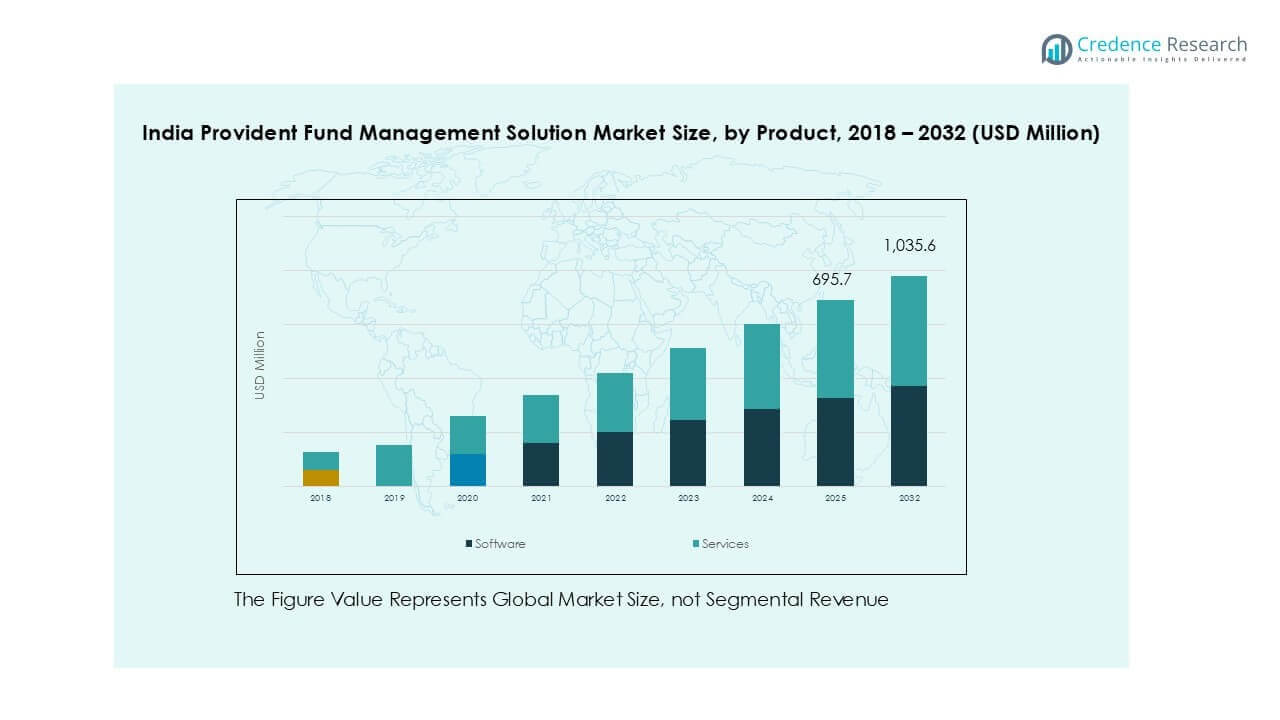
By Product
- Software
- Services
By Application
- PF Ledger & Contribution Management
- PF Transfer-In / Transfer-Out
- Loan Application & Processing
- Withdrawal & Final Settlement
- Trust Accounting & Balance Sheet
- Others
By Deployment
- Cloud
- On-premises
By End User
- Manufacturing
- Construction & Infrastructure
- Healthcare & Hospitals
- IT / IT-enabled Services
- Retail & FMCG Corporates
- Others
By Geography
- North India
- West India
- South India
- East India
Competitive Landscape
The India Provident Fund Management Solution market is moderately competitive, featuring a mix of domestic players and global solution providers. Leading companies such as Kalpak Solutions, Renessa Info Systems Limited, Ray Computech Pvt. Ltd., Workday, C-Quel India, Vitech Systems Group, and Andolasoft, Inc. focus on delivering end-to-end PF management platforms with compliance automation, ledger accuracy, and employee self-service capabilities. Domestic vendors compete by offering cost-effective, customizable solutions tailored to Indian regulatory requirements, while global firms leverage advanced analytics, AI-driven workflows, and cloud-native architectures to attract large enterprises. Strategic partnerships with HRMS and payroll providers are common, enabling seamless integrations and quicker deployment. Companies also invest in localized language support, training modules, and mobile-first features to expand adoption among SMEs. Recent developments highlight product upgrades with real-time EPFO updates, strengthened cybersecurity features, and automation capabilities that address the growing demand for accuracy, scalability, and regulatory compliance across diverse industries.
Key Player Analysis
- Kalpak Solutions
- Renessa Info Systems Limited
- Ray Computech Pvt. Ltd.
- Workday
- C-Quel India
- Vitech Systems Group
- Andolasoft, Inc.
- Other Key Players
Recent Developments
- In July 2025, Workday announced it will deepen its presence in India by setting up a new Global Capability Center (GCC) in Chennai.
Report Coverage
The research report offers an in-depth analysis based on Product, Application, Deployment, End User and Geography. It details leading market players, providing an overview of their business, product offerings, investments, revenue streams, and key applications. Additionally, the report includes insights into the competitive environment, SWOT analysis, current market trends, as well as the primary drivers and constraints. Furthermore, it discusses various factors that have driven market expansion in recent years. The report also explores market dynamics, regulatory scenarios, and technological advancements that are shaping the industry. It assesses the impact of external factors and global economic changes on market growth. Lastly, it provides strategic recommendations for new entrants and established companies to navigate the complexities of the market.
Future Outlook
- The market will see higher adoption of cloud-based platforms for scalability and remote access.
- AI and machine learning will drive predictive analytics and automated compliance alerts.
- Integration with HRMS and payroll systems will become a standard requirement for enterprises.
- Mobile-first solutions will gain traction, enabling employees to manage PF accounts anytime.
- SMEs will increasingly adopt affordable subscription-based PF management solutions.
- Vendors will focus on strengthening data security and compliance with privacy regulations.
- Demand will rise for real-time reporting and automated ledger reconciliation.
- Employee self-service portals will expand to include loans, transfers, and settlements.
- Partnerships between solution providers and payroll service companies will increase.
- Regional adoption will accelerate in East India as digital awareness and compliance enforcement improve.
Request a Free Sample
Fill in your details and we'll send you a free sample report.
- Sample data tables & charts
- Research methodology
Market Dynamics
Rising Regulatory Compliance Requirements
Stringent mandates from the Employees’ Provident Fund Organisation (EPFO) and frequent updates to labor laws are pushing Indian enterprises to adopt digital PF management solutions that ensure timely contributions, automated reporting, and error-free compliance. This minimizes penalties and improves audit readiness, making compliance a significant growth driver.
Digital Transformation and Automation Adoption
Organizations are rapidly shifting to AI-enabled, cloud-based platforms to automate payroll processing, contribution tracking, and settlements. Automated workflows reduce manual errors, improve data accuracy, and support real-time employee self-service, aligning with India's broader digitalization initiatives.
Growing Workforce and Employee Benefit Awareness
India’s expanding formal workforce and heightened focus on employee welfare are driving demand for efficient provident fund management systems. Companies seek scalable solutions to manage contributions for more employees, enhancing transparency and trust, which supports better retention and satisfaction.
Cloud-Based and Mobile-First Solutions
The need for scalable, cost-effective, and accessible fund management platforms is accelerating the adoption of cloud and mobile-first solutions. These platforms offer real-time access, easy integration with HRMS and payroll, and empower employees to manage their PF accounts remotely.
Integration with Payroll and HRMS Platforms
Seamless integration of PF management with existing HR and payroll systems streamlines operations, automates deductions, and enables instant compliance reporting. This reduces administrative burden and delivers end-to-end visibility of employee benefits, especially for large enterprises with diverse workforces.
Need a Custom Version of This Report?
Tailor the scope, geography, or segments to your exact requirements.
- Custom geography or segment scope
- Direct access to our analyst team
Frequently Asked Questions
What is the current market size for India Provident Fund Management Solution market, and what is its projected size in 2032?
At what Compound Annual Growth Rate is the India Provident Fund Management Solution market projected to grow between 2025 and 2032?
Which India Provident Fund Management Solution market segment held the largest share in 2024?
What are the primary factors fueling the growth of the India Provident Fund Management Solution market?
Who are the leading companies in the India Provident Fund Management Solution market?
Which region commanded the largest share of the India Provident Fund Management Solution market in 2024?
Table of Content
Chapter 1 Market Segmentation
- 1.1 Segmentation Framework
- 1.1.1 Product and Service Classification
- 1.1.2 Application and End-Use Classification
- 1.1.3 Technology and Solution Classification
- 1.1.4 Customer and Distribution Channel Classification
- 1.1.5 Geographic Segmentation
- 1.1.6 Market Segment Definitions and Boundaries
- 1.2 By Product
- 1.2.1 Software
- 1.2.2 Services
- 1.3 By End User
- 1.3.1 Manufacturing
- 1.3.2 Construction & Infrastructure
- 1.3.3 Healthcare & Hospitals
- 1.3.4 IT / IT-enabled Services
- 1.3.5 Retail & FMCG Corporates
- 1.3.6 Others
- 1.4 By Deployment
- 1.4.1 Cloud
- 1.4.2 On-premises
- 1.5 By Application
- 1.5.1 PF Ledger & Contribution Management
- 1.5.2 PF Transfer-In / Transfer-Out
- 1.5.3 Loan Application & Processing
- 1.5.4 Withdrawal & Final Settlement
- 1.5.5 Trust Accounting & Balance Sheet
- 1.5.6 Others
Chapter 2 Introduction
- 2.1 Report Objectives and Scope
- 2.2 Product Definition and Industry Terminology
- 2.3 Market Inclusions and Exclusions
- 2.4 Research Process
- 2.4.1 Primary Research and Expert Interviews
- 2.4.2 Secondary Research and Source Review
- 2.4.3 Top-Down and Bottom-Up Estimation
- 2.4.4 Data Triangulation and Verification
- 2.5 Market Size Measurement Basis
- 2.5.1 2024: USD 658.5 million → 2032: USD 1,035.6 million
- 2.6 Historical and Forecast Reference Periods
- 2.6.1 Base Year: 2024
- 2.6.2 Forecast Period: 2024-2032
- 2.7 Research Assumptions and Limitations
Chapter 3 Executive Summary
- 3.1 Market Snapshot and Key Findings
- 3.2 Base-Year Market Size, 2024
- 3.3 Forecast Market Size, 2032
- 3.4 Revenue and Volume Growth Outlook
- 3.5 Key Demand and Supply Indicators
- 3.6 Leading Market Segments
- 3.7 Fastest-Growing Market Opportunities
- 3.8 Regional Performance Highlights
- 3.9 Technology and Industry Transformation
- 3.10 Competitive Landscape Summary
- 3.11 Analyst View and Strategic Implications
Chapter 4 India Provident Fund Management Solution Market Trends and Developments
- 4.1 Historical Industry Development
- 4.2 Recent Market Trends and Developments
- 4.3 Demand and Customer Behavior Trends
- 4.4 Technology and Product Innovation
- 4.5 Artificial Intelligence, Automation and Digitalization
- 4.6 Local Manufacturing and Supply Chain Realignment
- 4.7 Industry Partnerships, Mergers and Acquisitions
- 4.8 Sustainability and Circular Economy Developments
- 4.9 Government and Private Sector Investment Trends
- 4.10 Emerging Business Models and Commercialization
- 4.11 Industry Developments and Announcements
Chapter 5 India Provident Fund Management Solution Market Production, Supply and Demand Analysis
- 5.1 Demand Trend and Consumption Analysis
- 5.2 Demand Forecast, 2024-2032
- 5.3 Production and Output Trend
- 5.4 Production and Output Forecast, 2024-2032
- 5.5 Installed Capacity and Capacity Utilization
- 5.6 Company-Wise Production Plants and Statistics
- 5.6.1 Installed Production Capacity
- 5.6.2 Actual Production
- 5.6.3 Planned Capacity and Expansion Targets
- 5.7 Supply Chain Structure and Procurement Trends
- 5.8 Supply-Demand Gap and Bottlenecks
- 5.9 Import Dependence and Sourcing Structure
- 5.10 Contract Manufacturing and Outsourcing
- 5.11 Regional Supply and Demand Concentration
Chapter 6 India Provident Fund Management Solution Market Pricing Analysis
- 6.1 Pricing Structure and Measurement
- 6.2 Historical Pricing Trends
- 6.3 Pricing Outlook, 2024-2032
- 6.4 Average Selling Price and Unit Economics
- 6.5 Pricing by Product and Market Segment
- 6.6 Geographic Pricing Differences
- 6.7 Key Input, Energy, Labor and Logistics Costs
- 6.8 Contract Pricing and Purchasing Models
- 6.9 Pricing Sensitivity and Competitive Positioning
- 6.10 Price, Margin and Profitability Implications
Chapter 7 India Provident Fund Management Solution Market Dynamics
- 7.1 Market Growth Drivers
- 7.1.1 Demand-Side Drivers
- 7.1.2 Technology and Innovation Drivers
- 7.1.3 Infrastructure and Investment Drivers
- 7.1.4 Regulatory and Policy Drivers
- 7.2 Market Restraints
- 7.2.1 Cost and Affordability Constraints
- 7.2.2 Technology and Adoption Barriers
- 7.2.3 Supply Chain and Operational Constraints
- 7.3 Market Challenges
- 7.3.1 Competitive Pressure and Margin Erosion
- 7.3.2 Skills, Infrastructure and Implementation Gaps
- 7.4 Emerging Market Opportunities
- 7.5 Market Dynamics Impact and Time-Horizon Assessment
Chapter 8 India Provident Fund Management Solution Value Chain Analysis
- 8.1 Industry Value Chain Overview
- 8.2 Upstream Suppliers and Critical Inputs
- 8.3 Technology and Component Providers
- 8.4 Manufacturing or Service Delivery
- 8.5 Distribution, Channel Partners and Integrators
- 8.6 Downstream Applications and End Users
- 8.7 Value Addition and Profit Pools
- 8.8 Vertical Integration and Outsourcing
- 8.9 Supplier Concentration and Risk
- 8.10 Supply Chain Localization and Resilience
Chapter 9 India Provident Fund Management Solution Market Regulations and Policies
- 9.1 Relevant Laws, Standards and Compliance Frameworks
- 9.2 Product, Service, Safety and Quality Requirements
- 9.3 Government Policies, Incentives and Subsidies
- 9.4 Imports, Exports and Trade Barriers
- 9.5 Public Procurement and Local Content Requirements
- 9.6 Environmental and Sustainability Compliance
- 9.7 Data Protection, AI and Cybersecurity Compliance
- 9.8 Upcoming Policy Changes and Market Implications
Chapter 10 India Provident Fund Management Solution Market Hotspots and Opportunities
- 10.1 Market Opportunity Mapping and Growth Hotspots
- 10.2 High-Growth Applications and Customer Groups
- 10.3 Underserved Markets and White-Space Opportunities
- 10.4 Emerging Technology and Product Opportunities
- 10.5 New Capacity and Investment Hotspots
- 10.6 Market Entry and Expansion Opportunities
- 10.7 Distribution and Partnership Opportunities
- 10.8 Near-Term and Long-Term Commercial Potential
- 10.9 Opportunity Attractiveness and Execution Risks
Chapter 11 India Provident Fund Management Solution Market Outlook, 2024-2032
- 11.1 Market Size and Analysis
- 11.1.1 Revenue (Market Measurement: 2024: USD 658.5 million → 2032: USD 1,035.6 million)
- 11.1.2 Market Volume and Quantity Sold
- 11.1.3 Historical Market Size
- 11.1.4 Base-Year Market Size, 2024
- 11.2 Market Forecast, 2024-2032
- 11.2.1 Revenue Forecast to 2032
- 11.2.2 Volume Forecast to 2032
- 11.2.3 CAGR and Year-on-Year Growth
- 11.2.4 Incremental Revenue Opportunity
- 11.3 Forecast Assumptions and Scenario Analysis
- 11.3.1 Base-Case Forecast
- 11.3.2 Optimistic and Conservative Scenarios
- 11.3.3 Technology, Pricing and Policy Sensitivities
- 11.4 Market Attractiveness and Growth Outlook
Chapter 12 India Provident Fund Management Solution Market Segmentation and Outlook
- 12.1 Segmentation Summary and Market Shares, 2024
- 12.2 Largest and Fastest-Growing Segments
- 12.3 By Product - Market Size and Forecast, 2024-2032
- 12.3.1 Segment Definition and Scope
- 12.3.2 Historical Market Size
- 12.3.3 Revenue Forecast, 2024-2032
- 12.3.4 Volume Forecast, 2024-2032
- 12.3.5 Base-Year Market Share, 2024
- 12.3.6 Segment CAGR and Growth Drivers
- 12.3.7 Subsegment Market Size and Forecast
- 12.3.7.1 Software
- 12.3.7.2 Services
- 12.3.8 Subsegment Pricing and Adoption Trends
- 12.3.9 Leading Suppliers and Competition
- 12.3.10 Regional Demand and Opportunities
- 12.4 By End User - Market Size and Forecast, 2024-2032
- 12.4.1 Segment Definition and Scope
- 12.4.2 Historical Market Size
- 12.4.3 Revenue Forecast, 2024-2032
- 12.4.4 Volume Forecast, 2024-2032
- 12.4.5 Base-Year Market Share, 2024
- 12.4.6 Segment CAGR and Growth Drivers
- 12.4.7 Subsegment Market Size and Forecast
- 12.4.7.1 Manufacturing
- 12.4.7.2 Construction & Infrastructure
- 12.4.7.3 Healthcare & Hospitals
- 12.4.7.4 IT / IT-enabled Services
- 12.4.7.5 Retail & FMCG Corporates
- 12.4.7.6 Others
- 12.4.8 Subsegment Pricing and Adoption Trends
- 12.4.9 Leading Suppliers and Competition
- 12.4.10 Regional Demand and Opportunities
- 12.5 By Deployment - Market Size and Forecast, 2024-2032
- 12.5.1 Segment Definition and Scope
- 12.5.2 Historical Market Size
- 12.5.3 Revenue Forecast, 2024-2032
- 12.5.4 Volume Forecast, 2024-2032
- 12.5.5 Base-Year Market Share, 2024
- 12.5.6 Segment CAGR and Growth Drivers
- 12.5.7 Subsegment Market Size and Forecast
- 12.5.7.1 Cloud
- 12.5.7.2 On-premises
- 12.5.8 Subsegment Pricing and Adoption Trends
- 12.5.9 Leading Suppliers and Competition
- 12.5.10 Regional Demand and Opportunities
- 12.6 By Application - Market Size and Forecast, 2024-2032
- 12.6.1 Segment Definition and Scope
- 12.6.2 Historical Market Size
- 12.6.3 Revenue Forecast, 2024-2032
- 12.6.4 Volume Forecast, 2024-2032
- 12.6.5 Base-Year Market Share, 2024
- 12.6.6 Segment CAGR and Growth Drivers
- 12.6.7 Subsegment Market Size and Forecast
- 12.6.7.1 PF Ledger & Contribution Management
- 12.6.7.2 PF Transfer-In / Transfer-Out
- 12.6.7.3 Loan Application & Processing
- 12.6.7.4 Withdrawal & Final Settlement
- 12.6.7.5 Trust Accounting & Balance Sheet
- 12.6.7.6 Others
- 12.6.8 Subsegment Pricing and Adoption Trends
- 12.6.9 Leading Suppliers and Competition
- 12.6.10 Regional Demand and Opportunities
- 12.7 Segment Growth Comparison
- 12.8 Segment Attractiveness and Priority Matrix
Chapter 13 India Provident Fund Management Solution End-Use and Application Market Outlook
- 13.1 End-Use Industry and Customer Demand Structure
- 13.2 Leading Applications and Customer Groups
- 13.3 End-Use Market Size, Share and Forecast
- 13.4 Major End-Use Industry Deep Dives
- 13.4.1 Customer Requirements and Use Cases
- 13.4.2 Demand and Replacement Cycles
- 13.4.3 Technical and Regulatory Considerations
- 13.4.4 Purchasing and Procurement Models
- 13.4.5 Leading Vendors and Distribution Channels
- 13.4.6 Forecast and Commercial Opportunities
- 13.5 Emerging Applications and Cross-Segment Demand
- 13.6 End-Use Industry Investment Priorities
Chapter 14 India Provident Fund Management Solution Geographic Market Outlook, 2024-2032
- 14.1 Domestic Market Distribution and Demand Clusters
- 14.2 State- or Province-Wise Market Size and Forecast, 2024-2032
- 14.3 City and Metropolitan Market Outlook
- 14.4 Industrial, Manufacturing and Commercial Clusters
- 14.5 Geographic Concentration of Key End Users
- 14.6 Local Pricing and Purchasing Differences
- 14.7 Domestic Production Facilities and Capacity Map
- 14.8 Local Infrastructure and Project Pipeline
- 14.9 State-Level Policy and Incentive Differences
- 14.10 Subnational Investment Hotspots and Opportunities
- 14.11 Distribution and Logistics Networks
- 14.12 Domestic Competitive Footprint
Chapter 15 India Provident Fund Management Solution Technology, Innovation and Sustainability Outlook
- 15.1 Technology Landscape and Maturity
- 15.2 Product, Process and Service Innovation
- 15.3 AI, Automation and Digital Tools in the Industry
- 15.4 Technology Adoption and Performance Benchmarking
- 15.5 Innovation Pipeline and R&D Investment
- 15.6 Patent and Intellectual Property Trends
- 15.7 Energy Efficiency and Resource Management
- 15.8 Sustainability, Recycling and Circularity
- 15.9 Technology Roadmap, 2024-2032
- 15.10 Risks of Obsolescence and Technology Substitution
Chapter 16 India Provident Fund Management Solution Market Key Strategic Imperatives
- 16.1 Growth and Market Entry Priorities
- 16.2 High-Return Products and Segments
- 16.3 Pricing, Profitability and Cost Optimization
- 16.4 Technology Investment and Product Differentiation
- 16.5 Supply Chain Localization and Resilience
- 16.6 Distribution and Customer Acquisition
- 16.7 Partnership, Acquisition and Capacity Strategy
- 16.8 Regional Expansion Priorities
- 16.9 Short-, Medium- and Long-Term Actions
Chapter 17 Competition Outlook
- 17.1 Industry Competition Characteristics
- 17.2 Market Structure and Concentration
- 17.3 Market Share and Competitive Positioning, 2024
- 17.4 Company-Wise Revenue and Product Benchmarking
- 17.5 Production and Service Capacity Benchmarking
- 17.6 Technology, Pricing and Differentiation
- 17.7 Regional Footprint and Distribution Strength
- 17.8 Mergers, Acquisitions and Strategic Alliances
- 17.9 New Entrants and Competitive Threats
- 17.10 Porter's Five Forces and Industry Attractiveness
- 17.11 Competitive Outlook, 2024-2032
Chapter 18 Company Profiles
- 18.1 Company Coverage and Selection Criteria
- 18.2 Kalpak Solutions
- 18.2.1 Business Description
- 18.2.2 Company Ownership and Geographic Presence
- 18.2.3 Product and Service Portfolio
- 18.2.4 Manufacturing and Operating Footprint
- 18.2.5 Production Capacity and Expansion Plans
- 18.2.6 Financial Performance and Investment
- 18.2.7 Market Share and Competitive Position
- 18.2.8 Technology and Innovation Capabilities
- 18.2.9 Strategic Alliances or Partnerships
- 18.2.10 Recent Developments
- 18.2.11 Growth Strategy and Outlook
- 18.3 Renessa Info Systems Limited
- 18.4 Ray Computech Pvt. Ltd.
- 18.5 Workday
- 18.6 C-Quel India
- 18.7 Vitech Systems Group
- 18.8 Andolasoft, Inc.
- 18.9 greytHR
- 18.10 RazorpayX Payroll
- 18.11 Zoho
- 18.12 Other Relevant Market Participants
Note: Every listed company is profiled on the structure shown under the first company. The company list is preliminary and may change based on research findings, market developments, data availability and client requirements.
Chapter 19 Disclaimer
- 19.1 Research and Forecast Disclaimer
- 19.2 Data Source and Estimation Limitations
Note: The depth of individual sections depends on data availability for this market. Volume, capacity, trade and other unit-based metrics are included where applicable.

