
Market Overview
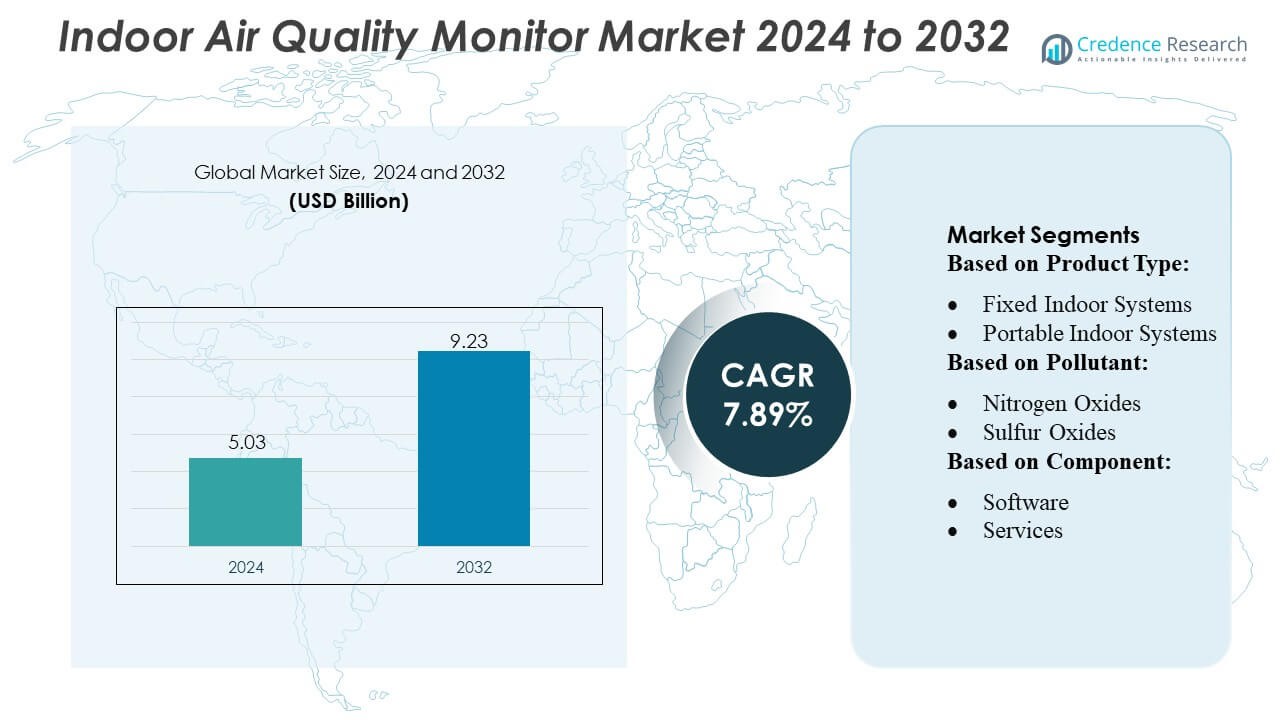
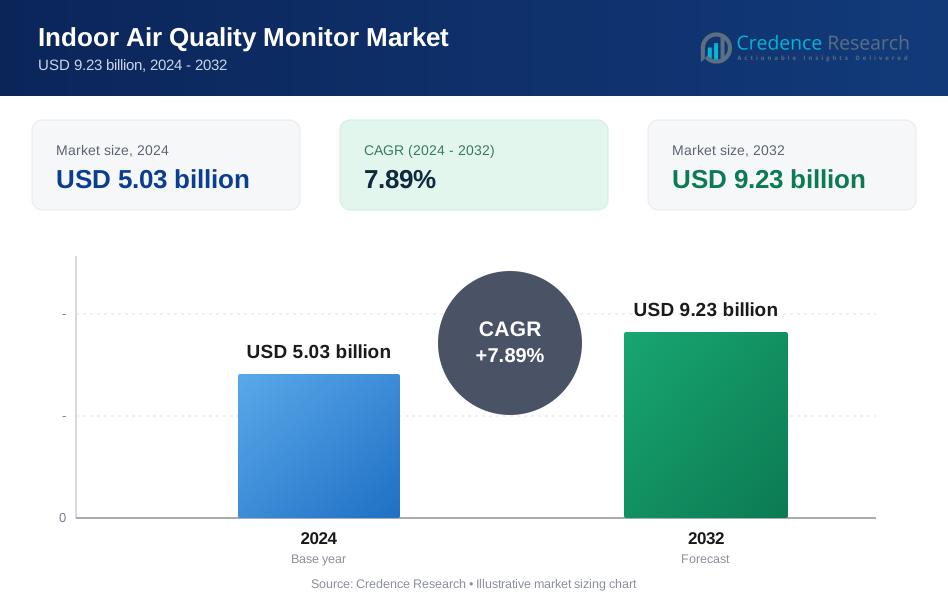
Indoor Air Quality Monitor Market size was valued USD 5.03 billion in 2024 and is anticipated to reach USD 9.23 billion by 2032, at a CAGR of 7.89% during the forecast period.
| REPORT ATTRIBUTE | DETAILS |
|---|---|
| Historical Period | 2020-2023 |
| Base Year | 2024 |
| Forecast Period | 2025-2032 |
| Indoor Air Quality Monitor Market Size 2024 | USD 5.03 Billion |
| Indoor Air Quality Monitor Market, CAGR | 7.89% |
| Indoor Air Quality Monitor Market Size 2032 | USD 9.23 Billion |
The Indoor Air Quality Monitor Market is shaped by a diverse group of global manufacturers that focus on advanced sensing technologies, multi-pollutant detection, and integration with smart building platforms. Leading companies strengthen competitiveness through continuous innovation in optical, electrochemical, and laser-based sensors, along with expanded offerings in connected and cloud-enabled monitoring systems. Strategic collaborations with HVAC providers and building automation firms further enhance product adoption across residential, commercial, and industrial settings. Asia-Pacific remains the leading regional market with approximately 30–32% share, supported by rapid urbanization, rising pollution levels, and strong investments in smart infrastructure and environmental compliance.
Market Insights
- The Indoor Air Quality Monitor Market reached USD 5.03 billion in 2024 and is projected to attain USD 9.23 billion by 2032 at a 89% CAGR, reflecting growing demand for accurate and connected indoor monitoring solutions.
- Rising health concerns, stricter IAQ regulations, and increasing adoption of smart building technologies drive strong demand across residential, commercial, and industrial segments, with indoor monitoring systems holding the dominant share.
- Advanced trends such as IoT integration, AI-based analytics, multi-pollutant detection, and compact consumer-grade sensors continue to transform product capabilities and broaden market penetration.
- The competitive landscape is defined by continuous innovation in sensing technologies, cloud-enabled platforms, and strategic partnerships with HVAC and automation providers, though high device cost and calibration challenges restrain adoption in price-sensitive regions.
- Asia-Pacific leads with 30–32% share, supported by rapid urbanization and pollution concerns, while North America and Europe follow with significant adoption driven by regulatory compliance and advanced building automation ecosystems.
Market Segmentation Analysis:
By Product Type
Indoor air quality monitoring systems represent the dominant product category with approximately 48–50% market share, driven by rising demand for continuous pollutant tracking in residential, commercial, and institutional facilities. Within this category, fixed indoor systems outperform portable models due to their higher measurement accuracy, integration with HVAC networks, and suitability for long-term compliance monitoring. Portable indoor systems continue to grow steadily as consumers adopt compact devices for personal health assessment. Outdoor air quality monitors, both fixed and portable, gain traction in urban centers, but remain secondary to indoor-focused deployments.
- For instance, Thermo Fisher’s Series 1400i indoor air quality monitors can detect particulate matter down to 0.3 µm, measuring flows of up to 1 m³/min, and integrate with building management systems for real-time HVAC control.
By Pollutant
The chemical pollutant segment accounts for the largest share at nearly 55–58%, supported by the need to monitor nitrogen oxides, sulfur oxides, carbon oxides, VOCs, and other hazardous gases linked to respiratory disorders and workplace safety risks. Among these, volatile organic compounds (VOCs) emerge as the most widely monitored due to their prevalence in household products, paints, furnishings, and industrial emissions. Physical pollutant monitoring-covering particulates, humidity, and temperature-records growing adoption as regulatory agencies emphasize PM2.5 and PM10 thresholds, but chemical monitoring continues to dominate due to broader industrial and indoor exposure concerns.
- For instance, Aeroqual’s Series 500 portable gas monitors detect VOCs with sensitivity down to 1 ppb and measure gases at flow rates up to 0.5 L/min, enabling real-time exposure monitoring in industrial and indoor environments.
By Component
Hardware leads the component segment with approximately 62–65% market share, supported by continuous advancements in sensor modules, processors, and output interfaces that enhance detection accuracy and real-time reporting. Sensors form the largest hardware sub-component, driven by demand for multi-parameter gas, particulate, and VOC sensing technologies integrated into residential and commercial systems. Processors and output devices expand steadily as manufacturers incorporate edge analytics, wireless connectivity, and user-friendly digital dashboards. Software and analytics layers grow in importance, yet hardware remains dominant due to its essential role in pollutant detection and environmental data acquisition.
Key Growth Drivers
1. Rising Health Awareness and Indoor Pollution Concerns
Growing awareness of indoor pollutants such as VOCs, carbon oxides, and particulate matter significantly accelerates adoption of indoor air quality monitors. Rising cases of asthma, allergies, and chronic respiratory diseases make households, commercial buildings, and healthcare facilities prioritize air quality assessment. Increased time spent indoors-exceeding 85–90% for most populations-amplifies the need for continuous monitoring. Public health campaigns, improved access to information, and consumer inclination toward preventive wellness further strengthen market growth across both residential and workplace environments.
- For instance, Siemens’ Desigo Air Quality Sensor integrates VOC, CO₂, temperature, and humidity measurement in a single device, with sampling rates of 1 measurement per second and a detection range of 0–2,000 ppm for CO₂, supporting real-time indoor air quality management in commercial buildings.
2. Regulatory Standards and Building Compliance Requirements
Stricter air quality regulations introduced by environmental and occupational safety agencies fuel strong uptake of advanced monitoring systems. Commercial buildings, industrial units, educational institutions, and hospitals must comply with guidelines covering PM2.5, PM10, CO₂ limits, VOC thresholds, and ventilation efficiency. Green building certifications such as LEED and WELL also mandate routine air quality tracking, pushing businesses toward fixed and networked monitoring systems. As governments increase enforcement of IAQ norms in both developed and emerging markets, demand for accurate, integrated monitoring technologies continues to expand.
- For instance, Teledyne’s API T640 particulate monitors measure PM1, PM2.5, and PM10 concentrations, enabling compliance monitoring in commercial and industrial environments. The monitors offer a wide detection range, typically from 0.1 to 10,000 µg/m³, and usually provide measurements as a 1-minute (or longer) average to ensure stable, high-quality data suitable for regulatory reporting.
3. Technological Advancements in Sensors and Connected Devices
Rapid innovations in sensor miniaturization, multi-pollutant detection, and IoT connectivity play a major role in market expansion. Modern systems incorporate high-precision electrochemical, optical, and laser-based sensors that improve accuracy while reducing power consumption. Integration with smart home platforms, HVAC controls, and cloud analytics enhances real-time visibility and automated responses. Manufacturers increasingly embed AI-driven algorithms for predictive maintenance and pollution pattern analysis. These advancements lower costs, improve usability, and broaden adoption across residential, commercial, and industrial segments.
Key Trends & Opportunities
1. Expansion of Smart Home Ecosystems and Consumer IoT Adoption
The growing penetration of smart home solutions creates significant opportunities for compact and connected indoor air quality monitors. Integration with devices such as thermostats, purifiers, and ventilation systems enhances automated control of indoor environments. Voice-enabled assistants and mobile dashboards make monitoring more accessible and actionable for consumers. As IoT adoption rises, manufacturers increasingly offer subscription-based analytics, multi-room sensing, and remote diagnostics. This trend positions air quality monitors as essential components of comprehensive home wellness ecosystems.
- For instance, Testo’s Indoor Air Quality Monitor 435 can measure CO₂ concentrations from 0–5,000 ppm, VOC levels from 0–10 ppm, and temperature/humidity, with a data logging interval of every 1 second, providing precise environmental control for offices and classrooms.
2. Increased Demand from Commercial and Industrial Facilities
Enterprises increasingly deploy fixed monitoring networks to ensure compliance with workplace safety regulations and maintain productive indoor environments. Office buildings, data centers, factories, warehouses, hospitals, and educational institutions demand continuous IAQ measurement for employee well-being and operational efficiency. Markets such as pharmaceuticals, semiconductors, and food processing require high-precision pollutant tracking to protect product quality. Growing investments in building automation and facility management platforms further expand opportunities for integrated, large-scale monitoring systems.
- For instance, Merck’s AEROSOLsense fixed IAQ monitors can measure PM1, PM2.5, and PM10 concentrations from 0–1,000 µg/m³, along with VOCs from 0–10 ppm and CO₂ from 0–5,000 ppm, enabling high-precision air quality monitoring in factories and laboratories.
3. Rising Adoption of Sustainability and Green Building Initiatives
Global momentum toward sustainable construction drives the use of IAQ monitors as part of energy-efficient building design. Governments and developers increasingly adopt green building standards that mandate tracking of CO₂, humidity, and pollutant levels to optimize ventilation performance. Real-time indoor environmental quality (IEQ) dashboards enhance decision-making for energy conservation and occupant comfort. As corporate ESG initiatives strengthen, demand for IAQ-linked reporting and environmental transparency continues to grow, creating strong opportunities for advanced, connected systems.
Key Challenges
1. High Cost of Advanced Monitoring Systems
Cost remains a significant barrier, particularly in price-sensitive residential and small commercial markets. Multi-pollutant sensors, advanced processors, and wireless connectivity features raise overall device costs, limiting adoption in developing regions. Long-term maintenance, calibration requirements, and replacement components add to operational expenses. While low-cost consumer IAQ devices exist, they often compromise accuracy, creating a performance gap that restrains broader uptake. Manufacturers must balance affordability and precision to expand penetration across all user categories.
2. Sensor Accuracy Limitations and Data Reliability Issues
Ensuring consistent and accurate pollutant detection poses a major challenge for both low-end and mid-range monitors. Environmental factors such as humidity, temperature variation, chemical interference, and sensor drift affect measurement precision. Many consumer-grade devices lack standardized calibration protocols and struggle to meet regulatory-grade accuracy. Data variability reduces user trust and affects decision-making for building automation systems. Improving sensor durability, establishing certification standards, and integrating AI-based calibration will be essential to overcoming reliability concerns.
Regional Analysis
North America
North America leads the Indoor Air Quality Monitor Market with an estimated 32–34% share, supported by strong regulatory enforcement from agencies such as the EPA and OSHA, which mandate continuous monitoring of indoor pollutants. High consumer awareness, extensive HVAC integration, and early adoption of smart home technologies drive widespread deployment across residential, commercial, and industrial environments. Rapid uptake of connected IAQ systems, presence of advanced sensor manufacturers, and increasing concerns over wildfire smoke infiltration further strengthen market demand. Corporations and institutions increasingly adopt high-precision, real-time monitoring solutions to meet sustainability and building performance standards.
Europe
Europe holds approximately 28–30% market share, driven by stringent indoor air quality standards and widespread adoption of energy-efficient, green-certified buildings. EU directives promoting workplace safety, ventilation performance, and low-emission construction materials push demand for advanced IAQ monitoring systems across offices, schools, and healthcare facilities. Growing focus on reducing exposure to VOCs, particulate matter, and carbon oxides enhances uptake of fixed and integrated monitoring networks. Countries such as Germany, the U.K., France, and the Nordic region demonstrate strong adoption due to mature building automation ecosystems and rising emphasis on occupant health and environmental transparency.
Asia-Pacific
Asia-Pacific represents the fastest-growing region, accounting for 30–32% market share, driven by rapid urbanization, industrial expansion, and widespread concern over indoor and outdoor pollution levels. High population density, rising construction of commercial complexes, and increasing awareness of pollution-related health risks fuel demand across both residential and institutional segments. Government initiatives addressing PM2.5 and PM10 risks, combined with expanding smart city programs, encourage adoption of connected IAQ systems. China, India, Japan, and South Korea lead installations, supported by growing middle-class awareness and investments in ventilation optimization and building automation technologies.
Latin America
Latin America accounts for roughly 6–8% market share, with demand gradually rising as public health agencies emphasize the risks associated with poor indoor ventilation and urban pollution. Commercial buildings, educational institutions, and healthcare facilities increasingly adopt IAQ monitors to comply with emerging regional standards. Economic recovery, modernization of building infrastructure, and heightened awareness of respiratory illnesses support steady uptake in major markets such as Brazil, Mexico, Chile, and Colombia. Growth remains moderate due to cost constraints, yet improving availability of affordable portable devices strengthens penetration across residential users.
Middle East & Africa
The Middle East & Africa region holds an estimated 4–6% market share, influenced by rising urban development, expanding commercial infrastructure, and increasing concern over indoor pollutants linked to HVAC inefficiencies and sealed building designs. GCC nations, particularly the UAE and Saudi Arabia, lead adoption as part of investment in smart buildings, hospitals, and high-performance commercial facilities. Awareness of IAQ’s role in occupant comfort and productivity is growing, although adoption in Africa remains limited by price sensitivity and lack of regulatory frameworks. Gradual investment in air-quality compliance and sustainability initiatives supports long-term growth.
Market Segmentations:
By Product Type:
- Fixed Indoor Systems
- Portable Indoor Systems
By Pollutant:
- Nitrogen Oxides
- Sulfur Oxides
By Component:
- Software
- Services
By Geography
- North America
- U.S.
- Canada
- Mexico
- Europe
- Germany
- France
- U.K.
- Italy
- Spain
- Rest of Europe
- Asia Pacific
- China
- Japan
- India
- South Korea
- South-east Asia
- Rest of Asia Pacific
- Latin America
- Brazil
- Argentina
- Rest of Latin America
- Middle East & Africa
- GCC Countries
- South Africa
- Rest of the Middle East and Africa
Competitive Landscape
The competitive landscape of the Indoor Air Quality Monitor Market features leading global companies such as Thermo Fisher Scientific Inc., Aeroqual, Siemens, Teledyne Technologies Incorporated, HORIBA Scientific, Testo SE & Co. KGaA, Merck KGaA, General Electric, 3M, and Emerson Electric Co. the Indoor Air Quality Monitor Market is defined by continuous innovation, expanding product portfolios, and strong integration with connected building ecosystems. Companies focus on developing high-precision, multi-pollutant detection systems equipped with advanced electrochemical, optical, and laser-based sensors that deliver real-time, accurate measurements. The market is increasingly shaped by IoT-enabled platforms that link monitoring devices with HVAC systems, smart home networks, and cloud analytics for automated ventilation control and predictive insights. Vendors strengthen competitiveness through investments in miniaturized sensors, AI-driven diagnostics, and wireless technologies that enhance usability and performance. Strategic collaborations with building automation firms, regulatory compliance pressures, and rising demand across residential, commercial, and industrial sectors further intensify competition and drive technological differentiation.
Key Player Analysis
- Thermo Fisher Scientific Inc.
- Aeroqual
- Siemens
- Teledyne Technologies Incorporated
- HORIBA Scientific
- Testo SE & Co. KGaA
- Merck KGaA
- General Electric
- 3M
- Emerson Electric Co.
Recent Developments
- In April 2025, BD launched the HemoSphere Alta, an advanced hemodynamic monitoring platform featuring AI-driven predictive algorithms like the Cerebral Autoregulation Index (CAI) and Hypotension Prediction Index (HPI) along with a 15″ touchscreen and hands-free voice/gesture controls to help clinicians proactively manage blood pressure and blood flow in critical care settings.
- In June 2024, ASUS announced new displays and computers at Computex, including the ProArt line of 5K and 8K professional monitors, the wellness-focused ASUS VU displays, and the flexible ZenScreen monitors.
- In February 2024, Honeywell International Inc. was designated the Official Sustainable Building Technology Partner for the Atlanta Hawks and the State Farm Arena. Through this multi-year partnership, Honeywell International Inc. will introduce a range of advanced upgrades to the building operations systems at State Farm Arena.
- In February 2024, Lenovo announced the launch of software, purpose-built AI devices, infrastructure solutions, and introduced two proof-of-concept devices, which stand out as challenging to the traditional PC and smartphone form factors.
Report Coverage
The research report offers an in-depth analysis based on Product Type, Pollutant, Component and Geography. It details leading market players, providing an overview of their business, product offerings, investments, revenue streams, and key applications. Additionally, the report includes insights into the competitive environment, SWOT analysis, current market trends, as well as the primary drivers and constraints. Furthermore, it discusses various factors that have driven market expansion in recent years. The report also explores market dynamics, regulatory scenarios, and technological advancements that are shaping the industry. It assesses the impact of external factors and global economic changes on market growth. Lastly, it provides strategic recommendations for new entrants and established companies to navigate the complexities of the market.
Future Outlook
- The market will experience steady expansion as indoor air quality becomes a core component of healthy building standards.
- Adoption of smart, connected monitoring systems will accelerate with wider integration into HVAC and building automation networks.
- Sensor technologies will advance toward higher accuracy, lower power consumption, and multi-pollutant detection capabilities.
- AI- and cloud-based analytics will gain prominence for predictive alerts, trend analysis, and automated ventilation control.
- Residential demand will strengthen as consumers prioritize health, wellness, and real-time environmental insights.
- Commercial and industrial facilities will increasingly deploy networked monitoring platforms to support compliance and operational efficiency.
- Portable and wearable IAQ monitors will gain traction among health-conscious users and field professionals.
- Green building certifications will continue to drive mandatory adoption of indoor air quality monitoring solutions.
- Manufacturers will expand offerings with more compact, affordable, and user-friendly models to increase market penetration.
- Emerging markets will witness faster growth as awareness improves and governments implement clearer IAQ regulations.
Request a Free Sample
Fill in your details and we'll send you a free sample report.
- Sample data tables & charts
- Research methodology
Need a Custom Version of This Report?
Tailor the scope, geography, or segments to your exact requirements.
- Custom geography or segment scope
- Direct access to our analyst team
Frequently Asked Questions
What is the current market size for the Indoor Air Quality Monitor Market, and what is its projected size in 2032?
At what Compound Annual Growth Rate is the Indoor Air Quality Monitor Market projected to grow between 2025 and 2032?
Which Indoor Air Quality Monitor Market segment held the largest share in 2024?
What are the primary factors fueling the growth of the Indoor Air Quality Monitor Market?
Who are the leading companies in the Indoor Air Quality Monitor Market?
Which region commanded the largest share of the Indoor Air Quality Monitor Market in 2024?
Table of Content
Chapter 1 Market Segmentation
- 1.1 Segmentation Framework
- 1.1.1 Product and Service Classification
- 1.1.2 Application and End-Use Classification
- 1.1.3 Technology and Solution Classification
- 1.1.4 Customer and Distribution Channel Classification
- 1.1.5 Geographic Segmentation
- 1.1.6 Market Segment Definitions and Boundaries
Chapter 2 Introduction
- 2.1 Report Objectives and Scope
- 2.2 Product Definition and Industry Terminology
- 2.3 Market Inclusions and Exclusions
- 2.4 Research Process
- 2.4.1 Primary Research and Expert Interviews
- 2.4.2 Secondary Research and Source Review
- 2.4.3 Top-Down and Bottom-Up Estimation
- 2.4.4 Data Triangulation and Verification
- 2.5 Market Size Measurement Basis
- 2.5.1 2024: USD 5.03 billion → 2032: USD 9.23 billion
- 2.6 Historical and Forecast Reference Periods
- 2.6.1 Base Year: 2024
- 2.6.2 Forecast Period: 2024-2032
- 2.7 Research Assumptions and Limitations
Chapter 3 Executive Summary
- 3.1 Market Snapshot and Key Findings
- 3.2 Base-Year Market Size, 2024
- 3.3 Forecast Market Size, 2032
- 3.4 Revenue and Volume Growth Outlook
- 3.5 Key Demand and Supply Indicators
- 3.6 Leading Market Segments
- 3.7 Fastest-Growing Market Opportunities
- 3.8 Regional Performance Highlights
- 3.9 Technology and Industry Transformation
- 3.10 Competitive Landscape Summary
- 3.11 Analyst View and Strategic Implications
Chapter 4 Global Indoor Air Quality Monitor Market Trends and Developments
- 4.1 Historical Industry Development
- 4.2 Recent Market Trends and Developments
- 4.3 Demand and Customer Behavior Trends
- 4.4 Technology and Product Innovation
- 4.5 Artificial Intelligence, Automation and Digitalization
- 4.6 Local Manufacturing and Supply Chain Realignment
- 4.7 Industry Partnerships, Mergers and Acquisitions
- 4.8 Sustainability and Circular Economy Developments
- 4.9 Government and Private Sector Investment Trends
- 4.10 Emerging Business Models and Commercialization
- 4.11 Industry Developments and Announcements
Chapter 5 Global Indoor Air Quality Monitor Market Production, Supply and Demand Analysis
- 5.1 Demand Trend and Consumption Analysis
- 5.2 Demand Forecast, 2024-2032
- 5.3 Production and Output Trend
- 5.4 Production and Output Forecast, 2024-2032
- 5.5 Installed Capacity and Capacity Utilization
- 5.6 Company-Wise Production Plants and Statistics
- 5.6.1 Installed Production Capacity
- 5.6.2 Actual Production
- 5.6.3 Planned Capacity and Expansion Targets
- 5.7 Supply Chain Structure and Procurement Trends
- 5.8 Supply-Demand Gap and Bottlenecks
- 5.9 Import Dependence and Sourcing Structure
- 5.10 Contract Manufacturing and Outsourcing
- 5.11 Regional Supply and Demand Concentration
Chapter 6 Global Indoor Air Quality Monitor Market Pricing Analysis
- 6.1 Pricing Structure and Measurement
- 6.2 Historical Pricing Trends
- 6.3 Pricing Outlook, 2024-2032
- 6.4 Average Selling Price and Unit Economics
- 6.5 Pricing by Product and Market Segment
- 6.6 Geographic Pricing Differences
- 6.7 Key Input, Energy, Labor and Logistics Costs
- 6.8 Contract Pricing and Purchasing Models
- 6.9 Pricing Sensitivity and Competitive Positioning
- 6.10 Price, Margin and Profitability Implications
Chapter 7 Global Indoor Air Quality Monitor Market Dynamics
- 7.1 Market Growth Drivers
- 7.1.1 Demand-Side Drivers
- 7.1.2 Technology and Innovation Drivers
- 7.1.3 Infrastructure and Investment Drivers
- 7.1.4 Regulatory and Policy Drivers
- 7.2 Market Restraints
- 7.2.1 Cost and Affordability Constraints
- 7.2.2 Technology and Adoption Barriers
- 7.2.3 Supply Chain and Operational Constraints
- 7.3 Market Challenges
- 7.3.1 Competitive Pressure and Margin Erosion
- 7.3.2 Skills, Infrastructure and Implementation Gaps
- 7.4 Emerging Market Opportunities
- 7.5 Market Dynamics Impact and Time-Horizon Assessment
Chapter 8 Global Indoor Air Quality Monitor Value Chain Analysis
- 8.1 Industry Value Chain Overview
- 8.2 Upstream Suppliers and Critical Inputs
- 8.3 Technology and Component Providers
- 8.4 Manufacturing or Service Delivery
- 8.5 Distribution, Channel Partners and Integrators
- 8.6 Downstream Applications and End Users
- 8.7 Value Addition and Profit Pools
- 8.8 Vertical Integration and Outsourcing
- 8.9 Supplier Concentration and Risk
- 8.10 Supply Chain Localization and Resilience
Chapter 9 Global Indoor Air Quality Monitor Market Regulations and Policies
- 9.1 Relevant Laws, Standards and Compliance Frameworks
- 9.2 Product, Service, Safety and Quality Requirements
- 9.3 Government Policies, Incentives and Subsidies
- 9.4 Imports, Exports and Trade Barriers
- 9.5 Public Procurement and Local Content Requirements
- 9.6 Environmental and Sustainability Compliance
- 9.7 Upcoming Policy Changes and Market Implications
Chapter 10 Global Indoor Air Quality Monitor Market Hotspots and Opportunities
- 10.1 Market Opportunity Mapping and Growth Hotspots
- 10.2 High-Growth Applications and Customer Groups
- 10.3 Underserved Markets and White-Space Opportunities
- 10.4 Emerging Technology and Product Opportunities
- 10.5 New Capacity and Investment Hotspots
- 10.6 Market Entry and Expansion Opportunities
- 10.7 Distribution and Partnership Opportunities
- 10.8 Near-Term and Long-Term Commercial Potential
- 10.9 Opportunity Attractiveness and Execution Risks
Chapter 11 Global Indoor Air Quality Monitor Market Outlook, 2024-2032
- 11.1 Market Size and Analysis
- 11.1.1 Revenue (Market Measurement: 2024: USD 5.03 billion → 2032: USD 9.23 billion)
- 11.1.2 Market Volume and Quantity Sold
- 11.1.3 Historical Market Size
- 11.1.4 Base-Year Market Size, 2024
- 11.2 Market Forecast, 2024-2032
- 11.2.1 Revenue Forecast to 2032
- 11.2.2 Volume Forecast to 2032
- 11.2.3 CAGR and Year-on-Year Growth
- 11.2.4 Incremental Revenue Opportunity
- 11.3 Forecast Assumptions and Scenario Analysis
- 11.3.1 Base-Case Forecast
- 11.3.2 Optimistic and Conservative Scenarios
- 11.3.3 Technology, Pricing and Policy Sensitivities
- 11.4 Market Attractiveness and Growth Outlook
Chapter 12 Global Indoor Air Quality Monitor Market Segmentation and Outlook
- 12.1 Segmentation Summary and Market Shares, 2024
- 12.2 Largest and Fastest-Growing Segments
- 12.3 Segment Growth Comparison
- 12.4 Segment Attractiveness and Priority Matrix
Chapter 13 Global Indoor Air Quality Monitor Geographic Market Outlook, 2024-2032
- 13.1 Regional Market Size and Share, 2024
- 13.2 Regional Market Forecast, 2024-2032
- 13.3 Regional Pricing, Production and Demand Differences
- 13.4 North America
- 13.4.1 United States
- 13.4.2 Canada
- 13.4.3 Mexico
- 13.5 Europe
- 13.5.1 Germany
- 13.5.2 France
- 13.5.3 Italy
- 13.5.4 United Kingdom
- 13.5.5 Spain
- 13.5.6 Poland
- 13.5.7 Russia
- 13.5.8 Netherlands
- 13.5.9 Belgium
- 13.5.10 Sweden
- 13.5.11 Denmark
- 13.5.12 Norway
- 13.5.13 Rest of Europe
- 13.6 Asia Pacific
- 13.6.1 China
- 13.6.2 India
- 13.6.3 Japan
- 13.6.4 South Korea
- 13.6.5 Thailand
- 13.6.6 Indonesia
- 13.6.7 Vietnam
- 13.6.8 Malaysia
- 13.6.9 Australia
- 13.6.10 Rest of Asia Pacific
- 13.7 Latin America
- 13.7.1 Brazil
- 13.7.2 Argentina
- 13.7.3 Colombia
- 13.7.4 Chile
- 13.7.5 Rest of Latin America
- 13.8 Middle East
- 13.8.1 Saudi Arabia
- 13.8.2 United Arab Emirates
- 13.8.3 Turkey
- 13.8.4 Israel
- 13.8.5 Iran
- 13.8.6 Rest of the Middle East
- 13.9 Africa
- 13.9.1 South Africa
- 13.9.2 Egypt
- 13.9.3 Nigeria
- 13.9.4 Morocco
- 13.9.5 Rest of Africa
- 13.10 Regional Investment, Policy and Supply Chain Differences
- 13.11 Regional Competitive Landscape
- 13.12 Geographic Growth Hotspots
Chapter 14 Global Indoor Air Quality Monitor Technology, Innovation and Sustainability Outlook
- 14.1 Technology Landscape and Maturity
- 14.2 Product, Process and Service Innovation
- 14.3 AI, Automation and Digital Tools in the Industry
- 14.4 Technology Adoption and Performance Benchmarking
- 14.5 Innovation Pipeline and R&D Investment
- 14.6 Patent and Intellectual Property Trends
- 14.7 Energy Efficiency and Resource Management
- 14.8 Sustainability, Recycling and Circularity
- 14.9 Technology Roadmap, 2024-2032
- 14.10 Risks of Obsolescence and Technology Substitution
Chapter 15 Global Indoor Air Quality Monitor Market Key Strategic Imperatives
- 15.1 Growth and Market Entry Priorities
- 15.2 High-Return Products and Segments
- 15.3 Pricing, Profitability and Cost Optimization
- 15.4 Technology Investment and Product Differentiation
- 15.5 Supply Chain Localization and Resilience
- 15.6 Distribution and Customer Acquisition
- 15.7 Partnership, Acquisition and Capacity Strategy
- 15.8 Regional Expansion Priorities
- 15.9 Short-, Medium- and Long-Term Actions
Chapter 16 Competition Outlook
- 16.1 Industry Competition Characteristics
- 16.2 Market Structure and Concentration
- 16.3 Market Share and Competitive Positioning, 2024
- 16.4 Company-Wise Revenue and Product Benchmarking
- 16.5 Production and Service Capacity Benchmarking
- 16.6 Technology, Pricing and Differentiation
- 16.7 Regional Footprint and Distribution Strength
- 16.8 Mergers, Acquisitions and Strategic Alliances
- 16.9 New Entrants and Competitive Threats
- 16.10 Porter's Five Forces and Industry Attractiveness
- 16.11 Competitive Outlook, 2024-2032
Chapter 17 Company Profiles
- 17.1 Company Coverage and Selection Criteria
- 17.2 Leading Market Participants – Standard Profile Structure
- 17.2.1 Business Description
- 17.2.2 Company Ownership and Geographic Presence
- 17.2.3 Product and Service Portfolio
- 17.2.4 Manufacturing and Operating Footprint
- 17.2.5 Production Capacity and Expansion Plans
- 17.2.6 Financial Performance and Investment
- 17.2.7 Market Share and Competitive Position
- 17.2.8 Technology and Innovation Capabilities
- 17.2.9 Strategic Alliances or Partnerships
- 17.2.10 Recent Developments
- 17.2.11 Growth Strategy and Outlook
- 17.3 Other Relevant Market Participants
Note: Every listed company is profiled on the structure shown under the first company. The company list is preliminary and may change based on research findings, market developments, data availability and client requirements.
Chapter 18 Disclaimer
- 18.1 Research and Forecast Disclaimer
- 18.2 Data Source and Estimation Limitations
Note: The depth of individual sections depends on data availability for this market. Volume, capacity, trade and other unit-based metrics are included where applicable.
