| REPORT ATTRIBUTE | DETAILS |
|---|---|
| Historical Period | 2020-2023 |
| Base Year | 2024 |
| Forecast Period | 2025-2032 |
| Internet Data Center (IDC) Market Size 2024 | USD 61,521.80 million |
| Internet Data Center (IDC) Market, CAGR | 11.84% |
| Internet Data Center (IDC) Market Size 2032 | USD 1,50,594.58 million |
Market Overview
Global Internet Data Center (IDC) market size was valued at USD 61,521.80 million in 2024 and is anticipated to reach USD 1,50,594.58 million by 2032, at a CAGR of 11.84% during the forecast period (2024-2032).
The global Internet Data Center (IDC) market is driven by the surge in data traffic, the widespread adoption of cloud computing, and the increasing demand for scalable, efficient storage and computing solutions. As organizations continue their digital transformation, IDC facilities are essential for supporting massive data storage, cloud services, and real-time data processing. The market is further propelled by advancements in energy-efficient technologies, with data centers adopting innovations like liquid cooling systems and renewable energy sources to reduce operational costs and meet sustainability goals. Additionally, the rapid growth of e-commerce, IoT, and big data analytics has intensified the need for robust data infrastructure. Regions such as North America and Asia-Pacific are witnessing high demand due to their dominance in technology and digital services, making them key players in shaping IDC market trends. These drivers and trends indicate a promising market outlook through 2032.
The Global Internet Data Center (IDC) market exhibits strong geographical diversity, with notable growth across North America, Asia Pacific, Europe, and the Middle East & Africa. North America remains a technological frontrunner due to its robust infrastructure and widespread digital adoption, while Asia Pacific is rapidly expanding, driven by digitization, smart city initiatives, and cloud adoption in emerging economies. Europe benefits from a highly regulated environment that emphasizes data privacy and green data center practices, and the Middle East & Africa are witnessing increased investments in smart infrastructure and cloud services. Key players shaping the global IDC market include technology giants such as Microsoft, Amazon Web Services, Google Cloud, and IBM, along with data center specialists like CyrusOne. These companies are continuously expanding their global presence through strategic investments in hyperscale facilities, edge computing, and sustainable energy solutions to meet the rising demand for scalable, secure, and efficient data infrastructure.
Market Insights
- The global Internet Data Center (IDC) market was valued at USD 61,521.80 million in 2024 and is projected to reach USD 150,594.58 million by 2032, growing at a CAGR of 11.84% during the forecast period.
- The market is expanding due to the increasing adoption of cloud computing, AI, and big data analytics across industries.
- Rising demand for edge computing and real-time data processing is reshaping IDC infrastructure globally.
- Competitive players such as Microsoft, Amazon Web Services, Google Cloud, and IBM continue to invest in hyperscale and sustainable data center models.
- High capital expenditure and energy consumption pose significant challenges to new entrants and mid-tier players.
- North America leads the global market, while Asia Pacific and Europe are showing rapid growth due to digital transformation initiatives.
- Green data centers and hybrid cloud deployments are gaining traction as companies seek operational efficiency and regulatory compliance.
Report Scope
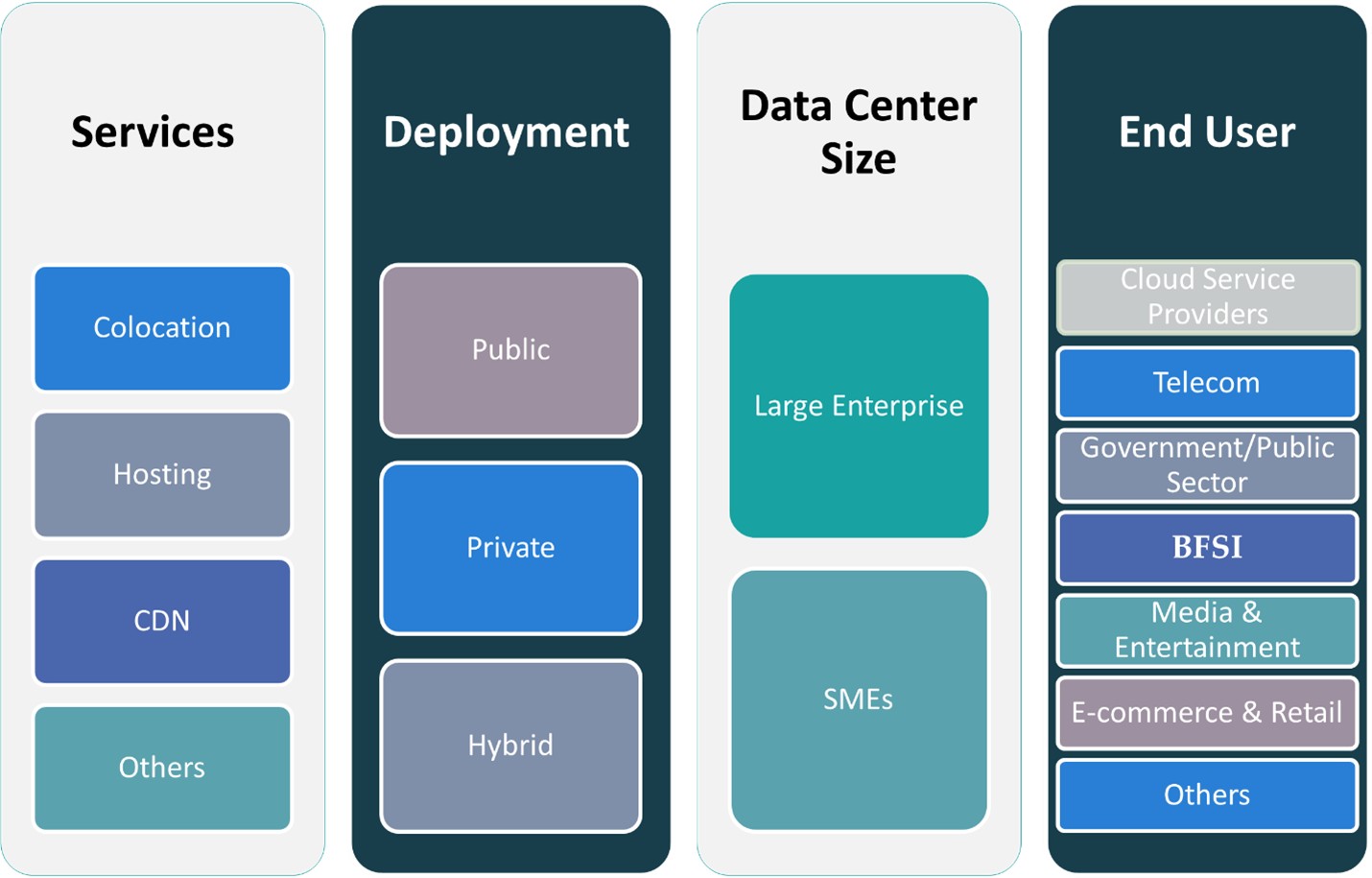
This report segments the Global Internet Data Center (IDC) Market as follows:
Market Drivers
Increasing Data Traffic and Digital Transformation
The rapid increase in global data generation and consumption is a primary driver of the Internet Data Center (IDC) market. As businesses and individuals increasingly rely on digital platforms for communication, commerce, and entertainment, the volume of data transmitted across networks has surged. For instance, India's data center capacity reached approximately 1,255 MW between January and September 2024, reflecting the country's rapid digital transformation. IDC facilities are crucial for handling this massive influx of data, supporting activities like data storage, processing, and retrieval. The digital transformation of enterprises, including their migration to cloud computing, further elevates the demand for data centers. These facilities offer the infrastructure necessary to manage and scale the growing volumes of data generated by new technologies like IoT, artificial intelligence, and machine learning.
Surge in Cloud Computing and IT Outsourcing
The widespread adoption of cloud computing is another significant factor contributing to the growth of the IDC market. As more companies shift to cloud-based services for flexibility, scalability, and cost-efficiency, there is a rising demand for data center infrastructure. For instance, India's data center industry is expected to add 795 MW of new capacity by the end of 2027, taking the total capacity to 1,825 MW. Cloud service providers require high-performance, reliable, and secure IDC facilities to store and manage data for clients across various industries. Additionally, organizations are increasingly outsourcing their IT infrastructure needs to third-party data centers, reducing their capital expenditures and focusing on core business operations. This trend supports the market's growth by driving the demand for both hyperscale and colocation data centers that can offer on-demand services and infrastructure scalability.
Rise in E-Commerce and Data-Driven Technologies
The global expansion of e-commerce and the increasing reliance on data-driven technologies significantly impact the IDC market. With businesses leveraging big data, analytics, and real-time data processing to enhance customer experiences, optimize operations, and make informed decisions, the need for robust data center infrastructure has become essential. E-commerce giants, in particular, require vast data centers to handle millions of transactions and customer interactions each day. This demand is further amplified by the rise of digital payment systems, customer data analytics, and the Internet of Things (IoT), which generate a continuous flow of data that must be stored, processed, and secured in high-performance data centers.
Technological Advancements in Energy Efficiency
Sustainability and energy efficiency are becoming critical factors in the IDC market. As the demand for data storage and processing increases, so does the energy consumption of data centers. To address environmental concerns and reduce operational costs, data center operators are adopting innovative technologies such as liquid cooling systems, advanced power management tools, and renewable energy sources like solar and wind power. These energy-efficient solutions are enabling data centers to operate more sustainably while reducing their carbon footprint. As companies face increasing pressure to meet corporate social responsibility (CSR) goals and comply with stricter environmental regulations, the integration of energy-efficient practices becomes a key competitive differentiator for IDC providers. This trend is not only contributing to cost savings but also aligning the IDC industry with broader sustainability objectives in the digital economy.
Market Trends
Expansion of Hyperscale Data Centers
One of the most prominent trends in the Global Internet Data Center (IDC) market is the rapid growth of hyperscale data centers. These large-scale facilities are designed to support massive cloud infrastructure, enabling cloud service providers like Amazon Web Services, Microsoft Azure, and Google Cloud to scale rapidly to meet increasing demand. For instance, India's total data center capacity is projected to expand further to around 1,600 MW by the end of 2024. Hyperscale data centers are characterized by their high efficiency, scalability, and ability to support large volumes of data processing and storage. As the demand for cloud-based services continues to rise, hyperscale data centers are becoming a cornerstone of the IDC market, driving significant investments and the development of state-of-the-art infrastructure to accommodate evolving business needs.
Adoption of Edge Computing
Another key trend is the rise of edge computing, which is reshaping how data is processed and stored. With edge computing, data is processed closer to its source, reducing latency and improving real-time data processing capabilities. This shift is being driven by the increasing use of IoT devices, autonomous vehicles, and real-time analytics applications that require low-latency data processing. For instance, the European Energy Efficiency Directive mandates data centers larger than 500 kW to report their energy use and emissions annually, effective May 2024. Edge data centers, which are smaller and strategically located closer to the end-user, complement traditional centralized IDC facilities. As the demand for low-latency services grows, more companies are investing in edge computing infrastructure, creating new opportunities for data center operators to expand their service offerings and capabilities.
Focus on Sustainability and Green Data Centers
Sustainability is becoming a major trend in the IDC market, as both consumers and regulatory bodies are demanding greener solutions. Data centers consume vast amounts of energy, and with the increasing demand for digital services, their environmental impact is under greater scrutiny. As a result, operators are focusing on the development of green data centers that utilize renewable energy sources such as wind and solar power, as well as energy-efficient technologies like liquid cooling systems and advanced power management solutions. Additionally, the use of artificial intelligence (AI) for optimizing energy consumption and reducing waste is gaining traction. Sustainability is now a competitive differentiator, as companies strive to meet environmental goals and appeal to eco-conscious consumers and stakeholders.
Rise of Colocation and Managed Services
The trend towards colocation and managed services is also gaining momentum within the IDC market. As businesses increasingly look for cost-effective solutions to meet their IT infrastructure needs, they are turning to colocation providers that offer shared data center spaces, allowing multiple clients to rent space while benefiting from high levels of security, redundancy, and scalability. Managed services, which provide customers with outsourced management of their IT systems, including server maintenance and network monitoring, are also on the rise. These services offer businesses the flexibility to focus on their core operations while leaving the complexities of infrastructure management to experienced providers. This trend reflects the growing preference for outsourced, scalable, and cost-efficient data center solutions, particularly among small and medium-sized enterprises.
Market Challenges Analysis
Rising Energy Consumption and Operational Costs
One of the most significant challenges facing the Global Internet Data Center (IDC) market is the increasing energy consumption and associated operational costs. Data centers are highly energy-intensive, as they require substantial power for running servers, cooling systems, and maintaining optimal performance. As the demand for data storage and processing continues to grow, the energy required to operate these facilities is rising, putting pressure on both cost structures and environmental sustainability efforts. Operators are tasked with finding ways to balance high energy demands with cost control while also adhering to strict environmental regulations. This has led to greater competition in securing access to affordable and sustainable energy sources, pushing many data centers to explore renewable energy solutions. However, despite advancements in energy-efficient technologies, the challenge of managing energy consumption remains a significant concern for data center operators.
Data Security and Compliance Issues
Data security and compliance are critical challenges in the IDC market, especially as cyber threats become more sophisticated. With increasing volumes of sensitive data being stored and processed in data centers, protecting this data from breaches, hacks, and unauthorized access has become a priority. For instance, India’s Digital Personal Data Protection Act is transforming the data protection landscape, impacting colocation data center operators. Additionally, regulatory compliance with industry standards such as GDPR, HIPAA, and other local data protection laws has added complexity to the operational landscape for IDC providers. Ensuring that data centers meet these compliance requirements often requires significant investment in security infrastructure, training, and operational procedures. As cyber threats evolve and regulations become stricter, IDC operators face the constant challenge of maintaining robust security measures and ensuring they comply with a growing number of data protection laws across multiple regions. This not only impacts operational costs but also requires ongoing investments in technology and expertise to safeguard against potential risks.
Market Opportunities
The Global Internet Data Center (IDC) market presents several growth opportunities driven by evolving technological advancements and expanding digital demands. One of the most significant opportunities lies in the expansion of edge computing. As businesses and consumers demand faster, more efficient data processing capabilities, edge data centers are emerging as a viable solution. By processing data closer to its source, edge computing reduces latency and enables real-time decision-making, making it essential for industries such as autonomous vehicles, IoT, and smart cities. IDC providers can capitalize on this shift by investing in localized, smaller-scale data centers that meet the specific needs of these high-demand applications. The increased reliance on IoT and AI technologies further amplifies the demand for edge data centers, offering a significant opportunity for providers to diversify their offerings and expand their market presence.
Another key opportunity in the IDC market is the rising demand for sustainability and green data centers. As businesses face growing pressure from regulators, investors, and consumers to adopt environmentally friendly practices, there is a strong opportunity for data center operators to differentiate themselves through energy-efficient solutions. The integration of renewable energy sources, liquid cooling technologies, and AI-driven energy optimization systems can help data centers reduce their environmental impact and operational costs. This shift towards greener operations not only appeals to environmentally conscious clients but also helps IDC providers meet increasingly stringent regulatory requirements. By prioritizing sustainability, operators can attract new customers, strengthen their brand image, and position themselves as leaders in a rapidly evolving market. These opportunities highlight a promising growth trajectory for IDC providers, particularly as the demand for cloud computing, data storage, and energy-efficient solutions continues to rise globally.
Market Segmentation Analysis:
By Services:
The Global Internet Data Center (IDC) market demonstrates strong growth across its service segments, including colocation, hosting, content delivery networks (CDN), and others. Among these, the colocation segment holds a significant share due to rising demand for cost-effective infrastructure management and flexibility in scaling IT operations. Enterprises are increasingly opting for colocation services to reduce capital expenditure while ensuring robust data security and connectivity. The hosting segment also continues to expand, driven by the proliferation of online platforms and the surge in cloud-based application deployment. Furthermore, the CDN segment is gaining momentum as media consumption, real-time streaming, and global content delivery requirements increase. CDNs ensure faster load times and enhanced user experience by distributing content from geographically dispersed servers. Other services, such as managed services and disaster recovery solutions, are also becoming integral to IDC operations, especially as businesses aim to improve efficiency and resilience. Collectively, these service-based segments contribute to the market’s growth by offering customized, scalable, and secure data center solutions for diverse business needs.
By Deployment:
Deployment models in the Internet Data Center (IDC) market-namely public, private, and hybrid-play a crucial role in shaping demand patterns and operational strategies. The public deployment model is widely adopted by businesses seeking scalable resources without the burden of infrastructure ownership. It offers cost efficiency and easy accessibility, making it attractive for startups, SMEs, and enterprises with variable workloads. In contrast, private IDCs provide enhanced data security, compliance, and control, thus appealing to organizations in highly regulated sectors such as healthcare, government, and banking. With increasing concerns over data privacy and the need for regulatory compliance, many enterprises are choosing private infrastructure for mission-critical operations. However, the hybrid segment is experiencing the fastest growth as it offers a balance between the flexibility of public cloud and the security of private infrastructure. Enterprises adopting hybrid models benefit from workload optimization and risk mitigation by distributing their data and applications across both environments, thereby enhancing operational agility and cost-effectiveness.
Segments:
Based on Services:
- Colocation
- Hosting
- CDN
- Others
Based on Deployment:
- Public
- Private
- Hybrid
Based on Data Center Size:
- Large Enterprise
- SMEs
Based on End- User:
- Cloud Service Providers
- Telecom
- Government/Public Sector
- BFSI
- Media & Entertainment
- E-commerce & Retail
- Others
Based on the Geography:
- North America
- U.S.
- Canada
- Mexico
- Europe
- UK
- France
- Germany
- Italy
- Spain
- Russia
- Belgium
- Netherlands
- Austria
- Sweden
- Poland
- Denmark
- Switzerland
- Rest of Europe
- Asia Pacific
- China
- Japan
- South Korea
- India
- Australia
- Thailand
- Indonesia
- Vietnam
- Malaysia
- Philippines
- Taiwan
- Rest of Asia Pacific
- Latin America
- Brazil
- Argentina
- Peru
- Chile
- Colombia
- Rest of Latin America
- Middle East
- UAE
- KSA
- Israel
- Turkey
- Iran
- Rest of Middle East
- Africa
- Egypt
- Nigeria
- Algeria
- Morocco
- Rest of Africa
Regional Analysis
North America
North America dominates the Global Internet Data Center (IDC) market, accounting for more than 38% of the total revenue in 2024. This leadership position is primarily attributed to the high concentration of hyperscale data centers, robust digital infrastructure, and early adoption of cloud computing technologies across industries. The United States, in particular, hosts several key players and tech giants such as Amazon Web Services, Google Cloud, and Microsoft Azure, which have significantly invested in building large-scale, energy-efficient data centers. Additionally, the region’s strong regulatory framework, focus on cybersecurity, and increasing enterprise demand for secure data storage further contribute to market growth. The widespread availability of high-speed internet and advanced 5G rollout also supports the growth of real-time applications and IoT, necessitating the development of additional data center capacity. As digital transformation continues to accelerate, North America is expected to maintain its dominance through strategic investments in edge computing and green data center infrastructure.
Asia Pacific
Asia Pacific stands as the second-largest region in the Global IDC market, with a market share of around 29% in 2024. This growth is fueled by rapid digitization across emerging economies such as China, India, Indonesia, and Southeast Asia. Governments in these countries are heavily investing in smart city initiatives, digital infrastructure, and cloud-first policies that are propelling the demand for localized and scalable data center services. China leads the regional market due to its massive user base and increasing data sovereignty regulations that require local data storage. Meanwhile, India is emerging as a high-potential market driven by rising internet penetration, a booming e-commerce sector, and a surge in cloud adoption among enterprises and startups. With a growing emphasis on digital services and the construction of new hyperscale and edge data centers, Asia Pacific is poised for robust expansion over the forecast period.
Europe
Europe captures approximately 21% of the Global IDC market, backed by advanced IT infrastructure and strong data privacy regulations such as the General Data Protection Regulation (GDPR). Countries like Germany, the United Kingdom, France, and the Netherlands are at the forefront of the regional data center ecosystem. European enterprises are increasingly adopting hybrid cloud solutions and colocation services to ensure compliance, reduce costs, and enhance flexibility. Additionally, the European Union’s emphasis on green and sustainable data center practices has led to a surge in demand for energy-efficient facilities. The region is also witnessing significant investment from American and Asian tech companies looking to establish local data hubs to serve the European market. With growing reliance on AI, IoT, and real-time analytics, Europe continues to strengthen its position as a mature and regulation-driven IDC market.
Middle East & Africa
The Middle East & Africa (MEA) region holds a smaller yet rapidly growing share of around 7% in the Global Internet Data Center market. Countries like the United Arab Emirates, Saudi Arabia, South Africa, and Nigeria are making strategic investments in digital transformation and smart infrastructure, fueling the demand for data center services. The UAE and Saudi Arabia are leading the region's IDC development with support from national digitalization agendas and large-scale cloud partnerships with global tech firms. Additionally, the rise of e-government services, fintech, and online education platforms is increasing the need for secure and scalable data infrastructure. Africa, while still developing, shows promise due to its young, tech-savvy population and growing internet usage. As connectivity improves and digital inclusion initiatives gain traction, the MEA region is expected to witness increased foreign investments and gradual expansion of both public and private data centers in the coming years.
Key Player Analysis
- Microsoft
- Amazon Web Services, Inc.
- CyrusOne
- Google Cloud
- IBM
Competitive Analysis
The competitive landscape of the Global Internet Data Center (IDC) market is defined by the strong presence of several leading players, including Microsoft, Amazon Web Services, Inc., CyrusOne, Google Cloud, and IBM. These companies dominate the market through continuous technological innovation, expansive global infrastructure, and strategic investments in hyperscale and edge data centers. Their ability to offer scalable, secure, and energy-efficient solutions positions them at the forefront of the industry. These firms compete on several fronts such as technological innovation, global reach, energy efficiency, and service reliability. Their focus on building hyperscale data centers, integrating advanced technologies like AI, machine learning, and IoT, and delivering seamless cloud connectivity has significantly raised the competitive bar in the industry. Intense competition has led to rapid infrastructure expansion, particularly in emerging markets, as companies strive to meet growing customer demands for low-latency, high-performance services. Additionally, players are increasingly adopting green and sustainable practices to align with environmental regulations and client expectations. Strategic collaborations, mergers, and acquisitions have also become key approaches to expanding service capabilities and entering untapped markets. This competitive intensity continues to push innovation while maintaining high standards of security, scalability, and operational efficiency.
Recent Developments
- In 2025, Microsoft plans to invest about $80 billion in AI-enabled data centers, significantly increasing its investment from previous years. Over half of this investment will be directed towards the United States, supporting AI model training and the development of cloud-based applications globally. This investment is part of Microsoft's broader strategy to advance AI technology and infrastructure.
- In September 2023, Google, Microsoft, Schneider Electric, and Danfoss jointly unveiled a collaborative initiative known as the Net Zero Innovation Hub for Data Center. This groundbreaking project is developed in partnership with the Danish Data Center Industry. The proposed location for this innovative center is Fredericia, Denmark.
Market Concentration & Characteristics
The Global Internet Data Center (IDC) market exhibits a moderate to high level of market concentration, characterized by the dominance of a few large and established players who control a significant portion of global revenues. These companies operate on a global scale with expansive infrastructure, including hyperscale and edge data centers, and offer diversified services such as colocation, hosting, and cloud integration. The market is marked by high entry barriers due to substantial capital requirements, technical expertise, and regulatory compliance standards, especially concerning data privacy and energy efficiency. Rapid technological advancements and the increasing demand for digital transformation have fueled competition, compelling providers to innovate continuously and invest in energy-efficient, scalable, and secure facilities. Additionally, the market reflects a shift toward hybrid cloud models and sustainable infrastructure solutions, aligning with environmental and enterprise demands. Overall, the IDC market is dynamic, innovation-driven, and concentrated among a few powerful entities with global operational capabilities.
Report Coverage
The research report offers an in-depth analysis based on Services, Deployment, Data Center Size, End-User and Geography. It details leading market players, providing an overview of their business, product offerings, investments, revenue streams, and key applications. Additionally, the report includes insights into the competitive environment, SWOT analysis, current market trends, as well as the primary drivers and constraints. Furthermore, it discusses various factors that have driven market expansion in recent years. The report also explores market dynamics, regulatory scenarios, and technological advancements that are shaping the industry. It assesses the impact of external factors and global economic changes on market growth. Lastly, it provides strategic recommendations for new entrants and established companies to navigate the complexities of the market.
Future Outlook
- The Internet Data Center market will continue to grow steadily, driven by increasing global data consumption.
- Cloud service adoption across enterprises will fuel demand for scalable and hybrid data center solutions.
- Edge computing infrastructure will expand to support low-latency applications and real-time data processing.
- Green data centers with sustainable energy practices will become a priority for service providers.
- Investments in AI, automation, and machine learning will enhance operational efficiency and security.
- The shift toward colocation and managed services will increase as businesses aim to reduce infrastructure costs.
- Data localization regulations will encourage the development of regional data center hubs.
- Emerging markets in Asia Pacific, Latin America, and the Middle East will experience rapid data center expansion.
- Cybersecurity measures and compliance frameworks will grow more stringent to protect sensitive data.
- Strategic mergers, acquisitions, and partnerships will reshape the competitive landscape of the industry.

Request a Free Sample
Fill in your details and we'll send you a free sample report.
- Sample data tables & charts
- Research methodology
Need a Custom Version of This Report?
Tailor the scope, geography, or segments to your exact requirements.
- Custom geography or segment scope
- Direct access to our analyst team
Frequently Asked Questions
What is the current size of the Global Internet Data Center (IDC)?
What factors are driving the growth of the Global Internet Data Center (IDC)?
What are some challenges faced by the Global Internet Data Center (IDC)?
Who are the major players in the Global Internet Data Center (IDC)?
Table of Content
Chapter 1. Report Introduction
- 1.1 Report Description & Purpose
- 1.1.1 Report Title & Market Definition
- 1.1.2 Unique Selling Propositions (USP) & Key Differentiators
- 1.1.3 Value Proposition for Stakeholders
- 1.2 Research Objectives
- 1.2.1 Market Sizing Objectives (Volume & Revenue) (Volume Where Applicable)
- 1.2.2 Segmentation Objectives
- 1.2.3 Competitive Intelligence Objectives
- 1.2.4 Forecast & Scenario Objectives
- 1.3 Report Scope
- 1.3.1 Internet Data Center (IDC) Scope – Segments & Subsegments Covered
- 1.3.2 Geographic Scope – Regions & Countries Covered
- 1.3.3 Historical Period, Base Year & Forecast Period (2024; forecast to 2032)
- 1.3.4 Inclusions & Exclusions
- 1.4 Industry Classification & Applicable Codes
- 1.5 Currency, Measurement Units & Valuation Basis
- 1.6 Target Stakeholders
- 1.7 Limitations & Assumptions
Chapter 2. Executive Summary
- 2.1 Global Internet Data Center (IDC) Market Snapshot
- 2.1.1 Market Size – Historical (2024) & Forecast (2024-2032) (2024: USD 61,521.80 million → 2032: USD 150,594.58 million)
- 2.1.2 Volume & Revenue – Global Totals (Volume Where Applicable)
- 2.1.3 Key Market Highlights – Top Five Facts
- 2.2 Internet Data Center (IDC) Market Segmentation Snapshot
- 2.2.1 Market Split by Region – 2024 vs. 2032
- 2.3 Competitive Snapshot
- 2.3.1 Top 10 Players by Revenue Share – 2024
- 2.3.2 Top 10 Players by Volume Share – 2024 (Volume Where Applicable)
- 2.3.3 Recent Strategic Developments (18-Month Summary)
- 2.4 Key Investment Highlights & Strategic Conclusions
Chapter 3. Internet Data Center (IDC) Market Dynamics & Industry Analysis
- 3.1 Market Overview & Context
- 3.1.1 Internet Data Center (IDC) Market Position in the Broader Industry Value Chain
- 3.1.2 Demand Structure & Purchasing Dynamics
- 3.1.3 Market Maturity & Development Stage by Region
- 3.2 Internet Data Center (IDC) Market Drivers
- 3.3 Internet Data Center (IDC) Market Restraints & Challenges
- 3.4 Internet Data Center (IDC) Market Opportunities
- 3.5 Porter's Five Forces Analysis
- 3.5.1 Threat of New Entrants
- 3.5.2 Bargaining Power of Suppliers
- 3.5.3 Bargaining Power of Buyers
- 3.5.4 Threat of Substitutes
- 3.5.5 Competitive Rivalry – Intensity Assessment
- 3.6 Internet Data Center (IDC) Value Chain Analysis
- 3.6.1 Upstream – Key Inputs, Resources & Suppliers
- 3.6.1.1 Key Input/Resource 1
- 3.6.1.2 Key Input/Resource 2
- 3.6.1.3 Key Input/Resource 3
- 3.6.2 Midstream – Core Operations & Value Creation
- 3.6.2.1 Operating Model & Process Overview
- 3.6.2.2 Key Operating Locations & Capabilities by Company
- 3.6.3 Downstream – Market Channels & End Users
- 3.6.3.1 Direct Sales & Customer Engagement Channels
- 3.6.3.2 Indirect Sales, Intermediaries & Partner Channels
- 3.6.4 Value Chain Profitability Analysis
- 3.6.1 Upstream – Key Inputs, Resources & Suppliers
- 3.7 PESTEL Analysis
- 3.7.1 Political Factors
- 3.7.2 Economic Factors
- 3.7.3 Social Factors
- 3.7.4 Technological Factors
- 3.7.5 Environmental Factors
- 3.7.6 Legal Factors
- 3.8 Internet Data Center (IDC) Supply Chain Analysis
- 3.8.1 Critical Input & Resource Availability Risk Assessment
- 3.8.2 Supplier & Operational Concentration Risk (Geographic Exposure)
- 3.8.3 Supply & Service Disruption Impact Analysis
- 3.9 Regulatory & Policy Landscape
Note: The regulatory and policy landscape section covers regulations based on their applicability to the market, Internet Data Center (IDC) category, geography, and scope of the study. Only regulatory frameworks with a material impact on operations, compliance, trade, sustainability, or market access are analyzed in detail.
Chapter 4. Key Investment Pockets & Opportunity Analysis
- 4.1 Internet Data Center (IDC) Market Attractiveness Analysis
- 4.1.1 By Region – Investment Attractiveness Matrix (Market Size × CAGR)
- 4.2 Absolute Revenue Growth Opportunity
- 4.2.1 By Region – Absolute Revenue Growth Through 2032
- 4.3 Incremental Demand Opportunity
- 4.3.1 By Region – Incremental Demand Through 2032
- 4.3.2 Segment – Incremental Demand
- 4.4 Emerging Submarket Opportunity Deep Dive (Subject to Applicability)
- 4.5 Priority Market Opportunity Scorecards
- 4.5.1 United States
- 4.5.2 Europe
- 4.5.3 Asia
- 4.5.4 Middle East & Africa
Note: Priority market opportunity scorecards reflect the geographic scope and strategic relevance of the study. Listed markets are indicative and may be adapted to the industry.
Chapter 5. Internet Data Center (IDC) Cross-Border Trade & Market Access Analysis
- 5.1 International Trade & Cross-Border Activity Overview
- 5.1.1 Global Export Value by Country (2024)
- 5.1.2 Global Export Volume by Country (2024) (Volume Where Applicable)
- 5.1.3 Global Import Value by Country (2024)
- 5.1.4 Global Import Volume by Country (2024) (Volume Where Applicable)
- 5.1.5 Net Trade Balance by Country (2024)
- 5.2 Export Analysis – Segment
- 5.2.1 Category 1 (Applicable Classification Code)
- 5.2.2 Category 2 (Applicable Classification Code)
- 5.2.3 Category 3 (Applicable Classification Code)
- 5.2.4 Category 4 (Applicable Classification Code)
- 5.2.5 Category 5 (Applicable Classification Code)
- 5.3 Import Analysis – Segment
- 5.3.1 Category 1 (Applicable Classification Code)
- 5.3.2 Category 2 (Applicable Classification Code)
- 5.3.3 Category 3 (Applicable Classification Code)
- 5.3.4 Category 4 (Applicable Classification Code)
- 5.3.5 Category 5 (Applicable Classification Code)
- 5.4 Cross-Border Pricing & Transaction Benchmarks
- 5.4.1 Export Pricing – Segment & Country
- 5.4.2 Import Pricing – Segment & Source Country
- 5.4.3 Price Trends (2024)
- 5.5 Key Cross-Border Trade & Delivery Routes
- 5.5.1 Cross-Border Trade/Delivery Route 1
- 5.5.2 Cross-Border Trade/Delivery Route 2
- 5.5.3 Cross-Border Trade/Delivery Route 3
- 5.5.4 Cross-Border Trade/Delivery Route 4
- 5.5.5 Cross-Border Trade/Delivery Route 5
- 5.6 Trade Policy & Market Access Impact Assessment
- 5.6.1 Tariff & Non-Tariff Barriers
- 5.6.2 Regional Trade & Economic Integration Frameworks
- 5.6.3 Bilateral & Multilateral Trade Agreements
- 5.6.4 Cross-Border Operating, Licensing & Localization Requirements
Note: This chapter applies where cross-border trade or delivery is relevant to Internet Data Center (IDC). Goods, services, and digital offerings are assessed using applicable classifications and transaction measures. Import-export volumes, trade balances, and route analyses are included only where meaningful to the market.
Chapter 6. Competitive Landscape & Company Benchmarking
- 6.1 Internet Data Center (IDC) Market Concentration & Structure
- 6.1.1 Herfindahl-Hirschman Index (HHI) – vs. 2024
- 6.1.2 Leading, Mid-Sized & Emerging Player Structure
- 6.1.3 Global, Regional & Local Player Dynamics
- 6.2 Internet Data Center (IDC) Market Share Analysis – 2024
- 6.2.1 Global Revenue Share by Company
- 6.2.2 Global Volume Share by Company (Volume Where Applicable)
- 6.2.3 Regional Revenue Share
- 6.2.4 Market Share Evolution ( vs. 2024)
- 6.2.5 Company Market Share by Key Segment
- 6.2.6 Company Market Share by Customer Group
- 6.3 Operating Scale, Capacity & Infrastructure Analysis
- 6.3.1 Global Operating Scale & Supply Capacity
- 6.3.2 Resource Utilization & Operating Efficiency
- 6.3.3 Output, Service Delivery & Activity Metrics
- 6.3.4 Operating Footprint & Infrastructure Map
- 6.3.5 Planned Operational & Capacity Expansion
- 6.4 Internet Data Center (IDC) Competitive Benchmarking Matrix
- 6.4.1 Revenue, Growth, Profitability & Operating Metric Comparison
- 6.4.2 Channel Revenue Mix
- 6.4.3 Geographic Revenue Exposure
- 6.4.4 R&D Intensity
- 6.4.5 Sustainability Maturity
- 6.5 Strategic Developments in Internet Data Center (IDC) (Last 24 Months)
- 6.5.1 Mergers, Acquisitions & Divestments
- 6.5.2 New Products, Services & Solutions in Internet Data Center (IDC)
- 6.5.3 Operational & Infrastructure Expansions
- 6.5.4 Strategic Alliances, Joint Ventures & Partnerships
- 6.5.5 Distribution Expansion & Market Entry
- 6.5.6 Sustainability & ESG Initiatives
- 6.6 Competitive Strategy Mapping
- 6.6.1 Leader, Challenger, Follower & Niche Classification
- 6.6.2 Pricing Strategy Comparison
- 6.6.3 Channel Strategy Matrix
Note: Strategic developments are included based on their materiality and the availability of reliable information.
Chapter 7. Global Internet Data Center (IDC) Market – By Sales & Delivery Channel
- 7.1 Segment Overview
- 7.1.1 Volume & Revenue Split by Channel (2024 & 2032) (Volume Where Applicable)
- 7.1.2 Channel Mix Evolution (2024-2032)
Chapter 8. Regional Market Analysis – Global Overview
- 8.1 Global Regional Overview
- 8.1.1 Regional Volume Share (Volume Where Applicable)
- 8.1.2 Regional Revenue Share
- 8.1.3 Regional Volume by Region (Volume Where Applicable)
- 8.1.4 Regional Revenue by Region
- 8.1.5 Regional Forecast Through 2032
- 8.2 Cross-Regional Segment Analysis
- 8.2.1 By Sales & Delivery Channel
- 8.2.2 By Competitive Positioning & Price Tier
Chapter 9. North America Internet Data Center (IDC) Market
- 9.1 United States
- 9.2 Canada
- 9.3 Mexico
Chapter 10. Europe Internet Data Center (IDC) Market
- 10.1 Germany
- 10.2 France
- 10.3 Italy
- 10.4 United Kingdom
- 10.5 Spain
- 10.6 Poland
- 10.7 Russia
- 10.8 Netherlands
- 10.9 Belgium
- 10.10 Sweden
- 10.11 Denmark
- 10.12 Norway
- 10.13 Rest of Europe
Chapter 11. Asia Pacific Internet Data Center (IDC) Market
- 11.1 China
- 11.2 India
- 11.3 Japan
- 11.4 South Korea
- 11.5 Thailand
- 11.6 Indonesia
- 11.7 Vietnam
- 11.8 Malaysia
- 11.9 Australia
- 11.10 Rest of Asia Pacific
Chapter 12. Latin America Internet Data Center (IDC) Market
- 12.1 Brazil
- 12.2 Argentina
- 12.3 Colombia
- 12.4 Chile
- 12.5 Rest of Latin America
Chapter 13. Middle East Internet Data Center (IDC) Market
- 13.1 Saudi Arabia
- 13.2 United Arab Emirates
- 13.3 Turkey
- 13.4 Israel
- 13.5 Iran
- 13.6 Rest of the Middle East
Chapter 14. Africa Internet Data Center (IDC) Market
- 14.1 South Africa
- 14.2 Egypt
- 14.3 Nigeria
- 14.4 Morocco
- 14.5 Rest of Africa
Chapter 15. Internet Data Center (IDC) Company Profiles
- 15.1 [Company 01]
- 15.1.1 Company Overview
- 15.1.2 Key Management Personnel
- 15.1.3 Products & Services Portfolio
- 15.1.4 Financial Performance
- 15.1.5 Key Market Focus & Geographic Presence
- 15.1.6 Recent Developments & Strategic Initiatives
Note: The company profile list is preliminary and may change based on research findings, market developments, data availability, and client requirements.
Chapter 16. Appendices
- Appendix A – List of Abbreviations & Acronyms
- Appendix B – Industry Classification Code Reference – Full Series
- Appendix C – Supply, Output & Operating Capacity Data Tables
- Appendix D – End-Use & Demand Base Tables
- Appendix E – Demand, Adoption & Usage Assumptions
- Appendix F – Pricing & Revenue Metric Reference Tables
- Appendix G – Company Operations & Infrastructure Database
- Appendix H – Cross-Border Trade & Activity Data Tables (Where Applicable)
- Appendix I – Regulatory Summary Tables
- Appendix J – Primary Research Participant List (Anonymized)
- Appendix K – Primary Research Questionnaire Framework
- Appendix L – Data Sources & Bibliography
- Appendix M – Market Size Divergence & Source Comparison
Chapter 17. Research Methodology
- 17.1 Research Framework & Philosophy
- 17.2 Secondary Research – Sources, Hierarchy & Data Extraction
- 17.3 Data Modeling – Bottom-Up & Top-Down Market Sizing
- 17.4 Primary Research – Stakeholder Framework, LOI & Sample Sizes
- 17.5 Forecast Methodology – Regression, Scenario & Sensitivity Analysis
- 17.6 Quality Control – Four-Layer Validation Framework
- 17.7 Limitations & Standard Assumptions
- 17.8 Disclaimer