
| REPORT ATTRIBUTE | DETAILS |
|---|---|
| Historical Period | 2019-2022 |
| Base Year | 2023 |
| Forecast Period | 2024-2032 |
| Italy Interior Design Market Size 2023 | USD 3,736.86 million |
| Italy Interior Design Market, CAGR | 3.11% |
| Italy Interior Design Market Size 2032 | USD 4,922.84 million |
Market Overview:
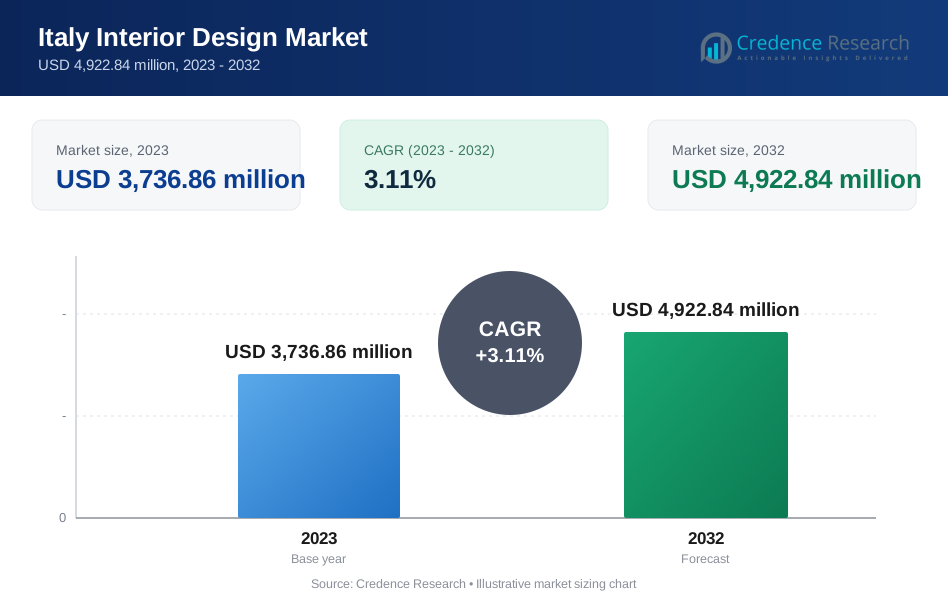
Italy Interior Design Market size was valued at USD 3,736.86 million in 2023 and is anticipated to reach USD 4,922.84 million by 2032, at a CAGR of 3.11% during the forecast period (2023-2032).
Several key factors are propelling the expansion of Italy’s interior design market. One of the most significant drivers is the Italian government's 'Furniture Bonus,' which provides a 50% tax deduction on purchases of new furniture and large household appliances for renovated properties. This initiative has encouraged consumers to invest in high-quality furnishings, boosting overall market demand. Additionally, the shift towards remote and hybrid work models, accelerated by the pandemic, has reshaped consumer preferences, emphasizing the need for aesthetically pleasing, functional, and ergonomic home environments. As a result, there has been a notable increase in spending on home renovation and interior design solutions. Furthermore, the industry’s growing commitment to sustainability is influencing purchasing decisions, with a rising preference for eco-friendly materials, energy-efficient appliances, and sustainable production processes. Consumers are increasingly seeking environmentally responsible designs that align with global sustainability goals, further driving market growth.
From a regional perspective, Northern Italy remains the country’s economic and industrial hub, with cities like Milan, Turin, and Bologna leading in manufacturing, innovation, and design excellence. Milan, in particular, is recognized as a global design capital, hosting prestigious events such as the Salone del Mobile, which significantly impacts international interior design trends. Central Italy, home to culturally rich cities like Florence and Rome, integrates classical artistry with contemporary design, creating a unique blend of heritage and modernity. This region is renowned for its high-end craftsmanship and luxury interiors, attracting both domestic and international consumers. Meanwhile, Southern Italy and the islands, despite facing economic disparities, offer vast potential for market expansion. The region’s emphasis on local craftsmanship, traditional materials, and artisanal techniques presents an opportunity for sustainable and culturally inspired interior design solutions
Market Insights:
- The Italian Interior Design Market is projected to grow from USD 3.7 billion in 2023 to USD 4.9 billion by 2032, at a CAGR of 3.11%, driven by strong consumer demand and government initiatives.
- The 'Furniture Bonus' tax incentive is a key driver, encouraging consumers to invest in new furniture and home renovations, stimulating demand for high-quality interior solutions.
- Shifting lifestyles, especially the rise of remote and hybrid work, has increased the need for ergonomic, functional, and aesthetically pleasing home spaces.
- Sustainability is a major trend, with consumers prioritizing eco-friendly materials, energy-efficient appliances, and sustainable production processes in their design choices.
- Technological innovations, including smart home integrations, augmented reality (AR), and virtual reality (VR), are enhancing consumer customization and transforming the design process.
- High costs of premium materials and luxury design solutions limit market accessibility, particularly for middle-income consumers, impacting broader market expansion.
- Regional growth is prominent in Northern Italy, with Milan and Turin leading in luxury and design innovation, while Southern Italy holds potential for expansion due to local craftsmanship and sustainability-focused designs.
Market Drivers:
Government Incentives and Policy Support
The Italian government has played a pivotal role in stimulating the interior design market through various financial incentives and policy measures. One of the most impactful initiatives is the 'Furniture Bonus,' which offers a 50% tax deduction on the purchase of new furniture and large household appliances for renovated properties. This incentive has significantly encouraged homeowners to invest in home improvement projects, directly boosting demand for high-quality furniture, fixtures, and interior decor solutions. Additionally, broader urban renewal programs and tax incentives for sustainable renovations further drive growth, fostering a dynamic and evolving market landscape. For instance, the Ecobonus offers tax deductions ranging from 50% to 85% for energy efficiency improvements in existing buildings, promoting sustainable renovations.
Shifting Consumer Preferences and Lifestyle Changes
The evolving lifestyle of Italian consumers has been a major catalyst in shaping the interior design industry. The increasing adoption of remote and hybrid work models has heightened the need for functional, ergonomic, and aesthetically pleasing home spaces. Consumers are now prioritizing comfort, efficiency, and personalization, leading to a surge in demand for modular furniture, smart home integrations, and multi-purpose interior solutions. For instance, IKEA has introduced the IKEA Place app, which uses AR technology to allow consumers to visualize furniture placement in real-time, enhancing the buying experience. Additionally, the rise of online retail and digital interior design services has made it easier for consumers to access diverse design options, accelerating market expansion. Younger generations, particularly millennials and Gen Z, are driving trends that emphasize individuality, minimalism, and contemporary aesthetics, further influencing market dynamics.
Sustainability and Demand for Eco-Friendly Solutions
Sustainability has become a defining trend in the Italian interior design market, shaping consumer preferences and industry practices. There is a growing inclination towards eco-friendly materials, energy-efficient appliances, and sustainable production methods. Consumers are increasingly seeking products that adhere to environmental standards, such as FSC-certified wood, recycled materials, and non-toxic finishes. The industry's response to this demand has led to the integration of circular economy principles, with many brands adopting sustainable sourcing, waste reduction strategies, and environmentally conscious manufacturing processes. Additionally, green building certifications and energy efficiency regulations continue to drive sustainable interior design choices, reinforcing Italy’s position as a leader in environmentally responsible design. For instance, The Salone del Mobile.Milano 2024 showcased products made from recycled and recyclable materials, such as Magis's In-side collection using bio-plastics and recycled polymers, and Arper's Catifa Carta, crafted from paper sheets bonded with natural resin.
Technological Integration and Innovation
Advancements in technology are transforming the Italian interior design market, enabling greater customization, efficiency, and convenience. Smart home technologies, including automated lighting, climate control, and voice-activated assistants, are becoming increasingly integrated into interior spaces, enhancing functionality and energy efficiency. Augmented reality (AR) and virtual reality (VR) tools are revolutionizing the design process, allowing consumers to visualize and experiment with different layouts, colors, and materials before making purchasing decisions. For instance, Kivisense has introduced Kivicube SLAM AR, a technology that allows for seamless placement of furniture in real-time environments, revolutionizing the design process. Additionally, digital platforms and e-commerce have expanded market accessibility, enabling both designers and consumers to explore innovative solutions with greater ease. As technology continues to evolve, the interior design industry in Italy is expected to further embrace digital transformation, shaping a more interactive and personalized market experience.
Market Trends:
Rising Popularity of Luxury and High-End Interiors
Italy has long been a global leader in luxury interior design, and the demand for high-end, bespoke interiors continues to grow. Consumers, particularly in the premium segment, are seeking exclusive, customized solutions that reflect sophistication and craftsmanship. For example, Cassina, a renowned Italian furniture brand, exemplifies this trend with its collaboration with global luxury brands, offering unique pieces. The Italian market has seen an increasing preference for artisanal furniture, handcrafted materials, and bespoke designs that emphasize both heritage and innovation. Luxury brands and design houses are expanding their offerings to cater to affluent clients who prioritize unique, high-quality interior solutions. Additionally, collaborations between renowned designers and global luxury brands are further elevating Italy’s position in the premium interior design sector.
Integration of Biophilic Design and Natural Elements
The concept of biophilic design, which integrates nature into interior spaces, is gaining widespread popularity across Italy. Consumers and businesses alike are embracing design elements that promote well-being, such as natural lighting, indoor greenery, organic materials, and open spaces. This trend is particularly evident in residential projects, corporate offices, and hospitality spaces where creating a serene and sustainable environment is a priority. For instance, Bosco Verticale in Milan, designed by Stefano Boeri Architetti, is a prime example, featuring over 20,000 plants on its residential towers, contributing to air quality improvement and temperature regulation. The use of stone, wood, and terracotta, combined with neutral and earthy color palettes, reflects Italy’s deep connection to nature and its rich architectural history. As wellness-focused interiors become more mainstream, designers are incorporating eco-conscious elements that enhance comfort and harmony with the surrounding environment.
Growing Influence of Minimalist and Contemporary Aesthetics
The shift towards minimalist and contemporary design has become increasingly prominent in the Italian interior design market. Modern consumers are favoring clean lines, uncluttered spaces, and functional layouts that emphasize simplicity and elegance. This trend is especially noticeable in urban areas where space optimization is crucial. The demand for sleek, modular, and multi-functional furniture has risen, aligning with the needs of younger homeowners and professionals who prioritize efficiency without compromising style. For instance, Calligaris presents the Ozzio Table, an extendable table that combines modern aesthetics with practicality, and the Canapé Sofa, which emphasizes comfort while maintaining a clean, uncluttered look. Additionally, contemporary Italian design is incorporating bold accents, statement lighting, and textured finishes, striking a balance between minimalism and artistic expression. The fusion of modern and classic elements continues to define Italy’s evolving interior design landscape.
Expansion of Smart Home and Digital Design Solutions
Technological advancements are playing a crucial role in reshaping Italy’s interior design industry. The adoption of smart home technologies, including voice-activated controls, automated lighting, and AI-driven climate management systems, has become increasingly common. Additionally, digital tools such as virtual reality (VR) and augmented reality (AR) are revolutionizing the design process, allowing homeowners and designers to visualize projects with precision before implementation. For instance, Apple Vision Pro offers a new way of looking at interior design through augmented reality, providing a three-dimensional spatial mapping experience. The rise of online interior design services and digital marketplaces has further democratized access to high-quality design solutions, making professional interior design services more accessible. As technology continues to evolve, the Italian market is witnessing a seamless integration of innovation and aesthetics, enhancing the overall design experience.
Market Challenges Analysis:
High Costs and Affordability Concerns
One of the primary challenges in the Italian interior design market is the high cost associated with premium materials, craftsmanship, and bespoke design solutions. While Italy is renowned for its luxury and high-end interiors, affordability remains a significant barrier for middle-income consumers. The increasing costs of raw materials, driven by global supply chain disruptions and inflation, have further escalated production expenses. As a result, many potential customers opt for cost-effective alternatives or delay home renovation projects, limiting market expansion beyond the affluent consumer base.
Regulatory Complexity and Bureaucratic Hurdles
The Italian interior design sector is subject to strict regulations, including building codes, environmental standards, and labor laws, which can complicate project execution. Compliance with sustainability and energy efficiency requirements, while beneficial in the long run, often involves additional costs and extended approval processes. Moreover, bureaucratic inefficiencies in obtaining construction permits and adhering to zoning regulations can delay interior design projects, impacting both residential and commercial developments. These regulatory hurdles pose challenges for designers, manufacturers, and investors looking to streamline operations.
Supply Chain Disruptions and Material Shortages
Global supply chain disruptions, exacerbated by geopolitical tensions and logistical challenges, have affected the availability of key raw materials used in interior design, such as wood, metals, and high-quality textiles. Delays in sourcing materials and increased transportation costs have resulted in extended project timelines and rising prices. Additionally, Italy’s reliance on imported materials for certain design elements makes the industry vulnerable to fluctuations in international trade, further straining the supply chain.
Economic Uncertainty and Market Volatility
The Italian interior design market is closely tied to the overall economic landscape, making it susceptible to downturns and fluctuations in consumer spending. Economic instability, rising interest rates, and inflation can lead to reduced disposable income, impacting investments in home improvement and interior design services. Businesses in the sector must navigate these uncertainties by adopting flexible pricing strategies and diversifying their offerings to cater to a wider audience.
Market Opportunities:
Italy's interior design market presents significant growth opportunities, driven by evolving consumer preferences, technological advancements, and increasing global demand for Italian craftsmanship. The rising popularity of sustainable and eco-friendly interiors offers a lucrative opportunity for businesses to innovate with environmentally conscious materials and energy-efficient solutions. With growing awareness of green building standards, companies that integrate sustainable design practices can capture a competitive edge. Additionally, the increasing demand for smart home solutions, such as automated lighting, climate control, and AI-driven home systems, presents a strong opportunity for interior designers and manufacturers to incorporate cutting-edge technology into residential and commercial spaces.
The expansion of Italy’s luxury real estate sector further enhances market potential, as high-net-worth individuals seek exclusive, tailor-made interior solutions that reflect sophistication and functionality. The global appreciation for Italian design excellence also provides opportunities for export growth, particularly in emerging markets where Italian furniture and décor are highly valued. Moreover, the digitalization of the interior design industry, including e-commerce platforms and virtual design consultations, allows businesses to reach a broader customer base beyond traditional brick-and-mortar operations. By leveraging these trends, Italian interior design firms can enhance market penetration, foster innovation, and maintain the country’s leadership in the global design industry.
Market Segmentation Analysis:
The Italy Interior Design Market is characterized by diverse segments, each catering to distinct customer needs and preferences.
By Project Type, the market is divided into residential, commercial, hospitality, healthcare, retail, educational, and public building projects. The residential sector holds a significant share, driven by increasing demand for aesthetic and functional home interiors. The commercial and hospitality sectors follow, as businesses and hotels seek to enhance their environments to create welcoming atmospheres. Healthcare and retail sectors also contribute, focusing on creating spaces that blend functionality with design. Educational and public buildings, though smaller in share, are expanding as institutions focus on modernizing spaces to enhance learning and service delivery.
By Service Type, the market offers a range of services, including interior design consulting, interior decoration, space planning, furniture and fixture selection, lighting design, and color consultation. Interior design consulting leads, driven by businesses and homeowners seeking professional guidance in creating tailored spaces. Other services, like lighting design and color consultation, are increasingly in demand as customers look for personalized and innovative solutions.
By Budget Range, the market spans several tiers: under $10,000, $10,000-$50,000, $50,000-$100,000, $100,000-$250,000, $250,000-$500,000, and over $500,000. A significant portion of the market falls within the $10,000-$50,000 range, which is appealing to both residential and commercial clients.
By Project Complexity, segments include simple refurbishments, major renovations, new builds, and high-end luxury projects. High-end luxury projects are growing, particularly among affluent clients seeking bespoke designs.
By Client Type, the market serves homeowners, businesses, architects, contractors, developers, and property managers, with each group contributing to various project scales and complexities.
Segmentation:
By Project Type
- Residential
- Commercial
- Hospitality
- Healthcare
- Retail
- Educational
- Public Buildings
By Service Type
- Interior Design Consulting
- Interior Decoration
- Space Planning
- Furniture & Fixture Selection
- Lighting Design
- Color Consultation
By Budget Range
- Under $10,000
- $10,000-$50,000
- $50,000-$100,000
- $100,000-$250,000
- $250,000-$500,000
- Over $500,000
By Project Complexity
- Simple Refurbishment
- Major Renovation
- New Build
- High-End Luxury
By Client Type
- Homeowners
- Businesses
- Architects
- Contractors
- Developers
- Property Managers
Regional Analysis:
The Italy Interior Design Market exhibits regional variation, with key regions contributing differently to the overall market landscape. Each region is characterized by unique economic factors, urban development patterns, and customer preferences that shape demand for interior design services.
Northern Italy, particularly Lombardy, Veneto, Emilia-Romagna, and Liguria, holds the largest share of the market, accounting for approximately 45% of the total revenue. This region is home to Italy's largest metropolitan areas, including Milan, a global fashion and design hub. Milan’s influence drives demand for high-end residential, commercial, and luxury interior design services. The region’s economic prosperity, with its robust industrial and financial sectors, supports continuous demand for commercial and office space design. Additionally, Northern Italy has a significant focus on residential interior design, with a growing trend of luxury apartments and modern villas. Milan’s position as a design epicenter further boosts demand for innovative interior solutions, including lighting design, furniture selection, and space planning.
Central Italy, including Tuscany, Lazio, and Umbria, contributes around 30% to the interior design market. Rome, the capital, is a key driver in this region, where interior design projects cater to both residential and commercial spaces. Tuscany, known for its rich cultural heritage and historical architecture, has a notable demand for interior design services in the restoration and renovation of historic buildings. Central Italy’s tourism sector also contributes to the market, with hospitality and retail interior design projects being particularly prominent in areas such as Florence and Rome. The region sees a mix of high-end luxury projects and more moderate-budget designs, with a growing interest in integrating contemporary design elements with classical architecture.
Southern Italy and Sicily, representing approximately 15% of the market share, show slower growth but are gradually increasing in demand due to urbanization and economic development. Naples and Palermo are key urban centers in this region, where both residential and commercial projects are on the rise. Southern Italy’s interior design market is influenced by a mix of traditional design preferences and the increasing trend of modernity in residential and commercial spaces. While luxury projects are not as dominant as in the North, there is an emerging middle-class market focused on affordable yet stylish design.
Key Player Analysis:
- Gensler
- Jacobs Engineering Group Inc.
- Perkins and Will
- Stantec Inc
- Areen Design Services Ltd
- IA Interior Architects
- Cannon Design
- Hirsch Bedner Associates
- NELSON & Associates Interior Design and Space Planning Inc.
- ReformaPlus
- Dome Milano Studio
- Cocinas Plus
Competitive Analysis:
The Italy Interior Design Market is characterized by a competitive landscape with a mix of established luxury brands, regional design firms, and emerging startups. Major players, such as Boffi, Minotti, and Poltrona Frau, dominate the high-end luxury segment, offering exclusive, custom-designed interiors and premium furnishings. These companies leverage Italy's reputation for craftsmanship and innovation to cater to affluent clients. In contrast, regional design firms focus on personalized and culturally integrated solutions, particularly for residential and commercial projects. Firms in regions like Milan, Rome, and Florence emphasize both modern and traditional Italian design aesthetics to cater to diverse customer preferences. For instance, Esperiri Milano offers an online interior design service that leverages virtual reality (VR) technology, allowing clients to preview their home designs in a realistic and immersive environment. The market also sees growing competition from digital platforms and online interior design services, which offer cost-effective and user-friendly solutions, appealing to younger, budget-conscious consumers. As a result, interior design firms must focus on differentiation through creativity, specialization, and adapting to evolving consumer demands to maintain a competitive edge.
Recent Developments:
- In July 2023, IA Interior Architects completed their first international hotel project in Italy. The luxury brand InterContinental Hotels & Resorts chose a historic neo-Renaissance palace on Via Veneto for its return to Italy after a seven-year absence. IA Interior Architects curated a complete renovation, preserving the glamorous character of the building that was once a manifesto of the Dolce Vita.
- n May 2024, Hirsch Bedner Associates (HBA) partnered with MERED to bring upscale hotel quality into the ICONIC Tower in Italy. This partnership aims to redefine luxury with stunning design and exclusive amenities, incorporating HBA's renowned expertise in creating luxurious, memorable spaces. The firm meticulously selects all materials to seamlessly bring the Italian design house Pininfarina's vision for the tower to life.
- In May 2023, Dimore Studio celebrated its 20th anniversary with a museum-like exhibition titled West Chelsea in New York. The exhibition featured 11 pieces of furniture sold exclusively on the online retailer Artemest, showcasing brushed steel and two-tone glossy lacquer. The main attraction was the Bonalumi cabinet with doors in laminated wood. This event was part of New York Design Week, highlighting the studio's innovative contemporary interiors.
Market Concentration & Characteristics:
The Italy Interior Design Market is moderately concentrated, with a few large firms holding significant market share, particularly in the luxury and high-end segments. Prominent brands like Boffi, Minotti, and Poltrona Frau dominate the premium market, providing bespoke, high-quality solutions for residential, commercial, and hospitality sectors. These firms leverage Italy’s strong reputation for design excellence and craftsmanship, catering to affluent clients globally. However, the market also has a large number of smaller, regional firms that contribute to its fragmented nature. These firms often specialize in residential and mid-range commercial projects, focusing on personalized service and local design aesthetics. The market is further diversified by the presence of online platforms offering more affordable and accessible interior design solutions. The characteristics of the market reflect a growing emphasis on sustainability, innovation, and integration of modern technology in design processes, with increasing demand for eco-friendly materials and smart home solutions.
Report Coverage:
The research report offers an in-depth analysis based on By Project Type, By Service Type, By Budget Range , By Project Complexity and By Client Type. It details leading market players, providing an overview of their business, product offerings, investments, revenue streams, and key applications. Additionally, the report includes insights into the competitive environment, SWOT analysis, current market trends, as well as the primary drivers and constraints. Furthermore, it discusses various factors that have driven market expansion in recent years. The report also explores market dynamics, regulatory scenarios, and technological advancements that are shaping the industry. It assesses the impact of external factors and global economic changes on market growth. Lastly, it provides strategic recommendations for new entrants and established companies to navigate the complexities of the market.
Future Outlook:
- The demand for luxury and high-end interior design services is expected to continue growing, driven by Italy’s reputation for craftsmanship and design excellence.
- Sustainable design solutions will become increasingly important, with eco-friendly materials and energy-efficient designs gaining traction among both residential and commercial clients.
- Digital tools and online platforms will reshape the market, making interior design more accessible to a wider audience, particularly younger, tech-savvy consumers.
- The shift towards remote working will influence the design of home offices and flexible commercial spaces, creating new opportunities in residential and office interior design.
- Smart home integration will drive demand for technologically advanced interiors, with a focus on automation, security, and energy management systems.
- Historic restoration projects will remain a key segment, particularly in cities like Rome and Florence, as cultural heritage preservation becomes a priority.
- The hospitality sector will see continued investment in unique, experience-driven interior designs to attract luxury travelers.
- Urbanization and economic growth in Southern Italy and Sicily will spur demand for modern residential and commercial interiors.
- Regional design firms will continue to thrive, offering customized solutions tailored to local tastes and needs.
- International brands will expand their presence in Italy, fostering greater competition and innovation within the market.
Request a Free Sample
Fill in your details and we'll send you a free sample report.
- Sample data tables & charts
- Research methodology
Need a Custom Version of This Report?
Tailor the scope, geography, or segments to your exact requirements.
- Custom geography or segment scope
- Direct access to our analyst team
Frequently Asked Questions
What is the current size of the Italy Interior Design Market?
What are the key drivers of growth in the market?
Which regions in Italy are contributing the most to the market?
What challenges does the Italy Interior Design Market face?
Table of Content
Chapter 1. Report Introduction
- 1.1 Report Description & Purpose
- 1.1.1 Report Title & Market Definition
- 1.1.2 Unique Selling Propositions (USP) & Key Differentiators
- 1.1.3 Value Proposition for Stakeholders
- 1.2 Research Objectives
- 1.2.1 Market Sizing Objectives (Volume & Revenue)
- 1.2.2 Segmentation Objectives
- 1.2.3 Competitive Intelligence Objectives
- 1.2.4 Forecast & Scenario Objectives
- 1.3 Report Scope
- 1.3.1 Italy Interior Design Scope – Types & Subtypes Covered
- 1.3.2 Geographic Scope – Regions & Countries Covered
- 1.3.3 Historical Period, Base Year & Forecast Period (2023; forecast to 2032)
- 1.3.4 Inclusions & Exclusions
- 1.4 HS Code & Classification Framework
- 1.5 Currency, Units & Pricing Basis
- 1.6 Target Stakeholders
- 1.7 Limitations & Assumptions
Chapter 2. Executive Summary
- 2.1 Global Italy Interior Design Market Snapshot
- 2.1.1 Market Size – Historical (2023) & Forecast (2023-2032) (2023: USD 3,736.86 million → 2032: USD 4,922.84 million)
- 2.1.2 Volume & Revenue – Global Totals
- 2.1.3 Key Market Highlights – Top Five Facts
- 2.2 Italy Interior Design Market Segmentation Snapshot
- 2.2.1 Market Split by Region – 2023 vs. 2032
- 2.3 Competitive Snapshot
- 2.3.1 Top 10 Players by Revenue Share – 2023
- 2.3.2 Top 10 Players by Volume Share – 2023
- 2.3.3 Recent Strategic Developments (18-Month Summary)
- 2.4 Key Investment Highlights & Strategic Conclusions
Chapter 3. Italy Interior Design Market Dynamics & Industry Analysis
- 3.1 Market Overview & Context
- 3.1.1 Italy Interior Design Market Position in the Broader Automotive Value Chain
- 3.1.2 OEM vs. Replacement Market Dynamics
- 3.1.3 Market Maturity & Development Stage by Region
- 3.2 Italy Interior Design Market Drivers
- 3.3 Italy Interior Design Market Restraints & Challenges
- 3.4 Italy Interior Design Market Opportunities
- 3.5 Porter's Five Forces Analysis
- 3.5.1 Threat of New Entrants
- 3.5.2 Bargaining Power of Suppliers
- 3.5.3 Bargaining Power of Buyers
- 3.5.4 Threat of Substitutes
- 3.5.5 Competitive Rivalry – Intensity Assessment
- 3.6 Italy Interior Design Value Chain Analysis
- 3.6.1 Upstream – Raw Material/Input Suppliers
- 3.6.1.1 Raw Material/Input 1
- 3.6.1.2 Raw Material/Input 2
- 3.6.1.3 Raw Material/Input 3
- 3.6.2 Midstream – Production/Manufacturing/Service Delivery
- 3.6.2.1 Production/Process Overview
- 3.6.2.2 Key Facility Locations & Capacity by Manufacturer
- 3.6.3 Downstream – Distribution & End Consumer
- 3.6.3.1 Primary Channel – B2B/OEM
- 3.6.3.2 Secondary Channels – Dealer, Retail, Online, Direct
- 3.6.4 Value Chain Profitability Analysis
- 3.6.1 Upstream – Raw Material/Input Suppliers
- 3.7 PESTEL Analysis
- 3.7.1 Political Factors
- 3.7.2 Economic Factors
- 3.7.3 Social Factors
- 3.7.4 Technological Factors
- 3.7.5 Environmental Factors
- 3.7.6 Legal Factors
- 3.8 Italy Interior Design Supply Chain Analysis
- 3.8.1 Raw Material/Input Supply Risk Assessment
- 3.8.2 Manufacturing Concentration Risk (Geographic Exposure)
- 3.8.3 Trade Disruption Impact Analysis
- 3.9 Regulatory & Policy Landscape
Note: The regulatory and policy landscape section covers regulations based on their applicability to the market, Italy Interior Design category, geography, and scope of the study. Only regulatory frameworks with a material impact on operations, compliance, trade, sustainability, or market access are analyzed in detail.
Chapter 4. Key Investment Pockets & Opportunity Analysis
- 4.1 Italy Interior Design Market Attractiveness Analysis
- 4.1.1 By Region – Investment Attractiveness Matrix (Volume × CAGR)
- 4.2 Absolute Revenue Growth Opportunity
- 4.2.1 By Region – Absolute USD Growth Through 2032
- 4.3 Incremental Volume Opportunity
- 4.3.1 By Region – Incremental Volume Through 2032
- 4.3.2 Segment – Incremental Volume
- 4.4 Emerging Submarket Opportunity Deep Dive (Subject to Applicability)
- 4.5 Emerging Market Opportunity Scorecards
- 4.5.1 United States
- 4.5.2 Europe
- 4.5.3 Asia
- 4.5.4 Middle East & Africa
Note: Emerging Market Opportunity Scorecards will be included based on relevance and strategic importance. Regions listed are indicative and may vary depending on data availability and market dynamics.
Chapter 5. Italy Interior Design Import-Export Analysis & Trade Flows
- 5.1 Global Trade Overview
- 5.1.1 Global Export Value by Country (2023)
- 5.1.2 Global Export Volume by Country (2023)
- 5.1.3 Global Import Value by Country (2023)
- 5.1.4 Global Import Volume by Country (2023)
- 5.1.5 Net Trade Balance by Country (2023)
- 5.2 Export Analysis – Segment
- 5.2.1 Type 1 (HS Code)
- 5.2.2 Type 2 (HS Code)
- 5.2.3 Type 3 (HS Code)
- 5.2.4 Type 4 (HS Code)
- 5.2.5 Type 5 (HS Code)
- 5.3 Import Analysis – Segment
- 5.3.1 Type 1 (HS Code)
- 5.3.2 Type 2 (HS Code)
- 5.3.3 Type 3 (HS Code)
- 5.3.4 Type 4 (HS Code)
- 5.3.5 Type 5 (HS Code)
- 5.4 Average Unit Trade Prices
- 5.4.1 Average Export Price – Segment & Country
- 5.4.2 Average Import Price – Segment & Source Country
- 5.4.3 Price Trends (2023)
- 5.5 Key Trade Route Analysis
- 5.5.1 Trade Route 1
- 5.5.2 Trade Route 2
- 5.5.3 Trade Route 3
- 5.5.4 Trade Route 4
- 5.5.5 Trade Route 5
- 5.6 Trade Policy Impact Assessment
- 5.6.1 US Anti-Dumping & Section 301 Tariffs
- 5.6.2 EU Customs Union Impact
- 5.6.3 Major Free Trade Agreements
- 5.6.4 USMCA Rules of Origin
Note: Trade policy analysis will be included only where relevant to the Italy Interior Design market.
Chapter 6. Competitive Landscape & Company Benchmarking
- 6.1 Italy Interior Design Market Concentration & Structure
- 6.1.1 Herfindahl-Hirschman Index (HHI) – vs. 2023
- 6.1.2 Tier 1, Tier 2 & Tier 3 Market Structure
- 6.1.3 Global, Regional & Local Player Dynamics
- 6.2 Italy Interior Design Market Share Analysis – 2023
- 6.2.1 Global Revenue Share by Company
- 6.2.2 Global Volume Share by Company
- 6.2.3 Regional Revenue Share
- 6.2.4 Market Share Evolution ( vs. 2023)
- 6.2.5 OEM Segment Share by Company
- 6.2.6 Replacement Segment Share by Company
- 6.3 Production/Delivery Capacity & Facility Analysis
- 6.3.1 Global Installed Capacity
- 6.3.2 Capacity Utilization Rates
- 6.3.3 Production/Output Volume
- 6.3.4 Facility Locations & Capacity Map
- 6.3.5 Planned Capacity Additions
- 6.4 Italy Interior Design Competitive Benchmarking Matrix
- 6.4.1 Revenue, Volume, CAGR & Profitability Comparison
- 6.4.2 Channel Revenue Mix
- 6.4.3 Geographic Revenue Exposure
- 6.4.4 R&D Intensity
- 6.4.5 Sustainability Maturity
- 6.5 Strategic Developments in Italy Interior Design (Last 24 Months)
- 6.5.1 Mergers, Acquisitions & Divestments
- 6.5.2 New Italy Interior Design Launches
- 6.5.3 Facility Expansions
- 6.5.4 Strategic Alliances, Joint Ventures & Partnerships
- 6.5.5 Distribution Expansion & Market Entry
- 6.5.6 Sustainability & ESG Initiatives
- 6.6 Competitive Strategy Mapping
- 6.6.1 Leader, Challenger, Follower & Niche Classification
- 6.6.2 Pricing Strategy Comparison
- 6.6.3 Channel Strategy Matrix
Note: Strategic developments are included based on their materiality and the availability of reliable information.
Chapter 7. Global Italy Interior Design Market – By Distribution Channel
- 7.1 Segment Overview
- 7.1.1 Volume & Revenue Split by Channel (2023 & 2032)
- 7.1.2 Channel Mix Evolution (2023-2032)
Chapter 8. Regional Market Analysis – Global Overview
- 8.1 Global Regional Overview
- 8.1.1 Regional Volume Share
- 8.1.2 Regional Revenue Share
- 8.1.3 Regional Volume by Region
- 8.1.4 Regional Revenue by Region
- 8.1.5 Regional Forecast Through 2032
- 8.2 Cross-Regional Segment Analysis
- 8.2.1 By Distribution Channel
- 8.2.2 By Brand/Price Tier
Chapter 9. North America Italy Interior Design Market
- 9.1 United States
- 9.2 Canada
- 9.3 Mexico
Chapter 10. Europe Italy Interior Design Market
- 10.1 Germany
- 10.2 France
- 10.3 Italy
- 10.4 United Kingdom
- 10.5 Spain
- 10.6 Poland
- 10.7 Russia
- 10.8 Netherlands
- 10.9 Belgium
- 10.10 Sweden
- 10.11 Denmark
- 10.12 Norway
- 10.13 Rest of Europe
Chapter 11. Asia Pacific Italy Interior Design Market
- 11.1 China
- 11.2 India
- 11.3 Japan
- 11.4 South Korea
- 11.5 Thailand
- 11.6 Indonesia
- 11.7 Vietnam
- 11.8 Malaysia
- 11.9 Australia
- 11.10 Rest of Asia Pacific
Chapter 12. Latin America Italy Interior Design Market
- 12.1 Brazil
- 12.2 Argentina
- 12.3 Colombia
- 12.4 Chile
- 12.5 Rest of Latin America
Chapter 13. Middle East Italy Interior Design Market
- 13.1 Saudi Arabia
- 13.2 United Arab Emirates
- 13.3 Turkey
- 13.4 Israel
- 13.5 Iran
- 13.6 Rest of the Middle East
Chapter 14. Africa Italy Interior Design Market
- 14.1 South Africa
- 14.2 Egypt
- 14.3 Nigeria
- 14.4 Morocco
- 14.5 Rest of Africa
Chapter 15. Italy Interior Design Company Profiles
- 15.1 [Company 01]
- 15.1.1 Company Overview
- 15.1.2 Key Management Personnel
- 15.1.3 Products & Services Portfolio
- 15.1.4 Financial Performance
- 15.1.5 Key Market Focus & Geographic Presence
- 15.1.6 Recent Developments & Strategic Initiatives
Note: The company profile list is preliminary and may change based on research findings, market developments, data availability, and client requirements.
Chapter 16. Appendices
- Appendix A – List of Abbreviations & Acronyms
- Appendix B – Industry Classification Code Reference – Full Series
- Appendix C – Production & Capacity Data Tables
- Appendix D – End-Use & Demand Base Tables
- Appendix E – Consumption & Replacement Rate Assumptions
- Appendix F – ASP Reference Tables
- Appendix G – Manufacturing & Facility Database
- Appendix H – Import-Export Data Tables
- Appendix I – Regulatory Summary Tables
- Appendix J – Primary Research Participant List (Anonymized)
- Appendix K – Primary Research Questionnaire Framework
- Appendix L – Data Sources & Bibliography
- Appendix M – Market Size Divergence & Source Comparison
Chapter 17. Research Methodology
- 17.1 Research Framework & Philosophy
- 17.2 Secondary Research – Sources, Hierarchy & Data Extraction
- 17.3 Data Modeling – Bottom-Up & Top-Down Market Sizing
- 17.4 Primary Research – Stakeholder Framework, LOI & Sample Sizes
- 17.5 Forecast Methodology – Regression, Scenario & Sensitivity Analysis
- 17.6 Quality Control – Four-Layer Validation Framework
- 17.7 Limitations & Standard Assumptions
- 17.8 Disclaimer
