
Market Overview
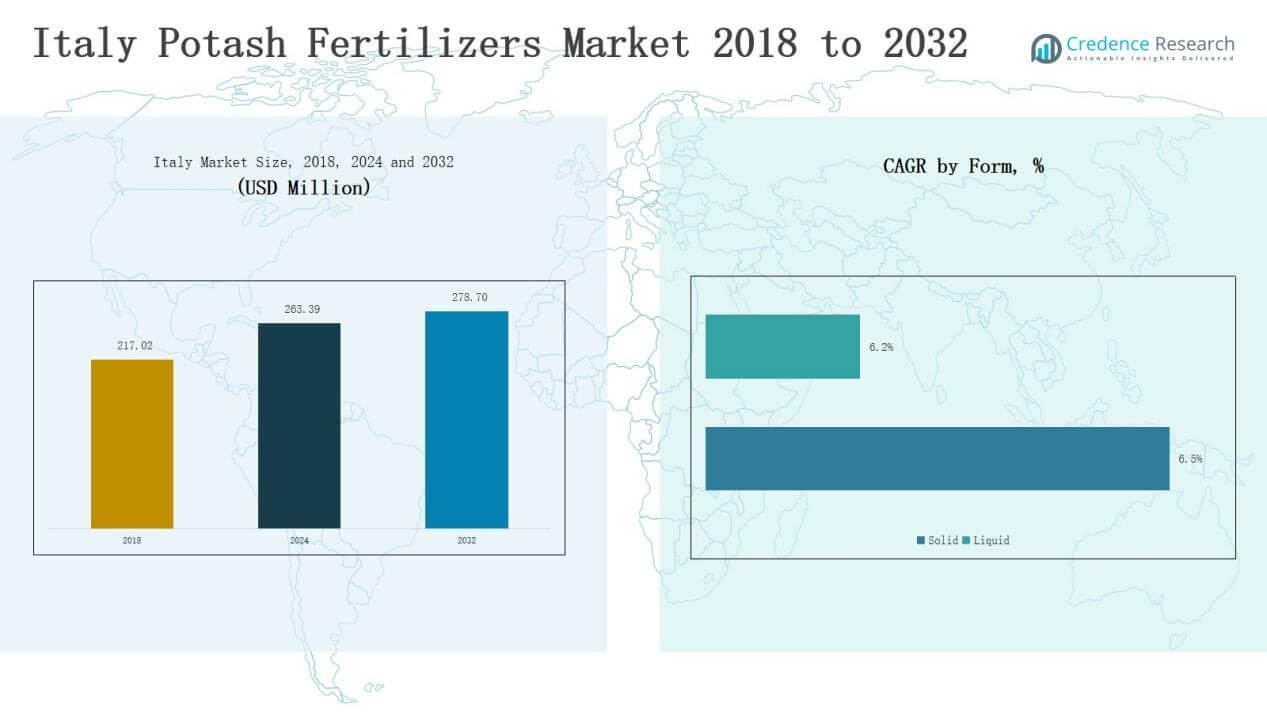
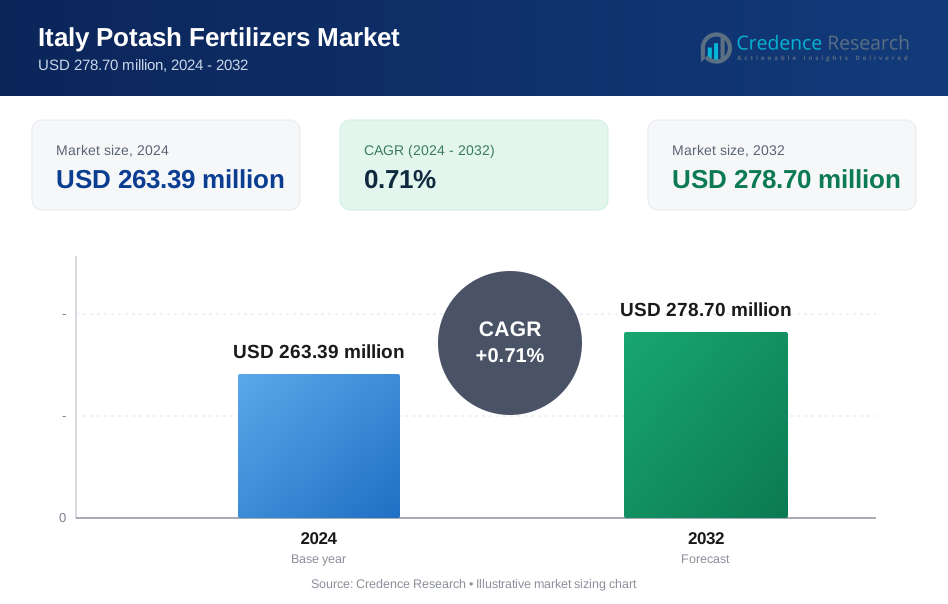
Italy Potash Fertilizers Market size was valued at USD 217.02 million in 2018 to USD 263.39 million in 2024 and is anticipated to reach USD 278.70 million by 2032, at a CAGR of 0.71% during the forecast period.
| REPORT ATTRIBUTE | DETAILS |
|---|---|
| Historical Period | 2020-2023 |
| Base Year | 2024 |
| Forecast Period | 2025-2032 |
| Italy Potash Fertilizers Market Size 2024 | USD 263.39 Million |
| Italy Potash Fertilizers Market, CAGR | 0.71% |
| Italy Potash Fertilizers Market Size 2032 | USD 278.70 Million |
The Italy Potash Fertilizers Market is shaped by a mix of global leaders and domestic suppliers that compete through product innovation, distribution reach, and sustainable practices. Prominent players include Pavoni&C SpA, Arpa S.p.A., HELM AG, The Mosaic Company, Yara International, ICL Group, and K+S Aktiengesellschaft. These companies focus on expanding chloride-free formulations such as sulphate of potash and potassium nitrate to meet the needs of high-value crops, including fruits, vegetables, and vineyards. Northern Italy emerged as the leading region with a 38% share in 2024, driven by extensive cereal and grain cultivation, advanced irrigation systems, and strong adoption of modern farming practices.
Market Insights
- The Italy Potash Fertilizers Market was valued at USD 263.39 million in 2024 and is projected to reach USD 278.70 million by 2032, growing at 0.71% CAGR.
- Potassium Chloride led the type segment with 52% share in 2024, supported by cost efficiency and strong use in cereal and grain cultivation, while sulphate of potash gained demand in fruit and vegetable farming.
- Broadcasting dominated the application method with 48% share in 2024 due to simplicity and lower cost, followed by fertigation driven by greenhouse and irrigation-based crop production.
- Solid formulations accounted for 67% share in 2024, reflecting widespread adoption in field crops, while liquid fertilizers gained momentum in fertigation and foliar applications in vineyards and greenhouses.
- Northern Italy held the leading regional share of 38% in 2024, supported by large-scale mechanized farming, strong vineyard production, and extensive adoption of modern irrigation and fertigation practices.
Market Segment Insights
By Type
Potassium Chloride dominated the Italy potash fertilizers market with a 52% share in 2024, supported by its cost efficiency and suitability for large-scale cereal and grain cultivation. Sulphate of Potash held a strong position due to demand from fruit and vegetable growers seeking chloride-free formulations. Potassium Nitrate gained traction in high-value horticultural crops for its dual supply of potassium and nitrogen, while the Others category, including mixed formulations, remained niche. Rising adoption of diversified crop systems and the focus on quality exports further drive differentiated demand across these fertilizer types, reinforcing their long-term role in Italy’s agriculture.
By Application Method
Broadcasting led the segment with a 48% share in 2024, driven by widespread adoption among cereal farmers for its simplicity and lower application cost. Fertigation followed, supported by expanding greenhouse production and irrigation systems in high-value crop regions. Foliar applications gained importance in vineyards and horticulture for targeted nutrient delivery, while Others, such as localized placement, contributed minimally. Increasing emphasis on precision nutrient management and efficiency is expected to boost demand for fertigation and foliar methods, particularly in specialized farming zones across Italy’s central and southern regions.
For instance, Netafim launched its AlphaDisc™ filter line to enhance fertigation efficiency in high-value crops, helping growers reduce clogging and improve irrigation system uniformity.
By Form
Solid fertilizers dominated the market with a 67% share in 2024, reflecting their easy storage, longer shelf life, and extensive use in field crops. Liquid formulations grew steadily, mainly in fertigation and foliar applications, where rapid nutrient uptake and uniform application are critical. Their adoption is increasing in modern farming systems, particularly in vineyards and greenhouse cultivation, although they remain secondary to solids. Expanding investments in greenhouse technology and advanced irrigation will accelerate liquid fertilizer demand, yet the established role of solids secures their dominance in bulk crop production across Italy’s key agricultural regions.
For instance, Yara International introduced its new YaraRega water-soluble NPK fertilizers in Italy, designed specifically for fertigation and drip irrigation systems to optimize nutrient efficiency in greenhouse crops.
 Key Growth Drivers
Rising Demand from High-Value Crops
The growing cultivation of fruits, vegetables, and vineyards in Italy is significantly driving demand for potash fertilizers. Farmers increasingly prefer chloride-free variants such as sulphate of potash and potassium nitrate to enhance crop quality and export competitiveness. The shift toward high-value crops ensures consistent uptake of specialized formulations that improve yield, taste, and shelf life. This trend aligns with Italy’s strong agricultural base focused on premium produce for both domestic and international markets.
For instance, ICL has introduced soluble Potassium Nitrate fertilizers that target horticulture crops in Europe and are chloride-free.
Government Support and Sustainable Practices
Government initiatives promoting sustainable agriculture and efficient fertilizer use have boosted the adoption of balanced nutrient application, including potash fertilizers. Subsidy programs, research-backed recommendations, and training for farmers encourage the use of eco-friendly solutions that reduce soil degradation and enhance crop resilience. Policies aimed at optimizing input efficiency and reducing environmental impact support wider adoption across different crop types. This driver strengthens the alignment between agricultural productivity and long-term sustainability goals in Italy.
Expansion of Precision Farming Technologies
The integration of precision farming tools and digital platforms is improving fertilizer application in Italy. Technologies such as GPS-enabled spreaders, soil testing, and fertigation systems enable accurate dosing of potash fertilizers, reducing wastage and maximizing crop response. Adoption of these practices is rising among commercial farms and cooperatives, particularly in Northern and Central Italy. This shift enhances fertilizer efficiency, lowers costs, and ensures consistent returns, thereby positioning precision agriculture as a strong driver of market growth.
For instance, Topcon's GPS fertilizer spreaders equipped with torque sensing and section control improved precision in fertilizer placement, particularly by automatically activating or deactivating spreader sections on awkward corners, enhancing fertilizer efficiency for Italian farms.
Key Trends & Opportunities
Shift Toward Specialty Potash Fertilizers
The Italian market is witnessing a notable shift toward specialty potash fertilizers, particularly sulphate of potash and potassium nitrate. These formulations cater to the needs of vineyards, fruits, and vegetable crops, where chloride sensitivity is high. Rising consumer demand for organic and premium-quality produce is fueling the adoption of these products. The trend provides opportunities for companies to expand their chloride-free portfolios and capture a growing segment focused on high-value crops.
For instance, potassium nitrate demand surged in controlled-environment and greenhouse farming applications, supporting simultaneous potassium and nitrogen uptake critical for premium produce.
Growth of Liquid Fertilizer Adoption
Liquid formulations are gaining traction, especially in fertigation and foliar applications within greenhouse and vineyard farming. Farmers prefer liquids for their quick absorption, uniform nutrient distribution, and compatibility with advanced irrigation systems. Although solids dominate the market, this trend presents opportunities for manufacturers to develop innovative liquid solutions tailored to Italian crops. Growing investments in modern irrigation and greenhouse cultivation strengthen the role of liquid potash fertilizers in shaping future growth.
For instacne, ICL Group introduced Solinure FertiMatch liquid fertilizers for greenhouse crops in Southern Europe, integrating advanced fertigation compatibility to improve nutrient efficiency.
Key Challenges
Price Volatility of Raw Materials The market faces challenges from fluctuating raw material prices, particularly potash ore and related imports. Italy relies heavily on external supply, exposing the sector to global price instability and geopolitical risks. Volatility in input costs can limit farmers’ purchasing capacity and reduce adoption rates of premium formulations. This dynamic impacts profitability for both producers and distributors, creating uncertainty across the supply chain.
Environmental Regulations and Compliance
Stringent European Union regulations on fertilizer use and environmental sustainability pose significant challenges to the market. Restrictions on nutrient runoff, emissions, and soil health preservation demand costly compliance from manufacturers and distributors. Farmers must also adapt their practices, which may increase operational expenses. While regulations support sustainability, they create barriers for small-scale producers and delay the widespread adoption of certain fertilizer formulations in Italy.
Competition from Alternative Nutrients
The rising adoption of organic fertilizers, bio-stimulants, and alternative nutrient sources poses competition to conventional potash fertilizers. Growing consumer preference for organic produce encourages farmers to reduce reliance on chemical-based inputs. Although potash remains essential for crop growth, alternatives often position themselves as cost-effective and environmentally friendly. This trend could slow growth in traditional potash fertilizer demand, particularly in regions with higher adoption of organic farming practices.
Regional Analysis
Northern Italy
Northern Italy dominated the Italy Potash Fertilizers Market with a 38% share in 2024, supported by extensive cultivation of cereals, grains, and high-value vineyards. Farmers in this region adopt both solid and liquid formulations, with fertigation gaining momentum due to advanced irrigation networks. The strong presence of commercial farms and cooperatives further enhances large-scale fertilizer use. Demand for chloride-free products such as sulphate of potash is rising, especially in fruit production zones. Northern Italy continues to lead in mechanized farming practices that drive consistent adoption.
Central Italy
Central Italy held a 27% share in 2024, driven by fruit, vegetable, and olive production. Farmers in this region increasingly prefer potassium nitrate and specialty fertilizers to support crop quality and export standards. Fertigation and foliar applications are expanding due to the prevalence of vineyards and horticulture. The region demonstrates a balanced mix of traditional broadcasting and modern application methods. Central Italy plays a vital role in strengthening the market’s focus on premium crops.
Southern Italy
Southern Italy accounted for a 22% share in 2024, reflecting steady demand from pulses, oilseeds, and horticultural crops. Adoption of potash fertilizers is expanding with the modernization of farming practices, though fragmented land holdings present challenges. Farmers rely heavily on cost-efficient potassium chloride, but uptake of specialty products is gradually increasing. Fertilizer usage is influenced by climatic conditions that demand better soil management. Southern Italy contributes significantly to the market through its large agricultural base.
Islands (Sicily and Sardinia)
The Islands region, including Sicily and Sardinia, captured a 13% share in 2024, driven by fruit, vegetable, and vineyard cultivation. Farmers favor foliar and fertigation methods to optimize nutrient efficiency in greenhouse and orchard systems. Specialty fertilizers such as sulphate of potash hold growing importance due to sensitivity of high-value crops. Limited land area compared to mainland regions influences overall volume, but high adoption in targeted crops ensures market relevance. The Islands highlight niche opportunities for premium formulations.
Market Segmentations:
By Type
- Potassium Chloride
- Sulphate of Potash
- Potassium Nitrate
- Others
By Application Method
- Broadcasting
- Foliar
- Fertigation
- Others
By Form
- Solid
- Liquid
By Crop Type
- Cereals and Grains
- Pulses and Oilseeds
- Fruits and Vegetables
- Others
By Region
- Northern Italy
- Central Italy
- Southern Italy
- Islands
Competitive Landscape
The Italy Potash Fertilizers Market is characterized by the presence of both international leaders and domestic suppliers competing through product innovation, distribution strength, and sustainable solutions. Global companies such as The Mosaic Company, Yara International, ICL Group, HELM AG, and K+S Aktiengesellschaft maintain a strong footprint through large-scale operations and diversified product portfolios. Domestic players like Pavoni&C SpA and Arpa S.p.A. strengthen competitiveness by addressing region-specific crop needs and providing localized services. Companies focus on expanding chloride-free formulations such as sulphate of potash and potassium nitrate to cater to fruit, vegetable, and vineyard growers. Strategic initiatives include partnerships with cooperatives, investments in precision farming solutions, and improved distribution networks to enhance farmer accessibility. Competitive intensity remains high, with differentiation driven by quality, cost efficiency, and alignment with Italy’s shift toward sustainable and high-value agriculture.
Key Players
- Pavoni&C SpA
- Arpa S.p.A.
- HELM AG
- The Mosaic Company
- Yara International
- ICL Group
- K+S Aktiengesellschaft
Recent Developments
- In December 2023, Yara International ASA acquired the organic-based fertilizer business of Agribios Italiana to strengthen its presence in Italy and expand its organic fertilizer portfolio.
- In January 2025, K+S AG introduced its C:LIGHT line of potassium and magnesium fertilizers with up to 90% lower CO₂ emissions, aimed at meeting Europe’s growing demand for sustainable crop nutrition.
- In July 2024, ICL (Israel Chemicals Ltd.) received EU organic certification for its potash fertilizers, enabling Italian organic farmers to legally integrate potassium chloride into certified agricultural practices.
Report Coverage
The research report offers an in-depth analysis based on Type, Application Method, Form, Crop Type and Region. It details leading market players, providing an overview of their business, product offerings, investments, revenue streams, and key applications. Additionally, the report includes insights into the competitive environment, SWOT analysis, current market trends, as well as the primary drivers and constraints. Furthermore, it discusses various factors that have driven market expansion in recent years. The report also explores market dynamics, regulatory scenarios, and technological advancements that are shaping the industry. It assesses the impact of external factors and global economic changes on market growth. Lastly, it provides strategic recommendations for new entrants and established companies to navigate the complexities of the market.
Future Outlook
- Demand for chloride-free fertilizers will increase with the expansion of fruit and vegetable cultivation.
- Precision farming adoption will strengthen fertilizer efficiency and reduce input costs for farmers.
- Liquid formulations will gain wider use in vineyards and greenhouse systems across the country.
- Government support for sustainable practices will encourage balanced nutrient application among growers.
- Partnerships between global suppliers and local cooperatives will expand product accessibility.
- Specialty fertilizers such as potassium nitrate will see stronger demand from high-value crops.
- Modern irrigation and fertigation systems will drive higher uptake of potash fertilizers.
- Organic and bio-based alternatives will emerge as competitive products alongside conventional potash.
- Regional demand will remain highest in Northern Italy due to mechanized and large-scale farming.
- Investments in supply chain resilience will reduce dependency on imports and improve availability.
Request a Free Sample
Fill in your details and we'll send you a free sample report.
- Sample data tables & charts
- Research methodology
Need a Custom Version of This Report?
Tailor the scope, geography, or segments to your exact requirements.
- Custom geography or segment scope
- Direct access to our analyst team
Frequently Asked Questions
What is the current market size for Italy Potash Fertilizers Market, and what is its projected size in 2032?
At what Compound Annual Growth Rate is the Italy Potash Fertilizers Market projected to grow between 2025 and 2032?
Which Italy Potash Fertilizers Market segment held the largest share in 2024?
What are the primary factors fueling the growth of the Italy Potash Fertilizers Market?
Who are the leading companies in the Italy Potash Fertilizers Market?
Which region commanded the largest share of the Italy Potash Fertilizers Market in 2024?
Table of Content
Chapter 1. Report Introduction
- 1.1 Report Description & Purpose
- 1.1.1 Report Title & Market Definition
- 1.1.2 Unique Selling Propositions (USP) & Key Differentiators
- 1.1.3 Value Proposition for Stakeholders
- 1.2 Research Objectives
- 1.2.1 Market Sizing Objectives (Volume & Revenue)
- 1.2.2 Segmentation Objectives
- 1.2.3 Competitive Intelligence Objectives
- 1.2.4 Forecast & Scenario Objectives
- 1.3 Report Scope
- 1.3.1 Italy Potash Fertilizers Scope – Types & Subtypes Covered
- 1.3.2 Geographic Scope – Regions & Countries Covered
- 1.3.3 Historical Period, Base Year & Forecast Period (2024; forecast to 2032)
- 1.3.4 Inclusions & Exclusions
- 1.4 HS Code & Classification Framework
- 1.5 Currency, Units & Pricing Basis
- 1.6 Target Stakeholders
- 1.7 Limitations & Assumptions
Chapter 2. Executive Summary
- 2.1 Global Italy Potash Fertilizers Market Snapshot
- 2.1.1 Market Size – Historical (2024) & Forecast (2024-2032) (2024: USD 263.39 million → 2032: USD 278.70 million)
- 2.1.2 Volume & Revenue – Global Totals
- 2.1.3 Key Market Highlights – Top Five Facts
- 2.2 Italy Potash Fertilizers Market Segmentation Snapshot
- 2.2.1 Market Split by Region – 2024 vs. 2032
- 2.3 Competitive Snapshot
- 2.3.1 Top 10 Players by Revenue Share – 2024
- 2.3.2 Top 10 Players by Volume Share – 2024
- 2.3.3 Recent Strategic Developments (18-Month Summary)
- 2.4 Key Investment Highlights & Strategic Conclusions
Chapter 3. Italy Potash Fertilizers Market Dynamics & Industry Analysis
- 3.1 Market Overview & Context
- 3.1.1 Italy Potash Fertilizers Market Position in the Broader Automotive Value Chain
- 3.1.2 OEM vs. Replacement Market Dynamics
- 3.1.3 Market Maturity & Development Stage by Region
- 3.2 Italy Potash Fertilizers Market Drivers
- 3.3 Italy Potash Fertilizers Market Restraints & Challenges
- 3.4 Italy Potash Fertilizers Market Opportunities
- 3.5 Porter's Five Forces Analysis
- 3.5.1 Threat of New Entrants
- 3.5.2 Bargaining Power of Suppliers
- 3.5.3 Bargaining Power of Buyers
- 3.5.4 Threat of Substitutes
- 3.5.5 Competitive Rivalry – Intensity Assessment
- 3.6 Italy Potash Fertilizers Value Chain Analysis
- 3.6.1 Upstream – Raw Material/Input Suppliers
- 3.6.1.1 Raw Material/Input 1
- 3.6.1.2 Raw Material/Input 2
- 3.6.1.3 Raw Material/Input 3
- 3.6.2 Midstream – Production/Manufacturing/Service Delivery
- 3.6.2.1 Production/Process Overview
- 3.6.2.2 Key Facility Locations & Capacity by Manufacturer
- 3.6.3 Downstream – Distribution & End Consumer
- 3.6.3.1 Primary Channel – B2B/OEM
- 3.6.3.2 Secondary Channels – Dealer, Retail, Online, Direct
- 3.6.4 Value Chain Profitability Analysis
- 3.6.1 Upstream – Raw Material/Input Suppliers
- 3.7 PESTEL Analysis
- 3.7.1 Political Factors
- 3.7.2 Economic Factors
- 3.7.3 Social Factors
- 3.7.4 Technological Factors
- 3.7.5 Environmental Factors
- 3.7.6 Legal Factors
- 3.8 Italy Potash Fertilizers Supply Chain Analysis
- 3.8.1 Raw Material/Input Supply Risk Assessment
- 3.8.2 Manufacturing Concentration Risk (Geographic Exposure)
- 3.8.3 Trade Disruption Impact Analysis
- 3.9 Regulatory & Policy Landscape
Note: The regulatory and policy landscape section covers regulations based on their applicability to the market, Italy Potash Fertilizers category, geography, and scope of the study. Only regulatory frameworks with a material impact on operations, compliance, trade, sustainability, or market access are analyzed in detail.
Chapter 4. Key Investment Pockets & Opportunity Analysis
- 4.1 Italy Potash Fertilizers Market Attractiveness Analysis
- 4.1.1 By Region – Investment Attractiveness Matrix (Volume × CAGR)
- 4.2 Absolute Revenue Growth Opportunity
- 4.2.1 By Region – Absolute USD Growth Through 2032
- 4.3 Incremental Volume Opportunity
- 4.3.1 By Region – Incremental Volume Through 2032
- 4.3.2 Segment – Incremental Volume
- 4.4 Emerging Submarket Opportunity Deep Dive (Subject to Applicability)
- 4.5 Emerging Market Opportunity Scorecards
- 4.5.1 United States
- 4.5.2 Europe
- 4.5.3 Asia
- 4.5.4 Middle East & Africa
Note: Emerging Market Opportunity Scorecards will be included based on relevance and strategic importance. Regions listed are indicative and may vary depending on data availability and market dynamics.
Chapter 5. Italy Potash Fertilizers Import-Export Analysis & Trade Flows
- 5.1 Global Trade Overview
- 5.1.1 Global Export Value by Country (2024)
- 5.1.2 Global Export Volume by Country (2024)
- 5.1.3 Global Import Value by Country (2024)
- 5.1.4 Global Import Volume by Country (2024)
- 5.1.5 Net Trade Balance by Country (2024)
- 5.2 Export Analysis – Segment
- 5.2.1 Type 1 (HS Code)
- 5.2.2 Type 2 (HS Code)
- 5.2.3 Type 3 (HS Code)
- 5.2.4 Type 4 (HS Code)
- 5.2.5 Type 5 (HS Code)
- 5.3 Import Analysis – Segment
- 5.3.1 Type 1 (HS Code)
- 5.3.2 Type 2 (HS Code)
- 5.3.3 Type 3 (HS Code)
- 5.3.4 Type 4 (HS Code)
- 5.3.5 Type 5 (HS Code)
- 5.4 Average Unit Trade Prices
- 5.4.1 Average Export Price – Segment & Country
- 5.4.2 Average Import Price – Segment & Source Country
- 5.4.3 Price Trends (2024)
- 5.5 Key Trade Route Analysis
- 5.5.1 Trade Route 1
- 5.5.2 Trade Route 2
- 5.5.3 Trade Route 3
- 5.5.4 Trade Route 4
- 5.5.5 Trade Route 5
- 5.6 Trade Policy Impact Assessment
- 5.6.1 US Anti-Dumping & Section 301 Tariffs
- 5.6.2 EU Customs Union Impact
- 5.6.3 Major Free Trade Agreements
- 5.6.4 USMCA Rules of Origin
Note: Trade policy analysis will be included only where relevant to the Italy Potash Fertilizers market.
Chapter 6. Competitive Landscape & Company Benchmarking
- 6.1 Italy Potash Fertilizers Market Concentration & Structure
- 6.1.1 Herfindahl-Hirschman Index (HHI) – vs. 2024
- 6.1.2 Tier 1, Tier 2 & Tier 3 Market Structure
- 6.1.3 Global, Regional & Local Player Dynamics
- 6.2 Italy Potash Fertilizers Market Share Analysis – 2024
- 6.2.1 Global Revenue Share by Company
- 6.2.2 Global Volume Share by Company
- 6.2.3 Regional Revenue Share
- 6.2.4 Market Share Evolution ( vs. 2024)
- 6.2.5 OEM Segment Share by Company
- 6.2.6 Replacement Segment Share by Company
- 6.3 Production/Delivery Capacity & Facility Analysis
- 6.3.1 Global Installed Capacity
- 6.3.2 Capacity Utilization Rates
- 6.3.3 Production/Output Volume
- 6.3.4 Facility Locations & Capacity Map
- 6.3.5 Planned Capacity Additions
- 6.4 Italy Potash Fertilizers Competitive Benchmarking Matrix
- 6.4.1 Revenue, Volume, CAGR & Profitability Comparison
- 6.4.2 Channel Revenue Mix
- 6.4.3 Geographic Revenue Exposure
- 6.4.4 R&D Intensity
- 6.4.5 Sustainability Maturity
- 6.5 Strategic Developments in Italy Potash Fertilizers (Last 24 Months)
- 6.5.1 Mergers, Acquisitions & Divestments
- 6.5.2 New Italy Potash Fertilizers Launches
- 6.5.3 Facility Expansions
- 6.5.4 Strategic Alliances, Joint Ventures & Partnerships
- 6.5.5 Distribution Expansion & Market Entry
- 6.5.6 Sustainability & ESG Initiatives
- 6.6 Competitive Strategy Mapping
- 6.6.1 Leader, Challenger, Follower & Niche Classification
- 6.6.2 Pricing Strategy Comparison
- 6.6.3 Channel Strategy Matrix
Note: Strategic developments are included based on their materiality and the availability of reliable information.
Chapter 7. Global Italy Potash Fertilizers Market – By Distribution Channel
- 7.1 Segment Overview
- 7.1.1 Volume & Revenue Split by Channel (2024 & 2032)
- 7.1.2 Channel Mix Evolution (2024-2032)
Chapter 8. Regional Market Analysis – Global Overview
- 8.1 Global Regional Overview
- 8.1.1 Regional Volume Share
- 8.1.2 Regional Revenue Share
- 8.1.3 Regional Volume by Region
- 8.1.4 Regional Revenue by Region
- 8.1.5 Regional Forecast Through 2032
- 8.2 Cross-Regional Segment Analysis
- 8.2.1 By Distribution Channel
- 8.2.2 By Brand/Price Tier
Chapter 9. North America Italy Potash Fertilizers Market
- 9.1 United States
- 9.2 Canada
- 9.3 Mexico
Chapter 10. Europe Italy Potash Fertilizers Market
- 10.1 Germany
- 10.2 France
- 10.3 Italy
- 10.4 United Kingdom
- 10.5 Spain
- 10.6 Poland
- 10.7 Russia
- 10.8 Netherlands
- 10.9 Belgium
- 10.10 Sweden
- 10.11 Denmark
- 10.12 Norway
- 10.13 Rest of Europe
Chapter 11. Asia Pacific Italy Potash Fertilizers Market
- 11.1 China
- 11.2 India
- 11.3 Japan
- 11.4 South Korea
- 11.5 Thailand
- 11.6 Indonesia
- 11.7 Vietnam
- 11.8 Malaysia
- 11.9 Australia
- 11.10 Rest of Asia Pacific
Chapter 12. Latin America Italy Potash Fertilizers Market
- 12.1 Brazil
- 12.2 Argentina
- 12.3 Colombia
- 12.4 Chile
- 12.5 Rest of Latin America
Chapter 13. Middle East Italy Potash Fertilizers Market
- 13.1 Saudi Arabia
- 13.2 United Arab Emirates
- 13.3 Turkey
- 13.4 Israel
- 13.5 Iran
- 13.6 Rest of the Middle East
Chapter 14. Africa Italy Potash Fertilizers Market
- 14.1 South Africa
- 14.2 Egypt
- 14.3 Nigeria
- 14.4 Morocco
- 14.5 Rest of Africa
Chapter 15. Italy Potash Fertilizers Company Profiles
- 15.1 [Company 01]
- 15.1.1 Company Overview
- 15.1.2 Key Management Personnel
- 15.1.3 Products & Services Portfolio
- 15.1.4 Financial Performance
- 15.1.5 Key Market Focus & Geographic Presence
- 15.1.6 Recent Developments & Strategic Initiatives
Note: The company profile list is preliminary and may change based on research findings, market developments, data availability, and client requirements.
Chapter 16. Appendices
- Appendix A – List of Abbreviations & Acronyms
- Appendix B – Industry Classification Code Reference – Full Series
- Appendix C – Production & Capacity Data Tables
- Appendix D – End-Use & Demand Base Tables
- Appendix E – Consumption & Replacement Rate Assumptions
- Appendix F – ASP Reference Tables
- Appendix G – Manufacturing & Facility Database
- Appendix H – Import-Export Data Tables
- Appendix I – Regulatory Summary Tables
- Appendix J – Primary Research Participant List (Anonymized)
- Appendix K – Primary Research Questionnaire Framework
- Appendix L – Data Sources & Bibliography
- Appendix M – Market Size Divergence & Source Comparison
Chapter 17. Research Methodology
- 17.1 Research Framework & Philosophy
- 17.2 Secondary Research – Sources, Hierarchy & Data Extraction
- 17.3 Data Modeling – Bottom-Up & Top-Down Market Sizing
- 17.4 Primary Research – Stakeholder Framework, LOI & Sample Sizes
- 17.5 Forecast Methodology – Regression, Scenario & Sensitivity Analysis
- 17.6 Quality Control – Four-Layer Validation Framework
- 17.7 Limitations & Standard Assumptions
- 17.8 Disclaimer
