
Market Overview:
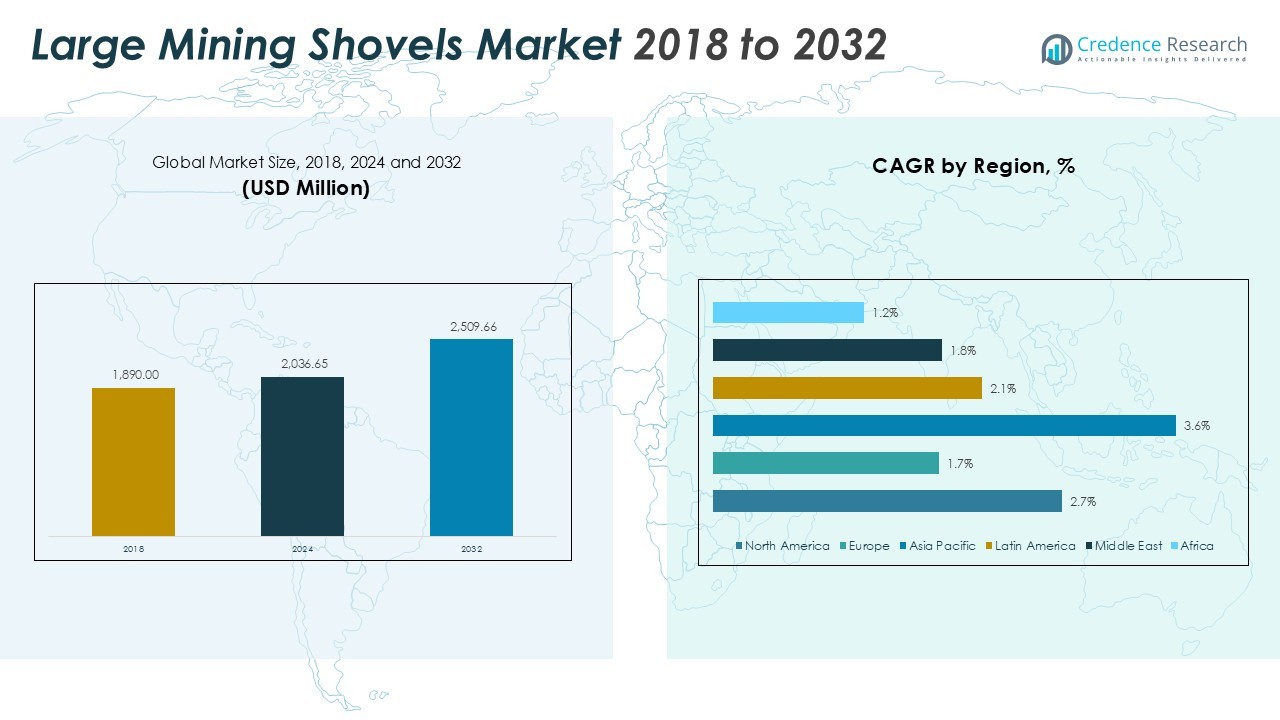
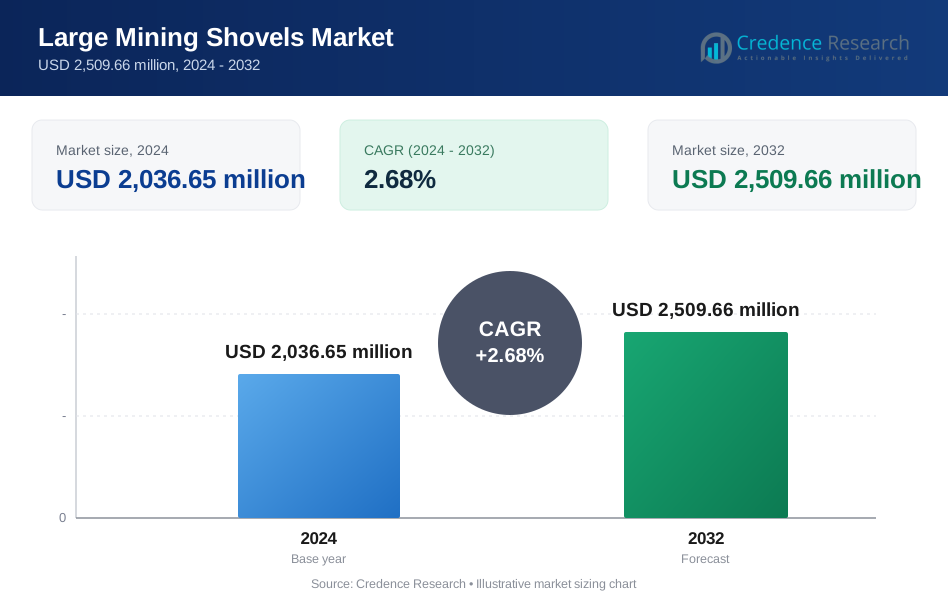
The Global Large Mining Shovels Market size was valued at USD 1,890 million in 2018 to USD 2,036.65 million in 2024 and is anticipated to reach USD 2,509.66 million by 2032, at a CAGR of 2.68% during the forecast period.
| REPORT ATTRIBUTE | DETAILS |
|---|---|
| Historical Period | 2020-2023 |
| Base Year | 2024 |
| Forecast Period | 2025-2032 |
| Large Mining Shovels Market Size 2024 | USD 2,036.65 Million |
| Large Mining Shovels Market, CAGR | 2.68% |
| Large Mining Shovels Market Size 2032 | USD 2,509.66 Million |
Market growth is primarily driven by rising global demand for coal, copper, iron ore, and other essential minerals required in energy generation, construction, and industrial manufacturing. Technological advancements, including automation, electrification, and real-time data monitoring, are transforming equipment performance and reliability. Additionally, the growing focus on operational safety, fuel efficiency, and reduced maintenance costs encourages mining operators to adopt next-generation shovels with improved power output and precision control systems.
Regionally, Asia Pacific dominates the Large Mining Shovels Market, accounting for a substantial market share due to extensive mining operations in China, India, and Australia. North America and Europe follow, driven by modernization of mining fleets and sustainable mining initiatives. Meanwhile, Latin America and Africa present high-growth opportunities with increasing mineral exploration investments.
Market Insights:
- The market was valued at USD 1,890 million in 2018 and is projected to reach USD 2,509.66 million by 2032, at a CAGR of 2.68%.
- Rising demand for coal, iron ore, copper, and other minerals drives the need for high-capacity mining shovels.
- Automation, electrification, and real-time monitoring enhance equipment reliability and operational efficiency.
- Focus on safety, fuel efficiency, and lower maintenance costs encourages adoption of advanced shovels.
- Asia Pacific leads the market due to extensive mining in China, India, and Australia, while North America and Europe grow steadily.
- Latin America and Africa offer growth potential with increasing mineral exploration and surface mining projects.
- High capital and maintenance costs challenge adoption, but energy-efficient and automated solutions provide opportunities.
Market Drivers:
Rising Demand for Minerals and Metals Enhancing Equipment Utilization
The Global Large Mining Shovels Market benefits from surging demand for minerals such as coal, iron ore, copper, and gold that support construction, energy, and manufacturing sectors. Expanding infrastructure projects and industrial output have intensified the need for efficient material handling solutions. Mining operators are focusing on productivity optimization and cost efficiency, driving the preference for high-capacity shovels capable of managing larger payloads. The market continues to advance through the integration of heavy-duty machines that ensure consistent performance under demanding conditions.
- For instance, Caterpillar's 6060 Hydraulic Mining Shovel is designed with a payload capacity of 61 tonnes, allowing it to efficiently load 227-tonne haul trucks in just 4 passes.
Technological Advancements Strengthening Operational Efficiency
The incorporation of advanced technologies, including automation, digital monitoring, and data analytics, is transforming equipment performance and reliability. Modern mining shovels feature intelligent control systems, GPS-based fleet tracking, and condition monitoring tools that minimize downtime and extend asset life. These innovations enable operators to achieve precise loading cycles and better energy utilization. The Global Large Mining Shovels Market gains strong momentum from these technological improvements that enhance output and reduce operational risks.
- For instance, Komatsu's FrontRunner autonomous haulage system has demonstrated significant operational endurance, with 10 of its autonomous trucks each achieving a benchmark of 100,000 operating hours.
Shift Toward Electrification and Sustainability in Mining Operations
Growing emphasis on environmental responsibility encourages the transition from diesel-powered to electric or hybrid mining shovels. Electric models help mining companies reduce carbon emissions, fuel costs, and noise levels without compromising productivity. Governments and mining corporations are adopting stringent environmental standards, prompting investment in eco-efficient machinery. It aligns with the global objective to achieve sustainable mining practices supported by clean technology.
Expansion of Surface Mining Activities Across Developing Regions
Rapid industrialization and rising demand for natural resources in emerging economies are fostering large-scale surface mining projects. Countries across Asia Pacific, Latin America, and Africa are investing heavily in mineral exploration and production. It has led to increased procurement of advanced shovels for efficient overburden removal and ore extraction. The Global Large Mining Shovels Market benefits from this expansion, supported by infrastructure growth and favorable mining policies.
Market Trends:
Integration of Automation and Digital Solutions Transforming Mining Operations
The Global Large Mining Shovels Market is witnessing a strong trend toward automation and digitalization to improve efficiency and operational safety. Advanced shovels now feature autonomous or semi-autonomous capabilities, allowing operators to perform precision loading and reduce human error. Real-time monitoring systems track machine performance, predict maintenance needs, and optimize fuel consumption. Fleet management software enables synchronized operations between shovels and haul trucks, maximizing productivity. Operators increasingly rely on telematics and data analytics to make informed decisions and reduce operational costs. It creates a competitive advantage for mining companies investing in technologically advanced machinery.
- For instance, Volvo Autonomous Solutions reached a significant milestone at a Norwegian quarry, where its fleet of seven autonomous trucks successfully hauled over 1 million tonnes of limestone.
Focus on Sustainability and Electrification Driving Equipment Innovation
Sustainability continues to shape trends in the Global Large Mining Shovels Market, with a shift toward electric and hybrid shovels to reduce emissions and energy consumption. Manufacturers are developing high-capacity electric models that maintain performance while lowering environmental impact. Mining companies are implementing eco-friendly practices to comply with stricter regulations and corporate sustainability goals. Lightweight materials and energy-efficient hydraulic systems further enhance shovel performance and reduce operational costs. It also encourages investments in equipment designed for long-term reliability and lower total cost of ownership. This trend reflects the industry's commitment to balancing productivity with environmental responsibility.
- For instance, at the Huaneng Yimin open-pit coal mine in China, 100 all-electric autonomous mining trucks delivered by XCMG are now in operation, each with a payload capacity of 90 metric tonnes.
Market Challenges Analysis:
High Capital Investment and Maintenance Costs Limiting Market Expansion
The Global Large Mining Shovels Market faces challenges due to the substantial initial investment required for procurement and deployment. Advanced shovels equipped with automation, electrification, and digital monitoring systems demand significant capital, which can restrict adoption among small and mid-sized mining operators. Maintenance and spare parts costs remain high, particularly for hydraulic and electrical components. It impacts operational budgets and can delay equipment replacement cycles. Mining companies must balance productivity gains with financial feasibility to optimize return on investment. This cost-intensive nature slows market penetration in regions with limited mining infrastructure.
Operational and Environmental Constraints Affecting Equipment Utilization
Operational efficiency of large mining shovels can be affected by challenging terrain, extreme weather conditions, and irregular ore deposits. Equipment downtime due to mechanical failures or harsh mining environments reduces overall productivity. Strict environmental regulations regarding emissions, noise, and land disturbance impose additional compliance requirements on operators. It necessitates careful planning, specialized machinery, and higher operational oversight. Regulatory pressures and site-specific limitations continue to challenge widespread deployment, affecting the market’s growth trajectory.
Market Opportunities:
Expansion of Mining Activities in Emerging Economies Driving Equipment Demand
The Global Large Mining Shovels Market presents significant opportunities due to rising mining activities in Asia Pacific, Latin America, and Africa. Growing demand for coal, iron ore, copper, and other essential minerals fuels investments in surface and open-pit mining operations. Mining companies are upgrading fleets to high-capacity shovels to improve efficiency and reduce operational downtime. It enables faster material handling and supports large-scale extraction projects. Favorable government policies and infrastructure development further encourage adoption of advanced mining machinery. This expansion creates a strong pipeline for new equipment sales and long-term service contracts.
Technological Innovation and Electrification Offering Competitive Advantage
Technological advancements in automation, electrification, and digital monitoring provide opportunities for market growth. Electric and hybrid shovels help reduce fuel consumption and emissions while maintaining high productivity levels. Manufacturers focusing on energy-efficient designs and predictive maintenance solutions can attract mining operators aiming to optimize costs. It also allows operators to enhance safety and operational precision, strengthening long-term asset utilization. Investment in smart mining equipment positions companies to meet global sustainability goals and regulatory standards. Continuous innovation opens new avenues for market penetration and increased adoption worldwide.
Market Segmentation Analysis:
By Power Source
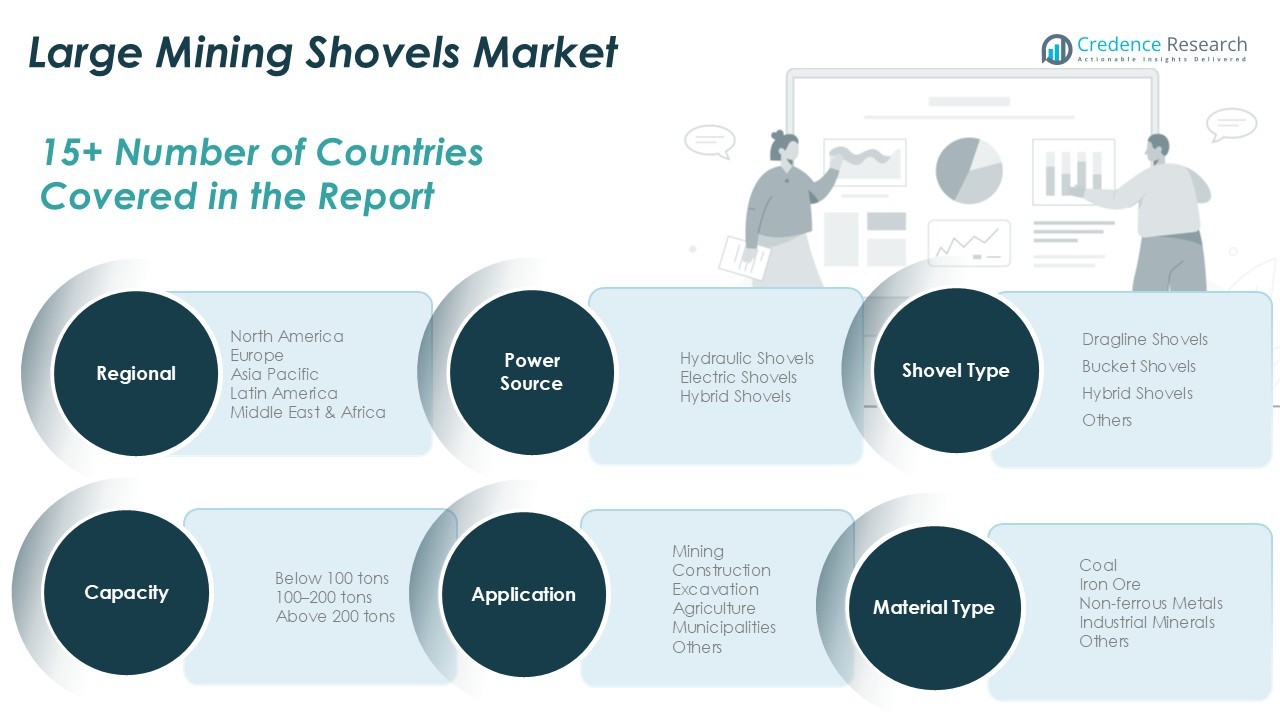
The Global Large Mining Shovels Market is segmented by power source into hydraulic, electric, and hybrid shovels. Hydraulic shovels dominate due to their high digging force, precision, and adaptability in diverse mining conditions. Electric shovels gain traction in large-scale operations for energy efficiency and lower carbon emissions. Hybrid shovels combine the advantages of both technologies, offering reduced fuel consumption and operational flexibility. It enables mining operators to optimize productivity while maintaining cost efficiency and sustainability goals.
- For instance, Caterpillar's 6090 FS hydraulic shovel is equipped with a powerful engine that provides a total rated net power of 3360 kW, enabling significant digging force for demanding mining operations.
By Application
By application, the market covers mining, construction, excavation, agriculture, municipalities, and other industrial uses. Mining remains the largest application segment, driven by strong demand for coal, iron ore, and non-ferrous metals. Construction and excavation utilize large shovels for material handling and site preparation. It supports infrastructure development and industrial projects by improving efficiency and reducing manual labor requirements. The diversification of applications allows operators to maximize equipment utilization across multiple sectors.
- For instance, the P&H 4800XPC shovel demonstrates high productivity in mining applications by being capable of loading a 400-ton haul truck in just 3 passes.
By Shovel Type
The market is classified into dragline shovels, bucket shovels, hybrid shovels, and others. Dragline shovels hold a significant share due to their ability to handle large volumes in open-pit mining. Bucket shovels provide high precision for loading and excavation tasks. Hybrid shovels offer energy-efficient operations and operational flexibility. It strengthens the overall efficiency of mining projects by aligning shovel type with site-specific requirements.
Segmentations:
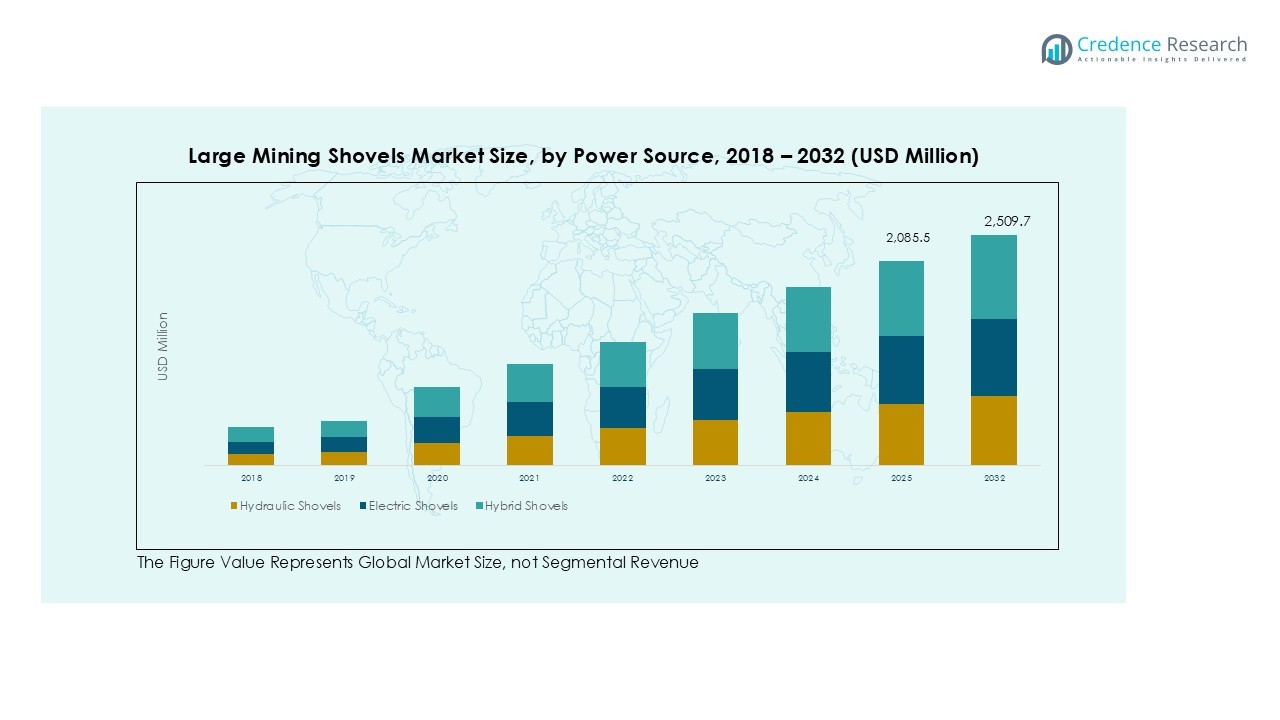
By Power Source:- Hydraulic Shovels
- Electric Shovels
- Hybrid Shovels
- Mining
- Construction
- Excavation
- Agriculture
- Municipalities
- Others
- Dragline Shovels
- Bucket Shovels
- Hybrid Shovels
- Others
- Below 100 tons
- 100–200 tons
- Above 200 tons
- Coal
- Iron Ore
- Non-ferrous Metals
- Industrial Minerals
- Others
- North America
- U.S.
- Canada
- Mexico
- Europe
- Germany
- France
- U.K.
- Italy
- Spain
- Rest of Europe
- Asia Pacific
- China
- Japan
- India
- South Korea
- South-east Asia
- Rest of Asia Pacific
- Latin America
- Brazil
- Argentina
- Rest of Latin America
- Middle East & Africa
- GCC Countries
- South Africa
- Rest of the Middle East and Africa
Regional Analysis:
North America
The North America Large Mining Shovels Market size was valued at USD 479.30 million in 2018 to USD 507.52 million in 2024 and is anticipated to reach USD 624.16 million by 2032, at a CAGR of 2.7% during the forecast period. The region holds a significant share due to well-established mining operations in the United States and Canada. It benefits from modernization of mining fleets and adoption of high-capacity shovels to improve operational efficiency. Companies are investing in automation and digital monitoring solutions to reduce downtime and enhance productivity. Rising demand for coal, copper, and industrial minerals continues to drive equipment procurement. The Global Large Mining ShovelsMarketMarket sees steady growth supported by infrastructure development and technological integration.
Europe
The Europe Large Mining Shovels Market size was valued at USD 387.07 million in 2018 to USD 396.28 million in 2024 and is anticipated to reach USD 453.13 million by 2032, at a CAGR of 1.7% during the forecast period. It maintains moderate growth due to declining coal production and stricter environmental regulations. Mining companies focus on fleet modernization and adopting energy-efficient shovels to comply with sustainability standards. Investments in predictive maintenance and digital control systems help optimize operational efficiency. The Global Large Mining Shovels Market benefits from industrial minerals extraction and modernization projects in Germany, Poland, and Spain.
Asia Pacific
The Asia Pacific Large Mining Shovels Market size was valued at USD 678.32 million in 2018 to USD 753.04 million in 2024 and is anticipated to reach USD 994.33 million by 2032, at a CAGR of 3.6% during the forecast period. The region dominates the market with extensive mining activities in China, India, and Australia. It experiences strong demand due to large-scale surface mining projects and increasing infrastructure development. Mining operators invest in automation and electric shovels to enhance productivity and reduce operating costs. The Global Large Mining Shovels Market benefits from government support and favorable mining policies. Rapid urbanization and industrial growth continue to drive market expansion.
Latin America
The Latin America Large Mining Shovels Market size was valued at USD 179.93 million in 2018 to USD 192.65 million in 2024 and is anticipated to reach USD 226.05 million by 2032, at a CAGR of 2.1% during the forecast period. The region benefits from rich mineral deposits in Brazil, Chile, and Peru. It experiences steady demand for large mining shovels due to copper, gold, and iron ore production. Companies invest in high-capacity shovels to improve operational efficiency in large-scale mining projects. The Global Large Mining Shovels Market sees growth supported by modernization of fleets and improved mining infrastructure. Expansion of mining exploration projects enhances equipment utilization.
Middle East
The Middle East Large Mining Shovels Market size was valued at USD 97.90 million in 2018 to USD 100.60 million in 2024 and is anticipated to reach USD 115.21 million by 2032, at a CAGR of 1.8% during the forecast period. It shows moderate growth due to investments in mineral exploration and quarrying activities. Mining operators focus on deploying advanced shovels to improve productivity and operational safety. The Global Large Mining Shovels Market benefits from growing demand for phosphate, bauxite, and other industrial minerals. Adoption of energy-efficient machinery helps reduce operational costs and emissions. Strategic infrastructure development supports market expansion.
Africa
The Africa Large Mining Shovels Market size was valued at USD 67.47 million in 2018 to USD 86.57 million in 2024 and is anticipated to reach USD 96.80 million by 2032, at a CAGR of 1.2% during the forecast period. It experiences growth driven by mining operations in South Africa, Zambia, and Morocco. Companies invest in high-capacity shovels for copper, gold, and platinum extraction. The Global Large Mining Shovels Market benefits from expansion in surface mining and improvements in mining infrastructure. Challenges related to terrain and operational efficiency persist but create opportunities for advanced equipment adoption. Rising foreign investment supports steady market development.
Key Player Analysis:
- Caterpillar Inc.
- Komatsu Ltd.
- Hitachi Construction Machinery Co., Ltd.
- Liebherr Group
- Volvo Construction Equipment
- Sandvik AB
- China National Coal Mining Equipment Co., Ltd.
- Zhengzhou Coal Mining Machinery Group Co., Ltd.
- BEML Ltd.
- JCB Ltd.
- Metso Corporation
- Boart Longyear Ltd.
Competitive Analysis:
The Global Large Mining Shovels Market is moderately consolidated, with leading players such as Caterpillar Inc., Komatsu Ltd., Hitachi Construction Machinery, Liebherr Group, and Epiroc AB dominating the industry. These companies maintain a competitive edge through technological advancements, extensive product portfolios, and strong brand recognition. Emerging Chinese manufacturers like SANY and XCMG are gaining traction by offering cost-effective solutions, particularly in Asia and Africa. Competition centers on payload capacity, automation capabilities, sustainability features, and comprehensive lifecycle support services. The market's growth is influenced by regional demand, technological innovations, and strategic partnerships among key players. Overall, the competitive landscape is characterized by a blend of established industry giants and emerging cost-competitive entrants, each striving to meet the evolving demands of large-scale mining operations.
Recent Developments:
- In August 2025, Caterpillar, Joule, and Wheeler Machinery Co. announced an agreement to power Joule's High-Performance Compute Data Center Campus in Utah.
- In January 2025, Volvo Construction Equipment announced a new lineup of articulated haulers, including the A50 model, with a planned stepwise introduction to global markets throughout the year.
Report Coverage:
The research report offers an in-depth analysis based on Power Source, Application, Shovel Type, Capacity, Material Type and Region It details leading market players, providing an overview of their business, product offerings, investments, revenue streams, and key applications. Additionally, the report includes insights into the competitive environment, SWOT analysis, current market trends, as well as the primary drivers and constraints. Furthermore, it discusses various factors that have driven market expansion in recent years. The report also explores market dynamics, regulatory scenarios, and technological advancements that are shaping the industry. It assesses the impact of external factors and global economic changes on market growth. Lastly, it provides strategic recommendations for new entrants and established companies to navigate the complexities of the market.
Future Outlook:
- The Global Large Mining Shovels Market will witness increased adoption of automated and semi-automated shovels to enhance operational efficiency.
- Demand for electric and hybrid shovels will rise due to environmental regulations and focus on reducing carbon emissions.
- Mining operators will prioritize predictive maintenance and digital monitoring to minimize downtime and extend equipment life.
- Expansion of surface mining activities in emerging economies will create new opportunities for high-capacity shovel deployment.
- Technological innovations in hydraulics, energy efficiency, and control systems will strengthen equipment performance.
- Companies will invest in sustainable solutions to align with corporate and government environmental initiatives.
- Integration of telematics and IoT solutions will allow real-time tracking and improved fleet management.
- Equipment manufacturers will focus on reducing total cost of ownership through enhanced durability and fuel efficiency.
- Strategic partnerships and regional expansions will support market penetration and access to new mining projects.
- The market will see continued diversification of applications across mining, construction, excavation, and industrial operations, driving long-term growth.
Request a Free Sample
Fill in your details and we'll send you a free sample report.
- Sample data tables & charts
- Research methodology
Need a Custom Version of This Report?
Tailor the scope, geography, or segments to your exact requirements.
- Custom geography or segment scope
- Direct access to our analyst team
Frequently Asked Questions
What is the current market size for the Global Large Mining Shovels Market, and what is its projected size in 2032?
At what Compound Annual Growth Rate is the Global Large Mining Shovels Market projected to grow between 2024 and 2032?
Which segment held the largest share of the Global Large Mining Shovels Market in 2024?
What are the primary factors fueling the growth of the Global Large Mining Shovels Market?
Which region commanded the largest share of the Global Large Mining Shovels Market in 2024?
Table of Content
Chapter 1. Report Introduction
- 1.1 Report Description & Purpose
- 1.1.1 Report Title & Market Definition
- 1.1.2 Unique Selling Propositions (USP) & Key Differentiators
- 1.1.3 Value Proposition for Stakeholders
- 1.2 Research Objectives
- 1.2.1 Market Sizing Objectives (Volume & Revenue)
- 1.2.2 Segmentation Objectives
- 1.2.3 Competitive Intelligence Objectives
- 1.2.4 Forecast & Scenario Objectives
- 1.3 Report Scope
- 1.3.1 Large Mining Shovels Scope – Types & Subtypes Covered
- 1.3.2 Geographic Scope – Regions & Countries Covered
- 1.3.3 Historical Period, Base Year & Forecast Period (2024; forecast to 2032)
- 1.3.4 Inclusions & Exclusions
- 1.4 HS Code & Classification Framework
- 1.5 Currency, Units & Pricing Basis
- 1.6 Target Stakeholders
- 1.7 Limitations & Assumptions
Chapter 2. Executive Summary
- 2.1 Global Large Mining Shovels Market Snapshot
- 2.1.1 Market Size – Historical (2024) & Forecast (2024-2032) (2024: USD 2,036.65 million → 2032: USD 2,509.66 million)
- 2.1.2 Volume & Revenue – Global Totals
- 2.1.3 Key Market Highlights – Top Five Facts
- 2.2 Large Mining Shovels Market Segmentation Snapshot
- 2.2.1 Market Split by Region – 2024 vs. 2032
- 2.3 Competitive Snapshot
- 2.3.1 Top 10 Players by Revenue Share – 2024
- 2.3.2 Top 10 Players by Volume Share – 2024
- 2.3.3 Recent Strategic Developments (18-Month Summary)
- 2.4 Key Investment Highlights & Strategic Conclusions
Chapter 3. Large Mining Shovels Market Dynamics & Industry Analysis
- 3.1 Market Overview & Context
- 3.1.1 Large Mining Shovels Market Position in the Broader Automotive Value Chain
- 3.1.2 OEM vs. Replacement Market Dynamics
- 3.1.3 Market Maturity & Development Stage by Region
- 3.2 Large Mining Shovels Market Drivers
- 3.3 Large Mining Shovels Market Restraints & Challenges
- 3.4 Large Mining Shovels Market Opportunities
- 3.5 Porter's Five Forces Analysis
- 3.5.1 Threat of New Entrants
- 3.5.2 Bargaining Power of Suppliers
- 3.5.3 Bargaining Power of Buyers
- 3.5.4 Threat of Substitutes
- 3.5.5 Competitive Rivalry – Intensity Assessment
- 3.6 Large Mining Shovels Value Chain Analysis
- 3.6.1 Upstream – Raw Material/Input Suppliers
- 3.6.1.1 Raw Material/Input 1
- 3.6.1.2 Raw Material/Input 2
- 3.6.1.3 Raw Material/Input 3
- 3.6.2 Midstream – Production/Manufacturing/Service Delivery
- 3.6.2.1 Production/Process Overview
- 3.6.2.2 Key Facility Locations & Capacity by Manufacturer
- 3.6.3 Downstream – Distribution & End Consumer
- 3.6.3.1 Primary Channel – B2B/OEM
- 3.6.3.2 Secondary Channels – Dealer, Retail, Online, Direct
- 3.6.4 Value Chain Profitability Analysis
- 3.6.1 Upstream – Raw Material/Input Suppliers
- 3.7 PESTEL Analysis
- 3.7.1 Political Factors
- 3.7.2 Economic Factors
- 3.7.3 Social Factors
- 3.7.4 Technological Factors
- 3.7.5 Environmental Factors
- 3.7.6 Legal Factors
- 3.8 Large Mining Shovels Supply Chain Analysis
- 3.8.1 Raw Material/Input Supply Risk Assessment
- 3.8.2 Manufacturing Concentration Risk (Geographic Exposure)
- 3.8.3 Trade Disruption Impact Analysis
- 3.9 Regulatory & Policy Landscape
Note: The regulatory and policy landscape section covers regulations based on their applicability to the market, Large Mining Shovels category, geography, and scope of the study. Only regulatory frameworks with a material impact on operations, compliance, trade, sustainability, or market access are analyzed in detail.
Chapter 4. Key Investment Pockets & Opportunity Analysis
- 4.1 Large Mining Shovels Market Attractiveness Analysis
- 4.1.1 By Region – Investment Attractiveness Matrix (Volume × CAGR)
- 4.2 Absolute Revenue Growth Opportunity
- 4.2.1 By Region – Absolute USD Growth Through 2032
- 4.3 Incremental Volume Opportunity
- 4.3.1 By Region – Incremental Volume Through 2032
- 4.3.2 Segment – Incremental Volume
- 4.4 Emerging Submarket Opportunity Deep Dive (Subject to Applicability)
- 4.5 Emerging Market Opportunity Scorecards
- 4.5.1 United States
- 4.5.2 Europe
- 4.5.3 Asia
- 4.5.4 Middle East & Africa
Note: Emerging Market Opportunity Scorecards will be included based on relevance and strategic importance. Regions listed are indicative and may vary depending on data availability and market dynamics.
Chapter 5. Large Mining Shovels Import-Export Analysis & Trade Flows
- 5.1 Global Trade Overview
- 5.1.1 Global Export Value by Country (2024)
- 5.1.2 Global Export Volume by Country (2024)
- 5.1.3 Global Import Value by Country (2024)
- 5.1.4 Global Import Volume by Country (2024)
- 5.1.5 Net Trade Balance by Country (2024)
- 5.2 Export Analysis – Segment
- 5.2.1 Type 1 (HS Code)
- 5.2.2 Type 2 (HS Code)
- 5.2.3 Type 3 (HS Code)
- 5.2.4 Type 4 (HS Code)
- 5.2.5 Type 5 (HS Code)
- 5.3 Import Analysis – Segment
- 5.3.1 Type 1 (HS Code)
- 5.3.2 Type 2 (HS Code)
- 5.3.3 Type 3 (HS Code)
- 5.3.4 Type 4 (HS Code)
- 5.3.5 Type 5 (HS Code)
- 5.4 Average Unit Trade Prices
- 5.4.1 Average Export Price – Segment & Country
- 5.4.2 Average Import Price – Segment & Source Country
- 5.4.3 Price Trends (2024)
- 5.5 Key Trade Route Analysis
- 5.5.1 Trade Route 1
- 5.5.2 Trade Route 2
- 5.5.3 Trade Route 3
- 5.5.4 Trade Route 4
- 5.5.5 Trade Route 5
- 5.6 Trade Policy Impact Assessment
- 5.6.1 US Anti-Dumping & Section 301 Tariffs
- 5.6.2 EU Customs Union Impact
- 5.6.3 Major Free Trade Agreements
- 5.6.4 USMCA Rules of Origin
Note: Trade policy analysis will be included only where relevant to the Large Mining Shovels market.
Chapter 6. Competitive Landscape & Company Benchmarking
- 6.1 Large Mining Shovels Market Concentration & Structure
- 6.1.1 Herfindahl-Hirschman Index (HHI) – vs. 2024
- 6.1.2 Tier 1, Tier 2 & Tier 3 Market Structure
- 6.1.3 Global, Regional & Local Player Dynamics
- 6.2 Large Mining Shovels Market Share Analysis – 2024
- 6.2.1 Global Revenue Share by Company
- 6.2.2 Global Volume Share by Company
- 6.2.3 Regional Revenue Share
- 6.2.4 Market Share Evolution ( vs. 2024)
- 6.2.5 OEM Segment Share by Company
- 6.2.6 Replacement Segment Share by Company
- 6.3 Production/Delivery Capacity & Facility Analysis
- 6.3.1 Global Installed Capacity
- 6.3.2 Capacity Utilization Rates
- 6.3.3 Production/Output Volume
- 6.3.4 Facility Locations & Capacity Map
- 6.3.5 Planned Capacity Additions
- 6.4 Large Mining Shovels Competitive Benchmarking Matrix
- 6.4.1 Revenue, Volume, CAGR & Profitability Comparison
- 6.4.2 Channel Revenue Mix
- 6.4.3 Geographic Revenue Exposure
- 6.4.4 R&D Intensity
- 6.4.5 Sustainability Maturity
- 6.5 Strategic Developments in Large Mining Shovels (Last 24 Months)
- 6.5.1 Mergers, Acquisitions & Divestments
- 6.5.2 New Large Mining Shovels Launches
- 6.5.3 Facility Expansions
- 6.5.4 Strategic Alliances, Joint Ventures & Partnerships
- 6.5.5 Distribution Expansion & Market Entry
- 6.5.6 Sustainability & ESG Initiatives
- 6.6 Competitive Strategy Mapping
- 6.6.1 Leader, Challenger, Follower & Niche Classification
- 6.6.2 Pricing Strategy Comparison
- 6.6.3 Channel Strategy Matrix
Note: Strategic developments are included based on their materiality and the availability of reliable information.
Chapter 7. Global Large Mining Shovels Market – By Distribution Channel
- 7.1 Segment Overview
- 7.1.1 Volume & Revenue Split by Channel (2024 & 2032)
- 7.1.2 Channel Mix Evolution (2024-2032)
Chapter 8. Regional Market Analysis – Global Overview
- 8.1 Global Regional Overview
- 8.1.1 Regional Volume Share
- 8.1.2 Regional Revenue Share
- 8.1.3 Regional Volume by Region
- 8.1.4 Regional Revenue by Region
- 8.1.5 Regional Forecast Through 2032
- 8.2 Cross-Regional Segment Analysis
- 8.2.1 By Distribution Channel
- 8.2.2 By Brand/Price Tier
Chapter 9. North America Large Mining Shovels Market
- 9.1 United States
- 9.2 Canada
- 9.3 Mexico
Chapter 10. Europe Large Mining Shovels Market
- 10.1 Germany
- 10.2 France
- 10.3 Italy
- 10.4 United Kingdom
- 10.5 Spain
- 10.6 Poland
- 10.7 Russia
- 10.8 Netherlands
- 10.9 Belgium
- 10.10 Sweden
- 10.11 Denmark
- 10.12 Norway
- 10.13 Rest of Europe
Chapter 11. Asia Pacific Large Mining Shovels Market
- 11.1 China
- 11.2 India
- 11.3 Japan
- 11.4 South Korea
- 11.5 Thailand
- 11.6 Indonesia
- 11.7 Vietnam
- 11.8 Malaysia
- 11.9 Australia
- 11.10 Rest of Asia Pacific
Chapter 12. Latin America Large Mining Shovels Market
- 12.1 Brazil
- 12.2 Argentina
- 12.3 Colombia
- 12.4 Chile
- 12.5 Rest of Latin America
Chapter 13. Middle East Large Mining Shovels Market
- 13.1 Saudi Arabia
- 13.2 United Arab Emirates
- 13.3 Turkey
- 13.4 Israel
- 13.5 Iran
- 13.6 Rest of the Middle East
Chapter 14. Africa Large Mining Shovels Market
- 14.1 South Africa
- 14.2 Egypt
- 14.3 Nigeria
- 14.4 Morocco
- 14.5 Rest of Africa
Chapter 15. Large Mining Shovels Company Profiles
- 15.1 [Company 01]
- 15.1.1 Company Overview
- 15.1.2 Key Management Personnel
- 15.1.3 Products & Services Portfolio
- 15.1.4 Financial Performance
- 15.1.5 Key Market Focus & Geographic Presence
- 15.1.6 Recent Developments & Strategic Initiatives
Note: The company profile list is preliminary and may change based on research findings, market developments, data availability, and client requirements.
Chapter 16. Appendices
- Appendix A – List of Abbreviations & Acronyms
- Appendix B – Industry Classification Code Reference – Full Series
- Appendix C – Production & Capacity Data Tables
- Appendix D – End-Use & Demand Base Tables
- Appendix E – Consumption & Replacement Rate Assumptions
- Appendix F – ASP Reference Tables
- Appendix G – Manufacturing & Facility Database
- Appendix H – Import-Export Data Tables
- Appendix I – Regulatory Summary Tables
- Appendix J – Primary Research Participant List (Anonymized)
- Appendix K – Primary Research Questionnaire Framework
- Appendix L – Data Sources & Bibliography
- Appendix M – Market Size Divergence & Source Comparison
Chapter 17. Research Methodology
- 17.1 Research Framework & Philosophy
- 17.2 Secondary Research – Sources, Hierarchy & Data Extraction
- 17.3 Data Modeling – Bottom-Up & Top-Down Market Sizing
- 17.4 Primary Research – Stakeholder Framework, LOI & Sample Sizes
- 17.5 Forecast Methodology – Regression, Scenario & Sensitivity Analysis
- 17.6 Quality Control – Four-Layer Validation Framework
- 17.7 Limitations & Standard Assumptions
- 17.8 Disclaimer
