| REPORT ATTRIBUTE | DETAILS |
|---|---|
| Historical Period | 2020-2023 |
| Base Year | 2024 |
| Forecast Period | 2025-2032 |
| Latin America Data Center Containment MarketSize 2024 | USD 191.95 million |
| Latin America Data Center Containment Market, CAGR | 10.02% |
| Latin America Data Center Containment MarketSize 2032 | USD 411.95 million |
Market Overview
The Latin America Data Center Containment Market is projected to grow from USD 191.95 million in 2024 to an estimated USD 411.95 million by 2032, reflecting a compound annual growth rate (CAGR) of 10.02% from 2025 to 2032. This growth is driven by the increasing demand for efficient data management solutions and the expansion of data center infrastructures across the region.
Key market drivers include the rapid digitalization of businesses, the proliferation of cloud computing services, and the rising need for effective thermal management in data centers. Additionally, trends such as the adoption of modular containment solutions and the integration of advanced cooling technologies are contributing to market expansion.
Geographically, countries like Brazil, Mexico, and Argentina are leading in the adoption of data center containment solutions, owing to their robust IT sectors and investments in digital infrastructure. Major players in the market include Schneider Electric, Vertiv, and Eaton, which offer a range of containment and cooling solutions tailored to the needs of Latin American data centers.
Market Insights
- The Latin America Data Center Containment Market is projected to grow from USD 191.95 million in 2024 to USD 411.95 million by 2032, with a CAGR of 10.02% from 2025 to 2032.
- The Global Data Center Containment Market is projected to grow from USD 3,719.95 million in 2024 to USD 8,654.34 million by 2032, driven by a CAGR of 11.13% from 2025 to 2032.
- The demand for efficient data management solutions and the expansion of data center infrastructures are key factors driving market growth in the region.
- The rapid digitalization of businesses and proliferation of cloud computing services are major drivers of the market, promoting the need for advanced containment systems.
- The rising need for effective thermal management in data centers is a significant market driver, boosting the adoption of advanced containment and cooling technologies.
- The high upfront costs of implementing containment solutions and cooling systems pose a restraint to market growth, particularly for smaller businesses.
- Brazil, Mexico, and Argentina are leading the region in the adoption of data center containment solutions due to their growing IT sectors and digital infrastructure investments.
- Leading companies like Schneider Electric, Vertiv, and Eaton dominate the market by offering innovative containment and cooling solutions tailored to the region’s needs.
Market Drivers
Government Support and Investments in IT Infrastructure
Another key factor propelling the Latin America Data Center Containment Market is government support for the development of IT infrastructure and digital ecosystems. Governments in the region have recognized the strategic importance of robust digital infrastructure in driving economic growth, and many have introduced policies and incentives to promote the development of data centers. For example, countries like Brazil and Mexico have rolled out initiatives aimed at fostering the growth of digital infrastructure, which includes the construction of new data centers and the enhancement of existing facilities. Governments are also investing in the expansion of high-speed broadband networks and improving internet connectivity, which directly supports the growth of the data center industry. Moreover, the increasing focus on data privacy regulations and compliance standards in Latin America has led to greater investments in secure and efficient data center technologies, including containment solutions, to ensure the integrity of data storage and processing.
Rising Demand for Edge Computing
Edge computing is becoming an increasingly critical part of the Latin American IT landscape, driving the need for more localized data processing and storage solutions. The growing adoption of IoT (Internet of Things) devices, coupled with the rising demand for real-time data processing, is pushing the need for edge computing infrastructure. Latin America is witnessing an increase in the deployment of edge data centers to meet the demands for low-latency and high-speed data processing. These edge data centers often require highly efficient containment solutions to optimize their cooling and airflow management. As edge computing continues to gain traction, especially in sectors such as retail, automotive, and manufacturing, data center operators are focusing on improving energy efficiency and scalability, both of which can be achieved through the adoption of containment solutions. The ability to deploy small, modular data centers equipped with the right containment and cooling systems is allowing businesses to keep up with the growing demand for localized data processing, which in turn boosts market growth in the region.
Increasing Demand for Efficient Cooling Solutions
The Latin America Data Center Containment Market is witnessing significant growth due to the escalating need for efficient cooling solutions in data centers. As businesses and organizations generate vast amounts of data, the infrastructure required to process and store this information becomes increasingly power-intensive, leading to higher thermal output from servers and equipment. For instance, the adoption of advanced cooling technologies such as liquid cooling and AI-powered systems has become essential to maintain optimal operating temperatures while addressing sustainability concerns. These solutions not only improve energy efficiency but also reduce operational costs and carbon footprints, making them indispensable in modern data center designs. Furthermore, containment systems like hot and cold aisle containment enhance airflow management, mitigate overheating risks, and contribute to energy savings. The focus on innovative cooling methods reflects the industry's commitment to balancing cost-effectiveness with environmental responsibility.
Expansion of Cloud Computing and Digital Transformation
The rapid expansion of cloud computing services and digital transformation initiatives across Latin America is driving the growth of the data center containment market. Businesses increasingly rely on cloud-based applications for scalability and efficiency, prompting investments in larger data centers equipped with advanced containment solutions. For instance, countries like Brazil, Mexico, and Argentina are experiencing significant investments in cloud infrastructure due to growing demand across industries such as healthcare, finance, and telecommunications. This shift towards cloud computing has led to the establishment of high-performance data centers requiring efficient cooling systems to ensure smooth operations. Containment solutions play a critical role in optimizing performance, enhancing scalability, and minimizing operational risks in these facilities. As digital transformation continues to accelerate across the region, the adoption of robust containment technologies remains vital for supporting the evolving needs of businesses while ensuring sustainability and resilience in data center operations.
Market Trends
Focus on Sustainability and Energy Efficiency
Sustainability and energy efficiency are increasingly becoming central to the design and operation of data centers across Latin America. With growing concerns over the environmental impact of data centers, operators are actively seeking solutions that help reduce their carbon footprint while maintaining high operational efficiency. Energy efficiency is a critical factor in the overall cost structure of data centers, particularly as energy prices rise in certain parts of the region. Data center operators are focusing on adopting energy-efficient containment solutions that not only improve airflow management but also reduce the overall energy consumption of cooling systems. Additionally, the integration of renewable energy sources, such as solar and wind power, into data center operations is becoming more prevalent. Some companies are even exploring the use of renewable energy directly for cooling systems, further enhancing the sustainability of their operations. With increasing pressure from both government regulations and stakeholders to adopt more sustainable practices, the trend towards energy-efficient and eco-friendly data center containment solutions will continue to be a significant driver in the market. This trend is also contributing to the growth of “green data centers,” where sustainability is at the core of design and operation.
Rise of Artificial Intelligence (AI) and Automation in Data Centers
Artificial intelligence (AI) and automation are rapidly transforming data center operations across the globe, and Latin America is no exception. The integration of AI-driven technologies in data center management is becoming a key trend in the region, as businesses seek to improve the efficiency and reliability of their data center operations. AI-powered systems are being used to monitor and manage the performance of containment systems in real-time, identifying inefficiencies and making adjustments to airflow and cooling systems automatically. This level of automation helps optimize energy consumption and improve the overall performance of data centers, leading to cost savings and reduced environmental impact. Furthermore, AI is being used to predict potential failures or maintenance needs, allowing operators to take proactive measures before issues arise. In Latin America, where businesses are increasingly adopting AI technologies to improve operational efficiency, the integration of AI and automation in data center containment solutions is seen as a natural progression. This trend not only enhances the operational efficiency of data centers but also contributes to improving uptime and ensuring better service delivery to customers.
Shift Toward Modular and Scalable Containment Solutions
One of the significant trends in the Latin America Data Center Containment Market is the growing preference for modular and scalable containment solutions. As organizations in the region expand their digital operations, they face increasing demands for adaptable and scalable data center infrastructure. Modular containment systems provide a flexible alternative to traditional setups, enabling businesses to adjust their data center capacity without disrupting ongoing operations. For instance, these systems allow companies to incrementally add servers or storage units as their needs evolve, avoiding costly overhauls. This adaptability is particularly vital as Latin America undergoes rapid digital transformation fueled by cloud computing adoption and the proliferation of data-intensive applications. Companies are increasingly drawn to modular solutions that align with their goals of cost management and operational efficiency. By embracing modular containment, businesses can ensure their data centers remain agile and capable of meeting the dynamic requirements of modern IT environments.
Integration of Advanced Cooling Technologies
Energy efficiency remains a critical focus in the Latin America Data Center Containment Market, driving the adoption of advanced cooling technologies. Traditional air-based cooling methods are gradually being supplemented or replaced by innovative solutions such as liquid cooling and immersion cooling. These technologies offer superior efficiency, especially for high-density server environments, by managing heat more effectively than conventional systems. For instance, liquid cooling systems utilize specialized coolants to directly transfer heat away from equipment, reducing energy consumption and operational costs. The adoption of such technologies is further accelerated by rising energy costs and growing concerns about sustainability in the region. As businesses seek to optimize their operations while minimizing environmental impact, advanced cooling methods provide a viable pathway to achieve these objectives. The integration of these technologies not only enhances cooling efficiency but also supports the broader industry shift toward greener practices, ensuring that data centers can meet both performance and sustainability goals in an increasingly competitive market.
Market Challenges
High Initial Capital Investment
One of the key challenges facing the Latin America Data Center Containment Market is the high initial capital investment required for the installation of containment systems. Building or upgrading data centers with advanced containment solutions involves significant upfront costs, which can be a barrier for many businesses, particularly small and medium-sized enterprises (SMEs). For instance, companies often struggle with the expenses associated with the procurement of specialized containment infrastructure, cooling systems, and other energy-efficient technologies. Moreover, the region's economic volatility and the fluctuations in exchange rates can further exacerbate the financial strain on businesses looking to invest in data center upgrades. As a result, companies may hesitate to adopt these advanced containment solutions due to the long-term financial commitment involved, despite the potential for long-term operational cost savings. Overcoming this challenge requires clear communication of the long-term benefits, along with supportive financing options or government incentives to encourage investment in energy-efficient data center solutions.
Lack of Skilled Workforce and Technical Expertise
Another significant challenge in the Latin America Data Center Containment Market is the shortage of skilled workforce and technical expertise required for the installation, maintenance, and optimization of containment systems. Data center operators and engineers need specialized knowledge to design and implement containment strategies that maximize efficiency while minimizing downtime. The need for highly trained personnel is even more pronounced as technologies like liquid cooling and AI-driven automation become more integrated into data center operations. However, many Latin American countries face a shortage of qualified professionals with the necessary expertise in advanced data center technologies. This skills gap limits the ability of businesses to adopt and maintain cutting-edge containment solutions. Additionally, the lack of technical education and training programs in some regions exacerbates this issue, delaying the deployment of state-of-the-art containment solutions. Addressing this challenge will require investment in education and training, along with collaborations between industry stakeholders and educational institutions to develop a skilled workforce capable of supporting the growing demand for advanced data center infrastructure.
Market Opportunities
Growing Demand for Cloud and Edge Computing Infrastructure
As the adoption of cloud computing and edge computing services continues to accelerate across Latin America, there is a significant opportunity for data center containment solutions to cater to the growing demand for efficient infrastructure. The increasing reliance on cloud-based applications, coupled with the rise of IoT devices, has resulted in a surge in the need for localized and energy-efficient data processing. Edge data centers, which are crucial for delivering low-latency services, require advanced containment systems to manage heat and ensure optimal airflow. The expansion of cloud infrastructure and edge computing provides a ripe opportunity for containment solution providers to offer scalable, modular, and energy-efficient solutions that support this growing demand. Companies investing in the development of edge data centers and cloud facilities in countries like Brazil, Mexico, and Argentina stand to benefit from integrating containment solutions that enhance both energy efficiency and operational performance.
Government Incentives for Sustainable Data Center Operations
Latin American governments are increasingly promoting sustainability through regulations and incentives aimed at reducing carbon footprints and promoting energy-efficient infrastructure. This presents an opportunity for data center operators to integrate advanced containment and cooling technologies that align with government sustainability goals. Countries like Brazil and Mexico have introduced initiatives to support green data centers and renewable energy adoption, which enhances the demand for energy-efficient containment solutions. Data center operators can leverage these incentives to invest in containment systems that reduce energy consumption, lower operational costs, and meet environmental regulations. By capitalizing on these government-led initiatives, companies can differentiate themselves as leaders in sustainability, which can attract environmentally conscious clients and offer a competitive edge in the market.
Market Segmentation Analysis
By Containment Type
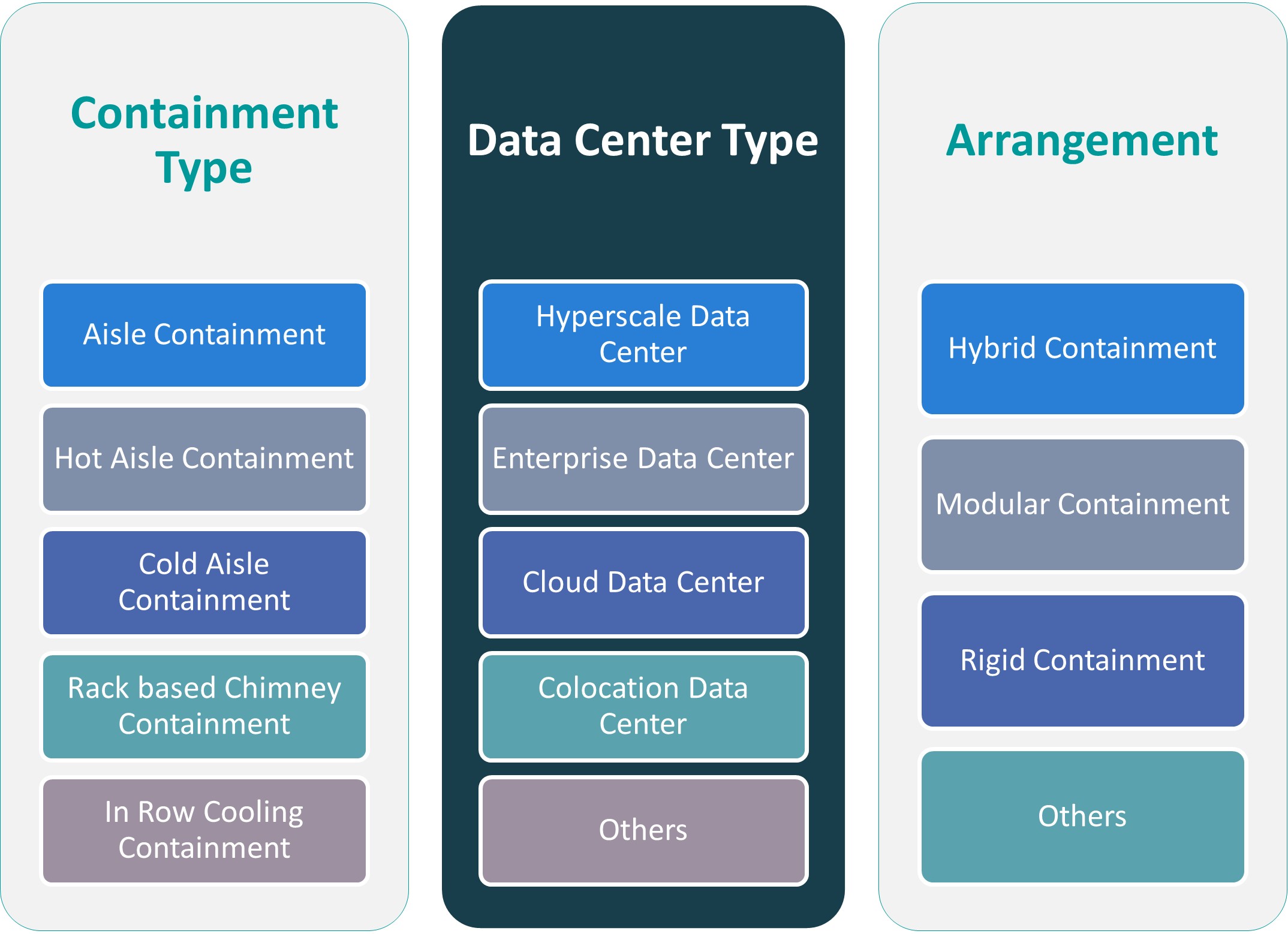
The Latin America Data Center Containment Market is primarily segmented based on containment types, with each solution tailored to address specific operational and cooling requirements. Aisle containment, one of the most common types, involves isolating hot and cold airflow to improve cooling efficiency and reduce energy consumption. Aisle containment systems are crucial for managing the increasing density of IT equipment in modern data centers, particularly in those experiencing growth or requiring high-performance computing. These solutions provide effective airflow management by creating dedicated pathways for hot and cold air, ensuring the optimal operation of data center equipment while minimizing the risk of overheating. Within aisle containment, hot aisle containment and cold aisle containment are the two predominant configurations. Hot aisle containment focuses on isolating the heat generated by servers by enclosing the hot aisles with barriers, leading to a more controlled environment and greater cooling efficiency. On the other hand, cold aisle containment isolates cold air paths, which are directed to the intake of servers, further enhancing airflow management. Additionally, rack-based chimney containment and in-row cooling containment have emerged as solutions for addressing heat hotspots and improving cooling where space is constrained. These systems help maintain a more uniform temperature distribution across the data center, contributing to overall energy efficiency and reducing operational costs.
By Data Center Type
The Latin America Data Center Containment Market is also segmented by the type of data center. Hyperscale data centers, which support vast amounts of data processing and storage, are the largest consumers of containment solutions. These facilities require highly efficient cooling and airflow management systems due to their size and the density of the IT equipment they house. Hyperscale data centers are typically operated by large tech companies and cloud service providers, requiring tailored containment solutions that support scalability, energy efficiency, and high-performance computing. With the increasing demand for cloud services in Latin America, hyperscale data centers are expected to drive substantial market growth. Enterprise data centers are another key segment within the market. These data centers are owned and operated by large enterprises to meet their internal IT infrastructure needs. Unlike hyperscale data centers, enterprise data centers tend to be smaller in scale but still require robust containment solutions for efficient thermal management. The rise in digital transformation efforts among enterprises in Latin America is pushing the demand for containment solutions to ensure the operational efficiency of these data centers. Cloud data centers, which host services such as cloud storage and SaaS applications, also contribute significantly to the market. As businesses migrate to cloud-based solutions, the need for energy-efficient containment systems that support large-scale cloud operations is growing. Similarly, colocation data centers, where multiple companies lease space for their IT infrastructure, are increasingly adopting advanced containment solutions to enhance cooling efficiency and reduce operational costs for clients. Each data center type presents unique requirements for containment systems, with a focus on improving energy efficiency, reducing costs, and ensuring operational continuity.
Segments
Based on Containment Type
- Aisle Containment
- Hot Aisle Containment
- Cold Aisle Containment
- Rack based Chimney Containment
- In Row Cooling Containment
Based on Data Center Type
- Hyperscale Data Center
- Enterprise Data Center
- Cloud Data Center
- Colocation Data Center
- Others
Based on Arrangement
- Hybrid Containment
- Modular Containment
- Rigid Containment
- Others
Based on Region
- Brazil
- Mexico
- Argentina
- Chile
Regional Analysis
Brazil (45%)
Brazil is the largest market in the region, accounting for over 45% of the total market share. As the largest economy in Latin America, Brazil is home to numerous large-scale data centers driven by the rapid adoption of cloud computing, big data, and IoT technologies. The country’s growing tech sector, combined with government initiatives promoting digital transformation, is fueling demand for advanced containment solutions. Major cities such as São Paulo and Rio de Janeiro are key hubs for data center infrastructure development. The Brazilian government’s emphasis on green energy and sustainability is also creating opportunities for energy-efficient containment systems, further bolstering the growth of the data ceer containment market.
Mexico (30%)
Mexico follows as the second-largest contributor, holding around 30% of the regional market share. The country's proximity to the United States and its growing IT infrastructure make it an attractive location for both global and local cloud service providers. Mexico’s data center market is expanding rapidly due to increasing demand for data storage and cloud services across sectors such as manufacturing, healthcare, and finance. The trend toward cloud adoption and edge computing is driving the need for efficient containment systems to support Mexico's growing data processing capacity. Mexico City and Monterrey are key regions for data center investments, and both continue to see increased interest in containment solutions that enhance cooling and energy efficiency.
Key players
- Nlyte Software
- Siemens AG
- Knurr
- Data Aire
Competitive Analysis
The Latin America Data Center Containment Market is characterized by the presence of several key players offering innovative containment and cooling solutions. Nlyte Software stands out with its advanced data center infrastructure management (DCIM) solutions, which are designed to optimize resource utilization and enhance operational efficiency. The company provides a comprehensive portfolio of containment solutions, including power, cooling, and airflow management tools, with a strong focus on sustainability. Siemens AG, a global leader in technology, offers a broad range of containment and cooling solutions, focusing on energy-efficient systems that meet the growing demand for green data centers. Knurr, with its innovative rack and containment solutions, focuses on providing high-performance containment systems that cater to modern data center requirements. Additionally, Data Aire is recognized for its precision cooling solutions tailored to support high-density environments, enhancing the cooling efficiency of data centers. These companies are competing by leveraging technology and innovation to meet the increasing demand for efficient, scalable, and sustainable data center operations in Latin America.
Recent Developments
- In November 2023, Huawei introduced two new additions to its Smart Modular Data Center and SmartLi uninterruptible power supply (UPS) series – FusionModule2000 6.0, a modular small/medium-sized data center solution, and UPS2000-H, a small-footprint power supply solution running on SmartLi Mini.
- In February 2025, Trane Technologies expanded its data center solutions to include liquid cooling thermal management systems, introducing the Trane 1MW Coolant Distribution Unit for high-performance workloads.
- In 2025, Honeywell launched a data center management suite to improve efficiency and sustainability by integrating operational and IT infrastructure data.
- In March 2025, Vertiv introduced new solutions to support dense AI and high-performance computing workloads, including consolidated infrastructure management software and prefabricated modular overhead infrastructure.
- In March 2025, Siemens announced a $285 million investment in U.S. manufacturing, including establishing new facilities in California and Texas. This investment aims to enhance manufacturing capabilities and advance AI technologies, supporting sectors such as commercial, industrial, construction, and AI data centers.
Market Concentration and Characteristics
The Latin America Data Center Containment Market exhibits a moderate to high level of market concentration, with several key players dominating the landscape, including global technology companies like Siemens AG, Nlyte Software, and Data Aire. These companies offer a wide range of innovative containment and cooling solutions, such as aisle containment, hot and cold aisle containment, and precision cooling systems, catering to the growing demand for energy-efficient and scalable data center operations. The market is characterized by increasing competition, driven by technological advancements, such as AI-powered automation and sustainable cooling solutions. As the demand for data processing and storage grows across the region, the market is witnessing significant investments from both global and regional players, making it increasingly competitive. Despite the dominance of large players, regional companies are also gaining traction by offering cost-effective solutions tailored to local requirements, contributing to a diverse and evolving market landscape.
Report Coverage
The research report offers an in-depth analysis based on Containment Type, Data Center Type, Arrangement and Region. It details leading market players, providing an overview of their business, product offerings, investments, revenue streams, and key applications. Additionally, the report includes insights into the competitive environment, SWOT analysis, current market trends, as well as the primary drivers and constraints. Furthermore, it discusses various factors that have driven market expansion in recent years. The report also explores market dynamics, regulatory scenarios, and technological advancements that are shaping the industry. It assesses the impact of external factors and global economic changes on market growth. Lastly, it provides strategic recommendations for new entrants and established companies to navigate the complexities of the market.
Future Outlook
- The increasing demand for data storage and processing will continue to drive the need for advanced containment solutions, with the market expected to grow significantly. This growth will be fueled by the ongoing digital transformation across various industries in Latin America.
- The rise of edge computing will create opportunities for localized data centers that require efficient containment systems to manage cooling and energy consumption effectively. Edge data centers will drive the demand for modular and scalable containment solutions in the region.
- Stringent government regulations regarding energy consumption and sustainability will push companies toward adopting more energy-efficient containment systems. Compliance with these regulations will be a critical factor in shaping market dynamics.
- The integration of advanced cooling technologies, such as liquid cooling and immersion cooling, will become more prevalent, improving energy efficiency in data centers. These innovations will reshape the landscape of data center containment solutions in the region.
- The rapid adoption of cloud services in Latin America will lead to the expansion of cloud data centers, which will require advanced containment systems for efficient thermal management. This trend will create strong market growth opportunities for containment solution providers.
- As sustainability becomes a priority, data center operators will invest in containment solutions that reduce environmental impact. The push for green data centers will drive the adoption of eco-friendly and energy-efficient containment systems.
- The integration of artificial intelligence and automation in data center management will enhance the efficiency of containment systems, providing real-time monitoring and predictive maintenance. This shift will lead to more intelligent, cost-effective containment solutions.
- With growing demand across Latin America, global data center operators will continue to expand their presence in the region, leading to a rise in infrastructure investments and increased demand for containment solutions.
- As different data centers require tailored solutions, the demand for customized containment systems will rise. Providers will increasingly focus on offering flexible, scalable containment options designed to meet the unique needs of data center operators.
- Strategic partnerships between containment solution providers, data center operators, and government bodies will lead to innovation and new product offerings. These collaborations will help drive the growth and evolution of the data center containment market in Latin America.

Request a Free Sample
Fill in your details and we'll send you a free sample report.
- Sample data tables & charts
- Research methodology
Need a Custom Version of This Report?
Tailor the scope, geography, or segments to your exact requirements.
- Custom geography or segment scope
- Direct access to our analyst team
Frequently Asked Questions
What is the market size of the Latin America Data Center Containment Market in 2023 and 2032?
What are the key drivers of the Latin America Data Center Containment Market?
What types of containment solutions are in demand in the market?
Who are the key players in the Latin America Data Center Containment Market?
Table of Content
Chapter 1. Report Introduction
- 1.1 Report Description & Purpose
- 1.1.1 Report Title & Market Definition
- 1.1.2 Unique Selling Propositions (USP) & Key Differentiators
- 1.1.3 Value Proposition for Stakeholders
- 1.2 Research Objectives
- 1.2.1 Market Sizing Objectives (Volume & Revenue) (Volume Where Applicable)
- 1.2.2 Segmentation Objectives
- 1.2.3 Competitive Intelligence Objectives
- 1.2.4 Forecast & Scenario Objectives
- 1.3 Report Scope
- 1.3.1 Latin America Data Center Containment Scope – Segments & Subsegments Covered
- 1.3.2 Geographic Scope – Selected Region & Countries Covered
- 1.3.3 Historical Period, Base Year & Forecast Period (2024; forecast to 2032)
- 1.3.4 Inclusions & Exclusions
- 1.4 Industry Classification & Applicable Codes
- 1.5 Currency, Measurement Units & Valuation Basis
- 1.6 Target Stakeholders
- 1.7 Limitations & Assumptions
Chapter 2. Executive Summary
- 2.1 Latin America Data Center Containment Snapshot
- 2.1.1 Market Size – Historical (2024) & Forecast (2024-2032) (2024: USD 191.95 million → 2032: USD 411.95 million)
- 2.1.2 Volume & Revenue – Regional Totals (Volume Where Applicable)
- 2.1.3 Key Market Highlights – Top Five Facts
- 2.2 Latin America Data Center Containment Segmentation Snapshot
- 2.2.1 Market Split by Country – 2024 vs. 2032
- 2.3 Competitive Snapshot
- 2.3.1 Top 10 Players by Revenue Share – 2024
- 2.3.2 Top 10 Players by Volume Share – 2024 (Volume Where Applicable)
- 2.3.3 Recent Strategic Developments (18-Month Summary)
- 2.4 Key Investment Highlights & Strategic Conclusions
Chapter 3. Latin America Data Center Containment Dynamics & Industry Analysis
- 3.1 Market Overview & Context
- 3.1.1 Latin America Data Center Containment Position in the Broader Industry Value Chain
- 3.1.2 Demand Structure & Purchasing Dynamics
- 3.1.3 Market Maturity & Development Stage by Country
- 3.2 Latin America Data Center Containment Drivers
- 3.3 Latin America Data Center Containment Restraints & Challenges
- 3.4 Latin America Data Center Containment Opportunities
- 3.5 Porter's Five Forces Analysis
- 3.5.1 Threat of New Entrants
- 3.5.2 Bargaining Power of Suppliers
- 3.5.3 Bargaining Power of Buyers
- 3.5.4 Threat of Substitutes
- 3.5.5 Competitive Rivalry – Intensity Assessment
- 3.6 Latin America Data Center Containment Value Chain Analysis
- 3.6.1 Upstream – Key Inputs, Resources & Suppliers
- 3.6.1.1 Key Input/Resource 1
- 3.6.1.2 Key Input/Resource 2
- 3.6.1.3 Key Input/Resource 3
- 3.6.2 Midstream – Core Operations & Value Creation
- 3.6.2.1 Operating Model & Process Overview
- 3.6.2.2 Key Operating Locations & Capabilities by Company
- 3.6.3 Downstream – Market Channels & End Users
- 3.6.3.1 Direct Sales & Customer Engagement Channels
- 3.6.3.2 Indirect Sales, Intermediaries & Partner Channels
- 3.6.4 Value Chain Profitability Analysis
- 3.6.1 Upstream – Key Inputs, Resources & Suppliers
- 3.7 PESTEL Analysis
- 3.7.1 Political Factors
- 3.7.2 Economic Factors
- 3.7.3 Social Factors
- 3.7.4 Technological Factors
- 3.7.5 Environmental Factors
- 3.7.6 Legal Factors
- 3.8 Latin America Data Center Containment Supply Chain Analysis
- 3.8.1 Critical Input & Resource Availability Risk Assessment
- 3.8.2 Supplier & Operational Concentration Risk (Geographic Exposure)
- 3.8.3 Supply & Service Disruption Impact Analysis
- 3.9 Regional & Country Regulatory Landscape
Note: The regulatory and policy landscape section covers regulations based on their applicability to the market, Latin America Data Center Containment category, geography, and scope of the study. Only regulatory frameworks with a material impact on operations, compliance, trade, sustainability, or market access are analyzed in detail.
Chapter 4. Key Investment Pockets & Opportunity Analysis
- 4.1 Latin America Data Center Containment Attractiveness Analysis
- 4.1.1 By Country – Investment Attractiveness Matrix (Market Size × CAGR)
- 4.2 Absolute Revenue Growth Opportunity
- 4.2.1 By Country – Absolute Revenue Growth Through 2032
- 4.3 Incremental Demand Opportunity
- 4.3.1 By Country – Incremental Demand Through 2032
- 4.3.2 Segment – Incremental Demand
- 4.4 Emerging Submarket Opportunity Deep Dive (Subject to Applicability)
- 4.5 Priority Country Opportunity Scorecards
- 4.5.1 Priority Country 1
- 4.5.2 Priority Country 2
- 4.5.3 Priority Country 3
- 4.5.4 Priority Country 4
Note: Priority countries are selected from within the region covered by the study. Numbered entries are indicative and are populated with relevant country names based on market size, growth potential, and strategic relevance.
Chapter 5. Latin America Data Center Containment Cross-Border Trade & Market Access Analysis
- 5.1 Intra-Regional & Extra-Regional Trade Overview
- 5.1.1 Regional Export Value by Country (2024)
- 5.1.2 Regional Export Volume by Country (2024) (Volume Where Applicable)
- 5.1.3 Regional Import Value by Country (2024)
- 5.1.4 Regional Import Volume by Country (2024) (Volume Where Applicable)
- 5.1.5 Net Trade Balance by Country (2024)
- 5.2 Export Analysis – Segment
- 5.2.1 Category 1 (Applicable Classification Code)
- 5.2.2 Category 2 (Applicable Classification Code)
- 5.2.3 Category 3 (Applicable Classification Code)
- 5.2.4 Category 4 (Applicable Classification Code)
- 5.2.5 Category 5 (Applicable Classification Code)
- 5.3 Import Analysis – Segment
- 5.3.1 Category 1 (Applicable Classification Code)
- 5.3.2 Category 2 (Applicable Classification Code)
- 5.3.3 Category 3 (Applicable Classification Code)
- 5.3.4 Category 4 (Applicable Classification Code)
- 5.3.5 Category 5 (Applicable Classification Code)
- 5.4 Cross-Border Pricing & Transaction Benchmarks
- 5.4.1 Export Pricing – Segment & Country
- 5.4.2 Import Pricing – Segment & Source Country
- 5.4.3 Price Trends (2024)
- 5.5 Key Cross-Border Trade & Delivery Routes
- 5.5.1 Cross-Border Trade/Delivery Route 1
- 5.5.2 Cross-Border Trade/Delivery Route 2
- 5.5.3 Cross-Border Trade/Delivery Route 3
- 5.5.4 Cross-Border Trade/Delivery Route 4
- 5.5.5 Cross-Border Trade/Delivery Route 5
- 5.6 Trade Policy & Market Access Impact Assessment
- 5.6.1 Tariff & Non-Tariff Barriers
- 5.6.2 Regional Trade & Economic Integration Frameworks
- 5.6.3 Bilateral & Multilateral Trade Agreements
- 5.6.4 Cross-Border Operating, Licensing & Localization Requirements
Note: Cross-border analysis applies where relevant to Latin America Data Center Containment. Country trade flows distinguish intra-regional activity from trade with markets outside the region. Regional external trade totals exclude intra-regional flows to avoid double counting. Classifications and transaction measures follow the market scope; volume and route analyses apply only where meaningful.
Chapter 6. Competitive Landscape & Company Benchmarking
- 6.1 Latin America Data Center Containment Concentration & Structure
- 6.1.1 Herfindahl-Hirschman Index (HHI) – vs. 2024
- 6.1.2 Leading, Mid-Sized & Emerging Player Structure
- 6.1.3 Global, Regional & Local Player Dynamics
- 6.2 Latin America Data Center Containment Share Analysis – 2024
- 6.2.1 Regional Revenue Share by Company
- 6.2.2 Regional Volume Share by Company (Volume Where Applicable)
- 6.2.3 Company Revenue Share by Country
- 6.2.4 Market Share Evolution ( vs. 2024)
- 6.2.5 Company Market Share by Key Segment
- 6.2.6 Company Market Share by Customer Group
- 6.3 Operating Scale, Capacity & Infrastructure Analysis
- 6.3.1 Regional Operating Scale & Supply Capacity
- 6.3.2 Resource Utilization & Operating Efficiency
- 6.3.3 Output, Service Delivery & Activity Metrics
- 6.3.4 Operating Footprint & Infrastructure Map
- 6.3.5 Planned Operational & Capacity Expansion
- 6.4 Latin America Data Center Containment Competitive Benchmarking Matrix
- 6.4.1 Revenue, Growth, Profitability & Operating Metric Comparison
- 6.4.2 Channel Revenue Mix
- 6.4.3 Revenue Exposure by Country Within the Region
- 6.4.4 R&D Intensity
- 6.4.5 Sustainability Maturity
- 6.5 Strategic Developments in Latin America Data Center Containment (Last 24 Months)
- 6.5.1 Mergers, Acquisitions & Divestments
- 6.5.2 New Products, Services & Solutions in Latin America Data Center Containment
- 6.5.3 Operational & Infrastructure Expansions
- 6.5.4 Strategic Alliances, Joint Ventures & Partnerships
- 6.5.5 Distribution Expansion & Market Entry
- 6.5.6 Sustainability & ESG Initiatives
- 6.6 Competitive Strategy Mapping
- 6.6.1 Leader, Challenger, Follower & Niche Classification
- 6.6.2 Pricing Strategy Comparison
- 6.6.3 Channel Strategy Matrix
Note: Strategic developments are included based on their materiality and the availability of reliable information.
Chapter 7. Latin America Data Center Containment – By Sales & Delivery Channel
- 7.1 Segment Overview
- 7.1.1 Volume & Revenue Split by Channel (2024 & 2032) (Volume Where Applicable)
- 7.1.2 Channel Mix Evolution (2024-2032)
Chapter 8. Country Market Analysis – Regional Overview
- 8.1 Country Market Overview Within the Region
- 8.1.1 Country Volume Share Within the Region (Where Applicable)
- 8.1.2 Country Revenue Share Within the Region
- 8.1.3 Market Volume by Country (Where Applicable)
- 8.1.4 Market Revenue by Country
- 8.1.5 Country Forecasts Through 2032
- 8.2 Cross-Country Segment Analysis
- 8.2.1 By Sales & Delivery Channel
- 8.2.2 By Competitive Positioning & Price Tier
Chapter 9. Latin America Data Center Containment – Priority Country 1
Chapter 10. Latin America Data Center Containment – Priority Country 2
Chapter 11. Latin America Data Center Containment – Priority Country 3
Chapter 12. Latin America Data Center Containment – Priority Country 4
Chapter 13. Latin America Data Center Containment Company Profiles
- 13.1 [Company 01]
- 13.1.1 Company Overview
- 13.1.2 Key Management Personnel
- 13.1.3 Products & Services Portfolio
- 13.1.4 Financial Performance
- 13.1.5 Regional Market Focus & Country Presence
- 13.1.6 Recent Developments & Strategic Initiatives
Note: The company profile list is preliminary and may change based on research findings, market developments, data availability, and client requirements.
Chapter 14. Appendices
- Appendix A – List of Abbreviations & Acronyms
- Appendix B – Industry Classification Code Reference – Full Series
- Appendix C – Supply, Output & Operating Capacity Data Tables
- Appendix D – End-Use & Demand Base Tables
- Appendix E – Demand, Adoption & Usage Assumptions
- Appendix F – Pricing & Revenue Metric Reference Tables
- Appendix G – Company Operations & Infrastructure Database
- Appendix H – Cross-Border Trade & Activity Data Tables (Where Applicable)
- Appendix I – Regulatory Summary Tables
- Appendix J – Primary Research Participant List (Anonymized)
- Appendix K – Primary Research Questionnaire Framework
- Appendix L – Data Sources & Bibliography
- Appendix M – Market Size Divergence & Source Comparison
Chapter 15. Research Methodology
- 15.1 Research Framework & Philosophy
- 15.2 Secondary Research – Sources, Hierarchy & Data Extraction
- 15.3 Data Modeling – Country-Level Estimates & Regional Aggregation
- 15.4 Primary Research – Stakeholder Framework, LOI & Sample Sizes
- 15.5 Forecast Methodology – Regression, Scenario & Sensitivity Analysis
- 15.6 Quality Control – Four-Layer Validation Framework
- 15.7 Limitations & Standard Assumptions
- 15.8 Disclaimer