
| REPORT ATTRIBUTE | DETAILS |
|---|---|
| Historical Period | 2019-2022 |
| Base Year | 2023 |
| Forecast Period | 2024-2032 |
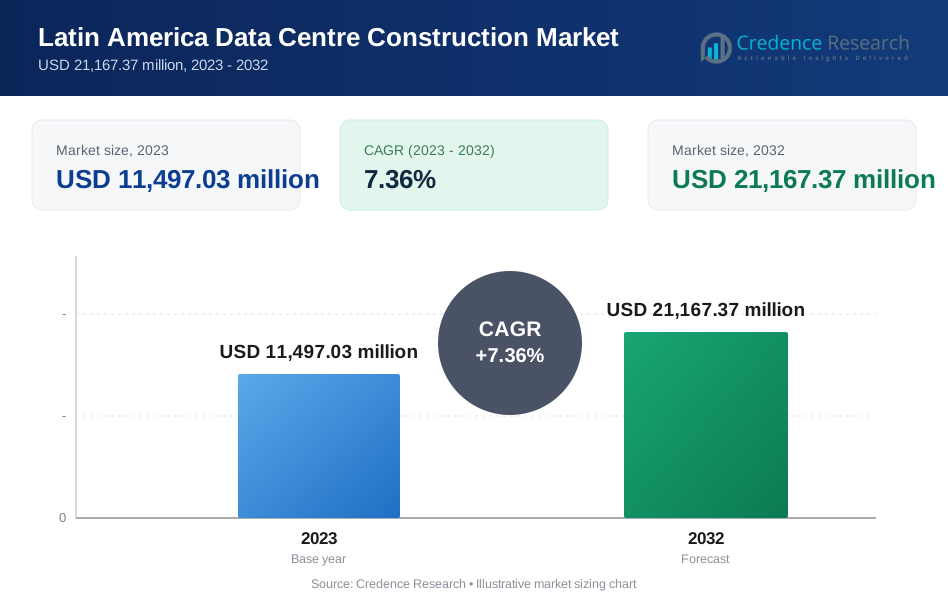
| Latin America Data Centre Construction Market Size 2023 | USD 11,497.03 million |
| Latin America Data Centre Construction Market, CAGR | 7.36% |
| Latin America Data Centre Construction Market Size 2032 | USD 21,167.37 million |
Market Overview
The Latin America Data Centre Construction Market is projected to grow from USD 11,497.03 million in 2023 to USD 21,167.37 million by 2032, reflecting a compound annual growth rate (CAGR) of 7.36%.
The Latin America Data Centre Construction Market is driven by the increasing demand for digital services, cloud computing, and data storage solutions, fueled by the region's expanding IT and telecom sectors. Government initiatives aimed at improving digital infrastructure, along with growing investments from both local and international companies, are further boosting the market. Additionally, the rising adoption of technologies like IoT and AI is prompting businesses to invest in modern, scalable data centres. Trends such as the focus on energy efficiency and sustainability in data centre design are also shaping the market, aligning with global efforts to reduce environmental impact and operational costs.
The Latin America Data Centre Construction Market is dominated by Brazil, which accounts for the largest market share due to its strong economy, large population, and high internet penetration. Argentina, Chile, Colombia, and Peru are also key markets, driven by increasing digitalization and government initiatives to improve data infrastructure. These countries are becoming attractive destinations for data centre investments, fueled by the growth of e-commerce, cloud computing, and IoT. Leading players in the market include AECOM Limited, Turner Construction Co., DPR Construction Inc., Fortis Construction, and Ascenty Data Centers E Telecomunicacoes, which are known for their expertise in data centre construction and infrastructure solutions.
Market Drivers
Rapid Digital Transformation
The Latin America Data Centre Construction Market is experiencing rapid growth due to the ongoing digital transformation across the region. Increased internet penetration has led to a surge in demand for data storage and processing capabilities, as more individuals and businesses come online. For instance, internet access has risen to levels comparable to the US, mainly driven by middle- and lower-income groups, fueling a new demand profile for “high value” e-commerce and financial services. The rise of e-commerce and digital marketplaces is further fueling this demand, requiring robust data infrastructure to support online shopping and digital transactions. Government initiatives are also playing a crucial role in this transformation, as investments in digital infrastructure aim to promote economic growth and enhance public services. By prioritizing the development of reliable data infrastructure, governments are laying the groundwork for a more connected and efficient digital economy.
Rising Demand for IoT and AI
The increasing use of Internet of Things (IoT) devices and artificial intelligence (AI) applications is generating massive amounts of data that require storage and processing, further driving the demand for data centres in Latin America. For instance, it is expected that there will be 513 million new IoT connections between 2020 and 2025 in Latin America. IoT and AI technologies enable real-time data generation and analysis, which is crucial for industries looking to optimize operations, improve decision-making, and enhance customer experiences. Data centres provide the essential infrastructure needed for real-time analytics, supporting businesses in harnessing the power of data to drive growth and innovation. As the use of IoT and AI expands, the need for advanced data centres capable of handling large-scale data processing and storage will continue to grow.
Cloud Computing Adoption
The adoption of cloud computing is a significant driver of the data centre construction market in Latin America. Cloud-based services offer a cost-effective solution for businesses of all sizes, enabling them to access necessary computing resources without the need for significant upfront investment. The scalability of cloud solutions allows businesses to easily adjust their resources to meet changing demands, ensuring flexibility and efficiency. This capability is particularly attractive to businesses in a dynamic market environment, where demand can fluctuate. Additionally, cloud computing provides access to a wide range of applications and services, enabling businesses to innovate and improve their operations. The growing preference for cloud solutions is driving the construction of data centres capable of supporting these scalable and flexible services.
Hyperscale Data Center Investments
Major hyperscale data centre providers are increasingly investing in Latin America, recognizing the region's potential as a growing market for digital services. These global companies are expanding their operations to serve regional customers, driving the construction of large-scale data centres. Such investments are not only enhancing the region's data infrastructure but also contributing to economic development by creating jobs and supporting local industries. The presence of hyperscale data centres also attracts other businesses, further boosting demand for advanced data infrastructure. This trend is positioning Latin America as an important hub for digital services, capable of serving both local and international markets with high-capacity, reliable data solutions.
Market Trends
Consolidation, Hyperscale Growth, and Focus on Sustainability
The Latin America Data Centre Construction Market is experiencing significant consolidation and growth, particularly driven by the investments of global hyperscale providers. These large-scale investments are leading to increased competition as major players establish a stronger presence in the region. Hyperscale providers are building expansive data centers in strategic markets across Latin America, aiming to serve regional customers more efficiently while reducing latency. For instance, hyperscale providers like AWS and Google have established cloud nodes in Brazil and Chile to improve connectivity and reduce latency. This trend towards regionalization of data centers is crucial for improving service delivery and meeting the growing demand for digital services. As a result, the market is seeing the development of larger and more sophisticated facilities that can support high-capacity data processing and storage. Alongside this, there is a strong emphasis on sustainability within the industry. Data center operators are increasingly focused on building green data centers that minimize environmental impact. This includes the integration of renewable energy sources, such as solar and wind power, to fuel data center operations. By adopting these sustainable practices, operators are not only reducing their carbon footprint but also aligning with global environmental goals and regulatory requirements, which are becoming increasingly stringent. The combination of consolidation, hyperscale growth, and a focus on sustainability is reshaping the data center landscape in Latin America, positioning the region as a critical hub for both regional and global digital services.
Edge Computing Expansion, Data Sovereignty, and Modular Data Centers
Another significant trend in the Latin America Data Centre Construction Market is the expansion of edge computing, driven by the need for distributed infrastructure that reduces latency and improves response times for data-intensive applications. As businesses demand quicker data processing capabilities, there is a growing shift towards the development of smaller-scale data centers located closer to end-users. This trend is especially important for applications like IoT and AI, where real-time data processing is crucial. The rise of edge computing is not only enhancing the performance of digital services but also promoting the proliferation of localized, smaller data centers across the region. Concurrently, there is an increased focus on data sovereignty, with governments and businesses prioritizing the storage of sensitive data within national borders. This emphasis on local data storage is driving the development of data centers that comply with stringent data localization laws, ensuring that data remains secure and under local jurisdiction. Additionally, the market is witnessing a shift towards modular data centers, which offer greater scalability and flexibility compared to traditional construction methods. These modular solutions can be rapidly deployed to meet growing demand, making them an attractive option for businesses looking to quickly expand their data infrastructure. Moreover, partnerships and collaborations among data center operators are becoming more common, as companies seek to share infrastructure and reduce operational costs. These partnerships also foster innovation in data center technologies and services, enabling operators to stay competitive in a rapidly evolving market.
Market Challenges Analysis
Infrastructure Constraints and Regulatory Hurdles
The Latin America Data Centre Construction Market faces significant challenges related to infrastructure and regulatory hurdles. For instance, one of the primary infrastructure constraints is the inadequate power grid, characterized by unreliable power supply and frequent outages, which can severely disrupt data center operations. Additionally, limited fiber optic infrastructure and high latency pose connectivity challenges, affecting the performance and reliability of data centers. These issues can limit the market’s growth potential, as consistent power and robust connectivity are critical for the efficient functioning of data centers. On the regulatory front, navigating complex legal frameworks related to data privacy, security, and environmental standards can be both time-consuming and costly. The process of obtaining necessary permits and approvals for data center construction often involves lengthy bureaucratic procedures, leading to delays in project timelines. These regulatory hurdles can deter investors and developers, making it challenging to establish and expand data centers swiftly.
Economic Volatility and Talent Shortages
Economic volatility presents another significant challenge for the Latin America Data Centre Construction Market. Currency fluctuations and economic instability can create uncertainty for investors and developers, affecting the financial viability of data center projects. Political risks, such as instability and changes in government policies, can further impact the business environment, leading to unpredictable regulatory landscapes and potential shifts in investment priorities. These economic factors can make it difficult for businesses to plan long-term investments in data center infrastructure. Additionally, the market faces a shortage of skilled professionals in areas such as data center design, operations, and maintenance. This talent gap can hinder the development and efficient operation of data centers, as specialized skills are required to manage these complex facilities. To address this challenge, companies need to invest in comprehensive training and development programs to build a skilled workforce capable of supporting the industry’s growth. Overcoming these economic and talent-related challenges is essential for sustaining the momentum of data center development in Latin America, ensuring that the region remains competitive in the global digital economy.
Market Segmentation Analysis:
By Type:
The Latin America Data Centre Construction Market is segmented by type into Tier 1, Tier 2, Tier 3, and Tier 4 facilities, which vary in terms of reliability, redundancy, and security. Tier 1 and Tier 2 data centres offer basic infrastructure with limited redundancy, suitable for non-critical operations. However, the market is increasingly leaning towards Tier 3 and Tier 4 data centres, which provide higher levels of redundancy and uptime, making them ideal for mission-critical applications. These high-tier facilities are in demand due to the growing emphasis on data security, reliability, and compliance with international standards. Sectors such as finance, healthcare, and IT, which require robust data handling capabilities, are driving the demand for these advanced facilities. The trend towards building more Tier 3 and Tier 4 data centres reflects the region’s commitment to supporting sophisticated digital services and ensuring business continuity.
By Infrastructure:
The data centre construction market in Latin America is also segmented based on infrastructure, encompassing IT infrastructure, power distribution and cooling (PD & Cooling) infrastructure, and miscellaneous infrastructure. IT infrastructure, including networking equipment, servers, and storage solutions, forms the backbone of data centre operations, ensuring high-speed connectivity and efficient data management. The demand for advanced IT infrastructure is driven by the need for seamless data processing and storage, supporting the region's expanding digital economy. PD & Cooling infrastructure is crucial for maintaining optimal operating conditions, as efficient power distribution and cooling systems are essential to prevent downtime and extend the lifespan of equipment. Miscellaneous infrastructure includes other critical components such as security systems and monitoring equipment, ensuring the safety and reliability of data centre operations. This comprehensive approach to infrastructure development is essential for supporting the growing demands of businesses in Latin America for secure, reliable, and scalable data centre solutions.
Segments:
Based on Type:
- Tier 1
- Tier 2
- Tier 3
- Tier 4
Based on Infrastructure:
- IT Infrastructure
- Networking Equipment
- Server
- Storage
- PD & Cooling Infrastructure
- Power Distribution
- Cooling
- Miscellaneous Infrastructure
Based on Vertical:
- IT & Telecom
- BFSI
- Government & Defense
- Healthcare
- Energy
- Others
Based on the Geography:
- Brazil
- Argentina
- Peru
- Chile
- Colombia
- Rest of Latin America
Regional Analysis
Brazil
Brazil dominates the Latin American data centre construction market with a substantial market share of approximately 45%. As the region's largest economy, Brazil's data centre landscape is rapidly expanding, driven by increasing digital transformation initiatives, cloud adoption, and the growing presence of global hyperscale providers. São Paulo, in particular, has emerged as a major data centre hub, attracting significant investments from both local and international players. The country's robust telecommunications infrastructure, large population, and thriving e-commerce sector contribute to the rising demand for data centre services. Brazil's government has also implemented favorable policies to attract foreign investments in the technology sector, further accelerating the growth of data centre construction. Major projects in the country focus on incorporating energy-efficient designs, renewable energy sources, and advanced cooling technologies to address sustainability concerns while meeting the escalating data processing and storage needs of businesses and consumers alike.
Chile
Chile has established itself as a key player in the Latin American data centre market, capturing roughly 15% of the market share. The country's political stability, strong economy, and strategic location have made it an attractive destination for data centre investments. Santiago, the capital city, is emerging as a significant data centre hub, benefiting from its advanced infrastructure and connectivity to submarine cable systems. Chile's commitment to renewable energy, with a particular focus on solar and wind power, has positioned it as a preferred location for green data centres. The government's progressive digital agenda and initiatives to position Chile as a digital hub for the region have further stimulated the growth of the data centre construction market.
Key Player Analysis
- AECOM Limited
- Turner Construction Co.
- DPR Construction Inc.
- Fortis Construction
- ZFB Group
- Aceco TI
- Constructora Sudamericana S.A
- HostDime Brasil
- CyrusOne Inc.
- RITTAL Sistemas Eletromecânicos Ltda. (Rittal GmbH & Co. KG)
- Legrand
- Delta Group
- Ascenty Data Centers E Telecomunicacoes
- Equinix Inc.
Competitive Analysis
The competitive landscape of the Latin America Data Centre Construction Market is marked by the presence of several key players, including AECOM Limited, Turner Construction Co., DPR Construction Inc., Fortis Construction, and Ascenty Data Centers E Telecomunicacoes. These companies are leaders in the market due to their extensive experience in designing and constructing state-of-the-art data centres that meet the region's growing demand for digital infrastructure. They offer comprehensive solutions that include site selection, construction, and integration of advanced IT and cooling systems, which are critical for the efficient operation of data centres. The competitive advantage of these players lies in their ability to deliver large-scale, high-tier facilities that ensure reliability, scalability, and security. Additionally, these companies are leveraging local partnerships, regional expertise, and advanced construction techniques to optimize project costs and timelines. By focusing on innovation, sustainability, and compliance with regional regulations, these players are well-positioned to capitalize on the increasing demand for data centre infrastructure across Latin America.
Recent Developments
- In August 2024, AECOM announced its UK Healthcare Alliance (UKHA) joint venture with Gleeds and Currie & Brown to provide program management services for the construction of two regional hospitals in Piura and Trujillo in northern Peru.
- In August 2024, Google announced the opening of its second data center in Latin America, in Canelones, Uruguay, with an investment of over $850 million.
- In May 2024, ZFB Group was mentioned as a key player in the Latin America Data Center Construction Market Report 2024.
- In April 2022, HostDime announced the start of construction of a solar power plant to support its data center in João Pessoa, Brazil.
Market Concentration & Characteristics
The Latin America Data Centre Construction Market exhibits moderate to high market concentration, with a few leading players holding significant market shares due to their established presence and extensive capabilities. Companies such as AECOM Limited, Turner Construction Co., and Ascenty Data Centers E Telecomunicacoes dominate the market by offering comprehensive data centre solutions that cater to the diverse needs of industries ranging from finance to telecommunications. These companies benefit from their ability to deliver high-quality, scalable infrastructure that meets the growing demand for reliable and secure data services. The market is characterized by a strong focus on building Tier 3 and Tier 4 facilities, which offer high levels of redundancy and uptime, crucial for mission-critical applications. Additionally, there is an increasing emphasis on sustainability and energy efficiency, with data centre operators adopting green technologies to minimize environmental impact. The combination of strategic location, advanced infrastructure, and a focus on innovation shapes the competitive dynamics of the Latin American data centre market.
Report Coverage
The research report offers an in-depth analysis based on Type, Infrastructure, Vertical and Geography. It details leading market players, providing an overview of their business, product offerings, investments, revenue streams, and key applications. Additionally, the report includes insights into the competitive environment, SWOT analysis, current market trends, as well as the primary drivers and constraints. Furthermore, it discusses various factors that have driven market expansion in recent years. The report also explores market dynamics, regulatory scenarios, and technological advancements that are shaping the industry. It assesses the impact of external factors and global economic changes on market growth. Lastly, it provides strategic recommendations for new entrants and established companies to navigate the complexities of the market.
Future Outlook
- The demand for data centres in Latin America will continue to grow, driven by increased digitalization and internet usage across the region.
- Investment in Tier 3 and Tier 4 data centres will rise to ensure higher reliability, security, and compliance with international standards.
- Brazil will maintain its position as the leading market, attracting the majority of data centre investments in Latin America.
- Countries like Argentina, Chile, and Colombia will see significant growth, becoming key markets for data centre construction due to their improving digital infrastructure.
- The adoption of cloud computing and IoT technologies will further increase the need for advanced data centre facilities.
- Sustainability will become a critical focus, with data centre operators prioritizing energy-efficient designs and the use of renewable energy sources.
- Edge computing will drive the development of smaller-scale data centres closer to end-users to reduce latency and improve service delivery.
- Economic stability and regulatory clarity will play vital roles in attracting more foreign investments into the region's data centre market.
- Partnerships between local and international firms will increase, fostering innovation and enabling the development of advanced data centre technologies.
- The growing emphasis on data sovereignty will lead to more localized data storage solutions, with countries enacting stricter data protection laws.
Request a Free Sample
Fill in your details and we'll send you a free sample report.
- Sample data tables & charts
- Research methodology
Need a Custom Version of This Report?
Tailor the scope, geography, or segments to your exact requirements.
- Custom geography or segment scope
- Direct access to our analyst team
Frequently Asked Questions
What is the current size of the Latin America Data Centre Construction Market?
What factors are driving the growth of the Latin America Data Centre Construction Market?
What are the key segments within the Latin America Data Centre Construction Market?
Who are the major players in the Latin America Data Centre Construction Market?
Table of Content
Chapter 1. Report Introduction
- 1.1 Report Description & Purpose
- 1.1.1 Report Title & Market Definition
- 1.1.2 Unique Selling Propositions (USP) & Key Differentiators
- 1.1.3 Value Proposition for Stakeholders
- 1.2 Research Objectives
- 1.2.1 Market Sizing Objectives (Volume & Revenue)
- 1.2.2 Segmentation Objectives
- 1.2.3 Competitive Intelligence Objectives
- 1.2.4 Forecast & Scenario Objectives
- 1.3 Report Scope
- 1.3.1 Latin America Data Centre Construction Scope – Types & Subtypes Covered
- 1.3.2 Geographic Scope – Regions & Countries Covered
- 1.3.3 Historical Period, Base Year & Forecast Period (2023; forecast to 2032)
- 1.3.4 Inclusions & Exclusions
- 1.4 HS Code & Classification Framework
- 1.5 Currency, Units & Pricing Basis
- 1.6 Target Stakeholders
- 1.7 Limitations & Assumptions
Chapter 2. Executive Summary
- 2.1 Global Latin America Data Centre Construction Market Snapshot
- 2.1.1 Market Size – Historical (2023) & Forecast (2023-2032) (2023: USD 11,497.03 million → 2032: USD 21,167.37 million)
- 2.1.2 Volume & Revenue – Global Totals
- 2.1.3 Key Market Highlights – Top Five Facts
- 2.2 Latin America Data Centre Construction Market Segmentation Snapshot
- 2.2.1 Market Split by Region – 2023 vs. 2032
- 2.3 Competitive Snapshot
- 2.3.1 Top 10 Players by Revenue Share – 2023
- 2.3.2 Top 10 Players by Volume Share – 2023
- 2.3.3 Recent Strategic Developments (18-Month Summary)
- 2.4 Key Investment Highlights & Strategic Conclusions
Chapter 3. Latin America Data Centre Construction Market Dynamics & Industry Analysis
- 3.1 Market Overview & Context
- 3.1.1 Latin America Data Centre Construction Market Position in the Broader Automotive Value Chain
- 3.1.2 OEM vs. Replacement Market Dynamics
- 3.1.3 Market Maturity & Development Stage by Region
- 3.2 Latin America Data Centre Construction Market Drivers
- 3.3 Latin America Data Centre Construction Market Restraints & Challenges
- 3.4 Latin America Data Centre Construction Market Opportunities
- 3.5 Porter's Five Forces Analysis
- 3.5.1 Threat of New Entrants
- 3.5.2 Bargaining Power of Suppliers
- 3.5.3 Bargaining Power of Buyers
- 3.5.4 Threat of Substitutes
- 3.5.5 Competitive Rivalry – Intensity Assessment
- 3.6 Latin America Data Centre Construction Value Chain Analysis
- 3.6.1 Upstream – Raw Material/Input Suppliers
- 3.6.1.1 Raw Material/Input 1
- 3.6.1.2 Raw Material/Input 2
- 3.6.1.3 Raw Material/Input 3
- 3.6.2 Midstream – Production/Manufacturing/Service Delivery
- 3.6.2.1 Production/Process Overview
- 3.6.2.2 Key Facility Locations & Capacity by Manufacturer
- 3.6.3 Downstream – Distribution & End Consumer
- 3.6.3.1 Primary Channel – B2B/OEM
- 3.6.3.2 Secondary Channels – Dealer, Retail, Online, Direct
- 3.6.4 Value Chain Profitability Analysis
- 3.6.1 Upstream – Raw Material/Input Suppliers
- 3.7 PESTEL Analysis
- 3.7.1 Political Factors
- 3.7.2 Economic Factors
- 3.7.3 Social Factors
- 3.7.4 Technological Factors
- 3.7.5 Environmental Factors
- 3.7.6 Legal Factors
- 3.8 Latin America Data Centre Construction Supply Chain Analysis
- 3.8.1 Raw Material/Input Supply Risk Assessment
- 3.8.2 Manufacturing Concentration Risk (Geographic Exposure)
- 3.8.3 Trade Disruption Impact Analysis
- 3.9 Regulatory & Policy Landscape
Note: The regulatory and policy landscape section covers regulations based on their applicability to the market, Latin America Data Centre Construction category, geography, and scope of the study. Only regulatory frameworks with a material impact on operations, compliance, trade, sustainability, or market access are analyzed in detail.
Chapter 4. Key Investment Pockets & Opportunity Analysis
- 4.1 Latin America Data Centre Construction Market Attractiveness Analysis
- 4.1.1 By Region – Investment Attractiveness Matrix (Volume × CAGR)
- 4.2 Absolute Revenue Growth Opportunity
- 4.2.1 By Region – Absolute USD Growth Through 2032
- 4.3 Incremental Volume Opportunity
- 4.3.1 By Region – Incremental Volume Through 2032
- 4.3.2 Segment – Incremental Volume
- 4.4 Emerging Submarket Opportunity Deep Dive (Subject to Applicability)
- 4.5 Emerging Market Opportunity Scorecards
- 4.5.1 United States
- 4.5.2 Europe
- 4.5.3 Asia
- 4.5.4 Middle East & Africa
Note: Emerging Market Opportunity Scorecards will be included based on relevance and strategic importance. Regions listed are indicative and may vary depending on data availability and market dynamics.
Chapter 5. Latin America Data Centre Construction Import-Export Analysis & Trade Flows
- 5.1 Global Trade Overview
- 5.1.1 Global Export Value by Country (2023)
- 5.1.2 Global Export Volume by Country (2023)
- 5.1.3 Global Import Value by Country (2023)
- 5.1.4 Global Import Volume by Country (2023)
- 5.1.5 Net Trade Balance by Country (2023)
- 5.2 Export Analysis – Segment
- 5.2.1 Type 1 (HS Code)
- 5.2.2 Type 2 (HS Code)
- 5.2.3 Type 3 (HS Code)
- 5.2.4 Type 4 (HS Code)
- 5.2.5 Type 5 (HS Code)
- 5.3 Import Analysis – Segment
- 5.3.1 Type 1 (HS Code)
- 5.3.2 Type 2 (HS Code)
- 5.3.3 Type 3 (HS Code)
- 5.3.4 Type 4 (HS Code)
- 5.3.5 Type 5 (HS Code)
- 5.4 Average Unit Trade Prices
- 5.4.1 Average Export Price – Segment & Country
- 5.4.2 Average Import Price – Segment & Source Country
- 5.4.3 Price Trends (2023)
- 5.5 Key Trade Route Analysis
- 5.5.1 Trade Route 1
- 5.5.2 Trade Route 2
- 5.5.3 Trade Route 3
- 5.5.4 Trade Route 4
- 5.5.5 Trade Route 5
- 5.6 Trade Policy Impact Assessment
- 5.6.1 US Anti-Dumping & Section 301 Tariffs
- 5.6.2 EU Customs Union Impact
- 5.6.3 Major Free Trade Agreements
- 5.6.4 USMCA Rules of Origin
Note: Trade policy analysis will be included only where relevant to the Latin America Data Centre Construction market.
Chapter 6. Competitive Landscape & Company Benchmarking
- 6.1 Latin America Data Centre Construction Market Concentration & Structure
- 6.1.1 Herfindahl-Hirschman Index (HHI) – vs. 2023
- 6.1.2 Tier 1, Tier 2 & Tier 3 Market Structure
- 6.1.3 Global, Regional & Local Player Dynamics
- 6.2 Latin America Data Centre Construction Market Share Analysis – 2023
- 6.2.1 Global Revenue Share by Company
- 6.2.2 Global Volume Share by Company
- 6.2.3 Regional Revenue Share
- 6.2.4 Market Share Evolution ( vs. 2023)
- 6.2.5 OEM Segment Share by Company
- 6.2.6 Replacement Segment Share by Company
- 6.3 Production/Delivery Capacity & Facility Analysis
- 6.3.1 Global Installed Capacity
- 6.3.2 Capacity Utilization Rates
- 6.3.3 Production/Output Volume
- 6.3.4 Facility Locations & Capacity Map
- 6.3.5 Planned Capacity Additions
- 6.4 Latin America Data Centre Construction Competitive Benchmarking Matrix
- 6.4.1 Revenue, Volume, CAGR & Profitability Comparison
- 6.4.2 Channel Revenue Mix
- 6.4.3 Geographic Revenue Exposure
- 6.4.4 R&D Intensity
- 6.4.5 Sustainability Maturity
- 6.5 Strategic Developments in Latin America Data Centre Construction (Last 24 Months)
- 6.5.1 Mergers, Acquisitions & Divestments
- 6.5.2 New Latin America Data Centre Construction Launches
- 6.5.3 Facility Expansions
- 6.5.4 Strategic Alliances, Joint Ventures & Partnerships
- 6.5.5 Distribution Expansion & Market Entry
- 6.5.6 Sustainability & ESG Initiatives
- 6.6 Competitive Strategy Mapping
- 6.6.1 Leader, Challenger, Follower & Niche Classification
- 6.6.2 Pricing Strategy Comparison
- 6.6.3 Channel Strategy Matrix
Note: Strategic developments are included based on their materiality and the availability of reliable information.
Chapter 7. Global Latin America Data Centre Construction Market – By Distribution Channel
- 7.1 Segment Overview
- 7.1.1 Volume & Revenue Split by Channel (2023 & 2032)
- 7.1.2 Channel Mix Evolution (2023-2032)
Chapter 8. Regional Market Analysis – Global Overview
- 8.1 Global Regional Overview
- 8.1.1 Regional Volume Share
- 8.1.2 Regional Revenue Share
- 8.1.3 Regional Volume by Region
- 8.1.4 Regional Revenue by Region
- 8.1.5 Regional Forecast Through 2032
- 8.2 Cross-Regional Segment Analysis
- 8.2.1 By Distribution Channel
- 8.2.2 By Brand/Price Tier
Chapter 9. North America Latin America Data Centre Construction Market
- 9.1 United States
- 9.2 Canada
- 9.3 Mexico
Chapter 10. Europe Latin America Data Centre Construction Market
- 10.1 Germany
- 10.2 France
- 10.3 Italy
- 10.4 United Kingdom
- 10.5 Spain
- 10.6 Poland
- 10.7 Russia
- 10.8 Netherlands
- 10.9 Belgium
- 10.10 Sweden
- 10.11 Denmark
- 10.12 Norway
- 10.13 Rest of Europe
Chapter 11. Asia Pacific Latin America Data Centre Construction Market
- 11.1 China
- 11.2 India
- 11.3 Japan
- 11.4 South Korea
- 11.5 Thailand
- 11.6 Indonesia
- 11.7 Vietnam
- 11.8 Malaysia
- 11.9 Australia
- 11.10 Rest of Asia Pacific
Chapter 12. Latin America Latin America Data Centre Construction Market
- 12.1 Brazil
- 12.2 Argentina
- 12.3 Colombia
- 12.4 Chile
- 12.5 Rest of Latin America
Chapter 13. Middle East Latin America Data Centre Construction Market
- 13.1 Saudi Arabia
- 13.2 United Arab Emirates
- 13.3 Turkey
- 13.4 Israel
- 13.5 Iran
- 13.6 Rest of the Middle East
Chapter 14. Africa Latin America Data Centre Construction Market
- 14.1 South Africa
- 14.2 Egypt
- 14.3 Nigeria
- 14.4 Morocco
- 14.5 Rest of Africa
Chapter 15. Latin America Data Centre Construction Company Profiles
- 15.1 [Company 01]
- 15.1.1 Company Overview
- 15.1.2 Key Management Personnel
- 15.1.3 Products & Services Portfolio
- 15.1.4 Financial Performance
- 15.1.5 Key Market Focus & Geographic Presence
- 15.1.6 Recent Developments & Strategic Initiatives
Note: The company profile list is preliminary and may change based on research findings, market developments, data availability, and client requirements.
Chapter 16. Appendices
- Appendix A – List of Abbreviations & Acronyms
- Appendix B – Industry Classification Code Reference – Full Series
- Appendix C – Production & Capacity Data Tables
- Appendix D – End-Use & Demand Base Tables
- Appendix E – Consumption & Replacement Rate Assumptions
- Appendix F – ASP Reference Tables
- Appendix G – Manufacturing & Facility Database
- Appendix H – Import-Export Data Tables
- Appendix I – Regulatory Summary Tables
- Appendix J – Primary Research Participant List (Anonymized)
- Appendix K – Primary Research Questionnaire Framework
- Appendix L – Data Sources & Bibliography
- Appendix M – Market Size Divergence & Source Comparison
Chapter 17. Research Methodology
- 17.1 Research Framework & Philosophy
- 17.2 Secondary Research – Sources, Hierarchy & Data Extraction
- 17.3 Data Modeling – Bottom-Up & Top-Down Market Sizing
- 17.4 Primary Research – Stakeholder Framework, LOI & Sample Sizes
- 17.5 Forecast Methodology – Regression, Scenario & Sensitivity Analysis
- 17.6 Quality Control – Four-Layer Validation Framework
- 17.7 Limitations & Standard Assumptions
- 17.8 Disclaimer
