| REPORT ATTRIBUTE | DETAILS |
|---|---|
| Historical Period | 2020-2023 |
| Base Year | 2024 |
| Forecast Period | 2025-2032 |
| Latin America Off The Road Tire Market Size 2023 | USD 929.93 Million |
| Latin America Off The Road Tire Market, CAGR | 3.43% |
| Latin America Off The Road Tire Market Size 2032 | USD 1,260.03 Million |
Market Overview
Latin America Off-the-Road Tire Market size was valued at USD 929.93 million in 2023 and is anticipated to reach USD 1,260.03 million by 2032, at a CAGR of 3.43% during the forecast period (2023-2032).
Several factors are propelling the growth of the Latin America OTR tire market. The region's abundant natural resources, including copper, lithium, gold, and iron ore, have led to increased mining activities, thereby boosting the demand for OTR tires. Additionally, the mechanization of agriculture and the expansion of farming activities have necessitated the use of specialized tires for agricultural machinery. Infrastructure development projects, such as the construction of roads, bridges, and ports, are also contributing to the increased demand for OTR tires. Furthermore, the introduction of eco-friendly OTR tires presents new opportunities for market players to cater to the growing emphasis on sustainability. Moreover, government support for large-scale projects and industrial development in rural zones further stimulates tire consumption. Increasing foreign direct investment (FDI) in sectors like mining and construction also supports long-term market expansion.
Within Latin America, Brazil stands out as the dominant market for OTR tires. The country's extensive agricultural lands and significant mining operations drive the demand for durable and high-performing OTR tires. Investments in infrastructure, including railways and ports, further augment this demand. Other countries in the region, such as Chile and Peru, also contribute to the market's growth due to their mining activities. The collective efforts of these nations in enhancing their industrial and infrastructural capabilities are expected to sustain the growth momentum of the OTR tire market in Latin America. Mexico is also emerging as a key contributor, benefiting from robust construction activity and a rising focus on energy and utility sectors. Regional integration initiatives and improved intra-regional trade logistics are expected to further enhance tire distribution networks.
Market Insights:
- The Latin America OTR tire market was valued at USD 929.93 million in 2023 and is projected to reach USD 1,260.03 million by 2032, registering a CAGR of 3.43% during the forecast period.
- The Global OTR tire market was valued at USD 18,234 million in 2023 and is expected to grow to USD 27,097.46 million by 2032, at a CAGR of 4.5%.
- Countries such as Brazil, Chile, and Peru are expanding mining operations, which boosts the demand for heavy-duty OTR tires due to their rich natural resources like copper, lithium, and iron ore.
- Mechanization in agriculture, particularly in Brazil and Argentina, is accelerating the need for durable OTR tires for advanced agricultural machinery used in large-scale farming.
- Large-scale public works in Colombia, Mexico, and Brazil-spanning roads, ports, and airports-are significantly increasing the demand for OTR tires in the construction sector.
- Manufacturers are focusing on eco-friendly tire designs and integrating digital tools like tire pressure monitoring systems to meet sustainability and operational efficiency needs.
- The high cost of advanced tires and the region's reliance on imports are significant challenges, with supply chain disruptions and currency volatility affecting tire availability and pricing.
- Brazil dominates the market due to its strong agricultural and mining sectors, while Mexico, Chile, and Peru contribute significantly through their growing construction and resource extraction industries.
Market Drivers:
Expansion of Mining Activities in Resource-Rich Regions
Latin America is endowed with vast natural reserves, including copper, lithium, gold, iron ore, and other minerals critical to the global supply chain. The intensification of mining operations, particularly in countries like Brazil, Chile, and Peru, has significantly increased the demand for heavy-duty machinery equipped with robust Off-the-Road (OTR) tires. These tires must withstand harsh environmental conditions and heavy loads, making them an indispensable component in mining activities. For instance, Carajás, the world's largest open-pit iron ore mine, employs ultra-class haul trucks that require robust OTR tires capable of handling the harsh conditions. As global demand for critical minerals rises, regional mining investments continue to surge, further amplifying the need for specialized tire solutions that offer both durability and performance. With multinational mining firms expanding their footprint in Latin America, the OTR tire market is experiencing consistent and sustained demand from this sector.
Agricultural Mechanization and Technological Adoption
Agriculture remains a cornerstone of the Latin American economy, and recent years have seen a steady shift toward mechanized farming practices. Tractors, harvesters, and other advanced equipment are increasingly replacing manual labor, especially in countries like Argentina and Brazil. This transformation is driving the demand for specialized OTR tires capable of navigating diverse terrains and delivering long-lasting performance in remote agricultural fields. Additionally, climate variability and the need for higher productivity have encouraged farmers to invest in modern machinery, boosting tire replacement cycles. The integration of smart farming technologies and precision agriculture has also led to higher expectations for tire performance, efficiency, and reliability, further propelling market growth in the region.
Infrastructure Development and Construction Boom
The ongoing expansion of infrastructure across Latin America is another critical driver fueling the OTR tire market. Governments are prioritizing public works programs involving road networks, bridges, airports, ports, and energy facilities. These projects rely heavily on earthmoving equipment, cranes, loaders, and dump trucks that utilize OTR tires. Countries such as Colombia, Mexico, and Brazil have launched large-scale infrastructure initiatives to stimulate economic growth, reduce logistical bottlenecks, and enhance connectivity. As a result, construction companies are increasingly investing in machinery equipped with high-performance OTR tires to meet tight deadlines and operational demands. This construction boom, driven by both public and private sector investments, is expected to sustain tire demand in the medium to long term.
Sustainability Trends and Innovations in Tire Technology
Growing environmental awareness and regulatory pressures are encouraging the adoption of eco-friendly tire technologies in the Latin American OTR market. Manufacturers are developing tires with reduced rolling resistance, longer lifespans, and recyclable materials to align with global sustainability goals. For instance, in 2023, Michelin introduced a new range of sustainable Off-the-Road (OTR) tires incorporating 60% recycled materials. This initiative aligns with Michelin's broader sustainability goals, aiming to use 40% renewable or recycled materials in its tires by 2030 and achieve 100% sustainable materials by 2050. Additionally, digital innovations such as tire pressure monitoring systems (TPMS) and predictive maintenance solutions are being integrated into heavy equipment to improve safety and reduce operational downtime. These advancements not only enhance performance but also lower the total cost of ownership, making them attractive to cost-conscious operators in mining, agriculture, and construction. As end-users increasingly prioritize sustainable and efficient solutions, manufacturers are responding with advanced OTR tire offerings tailored to Latin America's unique market dynamics.
Market Trends:
Rising Demand for Radial OTR Tires
The Latin America Off-the-Road (OTR) tire market is witnessing a gradual but steady shift from bias-ply to radial tire technology. Radial OTR tires offer superior performance, enhanced fuel efficiency, and extended lifespan, which makes them increasingly attractive across sectors such as mining, construction, and agriculture. For instance, both the Komatsu 930E and Caterpillar 797F, among the largest rigid dump trucks used in mining, are equipped with radial tires to handle the extreme demands of open-pit mining operations. This trend is further supported by the growing awareness of lifecycle cost savings among fleet operators. As operating costs rise and efficiency becomes a priority, businesses are recognizing the long-term value of investing in radial tires. Tire manufacturers are also expanding their product lines to meet this demand, contributing to increased adoption across both original equipment and aftermarket segments.
Increased Presence of Global Manufacturers
Another notable trend in the Latin America OTR tire market is the strengthening footprint of international tire manufacturers. Global brands are increasing investments in regional operations, partnerships, and distribution networks to capitalize on the growing market potential. Companies from North America, Europe, and Asia are setting up manufacturing facilities or expanding supply chains to serve Latin American customers more efficiently. This expansion not only enhances product availability but also introduces advanced tire technologies to the market. As a result, local end-users gain access to a broader range of high-performance products, which improves competitiveness and raises industry standards across key application areas.
Growth of Aftermarket Services and Tire Retreading
The development of tire aftermarket services is gaining traction as end-users in Latin America seek cost-effective solutions to extend the lifecycle of their OTR tires. Retreading, in particular, is becoming increasingly popular among mining and construction fleets, where tire expenses form a significant portion of operational costs. Tire service providers are leveraging advanced retreading technologies and maintenance programs to help operators manage tire wear, reduce downtime, and improve overall efficiency. For instance, Kal Tire, a global leader in mining tire management, opened an OTR retreading plant in Cananea, Mexico, in the heart of the country’s mining industry. The facility uses advanced robotic technology for skiving and grooving, offering retreading and repair services that can add thousands of hours to the life of a tire. This trend is reinforced by the regional push for sustainability and waste reduction, making tire retreading both an economically and environmentally viable option. As these services become more accessible, they are expected to play a vital role in shaping purchasing decisions and fleet management strategies.
Adoption of Smart Tire Solutions and Digital Monitoring
Digital transformation is making its way into the Latin American OTR tire industry through the adoption of smart tire technologies. Real-time monitoring tools, including tire pressure and temperature sensors, are being integrated into fleet systems to enhance safety, minimize unexpected failures, and optimize performance. This trend is gaining momentum among large-scale mining and construction projects that prioritize data-driven decision-making. The integration of these technologies is improving operational visibility and enabling predictive maintenance practices. As digital infrastructure continues to advance across Latin America, the adoption of intelligent tire management systems is expected to grow, enhancing operational reliability and cost-efficiency in the OTR sector.
Market Challenges Analysis:
High Cost of Advanced OTR Tires
One of the key restraints impacting the growth of the Latin America Off-the-Road (OTR) tire market is the high cost associated with advanced tire technologies. For example, in Mexico, OTR tires are engineered to withstand heavy loads and harsh terrains, which requires advanced materials and manufacturing processes, directly elevating their price. Radial and eco-friendly OTR tires, which offer longer life and better performance, often come at a significantly higher price compared to traditional bias-ply tires. For many small and medium-sized enterprises operating in agriculture and construction, the upfront investment required to adopt these premium products can be prohibitive. Despite the long-term cost benefits, limited capital availability and fluctuating commodity prices often deter end-users from transitioning to modern tire solutions.
Supply Chain Disruptions and Import Dependency
Another persistent challenge facing the market is the region’s dependency on imported OTR tires and components, which exposes it to global supply chain disruptions. The volatility in international logistics, freight costs, and raw material availability has affected the timely delivery and pricing of OTR tires in Latin America. Countries with underdeveloped manufacturing infrastructure face delays in tire availability, particularly during periods of high demand in sectors such as mining or construction. Additionally, currency fluctuations and trade barriers further complicate the procurement process, putting pressure on regional distributors and end-users.
Lack of Skilled Labor and Maintenance Infrastructure
The maintenance and management of OTR tires require a specialized workforce and advanced service infrastructure, both of which remain underdeveloped in several parts of Latin America. In rural and remote mining or agricultural zones, the scarcity of trained technicians and repair facilities often leads to inefficient tire usage and reduced product life. This lack of technical support not only increases operational downtime but also diminishes the performance benefits of premium tires. Overcoming this challenge will require investment in training programs and partnerships between tire manufacturers and local service providers to strengthen technical expertise across the region.
Market Opportunities:
The Latin America Off-the-Road (OTR) tire market presents significant opportunities for growth, particularly through infrastructure development and technological advancements. Governments across the region are prioritizing investments in roads, transportation corridors, ports, and energy projects to drive economic recovery and long-term development. These initiatives create a sustained demand for construction and earthmoving equipment, which in turn increases the need for high-performance OTR tires. International funding, public-private partnerships, and foreign direct investments are also supporting these developments, offering tire manufacturers and suppliers new avenues for expansion. The rise in cross-border trade and regional logistics also requires durable and reliable tires, reinforcing the importance of advanced OTR tire solutions.
Moreover, the shift toward sustainable operations and digitization offers another compelling growth opportunity. As industries such as mining, agriculture, and construction aim to reduce their environmental footprint, there is a growing demand for eco-friendly and fuel-efficient tire models. Manufacturers that can offer recyclable materials, lower rolling resistance, and longer-lasting products will find increasing acceptance in the market. Additionally, the adoption of smart tire technologies-such as real-time pressure monitoring and predictive maintenance tools-presents a chance to provide value-added solutions tailored to large-scale operations. Companies that invest in local manufacturing, offer aftermarket services, and integrate digital innovations will be well-positioned to capitalize on the evolving demands of Latin America’s OTR tire market.
Market Segmentation Analysis:
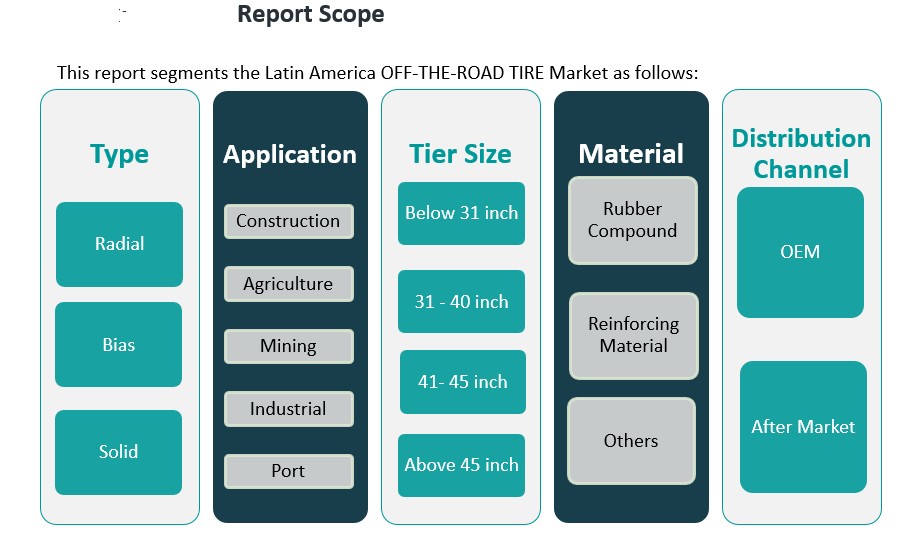
The Latin America Off-the-Road (OTR) tire market is segmented by type, application, tire size, material, and distribution channel, each offering distinct growth dynamics.
By type, radial tires are gaining momentum due to their enhanced performance, durability, and fuel efficiency, particularly in mining and large-scale agricultural applications. However, bias tires still retain demand in regions with cost-sensitive operations. Solid tires, although niche, are gradually finding use in industrial and port operations where puncture resistance and durability are critical.
By application, the construction segment holds a prominent share due to widespread infrastructure development across Brazil, Mexico, and Colombia. The agriculture segment is also witnessing strong demand, driven by increased mechanization and expansive farming operations in Argentina and Brazil. The mining sector continues to be a key driver, supported by the region’s vast mineral resources. Meanwhile, industrial and port applications are steadily growing, fueled by regional trade expansion and modernization of logistics infrastructure.
By tire size, the 31–40 inch and above 45 inch segments are leading due to their suitability for heavy-duty machinery in mining and large-scale construction projects. The below 31 inch segment caters primarily to agriculture and light construction equipment.
By material standpoint, rubber compounds dominate due to their wide applicability and performance benefits, while reinforcing materials are gaining prominence for high-load and extreme-condition applications.
By distribution, aftermarket sales represent a larger share, driven by the high replacement frequency in rugged operations. OEM sales, though smaller, are expected to rise with increasing equipment production and fleet expansions in key sectors.
Segmentation:
By Type Segment
- Radial
- Bias
- Solid
By Application Segment
- Construction
- Agriculture
- Mining
- Industrial
- Port
By Tire Size Segment
- Below 31 inch
- 31 - 40 inch
- 41 - 45 inch
- Above 45 inch
By Material Segment
- Rubber Compound
- Reinforcing Material
- Others
By Distribution Channel Segment
- OEM
- After Market
Regional Analysis:
The Latin America Off-the-Road (OTR) tire market exhibits varied dynamics across different countries, influenced by factors such as industrial activities, infrastructure development, and agricultural practices.
Brazil
Brazil stands as the dominant player in the Latin American OTR tire market, accounting for a significant share due to its expansive agricultural lands and robust mining sector. The country's extensive cultivation of crops like soybeans and sugarcane necessitates the use of durable OTR tires for agricultural machinery. Additionally, Brazil's rich mineral resources, including iron ore, drive the demand for heavy-duty tires in mining operations. Infrastructure projects, such as the construction of roads and ports, further bolster the market, making Brazil a pivotal contributor to the region's OTR tire industry.
Chile and Peru
Chile and Peru are significant contributors to the OTR tire market, primarily due to their extensive mining activities. Chile, being one of the world's leading copper producers, and Peru, with its rich deposits of minerals like gold and silver, rely heavily on OTR tires for mining equipment. The challenging terrains and demanding operational conditions in these countries necessitate high-quality, durable tires, thereby driving market growth.
Mexico and Argentina
Mexico and Argentina also play vital roles in the Latin American OTR tire market. Mexico's growing construction sector, fueled by urbanization and infrastructure development, increases the demand for OTR tires used in construction machinery. Argentina's vast agricultural activities, particularly in the cultivation of soybeans and wheat, require reliable OTR tires for farming equipment. Both countries' emphasis on enhancing their industrial and agricultural sectors contributes to the steady growth of the OTR tire market.
Colombia and Other Regions
Colombia's OTR tire market is driven by its mining and construction industries. The country's efforts to improve infrastructure and boost mineral extraction activities necessitate the use of specialized OTR tires. Other regions in Latin America, including countries like Bolivia and Ecuador, are gradually emerging in the OTR tire market, supported by their developing agricultural and mining sectors. As these countries invest in infrastructure and industrial growth, the demand for OTR tires is expected to rise, contributing to the overall expansion of the market in Latin America.
Key Player Analysis:
- Bridgestone
- Michelin
- Goodyear
- Yokohama Tire
- China National Tire & Rubber
- MRF
- Continental AG
- Belshina
- Cheng-Shin Rubber
- Eurotire
Competitive Analysis:
The Latin America Off-the-Road (OTR) tire market is moderately consolidated, with several global and regional players competing across diverse industry verticals. Leading manufacturers such as Bridgestone Corporation, Michelin Group, Goodyear Tire & Rubber Company, and Continental AG hold significant market shares due to their advanced product portfolios, robust distribution networks, and focus on technological innovation. These companies are investing in localized production, dealer partnerships, and aftersales services to strengthen their market presence. Additionally, emerging regional players are gaining traction by offering cost-effective alternatives tailored to local terrain conditions. Competitive strategies include product customization, expansion of radial tire offerings, and the integration of smart tire technologies. As infrastructure and industrial investments grow, market participants are intensifying efforts to capture opportunities in high-growth segments such as mining and agriculture, positioning themselves to address evolving customer demands and expand their footprint across Latin America.
Recent Developments:
- In March 2025, Bridgestone Americas unveiled two new tires featuring its next-generation ENLITEN technology: the Bridgestone R273 Ecopia regional tire for the steer position and the Bridgestone Duravis M705 for mixed fleet vehicles. These launches, showcased at the 2025 Technology & Maintenance Council Annual Meeting, highlight Bridgestone’s focus on sustainability and performance for commercial fleets.
- In February 2025, Yokohama Rubber finalized the acquisition of Goodyear’s global OTR tire business for $905 million. This acquisition, part of Yokohama’s medium-term management plan, will expand its off-highway tire product offerings and strengthen its position in the mining and construction tire segment globally, including Latin America.
Market Concentration & Characteristics:
The Latin America Off-the-Road (OTR) tire market is moderately concentrated, with a few dominant players such as Bridgestone, Michelin, Goodyear, Continental, and Pirelli holding significant market shares. These companies leverage their extensive product portfolios, technological advancements, and established distribution networks to maintain a competitive edge. The market is characterized by a strong demand for durable and high-performance tires, driven by the region's robust mining, agriculture, and construction sectors. Additionally, the increasing adoption of radial tires, known for their enhanced efficiency and longevity, is reshaping market dynamics. The presence of both global and regional manufacturers fosters a competitive environment, encouraging continuous innovation and strategic partnerships to cater to the diverse needs of end-users across Latin America.
Report Coverage:
The research report offers an in-depth analysis based on Type, Application, Tire Size, Material and Distribution Channel It details leading market players, providing an overview of their business, product offerings, investments, revenue streams, and key applications. Additionally, the report includes insights into the competitive environment, SWOT analysis, current market trends, as well as the primary drivers and constraints. Furthermore, it discusses various factors that have driven market expansion in recent years. The report also explores market dynamics, regulatory scenarios, and technological advancements that are shaping the industry. It assesses the impact of external factors and global economic changes on market growth. Lastly, it provides strategic recommendations for new entrants and established companies to navigate the complexities of the market.
Future Outlook:
- Rising investments in mining and construction will sustain long-term demand for high-performance OTR tires.
- Advancements in tire technology, including smart monitoring systems, will enhance operational efficiency.
- The shift toward radial tire adoption will accelerate as end-users prioritize fuel efficiency and durability.
- Eco-friendly and recyclable tire materials will gain traction due to growing environmental regulations.
- Expansion of regional infrastructure projects will create new opportunities across emerging markets.
- Strategic partnerships between OEMs and tire manufacturers will strengthen supply chains.
- Growth in precision agriculture will drive demand for specialized OTR tires in farming.
- Increased focus on aftermarket services and retreading will support cost-conscious sectors.
- Regional manufacturing capabilities are expected to grow, reducing import dependency.
- Digitalization and fleet management technologies will shape procurement and maintenance strategies.

Request a Free Sample
Fill in your details and we'll send you a free sample report.
- Sample data tables & charts
- Research methodology
Need a Custom Version of This Report?
Tailor the scope, geography, or segments to your exact requirements.
- Custom geography or segment scope
- Direct access to our analyst team
Frequently Asked Questions
What is the current size of the Latin America Off-the-Road Tire market?
What factors are driving the growth of the Latin America Off-the-Road Tire market?
What are the key segments within the Latin America Off-the-Road Tire market?
What are some challenges faced by the Latin America Off-the-Road Tire market?
Who are the major players in the Latin America Off-the-Road Tire market?
Table of Content
Chapter 1. Report Introduction
- 1.1 Report Description & Purpose
- 1.1.1 Report Title & Market Definition
- 1.1.2 Unique Selling Propositions (USP) & Key Differentiators
- 1.1.3 Value Proposition for Stakeholders
- 1.2 Research Objectives
- 1.2.1 Market Sizing Objectives (Volume & Revenue) (Volume Where Applicable)
- 1.2.2 Segmentation Objectives
- 1.2.3 Competitive Intelligence Objectives
- 1.2.4 Forecast & Scenario Objectives
- 1.3 Report Scope
- 1.3.1 Latin America Off-the-Road Tire Scope – Segments & Subsegments Covered
- 1.3.2 Geographic Scope – Selected Region & Countries Covered
- 1.3.3 Historical Period, Base Year & Forecast Period (2023; forecast to 2032)
- 1.3.4 Inclusions & Exclusions
- 1.4 Industry Classification & Applicable Codes
- 1.5 Currency, Measurement Units & Valuation Basis
- 1.6 Target Stakeholders
- 1.7 Limitations & Assumptions
Chapter 2. Executive Summary
- 2.1 Latin America Off-the-Road Tire Snapshot
- 2.1.1 Market Size – Historical (2023) & Forecast (2023-2032) (2023: USD 929.93 million → 2032: USD 1,260.03 million)
- 2.1.2 Volume & Revenue – Regional Totals (Volume Where Applicable)
- 2.1.3 Key Market Highlights – Top Five Facts
- 2.2 Latin America Off-the-Road Tire Segmentation Snapshot
- 2.2.1 Market Split by Country – 2023 vs. 2032
- 2.3 Competitive Snapshot
- 2.3.1 Top 10 Players by Revenue Share – 2023
- 2.3.2 Top 10 Players by Volume Share – 2023 (Volume Where Applicable)
- 2.3.3 Recent Strategic Developments (18-Month Summary)
- 2.4 Key Investment Highlights & Strategic Conclusions
Chapter 3. Latin America Off-the-Road Tire Dynamics & Industry Analysis
- 3.1 Market Overview & Context
- 3.1.1 Latin America Off-the-Road Tire Position in the Broader Industry Value Chain
- 3.1.2 Demand Structure & Purchasing Dynamics
- 3.1.3 Market Maturity & Development Stage by Country
- 3.2 Latin America Off-the-Road Tire Drivers
- 3.3 Latin America Off-the-Road Tire Restraints & Challenges
- 3.4 Latin America Off-the-Road Tire Opportunities
- 3.5 Porter's Five Forces Analysis
- 3.5.1 Threat of New Entrants
- 3.5.2 Bargaining Power of Suppliers
- 3.5.3 Bargaining Power of Buyers
- 3.5.4 Threat of Substitutes
- 3.5.5 Competitive Rivalry – Intensity Assessment
- 3.6 Latin America Off-the-Road Tire Value Chain Analysis
- 3.6.1 Upstream – Key Inputs, Resources & Suppliers
- 3.6.1.1 Key Input/Resource 1
- 3.6.1.2 Key Input/Resource 2
- 3.6.1.3 Key Input/Resource 3
- 3.6.2 Midstream – Core Operations & Value Creation
- 3.6.2.1 Operating Model & Process Overview
- 3.6.2.2 Key Operating Locations & Capabilities by Company
- 3.6.3 Downstream – Market Channels & End Users
- 3.6.3.1 Direct Sales & Customer Engagement Channels
- 3.6.3.2 Indirect Sales, Intermediaries & Partner Channels
- 3.6.4 Value Chain Profitability Analysis
- 3.6.1 Upstream – Key Inputs, Resources & Suppliers
- 3.7 PESTEL Analysis
- 3.7.1 Political Factors
- 3.7.2 Economic Factors
- 3.7.3 Social Factors
- 3.7.4 Technological Factors
- 3.7.5 Environmental Factors
- 3.7.6 Legal Factors
- 3.8 Latin America Off-the-Road Tire Supply Chain Analysis
- 3.8.1 Critical Input & Resource Availability Risk Assessment
- 3.8.2 Supplier & Operational Concentration Risk (Geographic Exposure)
- 3.8.3 Supply & Service Disruption Impact Analysis
- 3.9 Regional & Country Regulatory Landscape
Note: The regulatory and policy landscape section covers regulations based on their applicability to the market, Latin America Off-the-Road Tire category, geography, and scope of the study. Only regulatory frameworks with a material impact on operations, compliance, trade, sustainability, or market access are analyzed in detail.
Chapter 4. Key Investment Pockets & Opportunity Analysis
- 4.1 Latin America Off-the-Road Tire Attractiveness Analysis
- 4.1.1 By Country – Investment Attractiveness Matrix (Market Size × CAGR)
- 4.2 Absolute Revenue Growth Opportunity
- 4.2.1 By Country – Absolute Revenue Growth Through 2032
- 4.3 Incremental Demand Opportunity
- 4.3.1 By Country – Incremental Demand Through 2032
- 4.3.2 Segment – Incremental Demand
- 4.4 Emerging Submarket Opportunity Deep Dive (Subject to Applicability)
- 4.5 Priority Country Opportunity Scorecards
- 4.5.1 Priority Country 1
- 4.5.2 Priority Country 2
- 4.5.3 Priority Country 3
- 4.5.4 Priority Country 4
Note: Priority countries are selected from within the region covered by the study. Numbered entries are indicative and are populated with relevant country names based on market size, growth potential, and strategic relevance.
Chapter 5. Latin America Off-the-Road Tire Cross-Border Trade & Market Access Analysis
- 5.1 Intra-Regional & Extra-Regional Trade Overview
- 5.1.1 Regional Export Value by Country (2023)
- 5.1.2 Regional Export Volume by Country (2023) (Volume Where Applicable)
- 5.1.3 Regional Import Value by Country (2023)
- 5.1.4 Regional Import Volume by Country (2023) (Volume Where Applicable)
- 5.1.5 Net Trade Balance by Country (2023)
- 5.2 Export Analysis – Segment
- 5.2.1 Category 1 (Applicable Classification Code)
- 5.2.2 Category 2 (Applicable Classification Code)
- 5.2.3 Category 3 (Applicable Classification Code)
- 5.2.4 Category 4 (Applicable Classification Code)
- 5.2.5 Category 5 (Applicable Classification Code)
- 5.3 Import Analysis – Segment
- 5.3.1 Category 1 (Applicable Classification Code)
- 5.3.2 Category 2 (Applicable Classification Code)
- 5.3.3 Category 3 (Applicable Classification Code)
- 5.3.4 Category 4 (Applicable Classification Code)
- 5.3.5 Category 5 (Applicable Classification Code)
- 5.4 Cross-Border Pricing & Transaction Benchmarks
- 5.4.1 Export Pricing – Segment & Country
- 5.4.2 Import Pricing – Segment & Source Country
- 5.4.3 Price Trends (2023)
- 5.5 Key Cross-Border Trade & Delivery Routes
- 5.5.1 Cross-Border Trade/Delivery Route 1
- 5.5.2 Cross-Border Trade/Delivery Route 2
- 5.5.3 Cross-Border Trade/Delivery Route 3
- 5.5.4 Cross-Border Trade/Delivery Route 4
- 5.5.5 Cross-Border Trade/Delivery Route 5
- 5.6 Trade Policy & Market Access Impact Assessment
- 5.6.1 Tariff & Non-Tariff Barriers
- 5.6.2 Regional Trade & Economic Integration Frameworks
- 5.6.3 Bilateral & Multilateral Trade Agreements
- 5.6.4 Cross-Border Operating, Licensing & Localization Requirements
Note: Cross-border analysis applies where relevant to Latin America Off-the-Road Tire. Country trade flows distinguish intra-regional activity from trade with markets outside the region. Regional external trade totals exclude intra-regional flows to avoid double counting. Classifications and transaction measures follow the market scope; volume and route analyses apply only where meaningful.
Chapter 6. Competitive Landscape & Company Benchmarking
- 6.1 Latin America Off-the-Road Tire Concentration & Structure
- 6.1.1 Herfindahl-Hirschman Index (HHI) – vs. 2023
- 6.1.2 Leading, Mid-Sized & Emerging Player Structure
- 6.1.3 Global, Regional & Local Player Dynamics
- 6.2 Latin America Off-the-Road Tire Share Analysis – 2023
- 6.2.1 Regional Revenue Share by Company
- 6.2.2 Regional Volume Share by Company (Volume Where Applicable)
- 6.2.3 Company Revenue Share by Country
- 6.2.4 Market Share Evolution ( vs. 2023)
- 6.2.5 Company Market Share by Key Segment
- 6.2.6 Company Market Share by Customer Group
- 6.3 Operating Scale, Capacity & Infrastructure Analysis
- 6.3.1 Regional Operating Scale & Supply Capacity
- 6.3.2 Resource Utilization & Operating Efficiency
- 6.3.3 Output, Service Delivery & Activity Metrics
- 6.3.4 Operating Footprint & Infrastructure Map
- 6.3.5 Planned Operational & Capacity Expansion
- 6.4 Latin America Off-the-Road Tire Competitive Benchmarking Matrix
- 6.4.1 Revenue, Growth, Profitability & Operating Metric Comparison
- 6.4.2 Channel Revenue Mix
- 6.4.3 Revenue Exposure by Country Within the Region
- 6.4.4 R&D Intensity
- 6.4.5 Sustainability Maturity
- 6.5 Strategic Developments in Latin America Off-the-Road Tire (Last 24 Months)
- 6.5.1 Mergers, Acquisitions & Divestments
- 6.5.2 New Products, Services & Solutions in Latin America Off-the-Road Tire
- 6.5.3 Operational & Infrastructure Expansions
- 6.5.4 Strategic Alliances, Joint Ventures & Partnerships
- 6.5.5 Distribution Expansion & Market Entry
- 6.5.6 Sustainability & ESG Initiatives
- 6.6 Competitive Strategy Mapping
- 6.6.1 Leader, Challenger, Follower & Niche Classification
- 6.6.2 Pricing Strategy Comparison
- 6.6.3 Channel Strategy Matrix
Note: Strategic developments are included based on their materiality and the availability of reliable information.
Chapter 7. Latin America Off-the-Road Tire – By Sales & Delivery Channel
- 7.1 Segment Overview
- 7.1.1 Volume & Revenue Split by Channel (2023 & 2032) (Volume Where Applicable)
- 7.1.2 Channel Mix Evolution (2023-2032)
Chapter 8. Country Market Analysis – Regional Overview
- 8.1 Country Market Overview Within the Region
- 8.1.1 Country Volume Share Within the Region (Where Applicable)
- 8.1.2 Country Revenue Share Within the Region
- 8.1.3 Market Volume by Country (Where Applicable)
- 8.1.4 Market Revenue by Country
- 8.1.5 Country Forecasts Through 2032
- 8.2 Cross-Country Segment Analysis
- 8.2.1 By Sales & Delivery Channel
- 8.2.2 By Competitive Positioning & Price Tier
Chapter 9. Latin America Off-the-Road Tire – Priority Country 1
Chapter 10. Latin America Off-the-Road Tire – Priority Country 2
Chapter 11. Latin America Off-the-Road Tire – Priority Country 3
Chapter 12. Latin America Off-the-Road Tire – Priority Country 4
Chapter 13. Latin America Off-the-Road Tire Company Profiles
- 13.1 [Company 01]
- 13.1.1 Company Overview
- 13.1.2 Key Management Personnel
- 13.1.3 Products & Services Portfolio
- 13.1.4 Financial Performance
- 13.1.5 Regional Market Focus & Country Presence
- 13.1.6 Recent Developments & Strategic Initiatives
Note: The company profile list is preliminary and may change based on research findings, market developments, data availability, and client requirements.
Chapter 14. Appendices
- Appendix A – List of Abbreviations & Acronyms
- Appendix B – Industry Classification Code Reference – Full Series
- Appendix C – Supply, Output & Operating Capacity Data Tables
- Appendix D – End-Use & Demand Base Tables
- Appendix E – Demand, Adoption & Usage Assumptions
- Appendix F – Pricing & Revenue Metric Reference Tables
- Appendix G – Company Operations & Infrastructure Database
- Appendix H – Cross-Border Trade & Activity Data Tables (Where Applicable)
- Appendix I – Regulatory Summary Tables
- Appendix J – Primary Research Participant List (Anonymized)
- Appendix K – Primary Research Questionnaire Framework
- Appendix L – Data Sources & Bibliography
- Appendix M – Market Size Divergence & Source Comparison
Chapter 15. Research Methodology
- 15.1 Research Framework & Philosophy
- 15.2 Secondary Research – Sources, Hierarchy & Data Extraction
- 15.3 Data Modeling – Country-Level Estimates & Regional Aggregation
- 15.4 Primary Research – Stakeholder Framework, LOI & Sample Sizes
- 15.5 Forecast Methodology – Regression, Scenario & Sensitivity Analysis
- 15.6 Quality Control – Four-Layer Validation Framework
- 15.7 Limitations & Standard Assumptions
- 15.8 Disclaimer