
| REPORT ATTRIBUTE | DETAILS |
|---|---|
| Historical Period | 2020-2023 |
| Base Year | 2024 |
| Forecast Period | 2025-2032 |
| Long Duration Energy Storage Market Size 2023 | USD 4,261.11 Million |
| Long Duration Energy Storage Market, CAGR | 13.2% |
| Long Duration Energy Storage Market Size 2032 | USD 13005.91 Million |
Market Overview:
Global Long Duration Energy Storage Market size was valued at USD 4,261.11 million in 2023 and is anticipated to reach USD 13005.91 million by 2032, at a CAGR of 13.2% during the forecast period (2023-2032).
The market growth is primarily fueled by several key drivers. The accelerating integration of renewable energy sources such as solar and wind has increased the necessity for dependable energy storage to address intermittency issues. LDES technologies enable surplus energy storage during periods of high generation and ensure supply during peak demand or low production periods, thereby stabilizing the grid. Additionally, global efforts toward grid modernization and the need for greater resilience against outages and fluctuations are further promoting LDES adoption. Governments worldwide are actively supporting the sector through favorable policies, funding initiatives, and incentives that lower barriers to technology development and deployment. These factors, coupled with advancements in storage technologies such as flow batteries, compressed air energy storage, and thermal storage systems, are creating a favorable landscape for sustained market expansion.
Regionally, North America is expected to dominate the LDES market share over the forecast period, driven by strong governmental support, renewable energy mandates, and substantial investments in energy infrastructure upgrades, particularly in the United States. Europe follows closely, propelled by the European Union’s aggressive climate goals and an ongoing commitment to transition towards a low-carbon economy. Countries such as Germany, the United Kingdom, and France are investing heavily in long-duration storage technologies to enhance grid stability and support renewable energy integration. Meanwhile, the Asia-Pacific region is poised for significant growth, fueled by rapid industrialization, urbanization, and ambitious renewable energy targets in major economies like China, India, and Australia. China’s notable investments in grid-scale battery storage projects and India’s emphasis on expanding renewable capacity are expected to further accelerate LDES deployment in the region. Collectively, these regional developments underscore the global momentum behind long-duration energy storage as a cornerstone for a sustainable and resilient energy future.
Market Insights:
- The global Long Duration Energy Storage (LDES) market was valued at USD 4,261.11 million in 2023 and is expected to grow at a CAGR of 13.2%, reaching USD 13,005.91 million by 2032.
- The integration of renewable energy sources, such as wind and solar, drives the demand for LDES systems to address intermittency issues and stabilize the grid.
- Grid modernization efforts, along with the need for greater resilience against outages and extreme weather events, are accelerating the adoption of LDES technologies worldwide.
- Government support through favorable policies, grants, subsidies, and energy storage mandates plays a significant role in stimulating market growth and reducing adoption barriers.
- Technological advancements, including flow batteries, compressed air energy storage, and thermal storage, are making LDES solutions more cost-effective and scalable, contributing to increased adoption.
- High capital costs and long payback periods remain significant barriers, with utilities and investors hesitant to commit to large-scale projects due to financial concerns.
- Regional growth is strong, with North America leading the market, followed by Europe and the Asia-Pacific region, driven by investments, renewable energy goals, and grid infrastructure upgrades.
Market Drivers:
Increasing Renewable Energy Integration
The accelerating shift towards renewable energy sources is a primary driver of the global long duration energy storage market. For instance, NextEra Energy Resources has deployed large-scale battery energy storage systems (BESS) alongside wind and solar projects across the U.S. and Canada, enabling the storage of excess renewable energy and its dispatch during periods of low generation, thereby supporting grid flexibility and reliability. As countries expand their solar and wind capacities, the intermittent nature of these energy sources creates a critical need for effective storage solutions. Long duration energy storage systems enable excess energy produced during peak generation periods to be stored and dispatched when renewable output is low, ensuring grid stability and reliability. The ability of LDES technologies to bridge the gap between energy supply and demand is essential for the successful transition to a sustainable energy mix. As governments and industries pursue ambitious decarbonization targets, the demand for LDES is set to rise substantially, providing crucial support for integrating higher levels of renewable energy into the grid.
Growing Focus on Grid Modernization and Resilience
The modernization of aging grid infrastructures is another significant factor fueling the adoption of long duration energy storage solutions. Traditional grids are increasingly strained by the fluctuating output of renewable energy sources and the growing demand for electricity. LDES technologies offer critical grid services, including frequency regulation, voltage support, load shifting, and backup power during outages. These capabilities enhance grid flexibility and resilience, allowing operators to maintain a stable and efficient electricity supply under varying conditions. Furthermore, as extreme weather events and cybersecurity threats pose new challenges to energy systems, the role of long duration storage in safeguarding grid operations becomes even more vital. Investments in upgrading and future-proofing energy infrastructure are therefore accelerating the deployment of advanced storage technologies worldwide.
Supportive Government Policies and Incentives
Government initiatives and regulatory frameworks across the globe are playing a pivotal role in driving the long duration energy storage market. Policymakers are increasingly recognizing the strategic importance of energy storage in achieving renewable energy goals, enhancing energy security, and meeting climate commitments. Various incentives such as tax credits, grants, subsidies, and research funding are being introduced to lower the cost barriers associated with LDES deployment. Additionally, the establishment of energy storage targets and mandates in several regions is creating a favorable market environment for innovation and investment. As public and private sector collaboration intensifies, the regulatory landscape continues to evolve to support the scaling of long duration energy storage technologies, fostering greater market competitiveness and adoption.
Technological Advancements and Cost Reductions
Rapid technological advancements are significantly contributing to the growth of the long duration energy storage market. Innovations in materials science, system design, and manufacturing processes are leading to the development of more efficient, durable, and cost-effective storage solutions. Technologies such as flow batteries, compressed air energy storage, and thermal energy storage are gaining traction due to their ability to provide extended discharge durations with improved performance and lower operational costs. For instance, NTPC Limited in India is piloting novel LDES technologies-including gravity storage, CO₂ batteries, and advanced compressed air systems-to demonstrate their techno-commercial viability for large-scale deployment, aiming to provide cost-effective, round-the-clock green power. Moreover, economies of scale achieved through larger deployments are helping to reduce capital expenditures, making LDES solutions increasingly viable for both utilities and commercial users. As research and development efforts continue to push the boundaries of storage technology, enhanced performance and affordability are expected to further accelerate the global adoption of long duration energy storage systems.
Market Trends:
Emergence of New Storage Technologies
The global long duration energy storage market is witnessing a surge in the development and commercialization of innovative storage technologies. Beyond traditional lithium-ion batteries, companies are investing in alternatives such as iron-air batteries, gravity-based storage systems, and liquid air energy storage solutions. These technologies offer extended discharge durations, ranging from 10 to over 100 hours, which are essential for addressing multi-day renewable energy variability. Start-ups and established energy companies alike are raising significant capital to scale these new systems. For instance, Form Energy announced the construction of a 100-hour iron-air battery facility in the United States, signaling a major step toward commercial viability for next-generation long duration storage solutions.
Rising Demand for Seasonal Storage Solutions
A notable trend reshaping the market is the increasing demand for seasonal storage capabilities. As regions aim to achieve higher penetration of renewables, the need to store energy for weeks or even months becomes critical, particularly to address seasonal variations in solar and wind production. Projects such as hydrogen-based storage, pumped hydro expansion, and thermal storage for seasonal shifts are gaining attention. In Europe, the European Energy Research Alliance has emphasized the role of seasonal storage in supporting the continent’s goal of reaching climate neutrality by 2050. The growing focus on large-scale, long-duration, and seasonal energy storage solutions reflects a maturing market that is evolving beyond daily load balancing toward long-term grid stability.
Private Sector Investment and Strategic Partnerships
Another prominent trend driving the global long duration energy storage market is the influx of private sector investment and the formation of strategic partnerships. Major utilities, technology developers, and investors are increasingly collaborating to accelerate the commercialization and deployment of LDES projects. Companies like Breakthrough Energy Ventures and SoftBank Energy have announced substantial funding rounds to back emerging long-duration storage technologies. Furthermore, corporate energy buyers such as Google and Microsoft are exploring long duration storage solutions to meet their renewable energy procurement goals. These collaborations are not only infusing the market with necessary capital but are also creating integrated value chains that combine technology innovation, project development, and system operation expertise.
Policy Shifts toward Market Frameworks for Storage
Governments and regulatory agencies are moving beyond incentives and subsidies to introduce structured market mechanisms that recognize and compensate the unique value provided by long duration storage systems. For instance, Form Energy has received a $30 million grant from the California Energy Commission for its 100-hour iron-air battery project. New capacity markets, energy arbitrage opportunities, and ancillary service auctions are being designed to better integrate LDES into electricity markets. In Australia, the development of the Long Duration Energy Storage Council and related policy recommendations aim to create revenue models that ensure the economic viability of multi-hour storage technologies. Similarly, in the United States, initiatives under the Department of Energy’s Energy Earthshots program are targeting a 90% cost reduction in long duration storage within the decade. These emerging frameworks are expected to stimulate broader adoption by ensuring that storage technologies can compete fairly with traditional generation and short-duration storage resources.
Market Challenges Analysis:
High Capital Costs and Long Payback Periods
One of the primary restraints impacting the global long duration energy storage market is the high upfront capital investment required for system deployment. For example, BloombergNEF reports that thermal energy storage and compressed air energy storage had average capital expenditures of $232 per kilowatt-hour and $293 per kilowatt-hour, respectively, in 2023, while lithium-ion systems for four-hour duration averaged $304 per kilowatt-hour. Technologies such as flow batteries, compressed air storage, and thermal storage often involve significant infrastructure and material costs. In many cases, the long payback periods deter utilities and private investors from committing to large-scale projects, especially when short-duration lithium-ion systems remain more economically attractive in the near term. Although ongoing technological innovation is gradually lowering costs, the initial financial burden continues to pose a challenge to widespread adoption across both developed and emerging markets.
Regulatory and Market Uncertainty
Another major challenge facing the long duration energy storage sector is the lack of clear regulatory frameworks and revenue models to support its growth. In several regions, energy markets are not yet structured to recognize the full range of services provided by long duration systems, such as seasonal balancing, backup power, and capacity firming. The absence of dedicated incentives or market mechanisms often places LDES solutions at a disadvantage compared to conventional generation and short-duration storage. Furthermore, evolving policies and fragmented standards across jurisdictions add uncertainty for developers and investors, slowing the pace of commercialization and large-scale deployment.
Technology Maturity and Operational Risk
While innovative long duration storage technologies show promise, many of them remain at early or pilot stages of development. Challenges related to performance reliability, system scalability, durability under varying operating conditions, and overall lifecycle costs are still being addressed. Additionally, long-term operational risks and maintenance complexities for certain LDES technologies create hesitation among grid operators and financiers. Without proven track records of multi-year operations at scale, market confidence in newer technologies remains limited, representing a significant barrier to the transition from demonstration projects to full commercial integration.
Market Opportunities:
The global long duration energy storage market presents significant growth opportunities driven by the accelerating transition toward renewable energy and decarbonization targets worldwide. As solar and wind energy penetration increases, the necessity for reliable storage solutions capable of addressing variability over extended periods becomes critical. Long duration systems provide a unique value proposition by ensuring grid stability, enabling renewable baseload operations, and supporting the electrification of sectors like transportation and industry. Additionally, government initiatives aimed at achieving net-zero emissions, alongside emerging corporate sustainability commitments, are creating a favorable environment for substantial investments in long duration storage technologies. The increasing number of tenders for storage projects exceeding 10 hours of discharge capacity reflects a growing recognition of LDES as a strategic asset in modern energy systems.
Moreover, technological advancements and cost declines are widening the addressable market for long duration energy storage across utility-scale, commercial, and microgrid applications. New business models, such as storage-as-a-service and energy arbitrage strategies, are opening alternative revenue streams for LDES deployments. Developing regions, particularly in Asia-Pacific, Africa, and Latin America, also offer untapped opportunities where reliable, off-grid, or hybrid renewable systems are in high demand. As energy resilience, climate adaptation, and energy security become higher priorities for policymakers and industries, long duration storage solutions are poised to move beyond niche applications and achieve mainstream adoption. The convergence of supportive policy frameworks, technological innovation, and expanding use cases positions the LDES market for sustained and transformative growth over the next decade.
Market Segmentation Analysis:
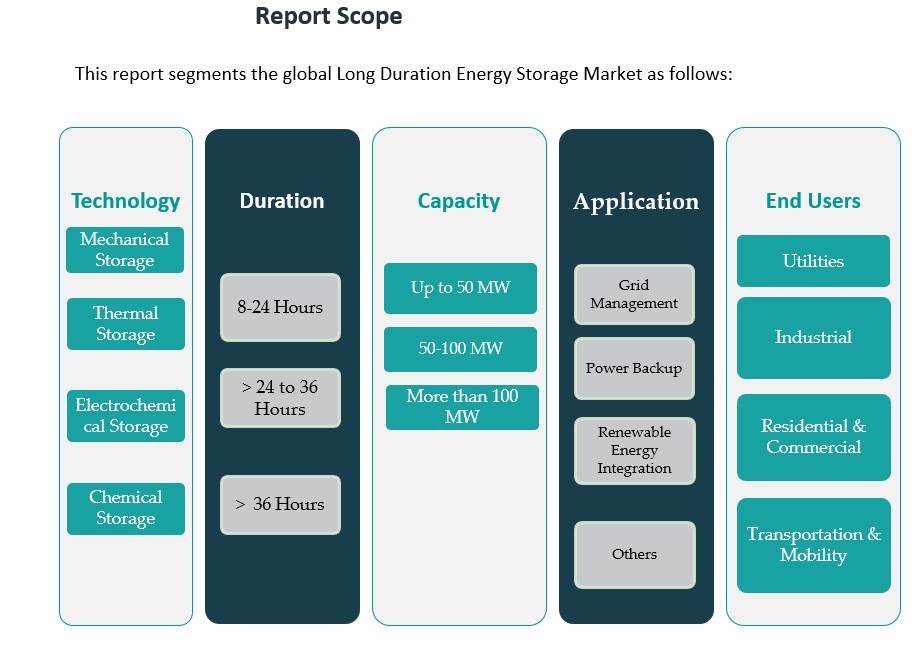
The global Long Duration Energy Storage (LDES) market is segmented across multiple dimensions, each driven by specific technological, application, and end-user needs.
By Technology, the market is divided into four segments: Mechanical Storage, Thermal Storage, Electrochemical Storage, and Chemical Storage. Mechanical storage, such as pumped hydro and compressed air, is widely used in large-scale grid applications. Thermal storage technologies, including molten salt and phase change materials, are crucial for maintaining energy availability during off-peak periods. Electrochemical storage, primarily consisting of flow batteries, is gaining traction due to its ability to offer long-duration energy storage with higher efficiency. Chemical storage, such as hydrogen storage, is poised for future growth as a flexible solution for both grid stability and transportation.
By Duration, LDES solutions are categorized into 8–24 hours, 24–36 hours, and more than 36 hours. The 8–24-hour range is dominant in applications requiring short-term energy backup, while the 24–36 hours segment supports medium-term grid stabilization. The more than 36 hours category, offering extended storage, is suited for seasonal storage needs and integrating renewable energy over long periods.
By Capacity, the market is segmented into up to 50 MW, 50-100 MW, and more than 100 MW. The 50-100 MW range is expected to see the highest growth, driven by increasing utility-scale deployments.
By Application, LDES is primarily used for grid management, power backup, renewable energy integration, and other industrial applications. The grid management and renewable energy integration segments are anticipated to dominate as they support decarbonization and energy security.
By End-User, utilities, industrial sectors, residential and commercial buildings, and transportation & mobility are the key consumers. Utilities are the largest adopters due to their need for reliable, large-scale energy storage to manage grid stability and renewable integration.
Segmentation:
By Technology
- Mechanical Storage
- Thermal Storage
- Electrochemical Storage
- Chemical Storage
By Duration
- 8–24 Hours
- 24–36 Hours
- 36 Hours
By Capacity
- Up to 50 MW
- 50-100 MW
- More than 100 MW
By Application
- Grid Management
- Power Backup
- Renewable Energy Integration
- Others
By End User
- Utilities
- Industrial
- Residential & Commercial
- Transportation & Mobility
Regional Analysis:
The global long duration energy storage (LDES) market is experiencing significant growth across various regions, driven by the increasing integration of renewable energy sources and the need for grid stability. As of 2024, North America leads the market, accounting for approximately 35% of the global share. This dominance is attributed to substantial investments in renewable energy projects, supportive government policies, and the modernization of aging grid infrastructure. The United States, in particular, is at the forefront, with aggressive decarbonization goals and significant funding for clean energy initiatives. Federal and state-level incentives, such as tax credits and grants for energy storage deployment, have played a crucial role in accelerating the adoption of LDES systems. Additionally, the increasing frequency of extreme weather events in the region has underscored the need for resilient energy systems, further propelling the market's expansion.
Europe follows closely, holding a market share of around 30%. The region's commitment to achieving climate neutrality by 2050 has led to substantial investments in renewable energy and corresponding storage solutions. Countries like Germany, the United Kingdom, and France are investing heavily in long-duration storage technologies to enhance grid stability and support renewable energy integration. The European Union's emphasis on sustainability and energy security is propelling the demand for LDES systems. Investments in technologies like pumped hydro storage and flow batteries are prominent, supported by favorable regulatory environments. Furthermore, the development of strategic gas reserves and the shift towards liquefied natural gas (LNG) have highlighted the importance of energy storage in ensuring energy security amid geopolitical tensions.
The Asia-Pacific region is poised for significant growth, currently holding a market share of approximately 25%. Rapid industrialization and urbanization in countries like China and India are leading to increased energy consumption. To meet growing demand and environmental goals, these nations are investing in renewable energy and corresponding storage solutions. China's significant investments in grid modernization and large-scale battery storage projects highlight the region's commitment to LDES development. Additionally, Japan and South Korea are contributing to market growth by advancing battery technologies and investing in resilient energy infrastructure. Favorable policies, including subsidies for energy storage deployment and mandates for renewable capacity expansion, are expected to provide lucrative market growth opportunities in the region during the forecast period.
Latin America and the Middle East & Africa collectively account for the remaining 10% of the global LDES market. In Latin America, countries like Brazil and Chile are exploring LDES solutions to support their renewable energy goals and enhance grid reliability. The Middle East & Africa region is gradually adopting energy storage technologies to diversify their energy mix and reduce dependence on fossil fuels. While these regions currently hold a smaller market share, ongoing investments and policy developments are expected to drive growth in the coming years.
Key Player Analysis:
- Form Energy
- ESS Tech, Inc
- Eos Energy Enterprises
- Invinity Energy Systems
- Samsung SDI
- LG Energy Solution
- Energy Vault, Inc
- Tesla
- Sumitomo Electric Industries, Ltd.
- CATL
- BYD Auto Co., Ltd.
- MAN Energy Solutions
- Highview Power
- Primus Power
- Malta Inc.
Competitive Analysis:
The global long duration energy storage market is highly competitive, characterized by the presence of established players and emerging innovators. Companies such as Form Energy, Highview Power, ESS Inc., and Energy Vault are leading technological advancements with differentiated solutions like iron-air batteries, liquid air energy storage, and gravity-based systems. Traditional energy companies and utility providers are increasingly investing in partnerships and acquisitions to expand their LDES capabilities and diversify their energy portfolios. Competitive strategies primarily focus on technology innovation, scalability, cost reduction, and securing large-scale pilot and commercial projects. Additionally, collaboration with governments and participation in public-private initiatives are critical factors enhancing market positioning. As the demand for long-duration storage continues to grow, competition is intensifying, with players striving to establish early mover advantages, secure funding, and demonstrate long-term operational success to capture emerging opportunities across global energy markets.
Recent Developments:
- In May 2024, ESS Tech, Inc., a U.S.-based company, partnered with Burbank Water and Power (BWP) to commission BWP's first long-duration energy storage system. The installation features a 75 kW/500 kWh ESS Energy Warehouse iron flow battery, which is connected to a 265 kW solar array at BWP's EcoCampus. This system is capable of powering approximately 300 homes and is a significant step toward supporting California’s goal of achieving zero-emission electricity by 2045.
- In October 2024, Form Energy, a company specializing in iron-air battery technology, secured $405 million in funding to accelerate manufacturing at its West Virginia facility and advance research initiatives. The funding round was led by T. Rowe Price, with participation from GE Vernova and several venture capital firms. This capital injection aims to support the deployment of Form Energy’s batteries, which are capable of storing energy for up to 100 hours, thereby enhancing grid stability and contributing to carbon emission reductions.
- In March 2023, Sumitomo Electric Industries, Ltd. introduced sEMSA, a cloud-based solution designed to optimize the energy management of grid storage batteries. This innovative product enables the optimization of charging and discharging schedules, maximizing profits for operators while supporting applications such as supply-demand balancing and power trading. The sEMSA system comprises dedicated servers for plan optimization and terminal units for on-site battery control, supporting various battery types and facilitating renewable energy integration.
Market Concentration & Characteristics:
The global long duration energy storage market exhibits a moderate to high level of concentration, with a mix of established energy companies, specialized storage technology firms, and emerging startups driving innovation. While a few key players dominate large-scale deployments, the market remains dynamic with continuous entry of new participants offering diverse technological solutions. The industry is characterized by rapid technological evolution, significant research and development activity, and growing collaboration between private companies and public institutions. Capital intensity and the need for long project timelines contribute to high entry barriers, favoring companies with strong financial backing and technical expertise. Additionally, the market is distinguished by long sales cycles, pilot project requirements, and evolving regulatory frameworks, which collectively influence adoption rates. As demand for renewable integration and grid resilience grows, the market is expected to consolidate further, with strategic partnerships and acquisitions shaping the competitive landscape.
Report Coverage:
The research report offers an in-depth analysis based on Technology, Duration, Capacity, Application and End User. It details leading market players, providing an overview of their business, product offerings, investments, revenue streams, and key applications. Additionally, the report includes insights into the competitive environment, SWOT analysis, current market trends, as well as the primary drivers and constraints. Furthermore, it discusses various factors that have driven market expansion in recent years. The report also explores market dynamics, regulatory scenarios, and technological advancements that are shaping the industry. It assesses the impact of external factors and global economic changes on market growth. Lastly, it provides strategic recommendations for new entrants and established companies to navigate the complexities of the market.
Future Outlook:
- Global LDES market is projected to expand steadily, driven by increasing renewable energy penetration and decarbonization initiatives.
- Advancements in alternative storage technologies such as iron-air batteries and gravity storage are expected to accelerate commercial adoption.
- Government mandates for energy storage targets will create a stronger policy-driven demand across developed and emerging economies.
- Seasonal energy storage applications will become more prominent, supporting long-term grid balancing and reliability.
- Private sector investments and venture capital funding in LDES startups will continue to surge over the next decade.
- Declining system costs through technological innovation and economies of scale will make LDES increasingly competitive with traditional generation assets.
- Utility-scale projects will dominate installations, although commercial and industrial applications will gain significant traction.
- Strategic partnerships between technology developers, utilities, and energy providers will shape new business models and accelerate deployments.
- Regulatory reforms will increasingly recognize and monetize the multi-service value of long duration storage assets.
- Emerging markets in Asia-Pacific, Latin America, and Africa will offer untapped growth opportunities for innovative and cost-effective LDES solutions.

Request a Free Sample
Fill in your details and we'll send you a free sample report.
- Sample data tables & charts
- Research methodology
Market Dynamics
Increasing Renewable Energy Integration
The rapid expansion of wind and solar power is creating a critical need for long duration energy storage to address intermittency and ensure grid stability. LDES systems enable surplus renewable energy to be stored and dispatched during periods of low generation, supporting the transition to a sustainable energy mix.
Grid Modernization and Resilience
Aging grid infrastructure and the rising frequency of extreme weather events are driving investments in LDES technologies, which provide essential services such as frequency regulation, load shifting, and backup power. These capabilities enhance grid flexibility and resilience, making energy systems more robust against outages and fluctuations.
Supportive Government Policies and Incentives
Governments worldwide are implementing favorable policies, grants, subsidies, and storage mandates to accelerate LDES deployment. These initiatives lower adoption barriers, stimulate innovation, and create a supportive regulatory environment for market growth.
Technological Advancements and Cost Reductions
Innovations in flow batteries, compressed air, and thermal storage are improving efficiency, scalability, and cost-effectiveness of LDES solutions. As technology matures and economies of scale are realized, the financial viability of long duration storage is increasing, encouraging broader adoption.
Private Sector Investment and Strategic Partnerships
Rising private investment and collaborations between utilities, technology developers, and corporate energy buyers are accelerating commercialization and deployment of LDES projects. These partnerships are infusing capital, fostering innovation, and building integrated value chains that support market expansion.
Need a Custom Version of This Report?
Tailor the scope, geography, or segments to your exact requirements.
- Custom geography or segment scope
- Direct access to our analyst team
Frequently Asked Questions
What is the current size of the Global Long Duration Energy Storage Market?
What factors are driving the growth of the Global Long Duration Energy Storage Market?
What are the key segments within the Global Long Duration Energy Storage Market?
What are some challenges faced by the Global Long Duration Energy Storage Market?
Who are the major players in the Global Long Duration Energy Storage Market?
Table of Content
Chapter 1 Market Segmentation
- 1.1 Segmentation Framework
- 1.1.1 Product and Service Classification
- 1.1.2 Application and End-Use Classification
- 1.1.3 Technology and Solution Classification
- 1.1.4 Customer and Distribution Channel Classification
- 1.1.5 Geographic Segmentation
- 1.1.6 Market Segment Definitions and Boundaries
- 1.2 By Duration
- 1.2.1 8–24 Hours
- 1.2.2 24–36 Hours
- 1.2.3 More than 36 Hours
- 1.3 By End User
- 1.3.1 Utilities
- 1.3.2 Industrial
- 1.3.3 Residential & Commercial
- 1.3.4 Transportation & Mobility
- 1.4 By Technology
- 1.4.1 Mechanical Storage
- 1.4.2 Thermal Storage
- 1.4.3 Electrochemical Storage
- 1.4.4 Chemical Storage
- 1.5 By Application
- 1.5.1 Grid Management
- 1.5.2 Power Backup
- 1.5.3 Renewable Energy Integration
- 1.5.4 Others
Chapter 2 Introduction
- 2.1 Report Objectives and Scope
- 2.2 Product Definition and Industry Terminology
- 2.3 Market Inclusions and Exclusions
- 2.4 Research Process
- 2.4.1 Primary Research and Expert Interviews
- 2.4.2 Secondary Research and Source Review
- 2.4.3 Top-Down and Bottom-Up Estimation
- 2.4.4 Data Triangulation and Verification
- 2.5 Market Size Measurement Basis
- 2.5.1 2023: USD 4,261.11 million → 2032: USD 13,005.91 million
- 2.6 Historical and Forecast Reference Periods
- 2.6.1 Base Year: 2023
- 2.6.2 Forecast Period: 2023-2032
- 2.7 Research Assumptions and Limitations
Chapter 3 Executive Summary
- 3.1 Market Snapshot and Key Findings
- 3.2 Base-Year Market Size, 2023
- 3.3 Forecast Market Size, 2032
- 3.4 Revenue and Volume Growth Outlook
- 3.5 Key Demand and Supply Indicators
- 3.6 Leading Market Segments
- 3.7 Fastest-Growing Market Opportunities
- 3.8 Regional Performance Highlights
- 3.9 Technology and Industry Transformation
- 3.10 Competitive Landscape Summary
- 3.11 Analyst View and Strategic Implications
Chapter 4 Global Long Duration Energy Storage Market Trends and Developments
- 4.1 Historical Industry Development
- 4.2 Recent Market Trends and Developments
- 4.3 Demand and Customer Behavior Trends
- 4.4 Technology and Product Innovation
- 4.5 Artificial Intelligence, Automation and Digitalization
- 4.6 Local Manufacturing and Supply Chain Realignment
- 4.7 Industry Partnerships, Mergers and Acquisitions
- 4.8 Sustainability and Circular Economy Developments
- 4.9 Government and Private Sector Investment Trends
- 4.10 Emerging Business Models and Commercialization
- 4.11 Industry Developments and Announcements
Chapter 5 Global Long Duration Energy Storage Market Production, Supply and Demand Analysis
- 5.1 Demand Trend and Consumption Analysis
- 5.2 Demand Forecast, 2023-2032
- 5.3 Production and Output Trend
- 5.4 Production and Output Forecast, 2023-2032
- 5.5 Installed Capacity and Capacity Utilization
- 5.6 Company-Wise Production Plants and Statistics
- 5.6.1 Installed Production Capacity
- 5.6.2 Actual Production
- 5.6.3 Planned Capacity and Expansion Targets
- 5.7 Supply Chain Structure and Procurement Trends
- 5.8 Supply-Demand Gap and Bottlenecks
- 5.9 Import Dependence and Sourcing Structure
- 5.10 Contract Manufacturing and Outsourcing
- 5.11 Regional Supply and Demand Concentration
Chapter 6 Global Long Duration Energy Storage Market Pricing Analysis
- 6.1 Pricing Structure and Measurement
- 6.2 Historical Pricing Trends
- 6.3 Pricing Outlook, 2023-2032
- 6.4 Average Selling Price and Unit Economics
- 6.5 Pricing by Product and Market Segment
- 6.6 Geographic Pricing Differences
- 6.7 Key Input, Energy, Labor and Logistics Costs
- 6.8 Contract Pricing and Purchasing Models
- 6.9 Pricing Sensitivity and Competitive Positioning
- 6.10 Price, Margin and Profitability Implications
Chapter 7 Global Long Duration Energy Storage Market Dynamics
- 7.1 Market Growth Drivers
- 7.1.1 Demand-Side Drivers
- 7.1.2 Technology and Innovation Drivers
- 7.1.3 Infrastructure and Investment Drivers
- 7.1.4 Regulatory and Policy Drivers
- 7.2 Market Restraints
- 7.2.1 Cost and Affordability Constraints
- 7.2.2 Technology and Adoption Barriers
- 7.2.3 Supply Chain and Operational Constraints
- 7.3 Market Challenges
- 7.3.1 Competitive Pressure and Margin Erosion
- 7.3.2 Skills, Infrastructure and Implementation Gaps
- 7.4 Emerging Market Opportunities
- 7.5 Market Dynamics Impact and Time-Horizon Assessment
Chapter 8 Global Long Duration Energy Storage Value Chain Analysis
- 8.1 Industry Value Chain Overview
- 8.2 Upstream Suppliers and Critical Inputs
- 8.3 Technology and Component Providers
- 8.4 Manufacturing or Service Delivery
- 8.5 Distribution, Channel Partners and Integrators
- 8.6 Downstream Applications and End Users
- 8.7 Value Addition and Profit Pools
- 8.8 Vertical Integration and Outsourcing
- 8.9 Supplier Concentration and Risk
- 8.10 Supply Chain Localization and Resilience
Chapter 9 Global Long Duration Energy Storage Market Regulations and Policies
- 9.1 Relevant Laws, Standards and Compliance Frameworks
- 9.2 Product, Service, Safety and Quality Requirements
- 9.3 Government Policies, Incentives and Subsidies
- 9.4 Imports, Exports and Trade Barriers
- 9.5 Public Procurement and Local Content Requirements
- 9.6 Environmental and Sustainability Compliance
- 9.7 Upcoming Policy Changes and Market Implications
Chapter 10 Global Long Duration Energy Storage Market Hotspots and Opportunities
- 10.1 Market Opportunity Mapping and Growth Hotspots
- 10.2 High-Growth Applications and Customer Groups
- 10.3 Underserved Markets and White-Space Opportunities
- 10.4 Emerging Technology and Product Opportunities
- 10.5 New Capacity and Investment Hotspots
- 10.6 Market Entry and Expansion Opportunities
- 10.7 Distribution and Partnership Opportunities
- 10.8 Near-Term and Long-Term Commercial Potential
- 10.9 Opportunity Attractiveness and Execution Risks
Chapter 11 Global Long Duration Energy Storage Market Outlook, 2023-2032
- 11.1 Market Size and Analysis
- 11.1.1 Revenue (Market Measurement: 2023: USD 4,261.11 million → 2032: USD 13,005.91 million)
- 11.1.2 Market Volume and Quantity Sold
- 11.1.3 Historical Market Size
- 11.1.4 Base-Year Market Size, 2023
- 11.2 Market Forecast, 2023-2032
- 11.2.1 Revenue Forecast to 2032
- 11.2.2 Volume Forecast to 2032
- 11.2.3 CAGR and Year-on-Year Growth
- 11.2.4 Incremental Revenue Opportunity
- 11.3 Forecast Assumptions and Scenario Analysis
- 11.3.1 Base-Case Forecast
- 11.3.2 Optimistic and Conservative Scenarios
- 11.3.3 Technology, Pricing and Policy Sensitivities
- 11.4 Market Attractiveness and Growth Outlook
Chapter 12 Global Long Duration Energy Storage Market Segmentation and Outlook
- 12.1 Segmentation Summary and Market Shares, 2023
- 12.2 Largest and Fastest-Growing Segments
- 12.3 By Duration - Market Size and Forecast, 2023-2032
- 12.3.1 Segment Definition and Scope
- 12.3.2 Historical Market Size
- 12.3.3 Revenue Forecast, 2023-2032
- 12.3.4 Volume Forecast, 2023-2032
- 12.3.5 Base-Year Market Share, 2023
- 12.3.6 Segment CAGR and Growth Drivers
- 12.3.7 Subsegment Market Size and Forecast
- 12.3.7.1 8–24 Hours
- 12.3.7.2 24–36 Hours
- 12.3.7.3 More than 36 Hours
- 12.3.8 Subsegment Pricing and Adoption Trends
- 12.3.9 Leading Suppliers and Competition
- 12.3.10 Regional Demand and Opportunities
- 12.4 By End User - Market Size and Forecast, 2023-2032
- 12.4.1 Segment Definition and Scope
- 12.4.2 Historical Market Size
- 12.4.3 Revenue Forecast, 2023-2032
- 12.4.4 Volume Forecast, 2023-2032
- 12.4.5 Base-Year Market Share, 2023
- 12.4.6 Segment CAGR and Growth Drivers
- 12.4.7 Subsegment Market Size and Forecast
- 12.4.7.1 Utilities
- 12.4.7.2 Industrial
- 12.4.7.3 Residential & Commercial
- 12.4.7.4 Transportation & Mobility
- 12.4.8 Subsegment Pricing and Adoption Trends
- 12.4.9 Leading Suppliers and Competition
- 12.4.10 Regional Demand and Opportunities
- 12.5 By Technology - Market Size and Forecast, 2023-2032
- 12.5.1 Segment Definition and Scope
- 12.5.2 Historical Market Size
- 12.5.3 Revenue Forecast, 2023-2032
- 12.5.4 Volume Forecast, 2023-2032
- 12.5.5 Base-Year Market Share, 2023
- 12.5.6 Segment CAGR and Growth Drivers
- 12.5.7 Subsegment Market Size and Forecast
- 12.5.7.1 Mechanical Storage
- 12.5.7.2 Thermal Storage
- 12.5.7.3 Electrochemical Storage
- 12.5.7.4 Chemical Storage
- 12.5.8 Subsegment Pricing and Adoption Trends
- 12.5.9 Leading Suppliers and Competition
- 12.5.10 Regional Demand and Opportunities
- 12.6 By Application - Market Size and Forecast, 2023-2032
- 12.6.1 Segment Definition and Scope
- 12.6.2 Historical Market Size
- 12.6.3 Revenue Forecast, 2023-2032
- 12.6.4 Volume Forecast, 2023-2032
- 12.6.5 Base-Year Market Share, 2023
- 12.6.6 Segment CAGR and Growth Drivers
- 12.6.7 Subsegment Market Size and Forecast
- 12.6.7.1 Grid Management
- 12.6.7.2 Power Backup
- 12.6.7.3 Renewable Energy Integration
- 12.6.7.4 Others
- 12.6.8 Subsegment Pricing and Adoption Trends
- 12.6.9 Leading Suppliers and Competition
- 12.6.10 Regional Demand and Opportunities
- 12.7 Segment Growth Comparison
- 12.8 Segment Attractiveness and Priority Matrix
Chapter 13 Global Long Duration Energy Storage End-Use and Application Market Outlook
- 13.1 End-Use Industry and Customer Demand Structure
- 13.2 Leading Applications and Customer Groups
- 13.3 End-Use Market Size, Share and Forecast
- 13.4 Major End-Use Industry Deep Dives
- 13.4.1 Customer Requirements and Use Cases
- 13.4.2 Demand and Replacement Cycles
- 13.4.3 Technical and Regulatory Considerations
- 13.4.4 Purchasing and Procurement Models
- 13.4.5 Leading Vendors and Distribution Channels
- 13.4.6 Forecast and Commercial Opportunities
- 13.5 Emerging Applications and Cross-Segment Demand
- 13.6 End-Use Industry Investment Priorities
Chapter 14 Global Long Duration Energy Storage Geographic Market Outlook, 2023-2032
- 14.1 Regional Market Size and Share, 2023
- 14.2 Regional Market Forecast, 2023-2032
- 14.3 Regional Pricing, Production and Demand Differences
- 14.4 North America
- 14.4.1 United States
- 14.4.2 Canada
- 14.4.3 Mexico
- 14.5 Europe
- 14.5.1 Germany
- 14.5.2 France
- 14.5.3 Italy
- 14.5.4 United Kingdom
- 14.5.5 Spain
- 14.5.6 Poland
- 14.5.7 Russia
- 14.5.8 Netherlands
- 14.5.9 Belgium
- 14.5.10 Sweden
- 14.5.11 Denmark
- 14.5.12 Norway
- 14.5.13 Rest of Europe
- 14.6 Asia Pacific
- 14.6.1 China
- 14.6.2 India
- 14.6.3 Japan
- 14.6.4 South Korea
- 14.6.5 Thailand
- 14.6.6 Indonesia
- 14.6.7 Vietnam
- 14.6.8 Malaysia
- 14.6.9 Australia
- 14.6.10 Rest of Asia Pacific
- 14.7 Latin America
- 14.7.1 Brazil
- 14.7.2 Argentina
- 14.7.3 Colombia
- 14.7.4 Chile
- 14.7.5 Rest of Latin America
- 14.8 Middle East
- 14.8.1 Saudi Arabia
- 14.8.2 United Arab Emirates
- 14.8.3 Turkey
- 14.8.4 Israel
- 14.8.5 Iran
- 14.8.6 Rest of the Middle East
- 14.9 Africa
- 14.9.1 South Africa
- 14.9.2 Egypt
- 14.9.3 Nigeria
- 14.9.4 Morocco
- 14.9.5 Rest of Africa
- 14.10 Regional Investment, Policy and Supply Chain Differences
- 14.11 Regional Competitive Landscape
- 14.12 Geographic Growth Hotspots
Chapter 15 Global Long Duration Energy Storage Technology, Innovation and Sustainability Outlook
- 15.1 Technology Landscape and Maturity
- 15.2 Product, Process and Service Innovation
- 15.3 AI, Automation and Digital Tools in the Industry
- 15.4 Technology Adoption and Performance Benchmarking
- 15.5 Innovation Pipeline and R&D Investment
- 15.6 Patent and Intellectual Property Trends
- 15.7 Energy Efficiency and Resource Management
- 15.8 Sustainability, Recycling and Circularity
- 15.9 Technology Roadmap, 2023-2032
- 15.10 Risks of Obsolescence and Technology Substitution
Chapter 16 Global Long Duration Energy Storage Market Key Strategic Imperatives
- 16.1 Growth and Market Entry Priorities
- 16.2 High-Return Products and Segments
- 16.3 Pricing, Profitability and Cost Optimization
- 16.4 Technology Investment and Product Differentiation
- 16.5 Supply Chain Localization and Resilience
- 16.6 Distribution and Customer Acquisition
- 16.7 Partnership, Acquisition and Capacity Strategy
- 16.8 Regional Expansion Priorities
- 16.9 Short-, Medium- and Long-Term Actions
Chapter 17 Competition Outlook
- 17.1 Industry Competition Characteristics
- 17.2 Market Structure and Concentration
- 17.3 Market Share and Competitive Positioning, 2023
- 17.4 Company-Wise Revenue and Product Benchmarking
- 17.5 Production and Service Capacity Benchmarking
- 17.6 Technology, Pricing and Differentiation
- 17.7 Regional Footprint and Distribution Strength
- 17.8 Mergers, Acquisitions and Strategic Alliances
- 17.9 New Entrants and Competitive Threats
- 17.10 Porter's Five Forces and Industry Attractiveness
- 17.11 Competitive Outlook, 2023-2032
Chapter 18 Company Profiles
- 18.1 Company Coverage and Selection Criteria
- 18.2 Form Energy
- 18.2.1 Business Description
- 18.2.2 Company Ownership and Geographic Presence
- 18.2.3 Product and Service Portfolio
- 18.2.4 Manufacturing and Operating Footprint
- 18.2.5 Production Capacity and Expansion Plans
- 18.2.6 Financial Performance and Investment
- 18.2.7 Market Share and Competitive Position
- 18.2.8 Technology and Innovation Capabilities
- 18.2.9 Strategic Alliances or Partnerships
- 18.2.10 Recent Developments
- 18.2.11 Growth Strategy and Outlook
- 18.3 ESS Tech, Inc
- 18.4 Eos Energy Enterprises
- 18.5 Invinity Energy Systems
- 18.6 Samsung SDI
- 18.7 LG Energy Solution
- 18.8 Energy Vault, Inc
- 18.9 Tesla
- 18.10 Sumitomo Electric Industries, Ltd.
- 18.11 Highview Power
- 18.12 Other Relevant Market Participants
Note: Every listed company is profiled on the structure shown under the first company. The company list is preliminary and may change based on research findings, market developments, data availability and client requirements.
Chapter 19 Disclaimer
- 19.1 Research and Forecast Disclaimer
- 19.2 Data Source and Estimation Limitations
Note: The depth of individual sections depends on data availability for this market. Volume, capacity, trade and other unit-based metrics are included where applicable.

