
Market Overview
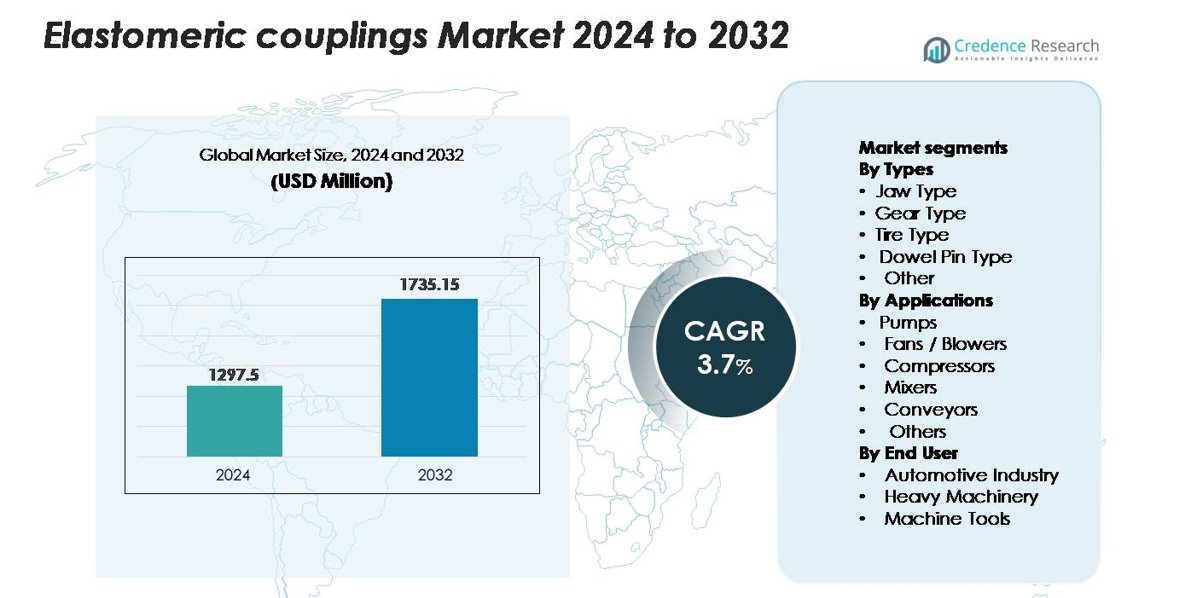
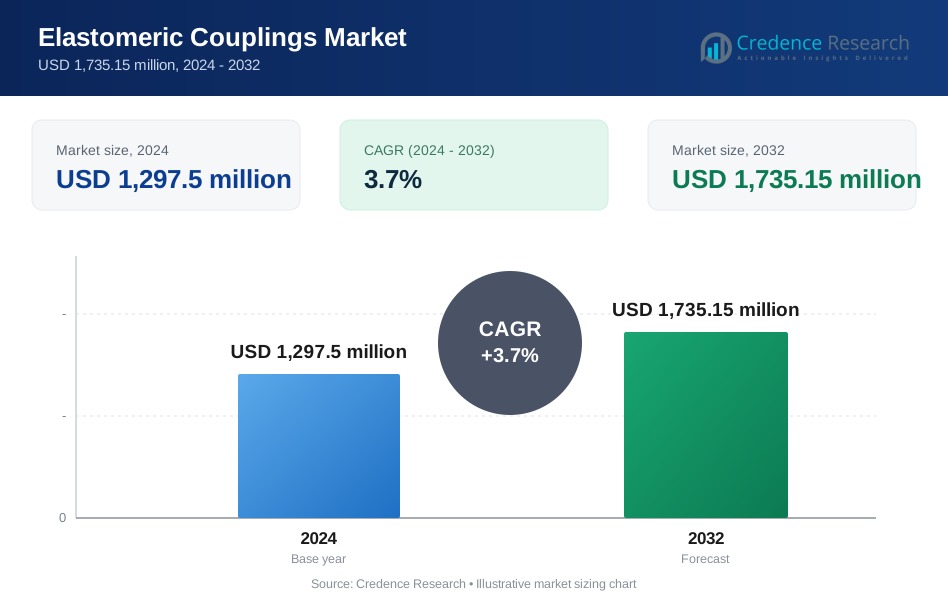
The global Elastomeric Couplings Market was valued at USD 1,297.5 million in 2024 and is projected to reach USD 1,735.15 million by 2032, advancing at a CAGR of 3.7% during the forecast period.
| REPORT ATTRIBUTE | DETAILS |
|---|---|
| Historical Period | 2020-2023 |
| Base Year | 2024 |
| Forecast Period | 2025-2032 |
| Elastomeric Couplings Market Size 2024 | USD 1,297.5 million |
| Elastomeric Couplings Market, CAGR | 3.7% |
| Elastomeric Couplings Market Size 2032 | USD 1,735.15 million |
The elastomeric couplings market is shaped by a mix of global and regional leaders, including Siemens, Regal Rexnord, Dodge, Altra Industrial Motion, SKF, Voith, REICH, Renold, John Crane, Tsubakimoto Chain, R+W Coupling, LORD, KWD, KTR, and VULKAN. These companies compete through advanced elastomer formulations, high-precision machining, and application-specific coupling designs for pumps, compressors, conveyors, and automation systems. Asia Pacific stands out as the leading region with a 34–36% market share, driven by rapid industrialization and large-scale manufacturing activity. North America and Europe follow, supported by strong adoption in automotive, oil & gas, and high-precision machinery applications.
Market Insights
- The global elastomeric couplings market was valued at USD 1,297.5 million in 2024 and is expected to reach USD 1,735.15 million by 2032, registering a CAGR of 3.7% during the forecast period.
- Strong demand from pumps, compressors, and conveyors drives market expansion, with pumps accounting for the largest application share, supported by industrial fluid-handling growth across utilities and processing plants.
- Market trends focus on maintenance-free couplings, high-durability elastomers, and precision-engineered designs suited for automation, robotics, and high-speed machinery, especially in modern manufacturing facilities.
- Competitive intensity increases as players like Siemens, Regal Rexnord, SKF, Voith, REICH, and Altra Industrial Motion invest in advanced materials, modular hub designs, and global distribution networks while facing restraints such as limited suitability in high-torque and high-temperature environments.
- Asia Pacific leads with 34–36% market share, followed by North America (28–30%) and Europe (24–26%), reflecting strong industrialization, pump deployment, and modernization of rotating equipment across key sectors.
Market Segmentation Analysis:
By Types:
Jaw-type elastomeric couplings represent the dominant sub-segment, accounting for the largest market share due to their compact structure, ease of installation, and ability to accommodate angular and parallel misalignment in industrial drives. Their replaceable elastomeric spiders reduce maintenance downtime, making them preferred in general-purpose machinery and OEM equipment. Gear-type couplings follow closely in applications requiring higher torque transmission, while tire-type and dowel-pin variants serve vibration-sensitive and heavy-duty rotating systems. Growing demand for flexible, shock-absorbing power-transmission components across manufacturing plants continues to reinforce jaw-type adoption.
- For instance, KTR’s ROTEX® jaw coupling range supports nominal torques up to 35,000 Nm and compensates for angular misalignment up to 1°, providing robust damping in pump and compressor drives.
By Applications:
Pumps hold the highest market share among applications, driven by their widespread use in water treatment facilities, chemical plants, HVAC systems, and oil & gas installations. Elastomeric couplings are favored in pump assemblies for their torsional flexibility, vibration damping, and ability to protect connected equipment from overload. Fans and blowers form the next major segment, particularly in ventilation and industrial air-handling systems that rely on misalignment-tolerant drivetrains. Compressors, mixers, and conveyor systems further contribute to market expansion as industries modernize rotating equipment to reduce noise, optimize alignment, and extend service life.
- For instance, the John Crane Powerstream® A-Series elastomeric coupling line offers models with maximum continuous torques up to 20,936 Nm (185,300 lb.in.) and are rated for speeds up to 9,600 rpm (for the smallest size, the A00C), enabling reliable performance in demanding pump and blower systems
By End User:
The automotive industry emerges as the leading end-user segment, securing the largest market share due to high integration of elastomeric couplings in engine test rigs, assembly systems, paint-shop conveyors, and robotic handling units. Their ability to reduce backlash, absorb shock loads, and enhance drivetrain reliability makes them essential across automotive manufacturing lines. Heavy machinery follows closely, driven by construction, mining, and processing equipment requiring robust torque-handling capability. Machine tool manufacturers also deploy elastomeric couplings for precise rotational control and vibration suppression in CNC systems, milling machines, and cutting tools, supporting consistent operational accuracy.
Key Growth Drivers
Rising Demand for Vibration-Damping Solutions in Rotating Equipment
Industrial facilities increasingly prioritize equipment reliability, reduced noise levels, and vibration control, which strengthens adoption of elastomeric couplings. Their inherent flexibility allows them to absorb torsional shocks, dampen dynamic loads, and maintain alignment across pumps, compressors, mixers, and conveyors. As industries digitize and deploy more sensitive automation systems, the need for couplings that protect motors and driven shafts becomes essential. Manufacturers also benefit from elastomeric couplings’ low maintenance requirements and simple installation, reducing operational downtime. Upgrades in water treatment, HVAC modernization, and growth in mid-sized industrial plants further accelerate replacement cycles, reinforcing long-term demand for flexible, damping-capable coupling solutions.
- For instance, REICH’s ARCUSAFLEX® rubber-disc coupling offers nominal torque capacities up to 72,000 Nm and torsional damping levels optimized for fluctuating load profiles, enabling measurable reductions in vibratory stress on connected machinery.
Expansion of Automation, Robotics, and High-Speed Machinery
The accelerated deployment of automated production lines, robotics, and CNC systems boosts the need for highly reliable couplings capable of operating at higher speeds with minimal backlash. Elastomeric couplings are increasingly used in servo-driven systems and precision machinery because they accommodate parallel and angular misalignment while ensuring smooth torque transmission. Their ability to maintain dynamic stability without frequent lubrication makes them suitable for fast-paced industrial processes. Growth in electronics assembly, packaging, automotive manufacturing, and semiconductor equipment strengthens this demand. As factories transition toward intelligent, high-throughput operations, elastomeric couplings become integral components supporting continuous, precision-intensive performance.
- For instance, R+W’s EKH elastomer coupling series is designed for applications in high-speed servo axes and robotic joints that require precise torsional behavior. The series features a broad torque range from 4 Nm up to 25,000 Nm and can accommodate standard operating speeds up to 13,000 rpm for smaller models, with finely balanced versions capable of reaching even higher speeds, depending on the specific model and elastomer insert used.
Growth in Fluid Handling Systems Across Industrial and Utility Sectors
Infrastructure development and industrial expansion continue to boost investment in pumps, blowers, and compressors equipment that relies heavily on elastomeric couplings. Utilities upgrading wastewater and desalination plants, chemical processors expanding fluid-transfer lines, and oil & gas operators enhancing midstream facilities all require reliable coupling systems. Elastomeric couplings’ ability to handle misalignment caused by thermal variations and mounting inconsistencies makes them ideal for pump-driven installations. In addition, their resistance to corrosive environments and operational flexibility promotes adoption in demanding processes such as slurry transport, ventilation, and chemical dosing. As global fluid-handling capacities scale, coupling demand increases proportionally.
Key Trends & Opportunities
Shift Toward Maintenance-Free and High-Durability Coupling Designs
A major trend shaping the market is the growing preference for maintenance-free designs using advanced elastomers that resist wear, fatigue, and chemical degradation. Manufacturers are developing couplings with higher torsional stiffness, improved thermal resistance, and extended service life to meet modern machinery requirements. This evolution opens opportunities for premium-grade elastomeric products tailored for harsh-duty pumps, compressors, and heavy industrial drives. The expansion of predictive maintenance and condition monitoring systems also encourages the adoption of couplings engineered for consistent performance under fluctuating loads. As industries pursue longer operating cycles and reduced maintenance budgets, demand for next-generation durable elastomeric couplings rises sharply.
- For instance, Siemens’ FLENDER N-Eupex DK elastomer coupling variant uses thermally optimized polymer elements tested for continuous operation at 90°C and rated for torques up to 70,000 Nm, enabling substantially longer service intervals in heavy-duty pump and compressor systems.
Increasing Customization for High-Precision and Sector-Specific Applications
Industries increasingly request customized couplings optimized for their operating conditions, creating meaningful opportunities for specialized manufacturers. Sectors such as packaging, semiconductor fabrication, pharmaceuticals, and food processing demand precision-aligned rotating components with controlled torsional behavior. This trend encourages development of application-specific elastomeric compounds, modular hub designs, and lightweight geometries suited for confined equipment spaces. Opportunities also emerge from renewable energy applications such as wind turbines and small hydropower units, where flexible misalignment compensation is critical. Customization enhances performance and reliability, enabling suppliers to differentiate their offerings in niche, high-performance industrial environments.
- For instance, Voith’s K series of highly flexible elastomer couplings incorporates customized elastomer packs engineered to withstand dynamic torques up to 1,300,000 Nm (1,300 kNm) and accommodate axial, radial, and angular displacements, meeting stringent requirements in precision-driven drive systems.
Adoption of Eco-Friendly and Energy-Efficient Industrial Components
Sustainability-oriented procurement policies are driving adoption of elastomeric couplings made from recyclable materials and energy-efficient designs that reduce mechanical losses. Industries aiming to comply with carbon-reduction mandates increasingly prefer components that support low-noise, low-vibration operation and extend equipment lifespan, thereby lowering total energy consumption. Manufacturers exploring bio-based elastomers and environmentally benign additives are well-positioned to gain traction. As industrial sustainability certifications and ESG reporting become mainstream, opportunities widen for suppliers offering eco-focused coupling technologies with reduced environmental impact
Key Challenges
Performance Limitations in High-Torque and High-Temperature Environments
Despite their advantages, elastomeric couplings face operational limitations in applications requiring extremely high torque, elevated temperatures, or exposure to aggressive chemicals. The elastomer elements may degrade, harden, or crack under continuous thermal stress, impacting coupling lifespan and performance stability. Heavy industrial systems such as large compressors, metal processing lines, and marine propulsion often require metallic gear or disc couplings instead. This restricts elastomeric couplings from penetrating ultra-heavy-duty markets. Overcoming these constraints requires advanced materials engineering and costlier formulations, which may hinder adoption in price-sensitive industries.
Intense Competition from Alternative Coupling Technologies
The market faces strong competition from gear, disc, grid, and fluid couplings, which offer superior performance in certain high-power or precision-heavy applications. These alternatives often deliver higher torque capacity, better thermal tolerance, and more predictable torsional stiffness, making them suitable for critical machinery. As industries pursue higher power densities and faster operating speeds, metallic and composite couplings could increasingly replace elastomeric types in specialized machinery. This competitive pressure forces elastomeric coupling manufacturers to invest in R&D, develop higher-performance elastomers, and offer improved lifecycle benefits raising overall production costs and squeezing margins.
Regional Analysis
North America
North America holds an estimated 28–30% share of the elastomeric couplings market, driven by strong adoption across automated manufacturing, oil & gas operations, and water treatment infrastructure. The United States leads regional demand due to extensive industrial retrofitting, high pump and compressor deployment, and rapid modernization of factory automation systems. Growth is also supported by expanding robotics applications in automotive and aerospace facilities. Canadian demand increases through investments in power generation, mining, and municipal utilities. The region’s emphasis on reducing maintenance downtime and improving equipment efficiency continues to reinforce steady uptake of elastomeric coupling solutions.
Europe
Europe accounts for approximately 24–26% of global market share, supported by well-established manufacturing clusters in Germany, Italy, and France. The region’s stringent operational safety norms and long-standing focus on vibration control enhance adoption in pumps, conveyors, and precision machinery. Growth in renewable energy plants, wastewater treatment facilities, and environmental compliance upgrades further expands demand. The automotive sector remains a major consumer, particularly in powertrain testing, machining systems, and assembly-line automation. Ongoing investment in Industry 4.0 and high-efficiency rotating equipment enables European industries to prioritize flexible couplings that reduce energy losses and extend machinery life.
Asia Pacific
Asia Pacific dominates the global landscape with the largest market share of 34–36%, driven by large-scale industrialization across China, India, Japan, and Southeast Asia. Rapid expansion of manufacturing plants, chemical processing units, and fluid-handling infrastructure fuels strong coupling consumption. China leads regional demand due to its vast pump, compressor, and automotive production base, while India’s growth is propelled by investments in heavy machinery, power generation, and smart manufacturing. Market penetration is also accelerated by rising adoption of precision equipment in electronics and semiconductor assembly. The region’s competitive manufacturing ecosystem drives high-volume procurement of elastomeric couplings.
Latin America
Latin America holds a moderate share of 7–8%, driven by demand from mining, oil & gas, food processing, and cement manufacturing sectors. Countries such as Brazil, Mexico, and Chile are expanding fluid-handling and material-processing capacity, supporting higher utilization of pumps, mixers, and conveyors equipped with elastomeric couplings. Industrial modernization efforts particularly in automotive assembly and agribusiness contribute to growing adoption of flexible, maintenance-friendly coupling types. Despite economic fluctuations, rising investment in water treatment facilities and infrastructure rehabilitation provides consistent demand. The region continues to benefit from increasing focus on equipment reliability and reduced downtime.
Middle East & Africa (MEA)
The Middle East & Africa region represents roughly 6–7% of the global market, supported by strong deployment of pumps, compressors, and blowers in oil & gas, petrochemical, and desalination operations. GCC countries lead demand with large-scale industrial projects and heavy investment in fluid-handling systems used in refining and wastewater management. In Africa, growing mining activity and electricity infrastructure upgrades stimulate additional coupling consumption. The region’s harsh operating environments characterized by heat, dust, and corrosive conditions drive preference for elastomeric couplings that offer misalignment tolerance and vibration damping while minimizing maintenance needs in remote industrial locations.
Market Segmentations:
By Types
- Jaw Type
- Gear Type
- Tire Type
- Dowel Pin Type
- Other
By Applications
- Pumps
- Fans / Blowers
- Compressors
- Mixers
- Conveyors
- Others
By End User
- Automotive Industry
- Heavy Machinery
- Machine Tools
By Geography
- North America
- U.S.
- Canada
- Mexico
- Europe
- Germany
- France
- U.K.
- Italy
- Spain
- Rest of Europe
- Asia Pacific
- China
- Japan
- India
- South Korea
- South-east Asia
- Rest of Asia Pacific
- Latin America
- Brazil
- Argentina
- Rest of Latin America
- Middle East & Africa
- GCC Countries
- South Africa
- Rest of the Middle East and Africa
Competitive Landscape
The elastomeric couplings market features a moderately consolidated competitive landscape, with global manufacturers competing on product durability, torsional performance, material innovation, and customization capabilities. Leading players focus on engineering advanced elastomer compounds that offer improved fatigue resistance, higher torque capacity, and better temperature stability to meet diverse industrial requirements. Competition is further shaped by the expansion of product portfolios targeting pumps, compressors, blowers, and precision machinery. Companies increasingly invest in automated manufacturing, precision machining, and modular hub designs to enhance consistency and reduce lead times. Strategic priorities also include strengthening distributor networks, improving aftermarket support, and expanding into high-growth regions such as Asia Pacific. As end users demand maintenance-free, vibration-damping solutions compatible with modern automated systems, manufacturers differentiate through application-specific designs, digital configuration tools, and performance-tested elastomer elements. Ongoing R&D efforts and selective mergers or partnerships continue to define competitive positioning in this evolving industrial components market.
Key Player Analysis
- VULKAN (India)
- Renold (UK)
- LORD (U.S.)
- KTR (India)
- Voith (Germany)
- John Crane (U.S.)
- R+W Coupling (U.S.)
- REICH (Germany)
- Siemens (Germany)
- Dodge (U.S
Recent Developments
- In June 2024, John Crane exhibited its coupling solutions at ACHEMA 2024 in Frankfurt. At the event, the company highlighted its Powerstream® elastomeric coupling series featuring urethane inserts with unrestricted shelf life, designed for pump, conveyor, and blower applications.
- In February 2024, REICH launched its “Hybrid drive for track construction machines” solution, combining the ARCUSAFLEX® rubber disc coupling with a switchable electromagnetic coupling, tailored for heavy-duty van/rail applications.
Report Coverage
The research report offers an in-depth analysis based on Types, Applications, End-User and Geography. It details leading market players, providing an overview of their business, product offerings, investments, revenue streams, and key applications. Additionally, the report includes insights into the competitive environment, SWOT analysis, current market trends, as well as the primary drivers and constraints. Furthermore, it discusses various factors that have driven market expansion in recent years. The report also explores market dynamics, regulatory scenarios, and technological advancements that are shaping the industry. It assesses the impact of external factors and global economic changes on market growth. Lastly, it provides strategic recommendations for new entrants and established companies to navigate the complexities of the market
Future Outlook
- Demand for elastomeric couplings will rise as industries modernize pumps, compressors, and mixers to improve reliability and reduce downtime.
- Automation and robotics expansion will increase adoption of flexible, low-maintenance coupling designs with improved torsional performance.
- Advancements in high-durability elastomer materials will extend coupling lifespan and support broader use in harsh operating environments.
- Precision machinery growth will drive demand for low-backlash couplings suited for CNC, packaging, and semiconductor applications.
- Manufacturers will invest in customized coupling solutions tailored to industry-specific torque, misalignment, and vibration requirements.
- Digital configuration tools and performance modeling will streamline coupling selection and enhance engineering accuracy.
- Energy-efficient industrial operations will favor couplings that reduce vibration-induced losses and enhance motor efficiency.
- Regional manufacturing expansion in Asia Pacific will continue to strengthen global production and consumption.
- Aftermarket demand will grow as plants prioritize predictive maintenance and regular elastomer replacement cycles.
- Competitive differentiation will focus on material innovation, modular designs, and expanded global distribution networks.
Request a Free Sample
Fill in your details and we'll send you a free sample report.
- Sample data tables & charts
- Research methodology
Need a Custom Version of This Report?
Tailor the scope, geography, or segments to your exact requirements.
- Custom geography or segment scope
- Direct access to our analyst team
Frequently Asked Questions
What is the current market size for elastomeric couplings, and what is its projected size in 2032?
At what Compound Annual Growth Rate is the elastomeric couplings market projected to grow between 2024 and 2032?
What are the key drivers for the growth of the elastomeric couplings market?
What are the primary factors fueling the growth of the elastomeric couplings market?
Who are the leading companies in the elastomeric couplings market?
Table of Content
Chapter 1. Report Introduction
- 1.1 Report Description & Purpose
- 1.1.1 Report Title & Market Definition
- 1.1.2 Unique Selling Propositions (USP) & Key Differentiators
- 1.1.3 Value Proposition for Stakeholders
- 1.2 Research Objectives
- 1.2.1 Market Sizing Objectives (Volume & Revenue)
- 1.2.2 Segmentation Objectives
- 1.2.3 Competitive Intelligence Objectives
- 1.2.4 Forecast & Scenario Objectives
- 1.3 Report Scope
- 1.3.1 Elastomeric Couplings Scope – Types & Subtypes Covered
- 1.3.2 Geographic Scope – Regions & Countries Covered
- 1.3.3 Historical Period, Base Year & Forecast Period (2024; forecast to 2032)
- 1.3.4 Inclusions & Exclusions
- 1.4 HS Code & Classification Framework
- 1.5 Currency, Units & Pricing Basis
- 1.6 Target Stakeholders
- 1.7 Limitations & Assumptions
Chapter 2. Executive Summary
- 2.1 Global Elastomeric Couplings Market Snapshot
- 2.1.1 Market Size – Historical (2024) & Forecast (2024-2032) (2024: USD 1,297.5 million → 2032: USD 1,735.15 million)
- 2.1.2 Volume & Revenue – Global Totals
- 2.1.3 Key Market Highlights – Top Five Facts
- 2.2 Elastomeric Couplings Market Segmentation Snapshot
- 2.2.1 Market Split by Region – 2024 vs. 2032
- 2.3 Competitive Snapshot
- 2.3.1 Top 10 Players by Revenue Share – 2024
- 2.3.2 Top 10 Players by Volume Share – 2024
- 2.3.3 Recent Strategic Developments (18-Month Summary)
- 2.4 Key Investment Highlights & Strategic Conclusions
Chapter 3. Elastomeric Couplings Market Dynamics & Industry Analysis
- 3.1 Market Overview & Context
- 3.1.1 Elastomeric Couplings Market Position in the Broader Automotive Value Chain
- 3.1.2 OEM vs. Replacement Market Dynamics
- 3.1.3 Market Maturity & Development Stage by Region
- 3.2 Elastomeric Couplings Market Drivers
- 3.3 Elastomeric Couplings Market Restraints & Challenges
- 3.4 Elastomeric Couplings Market Opportunities
- 3.5 Porter's Five Forces Analysis
- 3.5.1 Threat of New Entrants
- 3.5.2 Bargaining Power of Suppliers
- 3.5.3 Bargaining Power of Buyers
- 3.5.4 Threat of Substitutes
- 3.5.5 Competitive Rivalry – Intensity Assessment
- 3.6 Elastomeric Couplings Value Chain Analysis
- 3.6.1 Upstream – Raw Material/Input Suppliers
- 3.6.1.1 Raw Material/Input 1
- 3.6.1.2 Raw Material/Input 2
- 3.6.1.3 Raw Material/Input 3
- 3.6.2 Midstream – Production/Manufacturing/Service Delivery
- 3.6.2.1 Production/Process Overview
- 3.6.2.2 Key Facility Locations & Capacity by Manufacturer
- 3.6.3 Downstream – Distribution & End Consumer
- 3.6.3.1 Primary Channel – B2B/OEM
- 3.6.3.2 Secondary Channels – Dealer, Retail, Online, Direct
- 3.6.4 Value Chain Profitability Analysis
- 3.6.1 Upstream – Raw Material/Input Suppliers
- 3.7 PESTEL Analysis
- 3.7.1 Political Factors
- 3.7.2 Economic Factors
- 3.7.3 Social Factors
- 3.7.4 Technological Factors
- 3.7.5 Environmental Factors
- 3.7.6 Legal Factors
- 3.8 Elastomeric Couplings Supply Chain Analysis
- 3.8.1 Raw Material/Input Supply Risk Assessment
- 3.8.2 Manufacturing Concentration Risk (Geographic Exposure)
- 3.8.3 Trade Disruption Impact Analysis
- 3.9 Regulatory & Policy Landscape
Note: The regulatory and policy landscape section covers regulations based on their applicability to the market, Elastomeric Couplings category, geography, and scope of the study. Only regulatory frameworks with a material impact on operations, compliance, trade, sustainability, or market access are analyzed in detail.
Chapter 4. Key Investment Pockets & Opportunity Analysis
- 4.1 Elastomeric Couplings Market Attractiveness Analysis
- 4.1.1 By Region – Investment Attractiveness Matrix (Volume × CAGR)
- 4.2 Absolute Revenue Growth Opportunity
- 4.2.1 By Region – Absolute USD Growth Through 2032
- 4.3 Incremental Volume Opportunity
- 4.3.1 By Region – Incremental Volume Through 2032
- 4.3.2 Segment – Incremental Volume
- 4.4 Emerging Submarket Opportunity Deep Dive (Subject to Applicability)
- 4.5 Emerging Market Opportunity Scorecards
- 4.5.1 United States
- 4.5.2 Europe
- 4.5.3 Asia
- 4.5.4 Middle East & Africa
Note: Emerging Market Opportunity Scorecards will be included based on relevance and strategic importance. Regions listed are indicative and may vary depending on data availability and market dynamics.
Chapter 5. Elastomeric Couplings Import-Export Analysis & Trade Flows
- 5.1 Global Trade Overview
- 5.1.1 Global Export Value by Country (2024)
- 5.1.2 Global Export Volume by Country (2024)
- 5.1.3 Global Import Value by Country (2024)
- 5.1.4 Global Import Volume by Country (2024)
- 5.1.5 Net Trade Balance by Country (2024)
- 5.2 Export Analysis – Segment
- 5.2.1 Type 1 (HS Code)
- 5.2.2 Type 2 (HS Code)
- 5.2.3 Type 3 (HS Code)
- 5.2.4 Type 4 (HS Code)
- 5.2.5 Type 5 (HS Code)
- 5.3 Import Analysis – Segment
- 5.3.1 Type 1 (HS Code)
- 5.3.2 Type 2 (HS Code)
- 5.3.3 Type 3 (HS Code)
- 5.3.4 Type 4 (HS Code)
- 5.3.5 Type 5 (HS Code)
- 5.4 Average Unit Trade Prices
- 5.4.1 Average Export Price – Segment & Country
- 5.4.2 Average Import Price – Segment & Source Country
- 5.4.3 Price Trends (2024)
- 5.5 Key Trade Route Analysis
- 5.5.1 Trade Route 1
- 5.5.2 Trade Route 2
- 5.5.3 Trade Route 3
- 5.5.4 Trade Route 4
- 5.5.5 Trade Route 5
- 5.6 Trade Policy Impact Assessment
- 5.6.1 US Anti-Dumping & Section 301 Tariffs
- 5.6.2 EU Customs Union Impact
- 5.6.3 Major Free Trade Agreements
- 5.6.4 USMCA Rules of Origin
Note: Trade policy analysis will be included only where relevant to the Elastomeric Couplings market.
Chapter 6. Competitive Landscape & Company Benchmarking
- 6.1 Elastomeric Couplings Market Concentration & Structure
- 6.1.1 Herfindahl-Hirschman Index (HHI) – vs. 2024
- 6.1.2 Tier 1, Tier 2 & Tier 3 Market Structure
- 6.1.3 Global, Regional & Local Player Dynamics
- 6.2 Elastomeric Couplings Market Share Analysis – 2024
- 6.2.1 Global Revenue Share by Company
- 6.2.2 Global Volume Share by Company
- 6.2.3 Regional Revenue Share
- 6.2.4 Market Share Evolution ( vs. 2024)
- 6.2.5 OEM Segment Share by Company
- 6.2.6 Replacement Segment Share by Company
- 6.3 Production/Delivery Capacity & Facility Analysis
- 6.3.1 Global Installed Capacity
- 6.3.2 Capacity Utilization Rates
- 6.3.3 Production/Output Volume
- 6.3.4 Facility Locations & Capacity Map
- 6.3.5 Planned Capacity Additions
- 6.4 Elastomeric Couplings Competitive Benchmarking Matrix
- 6.4.1 Revenue, Volume, CAGR & Profitability Comparison
- 6.4.2 Channel Revenue Mix
- 6.4.3 Geographic Revenue Exposure
- 6.4.4 R&D Intensity
- 6.4.5 Sustainability Maturity
- 6.5 Strategic Developments in Elastomeric Couplings (Last 24 Months)
- 6.5.1 Mergers, Acquisitions & Divestments
- 6.5.2 New Elastomeric Couplings Launches
- 6.5.3 Facility Expansions
- 6.5.4 Strategic Alliances, Joint Ventures & Partnerships
- 6.5.5 Distribution Expansion & Market Entry
- 6.5.6 Sustainability & ESG Initiatives
- 6.6 Competitive Strategy Mapping
- 6.6.1 Leader, Challenger, Follower & Niche Classification
- 6.6.2 Pricing Strategy Comparison
- 6.6.3 Channel Strategy Matrix
Note: Strategic developments are included based on their materiality and the availability of reliable information.
Chapter 7. Global Elastomeric Couplings Market – By Distribution Channel
- 7.1 Segment Overview
- 7.1.1 Volume & Revenue Split by Channel (2024 & 2032)
- 7.1.2 Channel Mix Evolution (2024-2032)
Chapter 8. Regional Market Analysis – Global Overview
- 8.1 Global Regional Overview
- 8.1.1 Regional Volume Share
- 8.1.2 Regional Revenue Share
- 8.1.3 Regional Volume by Region
- 8.1.4 Regional Revenue by Region
- 8.1.5 Regional Forecast Through 2032
- 8.2 Cross-Regional Segment Analysis
- 8.2.1 By Distribution Channel
- 8.2.2 By Brand/Price Tier
Chapter 9. North America Elastomeric Couplings Market
- 9.1 United States
- 9.2 Canada
- 9.3 Mexico
Chapter 10. Europe Elastomeric Couplings Market
- 10.1 Germany
- 10.2 France
- 10.3 Italy
- 10.4 United Kingdom
- 10.5 Spain
- 10.6 Poland
- 10.7 Russia
- 10.8 Netherlands
- 10.9 Belgium
- 10.10 Sweden
- 10.11 Denmark
- 10.12 Norway
- 10.13 Rest of Europe
Chapter 11. Asia Pacific Elastomeric Couplings Market
- 11.1 China
- 11.2 India
- 11.3 Japan
- 11.4 South Korea
- 11.5 Thailand
- 11.6 Indonesia
- 11.7 Vietnam
- 11.8 Malaysia
- 11.9 Australia
- 11.10 Rest of Asia Pacific
Chapter 12. Latin America Elastomeric Couplings Market
- 12.1 Brazil
- 12.2 Argentina
- 12.3 Colombia
- 12.4 Chile
- 12.5 Rest of Latin America
Chapter 13. Middle East Elastomeric Couplings Market
- 13.1 Saudi Arabia
- 13.2 United Arab Emirates
- 13.3 Turkey
- 13.4 Israel
- 13.5 Iran
- 13.6 Rest of the Middle East
Chapter 14. Africa Elastomeric Couplings Market
- 14.1 South Africa
- 14.2 Egypt
- 14.3 Nigeria
- 14.4 Morocco
- 14.5 Rest of Africa
Chapter 15. Elastomeric Couplings Company Profiles
- 15.1 [Company 01]
- 15.1.1 Company Overview
- 15.1.2 Key Management Personnel
- 15.1.3 Products & Services Portfolio
- 15.1.4 Financial Performance
- 15.1.5 Key Market Focus & Geographic Presence
- 15.1.6 Recent Developments & Strategic Initiatives
Note: The company profile list is preliminary and may change based on research findings, market developments, data availability, and client requirements.
Chapter 16. Appendices
- Appendix A – List of Abbreviations & Acronyms
- Appendix B – Industry Classification Code Reference – Full Series
- Appendix C – Production & Capacity Data Tables
- Appendix D – End-Use & Demand Base Tables
- Appendix E – Consumption & Replacement Rate Assumptions
- Appendix F – ASP Reference Tables
- Appendix G – Manufacturing & Facility Database
- Appendix H – Import-Export Data Tables
- Appendix I – Regulatory Summary Tables
- Appendix J – Primary Research Participant List (Anonymized)
- Appendix K – Primary Research Questionnaire Framework
- Appendix L – Data Sources & Bibliography
- Appendix M – Market Size Divergence & Source Comparison
Chapter 17. Research Methodology
- 17.1 Research Framework & Philosophy
- 17.2 Secondary Research – Sources, Hierarchy & Data Extraction
- 17.3 Data Modeling – Bottom-Up & Top-Down Market Sizing
- 17.4 Primary Research – Stakeholder Framework, LOI & Sample Sizes
- 17.5 Forecast Methodology – Regression, Scenario & Sensitivity Analysis
- 17.6 Quality Control – Four-Layer Validation Framework
- 17.7 Limitations & Standard Assumptions
- 17.8 Disclaimer
