Market Overview:
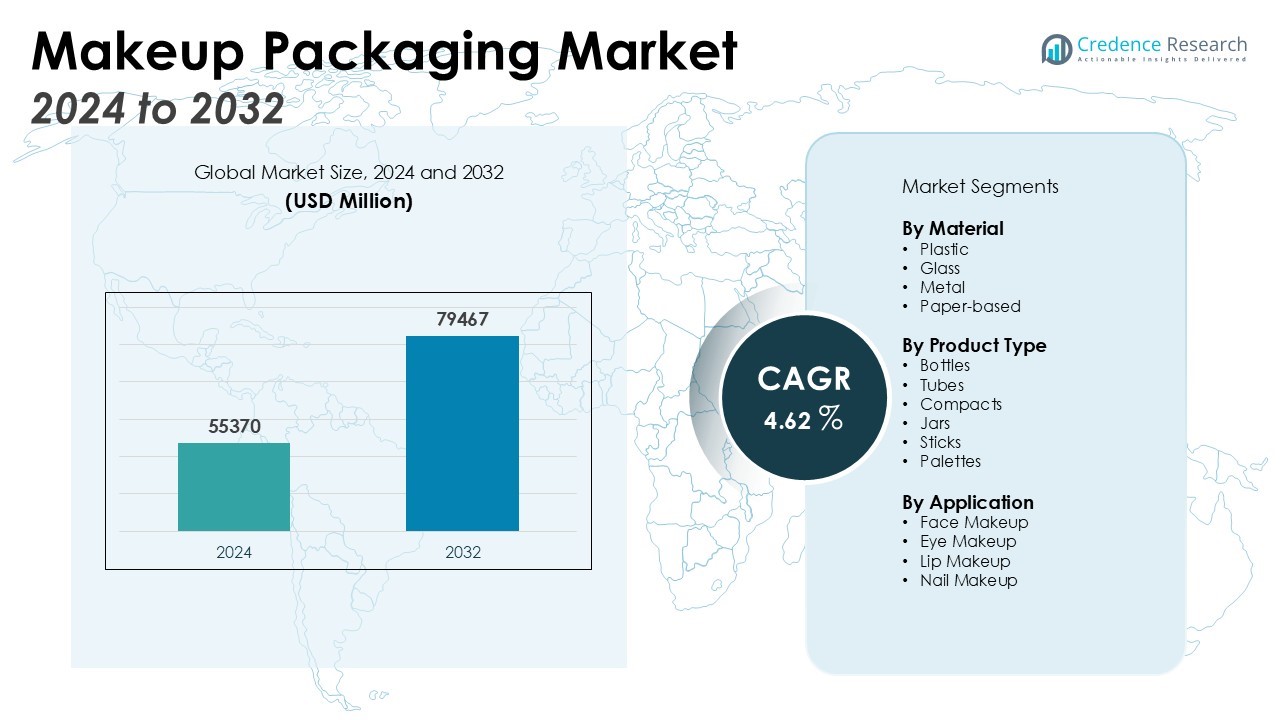
The makeup packaging market size was valued at USD 55370 million in 2024 and is anticipated to reach USD 79467 million by 2032, at a CAGR of 4.62 % during the forecast period (2024-2032).
| REPORT ATTRIBUTE | DETAILS |
|---|---|
| Historical Period | 2020-2024 |
| Base Year | 2024 |
| Forecast Period | 2025-2032 |
| Makeup Packaging Market Size 2024 | USD 55370 Million |
| Makeup Packaging Market, CAGR | 4.62 % |
| Makeup Packaging Market Size 2032 | USD 79467 Million |
Key drivers for the makeup packaging market include heightened consumer focus on personal grooming, brand differentiation, and product innovation. Leading brands prioritize unique packaging designs, advanced materials, and customizable options that align with current trends such as refillable and eco-friendly formats. Rising awareness around sustainability encourages the adoption of recyclable, biodegradable, and reusable materials. Technological advancements-such as airless pump systems, smart labeling, and digital printing-support enhanced shelf appeal and supply chain efficiency.
Regionally, Asia Pacific dominates the makeup packaging market, fueled by strong growth in the beauty and personal care sector, large millennial and Gen Z populations, and increased urbanization in countries such as China, Japan, and South Korea. North America and Europe follow closely, characterized by the presence of major cosmetic brands and a mature consumer base that values innovation and sustainability. The Middle East, Latin America, and Africa present emerging opportunities due to rising disposable incomes and growing popularity of Western beauty trends.
Market Insights:
- The makeup packaging market reached USD 55,370 million in 2024 and will grow to USD 79,467 million by 2032.
- Demand for innovative, portable, and customizable packaging designs drives brand differentiation and consumer engagement.
- Sustainability initiatives increase adoption of recyclable, biodegradable, and refillable materials across packaging formats.
- Social media and e-commerce trends fuel demand for visually distinctive, interactive packaging to enhance online presence.
- Asia Pacific holds 42% share, North America 28%, and Europe 21%, reflecting regional strengths in beauty consumption and production.
- Regulatory compliance, rising costs, and intense competition challenge brands to balance innovation, quality, and profitability.
- Key players such as Berry Global, BIG SKY PACKAGING, Huhtamaki, SILGAN HOLDINGS INC., AptarGroup, and Gerresheimer shape market dynamics.
Market Drivers:
Growing Demand for Innovative and Functional Packaging Solutions:
Consumers seek more than basic utility, driving brands to focus on innovative packaging designs. The makeup packaging market benefits from user-friendly applicators, tamper-evident closures, and compact, multi-purpose formats. Customizable packaging enhances product differentiation and personalized consumer experiences. Advanced dispensing systems like airless pumps and dropper bottles improve usability and product preservation, stimulating ongoing innovation.
- For instance, Tarte’s Sweet Tarte Cravings Eyeshadow Palette stands out for its creative, chocolate-inspired compact design, featuring 9 eyeshadow pans shaped like chocolate squares in a single portable palette.
Heightened Focus on Sustainability and Eco-Friendly Materials:
Rising environmental concerns and stricter regulations encourage the use of recyclable, biodegradable, and refillable materials. Brands integrate post-consumer recycled plastics, paper-based tubes, and compostable components to meet eco-conscious consumer demands. Companies align with circular economy initiatives, reducing waste and carbon footprint. Regulatory support in regions like Europe and North America reinforces the adoption of eco-friendly packaging solutions.
Influence of Social Media and E-Commerce Expansion:
Social media and e-commerce platforms fuel demand for visually striking and digitally optimized packaging. Bold graphics, unique shapes, and interactive features enhance product appeal and shareability online. Influencer marketing and unboxing trends emphasize packaging aesthetics in consumer purchasing decisions. E-commerce growth boosts the need for protective yet attractive packaging, with digital printing and smart technologies fostering real-time engagement.
- For instance, Senoptica Technologies received FDA approval in 2024 for its patented optical sensor technology, which improves the probability of detecting failed food packs by up to 11,000 times compared to traditional packaging standards.
Technological Advancements in Packaging Manufacturing and Design:
Advancements in materials and production processes drive market expansion, with injection molding and digital techniques enabling intricate designs. Automation enhances manufacturing efficiency, quality control, and cost reduction. Smart packaging features like QR codes and authentication tags improve product security and supply chain transparency. Lightweight, durable materials optimize transportation and shelf-life, positioning the industry for sustained innovation.
Market Trends:
Emphasis on Personalization and Limited-Edition Packaging Formats:
Personalization remains a significant trend, with brands creating unique packaging solutions that cater to individual preferences and seasonal launches. The makeup packaging market features customized graphics, name engravings, and exclusive colorways to enhance brand loyalty and consumer engagement. Limited-edition packaging for product collaborations and holiday collections increases demand for specialty formats. Brands leverage advanced digital printing and flexible manufacturing processes to support frequent design updates and rapid launches. The popularity of influencer collaborations and social media-driven campaigns reinforces the shift toward eye-catching, collectible packaging. This approach elevates the perceived value of products and differentiates brands in a crowded marketplace.
- For example, Morphe’s limited-edition James Charles Artistry Palette launched with 39 shades and sold out its initial batch in under 10 minutes, demonstrating overwhelming consumer demand for exclusive, collectible packaging designs.
Integration of Smart and Sustainable Packaging Technologies:
Smart and sustainable technologies shape the future of makeup packaging, reflecting rising consumer expectations for both functionality and environmental responsibility. The makeup packaging market incorporates QR codes, NFC tags, and augmented reality features to enhance consumer interaction and product authentication. Eco-friendly solutions such as refillable compacts, mono-material components, and biodegradable packaging attract environmentally conscious buyers and meet regulatory demands. Automation and digital tools streamline supply chains and enable greater design agility. Brands introduce transparent sourcing and traceability through digital labels, building consumer trust and supporting circular economy initiatives. These trends drive both innovation and market expansion, positioning companies to capitalize on evolving industry dynamics.
- For instance, Too Faced embedded NFC tags in 100,000 samples of its Maximum Plump lip gloss, distributed via BoxyCharm, enabling each recipient to access brand content instantly with their smartphones.
Market Challenges Analysis:
Complex Regulatory Compliance and Sustainability Demands:
Stringent regulations on material safety, recyclability, and labeling create persistent challenges for brands and manufacturers. The makeup packaging market faces frequent updates to global and regional standards, making compliance costly and time-intensive. Companies must balance aesthetics, functionality, and sustainability while meeting new environmental requirements. Sourcing sustainable materials at scale can strain supply chains and increase operational complexity. Ensuring product safety without sacrificing design flexibility adds further pressure. Brands that do not adapt quickly risk losing consumer trust and market share.
Rising Costs and Intense Market Competition:
Escalating raw material prices and logistics costs impact profit margins across the value chain. The makeup packaging market operates in a highly competitive environment where brands must continuously invest in innovation to maintain differentiation. High demand for advanced packaging technologies and premium materials increases production expenses. Counterfeit products and intellectual property risks require investment in security features, further raising costs. Intense competition from both global and local players accelerates price pressures and shortens product development cycles, challenging companies to balance quality, speed, and profitability.
Market Opportunities:
Expansion in Emerging Markets and Niche Segments:
Rising disposable incomes and changing beauty standards create strong growth prospects in emerging regions such as Asia Pacific, Latin America, and the Middle East. The makeup packaging market can capture new consumer bases by tailoring products to local preferences and cultural trends. Brands have opportunities to introduce innovative packaging for niche categories like vegan, organic, and clean beauty products. E-commerce and digital retail platforms enable wider market reach and support rapid product launches. Companies that localize packaging designs and invest in regional partnerships can achieve faster brand recognition and market penetration. This regional expansion supports long-term revenue growth.
Advancements in Sustainable and Smart Packaging Solutions:
Growing demand for environmentally responsible and tech-enabled packaging opens avenues for product and process innovation. The makeup packaging market benefits from new materials such as biodegradable plastics, refillable systems, and mono-material designs that align with circular economy principles. Adoption of smart packaging features-including QR codes, NFC tags, and augmented reality-creates engaging consumer experiences and adds value beyond basic functionality. Collaborations with technology providers and material innovators can drive differentiation and customer loyalty. Brands that position themselves as sustainability leaders and invest in digital capabilities are well placed to capitalize on evolving consumer expectations.
Market Segmentation Analysis:
By Material:
The makeup packaging market features a diverse mix of materials to address evolving consumer expectations and regulatory standards. Plastic remains the dominant choice due to its flexibility, cost-effectiveness, and compatibility with a wide range of products. Glass secures strong demand in premium and eco-conscious segments, valued for its recyclability and luxury appeal. Metal components, such as aluminum, offer durability and upscale aesthetics for select product lines. Paper-based materials are gaining traction among brands prioritizing sustainability, supporting innovations in biodegradable and recyclable packaging.
- For instance, Berry Global and Mars transitioned M&M’S®, SKITTLES®, and STARBURST® pantry jars to 100% recycled plastic packaging in 2025, eliminating more than 1,300 metric tons of virgin plastic each year.
By Product Type:
Product segmentation highlights bottles, tubes, compacts, jars, sticks, and palettes as the core packaging formats. Bottles and tubes lead in liquid and cream-based applications, driven by their convenience and controlled dispensing. Compacts and palettes dominate in color cosmetics, offering customization and portability. Jars appeal to premium skincare and specialty products, where product visibility and tactile experience are important. Sticks cater to growing demand for solid, on-the-go makeup formats, especially in foundations, lip balms, and highlighters.
- For instance, MAC’s customizable Pro Palette can be filled with 15 individual eyeshadow pans, with each pan holding 1.5g of product in a secure magnetic base for everyday or professional use.
By Application:
The makeup packaging market serves a broad array of cosmetic categories, including face, eye, lip, and nail products. Face makeup commands the largest share, with brands investing in innovative formats for foundations, powders, and blushes. Eye and lip segments require precise, visually appealing packaging to stand out in competitive retail environments. Nail products utilize compact, durable solutions designed for both at-home and professional use. Each application area shapes packaging design, emphasizing functionality, aesthetics, and user experience.
Segmentations:
By Material:
- Plastic
- Glass
- Metal
- Paper-based
By Product Type:
- Bottles
- Tubes
- Compacts
- Jars
- Sticks
- Palettes
By Application:
- Face Makeup
- Eye Makeup
- Lip Makeup
- Nail Makeup
By Region:
- Asia Pacific
- North America
- Europe
- Latin America
- Middle East & Africa
Regional Analysis:
Asia Pacific's Dominance in the Makeup Packaging Market
Asia Pacific holds a 42% share of the makeup packaging market, driven by strong demand from countries like China, Japan, South Korea, and India. Rapid urbanization, robust growth in the cosmetics sector, and a large millennial and Gen Z consumer base fuel expansion. Regional manufacturers benefit from advanced production capabilities and quick adoption of global beauty trends. Strategic investments in sustainable packaging enable local brands to gain a competitive edge. E-commerce penetration increases accessibility and supports the introduction of digitally optimized packaging formats, while limited-edition and customized designs cater to diverse consumer preferences.
North America's Role in the Makeup Packaging Market
North America accounts for 28% of the makeup packaging market, supported by a mature beauty industry and high consumer purchasing power. Packaging innovation, sustainability, and convenience are key drivers, with brands investing in advanced materials and user-friendly designs. Regulatory compliance and environmental awareness encourage the adoption of recyclable and refillable packaging. Major brands leverage strong distribution networks to expand reach and accelerate product launches. Influencer marketing and digital platforms amplify visibility, while collaborations with technology providers enhance packaging security and traceability.
Europe's Focus on Sustainable and Premium Makeup Packaging
Europe holds a 21% share in the makeup packaging market, driven by stringent sustainability regulations and demand for premium products. Consumers prioritize eco-friendly and visually distinctive packaging that aligns with luxury and ethical values. Regulatory requirements on recyclability and material sourcing influence packaging decisions. Manufacturers invest in sustainable materials, advanced decoration techniques, and refillable solutions to differentiate their offerings. The region’s strong presence of global beauty brands and emphasis on design excellence sustain growth, while companies adapt their packaging portfolios to meet trends in clean beauty and minimalist aesthetics.
Key Player Analysis:
- Amcor plc
- Albea S.A.
- Berry Global, Inc.
- HCP Packaging
- AptarGroup, Inc.
- Sonoco Products Company
- DS Smith plc
- Gerresheimer AG
- Libo Cosmetics Co., Ltd.
- Worldwide Packaging LLC
- Huhtamaki Oyj
- TriMas Corporation
Competitive Analysis:
The makeup packaging market features a competitive landscape shaped by global leaders and specialized regional players. Key companies include Berry Global Group Inc., BIG SKY PACKAGING, Huhtamaki, SILGAN HOLDINGS INC., AptarGroup, Inc., and Gerresheimer, all recognized for their advanced manufacturing capabilities and broad product portfolios. These firms focus on innovation, sustainable materials, and design differentiation to strengthen market position. They invest in strategic partnerships, product development, and acquisitions to expand reach and address evolving brand requirements. The market rewards flexibility, rapid response to trends, and compliance with regulatory standards. Companies compete by offering customization, efficient supply chain solutions, and value-added features that meet the expectations of both established brands and emerging beauty players.
Recent Developments:
- In July 2025, Amcor announced Maison Guerlain’s Aqua Allegoria hand creams feature packaging made from Amcor’s CleanStream® post-consumer recycled polymer, supporting luxury brands’ sustainability objectives without compromising aesthetics or quality.
- In July 2025, Amcor plc unveiled the Hector Child Resistant Closure (CRC), a lightweight polypropylene closure for household cleaning products, offering industry-leading recyclability and reduced material usage to help customers meet sustainability goals.
- In June 2024, Sonoco Products Company announced its intent to acquire Eviosys, a leading European supplier of metal food cans and aerosol packaging, for approximately $3.9 billion.
Market Concentration & Characteristics:
The makeup packaging market exhibits moderate concentration, with a mix of global leaders and regional players shaping the competitive landscape. It features established firms such as AptarGroup, Albéa, Amcor, and HCP Packaging, alongside emerging manufacturers in Asia Pacific. Intense competition drives continuous innovation in design, materials, and sustainability. Companies prioritize partnerships, new product launches, and strategic acquisitions to strengthen market position. The market values flexibility, rapid prototyping, and customization to address evolving brand requirements and consumer trends. Strong regulatory frameworks and high entry barriers maintain a quality-focused environment. Diverse product portfolios and advanced manufacturing capabilities define leading participants in the makeup packaging market.
Report Coverage:
The research report offers an in-depth analysis based on Material, Product Type, Application and Region. It details leading Market players, providing an overview of their business, product offerings, investments, revenue streams, and key applications. Additionally, the report includes insights into the competitive environment, SWOT analysis, current Market trends, as well as the primary drivers and constraints. Furthermore, it discusses various factors that have driven Market expansion in recent years. The report also explores Market dynamics, regulatory scenarios, and technological advancements that are shaping the industry. It assesses the impact of external factors and global economic changes on Market growth. Lastly, it provides strategic recommendations for new entrants and established companies to navigate the complexities of the Market.
Future Outlook:
- Makeup packaging market continues embracing innovations that prioritize personalization, functionality, and visual appeal.
- Brands invest in sustainable materials like mono-material designs, compostable components, and refillable systems.
- Smart features such as QR codes, NFC tags, and augmented reality labels enhance consumer experience and product authentication.
- Manufacturing processes adopt automation and digital tools to deliver faster turnaround and lower production costs.
- Collaboration between packaging suppliers and beauty brands accelerates the introduction of bespoke limited‑edition designs.
- Regional customization efforts support tailored packaging aesthetics that reflect local trends and cultural preferences.
- Emerging markets in Asia Pacific and Latin America show significant potential for premium and niche packaging formats.
- E-commerce growth pushes demand for robust, lightweight designs that ensure product safety while maximizing shelf‑impact.
- Regulatory requirements drive adoption of recyclable and traceable packaging solutions, reinforcing eco‑compliance.
- Strategic partnerships with material technology innovators create opportunities for advanced finishes and sustainable manufacturing.

Request a Free Sample
Fill in your details and we'll send you a free sample report.
- Sample data tables & charts
- Research methodology
Market Dynamics
Innovation in Packaging Design and Functionality
Brands are investing in unique, user-friendly, and customizable packaging formats such as airless pumps, dropper bottles, and compact multi-purpose designs to differentiate their products and enhance consumer experience, driving market growth.
Sustainability and Eco-Friendly Materials
Growing environmental awareness and regulatory pressures are pushing brands to adopt recyclable, biodegradable, and refillable packaging solutions, which attract eco-conscious consumers and support long-term market expansion.
Social Media and E-Commerce Influence
The rise of social media and online retail channels increases demand for visually distinctive and interactive packaging that enhances product appeal, shareability, and consumer engagement, fueling growth in the makeup packaging market.
Technological Advancements in Manufacturing
Innovations such as digital printing, smart labeling, and automation enable intricate designs, improved supply chain efficiency, and cost-effective production, supporting the rapid introduction of new packaging formats and features.
Regional Growth in Emerging Markets
Rising disposable incomes, urbanization, and changing beauty standards in Asia Pacific, Latin America, and the Middle East are expanding the consumer base and creating new opportunities for tailored and premium packaging solutions.
Need a Custom Version of This Report?
Tailor the scope, geography, or segments to your exact requirements.
- Custom geography or segment scope
- Direct access to our analyst team
Frequently Asked Questions
What is the current size of the makeup packaging market?
What factors are driving the growth of the makeup packaging market?
Q: What are the key segments within the makeup packaging market?
What are some challenges faced by the makeup packaging market?
Who are the major players in the makeup packaging market?
Table of Content
Chapter 1 Market Segmentation
- 1.1 Segmentation Framework
- 1.1.1 Product and Service Classification
- 1.1.2 Application and End-Use Classification
- 1.1.3 Technology and Solution Classification
- 1.1.4 Customer and Distribution Channel Classification
- 1.1.5 Geographic Segmentation
- 1.1.6 Market Segment Definitions and Boundaries
- 1.2 By Material
- 1.2.1 Plastic
- 1.2.2 Glass
- 1.2.3 Metal
- 1.2.4 Paper-based
- 1.3 By Application
- 1.3.1 Face Makeup
- 1.3.2 Eye Makeup
- 1.3.3 Lip Makeup
- 1.3.4 Nail Makeup
- 1.4 By Product Type
- 1.4.1 Bottles
- 1.4.2 Tubes
- 1.4.3 Compacts
- 1.4.4 Jars
- 1.4.5 Sticks
- 1.4.6 Palettes
Chapter 2 Introduction
- 2.1 Report Objectives and Scope
- 2.2 Product Definition and Industry Terminology
- 2.3 Market Inclusions and Exclusions
- 2.4 Research Process
- 2.4.1 Primary Research and Expert Interviews
- 2.4.2 Secondary Research and Source Review
- 2.4.3 Top-Down and Bottom-Up Estimation
- 2.4.4 Data Triangulation and Verification
- 2.5 Market Size Measurement Basis
- 2.5.1 2024: USD 55,370 million → 2032: USD 79,467 million
- 2.6 Historical and Forecast Reference Periods
- 2.6.1 Base Year: 2024
- 2.6.2 Forecast Period: 2024-2032
- 2.7 Research Assumptions and Limitations
Chapter 3 Executive Summary
- 3.1 Market Snapshot and Key Findings
- 3.2 Base-Year Market Size, 2024
- 3.3 Forecast Market Size, 2032
- 3.4 Revenue and Volume Growth Outlook
- 3.5 Key Demand and Supply Indicators
- 3.6 Leading Market Segments
- 3.7 Fastest-Growing Market Opportunities
- 3.8 Regional Performance Highlights
- 3.9 Technology and Industry Transformation
- 3.10 Competitive Landscape Summary
- 3.11 Analyst View and Strategic Implications
Chapter 4 Global Makeup Packaging Market Trends and Developments
- 4.1 Historical Industry Development
- 4.2 Recent Market Trends and Developments
- 4.3 Demand and Customer Behavior Trends
- 4.4 Technology and Product Innovation
- 4.5 Artificial Intelligence, Automation and Digitalization
- 4.6 Local Manufacturing and Supply Chain Realignment
- 4.7 Industry Partnerships, Mergers and Acquisitions
- 4.8 Sustainability and Circular Economy Developments
- 4.9 Government and Private Sector Investment Trends
- 4.10 Emerging Business Models and Commercialization
- 4.11 Industry Developments and Announcements
Chapter 5 Global Makeup Packaging Market Production, Supply and Demand Analysis
- 5.1 Demand Trend and Consumption Analysis
- 5.2 Demand Forecast, 2024-2032
- 5.3 Production and Output Trend
- 5.4 Production and Output Forecast, 2024-2032
- 5.5 Installed Capacity and Capacity Utilization
- 5.6 Company-Wise Production Plants and Statistics
- 5.6.1 Installed Production Capacity
- 5.6.2 Actual Production
- 5.6.3 Planned Capacity and Expansion Targets
- 5.7 Supply Chain Structure and Procurement Trends
- 5.8 Supply-Demand Gap and Bottlenecks
- 5.9 Import Dependence and Sourcing Structure
- 5.10 Contract Manufacturing and Outsourcing
- 5.11 Regional Supply and Demand Concentration
Chapter 6 Global Makeup Packaging Market Pricing Analysis
- 6.1 Pricing Structure and Measurement
- 6.2 Historical Pricing Trends
- 6.3 Pricing Outlook, 2024-2032
- 6.4 Average Selling Price and Unit Economics
- 6.5 Pricing by Product and Market Segment
- 6.6 Geographic Pricing Differences
- 6.7 Key Input, Energy, Labor and Logistics Costs
- 6.8 Contract Pricing and Purchasing Models
- 6.9 Pricing Sensitivity and Competitive Positioning
- 6.10 Price, Margin and Profitability Implications
Chapter 7 Global Makeup Packaging Market Dynamics
- 7.1 Market Growth Drivers
- 7.1.1 Demand-Side Drivers
- 7.1.2 Technology and Innovation Drivers
- 7.1.3 Infrastructure and Investment Drivers
- 7.1.4 Regulatory and Policy Drivers
- 7.2 Market Restraints
- 7.2.1 Cost and Affordability Constraints
- 7.2.2 Technology and Adoption Barriers
- 7.2.3 Supply Chain and Operational Constraints
- 7.3 Market Challenges
- 7.3.1 Competitive Pressure and Margin Erosion
- 7.3.2 Skills, Infrastructure and Implementation Gaps
- 7.4 Emerging Market Opportunities
- 7.5 Market Dynamics Impact and Time-Horizon Assessment
Chapter 8 Global Makeup Packaging Value Chain Analysis
- 8.1 Industry Value Chain Overview
- 8.2 Upstream Suppliers and Critical Inputs
- 8.3 Technology and Component Providers
- 8.4 Manufacturing or Service Delivery
- 8.5 Distribution, Channel Partners and Integrators
- 8.6 Downstream Applications and End Users
- 8.7 Value Addition and Profit Pools
- 8.8 Vertical Integration and Outsourcing
- 8.9 Supplier Concentration and Risk
- 8.10 Supply Chain Localization and Resilience
Chapter 9 Global Makeup Packaging Market Regulations and Policies
- 9.1 Relevant Laws, Standards and Compliance Frameworks
- 9.2 Product, Service, Safety and Quality Requirements
- 9.3 Government Policies, Incentives and Subsidies
- 9.4 Imports, Exports and Trade Barriers
- 9.5 Public Procurement and Local Content Requirements
- 9.6 Environmental and Sustainability Compliance
- 9.7 Upcoming Policy Changes and Market Implications
Chapter 10 Global Makeup Packaging Market Hotspots and Opportunities
- 10.1 Market Opportunity Mapping and Growth Hotspots
- 10.2 High-Growth Applications and Customer Groups
- 10.3 Underserved Markets and White-Space Opportunities
- 10.4 Emerging Technology and Product Opportunities
- 10.5 New Capacity and Investment Hotspots
- 10.6 Market Entry and Expansion Opportunities
- 10.7 Distribution and Partnership Opportunities
- 10.8 Near-Term and Long-Term Commercial Potential
- 10.9 Opportunity Attractiveness and Execution Risks
Chapter 11 Global Makeup Packaging Market Outlook, 2024-2032
- 11.1 Market Size and Analysis
- 11.1.1 Revenue (Market Measurement: 2024: USD 55,370 million → 2032: USD 79,467 million)
- 11.1.2 Market Volume and Quantity Sold
- 11.1.3 Historical Market Size
- 11.1.4 Base-Year Market Size, 2024
- 11.2 Market Forecast, 2024-2032
- 11.2.1 Revenue Forecast to 2032
- 11.2.2 Volume Forecast to 2032
- 11.2.3 CAGR and Year-on-Year Growth
- 11.2.4 Incremental Revenue Opportunity
- 11.3 Forecast Assumptions and Scenario Analysis
- 11.3.1 Base-Case Forecast
- 11.3.2 Optimistic and Conservative Scenarios
- 11.3.3 Technology, Pricing and Policy Sensitivities
- 11.4 Market Attractiveness and Growth Outlook
Chapter 12 Global Makeup Packaging Market Segmentation and Outlook
- 12.1 Segmentation Summary and Market Shares, 2024
- 12.2 Largest and Fastest-Growing Segments
- 12.3 By Material - Market Size and Forecast, 2024-2032
- 12.3.1 Segment Definition and Scope
- 12.3.2 Historical Market Size
- 12.3.3 Revenue Forecast, 2024-2032
- 12.3.4 Volume Forecast, 2024-2032
- 12.3.5 Base-Year Market Share, 2024
- 12.3.6 Segment CAGR and Growth Drivers
- 12.3.7 Subsegment Market Size and Forecast
- 12.3.7.1 Plastic
- 12.3.7.2 Glass
- 12.3.7.3 Metal
- 12.3.7.4 Paper-based
- 12.3.8 Subsegment Pricing and Adoption Trends
- 12.3.9 Leading Suppliers and Competition
- 12.3.10 Regional Demand and Opportunities
- 12.4 By Application - Market Size and Forecast, 2024-2032
- 12.4.1 Segment Definition and Scope
- 12.4.2 Historical Market Size
- 12.4.3 Revenue Forecast, 2024-2032
- 12.4.4 Volume Forecast, 2024-2032
- 12.4.5 Base-Year Market Share, 2024
- 12.4.6 Segment CAGR and Growth Drivers
- 12.4.7 Subsegment Market Size and Forecast
- 12.4.7.1 Face Makeup
- 12.4.7.2 Eye Makeup
- 12.4.7.3 Lip Makeup
- 12.4.7.4 Nail Makeup
- 12.4.8 Subsegment Pricing and Adoption Trends
- 12.4.9 Leading Suppliers and Competition
- 12.4.10 Regional Demand and Opportunities
- 12.5 By Product Type - Market Size and Forecast, 2024-2032
- 12.5.1 Segment Definition and Scope
- 12.5.2 Historical Market Size
- 12.5.3 Revenue Forecast, 2024-2032
- 12.5.4 Volume Forecast, 2024-2032
- 12.5.5 Base-Year Market Share, 2024
- 12.5.6 Segment CAGR and Growth Drivers
- 12.5.7 Subsegment Market Size and Forecast
- 12.5.7.1 Bottles
- 12.5.7.2 Tubes
- 12.5.7.3 Compacts
- 12.5.7.4 Jars
- 12.5.7.5 Sticks
- 12.5.7.6 Palettes
- 12.5.8 Subsegment Pricing and Adoption Trends
- 12.5.9 Leading Suppliers and Competition
- 12.5.10 Regional Demand and Opportunities
- 12.6 Segment Growth Comparison
- 12.7 Segment Attractiveness and Priority Matrix
Chapter 13 Global Makeup Packaging End-Use and Application Market Outlook
- 13.1 End-Use Industry and Customer Demand Structure
- 13.2 Leading Applications and Customer Groups
- 13.3 End-Use Market Size, Share and Forecast
- 13.4 Major End-Use Industry Deep Dives
- 13.4.1 Customer Requirements and Use Cases
- 13.4.2 Demand and Replacement Cycles
- 13.4.3 Technical and Regulatory Considerations
- 13.4.4 Purchasing and Procurement Models
- 13.4.5 Leading Vendors and Distribution Channels
- 13.4.6 Forecast and Commercial Opportunities
- 13.5 Emerging Applications and Cross-Segment Demand
- 13.6 End-Use Industry Investment Priorities
Chapter 14 Global Makeup Packaging Geographic Market Outlook, 2024-2032
- 14.1 Regional Market Size and Share, 2024
- 14.2 Regional Market Forecast, 2024-2032
- 14.3 Regional Pricing, Production and Demand Differences
- 14.4 North America
- 14.4.1 United States
- 14.4.2 Canada
- 14.4.3 Mexico
- 14.5 Europe
- 14.5.1 Germany
- 14.5.2 France
- 14.5.3 Italy
- 14.5.4 United Kingdom
- 14.5.5 Spain
- 14.5.6 Poland
- 14.5.7 Russia
- 14.5.8 Netherlands
- 14.5.9 Belgium
- 14.5.10 Sweden
- 14.5.11 Denmark
- 14.5.12 Norway
- 14.5.13 Rest of Europe
- 14.6 Asia Pacific
- 14.6.1 China
- 14.6.2 India
- 14.6.3 Japan
- 14.6.4 South Korea
- 14.6.5 Thailand
- 14.6.6 Indonesia
- 14.6.7 Vietnam
- 14.6.8 Malaysia
- 14.6.9 Australia
- 14.6.10 Rest of Asia Pacific
- 14.7 Latin America
- 14.7.1 Brazil
- 14.7.2 Argentina
- 14.7.3 Colombia
- 14.7.4 Chile
- 14.7.5 Rest of Latin America
- 14.8 Middle East
- 14.8.1 Saudi Arabia
- 14.8.2 United Arab Emirates
- 14.8.3 Turkey
- 14.8.4 Israel
- 14.8.5 Iran
- 14.8.6 Rest of the Middle East
- 14.9 Africa
- 14.9.1 South Africa
- 14.9.2 Egypt
- 14.9.3 Nigeria
- 14.9.4 Morocco
- 14.9.5 Rest of Africa
- 14.10 Regional Investment, Policy and Supply Chain Differences
- 14.11 Regional Competitive Landscape
- 14.12 Geographic Growth Hotspots
Chapter 15 Global Makeup Packaging Technology, Innovation and Sustainability Outlook
- 15.1 Technology Landscape and Maturity
- 15.2 Product, Process and Service Innovation
- 15.3 AI, Automation and Digital Tools in the Industry
- 15.4 Technology Adoption and Performance Benchmarking
- 15.5 Innovation Pipeline and R&D Investment
- 15.6 Patent and Intellectual Property Trends
- 15.7 Energy Efficiency and Resource Management
- 15.8 Sustainability, Recycling and Circularity
- 15.9 Technology Roadmap, 2024-2032
- 15.10 Risks of Obsolescence and Technology Substitution
Chapter 16 Global Makeup Packaging Market Key Strategic Imperatives
- 16.1 Growth and Market Entry Priorities
- 16.2 High-Return Products and Segments
- 16.3 Pricing, Profitability and Cost Optimization
- 16.4 Technology Investment and Product Differentiation
- 16.5 Supply Chain Localization and Resilience
- 16.6 Distribution and Customer Acquisition
- 16.7 Partnership, Acquisition and Capacity Strategy
- 16.8 Regional Expansion Priorities
- 16.9 Short-, Medium- and Long-Term Actions
Chapter 17 Competition Outlook
- 17.1 Industry Competition Characteristics
- 17.2 Market Structure and Concentration
- 17.3 Market Share and Competitive Positioning, 2024
- 17.4 Company-Wise Revenue and Product Benchmarking
- 17.5 Production and Service Capacity Benchmarking
- 17.6 Technology, Pricing and Differentiation
- 17.7 Regional Footprint and Distribution Strength
- 17.8 Mergers, Acquisitions and Strategic Alliances
- 17.9 New Entrants and Competitive Threats
- 17.10 Porter's Five Forces and Industry Attractiveness
- 17.11 Competitive Outlook, 2024-2032
Chapter 18 Company Profiles
- 18.1 Company Coverage and Selection Criteria
- 18.2 Amcor plc
- 18.2.1 Business Description
- 18.2.2 Company Ownership and Geographic Presence
- 18.2.3 Product and Service Portfolio
- 18.2.4 Manufacturing and Operating Footprint
- 18.2.5 Production Capacity and Expansion Plans
- 18.2.6 Financial Performance and Investment
- 18.2.7 Market Share and Competitive Position
- 18.2.8 Technology and Innovation Capabilities
- 18.2.9 Strategic Alliances or Partnerships
- 18.2.10 Recent Developments
- 18.2.11 Growth Strategy and Outlook
- 18.3 Albea S.A.
- 18.4 Berry Global, Inc.
- 18.5 HCP Packaging
- 18.6 AptarGroup, Inc.
- 18.7 Sonoco Products Company
- 18.8 DS Smith plc
- 18.9 Gerresheimer AG
- 18.10 Huhtamaki Oyj
- 18.11 Libo Cosmetics Co., Ltd.
- 18.12 Other Relevant Market Participants
Note: Every listed company is profiled on the structure shown under the first company. The company list is preliminary and may change based on research findings, market developments, data availability and client requirements.
Chapter 19 Disclaimer
- 19.1 Research and Forecast Disclaimer
- 19.2 Data Source and Estimation Limitations
Note: The depth of individual sections depends on data availability for this market. Volume, capacity, trade and other unit-based metrics are included where applicable.