
Malaysia Agrochemicals Market Overview:
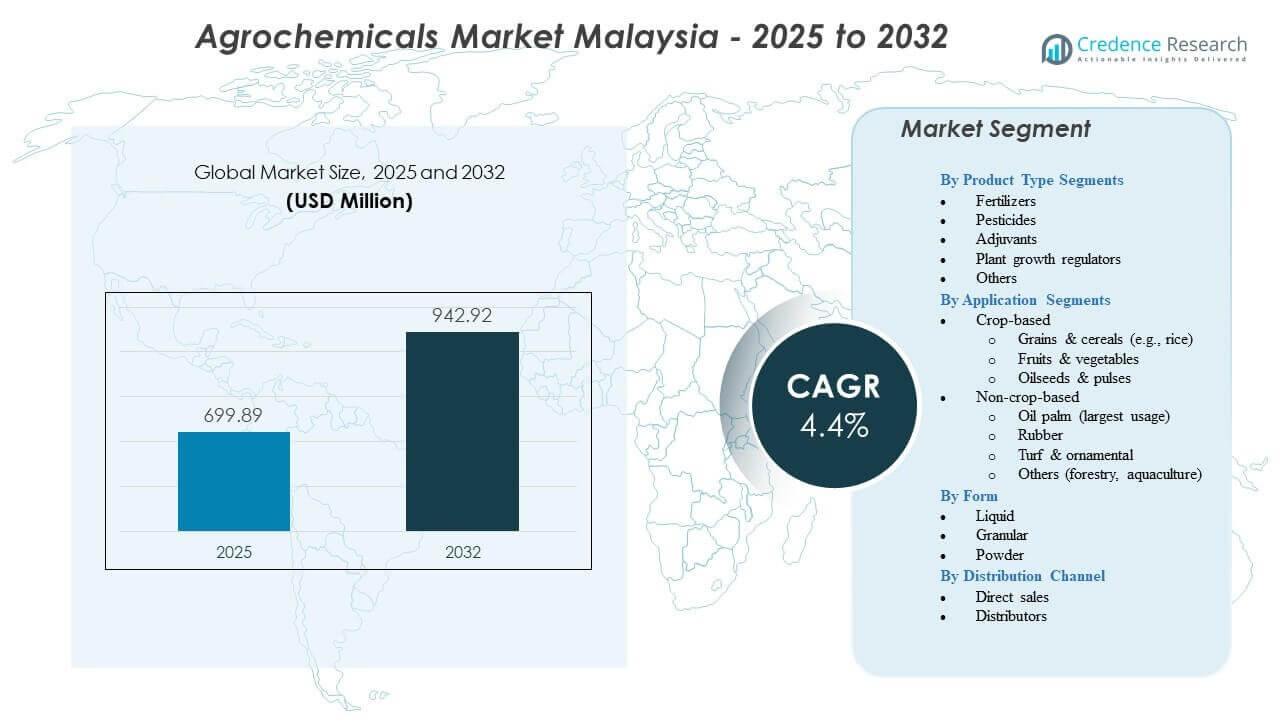
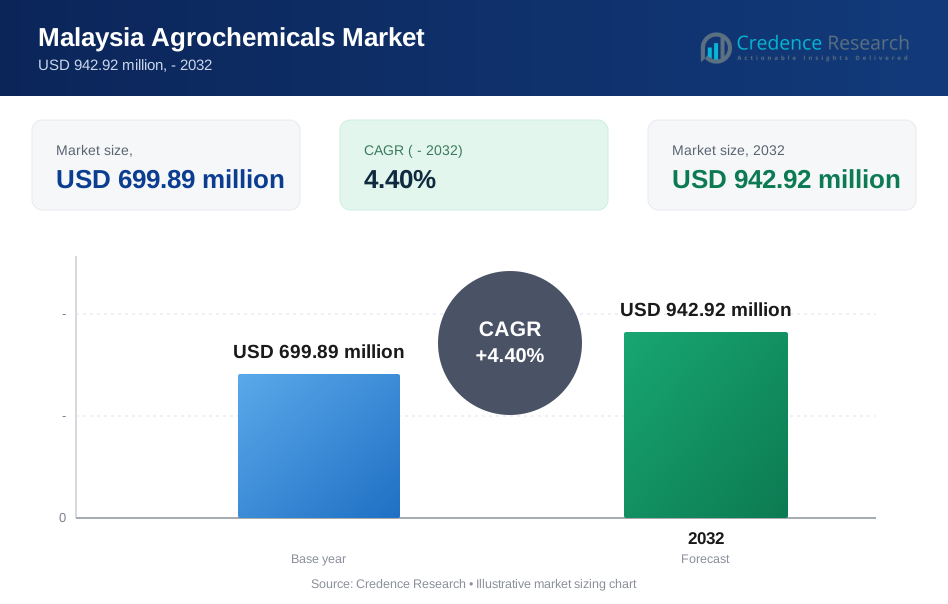
The Malaysia Agrochemicals Market is projected to grow from USD 699.89 million in 2025 to an estimated USD 942.92 million by 2032, with a compound annual growth rate (CAGR) of 4.4% from 2025 to 2032.
Strong demand emerges from expanding plantation activities, rising pest pressure, and the need for higher crop productivity across oil palm, rubber, and horticulture segments.
| REPORT ATTRIBUTE | DETAILS |
|---|---|
| Historical Period | 2020-2024 |
| Base Year | 2025 |
| Forecast Period | 2026-2032 |
| Malaysia Agrochemicals Market Size 2025 | USD 699.89 million |
| Malaysia Agrochemicals Market, CAGR | 4.4% |
| Malaysia Agrochemicals Market Size 2032 | USD 942.92 million |
Malaysia Agrochemicals Market Insights:
- Strong market drivers include expanding plantation acreage, higher pest pressure, and stricter quality standards that push growers toward certified fertilizers, pesticides, and soil enhancement products.
- Restraints emerge from regulatory tightening, environmental concerns, and rising pressure to shift away from older chemistries, which challenges suppliers dependent on legacy formulations.
- Regional dynamics show East Malaysia leading due to extensive oil palm estates requiring continuous chemical application, while Central and Southern regions grow through horticulture-driven demand.
- Northern Malaysia shows steady momentum as rice cultivation modernizes, and emerging clusters adopt structured nutrient and protection programs to strengthen crop resilience.
Malaysia Agrochemicals Market Drivers
Strong Expansion of High-Value Crop Plantations Driving Chemical Input Demand
Large oil palm, rubber, and fruit plantations expand their reliance on crop protection tools to secure yield stability across diverse terrains. Farmers use herbicides, fungicides, and fertilizers to maintain consistent productivity in large estates. Climate shifts push growers to adopt stronger disease control plans to protect sensitive crops. The Malaysia Agrochemicals Market benefits from steady use of inputs that protect plantation output. Producers increase focus on soil health products to support longer crop cycles. Rising pest outbreaks push estates to use planned applications with higher precision. Export targets raise quality standards that encourage broader chemical adoption. It strengthens reliance on regulated protection tools across key crop clusters.
Rising Pest Pressure and Disease Intensity Supporting Wider Adoption of Advanced Formulations
Tropical weather patterns raise pest survival rates and extend breeding cycles across major crops. Growers adopt stronger formulations to manage leaf spot, blight, and fungal spread. It creates structured demand for tested chemistries that limit damage in early stages. Smallholders adopt integrated treatment schedules to match plantation-level protocols. Awareness campaigns promote timely intervention for disease-prone zones. The Malaysia Agrochemicals Market gains steady support from higher concern over crop loss. Supply chains highlight the need for reliable inputs during monsoon-driven threats. Importers deliver targeted solutions that support pest load reduction during peak cycles.
- For instance, Syngenta Group reported that its PLINAZOLIN® technology, introduced in Asia for insect control, delivers rapid knockdown across multiple pest species and supports long residual activity, strengthening resistance management programs in tropical crops.
Government-Led Yield Improvement Programs Strengthening Input Reliability and Adoption
Public agencies promote yield improvement programs across rural zones to reduce national supply gaps. Subsidy-linked initiatives encourage use of regulated agrochemicals through verified suppliers. Farmers receive training that improves compliance with safe application rules. It increases trust in certified products and discourages informal alternatives. Stewardship programs raise awareness of soil nutrition and balanced fertilizer use. The Malaysia Agrochemicals Market benefits from structured knowledge-sharing systems across districts. Community-based outreach sessions raise adoption of proper dosage schedules. Improved credit access also increases demand for legally approved products.
- For instance, Bayer AG runs its Bayer ForwardFarming initiative globally, demonstrating integrated crop solutions across commercial farms and showcasing measurable improvements in input optimization and sustainable practices under monitored field conditions.
Shift Toward Professional Farm Management and Contract Farming Enhancing Agrochemical Penetration
Commercial farms invest in systematic crop planning to support consistent annual output. Contract farming agreements push growers to follow strict input standards. It creates stronger alignment between buyers and producers on approved chemical use. Estate managers adopt digital advisory systems that optimize chemical rotation cycles. Data-driven monitoring tools support compliance with import regulations. The Malaysia Agrochemicals Market gains momentum from farms adopting tighter operational control. Export-linked firms require traceability records that guide input selection. Farmers meeting contract terms use standard agrochemical packages to avoid quality penalties.
Malaysia Agrochemicals Market Trends
Growing Transition Toward Bio-Based Crop Protection Solutions and Sustainable Practices
Farmers review bio-based fertilizers and pesticides to reduce soil strain linked to repeated chemical cycles. Plantation groups test bio-stimulants to improve root strength during climate stress. It reflects rising interest in environmentally safer alternatives with regulated residue levels. Buyers in export markets prefer produce from farms shifting toward green inputs. The Malaysia Agrochemicals Market sees rising focus on low-toxicity options that fit global trade rules. Research entities promote microbial products to reduce long-term soil fatigue. Distributors increase supply of organic blends that support nutrient efficiency. Adoption of eco-compliant labels strengthens acceptance among large estates.
Expansion of Precision Application Technologies and Smart Farming Tools in Commercial Estates
Commercial farms invest in drones and GPS sprayers to improve chemical accuracy across large plots. Precision tools lower waste by directing inputs toward targeted areas. It supports better cost control for farms managing wide plantation zones. Application data gives managers better planning visibility for seasonal cycles. The Malaysia Agrochemicals Market aligns with rising interest in digital tools for precise field coverage. Sensors track soil moisture to guide fertilizer timing. Digital maps help adjust protection plans during disease alerts. Estates use automated systems to meet sustainability targets set by global buyers.
- For instance, Corteva Agriscience deploys Granular Insights™, a digital platform that processes millions of agronomic data points to deliver field-level recommendations, enabling precise input placement and optimized spray timing across commercial farms.
Consolidation in Distribution Networks and Higher Role of Integrated Supply Models
Regional distributors expand their product lines to offer complete fertilizer and crop protection bundles. Integrated distribution helps growers access multiple products from single channels. It creates stronger trust in suppliers offering technical support along with inputs. Larger players invest in advisory teams that guide product use. The Malaysia Agrochemicals Market evolves with networks that provide bundled solutions tied to performance outcomes. Retailers strengthen inventory systems to ensure steady rural supply. Contract-based delivery models increase reach in remote districts. Farmers prefer supply chains that guarantee authenticity and compliance.
- For instance, Hextar Group of Companies expanded its fertilizer portfolio through acquisition activities, strengthening nationwide distribution coverage and integrating crop protection and nutrient solutions under a unified supply structure.
Increasing Alignment with International Quality Standards to Support Export Compliance
Export markets demand produce with strict residue control, pushing farms to adopt compliant inputs. Certification programs monitor chemical use across plantations. It strengthens reliance on regulated formulations with proven residue performance. Buyers inspect traceability logs before approval of crop lots. The Malaysia Agrochemicals Market adapts to global food safety expectations that influence local farming practices. Estate managers lean toward approved formulations with verifiable testing records. Retail chains highlight safety-compliant farms for better pricing access. Growers maintain structured application logs to match overseas requirements.
Malaysia Agrochemicals Market Challenges Analysis
Regulatory Tightening, Cost Volatility, and Weak Smallholder Awareness Slowing Input Uptake Momentum
Regulatory bodies enforce strict rules that limit use of older formulations across sensitive crops. Farmers face higher compliance pressure linked to residue limits. It creates confusion for smallholders with limited training resources. Import price fluctuations raise cost barriers during peak planting seasons. The Malaysia Agrochemicals Market faces stress when small farms cannot afford advanced formulations. Poor awareness of safe usage practices raises misuse concerns. Supply chain gaps delay availability in remote rural areas. Weak extension services reduce clarity on approved chemical lists.
Environmental Concerns, Soil Degradation Risks, and Rising Demand for Low-Toxicity Inputs Challenging Legacy Products
Environmental groups push for reduced chemical footprints across plantation belts. Soil degradation issues drive concern over repeated use of harsh formulations. It places pressure on suppliers relying on older chemistries. Consumers demand cleaner produce with strict residue checks. The Malaysia Agrochemicals Market experiences slower uptake for products not meeting updated safety expectations. Growers hesitate to use inputs linked to long-term soil decline. Weather disruptions reduce spraying windows and weaken treatment success. Complex rules on pesticide disposal create extra compliance work for farmers.
Malaysia Agrochemicals Market Opportunities
Rising Adoption of Bio-Based Inputs, Digital Advisory Tools, and Sustainable Farming Support Programs Creating New Growth Potential
Bio-based fertilizers and biological pesticides gain interest across fruit and vegetable segments. It opens a strong pathway for suppliers offering eco-friendly input ranges. Plantation groups welcome digital tools that guide nutrient planning. Precision platforms raise acceptance of advanced input packages linked to output gains. The Malaysia Agrochemicals Market can broaden its footprint through tailor-made solutions for climate-sensitive zones. Government sustainability programs offer scope for certified product expansion. Distributors promoting residue-safe products gain traction among export-focused clusters. Structured training modules support adoption across smallholder groups.
Stronger Investment in High-Value Crop Expansion and Integrated Input Packages Unlocking Scalable Growth Prospects
Demand for premium crops encourages farms to improve productivity with advanced agrochemicals. It supports rising acceptance of tested treatment schedules. Integrated product bundles create new revenue channels for distributors. High-value horticulture encourages adoption of protective sprays and nutrient blends. The Malaysia Agrochemicals Market benefits from estates pursuing yield enhancement across wider acreages. Contract farming creates room for standardized input kits. Retail networks offering credit-linked purchases expand their customer base. Supplier partnerships with cooperatives unlock faster market penetration.
Malaysia Agrochemicals Market Segmentation Analysis:
By Product Type Segments
Fertilizers hold a strong position due to high usage in large plantation zones, with nitrogen, phosphorus, potassium, and compound blends supporting yield stability across diverse soil profiles. Pesticides maintain steady demand through herbicides, insecticides, fungicides, and rodenticides used to control pest cycles in tropical climates. Adjuvants gain adoption where farmers seek better spray efficiency and field coverage. Plant growth regulators support crop uniformity in fruit and vegetable production. Other inputs such as soil conditioners, liming agents, and micro-nutrients strengthen long-term soil health. The Malaysia Agrochemicals Market benefits from sustained reliance on these products across commercial and smallholder farms. It aligns with rising interest in regulated formulations that improve crop resilience and quality outcomes.
- For instance, Yara International ASA produces over 20 million tonnes of finished fertilizers annually across its global network, supplying compound and specialty nutrient blends tailored for plantation crops, including oil palm.
By Application Segments
Crop-based applications dominate through grains and cereals, fruits and vegetables, and oilseeds and pulses, where growers prioritize nutrition and protection to maintain consistent output. Non-crop-based demand grows through oil palm, rubber, turf, ornamental crops, forestry, and aquaculture. Oil palm drives the highest agrochemical usage due to large plantation areas requiring structured treatment plans. Rubber estates adopt steady input cycles for disease control. Turf and ornamental users focus on targeted formulations with low residue levels. Forestry units apply selective inputs to safeguard sapling growth. It reflects diverse usage patterns across the Malaysia Agrochemicals Market , supported by rising interest in improved farm efficiency.
- For instance, FGV Holdings Berhad manages more than 400,000 hectares of oil palm plantations, reflecting the scale of agrochemical application required to sustain estate productivity.
By Form
Liquid products lead due to ease of application and suitability for large-scale spraying in plantations. Granular forms support controlled nutrient release across varied soil types. Powder formats maintain relevance in specific crop protection tasks requiring concentrated active ingredients. The Malaysia Agrochemicals Market sees farms choosing forms based on cost, crop needs, and handling preferences. It encourages suppliers to offer multi-format portfolios that match different field conditions.
By Distribution Channel
Direct sales channels attract large estates seeking consistent supply and technical support. Distributors extend market reach across rural zones through established retail points and advisory networks. The Malaysia Agrochemicals Market maintains balanced growth across both channels. It benefits from stronger supply reliability and standardized product availability for all scales of farming.
Segmentation:
By Product Type Segments
- Fertilizers
- Nitrogen-based
- Phosphorus-based
- Potassium-based
- Compound fertilizers
- Pesticides
- Herbicides
- Insecticides
- Fungicides
- Rodenticides
- Adjuvants
- Plant growth regulators
- Others
- Soil conditioners
- Liming agents
- Micro-nutrients
By Application Segments
- Crop-based
- Grains & cereals (e.g., rice)
- Fruits & vegetables
- Oilseeds & pulses
- Non-crop-based
- Oil palm (largest usage)
- Rubber
- Turf & ornamental
- Others (forestry, aquaculture)
By Form
- Liquid
- Granular
- Powder
By Distribution Channel
- Direct sales
- Distributors
Regional Analysis:
Northern Malaysia captures close to 18% of the market share due to strong demand from rice cultivation zones in Kedah and Perlis. Grains and cereals drive steady fertilizer and pesticide usage across extended cropping cycles. Smallholders depend on regulated inputs to protect yields from disease pressure. It benefits from established distribution networks that support timely delivery during peak seasons. The Malaysia Agrochemicals Market sees rising interest in soil nutrition products in this region. Farmers adopt balanced nutrient plans to improve resilience in paddy fields.
Central and Southern Malaysia hold a combined market share of nearly 35%, driven by mixed horticulture, vegetable clusters, and commercial estates. High-value fruits and vegetables require precise chemical usage to meet domestic and export standards. Large-scale farming units in Johor promote stronger use of herbicides and specialty fertilizers. It supports a consistent flow of advanced formulations through direct sales channels. Retail hubs in Selangor and Kuala Lumpur strengthen supply reliability. The region also benefits from stronger awareness of regulated products and traceability needs.
Eastern and East Malaysia represent the largest market block with nearly 47% share due to heavy reliance on agrochemicals in oil palm and rubber plantations. Sabah and Sarawak record extensive use of herbicides, fungicides, and compound fertilizers for large estate operations. Plantation managers apply structured treatment plans to maintain yield targets. It supports a stable demand base throughout the year. The Malaysia Agrochemicals Market gains strong commercial momentum here due to larger acreage and higher input intensity. Farms follow technical guidance to protect plantation productivity under variable weather conditions.
Key Player Analysis:
- Agricultural Chemicals (M) Sdn Bhd (ACM)
- Hextar Group of Companies
- Crop Protection (M) Sdn Bhd
- Advansia Sdn Bhd
- Farmcochem Group
- Central Minerals & Chemicals Sdn Bhd (CMC)
- Kenso Corporation Sdn Bhd
- PK Fertilizers Sdn Bhd
- Ancom Nylex Berhad
- Bayer AG
- Syngenta Group
- BASF SE
- Nufarm Ltd
- UPL Ltd
- Corteva Agriscience
- Yara International ASA
Competitive Analysis:
Key players target plantation belts with specialized product ranges that match the technical demands of large estates. Fertilizer suppliers focus on compound blends tailored to oil palm and rubber, while crop protection companies promote herbicides and fungicides suited for tropical disease cycles. It creates strong competition across branded and generic portfolios with suppliers working to maintain price stability. The Malaysia Agrochemicals Market reflects steady investments in distributor partnerships that improve rural market penetration. Companies offer training programs to strengthen product awareness among smallholders. Retailers expand digital tools that support crop advisory services. Firms emphasize compliance with residue limits to meet rising expectations from export buyers. Competition remains intense due to increasing interest in bio-based inputs and integrated product bundles that improve field performance.
Recent Developments:
- In December 2025, Hextar Group of Companies, Hextar Global Bhd announced the acquisition of three fertiliser companies for RM120 million. This move complements its agrochemical operations by creating synergies in customer reach and distribution efficiency.
- In April 2025, Pursell Agri-Tech partnered with Wastech Group to construct a fertilizer production facility in Malaysia focused on manufacturing controlled-release fertilizers (CRFs), promoting sustainable agriculture practices across Southeast Asia.
- In September 2024, HELM AG formed a strategic partnership with Ancom Nylex Berhad via a USD 23.1 million equity placement, enhancing active-ingredient synthesis and expanding agrochemical distribution channels into Southeast Asia
Report Coverage:
The research report offers an in-depth analysis based on Product Type Segments, Application Segments, Form and Distribution Channel. It details leading market players, providing an overview of their business, product offerings, investments, revenue streams, and key applications. Additionally, the report includes insights into the competitive environment, SWOT analysis, current market trends, as well as the primary drivers and constraints. Furthermore, it discusses various factors that have driven market expansion in recent years. The report also explores market dynamics, regulatory scenarios, and technological advancements that are shaping the industry. It assesses the impact of external factors and global economic changes on market growth. Lastly, it provides strategic recommendations for new entrants and established companies to navigate the complexities of the market.
Future Outlook:
- Demand grows as plantations adopt structured nutrient plans to support crop resilience under shifting weather conditions.
- Input usage strengthens with wider adoption of precision tools that improve spraying accuracy across large estates.
- Bio-based formulations gain attention as farms seek safer residue profiles that meet export expectations.
- High-value horticulture expands reliance on regulated pesticides that protect fruit and vegetable quality.
- Plantation operators increase procurement of compound fertilizers designed for long-term soil balance.
- Digital advisory platforms guide farmers toward optimized input schedules that reduce waste.
- Distributors expand portfolios with integrated bundles that align with performance-targeted farming models.
- Compliance rules push growers to rely more on certified inputs with strong traceability support.
- Regional clusters in East Malaysia reinforce demand due to constant agrochemical use in oil palm belts.
- Training programs strengthen adoption among smallholders, raising overall market penetration for the Malaysia Agrochemicals Market .
Request a Free Sample
Fill in your details and we'll send you a free sample report.
- Sample data tables & charts
- Research methodology
Need a Custom Version of This Report?
Tailor the scope, geography, or segments to your exact requirements.
- Custom geography or segment scope
- Direct access to our analyst team
Frequently Asked Questions
What is the current market size for the Malaysia Agrochemicals Market , and what is its projected size in 2032?
At what Compound Annual Growth Rate is the Malaysia Agrochemicals Market projected to grow between 2025 and 2032?
Which Malaysia Agrochemicals Market segment held the largest share in 2025?
What are the primary factors fueling the growth of the Malaysia Agrochemicals Market ?
Who are the leading companies in the Malaysia Agrochemicals Market ?
Which region commanded the largest share of the Malaysia Agrochemicals Market in 2025?
Table of Content
Chapter 1. Report Introduction
- 1.1 Report Description & Purpose
- 1.1.1 Report Title & Market Definition
- 1.1.2 Unique Selling Propositions (USP) & Key Differentiators
- 1.1.3 Value Proposition for Stakeholders
- 1.2 Research Objectives
- 1.2.1 Market Sizing Objectives (Volume & Revenue)
- 1.2.2 Segmentation Objectives
- 1.2.3 Competitive Intelligence Objectives
- 1.2.4 Forecast & Scenario Objectives
- 1.3 Report Scope
- 1.3.1 Malaysia Agrochemicals Scope – Types & Subtypes Covered
- 1.3.2 Geographic Scope – Regions & Countries Covered
- 1.3.3 Historical Period, Base Year & Forecast Period (the historical period; forecast to 2032)
- 1.3.4 Inclusions & Exclusions
- 1.4 HS Code & Classification Framework
- 1.5 Currency, Units & Pricing Basis
- 1.6 Target Stakeholders
- 1.7 Limitations & Assumptions
Chapter 2. Executive Summary
- 2.1 Global Malaysia Agrochemicals Market Snapshot
- 2.1.1 Market Size – Historical (the historical period) & Forecast (2032) (base year: USD 699.89 million → 2032: USD 942.92 million)
- 2.1.2 Volume & Revenue – Global Totals
- 2.1.3 Key Market Highlights – Top Five Facts
- 2.2 Malaysia Agrochemicals Market Segmentation Snapshot
- 2.2.1 Market Split by Region – vs. 2032
- 2.3 Competitive Snapshot
- 2.3.1 Top 10 Players by Revenue Share –
- 2.3.2 Top 10 Players by Volume Share –
- 2.3.3 Recent Strategic Developments (18-Month Summary)
- 2.4 Key Investment Highlights & Strategic Conclusions
Chapter 3. Malaysia Agrochemicals Market Dynamics & Industry Analysis
- 3.1 Market Overview & Context
- 3.1.1 Malaysia Agrochemicals Market Position in the Broader Automotive Value Chain
- 3.1.2 OEM vs. Replacement Market Dynamics
- 3.1.3 Market Maturity & Development Stage by Region
- 3.2 Malaysia Agrochemicals Market Drivers
- 3.3 Malaysia Agrochemicals Market Restraints & Challenges
- 3.4 Malaysia Agrochemicals Market Opportunities
- 3.5 Porter's Five Forces Analysis
- 3.5.1 Threat of New Entrants
- 3.5.2 Bargaining Power of Suppliers
- 3.5.3 Bargaining Power of Buyers
- 3.5.4 Threat of Substitutes
- 3.5.5 Competitive Rivalry – Intensity Assessment
- 3.6 Malaysia Agrochemicals Value Chain Analysis
- 3.6.1 Upstream – Raw Material/Input Suppliers
- 3.6.1.1 Raw Material/Input 1
- 3.6.1.2 Raw Material/Input 2
- 3.6.1.3 Raw Material/Input 3
- 3.6.2 Midstream – Production/Manufacturing/Service Delivery
- 3.6.2.1 Production/Process Overview
- 3.6.2.2 Key Facility Locations & Capacity by Manufacturer
- 3.6.3 Downstream – Distribution & End Consumer
- 3.6.3.1 Primary Channel – B2B/OEM
- 3.6.3.2 Secondary Channels – Dealer, Retail, Online, Direct
- 3.6.4 Value Chain Profitability Analysis
- 3.6.1 Upstream – Raw Material/Input Suppliers
- 3.7 PESTEL Analysis
- 3.7.1 Political Factors
- 3.7.2 Economic Factors
- 3.7.3 Social Factors
- 3.7.4 Technological Factors
- 3.7.5 Environmental Factors
- 3.7.6 Legal Factors
- 3.8 Malaysia Agrochemicals Supply Chain Analysis
- 3.8.1 Raw Material/Input Supply Risk Assessment
- 3.8.2 Manufacturing Concentration Risk (Geographic Exposure)
- 3.8.3 Trade Disruption Impact Analysis
- 3.9 Regulatory & Policy Landscape
Note: The regulatory and policy landscape section covers regulations based on their applicability to the market, Malaysia Agrochemicals category, geography, and scope of the study. Only regulatory frameworks with a material impact on operations, compliance, trade, sustainability, or market access are analyzed in detail.
Chapter 4. Key Investment Pockets & Opportunity Analysis
- 4.1 Malaysia Agrochemicals Market Attractiveness Analysis
- 4.1.1 By Region – Investment Attractiveness Matrix (Volume × CAGR)
- 4.2 Absolute Revenue Growth Opportunity
- 4.2.1 By Region – Absolute USD Growth Through 2032
- 4.3 Incremental Volume Opportunity
- 4.3.1 By Region – Incremental Volume Through 2032
- 4.3.2 Segment – Incremental Volume
- 4.4 Emerging Submarket Opportunity Deep Dive (Subject to Applicability)
- 4.5 Emerging Market Opportunity Scorecards
- 4.5.1 United States
- 4.5.2 Europe
- 4.5.3 Asia
- 4.5.4 Middle East & Africa
Note: Emerging Market Opportunity Scorecards will be included based on relevance and strategic importance. Regions listed are indicative and may vary depending on data availability and market dynamics.
Chapter 5. Malaysia Agrochemicals Import-Export Analysis & Trade Flows
- 5.1 Global Trade Overview
- 5.1.1 Global Export Value by Country (the historical period)
- 5.1.2 Global Export Volume by Country (the historical period)
- 5.1.3 Global Import Value by Country (the historical period)
- 5.1.4 Global Import Volume by Country (the historical period)
- 5.1.5 Net Trade Balance by Country (the historical period)
- 5.2 Export Analysis – Segment
- 5.2.1 Type 1 (HS Code)
- 5.2.2 Type 2 (HS Code)
- 5.2.3 Type 3 (HS Code)
- 5.2.4 Type 4 (HS Code)
- 5.2.5 Type 5 (HS Code)
- 5.3 Import Analysis – Segment
- 5.3.1 Type 1 (HS Code)
- 5.3.2 Type 2 (HS Code)
- 5.3.3 Type 3 (HS Code)
- 5.3.4 Type 4 (HS Code)
- 5.3.5 Type 5 (HS Code)
- 5.4 Average Unit Trade Prices
- 5.4.1 Average Export Price – Segment & Country
- 5.4.2 Average Import Price – Segment & Source Country
- 5.4.3 Price Trends (the historical period)
- 5.5 Key Trade Route Analysis
- 5.5.1 Trade Route 1
- 5.5.2 Trade Route 2
- 5.5.3 Trade Route 3
- 5.5.4 Trade Route 4
- 5.5.5 Trade Route 5
- 5.6 Trade Policy Impact Assessment
- 5.6.1 US Anti-Dumping & Section 301 Tariffs
- 5.6.2 EU Customs Union Impact
- 5.6.3 Major Free Trade Agreements
- 5.6.4 USMCA Rules of Origin
Note: Trade policy analysis will be included only where relevant to the Malaysia Agrochemicals market.
Chapter 6. Competitive Landscape & Company Benchmarking
- 6.1 Malaysia Agrochemicals Market Concentration & Structure
- 6.1.1 Herfindahl-Hirschman Index (HHI) – vs.
- 6.1.2 Tier 1, Tier 2 & Tier 3 Market Structure
- 6.1.3 Global, Regional & Local Player Dynamics
- 6.2 Malaysia Agrochemicals Market Share Analysis –
- 6.2.1 Global Revenue Share by Company
- 6.2.2 Global Volume Share by Company
- 6.2.3 Regional Revenue Share
- 6.2.4 Market Share Evolution ( vs. )
- 6.2.5 OEM Segment Share by Company
- 6.2.6 Replacement Segment Share by Company
- 6.3 Production/Delivery Capacity & Facility Analysis
- 6.3.1 Global Installed Capacity
- 6.3.2 Capacity Utilization Rates
- 6.3.3 Production/Output Volume
- 6.3.4 Facility Locations & Capacity Map
- 6.3.5 Planned Capacity Additions
- 6.4 Malaysia Agrochemicals Competitive Benchmarking Matrix
- 6.4.1 Revenue, Volume, CAGR & Profitability Comparison
- 6.4.2 Channel Revenue Mix
- 6.4.3 Geographic Revenue Exposure
- 6.4.4 R&D Intensity
- 6.4.5 Sustainability Maturity
- 6.5 Strategic Developments in Malaysia Agrochemicals (Last 24 Months)
- 6.5.1 Mergers, Acquisitions & Divestments
- 6.5.2 New Malaysia Agrochemicals Launches
- 6.5.3 Facility Expansions
- 6.5.4 Strategic Alliances, Joint Ventures & Partnerships
- 6.5.5 Distribution Expansion & Market Entry
- 6.5.6 Sustainability & ESG Initiatives
- 6.6 Competitive Strategy Mapping
- 6.6.1 Leader, Challenger, Follower & Niche Classification
- 6.6.2 Pricing Strategy Comparison
- 6.6.3 Channel Strategy Matrix
Note: Strategic developments are included based on their materiality and the availability of reliable information.
Chapter 7. Global Malaysia Agrochemicals Market – By Distribution Channel
- 7.1 Segment Overview
- 7.1.1 Volume & Revenue Split by Channel ( & 2032)
- 7.1.2 Channel Mix Evolution (2032)
Chapter 8. Regional Market Analysis – Global Overview
- 8.1 Global Regional Overview
- 8.1.1 Regional Volume Share
- 8.1.2 Regional Revenue Share
- 8.1.3 Regional Volume by Region
- 8.1.4 Regional Revenue by Region
- 8.1.5 Regional Forecast Through 2032
- 8.2 Cross-Regional Segment Analysis
- 8.2.1 By Distribution Channel
- 8.2.2 By Brand/Price Tier
Chapter 9. North America Malaysia Agrochemicals Market
- 9.1 United States
- 9.2 Canada
- 9.3 Mexico
Chapter 10. Europe Malaysia Agrochemicals Market
- 10.1 Germany
- 10.2 France
- 10.3 Italy
- 10.4 United Kingdom
- 10.5 Spain
- 10.6 Poland
- 10.7 Russia
- 10.8 Netherlands
- 10.9 Belgium
- 10.10 Sweden
- 10.11 Denmark
- 10.12 Norway
- 10.13 Rest of Europe
Chapter 11. Asia Pacific Malaysia Agrochemicals Market
- 11.1 China
- 11.2 India
- 11.3 Japan
- 11.4 South Korea
- 11.5 Thailand
- 11.6 Indonesia
- 11.7 Vietnam
- 11.8 Malaysia
- 11.9 Australia
- 11.10 Rest of Asia Pacific
Chapter 12. Latin America Malaysia Agrochemicals Market
- 12.1 Brazil
- 12.2 Argentina
- 12.3 Colombia
- 12.4 Chile
- 12.5 Rest of Latin America
Chapter 13. Middle East Malaysia Agrochemicals Market
- 13.1 Saudi Arabia
- 13.2 United Arab Emirates
- 13.3 Turkey
- 13.4 Israel
- 13.5 Iran
- 13.6 Rest of the Middle East
Chapter 14. Africa Malaysia Agrochemicals Market
- 14.1 South Africa
- 14.2 Egypt
- 14.3 Nigeria
- 14.4 Morocco
- 14.5 Rest of Africa
Chapter 15. Malaysia Agrochemicals Company Profiles
- 15.1 [Company 01]
- 15.1.1 Company Overview
- 15.1.2 Key Management Personnel
- 15.1.3 Products & Services Portfolio
- 15.1.4 Financial Performance
- 15.1.5 Key Market Focus & Geographic Presence
- 15.1.6 Recent Developments & Strategic Initiatives
Note: The company profile list is preliminary and may change based on research findings, market developments, data availability, and client requirements.
Chapter 16. Appendices
- Appendix A – List of Abbreviations & Acronyms
- Appendix B – Industry Classification Code Reference – Full Series
- Appendix C – Production & Capacity Data Tables
- Appendix D – End-Use & Demand Base Tables
- Appendix E – Consumption & Replacement Rate Assumptions
- Appendix F – ASP Reference Tables
- Appendix G – Manufacturing & Facility Database
- Appendix H – Import-Export Data Tables
- Appendix I – Regulatory Summary Tables
- Appendix J – Primary Research Participant List (Anonymized)
- Appendix K – Primary Research Questionnaire Framework
- Appendix L – Data Sources & Bibliography
- Appendix M – Market Size Divergence & Source Comparison
Chapter 17. Research Methodology
- 17.1 Research Framework & Philosophy
- 17.2 Secondary Research – Sources, Hierarchy & Data Extraction
- 17.3 Data Modeling – Bottom-Up & Top-Down Market Sizing
- 17.4 Primary Research – Stakeholder Framework, LOI & Sample Sizes
- 17.5 Forecast Methodology – Regression, Scenario & Sensitivity Analysis
- 17.6 Quality Control – Four-Layer Validation Framework
- 17.7 Limitations & Standard Assumptions
- 17.8 Disclaimer
