
Market Introduction of Managed Serverless Platform Market
When referring to cloud computing, the term "serverless" describes an operational strategy used by many businesses. Because an organization's applications depend on managed services, this paradigm eliminates the need to patch, secure, and manage infrastructure and virtual machines. Serverless apps also require the integration of managed cloud services and function-as-a-service or FaaS. The market expansion for serverless architecture is attributed to the creation and deployment of applications over cloud infrastructure for increased agility and the development and testing of serverless architecture use cases, such as media & log processing, I.T. automation, IoT backends, etc. The sector as a whole is being encouraged to adopt serverless architecture by the actions of technology corporations.
What is the Market Size of Managed Serverless Platform Equipment in terms of value?
Over the following several years, the managed serverless platform market is expected to expand rapidly with a CAGR of XX%. By 2028, the market for managed serverless systems was projected to reach USD XX billion from an estimated USD XX billion in 2021. The Managed Serverless Platform will likely have a rapid expansion, benefiting the market's top players with a revenue potential of USD XX billion between 2022 and 2028.
Which is the major organization size segment in the Managed Serverless Platform Market?
In terms of revenue, the big business market accounted for more than 50.0% of the Managed Serverless Platform in 2021. Major firms are increasingly adopting serverless architecture service types due to the growing need for cloud automation, and this trend is expected to continue during the projected time. Large organizations invest a lot of money in cutting-edge technology to increase their total production and efficiency. Due to the ever-increasing volume of data, large firms must continuously invest in I.T. infrastructure and technological know-how to automate a range of activities. Large enterprises frequently use serverless architecture service types to reduce infrastructure CAPEX and OPEX. The serverless architecture service types that will enable large enterprises to save infrastructure costs, improve business operations, and effectively compete should be implemented with a significant investment.
Interesting Facts about Managed Serverless Platform Industry
- The United States, China, Canada, the United Kingdom, Germany, and France are the top nations in the Managed Serverless Platform market.
- The growing usage of cloud computing and market competition is the main reason driving the market's expansion.
- Allocated computing architectures, which are challenging and time-consuming to create, are restraining the growth of the global Managed Serverless Platform market.
- The North American region dominated the market in 2021 in terms of volume and value, and it is projected that this dominance will last throughout the forecast period.
- High growth is anticipated in the I.T. and telecommunications sectors during the projection.
Who are the leading participants and businesses in the Managed Serverless Platform market?
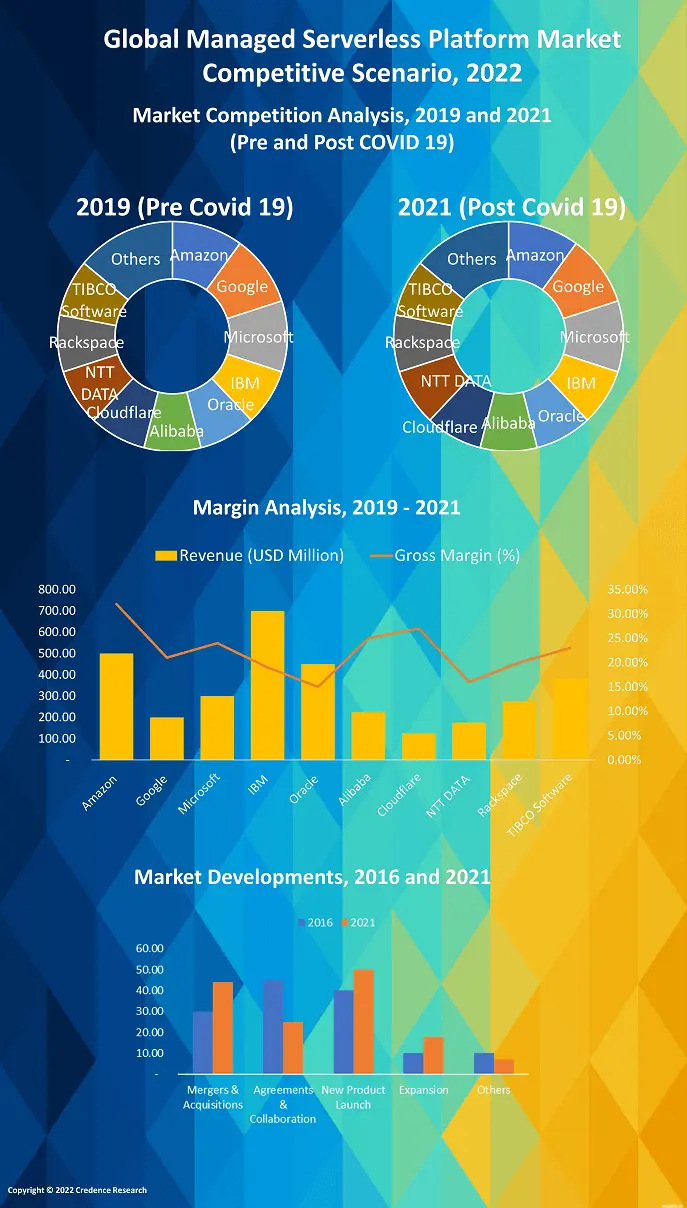
Microsoft (U.S.), Alibaba (China), Amazon (U.S.), Google (U.S.), NTT DATA (Japan), IBM (U.S.), Cloudflare (U.S.), Rackspace (U.S.), Oracle (U.S.), and TIBCO Software are the leading companies in the global Managed Serverless Platform market in terms of value (U.S.). To improve the quality of their Managed Serverless Platform production and seize a competitive market share globally, these main players are concentrating on technology breakthroughs and new product improvements. A few local and national businesses are also investing heavily to diversify their product lines and increase sales. For instance, Google Cloud released the Change Data Capture (CDC) service and DataStream, a serverless replication, in May 2021. This invention makes serverless architecture possible by enabling businesses to merge diverse components, such as Cloud storage, into Google.
Who are the Top 10 Market Players for Managed Serverless Platforms?
The top nations in the international Managed Serverless Platform market are China, the United States, the United Kingdom, India, Canada, Japan, Germany, France, Italy, and Brazil. The United States has the largest share of the Managed Serverless Platform in 2021, accounting for a sizeable volume portion of the global market. High levels of digitalization and the adoption of new cloud computing services by businesses are increasing demand in the area because these businesses are constantly innovating and implementing new technologies to stay competitive in the quickly changing market and deliver new features and products.
Which is the major Vertical in the Managed Serverless Platform Market?
In 2021, the Managed Serverless Platform market dominated the Telecommunications and I.T. segment. Most companies in the I.T. and telecom industries have shifted to cloud infrastructure. The growth of public clouds and the acceptance of serverless backend-as-a-service are expected to accelerate as telecom carriers try to use their infrastructure to offer hosting services. For handling legacy applications, most telecom corporations operate large-scale data centers. These data centers are also utilized to provide public cloud services. A serverless architecture enables businesses to do away with the need for additional resources and reduce capital expenses.
Enterprises may speed up the development and delivery of apps by combining DevOps with serverless computing solutions. The benefits of serverless architecture over conventional methods, such as cost reductions, easier server configuration, and painless server troubleshooting, are likely to propel industry expansion. Enterprise-level security, automated scalability, and resource management across geographically dispersed locations are all made easier for enterprises thanks to the design. The advancements in cloud technology driving enterprises to embrace microservices are driving the demand for serverless architecture solutions.
What are the Major Dynamic Factors for Managed Serverless Platform Market?
The rise of serverless architecture is largely driven by organizations' growing desire to eliminate the challenges associated with server management. To retain profitability and market competitiveness, businesses are under pressure to switch to less expensive models due to the growing use of cloud computing. Businesses can reduce the financial and resource commitment necessary for server administration thanks to serverless architecture's greater scalability and pay-as-you-go pricing model. Because serverless architecture adopts a more condensed approach than microservices and as global digitalization accelerates, businesses must take precautions to protect their serverless systems. Once the connection with cloud providers has been established, it uses tiny, standalone pieces of software that connect via several open APIs.
What is the Major Restriction for Managed Serverless Platform Market?
Allocated computing architectures, which are challenging and time-consuming to create, are the key factor restraining the growth of the global Managed Serverless Platform market. Microservices and serverless systems both have similar consequences. Evaluation, implementation, and testing of function size-related decisions take a lot of time. The number of functions that an application calls must be balanced. Mini-monoliths are created when granularity is ignored while controlling several functions. Services that rely on vendors or outside parties and use serverless architecture may have data security flaws. On serverless platforms, denial-of-service (DoS) assaults can overwhelm the user system and shut down vital features for many concurrent users. These elements are the main impediments to the market for serverless architecture.
Which Region Dominated the Managed Serverless Platform Market?
In 2021, the Managed Serverless Platform market was dominated by North America due to the quick development of technology and the presence of numerous notable players across sectors like retail, manufacturing, BFSI, healthcare, and I.T. & Telecom, which boast a sizable user base throughout the region. High levels of digitalization and the adoption of new cloud computing services by businesses are increasing demand in the area because these businesses are constantly innovating and implementing new technologies to stay competitive in the quickly changing market and deliver new features and products. Additionally, a company called Light Bend Inc. is attempting to overcome the drawbacks of serverless computing, which usually prevent its acceptance for more complex, data-hungry applications. In June 2021, the company launched Akka Serverless, a brand-new open-source development platform that it promised would raise the bar for building cloud-native applications.
As developers assume more responsibility for managing their apps, they are starting to employ platforms that automate infrastructure maintenance on their behalf without assistance from an I.T. operations team. The capacity to autonomously scale compute and memory resources up and down in response to requests from developers will be introduced, according to a statement made in June 2021 by Render, a provider of cloud services that streamline DevOps processes.
Segmentation of Global Managed Serverless Platform Market-
Global Managed Serverless Platform Market – By Deployment Model- Public cloud
- Private cloud
- Large Enterprises
- SMEs
- BFSI
- Telecommunications and IT
- Retail and eCommerce
- Healthcare and Life Sciences
- Government and Public sector
- Manufacturing
- Media and Enetertainment
- Others (transportation and logistics, energy and utilities, travel and hospitality, and education)
- North America
- U.S.
- Canada
- Europe
- Germany
- France
- U.K.
- Italy
- Spain
- Rest of Europe
- Asia Pacific
- China
- Japan
- India
- South Korea
- South-east Asia
- Rest of Asia Pacific
- Latin America
- Brazil
- Mexico
- Rest of Latin America
- Middle East & Africa
- GCC Countries
- South Africa
- Rest of Middle East and Africa
Request a Free Sample
Fill in your details and we'll send you a free sample report.
- Sample data tables & charts
- Research methodology
Need a Custom Version of This Report?
Tailor the scope, geography, or segments to your exact requirements.
- Custom geography or segment scope
- Direct access to our analyst team
Frequently Asked Questions
How does COVID-19 Impact the global Managed Serverless Platform market?
Which is the leading market for Managed Serverless Platform?
What are the key drivers for the growth of the Managed Serverless Platform market?
Which is the major segment in Managed Serverless Platform Market by Deployment Model?
Which is the major segment in Managed Serverless Platform Market by Organization Size?
Table of Content
Chapter 1. Report Introduction
- 1.1 Report Description & Purpose
- 1.1.1 Report Title & Market Definition
- 1.1.2 Unique Selling Propositions (USP) & Key Differentiators
- 1.1.3 Value Proposition for Stakeholders
- 1.2 Research Objectives
- 1.2.1 Market Sizing Objectives (Volume & Revenue)
- 1.2.2 Segmentation Objectives
- 1.2.3 Competitive Intelligence Objectives
- 1.2.4 Forecast & Scenario Objectives
- 1.3 Report Scope
- 1.3.1 Managed Serverless Platform Scope – Types & Subtypes Covered
- 1.3.2 Geographic Scope – Regions & Countries Covered
- 1.3.3 Historical Period, Base Year & Forecast Period (the historical period; forecast to the forecast period)
- 1.3.4 Inclusions & Exclusions
- 1.4 HS Code & Classification Framework
- 1.5 Currency, Units & Pricing Basis
- 1.6 Target Stakeholders
- 1.7 Limitations & Assumptions
Chapter 2. Executive Summary
- 2.1 Global Managed Serverless Platform Market Snapshot
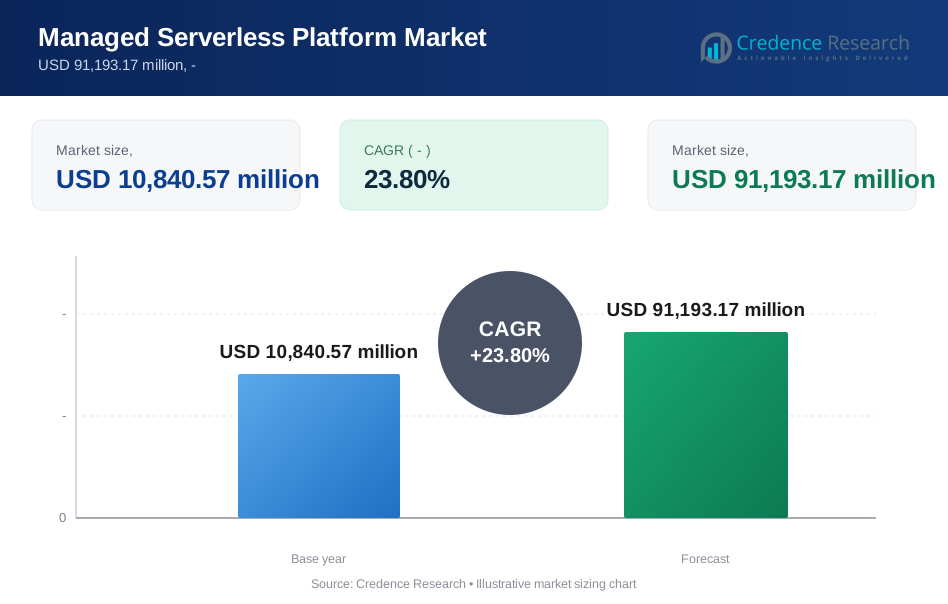
- 2.1.1 Market Size – Historical (the historical period) & Forecast (the forecast period) (base year: USD 10,840.57 million → forecast year: USD 91,193.17 million)
- 2.1.2 Volume & Revenue – Global Totals
- 2.1.3 Key Market Highlights – Top Five Facts
- 2.2 Managed Serverless Platform Market Segmentation Snapshot
- 2.2.1 Market Split by Region – vs.
- 2.3 Competitive Snapshot
- 2.3.1 Top 10 Players by Revenue Share –
- 2.3.2 Top 10 Players by Volume Share –
- 2.3.3 Recent Strategic Developments (18-Month Summary)
- 2.4 Key Investment Highlights & Strategic Conclusions
Chapter 3. Managed Serverless Platform Market Dynamics & Industry Analysis
- 3.1 Market Overview & Context
- 3.1.1 Managed Serverless Platform Market Position in the Broader Automotive Value Chain
- 3.1.2 OEM vs. Replacement Market Dynamics
- 3.1.3 Market Maturity & Development Stage by Region
- 3.2 Managed Serverless Platform Market Drivers
- 3.3 Managed Serverless Platform Market Restraints & Challenges
- 3.4 Managed Serverless Platform Market Opportunities
- 3.5 Porter's Five Forces Analysis
- 3.5.1 Threat of New Entrants
- 3.5.2 Bargaining Power of Suppliers
- 3.5.3 Bargaining Power of Buyers
- 3.5.4 Threat of Substitutes
- 3.5.5 Competitive Rivalry – Intensity Assessment
- 3.6 Managed Serverless Platform Value Chain Analysis
- 3.6.1 Upstream – Raw Material/Input Suppliers
- 3.6.1.1 Raw Material/Input 1
- 3.6.1.2 Raw Material/Input 2
- 3.6.1.3 Raw Material/Input 3
- 3.6.2 Midstream – Production/Manufacturing/Service Delivery
- 3.6.2.1 Production/Process Overview
- 3.6.2.2 Key Facility Locations & Capacity by Manufacturer
- 3.6.3 Downstream – Distribution & End Consumer
- 3.6.3.1 Primary Channel – B2B/OEM
- 3.6.3.2 Secondary Channels – Dealer, Retail, Online, Direct
- 3.6.4 Value Chain Profitability Analysis
- 3.6.1 Upstream – Raw Material/Input Suppliers
- 3.7 PESTEL Analysis
- 3.7.1 Political Factors
- 3.7.2 Economic Factors
- 3.7.3 Social Factors
- 3.7.4 Technological Factors
- 3.7.5 Environmental Factors
- 3.7.6 Legal Factors
- 3.8 Managed Serverless Platform Supply Chain Analysis
- 3.8.1 Raw Material/Input Supply Risk Assessment
- 3.8.2 Manufacturing Concentration Risk (Geographic Exposure)
- 3.8.3 Trade Disruption Impact Analysis
- 3.9 Regulatory & Policy Landscape
Note: The regulatory and policy landscape section covers regulations based on their applicability to the market, Managed Serverless Platform category, geography, and scope of the study. Only regulatory frameworks with a material impact on operations, compliance, trade, sustainability, or market access are analyzed in detail.
Chapter 4. Key Investment Pockets & Opportunity Analysis
- 4.1 Managed Serverless Platform Market Attractiveness Analysis
- 4.1.1 By Region – Investment Attractiveness Matrix (Volume × CAGR)
- 4.2 Absolute Revenue Growth Opportunity
- 4.2.1 By Region – Absolute USD Growth Through the forecast period
- 4.3 Incremental Volume Opportunity
- 4.3.1 By Region – Incremental Volume Through the forecast period
- 4.3.2 Segment – Incremental Volume
- 4.4 Emerging Submarket Opportunity Deep Dive (Subject to Applicability)
- 4.5 Emerging Market Opportunity Scorecards
- 4.5.1 United States
- 4.5.2 Europe
- 4.5.3 Asia
- 4.5.4 Middle East & Africa
Note: Emerging Market Opportunity Scorecards will be included based on relevance and strategic importance. Regions listed are indicative and may vary depending on data availability and market dynamics.
Chapter 5. Managed Serverless Platform Import-Export Analysis & Trade Flows
- 5.1 Global Trade Overview
- 5.1.1 Global Export Value by Country (the historical period)
- 5.1.2 Global Export Volume by Country (the historical period)
- 5.1.3 Global Import Value by Country (the historical period)
- 5.1.4 Global Import Volume by Country (the historical period)
- 5.1.5 Net Trade Balance by Country (the historical period)
- 5.2 Export Analysis – Segment
- 5.2.1 Type 1 (HS Code)
- 5.2.2 Type 2 (HS Code)
- 5.2.3 Type 3 (HS Code)
- 5.2.4 Type 4 (HS Code)
- 5.2.5 Type 5 (HS Code)
- 5.3 Import Analysis – Segment
- 5.3.1 Type 1 (HS Code)
- 5.3.2 Type 2 (HS Code)
- 5.3.3 Type 3 (HS Code)
- 5.3.4 Type 4 (HS Code)
- 5.3.5 Type 5 (HS Code)
- 5.4 Average Unit Trade Prices
- 5.4.1 Average Export Price – Segment & Country
- 5.4.2 Average Import Price – Segment & Source Country
- 5.4.3 Price Trends (the historical period)
- 5.5 Key Trade Route Analysis
- 5.5.1 Trade Route 1
- 5.5.2 Trade Route 2
- 5.5.3 Trade Route 3
- 5.5.4 Trade Route 4
- 5.5.5 Trade Route 5
- 5.6 Trade Policy Impact Assessment
- 5.6.1 US Anti-Dumping & Section 301 Tariffs
- 5.6.2 EU Customs Union Impact
- 5.6.3 Major Free Trade Agreements
- 5.6.4 USMCA Rules of Origin
Note: Trade policy analysis will be included only where relevant to the Managed Serverless Platform market.
Chapter 6. Competitive Landscape & Company Benchmarking
- 6.1 Managed Serverless Platform Market Concentration & Structure
- 6.1.1 Herfindahl-Hirschman Index (HHI) – vs.
- 6.1.2 Tier 1, Tier 2 & Tier 3 Market Structure
- 6.1.3 Global, Regional & Local Player Dynamics
- 6.2 Managed Serverless Platform Market Share Analysis –
- 6.2.1 Global Revenue Share by Company
- 6.2.2 Global Volume Share by Company
- 6.2.3 Regional Revenue Share
- 6.2.4 Market Share Evolution ( vs. )
- 6.2.5 OEM Segment Share by Company
- 6.2.6 Replacement Segment Share by Company
- 6.3 Production/Delivery Capacity & Facility Analysis
- 6.3.1 Global Installed Capacity
- 6.3.2 Capacity Utilization Rates
- 6.3.3 Production/Output Volume
- 6.3.4 Facility Locations & Capacity Map
- 6.3.5 Planned Capacity Additions
- 6.4 Managed Serverless Platform Competitive Benchmarking Matrix
- 6.4.1 Revenue, Volume, CAGR & Profitability Comparison
- 6.4.2 Channel Revenue Mix
- 6.4.3 Geographic Revenue Exposure
- 6.4.4 R&D Intensity
- 6.4.5 Sustainability Maturity
- 6.5 Strategic Developments in Managed Serverless Platform (Last 24 Months)
- 6.5.1 Mergers, Acquisitions & Divestments
- 6.5.2 New Managed Serverless Platform Launches
- 6.5.3 Facility Expansions
- 6.5.4 Strategic Alliances, Joint Ventures & Partnerships
- 6.5.5 Distribution Expansion & Market Entry
- 6.5.6 Sustainability & ESG Initiatives
- 6.6 Competitive Strategy Mapping
- 6.6.1 Leader, Challenger, Follower & Niche Classification
- 6.6.2 Pricing Strategy Comparison
- 6.6.3 Channel Strategy Matrix
Note: Strategic developments are included based on their materiality and the availability of reliable information.
Chapter 7. Global Managed Serverless Platform Market – By Distribution Channel
- 7.1 Segment Overview
- 7.1.1 Volume & Revenue Split by Channel ( & )
- 7.1.2 Channel Mix Evolution (the forecast period)
Chapter 8. Regional Market Analysis – Global Overview
- 8.1 Global Regional Overview
- 8.1.1 Regional Volume Share
- 8.1.2 Regional Revenue Share
- 8.1.3 Regional Volume by Region
- 8.1.4 Regional Revenue by Region
- 8.1.5 Regional Forecast Through the forecast period
- 8.2 Cross-Regional Segment Analysis
- 8.2.1 By Distribution Channel
- 8.2.2 By Brand/Price Tier
Chapter 9. North America Managed Serverless Platform Market
- 9.1 United States
- 9.2 Canada
- 9.3 Mexico
Chapter 10. Europe Managed Serverless Platform Market
- 10.1 Germany
- 10.2 France
- 10.3 Italy
- 10.4 United Kingdom
- 10.5 Spain
- 10.6 Poland
- 10.7 Russia
- 10.8 Netherlands
- 10.9 Belgium
- 10.10 Sweden
- 10.11 Denmark
- 10.12 Norway
- 10.13 Rest of Europe
Chapter 11. Asia Pacific Managed Serverless Platform Market
- 11.1 China
- 11.2 India
- 11.3 Japan
- 11.4 South Korea
- 11.5 Thailand
- 11.6 Indonesia
- 11.7 Vietnam
- 11.8 Malaysia
- 11.9 Australia
- 11.10 Rest of Asia Pacific
Chapter 12. Latin America Managed Serverless Platform Market
- 12.1 Brazil
- 12.2 Argentina
- 12.3 Colombia
- 12.4 Chile
- 12.5 Rest of Latin America
Chapter 13. Middle East Managed Serverless Platform Market
- 13.1 Saudi Arabia
- 13.2 United Arab Emirates
- 13.3 Turkey
- 13.4 Israel
- 13.5 Iran
- 13.6 Rest of the Middle East
Chapter 14. Africa Managed Serverless Platform Market
- 14.1 South Africa
- 14.2 Egypt
- 14.3 Nigeria
- 14.4 Morocco
- 14.5 Rest of Africa
Chapter 15. Managed Serverless Platform Company Profiles
- 15.1 [Company 01]
- 15.1.1 Company Overview
- 15.1.2 Key Management Personnel
- 15.1.3 Products & Services Portfolio
- 15.1.4 Financial Performance
- 15.1.5 Key Market Focus & Geographic Presence
- 15.1.6 Recent Developments & Strategic Initiatives
Note: The company profile list is preliminary and may change based on research findings, market developments, data availability, and client requirements.
Chapter 16. Appendices
- Appendix A – List of Abbreviations & Acronyms
- Appendix B – Industry Classification Code Reference – Full Series
- Appendix C – Production & Capacity Data Tables
- Appendix D – End-Use & Demand Base Tables
- Appendix E – Consumption & Replacement Rate Assumptions
- Appendix F – ASP Reference Tables
- Appendix G – Manufacturing & Facility Database
- Appendix H – Import-Export Data Tables
- Appendix I – Regulatory Summary Tables
- Appendix J – Primary Research Participant List (Anonymized)
- Appendix K – Primary Research Questionnaire Framework
- Appendix L – Data Sources & Bibliography
- Appendix M – Market Size Divergence & Source Comparison
Chapter 17. Research Methodology
- 17.1 Research Framework & Philosophy
- 17.2 Secondary Research – Sources, Hierarchy & Data Extraction
- 17.3 Data Modeling – Bottom-Up & Top-Down Market Sizing
- 17.4 Primary Research – Stakeholder Framework, LOI & Sample Sizes
- 17.5 Forecast Methodology – Regression, Scenario & Sensitivity Analysis
- 17.6 Quality Control – Four-Layer Validation Framework
- 17.7 Limitations & Standard Assumptions
- 17.8 Disclaimer
