
| REPORT ATTRIBUTE | DETAILS |
|---|---|
| Historical Period | 2019-2022 |
| Base Year | 2023 |
| Forecast Period | 2024-2032 |
| Mechanized Irrigation Systems Market Size 2023 | USD 16284.8 Million |
| Mechanized Irrigation Systems Market, CAGR | 16.20% |
| Mechanized Irrigation Systems Market Size 2032 | USD 62898.10 Million |
Market Insights
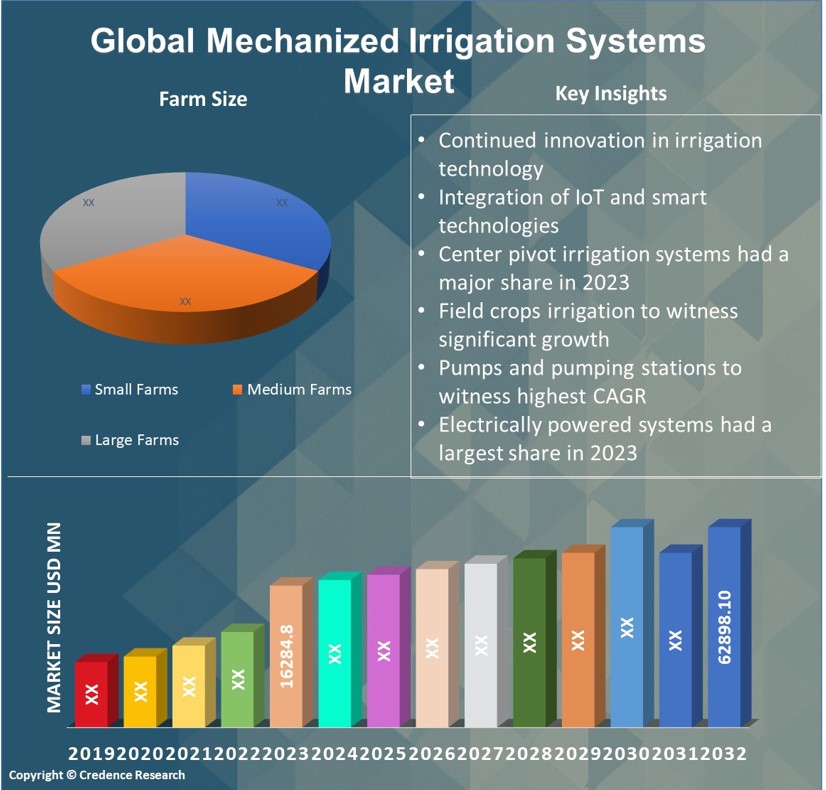
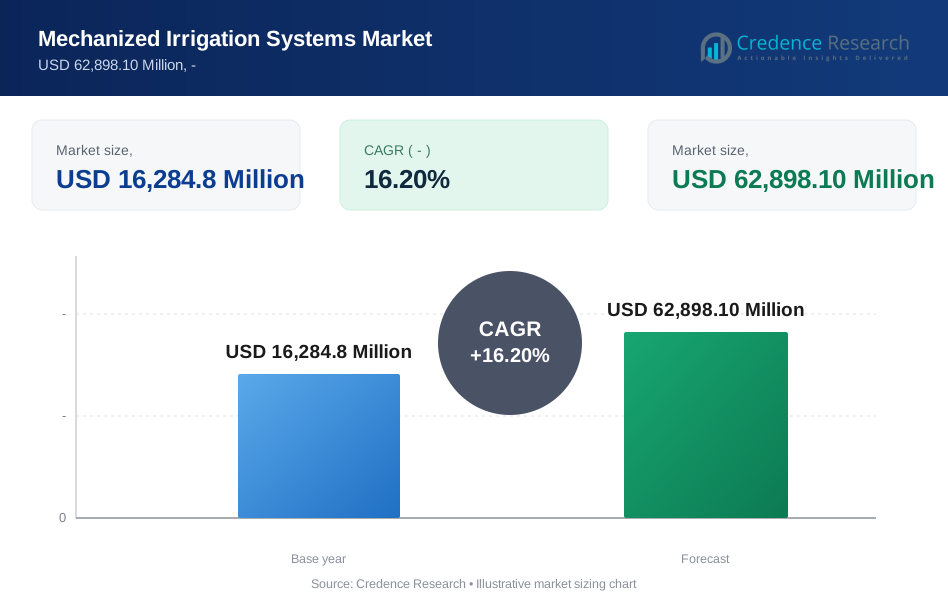
- The demand for mechanized irrigation systems was valued at USD 16284.8 Million in 2023 and is expected to reach USD 62898.10 Million in 2032, growing at a CAGR of 16.20% between 2024 and 2032.
- The largest type of mechanized irrigation system section is the center pivot irrigation system. On the other hand, linear move irrigation systems are expected to grow at a strong CAGR.
- The leading application type segment is field crop irrigation.
- The CAGR for pumps and pumping stations is expected to be the highest during the projection period.
- The electrically powered systems will probably have the highest CAGR throughout the prediction period.
- Small farms are estimated to have the greatest CAGR during the forecast period.
- The new installations segment will likely have the highest CAGR during the prediction period.
- Individual farmers will probably have the highest CAGR during the forecasting period.
- Manual control systems would likely have the highest CAGR during the projection period.
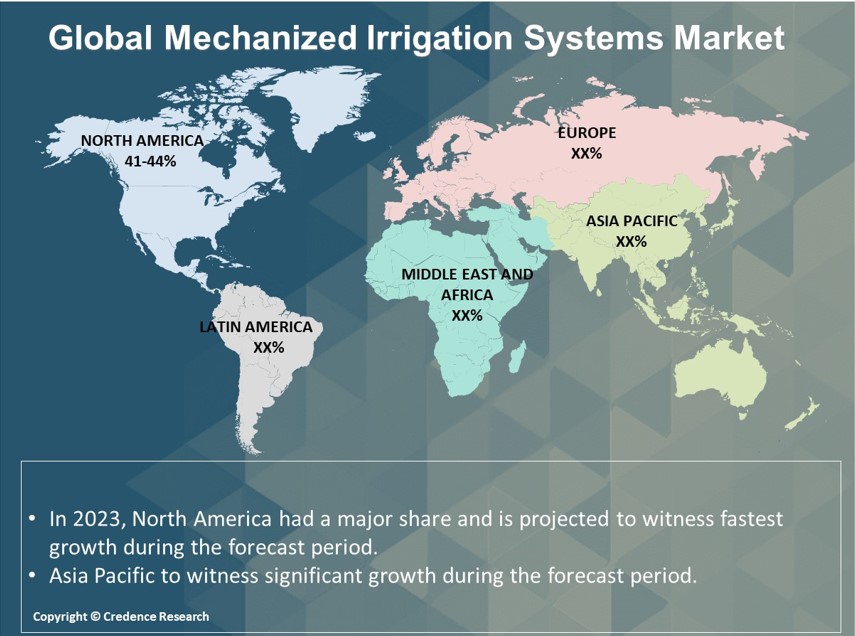
- North America dominated the mechanized irrigation systems market.
- Regarding the market share of mechanized irrigation systems, Europe is expected to come second.
- Asia Pacific is anticipated to grow fastest in the mechanized irrigation systems market.
- The primary drivers of market expansion are the ongoing irrigation technology innovation, integration of IoT and smart technologies, and the growing global population.
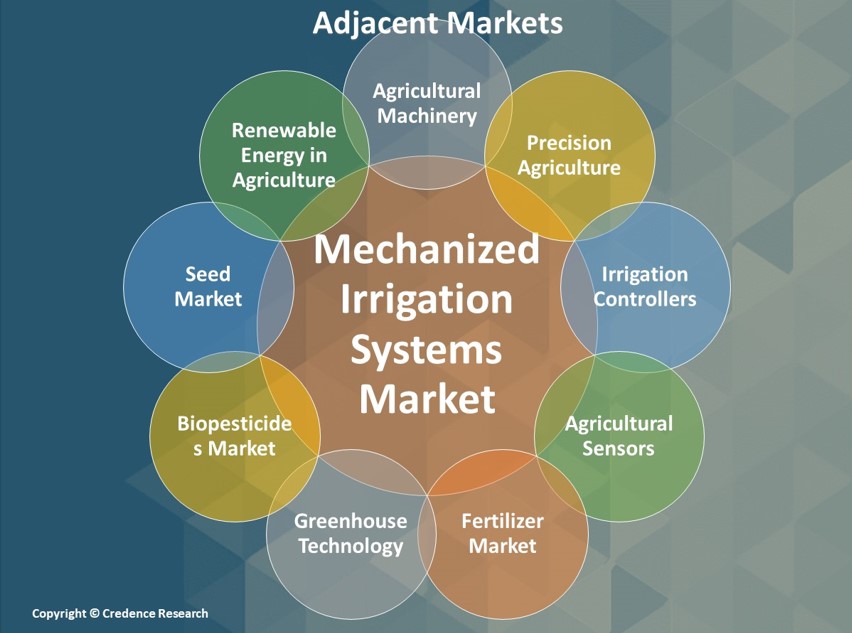
- The integration of precision agriculture and the expanding market for sensors that track crop health, weather, and soil moisture for targeted irrigation present many opportunities for the mechanized irrigation systems sector.
Executive Summary
Market Definition
Mechanized irrigation systems use pumps, sprinklers, drip hoses, and other machinery to provide water to fields and crops. These can regulate and keep an eye on water resources in addition to being made to pump a certain volume of water. The main goal of mechanized systems development is to alleviate global worries about water scarcity. Several types of fixed or mobile irrigation systems are available, such as solid set, lateral move, and center pivot irrigation systems.
Market Overview
With consistent growth in recent years, the global mechanized irrigation systems market is predicted to expand at a compound annual growth rate (CAGR) of 16.20% between 2024 and 2032. The market was valued at USD 16284.8 million in 2023 and is expected to reach USD 62898.10 million in 2032.
The growing use of automation and mechanization in agriculture is a major factor driving the market for mechanized irrigation systems. Equipment with various mechanical parts, including trusses, spans, towers, drivetrains, and others, makes up mechanized irrigation systems. These irrigation systems work very well and are best suited for larger landscapes.
The greater benefits of automated irrigation systems over traditional irrigation techniques are a significant additional factor driving the market for these systems. Large agricultural areas can be easily irrigated by mechanized irrigation systems, which are also easy to operate. Additionally, these systems improve yields because the water is applied more precisely. However, the market is severely hindered because of the relatively high initial costs of these systems and the general lack of awareness.
Segmentation by Type of Mechanized Irrigation System
- Center pivot irrigation systems are the market leader by type of mechanized irrigation system. The central pivot irrigation system is a common type of mechanized irrigation system in agriculture for effectively and consistently distributing water over large areas. Several pipes and sprinklers installed on movable towers that revolve around a central pivot point make up these systems.
- The linear move irrigation systems category is anticipated to exhibit a sizable CAGR during the projected period. Large fields may be effectively and consistently watered in agriculture using linear move irrigation systems, a mechanized irrigation system. They are also called traveling irrigation systems, wheel move systems, or lateral move systems.
- Other types of mechanized irrigation systems, including drip irrigation systems, lateral move (wheel move) irrigation systems, and traveler irrigation systems, additionally support the need for mechanized irrigation systems.
Segmentation by Application Type
- The main application type is field crop irrigation. In mechanized irrigation systems, field crop irrigation is the practice of irrigating agricultural fields with crops using automated and mechanized technologies.
- The fruit and vegetable irrigation category will likely register a significant CAGR during forecasting. Mechanized irrigation systems that apply water to crops like fruits and vegetables automatically or mechanically are called fruit and vegetable irrigation systems. This irrigation is a crucial part of contemporary agriculture and is designed to provide crops with the best possible growth, development, and yield.
- Other application types, such as vineyard, nursery, and turf irrigation, also contribute to the demand for mechanized irrigation systems.
Segmentation by Component
- It is projected that over the projection period, the category of pumps and pumping stations will grow at the fastest rate. Pumps and pumping stations are essential for mechanized irrigation systems that effectively distribute water to agricultural fields. To guarantee that crops receive the proper amount of water at the right time, these systems are made to automate and optimize the irrigation process.
- Other components, such as pipes and fittings, control systems, sprinklers and emitters, and filters and valves, also contribute to the demand for mechanized irrigation systems.
Segmentation by Power Source
- The electrically powered systems category will likely have the highest CAGR during the projection period. Mechanized irrigation systems rely heavily on electrically powered systems to enhance agricultural water management automation, accuracy, and efficiency. Water is delivered to crops in a controlled and efficient manner by mechanized irrigation systems, which are enhanced by electrically powered components.
- Other power sources, such as diesel-powered and solar-powered systems, also contribute to the demand for mechanized irrigation systems.
Segmentation by Farm Size
- Small farms are expected to have the foremost CAGR during the prediction period. Comparing smaller farms to larger commercial farms, the farmer usually has more resources and acres. They may be run by individuals or as a family business, and they frequently prioritize producing food for local markets over wide-scale distribution.
- Other farm sizes, such as medium and large farms, also contribute to the demand for mechanized irrigation systems.
Segmentation by Installation Type
- Throughout the forecast duration, the new installations category is anticipated to have the greatest CAGR. The acceptance of new mechanized irrigation installations may be influenced by developments in irrigation technology, such as enhanced sensors, automated control systems, and data analytics. These technological advancements can improve crop yield and water efficiency, so farmers can upgrade their systems to take advantage of them.
- Other installation types, such as retrofit installations (upgrades to existing systems), also contribute to the demand for mechanized irrigation systems.
Segmentation by End-User
- Individual farmers are anticipated to have the highest CAGR throughout the forecast period. Individual farmers are self-sufficient farmers who either own or oversee their farmland. Instead of functioning as a component of sizable farming cooperatives or enterprises, they are independent businesses. In mechanized irrigation systems, crops are irrigated with water using automated or mechanical devices. These systems seek to maximize crop yield while boosting efficiency and water usage.
- Other end-users, such as agricultural cooperatives and large agribusinesses, also contribute to the demand for mechanized irrigation systems.
Segmentation by Control Technology
- The manual control systems category is expected to have the highest compound annual growth rate (CAGR) throughout the projection period. The technique by which farmers or operators manually manage and control different aspects of the irrigation process is called a manual control system. In contrast to fully automated systems, which rely on sensors, controllers, and algorithms to make decisions, human intervention is necessary for manual control systems to set parameters, start actions, and make adjustments.
- Other control technologies, such as remote control systems and smart irrigation systems with sensors and IoT integration, also contribute to the demand for mechanized irrigation systems.
Segmentation by Region
- North America leads the mechanized irrigation systems industry. Large-scale farming operations and expansive agricultural landscapes are hallmarks of North America. In particular, mechanized irrigation systems are useful for effectively covering large areas.
- Europe is estimated to rank second in market size for mechanized irrigation systems.
- Asia Pacific will witness the most rapid growth of the mechanized irrigation systems market.
- World regions, including Africa, the Middle East, and Latin America, meet the remaining demand for mechanized irrigation systems.
The market for mechanized irrigation systems is primarily driven by growing demand for drip irrigation, integration of IoT and smart technologies, growing scarcity of water resources, and increased trade in agricultural products globally.
Regarding forecasting, North America will likely dominate the mechanized irrigation systems market. The increase can be ascribed to farmers becoming more knowledgeable about effective irrigation systems and growing crop demand. Countries use modern technologies to increase production while reducing resource usage in response to growing populations and rising food demands. The mechanized irrigation system is one of the best irrigation techniques for reducing water scarcity and raising crop yields. Therefore, North America is expected to witness a notable expansion in the market for mechanized irrigation systems.
In North America, government initiatives and policies frequently support water conservation and sustainable agricultural practices. Farmers are encouraged to invest in mechanized irrigation systems by subsidies and incentives for implementing cutting-edge irrigation technologies. North America's economic stability enables farmers to invest in cutting-edge farming technologies. Mechanized irrigation systems are made possible for agricultural enterprises by the availability of funding and credit facilities. North American farmers are frequently well-versed in the advantages of mechanized irrigation systems due to technology demonstrations, extension services, and agricultural education initiatives. The widespread adoption of these systems is facilitated by this awareness.
Throughout the forecast, the Asia Pacific region is anticipated to increase at the quickest rate. There has been an increasing trend of the adoption of new agricultural technology in the Asia Pacific region. Mechanized irrigation systems are becoming a more appealing option for precision farming as farmers look for methods to boost productivity and raise awareness, which will increase their market share. Some of the most populous countries in the world are found in the Asia Pacific region, and many of these countries heavily rely on agriculture for their economic growth. Modern agriculture, emphasizing mechanized irrigation systems, is driven by the need to produce more food to feed expanding populations. The Asia Pacific population is expanding quickly, increasing food demand. Farmers use cutting-edge, effective irrigation techniques to increase crop yields to meet this demand.
Key Highlights of the Report
The global mechanized irrigation systems market is segmented by type of mechanized irrigation system, application type, component, power source, farm size, installation type, end-user, control technology, and region. Regarding the type of mechanized irrigation system, center pivot irrigation systems are the market spearhead. Field crop irrigation is the top application type segment. The pumps and pumping stations category is anticipated to increase at the highest CAGR throughout the projection period. The electrically powered systems will experience the highest CAGR during the forecast period. Mechanized irrigation systems are expanding mostly in North America.
The need to manage water scarcity and maximize water use in agriculture drives the market for mechanized irrigation systems. Mechanized irrigation systems, like sprinklers and drip irrigation, are made to precisely and directly supply water to plant roots. With this focused approach, water is used more effectively, reducing waste. Farmers can minimize runoff and over-irrigation by tailoring their crop-specific watering schedule through precision irrigation technologies. Lack of water can have a detrimental effect on crop yields, which can impact food production. Mechanized irrigation systems are essential for ensuring that crops always have access to water, which raises yields and increases food security. These systems lessen the negative effects of water scarcity by offering a steady water supply.
However, according to forecasts, North America will hold the largest market share for mechanized irrigation systems globally. In North America, government initiatives and policies frequently support sustainable agricultural practices and water conservation. Subsidies and incentives for implementing cutting-edge irrigation technologies encourage farmer investment in mechanized systems. The Asia Pacific region is also assumed to have the market's sharpest growth. The Asia Pacific region is home to numerous nations putting policies and programs into place to modernize agriculture and increase water use efficiency. Farmers are encouraged to invest in these technologies through government support, subsidies, and incentives for adopting mechanized irrigation systems.
Which Key Factors Are Driving The Global Mechanized Irrigation Systems Market?
Increased investments in the agriculture sector encourage the adoption of advanced irrigation techniques, and better irrigation systems raise farm incomes. These are some factors driving the development of the mechanized irrigation systems sector.
What Are The Key Challenges In The Global Market For Mechanized Irrigation Systems?
Mechanized irrigation systems have several obstacles in the global market, including upfront costs associated with purchase and installation, infrastructure limitations, and a lack of incentives to conserve water.
What Market Opportunities Exist For Mechanized Irrigation Systems Globally?
The development of precision agriculture, climate-smart agriculture, drought-resistant crops, and renewable energy has created global market prospects for mechanized irrigation systems.
Market Drivers
Multiple factors propel the mechanized irrigation systems industry across the globe. The primary factors propelling the global mechanized irrigation systems market are as follows:
Growing Water Scarcity for Agriculture
The production of food is greatly impacted by water scarcity. Without water, people cannot irrigate crops and feed the world's fast-growing population. A limited supply of water is constantly contested for use in domestic, industrial, and environmental applications by agriculture, which accounts for about 70% of worldwide water withdrawals, according to the International Water Management Institute. To address this ever-increasing issue, numerous individuals have attempted to create more efficient water management techniques. One such technique is irrigation management. One way to increase crop yield is by applying irrigation, which involves moving water to the crops. The industry is expanding due to farmers utilizing contemporary irrigation methods like drip and sprinkler irrigation to maximize the use of available water resources. Many areas have seen the depletion of aquifers as a result of excessive groundwater extraction for agricultural purposes. Because of the unsustainable use of groundwater and the resulting water scarcity, farmers must implement effective irrigation techniques that use water more wisely. Governments worldwide are putting laws and policies in place to encourage water-efficient agricultural methods as they realize how important it is to address the issue of water scarcity. Modern technologies are encouraged to be invested in by farmers through incentives and subsidies for the adoption of mechanized irrigation systems.
Market Restraints
There are several obstacles that the global mechanized irrigation systems market must overcome to continue growing. Among them are the following:
High Investment Involved with Mechanized Irrigation Systems
The growth of the mechanized irrigation systems market is hampered by the high cost of setting up, running, and maintaining microirrigation systems. When it comes to mechanized irrigation, only crops that yield the highest return on investment are chosen. Due to their small land area and lower yield, small-scale farmers rely on manual irrigation techniques and natural water sources. Implementing a mechanized irrigation system will be challenging for farmers growing non-profitable crops, and since most Indian farmers operate on small plots of land, installing a mechanized irrigation system is out of the question due to its high cost. Consequently, this may hinder the market expansion for mechanized irrigation systems.
Opportunities
There are plenty of potential prospects in the global mechanized irrigation systems industry. Among these are the following:
Initiatives of the Global Government
Worldwide, governments are encouraging irrigation systems, training farmers, and offering subsidies to encourage productive farming that conserves water for future generations. In India, canals have long been considered a crucial irrigation medium. The disadvantage of canals is that water evaporates en route, preventing adequate water supply to crops and increasing farmers' reliance on rain. But with the government getting involved in the current state of affairs, things have started to change. These days, the government is searching for ways to minimize evaporation-related water loss while maintaining optimal agricultural water use. Over 85% more water is used efficiently (WUE) when drip irrigation is used. So, in addition to the central government, states such as Karnataka, Maharashtra, Haryana, Orissa, Gujarat, Telangana, AP, and MP have begun efforts to improve WUE. In this sense, it has been discovered that utilizing micro-irrigation techniques in the command area enhances WUE. Crop yield is doubled, and crop quality is enhanced by drip irrigation. The consistent application of water to every square inch of the field lowers labor expenses while increasing yield.
Competitive Landscape
Key Players
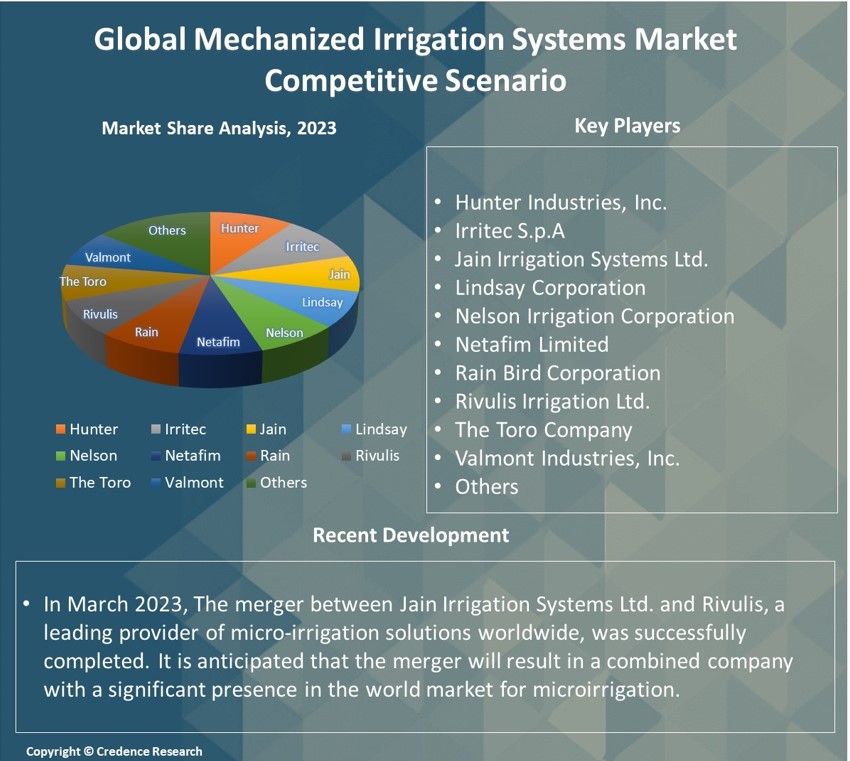
Several major competitors exist in the fiercely competitive global mechanized irrigation systems market. The followings are a few of the leading market participants and their market shares:
- Hunter Industries, Inc.
- Irritec S.p.A
- Jain Irrigation Systems Ltd.
- Lindsay Corporation
- Nelson Irrigation Corporation
- Netafim Limited
- Rain Bird Corporation
- Rivulis Irrigation Ltd.
- The Toro Company
- Valmont Industries, Inc.
- Others
To remain competitive, these companies prioritize product innovation, distribution channel expansion, mergers, and acquisitions.
The major global mechanized irrigation systems market players always try to remain ahead of the competition by introducing innovations and products.
In July 2023, Lindsay Corporation announced the acquisition of FieldWise, LLC, a market leader in agricultural technology products focusing on subscription-based, precision irrigation solutions. It is anticipated that the acquisition will fortify Lindsay's position in the precision irrigation market and broaden its range of irrigation products.
In May 2021, The AlphaDisc filter, introduced by Netafim, can help with improved crop irrigation in addition to keeping irrigation systems free of impurities.
In February 2021, Rain Bird Corporation released the Rain Bird Resources app. It is anticipated that this application would let irrigation specialists obtain the necessary data whenever needed.
Summary of Key Findings
- Mechanized irrigation systems become more capable and connected when integrated with IoT and smart technologies.
- The market is segmented by type of mechanized irrigation system, application type, component, power source, farm size, installation type, end-user, control technology, and region.
- The market's most popular type of mechanized irrigation system is the center pivot irrigation system.
- Field crop irrigation is the foremost application type category.
- Small farms are expected to grow fastest during the forecast period regarding CAGR.
- The category for manual control systems will likely see the highest CAGR during the anticipated time frame.
- North America is leading market development; the market is highly competitive with key players including Hunter Industries, Inc., Irritec S.p.A, Jain Irrigation Systems Ltd., Lindsay Corporation, Nelson Irrigation Corporation, Netafim Limited, Rain Bird Corporation, Rivulis Irrigation Ltd., The Toro Company, Valmont Industries, Inc., and Others.
Future Outlook
- The mechanized irrigation systems industry is expected to increase significantly in North America and has a positive outlook worldwide.
- Mechanized irrigation systems are becoming more popular due to the globalization of agriculture.
- During the projected period, one of the main factors anticipated to impede the growth of the mechanized irrigation systems market is high startup expenditures.
- To stay ahead of the competition, key enterprises must develop new products, expand their market reach, and keep their prices competitive.
How CXOs Can Benefit from the Credence Research Mechanized Irrigation Systems Market Report
The Credence Research Mechanized Irrigation Systems Market Report provides CXOs with a comprehensive overview of the market, including:
- Market size and growth forecast: The report provides detailed estimates of the global mechanized irrigation systems market size, segmented by type of mechanized irrigation system, application type, component, power source, farm size, installation type, end-user, control technology, and region. It also includes forecasts for the market through 2032 based on key trends and drivers.
- Market segmentation: The report segments the mechanized irrigation systems market by type of mechanized irrigation system, application type, component, power source, farm size, installation type, end-user, control technology, and region. This segmentation provides CXOs with a granular understanding of the market and the opportunities in each segment.
- Competitive landscape: The report profiles the key players in the mechanized irrigation systems market and provides insights into their strategies, product offerings, and financial performance. This information can help CXOs to identify and assess their competition.
- Key trends and drivers: The report identifies and analyzes the key trends and drivers shaping the mechanized irrigation systems market. This information can help CXOs to make informed decisions about their investments and strategies.
CXOs can use the insights from the Credence Research Mechanized Irrigation Systems Market Report to:
- Identify growth opportunities: The report can help CXOs identify new growth opportunities in the mechanized irrigation systems market. For example, the report identifies the growing demand for mechanized irrigation systems from large agribusinesses as a key opportunity.
- Make informed investment decisions: The report can help CXOs make informed investment decisions about mechanized irrigation systems. For example, the report provides insights into the key factors to consider when evaluating mechanized irrigation systems providers and selecting mechanized irrigation systems solutions.
- Develop competitive strategies: The report can help CXOs develop competitive strategies for their mechanized irrigation systems businesses. For example, the report identifies the key strategies that mechanized irrigation systems providers use to differentiate themselves from their competitors.
- Track market developments: The report can help CXOs track market developments and stay ahead of the curve. For example, the report provides insights into the latest trends and innovations in the mechanized irrigation systems market.
Overall, the Credence Research Mechanized Irrigation Systems Market Report is a valuable resource for CXOs who are looking to gain a deeper understanding of the market and identify growth opportunities.
Segmentation
- By Type of Mechanized Irrigation System
- Center Pivot Irrigation Systems
- Linear Move Irrigation Systems
- Drip Irrigation Systems
- Lateral Move (Wheel Move) Irrigation Systems
- Traveler Irrigation Systems
- By Application Type
- Field Crops Irrigation
- Fruit and Vegetable Irrigation
- Vineyard Irrigation
- Nursery and Turf Irrigation
- By Component
- Pumps and Pumping Stations
- Pipes and Fittings
- Control Systems
- Sprinklers and Emitters
- Filters and Valves
- By Power Source
- Electrically Powered Systems
- Diesel-Powered Systems
- Solar-Powered Systems
- By Farm Size
- Small Farms
- Medium Farms
- Large Farms
- By Installation Type
- New Installations
- Retrofit Installations (Upgrades to Existing Systems)
- By End-User
- Individual Farmers
- Agricultural Cooperatives
- Large Agribusinesses
- By Control Technology
- Manual Control Systems
- Remote Control Systems
- Smart Irrigation Systems with Sensors and IoT Integration
- By Region
- North America
- The U.S.
- Canada
- Mexico
- Europe
- Germany
- France
- The U.K.
- Italy
- Spain
- Rest of Europe
- Asia Pacific
- China
- Japan
- India
- South Korea
- South-east Asia
- Rest of Asia Pacific
- Latin America
- Brazil
- Argentina
- Rest of Latin America
- Middle East & Africa
- GCC Countries
- South Africa
- Rest of Middle East and Africa
- North America
Request a Free Sample
Fill in your details and we'll send you a free sample report.
- Sample data tables & charts
- Research methodology
Need a Custom Version of This Report?
Tailor the scope, geography, or segments to your exact requirements.
- Custom geography or segment scope
- Direct access to our analyst team
Frequently Asked Questions
How big is the global mechanized irrigation systems market right now?
What is the projected growth rate of the mechanized irrigation systems market between 2024 and 2032?
Which segment of the market leads in terms of mechanized irrigation systems?
Regarding application type, which market category is in the lead?
Which power source segment is estimated to have the highest CAGR throughout the forecast period?
In which region is the market for mechanized irrigation systems expanding?
Who are the key participants in the global market for mechanized irrigation systems?
What are the main market factors driving the mechanized irrigation systems sector?
What main market challenges prevent the growth of the mechanized irrigation systems sector?
What are the main market opportunities for the mechanized irrigation systems sector?
Table of Content
Chapter 1. Report Introduction
- 1.1 Report Description & Purpose
- 1.1.1 Report Title & Market Definition
- 1.1.2 Unique Selling Propositions (USP) & Key Differentiators
- 1.1.3 Value Proposition for Stakeholders
- 1.2 Research Objectives
- 1.2.1 Market Sizing Objectives (Volume & Revenue)
- 1.2.2 Segmentation Objectives
- 1.2.3 Competitive Intelligence Objectives
- 1.2.4 Forecast & Scenario Objectives
- 1.3 Report Scope
- 1.3.1 Mechanized Irrigation Systems Scope – Types & Subtypes Covered
- 1.3.2 Geographic Scope – Regions & Countries Covered
- 1.3.3 Historical Period, Base Year & Forecast Period (the historical period; forecast to the forecast period)
- 1.3.4 Inclusions & Exclusions
- 1.4 HS Code & Classification Framework
- 1.5 Currency, Units & Pricing Basis
- 1.6 Target Stakeholders
- 1.7 Limitations & Assumptions
Chapter 2. Executive Summary
- 2.1 Global Mechanized Irrigation Systems Market Snapshot
- 2.1.1 Market Size – Historical (the historical period) & Forecast (the forecast period) (base year: USD 16,284.8 Million → forecast year: USD 62,898.10 Million)
- 2.1.2 Volume & Revenue – Global Totals
- 2.1.3 Key Market Highlights – Top Five Facts
- 2.2 Mechanized Irrigation Systems Market Segmentation Snapshot
- 2.2.1 Market Split by Region – vs.
- 2.3 Competitive Snapshot
- 2.3.1 Top 10 Players by Revenue Share –
- 2.3.2 Top 10 Players by Volume Share –
- 2.3.3 Recent Strategic Developments (18-Month Summary)
- 2.4 Key Investment Highlights & Strategic Conclusions
Chapter 3. Mechanized Irrigation Systems Market Dynamics & Industry Analysis
- 3.1 Market Overview & Context
- 3.1.1 Mechanized Irrigation Systems Market Position in the Broader Automotive Value Chain
- 3.1.2 OEM vs. Replacement Market Dynamics
- 3.1.3 Market Maturity & Development Stage by Region
- 3.2 Mechanized Irrigation Systems Market Drivers
- 3.3 Mechanized Irrigation Systems Market Restraints & Challenges
- 3.4 Mechanized Irrigation Systems Market Opportunities
- 3.5 Porter's Five Forces Analysis
- 3.5.1 Threat of New Entrants
- 3.5.2 Bargaining Power of Suppliers
- 3.5.3 Bargaining Power of Buyers
- 3.5.4 Threat of Substitutes
- 3.5.5 Competitive Rivalry – Intensity Assessment
- 3.6 Mechanized Irrigation Systems Value Chain Analysis
- 3.6.1 Upstream – Raw Material/Input Suppliers
- 3.6.1.1 Raw Material/Input 1
- 3.6.1.2 Raw Material/Input 2
- 3.6.1.3 Raw Material/Input 3
- 3.6.2 Midstream – Production/Manufacturing/Service Delivery
- 3.6.2.1 Production/Process Overview
- 3.6.2.2 Key Facility Locations & Capacity by Manufacturer
- 3.6.3 Downstream – Distribution & End Consumer
- 3.6.3.1 Primary Channel – B2B/OEM
- 3.6.3.2 Secondary Channels – Dealer, Retail, Online, Direct
- 3.6.4 Value Chain Profitability Analysis
- 3.6.1 Upstream – Raw Material/Input Suppliers
- 3.7 PESTEL Analysis
- 3.7.1 Political Factors
- 3.7.2 Economic Factors
- 3.7.3 Social Factors
- 3.7.4 Technological Factors
- 3.7.5 Environmental Factors
- 3.7.6 Legal Factors
- 3.8 Mechanized Irrigation Systems Supply Chain Analysis
- 3.8.1 Raw Material/Input Supply Risk Assessment
- 3.8.2 Manufacturing Concentration Risk (Geographic Exposure)
- 3.8.3 Trade Disruption Impact Analysis
- 3.9 Regulatory & Policy Landscape
Note: The regulatory and policy landscape section covers regulations based on their applicability to the market, Mechanized Irrigation Systems category, geography, and scope of the study. Only regulatory frameworks with a material impact on operations, compliance, trade, sustainability, or market access are analyzed in detail.
Chapter 4. Key Investment Pockets & Opportunity Analysis
- 4.1 Mechanized Irrigation Systems Market Attractiveness Analysis
- 4.1.1 By Region – Investment Attractiveness Matrix (Volume × CAGR)
- 4.2 Absolute Revenue Growth Opportunity
- 4.2.1 By Region – Absolute USD Growth Through the forecast period
- 4.3 Incremental Volume Opportunity
- 4.3.1 By Region – Incremental Volume Through the forecast period
- 4.3.2 Segment – Incremental Volume
- 4.4 Emerging Submarket Opportunity Deep Dive (Subject to Applicability)
- 4.5 Emerging Market Opportunity Scorecards
- 4.5.1 United States
- 4.5.2 Europe
- 4.5.3 Asia
- 4.5.4 Middle East & Africa
Note: Emerging Market Opportunity Scorecards will be included based on relevance and strategic importance. Regions listed are indicative and may vary depending on data availability and market dynamics.
Chapter 5. Mechanized Irrigation Systems Import-Export Analysis & Trade Flows
- 5.1 Global Trade Overview
- 5.1.1 Global Export Value by Country (the historical period)
- 5.1.2 Global Export Volume by Country (the historical period)
- 5.1.3 Global Import Value by Country (the historical period)
- 5.1.4 Global Import Volume by Country (the historical period)
- 5.1.5 Net Trade Balance by Country (the historical period)
- 5.2 Export Analysis – Segment
- 5.2.1 Type 1 (HS Code)
- 5.2.2 Type 2 (HS Code)
- 5.2.3 Type 3 (HS Code)
- 5.2.4 Type 4 (HS Code)
- 5.2.5 Type 5 (HS Code)
- 5.3 Import Analysis – Segment
- 5.3.1 Type 1 (HS Code)
- 5.3.2 Type 2 (HS Code)
- 5.3.3 Type 3 (HS Code)
- 5.3.4 Type 4 (HS Code)
- 5.3.5 Type 5 (HS Code)
- 5.4 Average Unit Trade Prices
- 5.4.1 Average Export Price – Segment & Country
- 5.4.2 Average Import Price – Segment & Source Country
- 5.4.3 Price Trends (the historical period)
- 5.5 Key Trade Route Analysis
- 5.5.1 Trade Route 1
- 5.5.2 Trade Route 2
- 5.5.3 Trade Route 3
- 5.5.4 Trade Route 4
- 5.5.5 Trade Route 5
- 5.6 Trade Policy Impact Assessment
- 5.6.1 US Anti-Dumping & Section 301 Tariffs
- 5.6.2 EU Customs Union Impact
- 5.6.3 Major Free Trade Agreements
- 5.6.4 USMCA Rules of Origin
Note: Trade policy analysis will be included only where relevant to the Mechanized Irrigation Systems market.
Chapter 6. Competitive Landscape & Company Benchmarking
- 6.1 Mechanized Irrigation Systems Market Concentration & Structure
- 6.1.1 Herfindahl-Hirschman Index (HHI) – vs.
- 6.1.2 Tier 1, Tier 2 & Tier 3 Market Structure
- 6.1.3 Global, Regional & Local Player Dynamics
- 6.2 Mechanized Irrigation Systems Market Share Analysis –
- 6.2.1 Global Revenue Share by Company
- 6.2.2 Global Volume Share by Company
- 6.2.3 Regional Revenue Share
- 6.2.4 Market Share Evolution ( vs. )
- 6.2.5 OEM Segment Share by Company
- 6.2.6 Replacement Segment Share by Company
- 6.3 Production/Delivery Capacity & Facility Analysis
- 6.3.1 Global Installed Capacity
- 6.3.2 Capacity Utilization Rates
- 6.3.3 Production/Output Volume
- 6.3.4 Facility Locations & Capacity Map
- 6.3.5 Planned Capacity Additions
- 6.4 Mechanized Irrigation Systems Competitive Benchmarking Matrix
- 6.4.1 Revenue, Volume, CAGR & Profitability Comparison
- 6.4.2 Channel Revenue Mix
- 6.4.3 Geographic Revenue Exposure
- 6.4.4 R&D Intensity
- 6.4.5 Sustainability Maturity
- 6.5 Strategic Developments in Mechanized Irrigation Systems (Last 24 Months)
- 6.5.1 Mergers, Acquisitions & Divestments
- 6.5.2 New Mechanized Irrigation Systems Launches
- 6.5.3 Facility Expansions
- 6.5.4 Strategic Alliances, Joint Ventures & Partnerships
- 6.5.5 Distribution Expansion & Market Entry
- 6.5.6 Sustainability & ESG Initiatives
- 6.6 Competitive Strategy Mapping
- 6.6.1 Leader, Challenger, Follower & Niche Classification
- 6.6.2 Pricing Strategy Comparison
- 6.6.3 Channel Strategy Matrix
Note: Strategic developments are included based on their materiality and the availability of reliable information.
Chapter 7. Global Mechanized Irrigation Systems Market – By Distribution Channel
- 7.1 Segment Overview
- 7.1.1 Volume & Revenue Split by Channel ( & )
- 7.1.2 Channel Mix Evolution (the forecast period)
Chapter 8. Regional Market Analysis – Global Overview
- 8.1 Global Regional Overview
- 8.1.1 Regional Volume Share
- 8.1.2 Regional Revenue Share
- 8.1.3 Regional Volume by Region
- 8.1.4 Regional Revenue by Region
- 8.1.5 Regional Forecast Through the forecast period
- 8.2 Cross-Regional Segment Analysis
- 8.2.1 By Distribution Channel
- 8.2.2 By Brand/Price Tier
Chapter 9. North America Mechanized Irrigation Systems Market
- 9.1 United States
- 9.2 Canada
- 9.3 Mexico
Chapter 10. Europe Mechanized Irrigation Systems Market
- 10.1 Germany
- 10.2 France
- 10.3 Italy
- 10.4 United Kingdom
- 10.5 Spain
- 10.6 Poland
- 10.7 Russia
- 10.8 Netherlands
- 10.9 Belgium
- 10.10 Sweden
- 10.11 Denmark
- 10.12 Norway
- 10.13 Rest of Europe
Chapter 11. Asia Pacific Mechanized Irrigation Systems Market
- 11.1 China
- 11.2 India
- 11.3 Japan
- 11.4 South Korea
- 11.5 Thailand
- 11.6 Indonesia
- 11.7 Vietnam
- 11.8 Malaysia
- 11.9 Australia
- 11.10 Rest of Asia Pacific
Chapter 12. Latin America Mechanized Irrigation Systems Market
- 12.1 Brazil
- 12.2 Argentina
- 12.3 Colombia
- 12.4 Chile
- 12.5 Rest of Latin America
Chapter 13. Middle East Mechanized Irrigation Systems Market
- 13.1 Saudi Arabia
- 13.2 United Arab Emirates
- 13.3 Turkey
- 13.4 Israel
- 13.5 Iran
- 13.6 Rest of the Middle East
Chapter 14. Africa Mechanized Irrigation Systems Market
- 14.1 South Africa
- 14.2 Egypt
- 14.3 Nigeria
- 14.4 Morocco
- 14.5 Rest of Africa
Chapter 15. Mechanized Irrigation Systems Company Profiles
- 15.1 [Company 01]
- 15.1.1 Company Overview
- 15.1.2 Key Management Personnel
- 15.1.3 Products & Services Portfolio
- 15.1.4 Financial Performance
- 15.1.5 Key Market Focus & Geographic Presence
- 15.1.6 Recent Developments & Strategic Initiatives
Note: The company profile list is preliminary and may change based on research findings, market developments, data availability, and client requirements.
Chapter 16. Appendices
- Appendix A – List of Abbreviations & Acronyms
- Appendix B – Industry Classification Code Reference – Full Series
- Appendix C – Production & Capacity Data Tables
- Appendix D – End-Use & Demand Base Tables
- Appendix E – Consumption & Replacement Rate Assumptions
- Appendix F – ASP Reference Tables
- Appendix G – Manufacturing & Facility Database
- Appendix H – Import-Export Data Tables
- Appendix I – Regulatory Summary Tables
- Appendix J – Primary Research Participant List (Anonymized)
- Appendix K – Primary Research Questionnaire Framework
- Appendix L – Data Sources & Bibliography
- Appendix M – Market Size Divergence & Source Comparison
Chapter 17. Research Methodology
- 17.1 Research Framework & Philosophy
- 17.2 Secondary Research – Sources, Hierarchy & Data Extraction
- 17.3 Data Modeling – Bottom-Up & Top-Down Market Sizing
- 17.4 Primary Research – Stakeholder Framework, LOI & Sample Sizes
- 17.5 Forecast Methodology – Regression, Scenario & Sensitivity Analysis
- 17.6 Quality Control – Four-Layer Validation Framework
- 17.7 Limitations & Standard Assumptions
- 17.8 Disclaimer
