
Market Overview
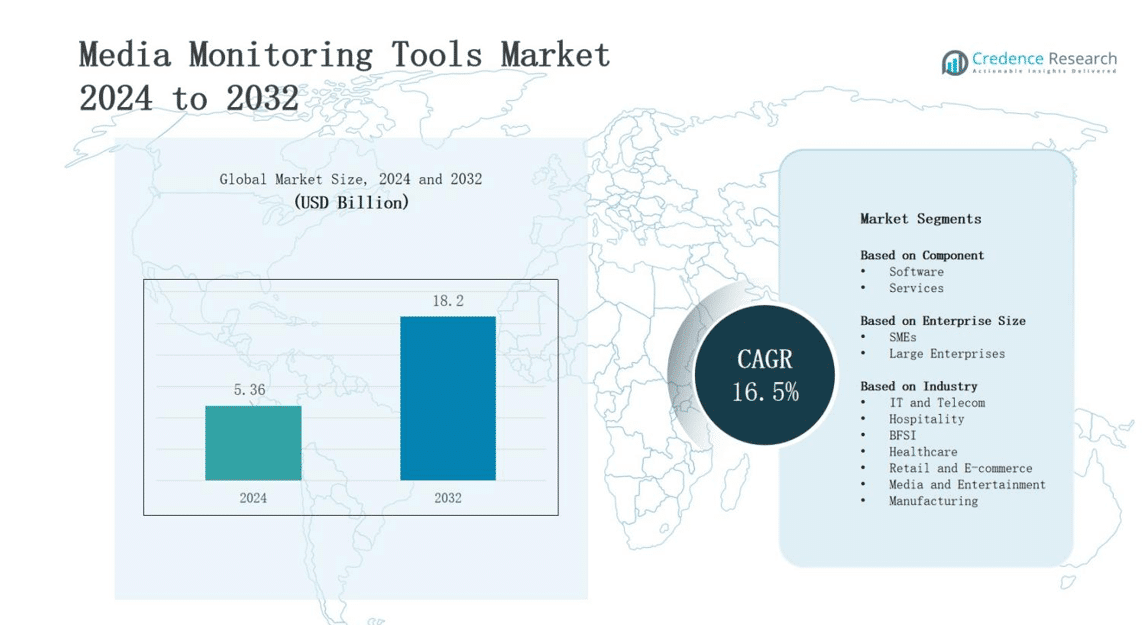
In the media monitoring tools market, revenue is expected to surge from USD 5.36 billion in 2024 to USD 18.2 billion by 2032, registering a robust CAGR of 16.5%.
| REPORT ATTRIBUTE | DETAILS |
|---|---|
| Historical Period | 2020-2023 |
| Base Year | 2024 |
| Forecast Period | 2025-2032 |
| Media Monitoring Tools Market Size 2024 | USD 5.36 billion |
| Media Monitoring Tools Market, CAGR | 16.5% |
| Media Monitoring Tools Market Size 2032 | USD 18.2 billion |
The media monitoring tools market is driven by the growing demand for real-time insights and brand reputation management across industries. Increasing adoption of digital marketing, social media analytics, and influencer monitoring compels organizations to track and analyze vast volumes of online content efficiently. Advanced AI and machine learning capabilities enhance sentiment analysis, predictive insights, and automated reporting, boosting operational efficiency. Additionally, rising competitive pressures and the need for data-driven decision-making fuel market growth. Key trends include the integration of cloud-based solutions, cross-platform monitoring, and the expansion of AI-powered analytics, enabling businesses to respond swiftly to emerging opportunities and risks.
The media monitoring tools market shows strong regional variation, with North America leading at 35% due to advanced digital infrastructure and high social media usage, followed by Europe at 28% driven by regulatory compliance and digital marketing adoption. Asia-Pacific holds 22% share, supported by rising internet penetration and e-commerce growth. Latin America and the Middle East & Africa account for 8% and 7% respectively, fueled by increasing social media engagement and technology investments. Key players, including Cision Ltd., Meltwater NV, Hootsuite Inc., Agility PR Solutions LLC, TVEyes Inc., BurrellesLuce, Critical Mention, Inc., Buzzcapture B.V., BoomSonar, Coosto BV, and CyberAlert LLC (Glean.info), compete through innovative analytics, AI-driven insights, and cross-platform monitoring solutions across these regions.
Market Insights
- The media monitoring tools market is expected to grow from USD 5.36 billion in 2024 to USD 18.2 billion by 2032, driven by demand for real-time insights and brand reputation management.
- The software segment leads with 68% share, offering AI-enabled sentiment tracking, analytics, and monitoring, while services hold 32%, supported by consulting, implementation, and maintenance to enhance operational efficiency
- Large enterprises dominate with 62% share, leveraging global operations and advanced solutions for brand management, competitor tracking, and customer insights, whereas SMEs hold 38%, adopting scalable, cost-efficient tools for market responsiveness.
- By industry, IT and Telecom holds 22%, retail and e-commerce 18%, BFSI 15%, manufacturing 12%, hospitality 12%, media and entertainment 10%, and healthcare 8%, driven by sentiment tracking and operational insight needs.
- Regionally, North America leads with 35%, Europe 28%, Asia-Pacific 22%, Latin America 8%, and Middle East & Africa 7%, with key players offering AI-driven, cross-platform monitoring and analytics solutions globally.
Market Drivers
Rising Demand for Real-Time Brand Insights
The media monitoring tools market benefits from businesses’ increasing focus on managing brand reputation and public perception. Companies need timely and accurate information about mentions across social media, news platforms, and forums to make informed decisions. It enables organizations to identify potential risks, track competitors, and understand consumer sentiment. Growing awareness of brand vulnerability to online controversies compels enterprises to implement comprehensive monitoring solutions. Real-time alerts allow faster response to critical issues, protecting brand value.
- For instance, Coca-Cola partnered with social listening platforms to analyze over 500,000 daily online mentions globally, enabling its marketing teams to adjust campaigns to shifting consumer sentiment.
Expansion of Digital Marketing and Social Media Analytics
Businesses increasingly rely on digital marketing campaigns and social media presence to reach target audiences effectively. The media monitoring tools market supports this growth by providing insights into campaign performance, engagement metrics, and influencer impact. It allows marketing teams to evaluate audience response, optimize content, and measure return on investment. Companies use monitoring data to enhance targeting strategies and refine messaging. The widespread adoption of online channels drives the need for platforms capable of handling large volumes of user-generated content efficiently, enabling businesses to gain a competitive edge in dynamic markets.
Integration of AI and Machine Learning Technologies
Advanced AI and machine learning applications accelerate the adoption of media monitoring tools. These technologies provide enhanced sentiment analysis, automated categorization, and predictive insights, helping organizations make proactive decisions. It reduces manual effort in data collection and reporting, allowing teams to focus on strategy and interpretation. AI-driven analytics improve accuracy in detecting trends and potential crises, enabling faster intervention. Companies increasingly invest in AI-enabled solutions to optimize resource allocation, strengthen brand strategy, and maintain an informed market position, driving sustained growth in the sector.
Growing Need for Data-Driven Decision Making
Organizations prioritize data-driven strategies to remain competitive and responsive to market shifts. The media monitoring tools market thrives on this demand by supplying comprehensive insights from multiple channels and sources. It allows companies to evaluate customer preferences, assess competitor performance, and anticipate emerging trends. Businesses leverage these insights to make informed marketing, communication, and product development decisions. Monitoring platforms provide actionable intelligence, improving efficiency, supporting strategic planning, and minimizing risk exposure.
- For instance, Netflix relies on audience viewing and sentiment data to determine which shows to promote or renew, with research showing that over 80% of viewing on the platform is driven by its recommendation algorithm.
Market Trends
Adoption of Cloud-Based Media Monitoring Solutions
The media monitoring tools market increasingly shifts toward cloud-based platforms due to their scalability and flexibility. It allows businesses to access real-time data from multiple sources without heavy infrastructure investment. Cloud solutions provide seamless integration with existing IT systems, supporting remote collaboration and rapid deployment. Companies benefit from lower maintenance costs, automatic updates, and enhanced data security. These platforms enable efficient storage, retrieval, and analysis of vast datasets, supporting informed decision-making and agile responses to market changes.
- For instance, Meltwater offers a cloud-based media intelligence platform that monitors online news, social media, print, broadcast, and podcasts in real time, supporting extensive data coverage and AI-powered automation features for large enterprises.
Integration of Artificial Intelligence and Predictive Analytics
Artificial intelligence and predictive analytics shape key trends in the media monitoring tools market. It enables advanced sentiment detection, trend forecasting, and automated categorization of online content. Companies gain deeper insights into consumer behavior, competitor actions, and emerging industry patterns. AI-driven analytics reduce reliance on manual processes while improving accuracy and speed of decision-making. Businesses increasingly invest in these capabilities to enhance strategic planning, optimize marketing campaigns, and maintain a competitive advantage in evolving digital landscapes.
- For instance, Determ, offers an AI assistant named "Synthia" providing AI-generated summaries and strategic insights from media coverage and online conversations, enhancing real-time decision-making for businesses.
Cross-Platform and Omnichannel Monitoring
Companies demand tools that provide insights across multiple platforms, including social media, news portals, blogs, and forums. The media monitoring tools market addresses this need by offering omnichannel monitoring capabilities that consolidate data from diverse sources. It allows organizations to track brand mentions, customer feedback, and campaign performance in one interface. Unified monitoring enables faster identification of risks and opportunities, strengthens customer engagement, and ensures consistent messaging. Cross-platform insights support data-driven strategies and proactive brand management initiatives.
Emphasis on Real-Time Alerts and Automated Reporting
Real-time alerts and automated reporting define a significant trend in the media monitoring tools market. It enables companies to respond promptly to emerging issues, minimizing potential damage to brand reputation. Automated dashboards and reporting streamline data visualization, allowing teams to focus on analysis rather than manual compilation. Businesses use these capabilities to monitor campaign effectiveness, track influencer activity, and evaluate public sentiment continuously. Timely insights enhance decision-making efficiency, improve stakeholder communication, and reinforce strategic market positioning.
Market Challenges Analysis
High Complexity in Data Management and Analysis
The media monitoring tools market faces challenges due to the massive volume and variety of data generated across platforms. It requires advanced algorithms and robust infrastructure to process, filter, and analyze information accurately. Companies often struggle to extract actionable insights from unstructured data such as social media posts, blogs, and multimedia content. Ensuring data quality and relevance demands constant updates and sophisticated analytical models. Organizations must balance efficiency and accuracy while minimizing errors, which increases operational costs and implementation complexity.
Privacy Concerns and Regulatory Compliance
Rising concerns over data privacy and strict regulatory frameworks create obstacles for the media monitoring tools market. It must comply with laws related to personal data protection, including cross-border data transfer restrictions and user consent requirements. Companies risk legal penalties and reputational damage if they mishandle sensitive information. Maintaining compliance while delivering real-time insights challenges software developers and businesses alike. Meeting evolving regulations requires continuous monitoring, frequent software updates, and enhanced security protocols, which can slow adoption and increase investment requirements.
Market Opportunities
Expansion in Emerging Markets
The media monitoring tools market holds significant opportunities in emerging regions where digital adoption and social media usage continue to grow rapidly. It allows businesses to track brand presence, customer sentiment, and competitive activity in these untapped markets. Companies can tailor strategies to local preferences and optimize marketing campaigns based on real-time insights. Growing internet penetration and smartphone usage drive demand for advanced monitoring solutions. Expanding into these regions offers vendors the chance to increase market share, develop localized offerings, and strengthen global presence, fueling long-term growth potential.
Advancements in AI and Predictive Analytics
Emerging technologies present opportunities for the media monitoring tools market to deliver deeper insights and enhanced functionality. It leverages AI and predictive analytics to identify trends, forecast customer behavior, and detect potential crises before they escalate. Businesses benefit from automated reporting, improved sentiment analysis, and actionable intelligence to inform strategic decisions. Continuous innovation enables providers to differentiate offerings, attract enterprise clients, and increase subscription-based revenue. Investment in these technologies positions companies to meet evolving customer expectations and maintain competitive advantage in the dynamic digital landscape.
Market Segmentation Analysis:
By Component
In the media monitoring tools market, the software segment leads with 68% share, driven by demand for real-time monitoring, analytics, and AI-enabled sentiment tracking. It enables organizations to improve campaign performance and make data-driven decisions efficiently. Services hold 32% share, supported by consulting, implementation, and maintenance, helping businesses integrate platforms and enhance operational efficiency across multiple channels.
- For instance, Brandwatch integrates with ChatGPT to help users summarize online conversations and detect emerging trends in seconds.
By Enterprise Size
Large enterprises dominate the market with 62% share due to multi-channel operations, global presence, and higher budgets for advanced monitoring solutions. It allows comprehensive brand reputation management, competitor tracking, and customer sentiment analysis. SMEs account for 38% share, fueled by growing awareness of online brand management. Cost-efficient, scalable tools encourage adoption, enabling smaller organizations to gain actionable insights and respond effectively to market changes.
- For instance, Coca-Cola uses Sprinklr’s social listening platform to monitor consumer feedback across 190+ countries, ensuring localized brand engagement strategies.
By Industry
IT and Telecom leads with 22% share due to real-time service feedback and competitor monitoring. Hospitality holds 12%, driven by guest review tracking and competitive benchmarking. BFSI accounts for 15%, focusing on brand perception and regulatory compliance. Healthcare represents 8%, while retail and e-commerce lead with 18%. Media and entertainment hold 10%, and manufacturing captures 12%, using monitoring tools for operational insights and brand management.
Segments:
Based on Component
- Software
- Services
Based on Enterprise Size
- SMEs
- Large Enterprises
Based on Industry
- IT and Telecom
- Hospitality
- BFSI
- Healthcare
- Retail and E-commerce
- Media and Entertainment
- Manufacturing
Based on the Geography:
- North America
- U.S.
- Canada
- Mexico
- Europe
- Germany
- France
- U.K.
- Italy
- Spain
- Rest of Europe
- Asia Pacific
- China
- Japan
- India
- South Korea
- South-east Asia
- Rest of Asia Pacific
- Latin America
- Brazil
- Argentina
- Rest of Latin America
- Middle East & Africa
- GCC Countries
- South Africa
- Rest of the Middle East and Africa
Regional Analysis
North America
North America dominates the media monitoring tools market with 35% share, driven by high digital adoption, widespread social media usage, and advanced technological infrastructure. It enables companies to monitor brand reputation, track customer sentiment, and evaluate marketing campaigns in real time. Strong presence of key market players and rising demand for AI-powered analytics fuels growth. Businesses leverage these tools to gain competitive intelligence, optimize operations, and improve stakeholder communication across industries.
Europe
Europe holds 28% share in the media monitoring tools market due to increasing adoption of digital marketing and social media monitoring solutions. It supports organizations in tracking customer feedback, managing public perception, and monitoring competitor activities. Regulatory compliance, data privacy concerns, and demand for cross-platform analytics drive market expansion. Companies utilize these tools to make informed decisions, enhance brand strategies, and respond promptly to emerging trends.
Asia-Pacific
Asia-Pacific captures 22% share, driven by rapid internet penetration, rising social media engagement, and growing digital marketing adoption. It allows businesses to monitor brand presence, analyze consumer sentiment, and gain competitive insights across diverse markets. Expanding e-commerce and IT sectors, along with increasing investments in AI-based solutions, contribute to steady growth. Companies leverage monitoring platforms to improve customer engagement, optimize campaigns, and strengthen market positioning.
Latin America
Latin America accounts for 8% share in the media monitoring tools market, fueled by increasing social media usage and the adoption of digital marketing strategies by enterprises. It helps businesses track brand reputation, customer feedback, and competitor activity in regional markets. Rising awareness of online reputation management and investment in technology solutions supports gradual growth. Companies use these tools to enhance customer relations and drive marketing effectiveness.
Middle East & Africa
Middle East & Africa hold 7% share, driven by growing digital adoption, increasing social media penetration, and demand for real-time insights. It enables companies to monitor customer sentiment, manage brand reputation, and track market trends effectively. Rising investments in technology infrastructure and growing awareness of analytics benefits encourage adoption. Businesses leverage monitoring platforms to optimize campaigns, improve service delivery, and maintain competitive advantage.
Key Player Analysis
- Critical Mention, Inc.
- BurrellesLuce
- TVEyes Inc.
- Hootsuite Inc.
- Cision Ltd.
- CyberAlert LLC (Glean.info)
- Buzzcapture B.V.
- Meltwater NV
- Agility PR Solutions LLC
- BoomSonar
- Coosto BV
Competitive Analysis
The media monitoring tools market is highly competitive, driven by technological advancements and increasing demand for real-time insights across industries. Key players, including Cision Ltd., Meltwater NV, Hootsuite Inc., Agility PR Solutions LLC, TVEyes Inc., BurrellesLuce, Critical Mention, Inc., Buzzcapture B.V., BoomSonar, Coosto BV, and CyberAlert LLC (Glean.info), compete by offering innovative solutions with AI-driven analytics, sentiment tracking, and cross-platform monitoring. It emphasizes product differentiation, strategic partnerships, and service enhancements to retain clients and expand market share. Companies focus on improving platform scalability, integration capabilities, and user experience to attract both SMEs and large enterprises. Investment in predictive analytics, automated reporting, and cloud-based platforms strengthens competitive positioning. Regional expansion, customer-centric solutions, and continuous technological upgrades drive growth and create barriers for new entrants. Intense rivalry compels players to maintain cost efficiency, enhance solution accuracy, and deliver actionable insights, ensuring sustained adoption across industries such as IT and telecom, BFSI, retail, healthcare, media, and manufacturing.
Recent Developments
- In February 2025, Meltwater launched a direct integration with Snapchat’s Public Profile API. This allows Meltwater users to analyze public Snapchat content and access detailed engagement metrics.
- In 2024, Meltwater expanded its partnership with Microsoft to integrate its media intelligence tools with Microsoft 365 and Teams, enhancing real-time AI-powered insights, using Microsoft Azure as its preferred cloud platform.
- In August 2024, Cision launched its CisionOne media monitoring platform in the APAC region, offering real-time tracking across multiple media channels with advanced analytics for PR teams.
- In April 2024, Hootsuite acquired Talkwalker, an AI-powered social listening platform, to bolster its social media management capabilities with advanced analytics and predictive insights.
Market Concentration & Characteristics
The media monitoring tools market exhibits a moderately concentrated structure, with a mix of established global players and emerging regional providers competing across segments and industries. It is characterized by high technological intensity, driven by demand for AI-enabled analytics, real-time monitoring, sentiment tracking, and predictive insights. Companies differentiate through product innovation, cross-platform capabilities, and cloud-based solutions, targeting both large enterprises and SMEs. Market leaders such as Cision Ltd., Meltwater NV, Hootsuite Inc., Agility PR Solutions LLC, TVEyes Inc., BurrellesLuce, Critical Mention, Inc., Buzzcapture B.V., BoomSonar, Coosto BV, and CyberAlert LLC (Glean.info) leverage strong brand presence, strategic partnerships, and advanced service offerings to maintain competitive advantage. It emphasizes customer-centric solutions, scalability, and data-driven decision support. Intense competition, regional expansion, and continuous technological upgrades define market dynamics, encouraging continuous innovation, improved operational efficiency, and broader adoption across industries including IT and telecom, BFSI, retail, healthcare, media, hospitality, and manufacturing.
Report Coverage
The research report offers an in-depth analysis based on Component, Enterprise Size, Industry and Geography. It details leading market players, providing an overview of their business, product offerings, investments, revenue streams, and key applications. Additionally, the report includes insights into the competitive environment, SWOT analysis, current market trends, as well as the primary drivers and constraints. Furthermore, it discusses various factors that have driven market expansion in recent years. The report also explores market dynamics, regulatory scenarios, and technological advancements that are shaping the industry. It assesses the impact of external factors and global economic changes on market growth. Lastly, it provides strategic recommendations for new entrants and established companies to navigate the complexities of the market.
Future Outlook
- The media monitoring tools market will witness increased adoption of AI and machine learning for predictive analytics and sentiment tracking.
- Cloud-based solutions will expand, enabling seamless integration and remote access for businesses of all sizes.
- Cross-platform monitoring will grow, allowing organizations to consolidate insights from social media, news, blogs, and forums.
- Large enterprises will continue to drive demand due to multi-channel operations and extensive digital presence.
- SMEs will increasingly adopt scalable, cost-efficient tools to manage brand reputation and marketing campaigns.
- Industry-specific solutions will gain traction in sectors like IT, BFSI, retail, healthcare, and media.
- Real-time alerts and automated reporting will become standard features for proactive decision-making.
- Regional expansion in Asia-Pacific, Latin America, and Middle East & Africa will create new growth opportunities.
- Partnerships and strategic collaborations among key players will enhance solution offerings and market reach.
- Continuous innovation in analytics, visualization, and user experience will shape competitive dynamics and adoption rates.

Request a Free Sample
Fill in your details and we'll send you a free sample report.
- Sample data tables & charts
- Research methodology
Market Dynamics
Demand for Real-Time Brand Insights
Organizations increasingly require immediate and accurate information about their brand mentions across digital channels to manage reputation and respond to emerging issues, driving adoption of advanced media monitoring tools.
Expansion of Digital Marketing and Social Media Analytics
The proliferation of digital marketing and influencer campaigns compels businesses to track engagement, sentiment, and campaign effectiveness, fueling demand for comprehensive monitoring platforms.
Integration of AI and Machine Learning
AI and machine learning enhance sentiment analysis, predictive insights, and automated reporting, enabling companies to process large volumes of unstructured data efficiently and make proactive decisions.
Growing Need for Data-Driven Decision Making
Businesses are prioritizing data-driven strategies to stay competitive, leveraging media monitoring tools to extract actionable intelligence from diverse sources for marketing, product development, and risk management.
Adoption of Cloud-Based Solutions
Cloud-based media monitoring platforms offer scalability, flexibility, and seamless integration, making it easier for organizations of all sizes to access real-time insights and reduce infrastructure costs.
Need a Custom Version of This Report?
Tailor the scope, geography, or segments to your exact requirements.
- Custom geography or segment scope
- Direct access to our analyst team
Frequently Asked Questions
What is the current market size for media monitoring tools market, and what is its projected size in 2032?
Which media monitoring tools market segment held the largest share in 2024?
What are the primary factors fueling the growth of the media monitoring tools market?
Who are the leading companies in the media monitoring tools market?
Table of Content
Chapter 1 Market Segmentation
- 1.1 Segmentation Framework
- 1.1.1 Product and Service Classification
- 1.1.2 Application and End-Use Classification
- 1.1.3 Technology and Solution Classification
- 1.1.4 Customer and Distribution Channel Classification
- 1.1.5 Geographic Segmentation
- 1.1.6 Market Segment Definitions and Boundaries
- 1.2 By Industry
- 1.2.1 IT and Telecom
- 1.2.2 Retail and E-commerce
- 1.2.3 BFSI
- 1.2.4 Manufacturing
- 1.2.5 Hospitality
- 1.2.6 Media and Entertainment
- 1.2.7 Healthcare
- 1.3 By Component
- 1.3.1 Software
- 1.3.2 Services
- 1.4 By Enterprise Size
- 1.4.1 SMEs
- 1.4.2 Large Enterprises
Chapter 2 Introduction
- 2.1 Report Objectives and Scope
- 2.2 Product Definition and Industry Terminology
- 2.3 Market Inclusions and Exclusions
- 2.4 Research Process
- 2.4.1 Primary Research and Expert Interviews
- 2.4.2 Secondary Research and Source Review
- 2.4.3 Top-Down and Bottom-Up Estimation
- 2.4.4 Data Triangulation and Verification
- 2.5 Market Size Measurement Basis
- 2.5.1 2024: USD 5.36 billion → 2032: USD 18.2 billion
- 2.6 Historical and Forecast Reference Periods
- 2.6.1 Base Year: 2024
- 2.6.2 Forecast Period: 2024-2032
- 2.7 Research Assumptions and Limitations
Chapter 3 Executive Summary
- 3.1 Market Snapshot and Key Findings
- 3.2 Base-Year Market Size, 2024
- 3.3 Forecast Market Size, 2032
- 3.4 Revenue and Volume Growth Outlook
- 3.5 Key Demand and Supply Indicators
- 3.6 Leading Market Segments
- 3.7 Fastest-Growing Market Opportunities
- 3.8 Regional Performance Highlights
- 3.9 Technology and Industry Transformation
- 3.10 Competitive Landscape Summary
- 3.11 Analyst View and Strategic Implications
Chapter 4 Global Media Monitoring Tools Market Trends and Developments
- 4.1 Historical Industry Development
- 4.2 Recent Market Trends and Developments
- 4.3 Demand and Customer Behavior Trends
- 4.4 Technology and Product Innovation
- 4.5 Artificial Intelligence, Automation and Digitalization
- 4.6 Local Manufacturing and Supply Chain Realignment
- 4.7 Industry Partnerships, Mergers and Acquisitions
- 4.8 Sustainability and Circular Economy Developments
- 4.9 Government and Private Sector Investment Trends
- 4.10 Emerging Business Models and Commercialization
- 4.11 Industry Developments and Announcements
Chapter 5 Global Media Monitoring Tools Market Production, Supply and Demand Analysis
- 5.1 Demand Trend and Consumption Analysis
- 5.2 Demand Forecast, 2024-2032
- 5.3 Production and Output Trend
- 5.4 Production and Output Forecast, 2024-2032
- 5.5 Installed Capacity and Capacity Utilization
- 5.6 Company-Wise Production Plants and Statistics
- 5.6.1 Installed Production Capacity
- 5.6.2 Actual Production
- 5.6.3 Planned Capacity and Expansion Targets
- 5.7 Supply Chain Structure and Procurement Trends
- 5.8 Supply-Demand Gap and Bottlenecks
- 5.9 Import Dependence and Sourcing Structure
- 5.10 Contract Manufacturing and Outsourcing
- 5.11 Regional Supply and Demand Concentration
Chapter 6 Global Media Monitoring Tools Market Pricing Analysis
- 6.1 Pricing Structure and Measurement
- 6.2 Historical Pricing Trends
- 6.3 Pricing Outlook, 2024-2032
- 6.4 Average Selling Price and Unit Economics
- 6.5 Pricing by Product and Market Segment
- 6.6 Geographic Pricing Differences
- 6.7 Key Input, Energy, Labor and Logistics Costs
- 6.8 Contract Pricing and Purchasing Models
- 6.9 Pricing Sensitivity and Competitive Positioning
- 6.10 Price, Margin and Profitability Implications
Chapter 7 Global Media Monitoring Tools Market Dynamics
- 7.1 Market Growth Drivers
- 7.1.1 Demand-Side Drivers
- 7.1.2 Technology and Innovation Drivers
- 7.1.3 Infrastructure and Investment Drivers
- 7.1.4 Regulatory and Policy Drivers
- 7.2 Market Restraints
- 7.2.1 Cost and Affordability Constraints
- 7.2.2 Technology and Adoption Barriers
- 7.2.3 Supply Chain and Operational Constraints
- 7.3 Market Challenges
- 7.3.1 Competitive Pressure and Margin Erosion
- 7.3.2 Skills, Infrastructure and Implementation Gaps
- 7.4 Emerging Market Opportunities
- 7.5 Market Dynamics Impact and Time-Horizon Assessment
Chapter 8 Global Media Monitoring Tools Value Chain Analysis
- 8.1 Industry Value Chain Overview
- 8.2 Upstream Suppliers and Critical Inputs
- 8.3 Technology and Component Providers
- 8.4 Manufacturing or Service Delivery
- 8.5 Distribution, Channel Partners and Integrators
- 8.6 Downstream Applications and End Users
- 8.7 Value Addition and Profit Pools
- 8.8 Vertical Integration and Outsourcing
- 8.9 Supplier Concentration and Risk
- 8.10 Supply Chain Localization and Resilience
Chapter 9 Global Media Monitoring Tools Market Regulations and Policies
- 9.1 Relevant Laws, Standards and Compliance Frameworks
- 9.2 Product, Service, Safety and Quality Requirements
- 9.3 Government Policies, Incentives and Subsidies
- 9.4 Imports, Exports and Trade Barriers
- 9.5 Public Procurement and Local Content Requirements
- 9.6 Environmental and Sustainability Compliance
- 9.7 Data Protection, AI and Cybersecurity Compliance
- 9.8 Upcoming Policy Changes and Market Implications
Chapter 10 Global Media Monitoring Tools Market Hotspots and Opportunities
- 10.1 Market Opportunity Mapping and Growth Hotspots
- 10.2 High-Growth Applications and Customer Groups
- 10.3 Underserved Markets and White-Space Opportunities
- 10.4 Emerging Technology and Product Opportunities
- 10.5 New Capacity and Investment Hotspots
- 10.6 Market Entry and Expansion Opportunities
- 10.7 Distribution and Partnership Opportunities
- 10.8 Near-Term and Long-Term Commercial Potential
- 10.9 Opportunity Attractiveness and Execution Risks
Chapter 11 Global Media Monitoring Tools Market Outlook, 2024-2032
- 11.1 Market Size and Analysis
- 11.1.1 Revenue (Market Measurement: 2024: USD 5.36 billion → 2032: USD 18.2 billion)
- 11.1.2 Market Volume and Quantity Sold
- 11.1.3 Historical Market Size
- 11.1.4 Base-Year Market Size, 2024
- 11.2 Market Forecast, 2024-2032
- 11.2.1 Revenue Forecast to 2032
- 11.2.2 Volume Forecast to 2032
- 11.2.3 CAGR and Year-on-Year Growth
- 11.2.4 Incremental Revenue Opportunity
- 11.3 Forecast Assumptions and Scenario Analysis
- 11.3.1 Base-Case Forecast
- 11.3.2 Optimistic and Conservative Scenarios
- 11.3.3 Technology, Pricing and Policy Sensitivities
- 11.4 Market Attractiveness and Growth Outlook
Chapter 12 Global Media Monitoring Tools Market Segmentation and Outlook
- 12.1 Segmentation Summary and Market Shares, 2024
- 12.2 Largest and Fastest-Growing Segments
- 12.3 By Industry - Market Size and Forecast, 2024-2032
- 12.3.1 Segment Definition and Scope
- 12.3.2 Historical Market Size
- 12.3.3 Revenue Forecast, 2024-2032
- 12.3.4 Volume Forecast, 2024-2032
- 12.3.5 Base-Year Market Share, 2024
- 12.3.6 Segment CAGR and Growth Drivers
- 12.3.7 Subsegment Market Size and Forecast
- 12.3.7.1 IT and Telecom
- 12.3.7.2 Retail and E-commerce
- 12.3.7.3 BFSI
- 12.3.7.4 Manufacturing
- 12.3.7.5 Hospitality
- 12.3.7.6 Media and Entertainment
- 12.3.7.7 Healthcare
- 12.3.8 Subsegment Pricing and Adoption Trends
- 12.3.9 Leading Suppliers and Competition
- 12.3.10 Regional Demand and Opportunities
- 12.4 By Component - Market Size and Forecast, 2024-2032
- 12.4.1 Segment Definition and Scope
- 12.4.2 Historical Market Size
- 12.4.3 Revenue Forecast, 2024-2032
- 12.4.4 Volume Forecast, 2024-2032
- 12.4.5 Base-Year Market Share, 2024
- 12.4.6 Segment CAGR and Growth Drivers
- 12.4.7 Subsegment Market Size and Forecast
- 12.4.7.1 Software
- 12.4.7.2 Services
- 12.4.8 Subsegment Pricing and Adoption Trends
- 12.4.9 Leading Suppliers and Competition
- 12.4.10 Regional Demand and Opportunities
- 12.5 By Enterprise Size - Market Size and Forecast, 2024-2032
- 12.5.1 Segment Definition and Scope
- 12.5.2 Historical Market Size
- 12.5.3 Revenue Forecast, 2024-2032
- 12.5.4 Volume Forecast, 2024-2032
- 12.5.5 Base-Year Market Share, 2024
- 12.5.6 Segment CAGR and Growth Drivers
- 12.5.7 Subsegment Market Size and Forecast
- 12.5.7.1 SMEs
- 12.5.7.2 Large Enterprises
- 12.5.8 Subsegment Pricing and Adoption Trends
- 12.5.9 Leading Suppliers and Competition
- 12.5.10 Regional Demand and Opportunities
- 12.6 Segment Growth Comparison
- 12.7 Segment Attractiveness and Priority Matrix
Chapter 13 Global Media Monitoring Tools End-Use and Application Market Outlook
- 13.1 End-Use Industry and Customer Demand Structure
- 13.2 Leading Applications and Customer Groups
- 13.3 End-Use Market Size, Share and Forecast
- 13.4 Major End-Use Industry Deep Dives
- 13.4.1 Customer Requirements and Use Cases
- 13.4.2 Demand and Replacement Cycles
- 13.4.3 Technical and Regulatory Considerations
- 13.4.4 Purchasing and Procurement Models
- 13.4.5 Leading Vendors and Distribution Channels
- 13.4.6 Forecast and Commercial Opportunities
- 13.5 Emerging Applications and Cross-Segment Demand
- 13.6 End-Use Industry Investment Priorities
Chapter 14 Global Media Monitoring Tools Geographic Market Outlook, 2024-2032
- 14.1 Regional Market Size and Share, 2024
- 14.2 Regional Market Forecast, 2024-2032
- 14.3 Regional Pricing, Production and Demand Differences
- 14.4 North America
- 14.4.1 United States
- 14.4.2 Canada
- 14.4.3 Mexico
- 14.5 Europe
- 14.5.1 Germany
- 14.5.2 France
- 14.5.3 Italy
- 14.5.4 United Kingdom
- 14.5.5 Spain
- 14.5.6 Poland
- 14.5.7 Russia
- 14.5.8 Netherlands
- 14.5.9 Belgium
- 14.5.10 Sweden
- 14.5.11 Denmark
- 14.5.12 Norway
- 14.5.13 Rest of Europe
- 14.6 Asia Pacific
- 14.6.1 China
- 14.6.2 India
- 14.6.3 Japan
- 14.6.4 South Korea
- 14.6.5 Thailand
- 14.6.6 Indonesia
- 14.6.7 Vietnam
- 14.6.8 Malaysia
- 14.6.9 Australia
- 14.6.10 Rest of Asia Pacific
- 14.7 Latin America
- 14.7.1 Brazil
- 14.7.2 Argentina
- 14.7.3 Colombia
- 14.7.4 Chile
- 14.7.5 Rest of Latin America
- 14.8 Middle East
- 14.8.1 Saudi Arabia
- 14.8.2 United Arab Emirates
- 14.8.3 Turkey
- 14.8.4 Israel
- 14.8.5 Iran
- 14.8.6 Rest of the Middle East
- 14.9 Africa
- 14.9.1 South Africa
- 14.9.2 Egypt
- 14.9.3 Nigeria
- 14.9.4 Morocco
- 14.9.5 Rest of Africa
- 14.10 Regional Investment, Policy and Supply Chain Differences
- 14.11 Regional Competitive Landscape
- 14.12 Geographic Growth Hotspots
Chapter 15 Global Media Monitoring Tools Technology, Innovation and Sustainability Outlook
- 15.1 Technology Landscape and Maturity
- 15.2 Product, Process and Service Innovation
- 15.3 AI, Automation and Digital Tools in the Industry
- 15.4 Technology Adoption and Performance Benchmarking
- 15.5 Innovation Pipeline and R&D Investment
- 15.6 Patent and Intellectual Property Trends
- 15.7 Energy Efficiency and Resource Management
- 15.8 Sustainability, Recycling and Circularity
- 15.9 Technology Roadmap, 2024-2032
- 15.10 Risks of Obsolescence and Technology Substitution
Chapter 16 Global Media Monitoring Tools Market Key Strategic Imperatives
- 16.1 Growth and Market Entry Priorities
- 16.2 High-Return Products and Segments
- 16.3 Pricing, Profitability and Cost Optimization
- 16.4 Technology Investment and Product Differentiation
- 16.5 Supply Chain Localization and Resilience
- 16.6 Distribution and Customer Acquisition
- 16.7 Partnership, Acquisition and Capacity Strategy
- 16.8 Regional Expansion Priorities
- 16.9 Short-, Medium- and Long-Term Actions
Chapter 17 Competition Outlook
- 17.1 Industry Competition Characteristics
- 17.2 Market Structure and Concentration
- 17.3 Market Share and Competitive Positioning, 2024
- 17.4 Company-Wise Revenue and Product Benchmarking
- 17.5 Production and Service Capacity Benchmarking
- 17.6 Technology, Pricing and Differentiation
- 17.7 Regional Footprint and Distribution Strength
- 17.8 Mergers, Acquisitions and Strategic Alliances
- 17.9 New Entrants and Competitive Threats
- 17.10 Porter's Five Forces and Industry Attractiveness
- 17.11 Competitive Outlook, 2024-2032
Chapter 18 Company Profiles
- 18.1 Company Coverage and Selection Criteria
- 18.2 Cision Ltd.
- 18.2.1 Business Description
- 18.2.2 Company Ownership and Geographic Presence
- 18.2.3 Product and Service Portfolio
- 18.2.4 Manufacturing and Operating Footprint
- 18.2.5 Production Capacity and Expansion Plans
- 18.2.6 Financial Performance and Investment
- 18.2.7 Market Share and Competitive Position
- 18.2.8 Technology and Innovation Capabilities
- 18.2.9 Strategic Alliances or Partnerships
- 18.2.10 Recent Developments
- 18.2.11 Growth Strategy and Outlook
- 18.3 Meltwater NV
- 18.4 Hootsuite Inc.
- 18.5 Agility PR Solutions LLC
- 18.6 TVEyes Inc.
- 18.7 BurrellesLuce
- 18.8 Critical Mention, Inc.
- 18.9 Buzzcapture B.V.
- 18.10 BoomSonar
- 18.11 Coosto BV
- 18.12 Other Relevant Market Participants
Note: Every listed company is profiled on the structure shown under the first company. The company list is preliminary and may change based on research findings, market developments, data availability and client requirements.
Chapter 19 Disclaimer
- 19.1 Research and Forecast Disclaimer
- 19.2 Data Source and Estimation Limitations
Note: The depth of individual sections depends on data availability for this market. Volume, capacity, trade and other unit-based metrics are included where applicable.

